30 Spinach Companion Plants (And Their Benefits)
I still remember the spring my entire spinach bed bolted within a single hot week, turning tender leaves bitter almost overnight. That single season taught me something most seed packets never mention: spinach performs best when it has the right neighbors, not when it grows alone in a bare row.
Peas, beans, onions, and brassicas like cabbage and broccoli are the most reliable companions for spinach, since they share its love of cool weather without competing for the same nutrients.
Tall, heat-tolerant plants such as tomatoes, corn, peppers, and sunflowers also deserve a spot on this list, because they shade spinach through the hottest part of summer and can delay the bolting that ruins so many home harvests.
This guide walks through 30 companion plants for spinach and the science behind every pairing.
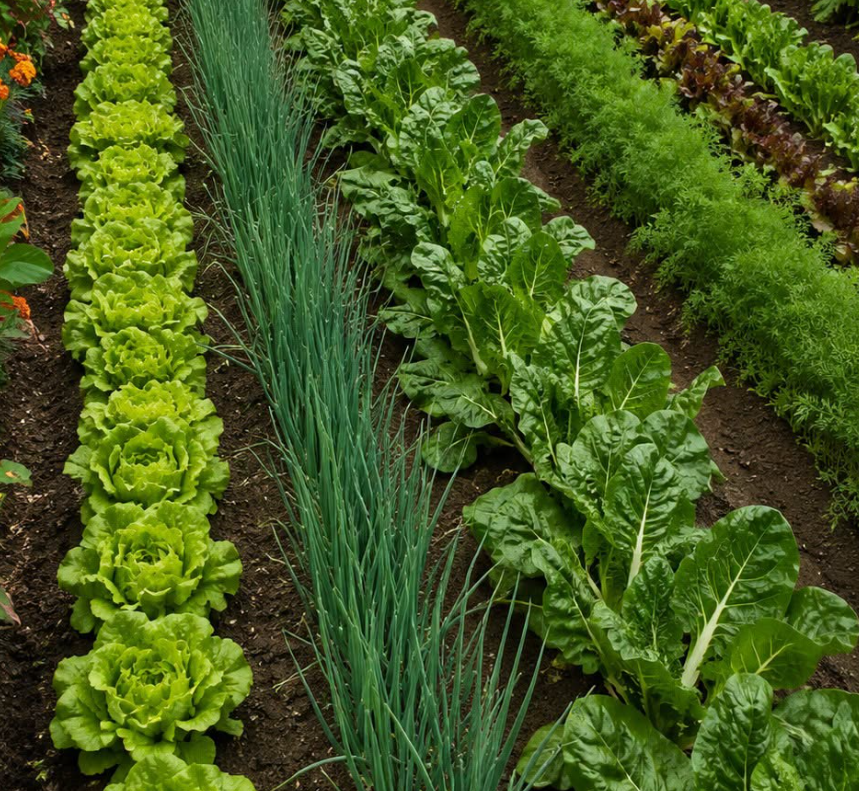
Why Companion Planting Works for Spinach
Spinach is a fast, cool-season crop. According to the University of Arizona Cooperative Extension, spinach seed germinates once soil temperatures reach about 40°F, and under good conditions it can mature in as little as four weeks.
That short life cycle is both a strength and a weakness. It means spinach fits neatly between slower crops, but it also means the plant has very little time to recover from pest damage or heat stress before bolting sets in.
Companion planting addresses several of these pressure points at once.
- It slows bolting. Taller companions cast afternoon shade, which keeps soil temperatures lower during the hottest weeks of the season.
- It confuses pests. Aromatic herbs and alliums mask the scent signals that aphids and leafminers use to find host plants.
- It saves space. Spinach matures quickly, so it fits well between slower crops that will fill the bed once spinach is harvested.
- It supports beneficial insects. Flowering companions attract the predators that keep aphid populations in check naturally.
Pest pressure on spinach is a genuine concern, not a minor inconvenience. The Pacific Northwest Pest Management Handbooks note that aphid populations tend to be higher on plants that are heavily fertilized with nitrogen, which makes companion strategies that avoid over-fertilizing especially useful for spinach growers.
Leafminers are another persistent problem. The University of Minnesota Extension explains that the spinach leafminer tunnels through leaf tissue, creating irregular blotch-shaped mines that ruin the leaf’s appearance and reduce its ability to photosynthesize.
None of these pests disappear entirely because of a companion plant. But a well-planned bed genuinely reduces the pressure, and that difference is often the gap between a full harvest and a disappointing one.
The 30 Best Companion Plants for Spinach
Here is the complete list, organized by category so you can plan a bed with a clear purpose behind every plant you choose.
Legumes — Natural Soil Builders
Legumes work through a simple mechanism: bacteria living in their root nodules convert nitrogen from the air into a form plants can use. Spinach, which is a notably nitrogen-hungry leafy green, benefits directly from growing nearby.
1. Peas
Peas fix nitrogen in the soil, feeding the spinach growing beside them without any additional fertilizer. Both crops also share the same cool-season growing window, so their needs line up almost perfectly.
Peas climb, which means a simple trellis lets you grow them vertically along one edge of the spinach bed without giving up valuable ground space.
I sow peas and spinach on the same day each spring, and by the time the peas need support, the spinach below is already filling in nicely.
2. Bush Beans
Bush beans offer the same nitrogen-fixing benefit as peas, though they grow later in the season once the weather has warmed. This makes them a natural follow-on crop once early spinach has been harvested.
Their low, compact growth habit also means they will not compete heavily for light with any spinach still finishing up nearby.
Rotate bush beans into a spinach bed rather than planting them at the exact same time, since bush beans prefer warmer soil than spinach tolerates well.
3. Pole Beans
Pole beans provide the same soil-enriching nitrogen as bush beans, but their vertical growth habit adds a genuine practical bonus. A row of pole beans on a trellis can cast just enough afternoon shade to protect nearby spinach from bolting early.
This makes pole beans one of the better choices if you are trying to stretch a spinach harvest a few extra weeks into early summer.
Position the trellis on the western side of the spinach bed so the shade falls during the hottest part of the day.
Alliums — The Pest-Confusing Family
Onions and their relatives share a common defense mechanism. Their sulfur compounds mask the scent trails that aphids and other pests rely on to locate host plants.
4. Onions
Onions release a strong sulfur scent that can help confuse aphids searching for spinach by smell. They also grow at a similar, unhurried pace, so neither crop crowds the other out.
Because onions occupy relatively little horizontal space, they tuck easily along the edges of a spinach bed without sacrificing much growing room.
I plant a border of onions around my spinach rows each spring, mainly because it is such a low-effort way to add a layer of pest protection.
5. Garlic
Garlic works through the same sulfur-based scent-masking as onions, and it has the added benefit of mild antifungal properties in the surrounding soil.
Since garlic is typically planted in autumn, it will already be established and growing by the time spring spinach seedlings emerge, giving you overlapping protection from the very start of the season.
Garlic also requires very little maintenance once planted, which makes it an easy addition for gardeners short on time.
6. Chives
Chives are compact, tidy, and simple to tuck directly along a spinach row without disturbing the shallow spinach roots nearby.
Their light onion scent adds a further layer of confusion for aphids, and their purple flowers, once mature, draw in pollinators and other beneficial insects.
Chives are perennial in most climates, so a single planting will keep returning to protect your spinach bed for years.
7. Leeks
Leeks bring the same pungent, aphid-confusing aroma as onions and garlic, but they grow more slowly, which matches well with spinach’s own short but intensive growing window.
Because leeks tolerate cool soil better than most alliums, they are a strong choice for very early spring plantings alongside spinach.
I find leeks especially useful in raised beds, where their upright growth habit does not shade nearby spinach leaves.
Brassicas — Shared Cool-Season Needs
Brassicas and spinach both thrive in cool weather, which makes them natural bedfellows even though they do not repel each other’s pests directly.
8. Cabbage
Cabbage shares spinach’s preference for cool temperatures and rich, well-drained soil, which means the two crops can be planted at the same time without one racing ahead of the other.
Cabbage’s broad, upright leaves also do not compete heavily with the low, ground-hugging habit of spinach for light.
I interplant early cabbage transplants with spinach seed, harvesting the spinach well before the cabbage needs the full width of the bed.
9. Broccoli
Broccoli grows in the same cool-season window as spinach and tolerates similar soil conditions, making bed planning considerably simpler when you grow them together.
Its upright growth habit leaves the soil around its base open, which is exactly where a fast, low-growing crop like spinach fits best.
By the time broccoli heads mature, the spinach planted nearby has typically already been harvested and cleared.
10. Cauliflower
Cauliflower has similar nutrient and watering needs to broccoli and cabbage, so it slots into a spinach companion plan just as easily.
Its slower growth rate compared to spinach means there is a natural sequencing to the bed: spinach comes and goes first, and cauliflower fills the space afterward.
I find cauliflower slightly more demanding of consistent moisture than its brassica relatives, so keep that in mind when planning irrigation for the shared bed.
11. Kale
Kale is remarkably cold-hardy, even more so than spinach, which makes it a useful bookend crop at the very start and end of the cool season.
Because kale can be harvested leaf by leaf over an extended period, it does not need the same amount of space all at once, leaving room for spinach to fill in nearby.
I often plant kale as a border crop around a spinach bed, since its taller form does not shade the spinach significantly at these smaller scales.
12. Brussels Sprouts
Brussels sprouts take considerably longer to mature than spinach, which means the two rarely compete for space at the same point in the season.
Early spinach can be sown directly between young Brussels sprouts transplants, since the sprouts will not need the full bed width until much later in the year.
This pairing is a good example of using spinach’s short life cycle to get a second harvest from ground that would otherwise sit empty for months.
Root and Quick-Growing Crops
These companions round out a spinach bed by using different root depths and different maturity rates, so nothing goes to waste.
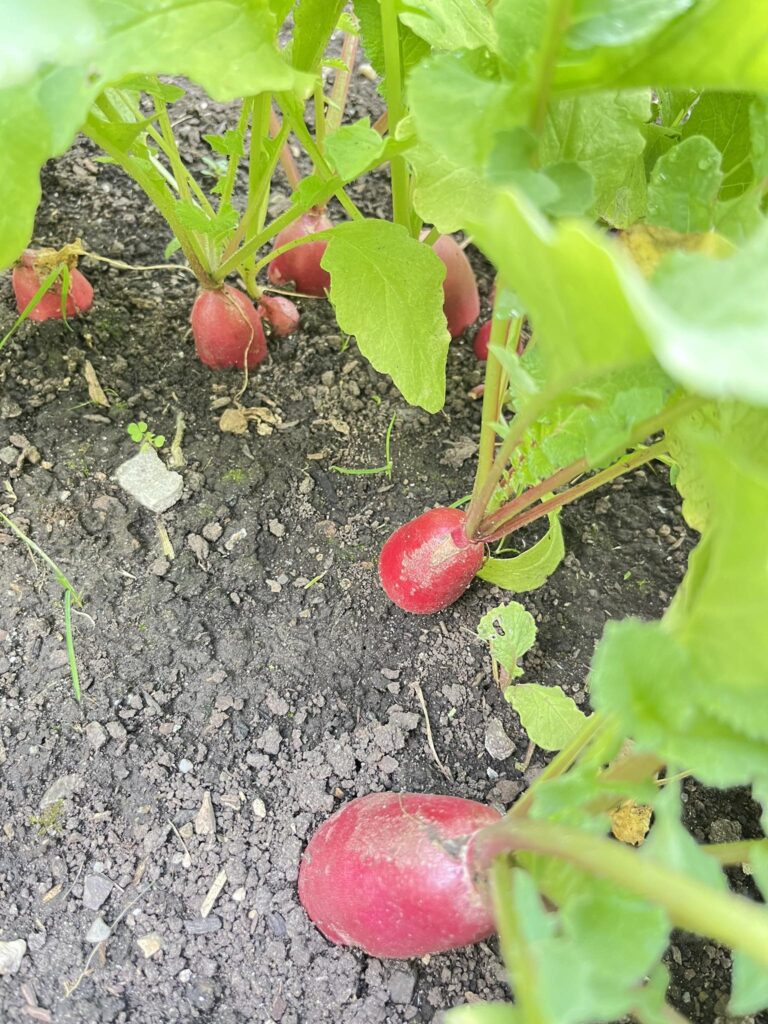
13. Radishes
Radishes germinate in just five to seven days, considerably faster than spinach, and their quick harvest frees up space almost immediately.
Because radishes have a small, deep taproot while spinach roots stay shallow and wide, the two rarely compete directly for soil nutrients or moisture.
I scatter radish seed through my spinach rows as a matter of habit, since the radishes are usually ready to pull before the spinach even needs the extra room.
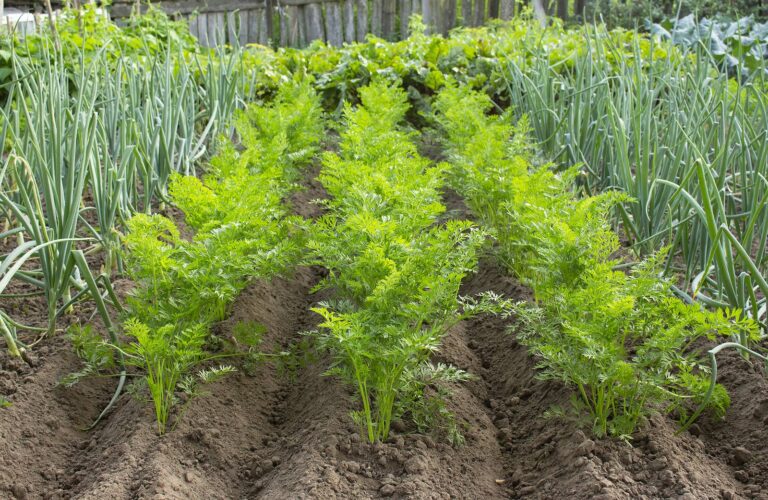
14. Carrots
Carrots take considerably longer to mature than spinach, which allows the two crops to share a bed in succession rather than in direct competition.
Carrots’ deep taproot draws water and nutrients from a different soil layer than spinach’s shallow roots, so the pairing makes efficient use of the full soil profile.
Sow spinach along the edges of a carrot bed early in the season, and harvest it well before the carrots need the space to bulk up underground.
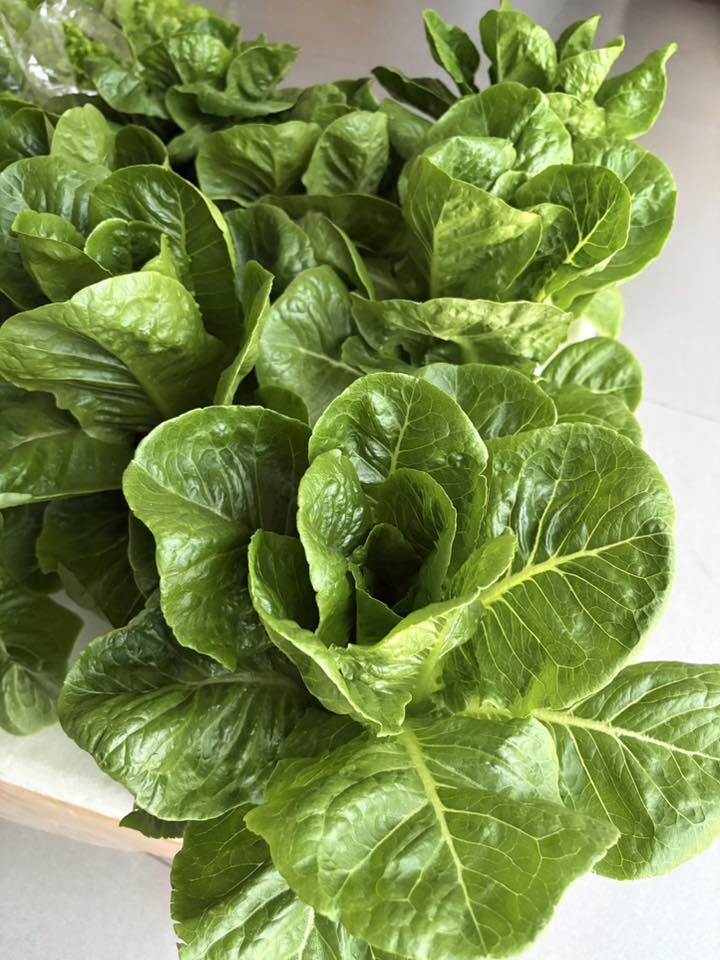
15. Lettuce
Lettuce shares nearly identical growing conditions with spinach, including a preference for cool weather and consistent moisture.
Both crops mature at a comparable pace, so planting them together works best when you treat the bed as one combined cool-season harvest rather than two competing crops.
I alternate rows of lettuce and spinach for variety in salads, and the mixed planting also helps disguise both crops from pests that key in on a single, uniform target.
Aromatic Herbs — Natural Pest Deterrents
Herbs work on spinach the same way they work throughout the vegetable garden: strong scent compounds interrupt the chemical signals that pests use to find their next meal.
16. Dill
Dill, while still young and leafy, attracts beneficial predatory insects like ladybugs and parasitic wasps that feed on aphids.
Its fine, feathery foliage does not compete significantly for light with the broader spinach leaves growing nearby.
Harvest or remove dill before it flowers, since a bolted, flowering dill plant shifts from a helpful neighbor to one that can hinder germination in the surrounding soil.
17. Cilantro
Young cilantro attracts many of the same beneficial insects as dill, adding another layer of natural pest management to the bed.
Because cilantro also bolts quickly in warm weather, it shares a similar life cycle rhythm with spinach, which makes succession planning between the two fairly intuitive.
I harvest cilantro for the kitchen well before it flowers anyway, so its usefulness in the garden and in cooking line up nicely.
18. Oregano
Oregano’s strong, pungent scent can help mask the presence of spinach from pests that hunt primarily by smell.
As a low, spreading perennial herb, oregano also helps shade the soil around the base of nearby spinach plants, which supports moisture retention during warmer weeks.
Once established, oregano requires very little care, making it a practical border plant around a spinach bed for years at a time.
19. Thyme
Thyme stays low to the ground, so it will never shade out spinach the way a taller herb could.
Its aromatic oils disrupt the scent trails that aphids rely on, while its dense growth habit doubles as a living mulch that helps retain soil moisture.
I let thyme spread along the path edges of my raised beds, where it tolerates occasional foot traffic without much complaint.
20. Rosemary
Rosemary’s strong, woody fragrance is known to deter a range of common garden pests, including some that trouble spinach directly.
Because rosemary is a perennial shrub, it becomes a permanent fixture at the edge of the garden rather than something replanted each season.
Its need for well-drained soil means it should sit at the drier edge of a spinach bed rather than in the middle, where consistent moisture matters more.
Flowering Companions — Recruiting Beneficial Insects
Flowers do not repel pests directly so much as they recruit an army of natural predators that keep aphid and leafminer populations from getting out of hand.
21. Marigolds
Marigolds reliably attract pollinators and several predatory insects, even though some of their more dramatic pest-repelling reputation does not hold up under closer research scrutiny.
Certain marigold varieties can also suppress harmful soil nematodes over time, though this benefit typically requires a full season of dense planting to become noticeable.
I still plant marigolds every year along my spinach bed, mostly because they are cheerful, low-maintenance, and genuinely do bring in more helpful insects than harmful ones.
22. Nasturtiums
Nasturtiums function as a trap crop, drawing aphids toward themselves and away from the more valuable spinach leaves nearby.
They are also edible, with a peppery bite that works well in salads, which makes them useful in the kitchen even after they have done their job in the garden.
Let a few nasturtiums sacrifice themselves to aphids each season rather than removing them at the first sign of pest activity, since that is the entire purpose of a trap crop.
23. Calendula
Calendula draws in hoverflies and ladybugs, both of which feed heavily on the aphids that commonly trouble spinach.
It blooms for an extended stretch of the growing season, which means the beneficial insects it attracts stick around consistently rather than in a single short burst.
I scatter calendula seed along the edges of my spinach bed each spring, since it self-seeds readily and often returns unprompted the following year.
24. Sweet Alyssum
Sweet alyssum is a low, spreading flower that attracts hoverflies in large numbers, and hoverfly larvae are voracious aphid predators.
Its tight, ground-hugging growth habit also helps suppress small weeds that might otherwise compete with spinach for nutrients and moisture.
Sweet alyssum blooms almost continuously from early summer through the first frost, so the benefit it provides does not fade partway through the season.
Shade-Providing Companions for Hot Weather
This group solves spinach’s biggest structural weakness: its tendency to bolt the moment summer heat arrives. Taller plants placed thoughtfully can buy you several extra weeks of harvest.
25. Tomatoes
Tomatoes grow tall enough by midsummer to cast genuine afternoon shade over nearby spinach, which can delay bolting during the hottest stretch of the season.
Position tomato plants on the western or southern side of the spinach bed, depending on your hemisphere, so the shade falls during peak afternoon heat rather than blocking morning sun.
Keep some distance between the two, since tomato roots spread wide near the surface and can compete with spinach for moisture if planted too closely.
26. Peppers
Peppers offer a similar shading benefit to tomatoes, though on a somewhat smaller scale given their more compact growth habit.
They share a general preference for well-drained, fertile soil with spinach, which simplifies bed planning when the two are grown together.
I plant an early spring spinach crop that finishes well before peppers reach their full height and begin providing meaningful shade later in the season.
27. Eggplant
Eggplant’s broad leaves provide dense shade once the plant matures, which can meaningfully extend a nearby spinach harvest into warmer weeks.
Because eggplant is slow to establish, an early spinach crop can occupy the same bed space productively while the eggplant is still getting started.
This pairing works best as a succession planting rather than a simultaneous one, since eggplant needs considerably warmer soil than spinach tolerates at germination.
28. Corn
Corn grows tall quickly, and its narrow footprint at the base leaves plenty of room for a shorter companion like spinach to grow nearby without being crowded out.
The dappled shade corn provides can be enough to slow bolting in spinach planted along its northern or eastern edge, depending on your local sun angle.
I sow spinach at the base of young corn early in the season, well before the corn canopy closes in and demands more root space.
29. Sunflowers
Sunflowers grow rapidly and provide substantial afternoon shade once established, making them a genuinely useful companion for extending a spinach harvest.
Beyond shade, sunflowers attract pollinators and beneficial insects in large numbers, adding a secondary benefit beyond their physical structure.
Plant sunflowers along the western edge of a spinach bed, spaced widely enough that their roots do not compete heavily with the shallow spinach roots nearby.
Fruit Companions
30. Strawberries
Strawberries and spinach both thrive in cool, rich soil, which makes bed planning between the two remarkably straightforward.
Strawberry flowers attract hoverflies, and hoverfly larvae feed on many of the same aphids that trouble spinach, giving this pairing a genuine pest-management benefit rather than a purely aesthetic one.
I grow strawberries as a low border around spinach beds, since their sprawling habit fills in ground that would otherwise sit bare and exposed to weeds.
Plants to Avoid Near Spinach
Not every neighbor helps. A handful of plants can genuinely work against a healthy spinach harvest, so it is worth a brief mention.
Potatoes compete heavily for soil nutrients and are frequently cited by gardening researchers as a poor spinach companion.
Fennel is broadly antagonistic to most garden neighbors, spinach included, due to the allelopathic compounds it releases into the soil.
Beets and Swiss chard, while not harmful in the same season, share spinach’s family lineage and its pests. Rotating them into a different bed each year, rather than growing them side by side repeatedly, helps prevent a buildup of shared soil-borne pathogens and leafminer pupae.
Common Mistakes Gardeners Make
I have made most of these mistakes myself over the years, so treat this as a shortcut around a few wasted seasons.
Over-fertilizing with nitrogen. Aphid populations tend to be higher on plants that are fertilized liberally with nitrogen, according to pest management research, so a lighter, more measured feeding schedule can actually reduce pest pressure.
Planting too densely. Overcrowded spinach is considerably more susceptible to downy mildew and other fungal issues, since airflow around the leaves matters more than most gardeners assume.
Ignoring bolted herbs. A flowering dill or cilantro plant behaves very differently from a young, leafy one. Once herbs bolt, pull them or relocate them away from the spinach bed.
Skipping crop rotation. Growing spinach or its chenopod relatives in the same spot every year allows soil-borne pathogens and pest pupae to build up rather than break down.
A Simple Layout to Try This Season
I prefer to keep this practical rather than theoretical. Here is a layout that has worked reliably in my own raised beds.
- Border rows: Chives, onions, or leeks along the outer edge of the bed.
- Interplanted rows: Spinach alternated with quick radishes and lettuce.
- Shade line: Tomatoes, peppers, or sunflowers along the western edge for summer protection.
- Flower accents: Calendula or nasturtiums tucked into corners to draw in beneficial insects.
This kind of layout does not demand extra space. It simply asks you to think about what goes where, rather than growing spinach in an isolated row with nothing around it.
Timing matters just as much as placement. Sow alliums and herbs alongside or slightly before your spinach seed, so the protective scent barrier is already established by the time pests begin scouting the bed. Fast crops like radishes can go in on the very same day as spinach, since they will be harvested and gone long before spinach needs the extra room.
Frequently Asked Questions
What is the best companion plant for spinach? Peas and other legumes are generally considered the most effective, since they fix nitrogen in the soil and share spinach’s preference for cool weather.
Can I plant spinach and tomatoes together? Yes, though timing matters. Sow spinach early in spring so it matures and gets harvested before the tomato plant grows tall enough to fully shade it out, then let the tomato’s later growth extend a second, smaller spinach planting into early summer.
Do marigolds really help protect spinach? Marigolds are more valuable as pollinator and beneficial-insect attractors than as a direct pest repellent. They are worth planting, but should not be relied on as a sole line of defense.
How close should companion plants be to spinach? Most companions can be planted directly in the same row or in an adjacent row a few inches away. Taller plants like corn or sunflowers should sit far enough back that they do not block morning sun entirely.
Is it fine to plant spinach and lettuce in the same bed? Yes, and it is one of the easiest pairings on this list, since both crops share nearly identical soil, moisture, and temperature preferences.
Should I avoid planting beets near spinach? Beets are not harmful within a single season, but they share spinach’s family and its pests. Rotating the two into different beds each year is the safer long-term approach.
Does companion planting stop spinach from bolting? It cannot stop bolting entirely, since that is driven mainly by day length and temperature, but shade from taller companions can meaningfully delay it during the hottest weeks of the year.
Final Thoughts
Companion planting will not solve every problem in a spinach bed, and I will not pretend otherwise. But after testing many of these pairings across several seasons, I can say the difference is real and worth the small amount of extra planning.
Start small. Pick three or four companions from this list, watch how your spinach responds this season, and build a fuller plan from there.
Gardening rewards patience more than perfection. You do not need all 30 plants in a single bed to see a noticeable improvement. Even a simple pairing of peas and radishes alongside your spinach rows will show you, within one season, why so many growers rely on this approach.
References
- West Virginia University Extension — Companion Planting https://extension.wvu.edu/lawn-gardening-pests/gardening/garden-management/companion-planting
- University of Minnesota Extension — Companion Planting in Home Gardens https://extension.umn.edu/planting-and-growing-guides/companion-planting-home-gardens
- University of Minnesota Extension — Leafminers in Home Gardens https://extension.umn.edu/yard-and-garden-insects/leafminers
- Washington State University Extension, Hortsense — Spinach: Aphids https://hortsense.cahnrs.wsu.edu/fact-sheet/spinach-aphids/
- University of California Agriculture and Natural Resources, UC IPM — Leafminers: Spinach https://ipm.ucanr.edu/agriculture/spinach/leafminers/
- University of Arizona Cooperative Extension — Growing Spinach https://cales.arizona.edu/yavapai/anr/hort/byg/archive/growingspinach.html
- Clemson University, Home & Garden Information Center — Spinach https://hgic.clemson.edu/factsheet/spinach/

Tim M Dave is a gardening expert with a passion for houseplants, particularly cacti and succulents. With a degree in plant biology from the University of California, Berkeley, he has vast experience in gardening. Over the years, he has cultivated a vast collection of desert plants and learned a great deal about how to grow and care for these unique companions.