25 Idaho Native Flowers (With Growing Details)
Idaho holds more than 2,500 native plant species, according to a 2023 proclamation from Governor Brad Little marking Native Plant Month. That number alone tells you this state is a wildflower paradise.
I’ve spent time hiking through the Sawtooths, the Owyhee canyonlands, and the forests near Coeur d’Alene. Every season brings a new burst of color. Some blooms last only a few weeks. Others carpet entire hillsides for months.
This guide walks through 25 native Idaho flowers worth knowing. Whether you’re planning a spring hike, building a native garden, or simply curious about what grows in your backyard, you’ll find something useful here.
Let’s dig in.
25 Idaho Native Flowers
1. Syringa (Philadelphus lewisii)
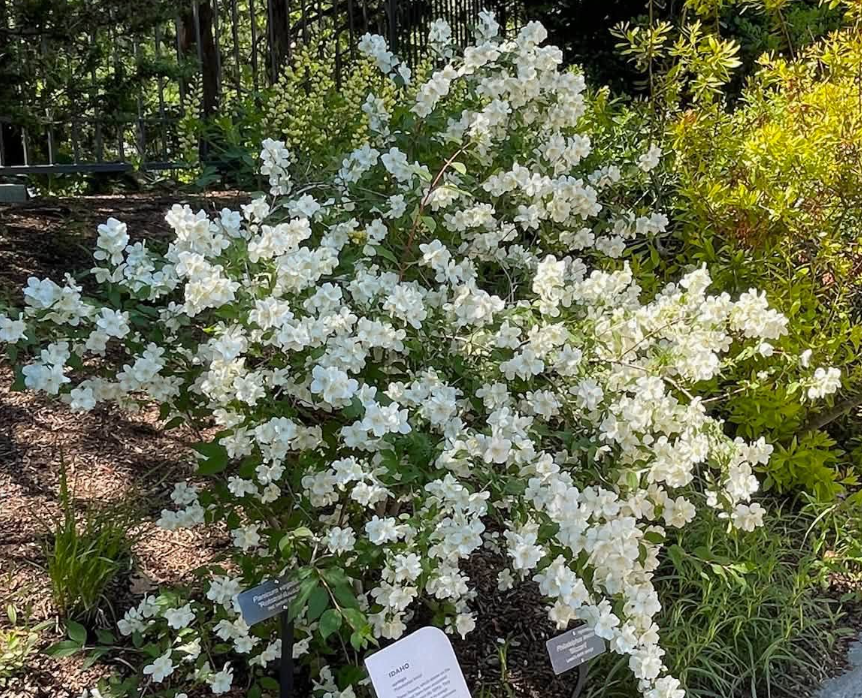
Syringa is Idaho’s official state flower, adopted in 1931. It’s also called mock orange because its scent resembles orange blossoms. The flower appeared on Idaho’s state seal decades before it earned official status.
This deciduous shrub grows between six and ten feet tall. Clusters of white, four-petaled flowers bloom along its branches from May through June. Meriwether Lewis himself collected specimens near the Clearwater River in 1806.
You’ll find Syringa along riverbanks, rocky slopes, and canyon walls across the state. It peaks around the same time Chinook salmon migrate upstream. I find that timing oddly poetic, two Idaho icons arriving together each spring.
2. Bitterroot (Lewisia rediviva)
Bitterroot is one of the toughest flowers you’ll ever see. It grows in dry, rocky, seemingly lifeless soil where almost nothing else survives. The bright pink to white blossoms seem to appear from bare gravel overnight.
Native Americans harvested its roots as a staple food source, boiling them into a nutritious paste. The plant’s resilience earned it the species name rediviva, meaning “brought back to life.” Dried roots can resprout even after years of dormancy.
Bitterroot blooms in late April through June across southern and central Idaho’s arid foothills. It’s low-growing, rarely reaching more than a few inches tall. Look closely near rocky outcrops, because the leaves often wither before the flower opens.
3. Arrowleaf Balsamroot (Balsamorhiza sagittata)
Arrowleaf Balsamroot turns entire hillsides golden yellow every spring. Its sunflower-like blooms and large arrow-shaped leaves make it one of Idaho’s most recognizable wildflowers. Drivers along mountain highways often pull over just to photograph the display.
This plant can live for decades, with taproots reaching several feet into the soil. That deep root system helps it survive drought conditions that would kill shallower-rooted species. Elk and deer graze on its foliage in early spring.
You’ll spot Arrowleaf Balsamroot on open slopes and sagebrush country throughout Idaho. Peak bloom usually hits in May. I always think of it as the flower that announces winter is truly over.
ALSO READ: 20 Trees Native to Idaho (With Growing Details)
4. Common Camas (Camassia quamash)
Camas produces striking blue-purple, star-shaped flowers on tall spikes. It grows in wet mountain meadows that stay soggy through early summer. Entire meadows can turn a shade of blue so vivid it looks almost unreal from a distance.
This flower held immense cultural and nutritional importance for Indigenous peoples, including the Nez Perce. Its bulb was roasted and eaten as a primary food source, traded across tribal networks throughout the Pacific Northwest.
Camas blooms from May to June at moderate to high elevations. Camas Prairie in north-central Idaho takes its name directly from this plant. If you visit during peak bloom, the fields look like a rippling blue lake.
5. Indian Paintbrush (Castilleja species)
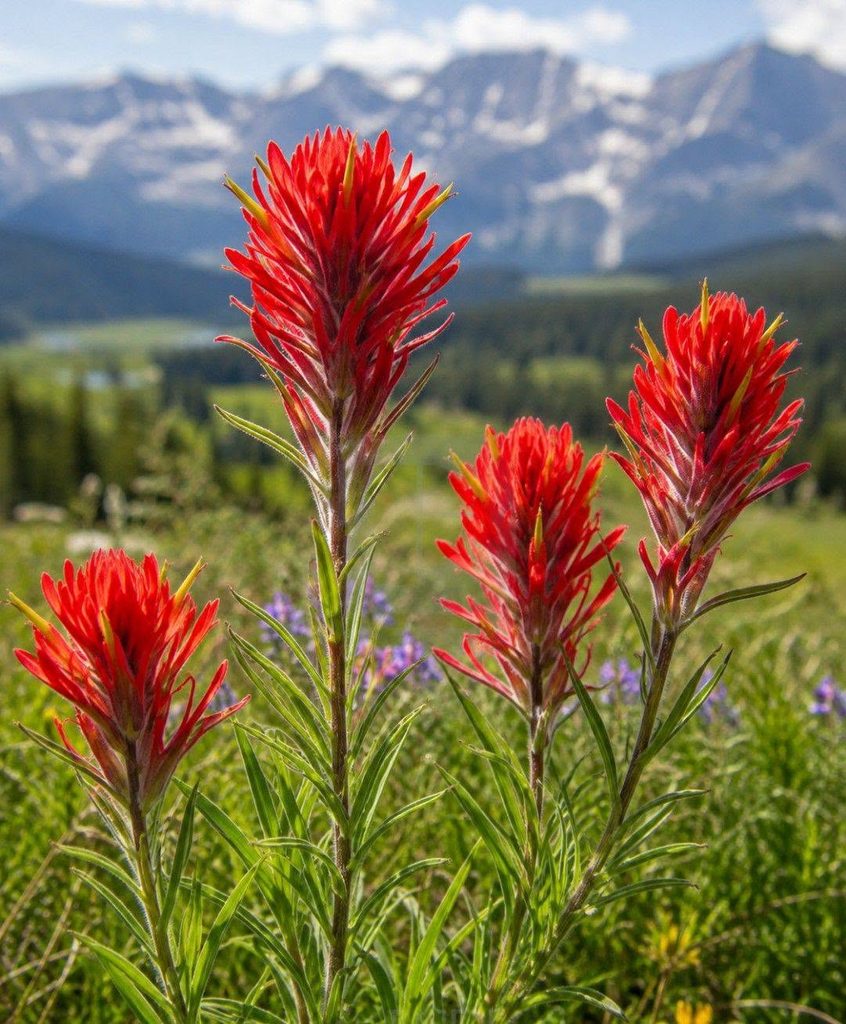
Indian Paintbrush is instantly recognizable by its brush-like, fiery red or orange bracts. What most people mistake for petals are actually modified leaves surrounding a small, tube-shaped flower. Idaho hosts several species within this genus.
This plant is partially parasitic. It taps into the root systems of nearby grasses and sagebrush to absorb extra nutrients. That’s part of why it’s notoriously difficult to transplant into home gardens, it needs a host neighbor.
You’ll find Indian Paintbrush blooming from June through August in meadows, forests, and roadside areas statewide. Hummingbirds are drawn to its nectar. It pairs beautifully with Lupine, creating one of Idaho’s classic wildflower color combinations.
6. Silvery Lupine (Lupinus argenteus)
Lupine produces tall spikes of purple-blue, pea-like flowers above silvery-green, palm-shaped leaves. It’s a legume, meaning it fixes nitrogen in the soil and actually improves growing conditions for surrounding plants.
Fields of Lupine mixed with Indian Paintbrush create some of the most photographed wildflower scenes in the American West. Idaho’s mountain meadows and forest openings light up with this combination from June to August.
Be cautious, though. Some lupine species contain alkaloids that are toxic to livestock and humans if ingested. I always admire it from the trail rather than picking it, both for conservation reasons and simple safety.
7. Shooting Star (Dodecatheon pulchellum)
Shooting Star has one of the most distinctive flower shapes in Idaho. Its pink to magenta petals sweep backward, away from a pointed yellow center, resembling a tiny comet streaking through the grass.
This flower thrives in moist meadows, along streambanks, and in seasonally wet areas at mid to high elevations. It’s an early bloomer, often appearing in April and May, right as snowmelt saturates the soil.
Shooting Star doesn’t linger long. The entire above-ground plant can die back within weeks of blooming, once soil moisture drops. Catching it in bloom takes good timing, which makes finding it feel like a small reward.
ALSO READ: 25 Shrubs With Red Leaves (Details, With Pictures)
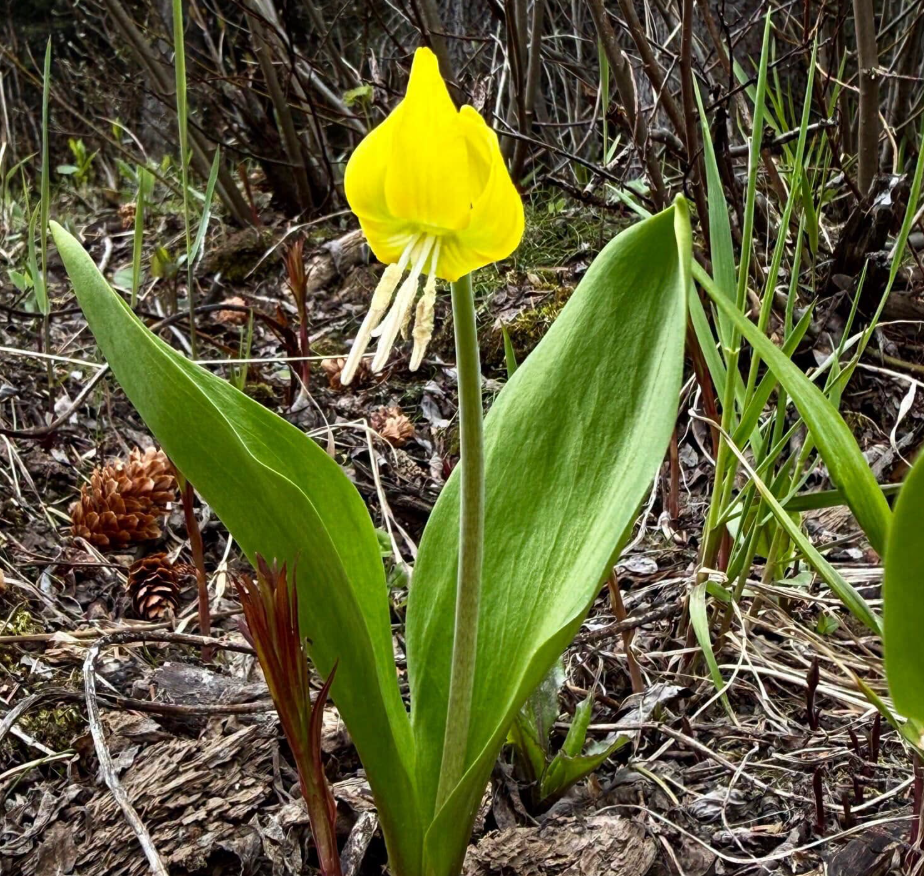
8. Glacier Lily (Erythronium grandiflorum)
Glacier Lily is a true harbinger of spring at high elevation. Its nodding, bright yellow petals curl backward, and it often blooms right at the edge of melting snowbanks, sometimes pushing straight through thin snow cover.
Grizzly bears in nearby mountain regions are known to dig up and eat its bulbs after hibernation, making it an important early food source for wildlife emerging from winter dormancy.
You’ll find Glacier Lily in subalpine meadows and forest clearings across central and northern Idaho, typically blooming from May through July depending on elevation and snowmelt timing. Higher trails bloom later into summer.
9. Western Columbine (Aquilegia formosa)
Western Columbine has an elegant, almost architectural shape. Its red and yellow petals form backward-pointing spurs that store nectar, specifically shaped to accommodate the long tongues and bills of hummingbirds and hawk moths.
This flower prefers partial shade and moist soil, often found along stream corridors, in open forests, and near seeps. It typically grows one to three feet tall, swaying gracefully in mountain breezes.
Western Columbine blooms from June to August across much of Idaho’s forested terrain. I’ve always thought it looks slightly whimsical, almost like something drawn for a fairy tale rather than a real mountain plant.
10. Fireweed (Chamerion angustifolium)
Fireweed earns its name honestly. It’s often the first plant to colonize burned or disturbed land, sending up tall spikes of vivid pink-purple flowers that bloom from bottom to top over several weeks.
After Idaho’s frequent wildfires, Fireweed can dominate a landscape within a single growing season. Its seeds are wind-dispersed and remarkably abundant, a single plant can produce tens of thousands of seeds in one year.
You’ll see Fireweed blooming from July through September in disturbed soils, roadsides, and burn areas statewide. Beekeepers value it highly, since it produces a light, delicately flavored honey prized by connoisseurs.
11. Common Yarrow (Achillea millefolium)
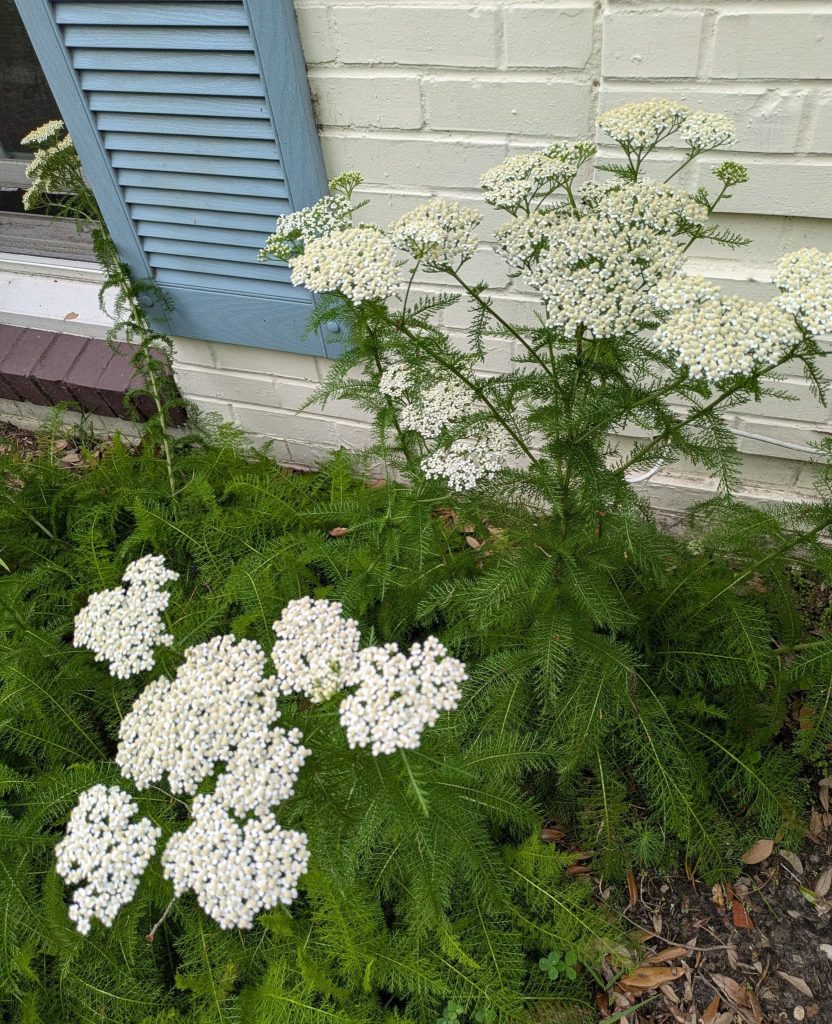
Yarrow is one of Idaho’s most adaptable native flowers. Its flat clusters of small white (occasionally pink) blooms sit atop fern-like, aromatic foliage. It tolerates poor soil, drought, and full sun with equal ease.
This plant has a long history of medicinal use among Indigenous peoples and early settlers, who applied crushed leaves to wounds. Modern gardeners value it mainly for its drought tolerance and pollinator appeal.
Yarrow blooms from June through September across nearly every habitat in Idaho, from valley floors to mountain meadows. It’s a favorite of butterflies and beneficial insects, making it a smart choice for wildlife gardens.
12. Upland Larkspur (Delphinium nuttallianum)
Upland Larkspur produces striking deep blue to purple flowers with a distinctive backward spur, giving the bloom its name. It’s one of the earlier wildflowers to appear in sagebrush steppe and open woodland habitats.
This plant is toxic to cattle, particularly in early growth stages, and ranchers keep a close eye on pastures where it’s common. Wild populations, however, support native pollinators without the same grazing concerns.
Larkspur typically blooms in April and May at lower to mid elevations before summer heat sets in. Its rich color stands out sharply against Idaho’s still-brown early spring grasses, a welcome flash of blue.
ALSO READ: 25 Shrubs With Yellow Leaves (With Pictures)
13. Scarlet Gilia (Ipomopsis aggregata)
Scarlet Gilia, sometimes called Skyrocket, produces tall, slender spikes covered in trumpet-shaped red flowers. The plant’s tubular blooms are specifically adapted to attract hummingbirds, particularly the broad-tailed and rufous species migrating through Idaho.
Interestingly, this flower can shift its color slightly through the season. Some researchers have documented populations transitioning from red toward pale pink as hummingbird activity declines and hawk moths take over pollination duty.
Scarlet Gilia blooms from June to August on dry, rocky slopes and roadsides throughout southern and central Idaho. Crushed foliage gives off a skunky odor, so admire it visually rather than by scent.
14. Blanketflower (Gaillardia aristata)
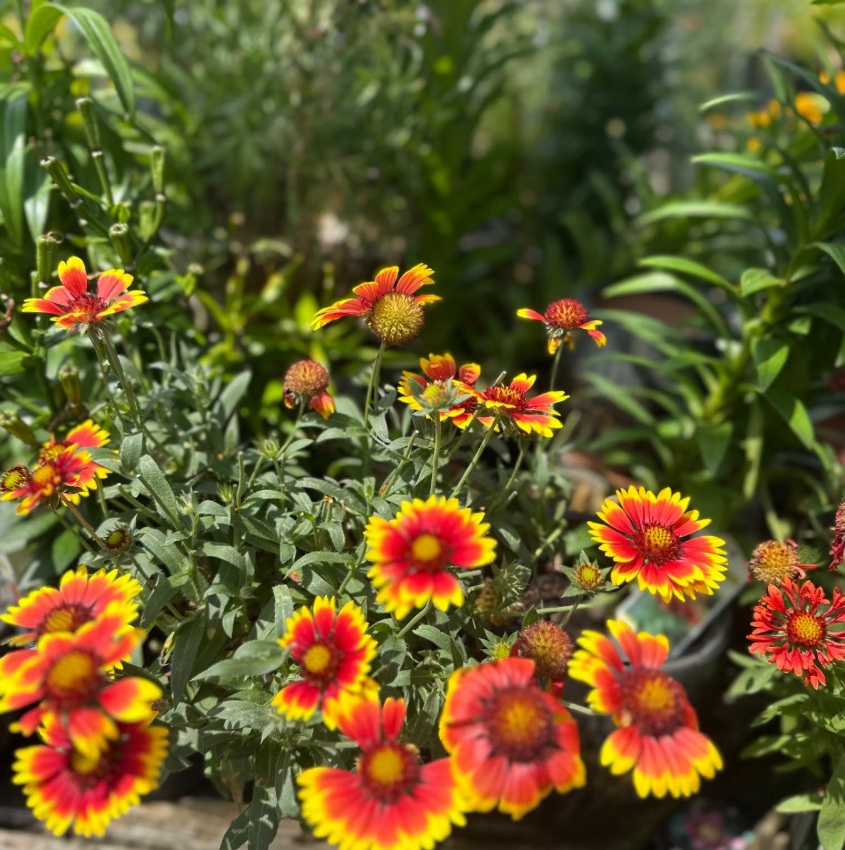
Blanketflower brings bold color to Idaho’s dry grasslands. Its daisy-like blooms combine red-orange centers with bright yellow tips, creating a two-toned effect that stands out even from a moving car window.
This flower is remarkably drought-tolerant once established, making it a popular choice for xeriscaping and native plant gardens. It attracts a wide range of pollinators, including bees, butterflies, and beneficial wasps.
Blanketflower blooms from June through September, one of the longer bloom windows on this list. You’ll find it in prairies, open meadows, and along roadsides throughout much of southern and central Idaho.
15. Sego Lily (Calochortus nuttallii)
Sego Lily is a delicate, three-petaled white to lavender flower with a distinctive purple blotch at the base of each petal. It’s actually the state flower of neighboring Utah, but grows widely across Idaho too.
The bulb of this plant served as an emergency food source for early Mormon settlers during a devastating crop failure in the 1840s, a fact still celebrated in regional history and folklore today.
Sego Lily blooms from May through July in dry, open sagebrush habitats and rocky foothills. Each bloom lasts only a few days, so seeing one in perfect condition feels like genuinely good timing.

16. Wilcox’s Penstemon (Penstemon wilcoxii)
Penstemon species are abundant across Idaho, and Wilcox’s Penstemon is one of the more common native varieties. It produces tubular, violet-blue flowers arranged along upright stems, typically one to two feet tall.
Penstemons as a genus are heavily represented in the Pacific Northwest, with Idaho hosting dozens of native species adapted to everything from alpine scree to dry sagebrush flats. Bees and hummingbirds both rely on them.
This species blooms from May through July in open forests, meadows, and rocky slopes, mostly in northern and central Idaho. Its tolerance for poor soil makes it a favorite among native landscaping enthusiasts.
17. Woods’ Rose (Rosa woodsii)
Woods’ Rose is Idaho’s most widespread native wild rose. It produces classic pink, five-petaled blooms with a soft, sweet fragrance, followed by bright red rose hips that persist well into winter.
Wildlife rely heavily on this shrub. Birds and small mammals eat the hips through colder months, while deer browse the foliage and stems. The dense, thorny growth also provides excellent nesting cover.
Woods’ Rose blooms from May through July along streambanks, forest edges, and open rangeland statewide. Its rose hips are exceptionally high in vitamin C, historically used by Indigenous peoples and settlers alike.
18. Kinnikinnick (Arctostaphylos uva-ursi)
Kinnikinnick, also called bearberry, is a trailing evergreen shrub with small, leathery leaves. Its bell-shaped pink and white flowers bloom in clusters from March through June, eventually giving way to bright red berries.
This plant tolerates poor, sandy, or rocky soil exceptionally well, making it a common groundcover across northern Idaho’s forests. Its dense mat-like growth also helps prevent soil erosion on exposed slopes.
The name Kinnikinnick comes from an Algonquian word referring to a smoking mixture, since Indigenous peoples traditionally dried and blended the leaves with tobacco. Bears and birds both feed heavily on its winter berries.
19. Serviceberry (Amelanchier alnifolia)
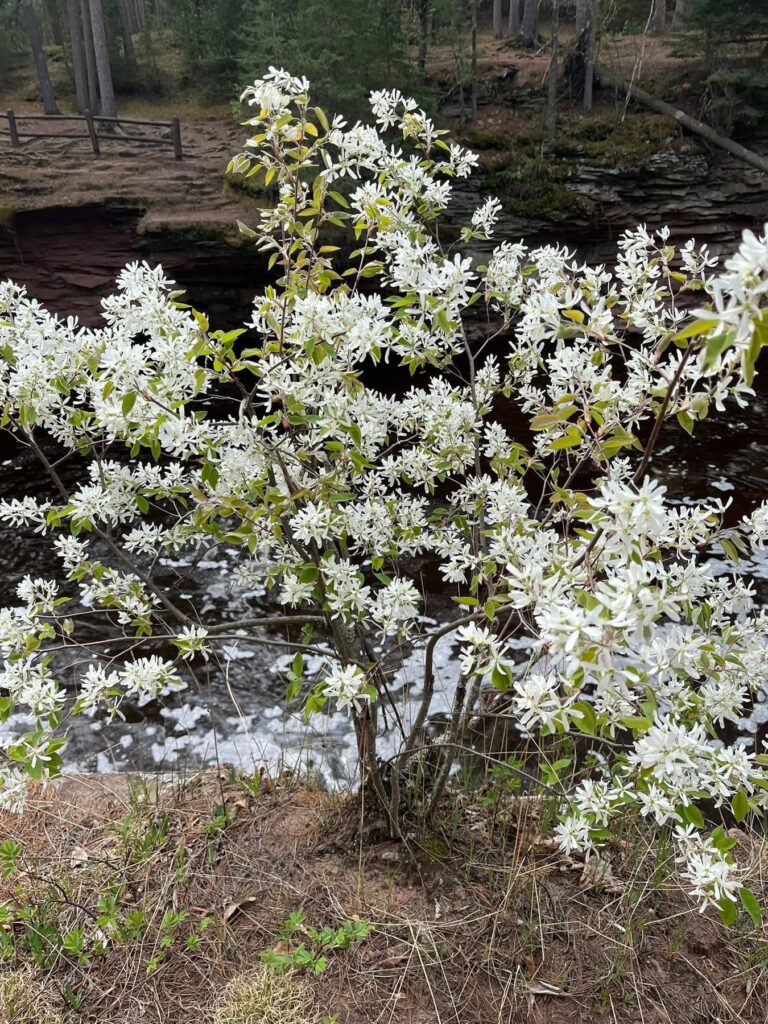
Serviceberry produces clusters of small, white, five-petaled flowers early in spring, often before the leaves fully emerge. It’s one of the first shrubs to bloom in northern Idaho, sometimes as early as March.
Its purple-blue berries that follow in summer are edible and were a critically important food source for Indigenous peoples, who dried them for winter storage or mixed them into pemmican with meat and fat.
You’ll find Serviceberry across nearly every habitat type in Idaho, from riverbanks to mountain slopes. Its reliable, early blooms make it a favorite marker for gardeners and hikers tracking the arrival of spring.
20. Western Trillium (Trillium ovatum)
Western Trillium is a striking woodland flower with three broad white petals that gradually fade to pink as they age. It’s often found growing in the dappled shade of Idaho’s northern coniferous forests.
This flower has an unusually slow life cycle. It can take seven years or more from seed germination before a plant produces its first bloom, making mature patches genuinely rare and worth protecting.
Western Trillium blooms from April through June in moist, shaded forest understories, mostly in the Idaho Panhandle. Please resist picking it, since damaging the stem can prevent the plant from flowering again for years.
21. Yellow Monkeyflower (Mimulus guttatus)
Yellow Monkeyflower produces bright, snapdragon-like blooms with distinctive reddish spots inside the throat of each flower. It thrives in consistently wet locations, springs, seeps, streambanks, and areas with standing water.
This plant is a strong indicator of reliable water sources, so hikers sometimes use it as a practical clue when searching for a spring in dry terrain. It’s also a favorite among native pollinator gardeners.
Yellow Monkeyflower blooms from May through September, one of the longest bloom periods among Idaho’s native wildflowers. It’s common throughout the state wherever moisture is dependable, from low valleys to mid-elevation forests.
22. Elephant’s Head (Pedicularis groenlandica)
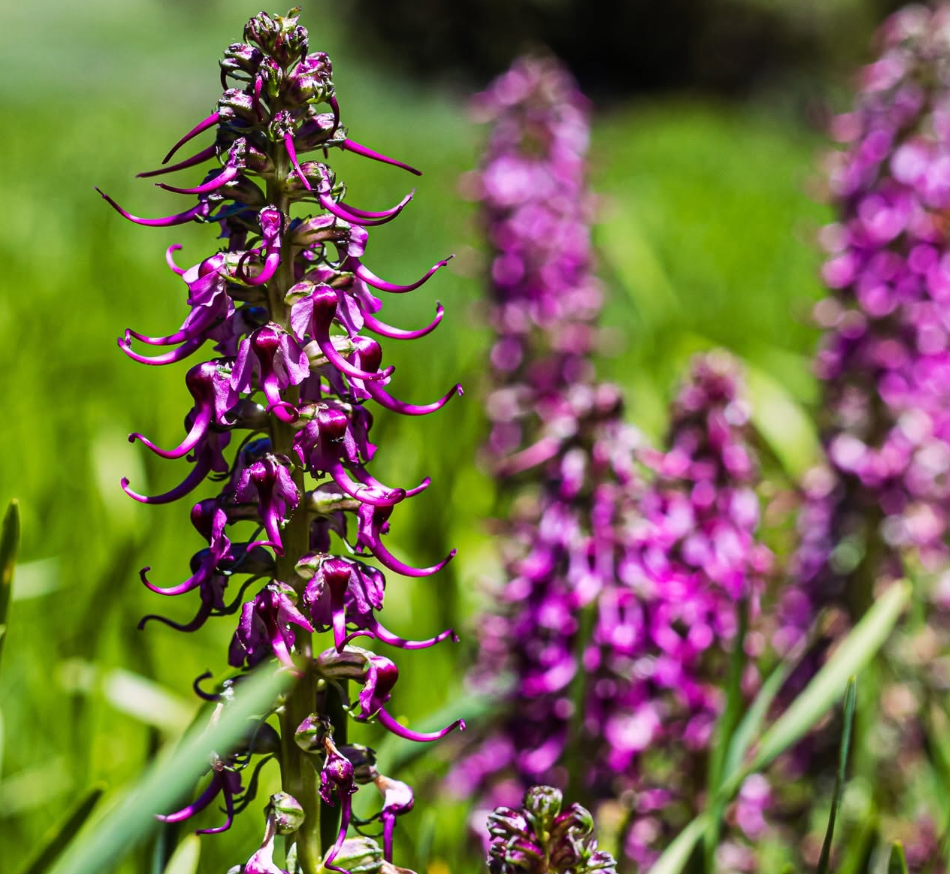
Elephant’s Head is one of Idaho’s most whimsical native flowers. Each small pink bloom genuinely resembles a tiny elephant’s head, complete with a curved trunk and two flared ears, arranged in a tall spike.
This plant is hemiparasitic, meaning it draws some nutrients from the roots of surrounding plants while still photosynthesizing on its own. It typically grows in wet subalpine and alpine meadows near snowmelt streams.
Elephant’s Head blooms from June through August at higher elevations across central Idaho’s mountain ranges. Finding a patch feels like discovering a secret, since it requires a bit of a hike to reach its habitat.
23. Lewis Flax (Linum lewisii)
Lewis Flax produces delicate, sky-blue flowers that open in the morning and often drop their petals by afternoon. Despite this brief daily bloom, the plant produces new flowers continuously throughout its blooming season.
Named after Meriwether Lewis, who documented it during the Lewis and Clark expedition, this flower shares a naming legacy with Syringa. Both plants connect Idaho’s wildflower heritage directly to that historic journey.
Lewis Flax blooms from May through August in dry, open habitats including sagebrush steppe and rocky foothills statewide. Its thin, wiry stems sway easily in the wind, giving fields a gentle, shimmering blue movement.
24. Wild Strawberry (Fragaria virginiana)
Wild Strawberry produces small, white, five-petaled flowers close to the ground, followed by tiny, intensely flavored red berries. Though the fruit is much smaller than cultivated strawberries, many say the flavor is more concentrated.
This low-growing native spreads via runners, forming dense mats that serve as effective, low-maintenance groundcover. It tolerates a range of light conditions, from full sun to partial forest shade.
Wild Strawberry blooms from April through June across meadows, forest edges, and open woodlands throughout Idaho. Birds, small mammals, and foraging hikers all compete for the berries once they ripen in early summer.
25. Oregon Grape (Mahonia aquifolium)
Oregon Grape rounds out this list as one of Idaho’s most useful native shrubs. It produces clusters of small, bright yellow flowers in early spring, followed by dark blue-purple berries that resemble grapes.
Its holly-like, spiny leaves stay evergreen year-round, providing structure and cover for wildlife even in winter. The berries, while tart, are edible and were traditionally used by Indigenous peoples for food and dye.
Oregon Grape blooms from March through May in forested areas, particularly throughout northern Idaho. It’s a common understory plant, thriving in the partial shade beneath the region’s coniferous canopy.
Why Idaho’s Native Flowers Matter
Native flowers aren’t just pretty additions to a hike. They support the pollinators, birds, and wildlife that depend on Idaho’s ecosystems staying intact. Bees, hummingbirds, and butterflies all rely on the specific bloom timing these plants provide.
Planting native species in home gardens also reduces water use significantly, since these flowers evolved for Idaho’s actual climate rather than imported growing conditions. That’s a practical benefit alongside the environmental one.
If you’re building a native garden, start with a few tough, adaptable choices like Yarrow, Blanketflower, or Lewis Flax. They’re forgiving for beginners and still deliver real value to local pollinators.
Best Times to See Idaho Wildflowers
Bloom timing shifts by elevation and region, but a general pattern holds across the state. Lower elevations peak from April through June. Mid to high elevations often peak from June through August, depending on snowmelt.
Popular wildflower viewing areas include Camas Prairie, the Sawtooth National Recreation Area, Hells Canyon, and the trails around Sun Valley. Each offers a slightly different mix of species and timing.
I’d recommend checking trail conditions before heading into higher elevations, since snowmelt timing shifts noticeably from year to year. A late spring can push peak bloom back by several weeks in mountain areas.
Final Thoughts
Idaho’s native flowers tell a story about resilience, adaptation, and deep cultural history. From the fragrant Syringa to the whimsical Elephant’s Head, each species has carved out its own niche in a demanding landscape.
Next time you’re out on an Idaho trail, take a moment to look closer. These 25 flowers represent just a fraction of what this state has to offer, but they’re a solid, rewarding place to start.

Tim M Dave is a gardening expert with a passion for houseplants, particularly cacti and succulents. With a degree in plant biology from the University of California, Berkeley, he has vast experience in gardening. Over the years, he has cultivated a vast collection of desert plants and learned a great deal about how to grow and care for these unique companions.