35 Flowering Cactus Varieties (With Pictures, and Growing Details)
Many people think cacti are only tough, spiny plants. I used to think the same. Then I saw a cactus in full bloom, and my view changed for good.
A flowering cactus can turn a dry corner into a burst of colour. Some flowers last a single night. Others cover the plant for weeks. In this guide, I share 35 flowering cactus varieties in four clear groups, so you can pick the right one with confidence.
What Makes a Cactus Flower?
Cacti belong to the family Cactaceae. Depending on the source, this family holds roughly 1,750 to 2,000 species. Almost all of them are native to the Americas. The Sonoran Desert region alone hosts about 300 species.
Flowering depends on light, temperature, water and age. Most desert cacti need bright sun and a cool, dry winter rest. Tropical types, such as the holiday cacti, follow different rules. They flower in response to short days and long nights.
Before you buy, keep these points in mind:
- Check hardiness. Some cacti survive deep frost, while others die below freezing.
- Match the light. Desert types need full sun. Jungle types like bright, indirect light.
- Be patient. Many cacti flower only when mature.
- Handle with care. Even “soft-looking” cacti can have tiny, painful barbs.
Jungle and Epiphytic Cacti (7 Varieties)
Not all cacti come from deserts. These types grow on trees in tropical forests. They like bright, indirect light, more water and higher humidity. Most are ideal houseplants.
1. Christmas Cactus (Schlumbergera × buckleyi)
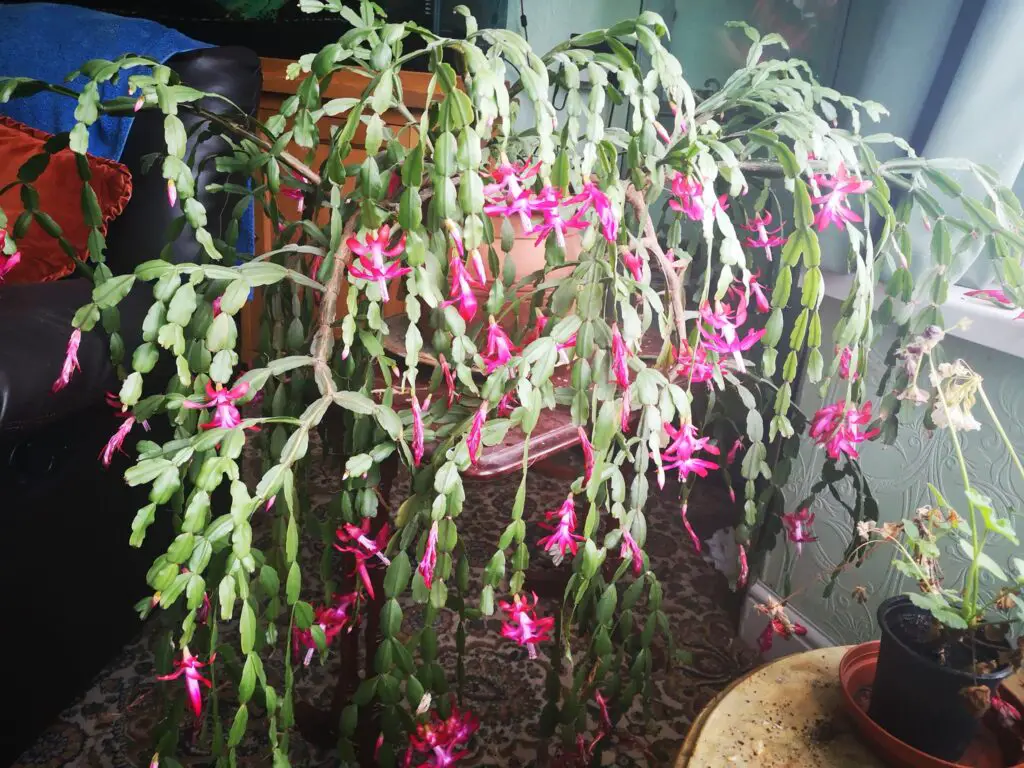
The Christmas Cactus is a well-loved winter houseplant. It comes from the mountain forests of Brazil. Its stem segments have smooth, scalloped edges.
It is a short-day plant. Penn State Extension notes that it needs about six weeks of short days to bloom. The University of Florida adds that it usually needs at least 12 hours of darkness.
Cool nights help too. If the temperature stays below about 60°F, buds can form regardless of day length. Keep it away from lamps and streetlights in autumn.
The anthers of the true Christmas cactus are purplish-brown, according to Clemson Extension. This is one way to tell it apart from its cousin.
2. Thanksgiving Cactus (Schlumbergera truncata)

Thanksgiving Cactus is the most common “Christmas cactus” sold in shops. Its stem segments have two to four saw-toothed points. That is the easiest way to identify it.
Clemson Extension notes that it flowers about a month before the true Christmas cactus. The colours include red, rose, purple, lavender, peach, orange, cream and white. The anthers are yellow.
It needs 8 to 10 hours of daylight and cooler nights to set buds. After flowering, water less. Repot only after the blooms fade.
I find it one of the easiest holiday plants to keep. With care, it may live for decades.
3. Easter Cactus (Hatiora gaertneri)
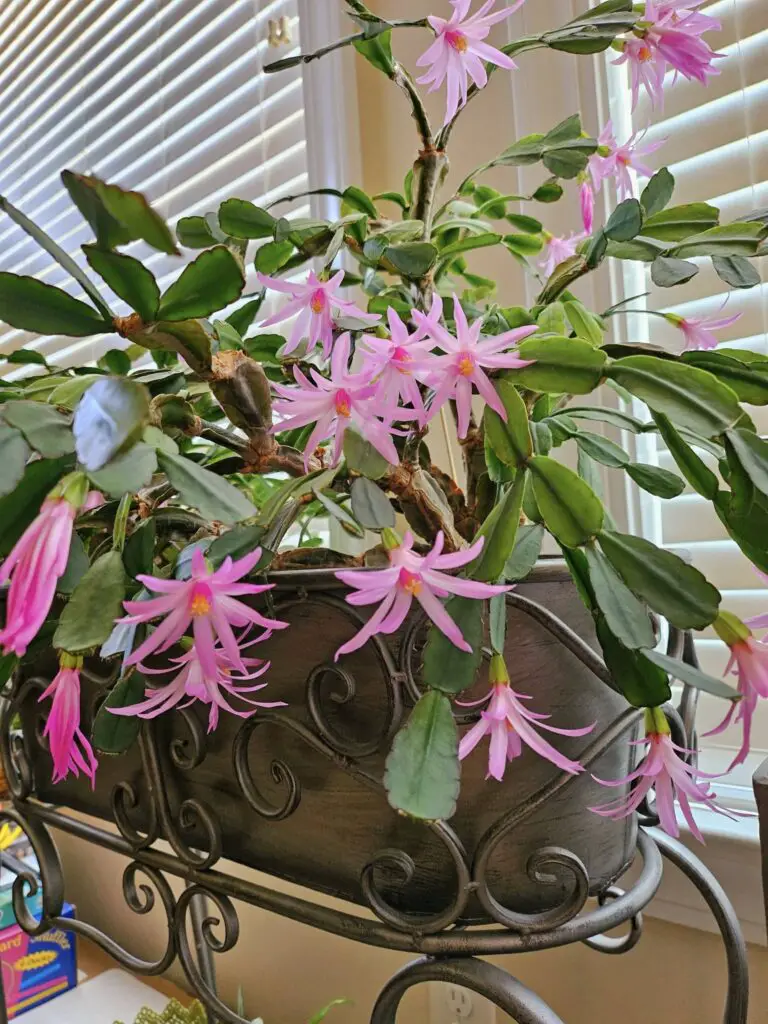
Easter Cactus is the spring member of the holiday cactus family. Its stem segments are rounded, and its flowers are star-shaped. They are often bright red or pink.
The University of Minnesota Extension says it needs 8 to 12 weeks of short days to set buds. That is longer than the other two. It usually blooms in late winter or early spring.
The University of Illinois Extension calls it the hardest of the three to keep healthy. It needs a cooler, drier rest period. Bright, indirect light is best.
It is a rewarding challenge. A well-flowering Easter Cactus is a joy in early spring.
4. Orchid Cactus (Epiphyllum hybrids)
Orchid Cactus is famous for huge, showy flowers. The blooms come in pink, red, orange, yellow and white. Many are scented.
The stems are flat and leaf-like, with wavy edges. The plants grow as epiphytes in nature. At home, they do well in hanging baskets.
Flowers appear in spring on mature plants. Each bloom lasts only a few days. But a healthy plant produces many in waves.
Give it bright, indirect light and well-drained, airy soil. Feed lightly in the growing season. It is a splendid plant for a covered porch.
5. Queen of the Night (Epiphyllum oxypetalum)
This is the true “Queen of the Night” of the jungle cactus world. It has long, wavy, leaf-like stems. It can grow quite large indoors.
The flowers are huge, white and strongly fragrant. They open after dark and wilt by morning. Many gardeners invite friends over to watch the once-a-year show.
It needs bright, indirect light and moderate water. Plants often need to be mature before blooming. A slightly root-bound plant flowers better.
I have seen people wait years for one night of bloom. Most say it was worth every minute.
6. Dragon Fruit (Selenicereus undatus)
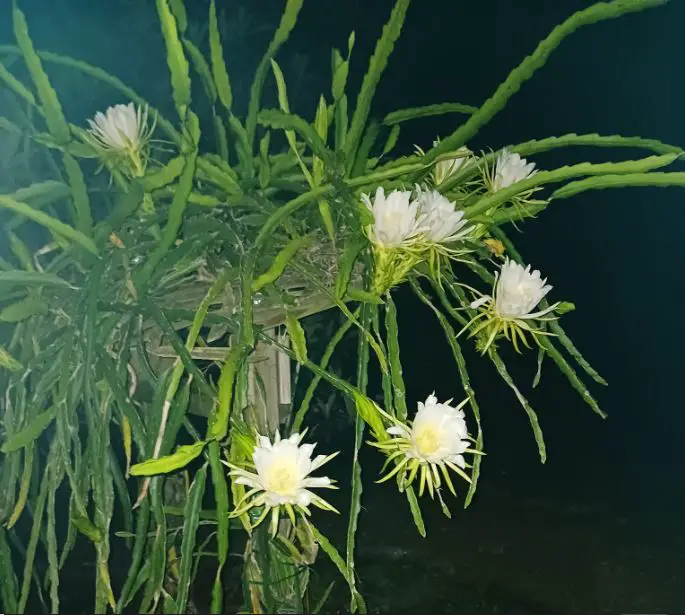
Dragon Fruit is a climbing cactus grown for both beauty and fruit. Its long, triangular stems need a strong support. It does best in zones 10 and 11 outdoors.
The flowers are enormous, white and fragrant. They open at night in summer and close by morning. Bats and moths pollinate them in the wild.
Some plants need a second variety for fruit. Hand pollination can help. Provide bright light and regular water in the growing season.
It is a fun, productive plant. Few cacti give you flowers and fruit in the same year.
7. Rat Tail Cactus (Aporocactus flagelliformis)
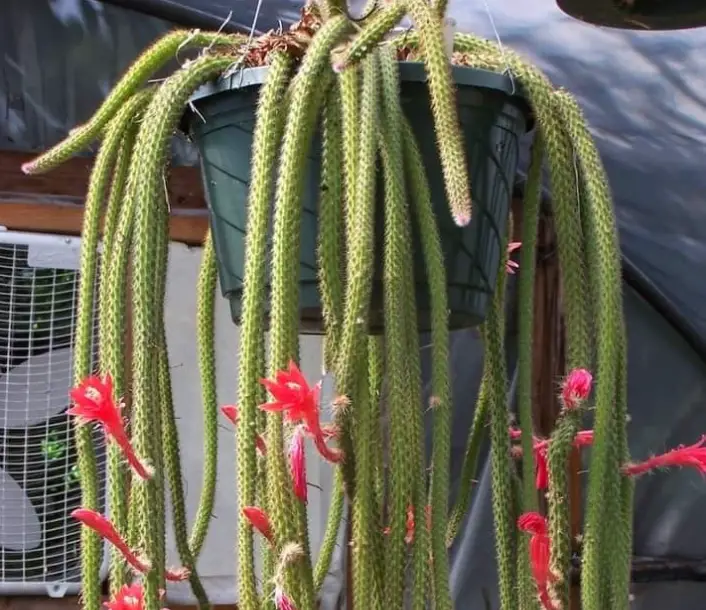
Rat Tail Cactus has long, thin, trailing stems. They can hang several feet down. It is perfect for hanging baskets.
In spring, it produces bright pink to red tubular flowers along the stems. They last several days. Hummingbirds are attracted to them outdoors.
The plant likes bright, indirect light and a coarse, free-draining mix. Water regularly in spring and summer. Reduce watering in winter.
It is a graceful plant. I think it suits a sunny hallway or porch beautifully.
Desert Giants and Columnar Cacti (5 Varieties)
These cacti grow tall and often flower at night. They suit warm, dry climates. Most are best for large gardens or greenhouses.
8. Saguaro (Carnegiea gigantea)
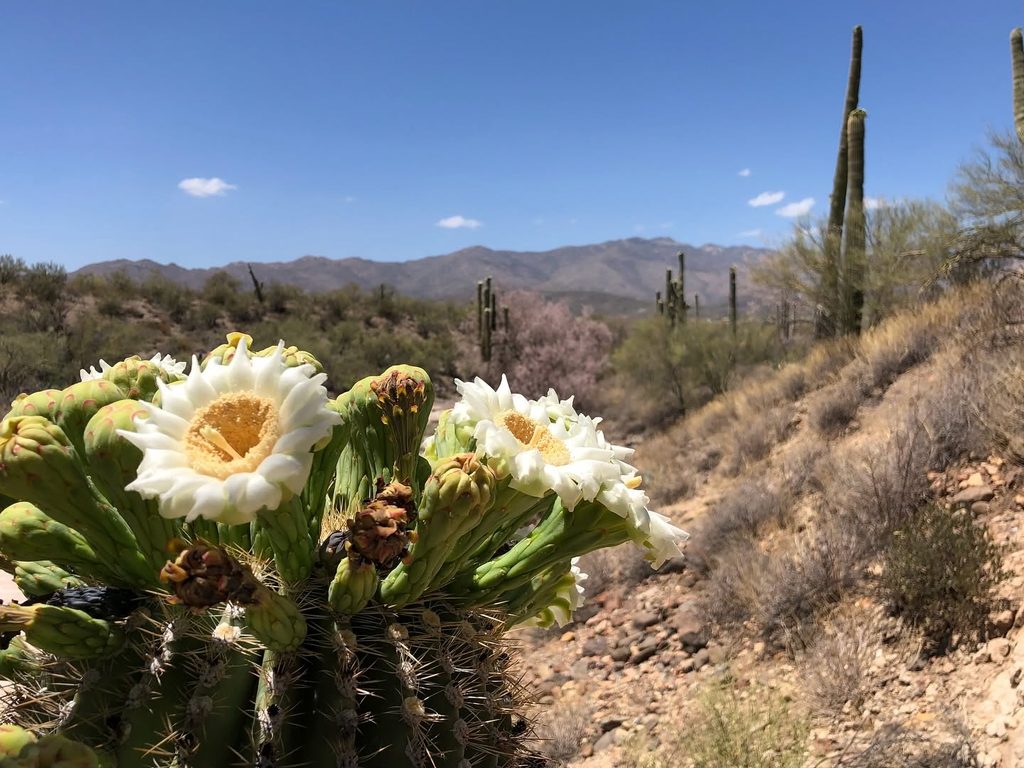
The Saguaro is the icon of the American Southwest. Its creamy white flowers were named Arizona’s state flower in 1931. Each bloom is about 3 inches wide and sits near the tops of the stems and arms.
Saguaro National Park describes the flowers as white with yellow centres. They open at night and close the following day. The park’s best displays usually come toward the end of May.
Park scientists also found something curious. Saguaros tend to bloom from east to west, then counterclockwise. This came from a study that ran from 2017 to 2023.
Saguaros grow very slowly and take decades to flower. Harming one is illegal in Arizona. If you want one, buy a licensed nursery plant.
9. Organ Pipe Cactus (Stenocereus thurberi)
The Organ Pipe Cactus grows many upright stems from one base. From a distance, it looks like a giant church organ. In the United States, it grows mainly in southern Arizona.
The flowers are pale purple-white and open at night. They usually close by the next midday. Bats and moths are the main pollinators.
This cactus does not tolerate hard frost. It suits zones 9 to 11 and needs sharp drainage. In cooler areas, grow it in a large pot and bring it indoors in winter.
I like it for its bold shape. Even without flowers, it makes a strong garden statement.
10. Arizona Queen of the Night (Peniocereus greggii)
This cactus looks like a bundle of dry sticks for most of the year. Then, for one night in summer, it becomes the star of the desert. The flowers are large, white and sweetly scented.
Many plants in one area bloom on the same night. Moths visit in numbers. The National Park Service lists the night-blooming cereus among the white cactus flowers of summer at Saguaro National Park.
The plant grows from a large, tuberous root. That root stores water and helps it survive drought. Overwatering can rot it quickly.
It is a tricky plant to grow, but it is worth the effort. Its single-night show is unforgettable.
11. Peruvian Apple Cactus (Cereus repandus)
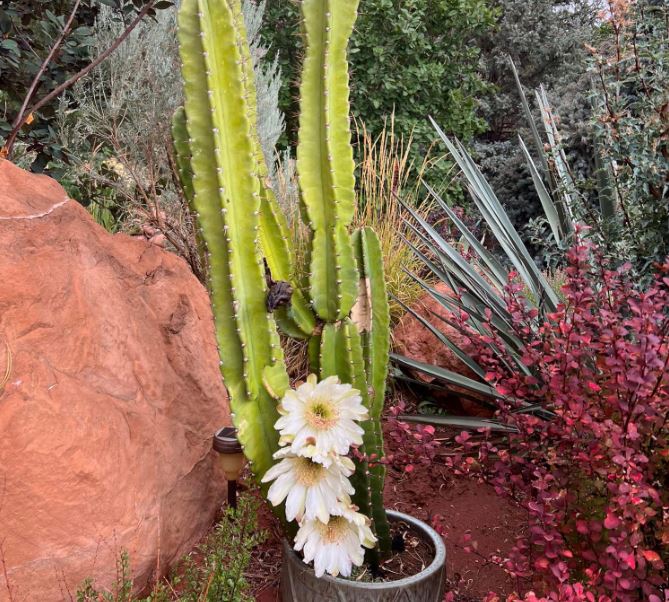
Peruvian Apple Cactus is a fast-growing, tree-like columnar cactus. It can reach over 20 feet outdoors. In pots, it stays much smaller.
The flowers are large, white and nocturnal. They open after dark and fade by morning. Pollinated flowers become smooth red fruit with white flesh.
It grows best in full sun with well-drained soil. Zones 9 to 11 suit it outdoors. Indoors, give it your brightest window.
It is a good choice if you want height quickly. Prune it lightly to control size.
12. Blue Candle (Myrtillocactus geometrizans)
Blue Candle has bluish-green, ribbed branches that grow like a candelabra. Its colour is striking, even without flowers. It comes from central Mexico.
The flowers are small, greenish-white and open in clusters. They may not be showy, but they attract many insects. Small purple berries follow.
The plant is tough and easy to keep. It handles heat, sun and neglect well. It does need protection from frost.
I recommend it to beginners. It grows steadily, and it flowers more readily than many other tall cacti.
Barrel and Globular Cacti (12 Varieties)
Round cacti are perfect for pots and small gardens. Many flower in a neat ring around the crown. Some are famous for their large, colourful blooms.
13. Fishhook Barrel Cactus (Ferocactus wislizeni)
The Fishhook Barrel is common across the deserts of Arizona and northern Mexico. It gets its name from its curved central spines. Older plants often lean toward the southwest.
The National Park Service lists its flowers as yellow to orange, appearing in summer at Saguaro National Park. They form a ring on the crown. Cactus bees help pollinate them.
After flowering, the plant carries yellow fruit for months. This adds a second layer of interest.
Give it full sun and lean, gritty soil. It needs almost no water in winter. It rewards neglect better than kindness.
14. Golden Barrel Cactus (Echinocactus grusonii)
Golden Barrel is one of the most popular cacti in the world. It forms a perfect golden ball with bright yellow spines. It is native to central Mexico.
The yellow flowers grow in a ring at the top. However, plants often need to be mature, sometimes 10 to 20 years old, before they bloom. Young pot plants rarely flower.
Wild populations are under pressure, so buy nursery-grown plants only. It is best for zones 9 to 11 and needs excellent drainage.
Patience is key here. When it does flower, the crown looks like a golden wreath.
15. Powder Puff Cactus (Mammillaria bocasana)
Powder Puff is a small, clustering cactus covered in soft-looking white hairs. It is a favourite for windowsills. But do not be fooled by its fluffy look. Hooked spines hide among the hairs.
In spring and summer, it makes a ring of creamy white to pale yellow flowers. Sometimes they have a pink tinge. Red fruits follow.
It needs bright light and very little water. Let the soil dry completely between drinks. Overwatering is the main cause of death.
I find it one of the easiest cacti to flower indoors. A cool, dry winter rest helps a lot.
16. Fishhook Pincushion (Mammillaria microcarpa)
This small cactus is native to Arizona and northern Mexico. It is often seen in Saguaro National Park. The National Park Service lists it as a pink-flowering cactus in the April to May bloom season.
The flowers are small but plentiful. They form a crown of pink to purple around the top of each stem. Later, slim red fruits appear.
It is a good choice for rock gardens in warm zones. It also does well in pots. Provide sharp drainage and full sun.
Its small size makes it easy to place. It shows how much colour a tiny cactus can offer.
17. Old Lady Cactus (Mammillaria hahniana)
Old Lady Cactus is covered in fine white hairs that look like a grandmother’s silver hair. It forms a neat, rounded body. The name is charming, and so is the plant.
In spring, it grows a ring of deep pink to magenta flowers around the crown. The contrast with the white hairs is striking. It makes a lovely small potted display.
Give it bright light and a very free-draining mix. Water sparingly. A cool winter rest greatly improves blooming.
I love how much impact one small plant can have. It is ideal for a sunny shelf.
18. Easter Lily Cactus (Echinopsis oxygona)
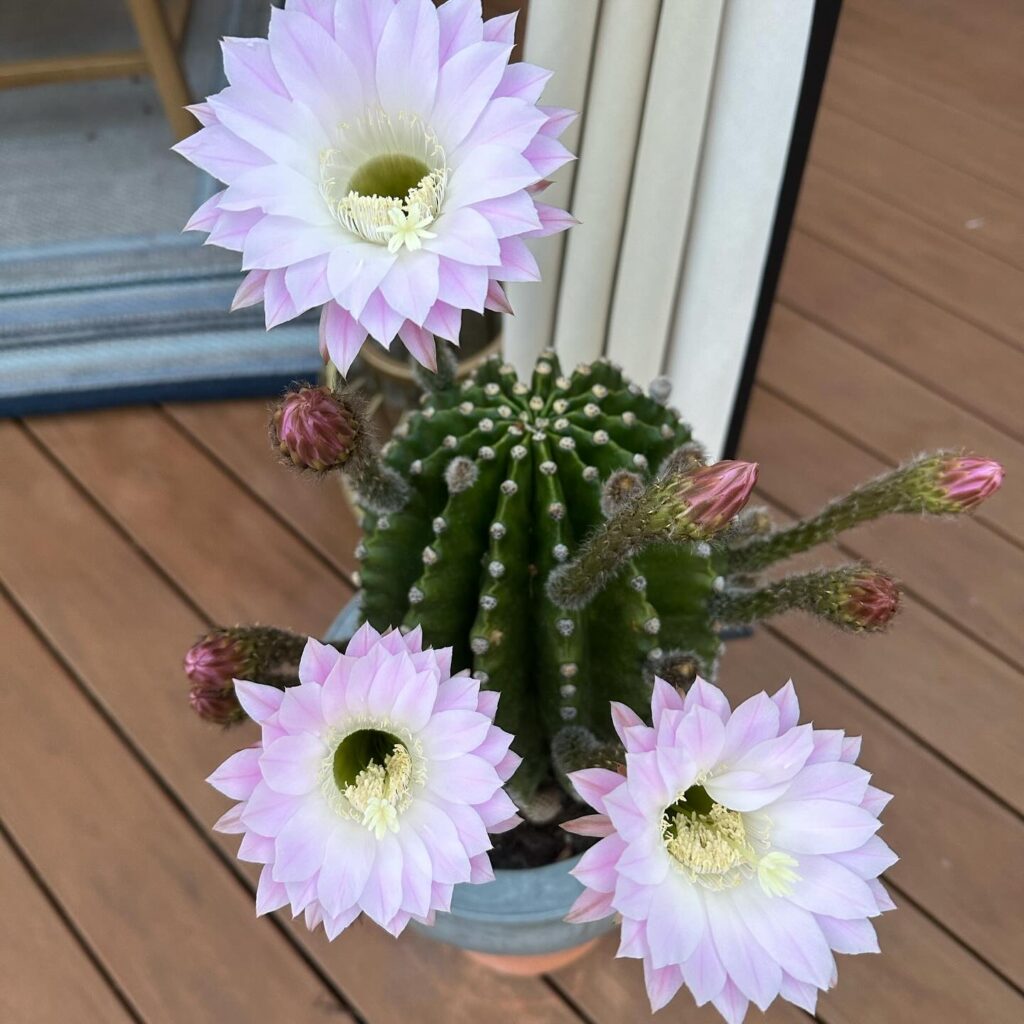
Easter Lily Cactus is a small, ribbed globe that produces surprisingly huge flowers. The blooms are long, trumpet-shaped and often pink or white. They can be far larger than the plant body.
Each flower lasts only a day or two. Several may open in a wave, so the show is spectacular. Many hybrids exist in different colours.
The plant makes many offsets, which are easy to separate and pot. Give it bright light and moderate water in summer. Keep it dry and cool in winter.
It is one of the best cacti for beginners. The reward-to-effort ratio is excellent.
19. Red Torch Cactus (Echinopsis huascha)
Red Torch Cactus grows as a cluster of slim, upright columns. It comes from Argentina. The stems are green with yellow spines.
The flowers are the highlight. They are bright red, orange or yellow funnels that open in the day. They appear in late spring and summer.
It grows well in pots and sunny beds in warm areas. Protect it from hard frost. Water regularly in summer, but let it dry between drinks.
I always enjoy its vivid colours. It is a cheerful cactus that suits a bright patio.
20. Bishop’s Cap (Astrophytum myriostigma)
Bishop’s Cap is a spineless cactus with five ribs. It looks like a bishop’s hat, hence the name. Its grey-green body is dotted with tiny white flecks.
The flowers are yellow with a red throat and appear at the top in summer. They are large compared to the body. They open on sunny days.
This is a slow grower from Mexico. It hates wet feet. Use gritty soil and a pot with good drainage.
It is a collector’s favourite. It has a clean, modern look even when not in bloom.
21. Star Cactus (Astrophytum asterias)
Star Cactus is also called Sand Dollar Cactus. It is flat, round and spineless. Small tufts of white wool mark each rib.
In spring and summer, it produces yellow flowers with a red-orange centre. The blooms are big for such a small plant. Each lasts a few days.
It is slow and sensitive to overwatering. Wild populations are now rare, so buy only from reputable growers. Give it strong light and very sharp drainage.
I think of it as a plant for patient growers. A blooming Star Cactus feels like a small victory.
22. Chin Cactus (Gymnocalycium)
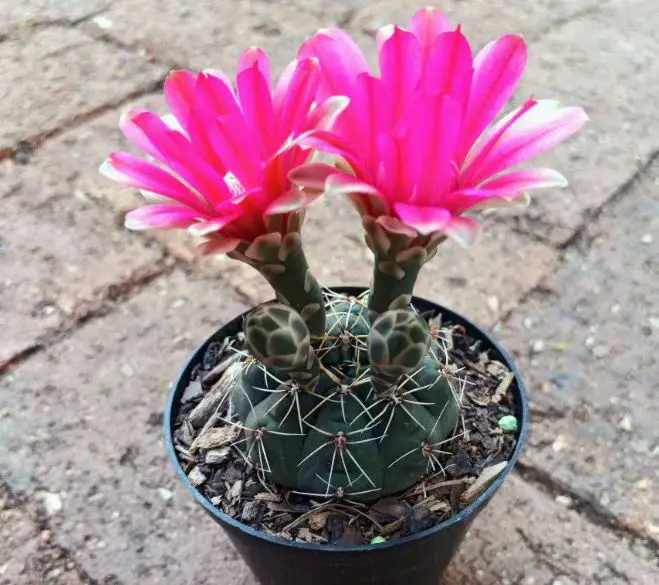
Chin Cactus is a group of small, round cacti from South America. The name comes from the chin-like bumps under each spine cluster. They are compact and easy to keep.
Flowers are often pale pink, white or greenish and appear in spring and summer. Many are large for the plant. The most common houseplant form is the colourful grafted “Moon Cactus.”
Chin cacti tolerate less light than many cacti. They do well on east or west windowsills. Water lightly and let the soil dry between waterings.
They are a good choice if your home is not very sunny. They bloom more reliably than many indoor cacti.
23. Crown Cactus (Rebutia)
Crown Cactus is a small, clumping cactus from the mountains of Argentina and Bolivia. It stays tiny, often just a few inches wide. Over time, it forms a dense cluster.
In spring, it blooms in a ring of orange, red, yellow or pink flowers. The blooms can nearly cover the plant. It is one of the most free-flowering cacti.
Crown Cactus tolerates cooler temperatures. A cool, dry winter helps it set buds. In summer, give it bright light and regular water.
I recommend it to anyone who wants lots of flowers from a small pot.
24. Golden Ball / Lemon Ball Cactus (Parodia leninghausii)
This cactus grows as a golden-spined column that can reach a foot or more. It comes from southern Brazil. It looks a bit like a soft yellow candle.
Large yellow flowers grow at the top in summer. They give the plant a crown of colour. Older plants flower more freely.
It likes bright light and a little afternoon shade in hot climates. Use gritty soil. Water moderately in summer and sparingly in winter.
It is a bold, cheerful cactus. It looks lovely in a pot on a sunny terrace.
Hedgehog, Prickly Pear and Cholla: Hardy Cacti (11 Varieties)
Many gardeners are surprised to learn that some cacti survive cold winters. These types are much tougher than they look. They suit rock gardens and dry beds.
Colorado State University Extension notes that cold-hardy cacti are relatively rare, yet a few flourish. It also reports that five Echinocereus species grow in Colorado.
25. Scarlet Hedgehog (Echinocereus coccineus)
Scarlet Hedgehog forms a mound of many stems. It is one of the five hedgehog species recorded in Colorado. It grows in rocky, dry places.
In spring, it makes brilliant red flowers. They cover the mound and draw hummingbirds. It is a wonderful sight in a gravel garden.
It tolerates cold when kept dry in winter. Wet soil is the greater danger. Plant it on a slope or in a raised bed.
I think this is one of the best cold-hardy cacti for colour. It is dependable and beautiful.
26. Kingcup Cactus (Echinocereus triglochidiatus)
Kingcup Cactus forms round clumps of stout, spiny stems. It is another native hedgehog found in Colorado and the wider Southwest. The stems can multiply into large mounds.
The flowers are bright red, cup-shaped and glowing. They open in spring. The petals often look like polished glass.
It thrives in full sun and poor, well-drained soil. It also tolerates cold winters. Give it space to spread.
It is a superb choice for a dry garden. Hummingbirds love it as much as I do.
27. Lace Hedgehog (Echinocereus reichenbachii)
Lace Hedgehog has small, upright stems covered in delicate, comb-like spines. The spines give it a lacy look. It is compact and neat.
In late spring, it produces large, pink to magenta flowers. They often have a paler throat. Plants bloom at a young age, which is unusual for cacti.
It is fast growing by cactus standards. Many gardeners rate it hardy in about zone 5 and warmer. Keep the soil very well drained.
This is an excellent “first cactus” for a rock garden. It gives fast rewards.
28. Green-Flowered Hedgehog (Echinocereus viridiflorus)
This is a tiny hedgehog cactus from the short-grass prairies of the central United States. It is the only Echinocereus species that grows natively around Denver, according to Colorado State University Extension.
The flowers are small, green to yellow-green with a hint of brown. They are unusual and subtle. They often open in late spring.
It is very cold hardy. It grows best in gritty soil and full sun. It is small enough for a trough garden.
I love its modest charm. It is a plant for people who appreciate quiet beauty.
29. Missouri Foxtail Cactus (Escobaria missouriensis)
Missouri Foxtail is a small, round cactus that grows across a wide area. It ranges from Arizona to the Dakotas. That range shows how tough it is.
It blooms in spring with pale cream to yellow-green flowers, often with pink stripes. Small red fruits follow. It is easy to overlook until it flowers.
It is very hardy in cold, dry climates. Use gritty soil and full sun. Protect it from winter wet.
This is a great choice for anyone in a cold region who still wants a true cactus.
30. Beavertail Cactus (Opuntia basilaris)
Beavertail is a spineless-looking prickly pear with blue-gray, flat pads. It comes from the Mojave Desert. The pads may turn purple in cold or drought.
The flowers are vivid magenta and silky. They appear in spring, covering the plant in colour. Each bloom is large and eye-catching.
Do not touch the pads with bare hands. They carry tiny, hair-like barbs called glochids. Gardeners often report it as hardy to about zone 5 when kept dry.
For a low-maintenance, showy plant, this is one of my top picks.
31. Eastern Prickly Pear (Opuntia humifusa)
Eastern Prickly Pear is one of the most cold-tolerant cacti. Unlike most cacti, it is native to the eastern United States. It forms low, spreading mats.
In early summer, it makes yellow flowers with red centres. They are large and glossy. Reddish-purple fruits follow.
The pads shrivel in winter and plump up again in spring. That is normal. It thrives in poor, sandy soils.
It is a wonderful plant for cold gardens. It proves cacti can live almost anywhere.
32. Engelmann Prickly Pear (Opuntia engelmannii)
Engelmann Prickly Pear is a large, bushy cactus of the Southwest. Its pads are big, round and blue-green. It can form a wide shrub.
The flowers are yellow, fading to orange-red. They appear in spring and early summer. Purple fruit, called tunas, follow.
It tolerates light to moderate frost. It also handles heat and drought very well. Give it room, as it can spread widely.
It is a handsome, bold plant. Wildlife also enjoys the fruit.
33. Bunny Ears Cactus (Opuntia microdasys)
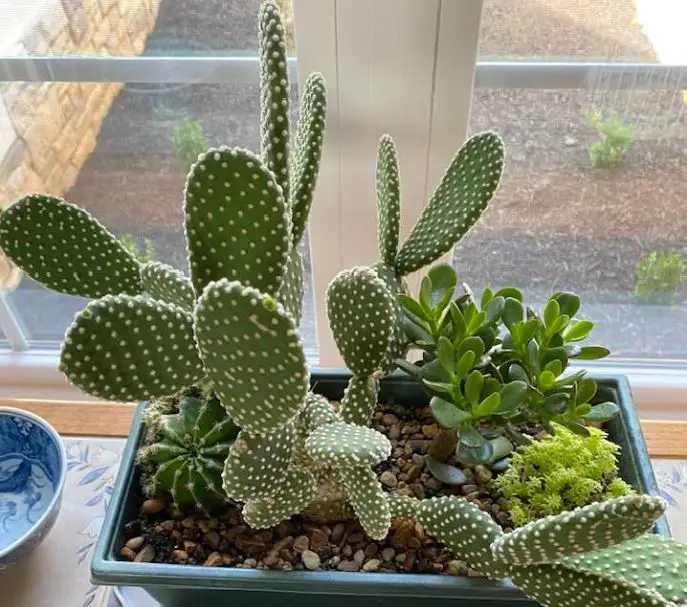
Bunny Ears has soft-looking, paired pads that resemble a rabbit’s ears. It is popular as a houseplant. It comes from Mexico.
Flowers are yellow and appear in spring and summer. However, indoor plants rarely bloom. They need strong light and a cool, dry winter to flower.
The tiny golden glochids are a real hazard. They detach easily and irritate skin. Wear thick gloves when handling.
It is a fun plant, but respect it. Keep it away from small children.
34. Teddy Bear Cholla (Cylindropuntia bigelovii)
Teddy Bear Cholla looks fuzzy and soft from a distance. In reality, it has dense, sharp spines that catch on skin. It grows in the Sonoran and Mojave deserts.
The flowers are pale yellow to cream, often with a pink or lavender tinge. They appear in spring. They are small but attractive in large numbers.
This plant is best admired at a distance. Its segments detach easily. That makes it hard to handle in gardens with pets or children.
I would recommend it only for large, secure desert landscapes.
35. Cane Cholla (Cylindropuntia imbricata)
Cane Cholla is a branching, tree-like cactus that can reach about 6 feet. It is native to Colorado, New Mexico and Texas. Its jointed stems have a woody look.
In early summer, it produces magenta or purple flowers. They stand out beautifully against the grey-green stems. Yellow fruits often remain into winter.
It is cold hardy in many areas and does well in dry, sunny beds. Give it plenty of room. Wear protective clothing when pruning.
It is a strong choice for a xeriscape garden. It adds structure in every season.
Quick Tips to Help Any Cactus Bloom
- Provide strong light. Most desert cacti need at least 6 hours of direct sun.
- Give a winter rest. Cool, dry conditions trigger buds in many species.
- Use gritty soil. Drainage prevents rot, the top killer of cacti.
- Water carefully. Soak thoroughly, then let the soil dry out.
- Respect day length. Holiday cacti need long nights, with no artificial light.
- Wear gloves. Glochids and spines can cause painful injuries.
Final Thoughts
Flowering cacti are far more varied than most people expect. Some bloom for a single magical night. Others cover themselves in colour every spring.
If you are new to cacti, I suggest starting with Easter Lily Cactus, Crown Cactus or Thanksgiving Cactus. They flower reliably and forgive small mistakes. If you live in a cold region, try Eastern Prickly Pear or a hedgehog cactus.
Whichever you choose, check your climate first. Give the plant the light it needs, and be patient. A cactus in bloom is one of the most rewarding sights in gardening.
References
- U.S. National Park Service. Flowers – Saguaro National Park. https://www.nps.gov/sagu/learn/nature/flowers.htm
- U.S. National Park Service. Saguaro Flower Power Project. https://www.nps.gov/sagu/getinvolved/saguaro-flower-power-project.htm
- University of Minnesota Extension. Holiday cacti. https://extension.umn.edu/houseplants/holiday-cacti
- Clemson University Home & Garden Information Center. Thanksgiving & Christmas Cacti. https://hgic.clemson.edu/factsheet/thanksgiving-christmas-cacti/
- University of Illinois Extension. Brighten your holidays with blooming cacti: a guide to holiday cactus care. https://extension.illinois.edu/blogs/garden-scoop/2024-12-09-brighten-your-holidays-blooming-cacti-guide-holiday-cactus-care
- University of Florida IFAS Gardening Solutions. Christmas Cactus. https://gardeningsolutions.ifas.ufl.edu/plants/houseplants/christmas-cactus/
- Colorado State University Extension, Pueblo County. Know Your Natives: Echinocereus Cacti. https://pueblo.extension.colostate.edu/know-your-natives-echinocereus-cacti/

Tim M Dave is a gardening expert with a passion for houseplants, particularly cacti and succulents. With a degree in plant biology from the University of California, Berkeley, he has vast experience in gardening. Over the years, he has cultivated a vast collection of desert plants and learned a great deal about how to grow and care for these unique companions.