30 Plants That Eat Bugs (Identification, With Pictures)
Most plants live on sunlight, water, and soil. A small group of them has found another way to eat. These plants catch and digest insects, and some even trap spiders, tiny aquatic animals, and, in rare cases, small mammals.
I still remember the first time I saw a Venus flytrap close on a fly. It felt like watching a rule of nature being broken. Plants are supposed to be the meal, not the diner.
This guide covers 30 plants that eat bugs. For each one, you will learn what it looks like, how it traps prey, where it grows, and other important facts.
Why Do Some Plants Eat Bugs?
Carnivorous plants usually grow in places with very poor soil, such as bogs and wet sands. These soils lack nitrogen and phosphorus. Insects are the plant’s fertilizer.
Photosynthesis still provides most of the plant’s energy. As the U.S. Fish and Wildlife Service explains, the Venus flytrap gets its energy from the sun. Digesting insects only adds nutrients that are hard to find in its habitat.
Researchers at the University of Vermont and Mount Holyoke College note that about 600 carnivorous species had been identified in their review. Newer counts are higher, because botanists keep describing new species, especially in the pitcher plant and bladderwort groups.
The 5 Main Trap Types
The UC Davis Botanical Conservatory lists five main trap types: snap, pitfall, flypaper, bladder, and lobster-pot. These traps are either active, meaning they move, or passive, meaning they do not.
Knowing these types makes the list below easier to follow. Each plant uses one of them, and a few combine features.
- Snap traps: Two lobes close quickly around prey.
- Pitfall traps: Prey slips into a deep, fluid-filled tube.
- Flypaper traps: Sticky glue holds the insect in place.
- Bladder traps: A tiny chamber sucks in prey underwater.
- Lobster-pot traps: Prey enters easily but cannot find the way out.
Snap-Trap Plants
1. Venus Flytrap (Dionaea muscipula)
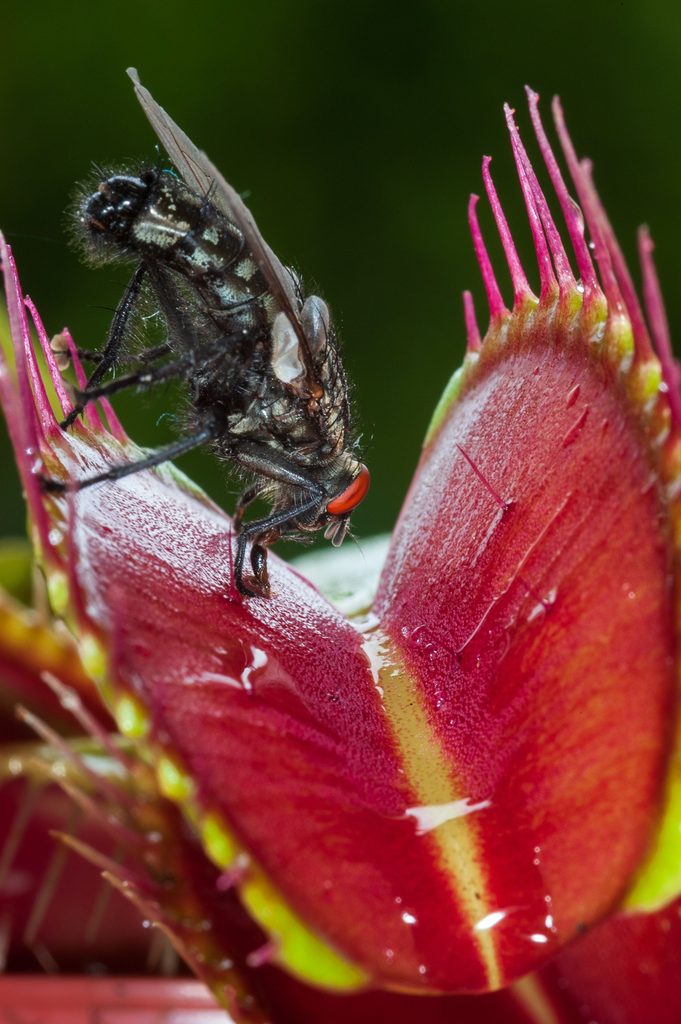
The Venus flytrap is the most famous carnivorous plant on Earth. Each leaf ends in two hinged lobes edged with stiff, tooth-like bristles. It is native to the wetlands of North and South Carolina.
The trap uses a hair-trigger system. When an insect touches the tiny trigger hairs twice within about 20 seconds, the lobes snap shut. Ants, beetles, and spiders are common victims.
This plant is also in trouble in the wild. North Carolina made poaching Venus flytraps a felony in 2014. Buy only tissue-cultured plants from reputable nurseries, as the U.S. Fish and Wildlife Service advises.
2. Waterwheel Plant (Aldrovanda vesiculosa)
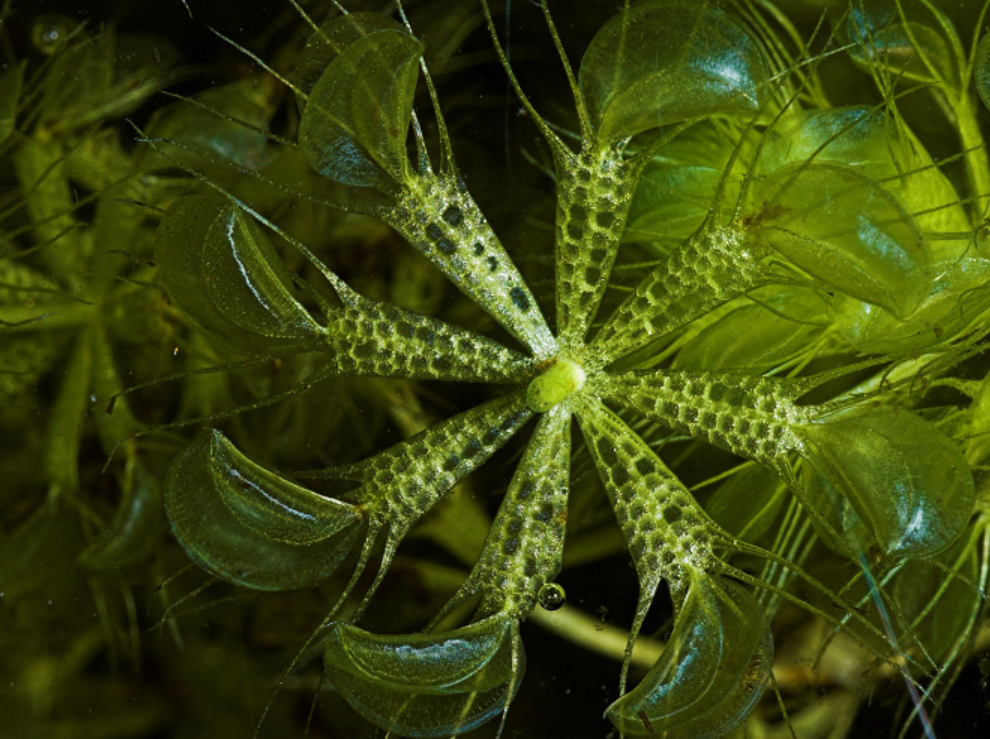
The waterwheel plant is often called an underwater Venus flytrap. It floats freely in still water, with small whorls of leaves arranged like the spokes of a wheel. It is the only species in its genus.
Each tiny trap snaps shut in a fraction of a second. Its prey includes water fleas and other small aquatic animals. It does not eat flies the way its land relative does.
The plant is rare and has declined across much of its range. Pollution and the loss of clean, shallow ponds are the main causes. For that reason, it is more often seen in botanical collections than in nature.
Pitcher Plants of North America
3. Purple Pitcher Plant (Sarracenia purpurea)
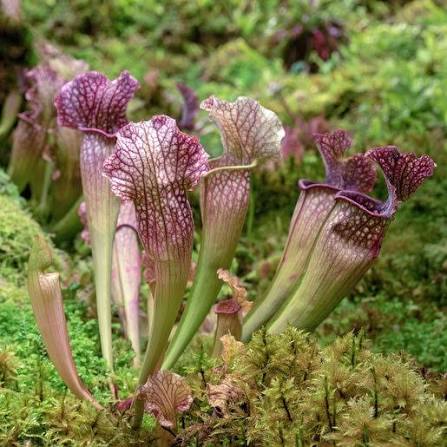
The purple pitcher plant is one of the toughest carnivorous plants in cold climates. It grows in bogs from Canada to the Gulf Coast. Its pitchers are short, curved, and often veined in red or purple.
The pitcher collects rainwater. Insects lured by nectar slip on the slick rim and drown inside. Downward-pointing hairs make climbing out almost impossible.
The USDA Forest Service features this plant in its Plant of the Week series. In my view, it is the best choice for a beginner in a cool climate. It can survive freezing winters outdoors.
4. Yellow Trumpet Pitcher (Sarracenia flava)
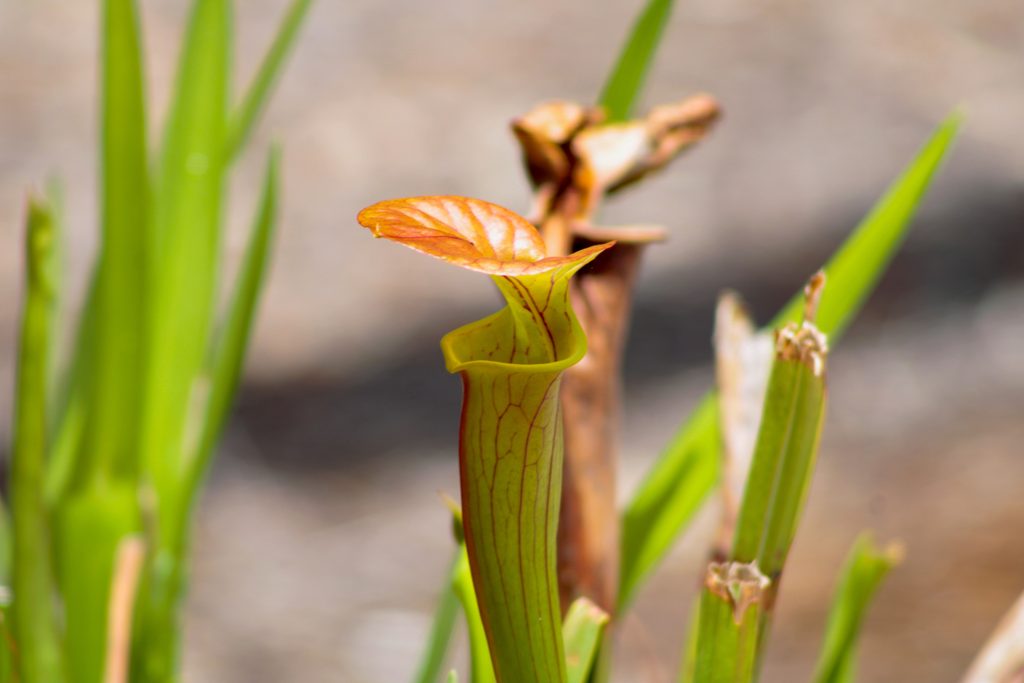
This plant lives up to its name. Its tall, trumpet-shaped pitchers can reach about two to three feet. They are yellow-green, often with deep red veins near the throat.
It is native to the southeastern United States. Flies, wasps, and moths are lured by the sweet nectar around the lid. Once inside, they cannot climb out.
A large group of yellow trumpets in a bog is a striking sight. They are also very popular in collections. Give them full sun and wet roots, and they reward you with tall, bold pitchers.
5. Parrot Pitcher Plant (Sarracenia psittacina)
The parrot pitcher plant looks different from its tall cousins. Its pitchers lie low, close to the ground, and curl like a lobster pot. The hooded tip resembles a parrot’s beak, hence the name.
The trap works as a one-way maze. Insects and small crawling prey enter through a small opening and follow light spots deeper into the tube. Hairs inside push them toward the digestive zone.
It can tolerate periods of flooding better than most pitcher plants. That makes it interesting for water gardens. It grows naturally in wet areas of the southeastern United States.
6. Hooded Pitcher Plant (Sarracenia minor)
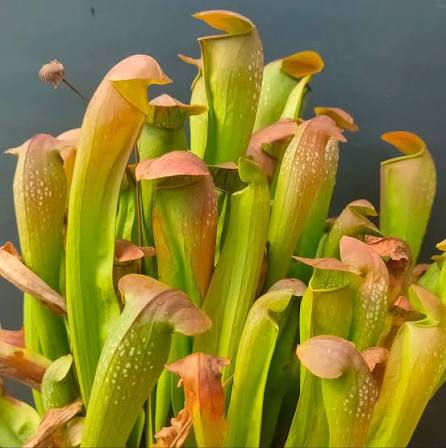
The hooded pitcher plant has a curved hood that arches over the opening. The hood protects the pitcher from rain, so the fluid inside does not overflow. This is a smart design for a wet habitat.
Pale, translucent spots on the hood act like windows. Insects fly toward the light and bump against the glass-like patches. They then fall back into the tube.
This species is native to the southeastern United States. Its smaller size suits patios and small bog containers. It is a nice choice when space is limited.
ALSO READ: 15 Herbs That Repel Bugs (Naturally, With Details)
7. White-Topped Pitcher Plant (Sarracenia leucophylla)
The white-topped pitcher plant is one of the most beautiful of all. Tall pitchers show white tops with bright red or crimson veins. In late summer, a bog full of them looks almost unreal.
It grows on the Gulf Coast, mainly in Florida, Alabama, and Mississippi. The pale top and the nectar lure flying insects. Many bees, wasps, and flies end up inside.
Wild populations have suffered from habitat loss and drainage of wet savannas. If you want one, choose a nursery-grown plant. Supporting responsible growers helps protect wild stands.
8. Cobra Lily (Darlingtonia californica)
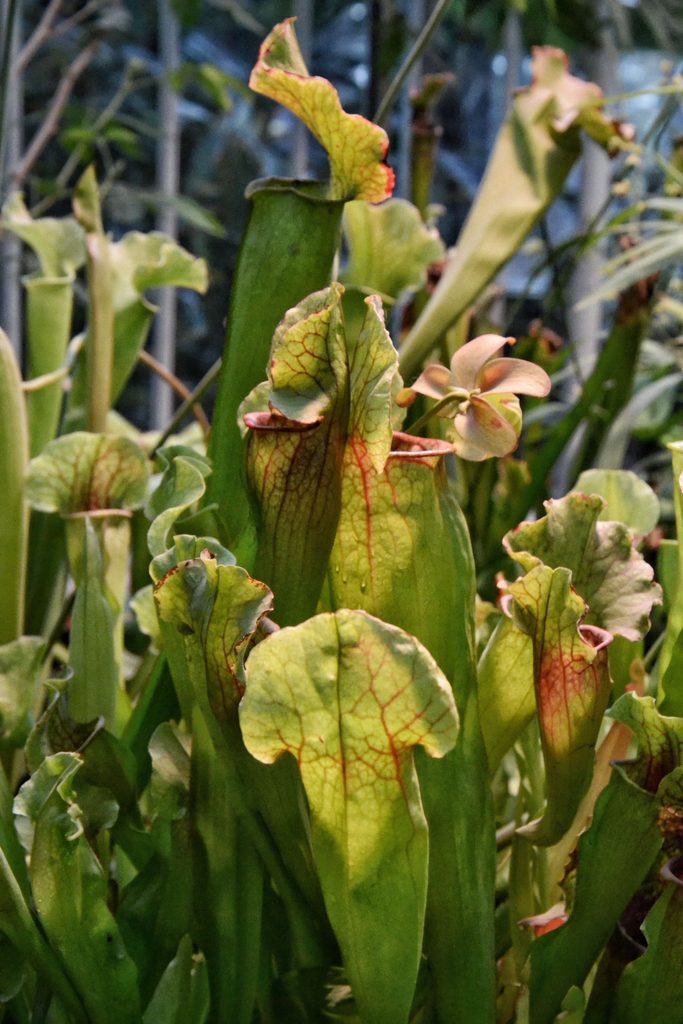
The cobra lily looks like a rearing snake. Its hooded tube ends in a forked, fishtail-like appendage. It grows in cold, running-water seeps in northern California and Oregon.
The top of the hood has clear, window-like patches. Insects, especially ants and flies, fly toward the light and become confused. They then drop into the tube and cannot find the exit.
This plant is a real challenge to grow outside its home. Its roots need cold, flowing water. I would recommend it only to patient growers who enjoy a project.
Tropical Pitcher Plants
9. Giant Malaysian Pitcher (Nepenthes rajah)
Nepenthes rajah is famous for the size of its pitchers. It grows on Mount Kinabalu in Borneo, and its large pitchers can hold several liters of fluid. Few carnivorous plants are this impressive.
Mostly, it catches insects, but it is also known to trap small animals now and then. It is an extreme case, not the rule. Its main diet is still bugs.
It is rare in the wild and hard to grow. It needs cool, humid conditions that most homes cannot provide. Look at it in botanical gardens and conservatories instead.
10. Lowland Pitcher Plant (Nepenthes alata)
Nepenthes alata comes from the Philippines. It forms green to reddish pitchers with a wide, ribbed mouth. The plant often climbs, with long vines reaching toward the light.
Sweet nectar on the lip draws in ants, flies, and other small insects. The waxy inner wall is slippery, so prey slides straight into the digestive fluid.
It is one of the more adaptable tropical pitchers. Keep it in bright light and humidity, and it can do well indoors. It is often sold in garden centers.
11. Hybrid Pitcher Plant (Nepenthes × ventrata)
This plant is a natural cross between Nepenthes ventricosa and Nepenthes alata. It is one of the hardiest tropical pitchers. Many beginners start with it for that reason.
Its pitchers are small to medium, green with pale or red tones. They produce nectar and catch fruit flies, gnats, and ants. A few plants can keep a kitchen free of tiny pests.
I like it as a first tropical pitcher. It forgives mistakes better than most. Use soft water, bright light, and steady humidity, and it should grow well.
12. Lowe’s Pitcher Plant (Nepenthes lowii)
Nepenthes lowii has one of the strangest diets in the plant world. The UC Davis Botanical Conservatory notes that it has a special relationship with tropical tree shrews. The plant offers sweet nectar, and the animals feed on it.
While feeding, the shrews leave droppings inside the pitcher. The plant uses this waste as a nutrient source, because the soil where it grows is so poor. Insects are caught too, but animal waste is a major part of the deal.
This arrangement shows how creative evolution can be. It also reminds us that carnivory is not always about hunting. Sometimes it is about clever partnerships.
13. Albany Pitcher Plant (Cephalotus follicularis)
The Albany pitcher plant is a small, charming species from the coast of Western Australia. Its pitchers are only a few centimeters tall. They are covered with a ribbed lid and a toothed rim.
It is the only species in its family. Ants and other crawling insects walk onto the rim and fall inside. The pitchers sit on the ground, so walking insects are its main prey.
It is popular with collectors for its compact size. However, it dislikes heat and root disturbance. Give it a bright spot and avoid repotting too often.
14. Sun Pitchers (Heliamphora)
Heliamphora, also called marsh pitchers, grows on the flat-topped mountains of the Guiana Highlands in South America. The genus contains about 23 species. Their leaves form simple, funnel-like tubes.
A small nectar spoon at the top of each pitcher draws insects in. Rain fills the tube, and an overflow slit keeps the water at the right level. Prey that falls in is digested with the help of the fluid and, likely, helpful microbes.
They are among the most unusual pitcher plants. They need cool nights, high humidity, and pure water. They are a joy for experienced growers.
ALSO READ: 10 Beautiful Flowers That Repel Bugs and Mosquitoes from Your Garden
Sundews and Other Flypaper Plants
15. Round-Leaved Sundew (Drosera rotundifolia)
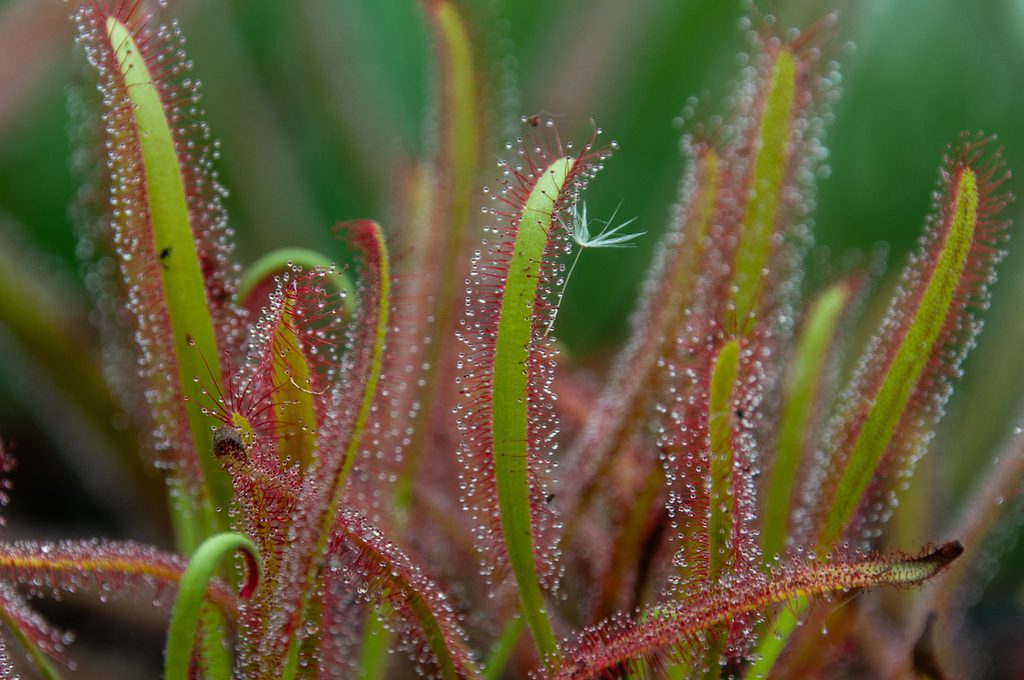
The round-leaved sundew is the classic sundew of cool northern bogs. It grows across North America, Europe, and Asia. Its round leaves are covered with red, glistening tentacles.
Each tentacle carries a sticky droplet that looks like morning dew. Insects mistake it for water or nectar. Once they touch it, the glue holds them, and the leaf slowly curls around the prey.
Charles Darwin was fascinated by sundews. In an 1860 letter, he wrote that he cared more about Drosera than the origin of all species. That tells you how powerful this little plant can be.
16. Cape Sundew (Drosera capensis)
The Cape sundew comes from the Cape region of South Africa. It has long, strap-like leaves and pink flowers. It is one of the easiest sundews for beginners.
When a gnat lands on a leaf, the tentacles and then the whole blade bend slowly toward the prey. You can watch this happen over a few hours. It is a wonderful plant for children and classrooms.
It grows fast and can reproduce from seed in a pot. Keep the soil wet and place it in bright light. In a sunny window, it can catch fungus gnats efficiently.
17. Threadleaf Sundew (Drosera filiformis)
The threadleaf sundew has an upright growth form, unlike most flat-growing sundews. Its leaves are long, thin, and covered with sticky red or pink tentacles. It grows in wet sands along the eastern United States.
The long threads act like a fishing line. Small flying insects touch them and stick. The leaf then bends slowly to hold the prey.
The University of Florida IFAS Extension notes that sundews often grow in the same bogs as pitcher plants. This one is a lovely companion plant in a bog garden.
18. Spoonleaf Sundew (Drosera spatulata)
The spoonleaf sundew forms flat rosettes of small, spoon-shaped leaves. It is native to parts of East Asia, Australia, and New Zealand. It is a common choice in garden shops.
Its sticky tentacles trap tiny insects, such as gnats and small flies. Because the plant is small, it catches small prey. A large fly is usually too much for it.
It is a tough and cheerful plant. It spreads easily and often forms tidy mats. Use it as a living ground cover in a bog pot.
19. Oblong-Leaved Sundew (Drosera intermedia)
The oblong-leaved sundew grows in Europe and eastern North America. It likes peaty, wet ground, often on the edge of ponds. Its leaves are long and narrow, with a rounded tip.
The tentacles glisten in the sun. Small flies and gnats land on them and stick. The sticky glue slowly breaks down the prey with the help of enzymes.
This sundew is a good reminder that you do not need a jungle to find carnivorous plants. Some live in cool, temperate bogs near cities. Look closely at a wet, mossy area, and you may be surprised.
20. Forked Sundew (Drosera binata)
The forked sundew has long leaves that split into two or more branches. It comes from Australia and New Zealand. The Y-shaped leaves look like glittering antlers.
Each branch carries many sticky tentacles. Flying insects land on the dew and get stuck. The plant is larger than most sundews, so it can handle slightly bigger prey.
It is a strong grower and a favorite among hobbyists. Give it bright light, wet roots, and pure water. In summer, it may flower with delicate white blooms.
21. Portuguese Sundew (Drosophyllum lusitanicum)
The Portuguese sundew is the odd one in its group. It grows in dry, sandy soils in Portugal, Spain, and Morocco. Most sundews live in wet bogs, but this one prefers dry hillsides.
Its long, grass-like leaves drip with sticky glue. Flies and other insects land on them and cannot escape. In the past, some rural people hung the leaves indoors to catch flies.
It does not like wet feet, which makes it hard to keep in a pot. It needs deep containers, dry roots, and strong sunlight. It is not an easy plant, but it is a fascinating one.
22. Rainbow Plant (Byblis)
The rainbow plant comes from Australia and New Guinea. Its thin leaves are covered with sticky glands that shimmer in sunlight. The effect looks like tiny rainbows on a bright day.
Byblis is a passive flypaper trap. Its leaves do not move when prey lands. The glue alone holds the insect until the plant absorbs its nutrients.
The genus has around eight species. It does best in sunny, warm conditions with moist, sandy soil. In a greenhouse, it can cover a bench with glittering leaves.
23. Roridula (Roridula gorgonias)
Roridula is a shrub-like plant from the Western Cape of South Africa. Its leaves carry sticky, resinous tentacles. Insects get stuck on them quickly.
The surprise is that the plant does not digest its prey by itself. A small bug called Pameridea lives on the plant and eats the trapped insects. The plant then absorbs nutrients from the bug’s droppings.
This partnership is one of the most interesting in botany. It shows that a plant can be a carnivore with the help of a partner. There are only two species in the genus.
Butterworts
24. Common Butterwort (Pinguicula vulgaris)
The common butterwort forms a flat rosette of pale green, greasy-looking leaves. It grows in damp, cool places across the Northern Hemisphere. In summer, it sends up a purple, violet-like flower.
The leaf surface is covered with sticky glands. Small insects, such as gnats and tiny flies, stick to it. The edges of the leaf can slowly roll inward to hold the prey.
The name comes from an old use. In Scandinavia, people used the leaves to curdle milk. That is a nice example of how humans have long observed these plants.
25. Mexican Butterwort (Pinguicula moranensis)
The Mexican butterwort is a popular houseplant. It grows in mountain regions of Mexico and Guatemala. In summer, it forms sticky, carnivorous leaves. In winter, it may switch to smaller, non-sticky leaves.
The summer leaves are excellent at catching fungus gnats. Many growers keep one near their other houseplants for this reason. It is a natural and quiet pest control.
It prefers bright light, good airflow, and a well-draining mix. Water it with distilled or rainwater. With the right care, it produces large pink or purple flowers.
Bladderworts and Corkscrew Plants
26. Common Bladderwort (Utricularia vulgaris)
The common bladderwort floats in ponds and slow streams across Europe and Asia. It has no real roots. Its feathery stems carry hundreds of tiny, bladder-shaped traps.
Each bladder works like a vacuum. The UC Davis Botanical Conservatory describes how the trap pumps water out to create a seal. When prey touches a trigger hair, the trap opens and sucks the animal in within a fraction of a second.
A research review by Ellison and Gotelli reports that this species gets about half of its nitrogen from captured prey. The rest comes from the surrounding water. Its prey includes mosquito larvae and water fleas.
27. Humped Bladderwort (Utricularia gibba)
The humped bladderwort is a small, widespread aquatic plant. It floats in shallow, calm waters and wet soils in many parts of the world. Its yellow flowers rise above the water on thin stalks.
The traps are tiny, but they work fast. They catch microscopic animals and small aquatic larvae. It is a quiet hunter, and you may never notice it unless you look closely.
Scientists have also found that this plant has one of the smallest genomes among flowering plants. That makes it a favorite for genetic research. Even a modest pond plant can teach us a lot.
28. Corkscrew Plant (Genlisea)
The corkscrew plant is one of the strangest carnivores. It lives in wet soils in Africa and South and Central America. The genus has about 27 to 30 species.
Its traps hide underground. They are Y-shaped tubes with spiral channels that work like a lobster pot. Tiny soil organisms enter easily but cannot go back out.
I should be honest here. This plant does not eat bugs in the usual sense. Its prey is mostly microscopic, such as protozoa. It still deserves a place on the list because of its clever design.
Unusual and Part-Time Carnivores
29. Brocchinia reducta (Carnivorous Bromeliad)
Brocchinia reducta is a bromeliad from the Guiana Highlands of South America. Its leaves form a tight, upright tank. Sweet scents and a waxy surface lure insects to the center.
Insects fall into the fluid-filled tank and drown. The plant then absorbs nutrients from the decaying bodies. It grows in poor, sandy soils, where every extra nutrient counts.
Scientists still study how much the plant gains from its prey. Carnivory in bromeliads is less proven than in classic species. That is what makes this plant so interesting.
30. Triphyophyllum peltatum (Part-Time Carnivorous Vine)
Triphyophyllum peltatum is a woody vine from the rainforests of West Africa. It is a rare example of a plant that eats insects only at certain times. For most of its life, it looks like a normal vine.
During one growth stage, it produces special sticky leaves. These leaves catch insects like flypaper. Few plants switch between normal and carnivorous modes in this way.
It is hard to find outside its native forest, and it is almost never grown at home. Still, it shows that carnivory is not one single path. Evolution found many ways to turn leaves into traps.
Quick Tips for Growing Plants That Eat Bugs
Most carnivorous plants share a few needs. Use distilled water or rainwater, because tap water can leave minerals that harm the roots. Give them lots of light, and plant them in a nutrient-poor mix such as peat and sand.
Do not fertilize them. Do not feed them hamburger or other human food. If you want to feed your plant, offer a live or freshly dead insect now and then.
Also, remember that wild plants should stay in the wild. Buy from reputable nurseries, as wildlife agencies advise. This protects fragile habitats. According to the University of Florida IFAS Extension, about 75 percent of wild Venus flytraps live on protected land, which shows how limited their natural range is.
Frequently Asked Questions
What is the most common plant that eats bugs?
The Venus flytrap is the most widely known. Pitcher plants and sundews are also very common, especially in garden centers and bogs. For beginners, the Cape sundew and the hybrid Nepenthes × ventrata are easy choices.
Do plants that eat bugs harm people?
No. These plants are harmless to humans and pets. A Venus flytrap cannot hurt a finger, and a pitcher plant only holds liquid. They only trap small animals.
Can carnivorous plants live without insects?
Yes, for a time. They still make energy through photosynthesis. However, catching prey helps them grow stronger, especially in poor soil.
Final Thoughts
These 30 plants prove that nature is more inventive than we often think. From snap traps and sticky leaves to underwater vacuums, each design solves the same problem in a different way. Their habitats are small and often under threat.
If you want to start, pick one easy plant and learn its needs. Respect the wild populations, and buy only from trusted growers. A single sundew on your windowsill can make a dull day more interesting.
References
- U.S. Fish and Wildlife Service. Venus flytrap (Dionaea muscipula). https://www.fws.gov/species/venus-fly-trap-dionaea-muscipula
- USDA Forest Service. Plant of the Week: Purple Pitcherplant (Sarracenia purpurea). https://www.fs.usda.gov/wildflowers/plant-of-the-week/sarracenia_purpurae.shtml
- UF/IFAS Extension. Weekly What Is It?: Sundews. https://blogs.ifas.ufl.edu/escambiaco/2020/05/27/weekly-what-is-it-sundews
- UF/IFAS Extension. Weekly What Is It?: Venus flytraps. https://blogs.ifas.ufl.edu/escambiaco/?p=44345
- UC Davis Botanical Conservatory. Carnivorous Species. https://conservatory.ucdavis.edu/collections/carnivorous
- University of Arkansas System Division of Agriculture. Plant of the Week: Venus Flytrap. https://uaex.uada.edu/yard-garden/resource-library/plant-week/venus-flytrap-2-24-06.aspx
- Ellison, A. M., and Gotelli, N. J. Evolutionary ecology of carnivorous plants. University of Vermont. https://www.uvm.edu/~ngotelli/manuscriptpdfs/TREE16p623.pdf

Tim M Dave is a gardening expert with a passion for houseplants, particularly cacti and succulents. With a degree in plant biology from the University of California, Berkeley, he has vast experience in gardening. Over the years, he has cultivated a vast collection of desert plants and learned a great deal about how to grow and care for these unique companions.