40 Different Types of Violets (Identifying Every Viola Species and Variety)
I have always had a soft spot for violets. They show up uninvited in lawns, they survive frost, and they still manage to look delicate. That contradiction is part of their charm.
The genus Viola is far bigger than most gardeners realize. Botanists recognize somewhere between 400 and 600 species worldwide, with some estimates reaching nearly 1,000 once accepted hybrids are counted. That number alone explains why “violet” means very different things depending on where you live.
This guide breaks down 40 types of violets into four clear categories: North American natives, European species, Asian and Pacific varieties, and garden cultivars. Each one gets a detailed, honest description you can actually use for identification or planting decisions.
Let’s get into it.
What Exactly Is a Violet?
Before the list, a quick clarification. Violet, viola, and pansy are not separate plants — they are all members of the same genus, Violaceae.
In horticulture, “pansy” usually refers to large-flowered, multicolored hybrids grown as annuals. “Viola” often describes smaller-flowered perennials or annuals. “Violet” is the general term, especially for wild species.
The Violaceae family itself holds about 800 species globally, though most of those are tropical trees and shrubs unrelated to the violets in your garden. The herbaceous violets we care about make up roughly 400 to 500 of those species.
Now, the 40 types.
Group 1: North American Native Violets
These are the wildflowers you likely already know, whether you planted them or not.
1. Viola sororia — Common Blue Violet
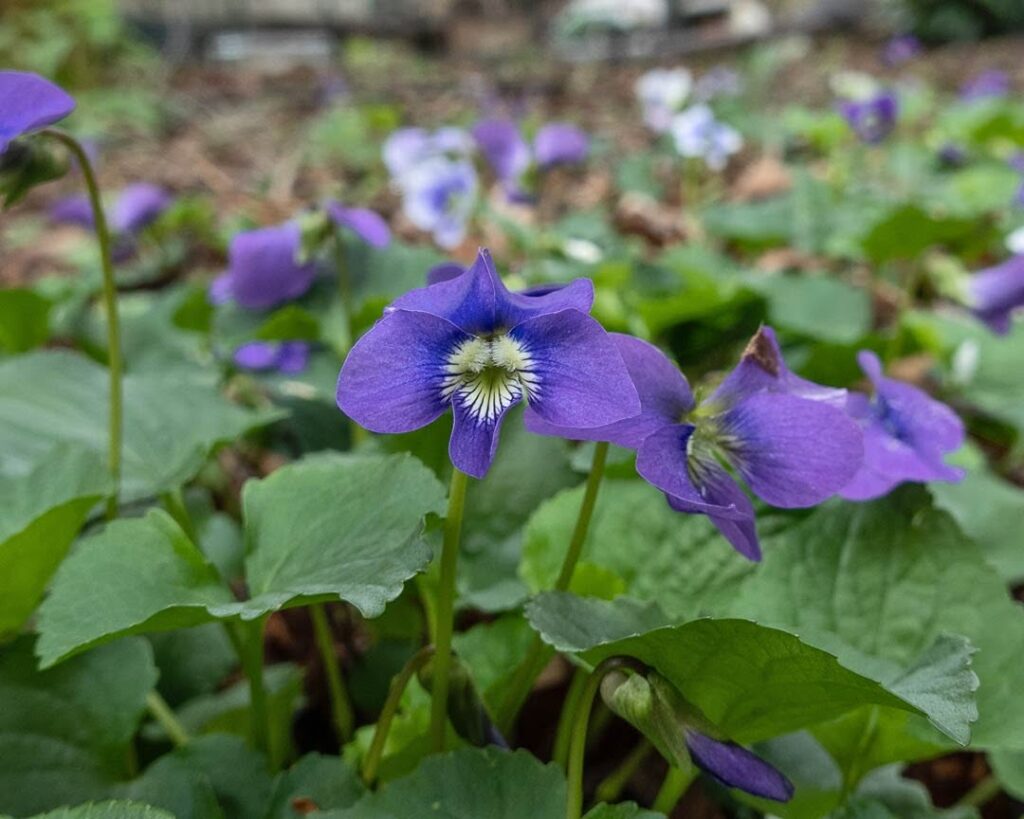
This is the plant most Americans picture when they hear “violet.” It is the official state flower of Illinois, Wisconsin, New Jersey, and Rhode Island, a distinction it earned after Illinois schoolchildren voted for it back in 1907.
Common Blue Violet spreads through both seed and rhizome, which is why it colonizes lawns so effortlessly. It tolerates full sun, deep shade, clay soil, and even the root exudates of black walnut trees that kill off many other plants nearby.
Interestingly, this species produces two kinds of flowers. The showy purple blooms appear in spring, but later in summer it also forms small, closed flowers near the ground that self-pollinate and quietly produce most of its seed.
2. Viola pedata — Bird’s-Foot Violet
Named for its deeply lobed leaves that resemble a bird’s foot, this species stands apart from most other native violets almost immediately. The flowers are noticeably larger too, often a striking bicolor of dark purple upper petals against a lighter lavender lower lip.
Unlike the moisture-loving violets on this list, Bird’s-Foot Violet actually prefers dry, sandy, and even rocky soil. It struggles in rich garden loam, which surprises a lot of gardeners who assume all violets want the same conditions.
I find this one the hardest native violet to keep alive in a typical backyard bed, simply because most of us over-water it out of habit.
3. Viola cucullata — Marsh Blue Violet
Found from Minnesota through New England and up into eastern Canada, this species thrives in wet meadows, stream banks, and low-lying ground that stays consistently damp. Its range stretches as far northeast as Newfoundland and Prince Edward Island.
The flowers sit noticeably above the foliage on tall stalks, which helps separate it from the more common Viola sororia at a glance. The blossoms tend toward a deeper, cooler blue rather than the violet-purple seen in drier-growing cousins.
If you have a soggy corner of the yard that nothing else seems to like, this is one of the few ornamentals that will genuinely thank you for it.
4. Viola blanda — Sweet White Violet
A small, fragrant, white-flowered species common in cool, moist woodlands across the northeastern United States and eastern Canada. The scent is noticeably stronger than most native violets, which tend to have little to no fragrance at all.
It spreads by slender above-ground stolons rather than relying purely on seed, and over a few seasons it forms tidy, low woodland carpets beneath deciduous trees. The leaves are small, rounded, and slightly glossy.
Because it needs consistent moisture and cool shade, Sweet White Violet rarely naturalizes in open, sunny lawns the way Viola sororia does.
5. Viola canadensis — Canada Violet
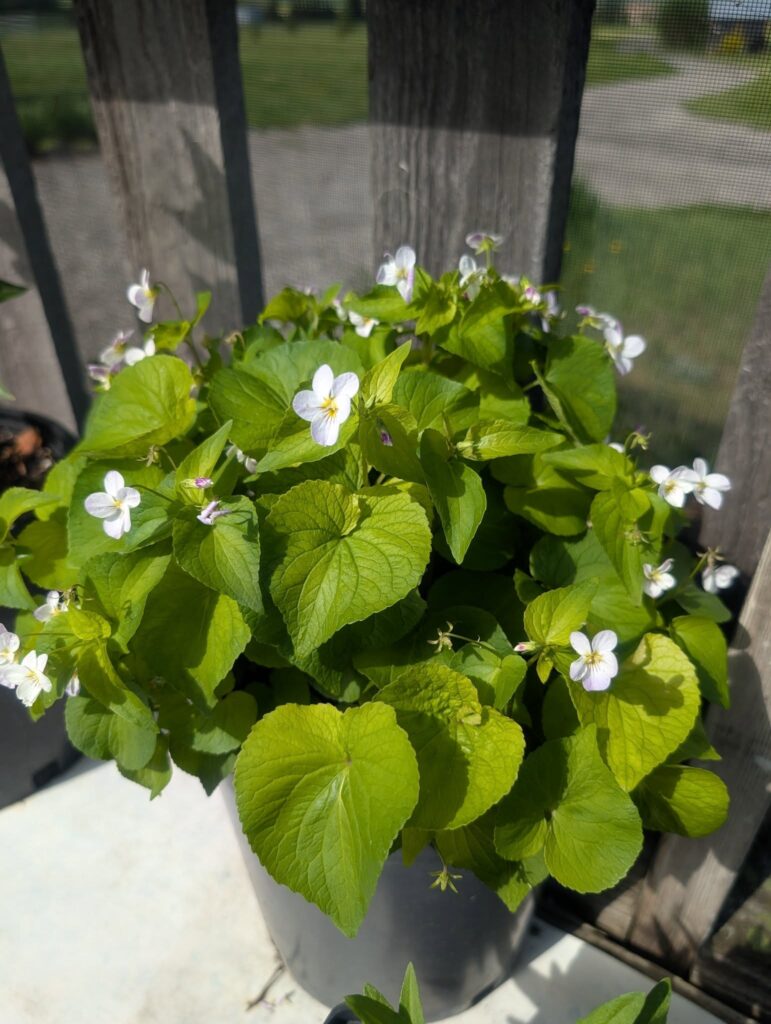
Unlike most violets on this list, Canada Violet has leafy above-ground stems instead of a basal rosette hugging the soil. This gives the plant a slightly taller, bushier appearance that stands out in a shaded woodland bed.
The white flowers carry a yellow throat and a faint violet tinge on the petal reverse, visible mainly when the bloom is viewed from behind or in strong backlight. It flowers later into summer than many spring-only natives.
It is also one of the more cold-hardy woodland violets, occurring well into Canada’s boreal forest edges, which explains the common name.
6. Viola pubescens — Downy Yellow Violet
One of the few native yellow-flowered violets found in the eastern United States, this species is easy to distinguish from its blue and purple relatives at a glance. The stems and leaves carry fine, soft hairs, which is exactly where the common name comes from.
It typically grows a few inches taller than the low, rosette-forming violets, often reaching six to twelve inches in rich woodland soil. The flowers show fine purple veining on the lower petal, a common nectar-guide feature across the genus.
Downy Yellow Violet prefers dappled shade under deciduous canopy and tends to decline quickly if exposed to prolonged full sun.
7. Viola striata — Pale Violet
This species blooms creamy-white flowers with fine purple veining from April through July, a noticeably longer bloom window than most other native violets manage in the same range. Most wild violets finish flowering by late spring.
Unlike the tight basal rosettes of Viola sororia, Pale Violet has aerial, leafy stems, giving the plant a slightly different silhouette in the garden. It readily self-seeds into loose colonies rather than spreading tightly by rhizome.
It grows well in a wide range of soil types but performs best with a neutral to slightly alkaline pH, which is worth checking before planting it near acid-loving shrubs.
8. Viola lanceolata — Lance-Leaved Violet
Recognizable instantly by its narrow, lance-shaped leaves, which can stretch up to six inches long while staying under an inch wide. Most other violets on this list have rounded or heart-shaped foliage, making this one easy to pick out.
It grows almost exclusively in bogs, swamps, and other consistently wet, acidic soils, including coastal plain wetlands. The small white flowers show purple veining on the lower petal and sit on reddish-purple stalks that can nod slightly.
This is a good indicator species if you are trying to judge whether a patch of ground stays genuinely wet year-round.
9. Viola walteri — Walter’s Violet
Named after 18th-century botanist Thomas Walter, author of Flora Caroliniana, this species is native to the southeastern United States and favors moist, rocky woodland ledges. It spreads through both rhizomes and above-ground stolons when moisture is adequate.
The foliage is partially evergreen, meaning it holds some leaves through winter before fresh growth appears in early spring. In drier conditions, the plant stays put rather than spreading, which makes it fairly easy to control in a bed.
Its form can appear stemless at times, even though it technically produces an aerial stem, which occasionally confuses new gardeners trying to key it out.
10. Viola hastata — Halberd-Leaved Violet
This Appalachian native has mottled, arrow-shaped leaves marked with a silvery pattern along the veins, making it one of the more visually distinctive violets in eastern woodlands. The small yellow flowers appear in early spring before the tree canopy fully leafs out.
It is one of the more shade-tolerant violets on this list, often found thriving under dense hardwood canopy where few other flowering perennials survive. It spreads slowly by rhizome rather than aggressively self-seeding.
Because of its patterned foliage, gardeners sometimes grow it as much for its leaves as for its modest yellow blooms.
ALSO READ: African Violets Cultivation: How to Grow These Beauties in Your Home
Group 2: European and Mediterranean Violets
Europe gave the world the sweet violet, the plant behind centuries of perfume and folklore.
11. Viola odorata — Sweet Violet
The most fragrant violet in cultivation, and the historic source of true violet perfume used across European perfumery since at least the 19th century. It has naturalized widely across North America after being introduced from Europe by early settlers and gardeners.
Sweet Violet spreads by both seed and runners, forming dense low mats in shaded borders and woodland edges. Its flowers range from deep purple to occasional white forms, and both the flowers and leaves have a long history of culinary and medicinal use.
Because true wild-harvested Viola odorata has limited supply, other regional species are sometimes substituted for it in traditional herbal markets, which has caused some confusion around sourcing.
12. Viola riviniana — Common Dog Violet
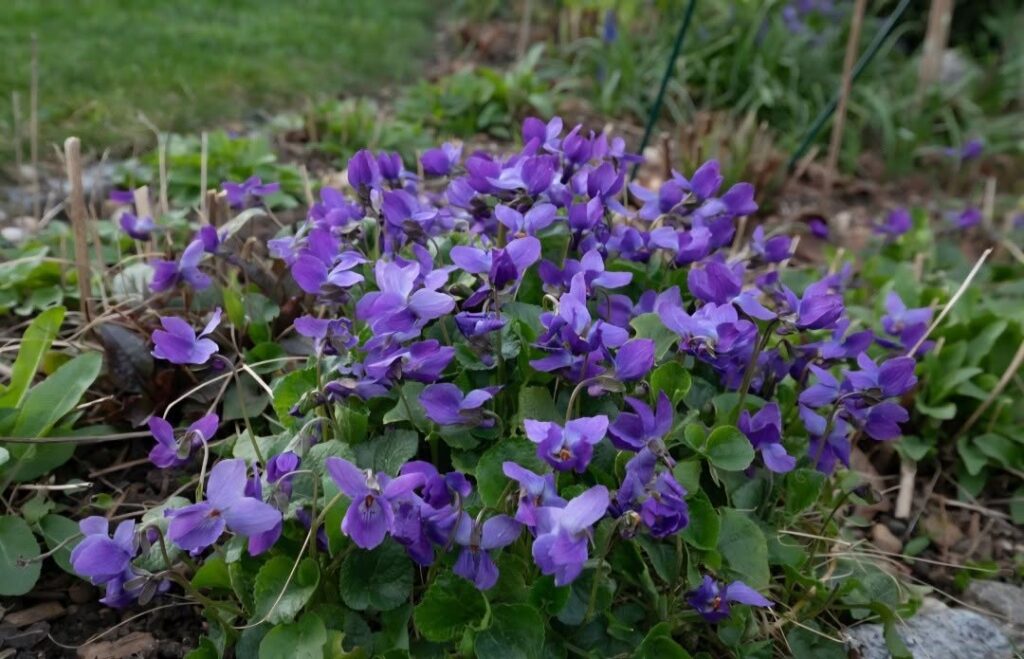
Widespread across the United Kingdom and mainland Europe, this species lacks fragrance entirely, hence the somewhat dismissive “dog” in its common name, historically used to mean “inferior” or “scentless.” It blooms slightly earlier in spring than the sweet violet.
The flowers are a pale to mid blue-violet, generally larger than Viola odorata, with a pale, straight spur at the back of the bloom. It favors hedgerows, woodland edges, and grassy banks rather than deep shade.
It is one of the most commonly recorded wildflowers in British countryside surveys, largely because it tolerates a wide range of soil and light conditions.
13. Viola canina — Heath Dog Violet
A close relative of the common dog violet, but adapted to drier, sandier heathland rather than woodland edges. Its petals are a paler blue-violet, and the spur behind the flower is straighter and thinner than in Viola riviniana.
This species tends to bloom slightly later in the season and holds up better in open, exposed ground than most woodland violets. It rarely tolerates the deep shade that suits Viola odorata or Viola blanda.
Because it prefers such specific heathland conditions, it is less commonly grown in ordinary garden beds compared to its woodland relatives.
14. Viola hirta — Hairy Violet
Distinguished by fine hairs across its leaves and stems, a feature you can usually confirm just by running a finger gently over the foliage. This species prefers calcareous, chalky soils and open grassland across Central and Western Europe.
Unlike Viola odorata, it produces no runners, which keeps its growth habit noticeably tighter and less spreading. The pale violet-blue flowers appear slightly later than the sweet violet in most regions.
Gardeners working with alkaline or chalky soil often find this species easier to establish than moisture-loving violets bred for richer, acidic ground.
15. Viola palustris — Marsh Violet
A cold-climate species found in bogs and wet moorland across northern Europe, including Scandinavia, the British uplands, and alpine wetlands further south. The pale lilac flowers show distinctive dark purple veining that helps guide pollinators to the nectar spur.
It spreads by thin, creeping rhizomes just below the surface of consistently saturated ground, forming loose colonies rather than dense mats. Unlike many violets on this list, it shows little tolerance for dry soil at any point in the season.
This makes it a useful indicator plant for genuinely boggy conditions in northern European habitats.
16. Viola tricolor — Wild Pansy / Johnny Jump-Up
This is the direct ancestor of the modern garden pansy, and its genetics run through nearly every large-flowered hybrid sold today. A single seed capsule can produce up to 50 seeds, which explains how readily it self-sows once established in a garden bed.
The flowers typically show three colors at once, purple, yellow, and white, with fine purple veining acting as nectar guides for bees. It grows as an annual, biennial, or short-lived perennial depending on climate and conditions.
It blooms from spring into summer and has a slightly minty taste, which is why its edible flowers occasionally show up in salads and garnishes.
17. Viola reichenbachiana — Early Dog Violet
Blooming slightly earlier than Viola riviniana, sometimes by two to three weeks in the same region, this woodland species has narrower, more pointed petals than its close relative. The spur is straighter and darker in color as well.
It favors deciduous woodland with dappled spring sunlight, timing its bloom to take advantage of light before the tree canopy fully closes overhead. Once summer shade sets in, the plant largely finishes flowering for the year.
Distinguishing it from Viola riviniana in the field usually comes down to close inspection of the spur shape and petal overlap.
18. Viola pyrenaica — Pyrenean Violet
Native to mountainous regions of southern Europe, particularly the Pyrenees mountain range it is named for, this compact species is adapted to rocky, well-drained alpine soils at higher elevations. It stays notably low and tight compared to lowland European violets.
Its flowers are similar in color to Viola riviniana but appear later in the season, timed to the shorter alpine growing window. The leaves are rounder and more leathery, an adaptation to drier, wind-exposed mountain slopes.
Because of its alpine origin, it performs best in rock gardens or raised beds with sharp drainage rather than typical rich garden soil.
19. Viola elatior — Tall Violet
One of the taller European species on this list, Tall Violet grows well above the low rosette form typical of most violets, sometimes reaching over a foot in height. It favors damp meadows and floodplain grassland across Central and Eastern Europe.
Its pale blue-violet flowers are smaller relative to the plant’s overall height, and the leaves are noticeably larger and more elongated than most other European species covered here. It has become increasingly rare in parts of its historic range.
Habitat loss from wetland drainage has made this one of the more conservation-flagged violets in Europe today.
20. Viola persicifolia — Fen Violet
A rare wetland species found in calcareous fens across parts of Europe, this violet has pale, almost white-blue flowers and narrow, willow-like leaves. Its common name reflects the specific fen habitat it depends on.
Habitat loss has made it increasingly uncommon in the wild, and several European countries now list it as a species of conservation concern. It requires consistently high water tables and calcium-rich soil to persist long-term.
Because of its narrow habitat requirements, it is rarely available through ordinary nursery trade and is more often encountered through conservation planting projects.
ALSO READ: 25 Best Plants for an East-Facing Window (And Why They Thrive There)
Group 3: Asian, Australian, and Other Regional Violets
Violets are genuinely global. Roughly 70 species and their hybrids occur in North America and Hawaii alone, and Asia holds a comparable diversity of its own.
21. Viola mandshurica — Manchurian Violet
Common across Korea, China, and parts of Japan, this species produces deep purple flowers in early spring and is frequently featured in East Asian traditional gardens and folk medicine practices. It tends to bloom slightly earlier than most regional relatives.
The plant forms a tidy basal rosette and spreads modestly by seed rather than aggressive rhizome growth. Its flowers are noticeably larger and more richly colored than several smaller Asian species on this list.
It has also been studied as one of several regional violets used interchangeably in traditional remedies across its native range.
22. Viola japonica — Japanese Violet
A compact species with rounded leaves and reddish-purple flowers, this violet is popular in Japanese woodland gardens for its tidy, low-growing habit and modest spread. It rarely becomes weedy the way some North American species do.
The foliage often takes on a slightly reddish or bronze tint in cooler weather, adding seasonal interest beyond the bloom period. It prefers humus-rich soil with reliable moisture and partial shade.
Because of its restrained growth habit, it is often chosen for container plantings and small ornamental borders rather than open naturalized beds.
23. Viola verecunda — Asian Wood Violet
A small, pale-flowered species found throughout temperate Asia, typically growing in shaded, moist forest understories alongside ferns and other woodland groundcover. Its flowers are pale lilac to nearly white, often smaller than other species on this list.
It spreads readily by seed in favorable conditions but rarely becomes invasive outside its native range. The leaves are rounded and slightly glossy, similar in appearance to several North American woodland violets.
Its unassuming size means it is often overlooked in the wild despite being fairly widespread across its native forests.
24. Viola philippica — Banafsha Violet
This species is one of several used as a substitute source for “banafsha,” a traditional remedy historically derived from Viola odorata. Because true sweet violet has limited distribution and high demand, related species like this one are sometimes traded in its place.
The flowers are a deep violet-purple, and the plant grows in a low rosette similar to many other Asian violets. It is native to parts of East Asia and has long been part of regional herbal traditions.
This substitution practice has occasionally raised questions about the consistency and identification accuracy of herbal products sold under the banafsha name.
25. Viola betonicifolia — Arrowleaf Violet
Found across parts of Asia, Australia, and the Pacific, this species has narrow, arrow-shaped leaves and pale violet flowers with darker veining that guide pollinators toward the nectar spur. Its range is unusually broad for a single Viola species.
It tolerates a range of soil types and light conditions, which likely explains its wide geographic distribution compared to more habitat-specific relatives. It generally grows as a low, spreading perennial.
Because of this adaptability, it has been studied alongside other regional violets used in traditional Asian herbal preparations.
26. Viola hederacea — Australian Native Violet
A popular groundcover in Australian gardens, this species has small ivy-shaped leaves and delicate purple-and-white flowers that appear almost continuously through warmer months in mild climates. It spreads by thin runners rather than seed alone.
It tolerates both sun and shade fairly well, making it a flexible choice for Australian home gardens and public landscaping. It also handles light foot traffic better than most violets on this list, which suits its use between stepping stones.
Its low, mat-forming habit has made it one of the more commercially available native groundcovers in Australian nurseries.
27. Viola banksii — Ivy-Leaf Violet
Closely related to Viola hederacea and often confused with it in casual identification, this species has slightly larger flowers and a somewhat more vigorous spreading habit. It thrives particularly well in coastal Australian conditions.
The leaves are similarly ivy-shaped but tend to be a touch glossier, and the flowers show a bit more purple saturation near the throat. It tolerates salt-laden coastal air better than many inland violet species.
Because of the close resemblance to Viola hederacea, nursery labeling between the two species is sometimes inconsistent.
28. Viola diffusa — Creeping Asian Violet
A low, spreading species found across South and Southeast Asia, this violet roots readily wherever its stolons touch moist soil, forming dense mats over time. It behaves more like a groundcover than an upright perennial.
The small flowers are pale lilac to white and sit close to the foliage rather than rising on tall stalks. It favors consistently humid, shaded conditions found in monsoon-affected regions.
Its aggressive rooting habit makes it useful for erosion control on shaded slopes within its native range.
29. Viola biflora — Alpine Yellow Violet
One of the few yellow-flowered violets found in both Europe and Asia, this species typically grows at high altitudes in alpine meadows and rocky slopes. Its name references the tendency of each stem to carry a pair of flowers.
The plant stays low and compact, an adaptation shared with many alpine species that face short growing seasons and harsh wind exposure. The yellow petals often carry fine dark veining near the throat.
Because of its high-elevation habitat, it is rarely encountered outside mountain hiking regions or specialized alpine garden collections.
30. Viola selkirkii — Great Spurred Violet
A circumboreal species found across northern Asia, Europe, and North America, this violet has a notably long, thick spur compared to related species, giving the flower a somewhat elongated profile. It favors cool, moist, coniferous or mixed woodland.
It tends to bloom slightly later than lowland violets in the same region, timed to cooler spring conditions typical of its northern range. The flowers are a soft violet-blue with a paler throat.
Its wide, three-continent distribution makes it one of the more geographically remarkable violets on this entire list.
Group 4: Garden Cultivars and Ornamental Hybrids
Breeders have spent well over a century refining wild violets into garden performers. Modern viola breeding programs, some running for decades and thousands of seedlings, have produced the cultivars below.
31. Viola x wittrockiana — Garden Pansy
The classic bedding plant, bred from multiple wild species including Viola tricolor, Viola lutea, and Viola altaica. Large, multicolored, “faced” flowers make it the most recognizable violet relative in commercial horticulture worldwide.
Garden pansies are typically grown as cool-season annuals, thriving in autumn and spring but fading quickly once summer heat arrives. Breeders continue to release new color series nearly every year, aimed at both home gardeners and commercial landscapers.
Despite their delicate look, pansies tolerate light frost surprisingly well, which is why they remain a staple of fall and winter plantings in many climates.
32. Viola cornuta — Horned Violet
Native to the Pyrenees, this perennial gets its name from the narrow, horn-like spur that projects from the back of each flower. It has played a significant role in breeding modern garden violas through repeated crossing with pansy relatives.
It blooms best in cool weather and often stalls or declines during the heat of summer, recovering again once temperatures drop in autumn. Cutting the plants back after a bloom lull can encourage a fresh flush of flowers.
Unlike the pansy, its flowers are smaller and more numerous, giving plantings a fuller, more textured look rather than a few large individual blooms.
33. Viola ‘Sorbet’ Series — Cool-Season Bedding Violas
A widely sold commercial series available in yellow, orange, blue, white, and multicolored “face” patterns, bred specifically for reliable cool-season performance. Extension horticulturists frequently recommend it for winter containers in mild climates.
The series is valued for its compact habit and heavy flower production relative to plant size, making it efficient for mass plantings. It generally outperforms older viola cultivars in both cold tolerance and flower count per plant.
Because of its reliability, it has become one of the more commonly available viola lines at garden centers across the southern United States.
34. Viola ‘Etain’ — Apricot-Edged Viola
A well-loved heirloom cultivar with pale yellow petals edged in soft lilac, giving each bloom a gentle, two-toned look that reads as almost pastel from a distance. It has remained popular in cottage-style gardens for decades.
It is often compared directly to newer cultivars like ‘Halo Lilac,’ which shares a similar bicolor structure but with a different base color and slightly larger flower size. ‘Etain’ tends to have a looser, more relaxed growth habit than modern bred series.
Its long-standing popularity comes largely from how naturally it fits into informal, old-fashioned garden designs.
35. Viola ‘Freckles’ — Speckled Viola
Recognized by its lilac-blue petals dotted with darker purple speckling, resembling the natural variation seen in some wild Viola sororia populations. The speckled pattern gives each flower a slightly individual, almost hand-painted look.
It is grown both as a novelty bedding plant and as a container specimen where its detailed petal pattern can be appreciated up close. Bloom production is generally strong through the cooler months of the growing season.
Because the speckling pattern varies slightly from plant to plant, no two ‘Freckles’ violas ever look quite identical.
36. Viola ‘Rebecca’ — Vanilla-Scented Viola
A fragrant, cream-and-purple cultivar prized for its scent, which is unusual among modern hybrid violas that were bred primarily for color rather than fragrance. The vanilla-like scent is most noticeable on warm, still afternoons.
Its compact size and gentle color combination make it a favorite for scented garden borders placed near seating areas or walkways. It performs similarly to other cool-season violas in terms of bloom timing and care requirements.
Fragrance-focused breeding like this remains relatively rare in modern viola cultivars, which makes ‘Rebecca’ something of a standout among its peers.
37. Heartsease Cultivars (Viola tricolor Selections)
Modern seed companies still sell refined selections of the original wild pansy, sold under names like “Heartsease Improved,” valued for their cottage garden authenticity and old-fashioned charm. These selections stay closer to the wild tricolor form than modern large-flowered pansies.
They typically grow smaller and more delicate than Viola x wittrockiana hybrids, with the classic purple, yellow, and white face pattern intact. Many gardeners choose them specifically for historical or heirloom garden restorations.
Because they self-seed readily, a single planting can persist informally in a garden bed for years with minimal replanting.
38. Viola sororia ‘Priceana’ — Confederate Violet
A naturally occurring color form of the common blue violet, with white petals and blue-veined centers that create a striking, almost porcelain appearance. It arose as a natural variant rather than a deliberately bred hybrid.
It has earned recognition for its ornamental garden merit and spreads with the same vigor as the standard blue-flowered Viola sororia. Its heart-shaped leaves form a dense green carpet beneath the blooms in spring.
Because it shares its parent species’ adaptability, it grows equally well in sun, shade, and a wide range of soil types.
39. Viola labradorica — Labrador Violet
Grown as much for its purple-tinted foliage as its small lavender flowers, this cultivar adds color to a shade garden even outside the bloom period. The dusky purple leaf tone is most pronounced in cooler weather.
It self-seeds gently rather than aggressively, making it easier to manage in a mixed border than more assertive spreaders like Viola sororia. It works particularly well as a shade groundcover paired with ferns or hostas.
Its dual appeal, foliage color plus flowers, is part of why it remains a steady seller among shade-garden perennials.
40. Viola koreana — Korean Violet
An increasingly popular ornamental groundcover with variegated, silvery foliage and small violet-blue flowers, often used to brighten shaded borders that would otherwise look flat during the off-bloom season. The foliage pattern is its main selling point.
It spreads slowly and stays relatively well-behaved compared to more vigorous groundcover violets, which makes it suitable for smaller, more controlled planting beds. It prefers consistent moisture and dappled shade.
Because of its ornamental foliage, it is often marketed more as a decorative groundcover than as a traditional flowering violet.
Quick Comparison: Violet vs. Viola vs. Pansy
| Term | Typical Flower Size | Growth Habit | Common Use |
| Violet | Small | Perennial, spreading | Wildflower gardens, naturalizing |
| Viola | Small to medium | Annual or short-lived perennial | Borders, containers |
| Pansy | Large, multicolored | Annual or biennial | Bedding displays |
I find this table useful because the terms get thrown around loosely at garden centers. Knowing the difference saves you from buying the wrong plant for the wrong spot.
How to Grow Violets: A Short, Practical Guide
Violets are forgiving plants. That is exactly why they show up in lawns without an invitation.
Soil and moisture matter more than sunlight. Most species prefer humus-rich, consistently moist, well-drained soil. Some, like Viola pedata, actually prefer it drier and sandier.
Light tolerance is wide. Many native species handle full sun to deep shade equally well, though flowering usually improves with at least partial sun.
Watering habits affect blooming. Cultivated violas and pansies should be watered regularly but never left soggy, since overwatering triggers root rot faster than drought stress does.
Cool weather brings the best blooms. Most cultivated pansies and violas bloom heaviest in spring and fall, slowing noticeably once summer heat arrives.
Deadheading extends flowering. Removing spent blooms on garden violas can trigger a fresh round of buds, especially after a summer slowdown.
Pests are rarely a serious issue. Extension horticulturists generally note few major disease or insect problems specific to violets, which makes them low-maintenance by most garden standards.
Are Violets Edible? A Quick Note
Yes, and this surprises a lot of people the first time they hear it. Violet flowers and young leaves are edible and have been used in salads, garnishes, jellies, and candied decorations for generations.
Violet leaves also carry notable amounts of vitamins A and C, which is part of why some herbalists historically valued the plant beyond its appearance.
That said, always confirm identification before eating any wild plant, since some look-alikes exist in the broader Violaceae family.
Ecological Role: Why Violets Matter Beyond the Garden
Violets are not just pretty. They are larval host plants for several fritillary butterfly species, including the Great Spangled Fritillary and the Variegated Fritillary.
Their early spring bloom time also makes them one of the first nectar sources available to bees after winter, which matters more than most gardeners realize for pollinator survival.
Several native bee species, including specialized Andrena bees, rely specifically on violet pollen. Losing violet populations in a region can have a small but measurable ripple effect on local pollinator activity.
A Brief History of the Violet in Human Culture
Violets have carried symbolic weight for thousands of years, long before anyone organized them into 40 tidy categories. Ancient Greeks associated the flower with Athens itself, using it as a civic emblem.
Sweet violet, in particular, became a staple of European perfumery by the 19th century. Its scent was so prized that Victorian-era demand occasionally outpaced supply, which is part of why substitute species entered the trade in other regions.
In the eastern United States, violets carry a different kind of history. Illinois adopted the violet as its state flower in 1908, after schoolchildren voted it in over contenders like the wild rose and goldenrod. Three more states followed with the same choice.
Native American communities also used violets medicinally long before European settlement. The Cherokee, for example, applied preparations from the plant for colds, headaches, and sore throats, according to ethnobotanical records maintained by university extension programs.
That layered history is part of why the plant still feels meaningful today, even to people who only know it as the weed politely tolerated in a spring lawn.
How to Identify a Wild Violet in Four Steps
Not everyone needs the full 40-species breakdown. If you just want to identify what is growing in your yard, this shortcut helps.
Step one: check the leaf shape. Heart-shaped leaves point toward Viola sororia; narrow, lance-shaped leaves suggest Viola lanceolata; deeply lobed leaves indicate Viola pedata.
Step two: look at the flower color. Blue-purple is most common in North America, but yellow points toward Viola pubescens, and pure white with purple veining suggests Viola blanda or Viola striata.
Step three: note the habitat. Wet, boggy ground favors Viola cucullata or Viola lanceolata. Dry, sandy soil favors Viola pedata. Shaded woodland favors Viola canadensis or Viola walteri.
Step four: check the stem structure. Most native violets form a basal rosette with no visible stem, while a few species, including Viola canadensis, produce upright, leafy stems instead.
This four-step method will not replace a formal botanical key, but it narrows the options quickly for casual identification.
Regional Distribution: Where Violets Grow
Violets are genuinely everywhere, which is part of their appeal. Viola occurs natively on every continent except Antarctica, according to global plant distribution records.
The genus is most concentrated in temperate regions of the Northern Hemisphere, though populations extend into warmer parts of South America and even into higher elevations of the Pacific Islands.
Canada alone hosts 41 native Viola species, along with several introduced and naturalized ones, concentrated heavily in the country’s southeastern provinces.
In India, roughly 30 species grow within the country’s hilly and mountainous regions, several of which have historically been substituted for one another in traditional herbal preparations due to limited supply of the primary source species.
This wide distribution is exactly why a list like this one has to pull from North America, Europe, Asia, and Australia to be genuinely useful.
Frequently Asked Questions
How many types of violets exist in total? Estimates vary, but researchers generally cite between 400 and 600 recognized Viola species, with some counts reaching close to 1,000 once hybrids are included.
What is the difference between a violet and a pansy? Pansies are large-flowered hybrid cultivars bred primarily for bedding displays, while violets typically refer to smaller-flowered wild or naturalized species.
Are all violets purple? No. Violets bloom in blue, purple, white, yellow, and multicolored combinations, depending on the species.
Do violets come back every year? Most wild violet species are perennial and return yearly, while many garden pansies and some violas are grown as annuals or short-lived perennials.
Why do violets grow in my lawn without being planted? Common species like Viola sororia self-seed aggressively and spread by rhizomes, which is why they appear uninvited in lawns and garden beds.
Final Thoughts
Forty types barely scratches the surface of a genus this large, but it covers the species and cultivars most gardeners, foragers, and plant enthusiasts will actually encounter. From the shy woodland violet under a maple tree to the loud, multicolored pansy in a spring planter, this is one plant family that rewards a closer look.
I would encourage anyone curious about violets to check their own backyard first. There is a decent chance one of these forty is already growing there, waiting to be noticed.
References
- USDA Forest Service — Marsh Blue Violet (Viola cucullata) Plant of the Week https://www.fs.usda.gov/wildflowers/plant-of-the-week/viola_cucullata.shtml
- NC State University Extension Gardener Plant Toolbox — Viola (Genus Overview) https://plants.ces.ncsu.edu/plants/viola/
- NC State University Extension Gardener Plant Toolbox — Viola sororia (Common Blue Violet) https://plants.ces.ncsu.edu/plants/viola-sororia/
- NC State University Extension Gardener Plant Toolbox — Viola cornuta (Horned Violet) https://plants.ces.ncsu.edu/plants/viola-cornuta/
- NC State University Extension Gardener Plant Toolbox — Viola tricolor (Wild Pansy) https://plants.ces.ncsu.edu/plants/viola-tricolor/
- NC State University Extension — Herbaceous Ornamentals, Extension Gardener Handbook https://content.ces.ncsu.edu/extension-gardener-handbook/10-herbaceous-ornamentals
- University of Florida IFAS Extension — Cool Season Flower Power: Violas https://blogs.ifas.ufl.edu/charlotteco/2025/02/05/cool-season-flower-power-violas/

Tim M Dave is a gardening expert with a passion for houseplants, particularly cacti and succulents. With a degree in plant biology from the University of California, Berkeley, he has vast experience in gardening. Over the years, he has cultivated a vast collection of desert plants and learned a great deal about how to grow and care for these unique companions.