20 Caterpillars That Eat Tomato Plants (How to Identify and Stop Them)
You water, feed, and stake your tomatoes for weeks. Then one morning, the leaves are gone and the fruit has holes. A caterpillar is usually the culprit.
I have seen this happen to careful gardeners, and the shock is always the same. The pest is often well hidden, and the damage looks sudden. Knowing your enemy is the best first step.
This guide lists 20 caterpillars that eat tomato plants. For each one, you will learn how to recognize it, what damage it causes, and what to do. Some pests are global, and some are regional, so you can find your local suspect.
How to Tell If a Caterpillar Is Eating Your Tomatoes
Caterpillars leave clear clues. Look for these signs before you spot the insect itself.
- Missing leaves or ragged edges on the upper plant.
- Dark green or black droppings (called frass) on leaves or soil.
- Holes in fruit, often near the stem end.
- Seedlings cut off at or just above the soil line.
- Thin, winding trails or blotches inside the leaf.
Many caterpillars feed at night or at dusk. Check your plants early in the morning or in the evening. A flashlight helps a lot.
Hornworms: The Giants
1. Tobacco Hornworm (Manduca sexta)
The tobacco hornworm is the best-known tomato pest. It is bright green and can grow as thick as a finger. It has seven diagonal white lines on each side and a curved red horn at the rear.
University of Florida IFAS Extension notes that in the Southeast, this species is far more common than the tomato hornworm. It eats leaves and fruit. A single large caterpillar can eat several leaves in one night.
The adult is the Carolina sphinx moth, which often hovers at flowers like a small hummingbird. Pick the caterpillars by hand at dusk or dawn. If you see white cocoons on its back, leave it alone, as parasitic wasps are doing the work for you.
2. Tomato Hornworm (Manduca quinquemaculata)
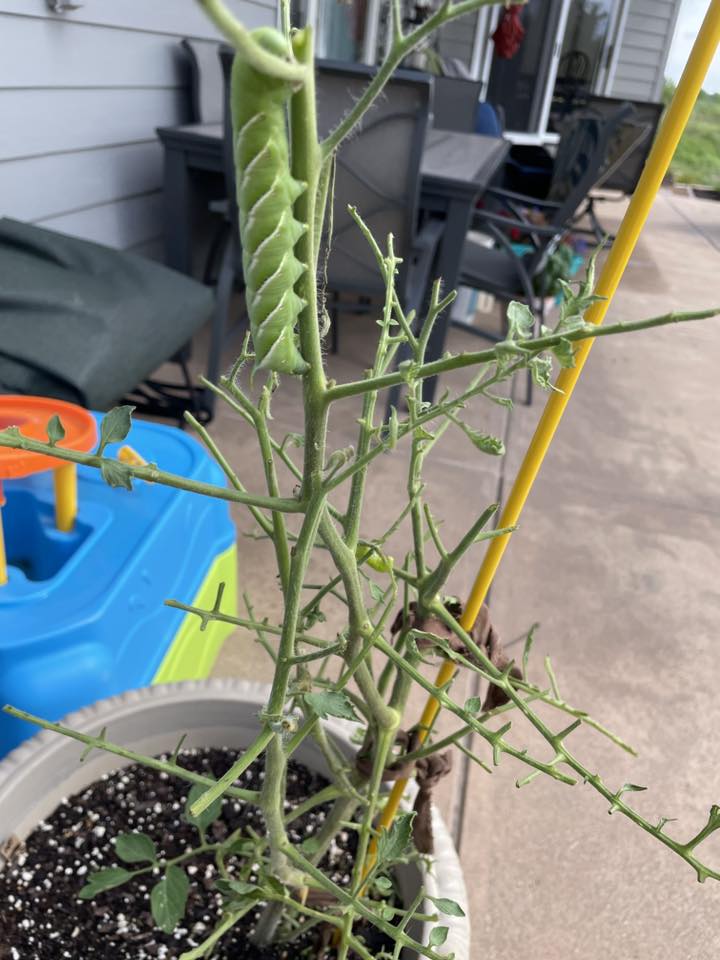
The tomato hornworm looks very similar. The easy difference is the markings. It has eight V-shaped marks on each side and a straight, blue-black horn.
It lives across a wide area, from northern Mexico to southern Canada, according to UF/IFAS. The adult is the five-spotted hawkmoth. Its caterpillars strip leaves first and then bite into green fruit.
They blend in so well that you may miss them. Look for the droppings, then follow the trail up. After harvest, till the soil, because Illinois Extension reports that tilling can destroy up to 90% of overwintering pupae.
Fruit-Boring Caterpillars
3. Tomato Fruitworm, or Corn Earworm (Helicoverpa zea)
The tomato fruitworm is a serious fruit pest. Its color changes a lot. It can be light green, tan, pink, or nearly black, often with fine stripes along the body.
The larva usually enters the fruit near the stem end, according to UC IPM. It prefers green fruit and leaves droppings inside. Eggs are laid one at a time, so the damage often looks random.
Purdue Extension advises using pheromone traps. If you catch only one to four moths a week, spraying is not needed. Corn in silk can also pull the moths away from your tomatoes.
4. Old World Bollworm (Helicoverpa armigera)
This pest is the cousin of the tomato fruitworm. It lives across Africa, Asia, Europe, and Australia, and it reached Brazil in 2013. In many warm regions, it is a leading tomato pest.
The caterpillar bores into green and ripening fruit. One hole can let in rot, which spoils the whole tomato. A small injury can become a total loss.
Check plants weekly for eggs and tiny larvae. Remove damaged fruit and destroy it. Do not leave it on the ground, or the pest will keep breeding.
5. Tobacco Budworm (Heliothis virescens)
The tobacco budworm is another member of this group. It is common in the southern United States. It attacks flower buds and young fruit, not only leaves.
You may notice buds that fall early or small, round holes in green fruit. The color of the larva ranges from green to brown. It looks plain, so look at the damage instead.
Use scouting and pheromone traps, as with other fruit borers. Early action matters. Once a larva is inside the fruit, sprays rarely reach it.
ALSO READ: 7 Reasons Tomatoes are Dropping Off the Vine Prematurely (And How to Fix)
Armyworms: The Leaf and Fruit Chewers
6. Beet Armyworm (Spodoptera exigua)
The beet armyworm is a widespread pest of tomato. UC IPM says it appears in California tomato fields every year, and in some areas, it may be the most important caterpillar pest. That is a strong statement.
Young larvae skeletonize leaves, leaving only veins. Older ones can enter the fruit and feed on flower buds, which causes buds to drop. Many larvae show a small dark spot on the side behind the head.
Watch for egg masses on leaf undersides. They are covered with a fuzzy, white layer. Remove infested leaves early to stop the spread.
7. Western Yellowstriped Armyworm (Spodoptera praefica)
This armyworm is a western pest. UC IPM lists it among the main worm pests of California tomatoes. It feeds in groups when young.
The larva has pale stripes along its sides. The damage begins as small, clear patches on leaves. Later, the larvae spread and eat holes in the fruit.
Scout in early summer. Crush egg clusters when you find them. Small larvae are much easier to control than large ones.
8. Yellowstriped Armyworm (Spodoptera ornithogalli)
This one is a common pest in the eastern United States. Purdue Extension advises inspecting leaves in June. The goal is to find it small, before it moves to the fruit.
The caterpillar is dark with yellow stripes along its length. It chews irregular holes in leaves. Large larvae also scar green fruit.
Look at the undersides of leaves for egg masses. Hand-picking works in small gardens. Keep weeds under control because they can host the moths.
9. Southern Armyworm (Spodoptera eridania)
The southern armyworm lives in warm regions of the Americas. It feeds on many crops and weeds. Tomatoes are only one of its choices.
The larvae are dark, often with a pale band along each side. They chew leaves and sometimes fruit. They can appear in large numbers in late summer.
Check plants near weedy borders first. Remove weeds that shelter eggs. Then inspect your tomato leaves every few days.
10. Fall Armyworm (Spodoptera frugiperda)
The fall armyworm is best known as a corn pest. Utah State University Extension lists it among caterpillars that can harm crops in high tunnels. Tomatoes are not its favorite, but it will feed on them.
This species spread to Africa in 2016 and later to Asia. It is a strong migrant. Tomatoes grown next to corn face the highest risk.
Look for an upside-down Y mark on the head of the larva. Check leaf whorls and fruit. Keep a clean border between corn and your tomato bed.
11. Tobacco Cutworm, or Cluster Caterpillar (Spodoptera litura)
This pest is common in South and Southeast Asia and the Pacific. It is also called the cluster caterpillar. Young larvae feed together, so damage starts in patches.
They first scrape the leaf surface. Later, they eat large holes and attack fruit. A whole plant can be bare in a few days if you ignore it.
Find the egg masses, which are covered with brown hairs. Remove them by hand. Check the plants every morning during warm months.
12. Egyptian Cotton Leafworm (Spodoptera littoralis)
This caterpillar lives in Africa, the Mediterranean, and the Middle East. It feeds on many crops, including tomato. Gardeners in warm climates often meet it.
The larvae range from gray to dark brown, with pale lines. They eat leaves and then bore into fruit. They feed mostly at night, so a daytime check can miss them.
Look at leaf undersides for egg clusters. Use light traps or pheromone traps to monitor moths. Remove infested leaves quickly.
ALSO READ: Spider Mites on Tomato Plants: Identification, Damage, and Effective Control
Cutworms: The Night Cutters
13. Black Cutworm (Agrotis ipsilon)
The black cutworm is a classic seedling killer. Purdue Extension describes it as greasy black and up to two inches long. It feeds at night and cuts small plants at or just above the soil line.
You might find a healthy seedling lying on the ground. Dig around the base in the daytime. The curled caterpillar is often hiding in the soil.
Purdue advises working or clearing winter weeds at least 10 to 14 days before transplanting. Moths lay eggs on those weeds. A collar made of cardboard around each stem also helps.
14. Variegated Cutworm (Peridroma saucia)
The variegated cutworm is a sporadic but real pest. Larvae grow up to about an inch and a half. They are brownish-black with orange markings.
Moths lay eggs on stems and lower leaves in spring or summer. The larvae climb plants at night and eat leaves, stems, and green fruit. They are more flexible than other cutworms.
Hand-pick them with a flashlight after dark. Keep the garden free of weeds. Use stem collars on young plants.
15. Turnip Moth, or Common Cutworm (Agrotis segetum)
This cutworm lives in Europe, Asia, and Africa. It is a general feeder that attacks many vegetables. Tomato seedlings are an easy target.
The larvae are gray-brown and curl up when disturbed. They cut stems near the soil and sometimes bite into low-hanging fruit. Cut plants are the first sign.
Turn over the soil before planting to expose the larvae to birds. Use collars around young stems. Replace damaged seedlings quickly.
Loopers: The Arching Crawlers
16. Cabbage Looper (Trichoplusia ni)
Loopers are easy to spot because they crawl by arching their backs. The cabbage looper is pale green with thin white stripes. It is common on cabbage, but it also visits tomatoes.
UC IPM notes that natural parasites and a viral disease usually keep loopers below damaging levels. Moderate numbers can even help, because they host wasps that attack fruitworms. That is an interesting point.
So do not panic at the first one. Watch the numbers. Handpick them if the leaf damage grows.
17. Alfalfa Looper (Autographa californica)
The alfalfa looper is another looping pest. It lives mainly in the western United States. It feeds on many crops and moves into tomato fields from nearby alfalfa.
The larva is green with white stripes and has the same arching walk. It makes ragged holes in leaves. It rarely hurts fruit.
Because of natural enemies, UC IPM treats loopers as a minor pest in tomatoes. Protect those helpers. Avoid broad-spectrum sprays that kill wasps and Trichogramma.
18. Golden Twin-Spot Moth (Chrysodeixis chalcites)
This looper is a known pest of tomatoes in warm greenhouses, especially in Europe, Africa, and the Mediterranean. It feeds on leaves and young fruit. Greenhouses give it a warm home all year.
The larva is green and moves with a looping walk. It chews holes in leaves and scars the fruit surface. Damage rises quickly in a closed, warm space.
Use fine insect netting on vents. Check leaves weekly. Remove eggs and small larvae by hand.
ALSO READ: Tomato Wilting: How Do You Save Dying Tomato Plant
Leaf Miners and Fruit Pests
19. Tomato Pinworm (Keiferia lycopersicella)
The tomato pinworm is a tiny caterpillar with a big impact. UC IPM explains that it mines leaves, causing blotch-like marks. It causes most damage when it attacks the fruit.
Look for folded leaves that act as a small shelter. University of California advisors suggest pheromone traps. They also give a practical action level of one or two larvae per six feet of row showing mines or folded leaves.
Because the caterpillar is small, many gardeners miss it. Check the leaves closely. Remove and destroy mined leaves.
20. Tomato Leafminer (Tuta absoluta)
The tomato leafminer is one of the most feared tomato pests today. It comes from South America. It reached Spain in 2006 and has spread across Europe, Africa, and Asia since then.
The tiny larva feeds inside the leaf, leaving winding, see-through tunnels. It also attacks stems and fruit. If left alone, it can ruin most of an unprotected crop.
Use insect netting, sticky traps, and pheromone traps early. Remove infested leaves and put them in a sealed bag. Report heavy outbreaks to your local extension or agriculture office.
How to Protect Your Tomatoes From Caterpillars
Most of these pests share the same weaknesses. A few steady habits protect your plants.
- Scout often. Check leaves, stems, and fruit twice a week. Early detection is the key.
- Hand-pick. In a home garden, this is often all you need, as Illinois Extension notes.
- Till after harvest. This exposes overwintering pupae.
- Control weeds. Many moths lay eggs on weeds near your plants.
- Use netting. Fine mesh keeps moths away from the plants.
- Protect natural enemies. Wasps and other helpers kill many caterpillars.
- Consider Bt. Colorado State University Extension lists Bacillus thuringiensis as one option against hornworms. Read the label first.
Contact your local extension office before using any pesticide. Rules and approved products differ by place.
Frequently Asked Questions
What is the most common caterpillar that eats tomato plants?
The tobacco hornworm and the tomato hornworm are the best known. In the Southeast of the United States, the tobacco hornworm is the more common one. Illinois Extension also says it is the one gardeners see more often.
Can I touch a hornworm?
Yes. Hornworms do not sting or bite. The horn looks scary, but it is harmless. Wear gloves if you prefer.
Should I kill a hornworm with white cocoons on its back?
No. Those cocoons belong to parasitic wasps. The wasp larvae feed on the caterpillar and will kill it. Leave it in your garden to help control future pests.
Will my tomato plant recover from caterpillar damage?
Often, yes. Tomato plants can handle some leaf loss. Fruit damage is more serious, so protect the fruit first.
Final Thoughts
Caterpillars can look harmless, but a few of them can ruin a crop. Learn the 20 pests in this guide, and you will know what to look for. Early action beats late spraying every time.
Start with a simple habit. Walk through your garden at dusk with a flashlight, and look closely. A few minutes each evening can save your whole harvest.
References
- Illinois Extension, University of Illinois. Hornworm. https://extension.illinois.edu/gardening/hornworm
- University of Florida IFAS Extension. Tomato Hornworm, Manduca quinquemaculata (Haworth). https://ask.ifas.ufl.edu/publication/IN1206
- Colorado State University. Hornworms. https://agsci.colostate.edu/agbio/ipm-pests/hornworms/
- UC Statewide IPM Program, University of California. Tomato Pest Management Guidelines: Loopers. https://ipm.ucanr.edu/PMG/r783300811.html
- UC Statewide IPM Program, University of California. Tomato Pest Management Guidelines: Beet Armyworm. https://ipm.ucanr.edu/PMG/r783300311.html
- Purdue University Extension. Management of Insect Pests on Fresh Market Tomatoes (E-97). https://www.extension.entm.purdue.edu/publications/E-97/E-97.html
- Utah State University Extension. High Tunnel Pests: Caterpillars. https://extension.usu.edu/pests/research/high-tunnel-pests-caterpillars

Tim M Dave is a gardening expert with a passion for houseplants, particularly cacti and succulents. With a degree in plant biology from the University of California, Berkeley, he has vast experience in gardening. Over the years, he has cultivated a vast collection of desert plants and learned a great deal about how to grow and care for these unique companions.