20 Trees Native to Idaho (With Growing Details)
Idaho surprised me the first time I drove north from Boise into the Panhandle. Within a few hours, I passed through dry sagebrush flats, dense conifer forests, and cedar groves that felt almost coastal. That kind of variety is rare, and it’s the reason Idaho supports so many native tree species.
Idaho’s forests cover roughly 21.5 million acres, an area larger than Vermont, New Hampshire, Massachusetts, Connecticut, and Rhode Island combined. That is according to the Idaho Forest Products Commission.
Within those forests grow more than 20 distinct native tree species, ranging from towering conifers to shimmering hardwoods.
Why Idaho Has Such Diverse Native Trees
Idaho’s tree diversity comes down to elevation and moisture. The state stretches from below 1,000 feet along the Clearwater River valley to more than 12,000 feet in the Lost River Range.
Northern Idaho catches moist Pacific air, which supports species you’d expect on the coast, like western hemlock and Pacific yew. Southern Idaho is drier and dominated by ponderosa pine, Douglas-fir, and juniper woodlands.
Douglas-fir is Idaho’s single most abundant forest type, covering more than 6 million acres statewide, according to USDA Forest Service inventory data. Subalpine fir, meanwhile, is the most numerous tree species by individual count.
With that backdrop in mind, here are the 20 native trees that define Idaho’s landscape.
Idaho’s Native Conifers (Softwoods)
1. Western White Pine (Pinus monticola)
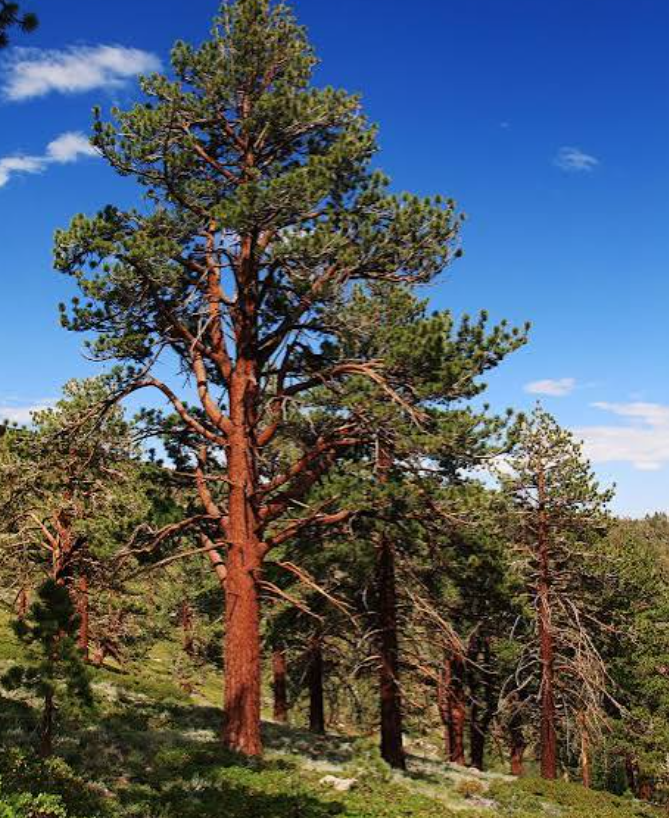
This is Idaho’s official state tree, adopted by the state legislature in 1935. It once dominated the moist forests of northern Idaho so thoroughly that loggers nicknamed it “King Pine.”
The tree grows tall and straight, often reaching 150 to 180 feet, with a trunk that runs branch-free for two-thirds of its length. Needles grow in bundles of five, blue-green in color, two to four inches long.
I find its story bittersweet. A fungal disease called white pine blister rust arrived from Europe around 1910 and devastated the species. Today, western white pine numbers are roughly 93 percent lower than they were 40 years ago, based on Idaho Forest Products Commission data.
The largest known specimen stands 219 feet tall near Elk River, Idaho. Forest geneticists have spent decades breeding rust-resistant seedlings, and replanting efforts continue across the tree’s historic range.
2. Ponderosa Pine (Pinus ponderosa)
Ponderosa pine thrives on drier, lower to middle elevation sites, often forming open, park-like stands of a single species. Its thick, plated bark gives it strong resistance to wildfire, which lets it survive burns that kill competing trees.
Mature bark takes on a distinctive orange-red color and breaks into puzzle-piece plates. Some people describe the bark’s scent as similar to vanilla or butterscotch when warmed by sun, and I’ve tested this myself on a hot afternoon near McCall. It’s true.
The wood is aromatic and light yellow, commonly milled into trim, shelving, and interior paneling. Needles grow in bundles of three, five to ten inches long.
3. Lodgepole Pine (Pinus contorta)
Lodgepole pine earned its name because Native American tribes used its tall, slender trunks to frame teepees. The tree still serves a similar structural role today, used for framing and finishing lumber.
Fire actually helps this species reproduce. Many lodgepole cones are sealed with resin and only open when heat from a wildfire melts that seal, releasing seeds onto the newly cleared forest floor. Large, even-aged stands across Idaho often mark where a major fire once burned.
Needles are short, roughly one to three inches, and grow in bundles of two. The tree tends to grow narrow and densely packed, especially in young stands.
4. Douglas-fir (Pseudotsuga menziesii)
Despite its common name, Douglas fir is not a true fir. It’s more closely related botanically to hemlock, which is why the genus name Pseudotsuga translates roughly to “false hemlock.”
This is Idaho’s most widespread forest type, covering more than 6 million acres statewide according to USDA Forest Service data. Trees commonly reach 100 to 130 feet, with exceptionally strong wood prized for structural framing lumber.
You can identify it by its distinctive cones, which have three-pointed bracts that look like tiny mouse tails poking out between the scales. Flat, soft needles and thick, corky bark round out the identification picture.
5. Grand Fir (Abies grandis)
Grand fir grows prolifically through Idaho’s mountainous regions, often called “white fir” locally. It’s noted for straight, even grain and long wood fibers, which make it valuable for dimensional lumber and plywood production.
Needles are flat and arranged in a distinctive flat spray along the branch, glossy dark green on top with two white bands underneath. Crush a needle and you’ll notice a citrus-like scent, which I always find a pleasant surprise on a forest walk.
Mature trees can exceed 150 feet in favorable, moist growing sites. This species tolerates shade reasonably well, letting it regenerate under a forest canopy where sun-loving species struggle.
6. Subalpine Fir (Abies lasiocarpa)
Subalpine fir occupies Idaho’s higher elevations, often forming the last tree line before alpine tundra takes over. It is the most abundant tree species in Idaho by individual count, based on USDA Forest Service forest inventory analysis.
The tree grows in a narrow, spire-like shape that sheds heavy mountain snow efficiently. This adaptation helps it survive brutal winter conditions at elevations where few other conifers persist.
Needles are soft, blue-green, and curve upward along the branch. Purple, upright cones sit near the top of the crown, a helpful identification feature when the tree is young enough to inspect closely.
7. Engelmann Spruce (Picea engelmannii)
Engelmann spruce grows in cool, moist high-elevation forests, frequently paired with subalpine fir in Idaho’s mixed conifer stands. It tolerates cold winters and short growing seasons that would stress lower-elevation species.
Needles are sharp, four-sided, and roll easily between your fingers, a quick way to distinguish spruce from fir in the field. The bark is thin and scaly, flaking off in small, papery plates.
This species provides critical habitat, particularly for red squirrels that cache its cones as a winter food source. Mature trees can live several hundred years in undisturbed subalpine settings.
8. Western Larch (Larix occidentalis)
Western larch, commonly called tamarack in Idaho, is unusual among conifers because it drops its needles every autumn. Before that happens, the needles turn a striking golden color, adding fall foliage to an otherwise evergreen forest.
The tree favors upper elevations with cool temperatures and moderate precipitation, typically in northern Idaho. Its reddish-brown wood is tight-grained and durable, popular for flooring, plywood, and interior trim work.
Soft needles grow in clusters along short spur branches. Bark on mature trees is thick, deeply furrowed, and provides notable fire resistance, similar in function to ponderosa pine’s protective bark.
9. Whitebark Pine (Pinus albicaulis)
Whitebark pine grows at Idaho’s harshest, highest elevations, often twisted into gnarled shapes by relentless wind exposure. It plays an outsized ecological role: its large, nutritious seeds are a critical food source for Clark’s nutcrackers and grizzly bears preparing for hibernation.
The species faces serious decline. Northern Idaho stands have dropped by 50 to 100 percent in some areas, driven by white pine blister rust and altered fire patterns, according to research summarized by University of Idaho scholars.
Climate modeling suggests even modest warming could shrink suitable whitebark pine habitat by up to 90 percent. Conservation groups and federal agencies now prioritize this species for restoration planting.
10. Western Redcedar (Thuja plicata)
Western redcedar favors cool, moist, shaded sites, often growing alongside western hemlock in northern Idaho’s Panhandle forests. It is slow-growing but exceptionally long-lived and remarkably resistant to decay.
Indigenous peoples in the region historically used redcedar wood and bark to weave baskets and clothing, a testament to how workable and durable the material is. Today, the wood remains popular for siding and specialty lumber.
Look for flat, scale-like foliage arranged in drooping, fan-shaped sprays, plus stringy, fibrous reddish bark. The “Champion Tree of Idaho,” a giant western redcedar, still stands near Elk River.
11. Western Hemlock (Tsuga heterophylla)
Western hemlock grows in cool, shady, moist sites across central and northern Idaho, often in the understory of taller conifers. Its wood grain suits it well for moulding, baseboards, window components, and stair railings.
A charming identification trick: hemlocks act almost like natural weather vanes. Their topmost branch tends to bend consistently away from the direction of prevailing wind, something I now notice on every hike through hemlock country.
Needles are short, flat, and unevenly arranged along the twig, with two white stripes underneath. The tree’s crown typically droops slightly at the very top, another handy field mark.
12. Mountain Hemlock (Tsuga mertensiana)
Mountain hemlock occupies higher, colder elevations than its western hemlock relative, often near timberline in Idaho’s mountain ranges. It tolerates heavy, persistent snowpack better than most other conifers in the state.
Needles are bluish-green, radiating around the twig rather than lying flat in two rows like western hemlock. Cones are noticeably larger too, typically one and a half to three inches long.
This species grows slowly at high elevation, and old specimens can be centuries old despite modest trunk diameter. It’s less commercially harvested than lower-elevation conifers, largely due to its remote, high-mountain habitat.
13. Rocky Mountain Juniper (Juniperus scopulorum)
Rocky Mountain juniper handles Idaho’s driest, harshest sites, often found scattered across southern Idaho’s high desert and canyon rimrock. It’s a tough, drought-tolerant species that can survive where few other trees manage.
Foliage is scale-like and aromatic, and the tree produces small, bluish, berry-like cones that wildlife species readily consume through winter. Growth is slow, and trunks often twist into striking, sculptural shapes over centuries.
Some juniper specimens in the Intermountain West are estimated to be well over a thousand years old, underscoring how slowly this species grows in arid conditions. It provides essential cover and food for birds and small mammals in otherwise sparse terrain.
14. Pacific Yew (Taxus brevifolia)
Pacific yew grows as an understory tree in the cool, moist conifer forests of northern Idaho, rarely reaching the towering heights of its neighbors. It typically stays under 50 feet, often forming a shrubby, multi-stemmed shape.
This species gained major scientific attention because its bark contains paclitaxel, a compound used in cancer chemotherapy drugs, particularly Taxol. That discovery, made in the late twentieth century, elevated a once-overlooked understory tree into a medically significant species.
Needles are flat, dark green, and soft to the touch, arranged in two rows along the twig. Bright red, berry-like arils surround the seed, though most parts of the plant are toxic if ingested.
Idaho’s Native Hardwoods (Broadleaf Trees)
15. Quaking Aspen (Populus tremuloides)
Quaking aspen might be the most beloved native tree in Idaho, especially across the state’s southern mountains. It’s the most widely distributed native tree species in North America, according to USDA Forest Service silvics research, growing across 111 degrees of longitude and 48 degrees of latitude.
The name comes from its flattened leaf stems, which cause round leaves to tremble in even a light breeze. Bark ranges from greenish-white to yellowish-gray, and the green tint actually comes from chlorophyll present right in the bark itself.
Aspens typically grow 20 to 80 feet tall and rarely live past 150 years, though some clonal root systems persist far longer. Groves usually represent a single genetic organism, spreading through root suckers rather than seed.
Sadly, Idaho has lost an estimated 60 percent of its historic aspen coverage since the turn of the last century, according to Idaho Department of Fish and Game data. Conservation groups, including a dedicated Eastern Idaho Aspen Working Group, now actively work to reverse that decline.
16. Black Cottonwood (Populus trichocarpa)
Black cottonwood grows along Idaho’s rivers and streams, often forming tall, fast-growing groves in floodplain soil. It’s the largest native poplar in North America, with mature trees sometimes exceeding 150 feet given enough water and time.
Leaves are broad, glossy dark green above, and pale silvery underneath, fluttering noticeably in wind similar to aspen leaves. In spring, the tree releases cottony seed tufts that drift through the air, which is exactly where its common name comes from.
This species plays a major role in riparian ecosystem health, stabilizing riverbanks and providing shade that keeps stream temperatures cooler for fish. Beavers frequently rely on cottonwood bark and branches as a primary food source.
17. Narrowleaf Cottonwood (Populus angustifolia)
Narrowleaf cottonwood favors higher elevation streamsides than black cottonwood, often found along mountain creeks throughout central and southern Idaho. As the name suggests, its leaves are noticeably narrower and more willow-like than other cottonwood species.
The tree typically grows 40 to 60 feet tall, smaller and more slender than its black cottonwood relative. Bark on young trees is smooth and greenish, becoming furrowed and gray with age.
I appreciate how this species often hybridizes naturally with other cottonwoods where their ranges overlap, creating identification puzzles for botanists. It remains an important streamside stabilizer across Idaho’s mountain drainages.
18. Paper Birch (Betula papyrifera)
Paper birch grows scattered through northern Idaho’s moist forests, easily recognized by its striking white, papery bark that peels in thin horizontal sheets. Native peoples across North America historically used this bark for canoes, containers, and writing material.
Leaves are oval with serrated edges, turning bright yellow in autumn against the white trunk, a combination that photographers chase every fall. The tree tends to grow in clusters or as a component within mixed conifer stands rather than in pure groves.
Paper birch is relatively short-lived compared to Idaho’s conifers, typically 60 to 90 years, and prefers cooler, moist growing sites. It serves as an important early colonizer species after fire or logging disturbance opens up forest canopy.
19. Water Birch (Betula occidentalis)
Water birch grows along streambanks and wetland margins throughout Idaho, usually forming a shrubby, multi-stemmed small tree rather than a single tall trunk. Bark is dark reddish-brown to nearly black, quite different from paper birch’s bright white coloring.
This species rarely exceeds 30 feet in height, and it typically grows in dense thickets that provide excellent cover for wildlife and birds. Leaves are small, oval, and finely toothed, turning yellow in fall.
Water birch tolerates seasonal flooding well, which is exactly why it clusters so consistently along Idaho’s creeks and river margins. It plays a supporting role in bank stabilization alongside cottonwoods and willows.
20. Bigtooth Maple (Acer grandidentatum)
Bigtooth maple grows in scattered canyon and mountainside pockets across southern Idaho, often the state’s best source of vivid autumn color. Leaves resemble a smaller version of sugar maple foliage, turning brilliant shades of orange, red, and yellow each fall.
The tree usually stays under 40 feet in Idaho’s drier climate, sometimes appearing more shrub-like in exposed, rocky sites. It favors north-facing slopes and canyon bottoms where soil moisture lingers longer through the dry season.
Some of the best bigtooth maple viewing happens in areas like City of Rocks National Reserve, where canyon microclimates support dense stands. I’d genuinely recommend a fall visit if vivid foliage color is on your travel list, since this species is less common than Idaho’s conifers and easy to overlook outside peak season.
Quick Comparison: Softwoods vs. Hardwoods in Idaho
Idaho’s native trees split naturally into two broad categories, and understanding the difference helps with quick field identification.
Softwoods (conifers) have needle-like or scale-like leaves and reproduce using cones. They dominate Idaho’s forest acreage and include species like Douglas-fir, ponderosa pine, and western redcedar.
Hardwoods (broadleaf trees) have flat, broad leaves and typically lose them each fall. In Idaho, this group includes aspen, cottonwood, birch, and bigtooth maple, usually concentrated near water or at lower elevations.
Of the ten major softwood species found in Idaho, eight carry significant commercial value, together accounting for more than 85 percent of the state’s total timber volume, based on Idaho Forest Products Commission figures.
Where to See Idaho’s Native Trees
If you want to see this diversity firsthand, a few regions stand out. Northern Idaho’s Panhandle, including the Coeur d’Alene and Bitterroot Mountains, hosts the moist mixed conifer forests where western white pine, redcedar, and hemlock thrive.
Central Idaho’s Sawtooth and Salmon-Challis National Forests showcase subalpine fir, whitebark pine, and Engelmann spruce at higher elevations. Southern Idaho’s canyons and high desert areas reveal juniper woodlands and pockets of bigtooth maple.
For aspen in full autumn glory, the mountains east of Blackfoot and much of the Sawtooth Valley offer some of the most reliable golden displays in the state. Timing typically peaks in late September to early October, depending on elevation and that year’s weather.
Final Thoughts
Writing this list reminded me how much Idaho’s identity is tied to its trees, from the state-designated western white pine to the humble, resilient aspen groves that turn entire mountainsides gold each fall. These 20 species represent millions of years of adaptation to Idaho’s demanding, varied terrain.
Many of them face real pressure today, whether from disease, wildfire patterns, or changing climate conditions. Knowing these trees, and supporting the restoration work already underway across the state, feels like a small but meaningful way to help protect what makes Idaho’s forests so distinct.
Next time you’re on a trail in Idaho, take a closer look at the bark, needles, or leaves around you. There’s a good chance you’ll recognize one of these 20 species, and understanding what you’re looking at tends to make the whole hike more rewarding.
References
- Idaho Forest Products Commission. “Trees of Idaho.” https://www.idahoforests.org/content-item/trees-of-idaho/
- USDA Forest Service Research and Development. “Idaho’s Forest Resources, 2006-2015.” https://research.fs.usda.gov/treesearch/57460
- USDA Forest Service. “Quaking Aspen — Silvics of North America.” https://research.fs.usda.gov/silvics/quaking-aspen
- Idaho Department of Fish and Game. “Eastern Idaho Aspen Working Group Created to Combat Loss of Native Aspen.” https://idfg.idaho.gov/press/eastern-idaho-aspen-working-group-created-combat-loss-native-aspen
- Idaho Department of Lands. “2022 Idaho Forest Health Highlights.” https://www.idl.idaho.gov/wp-content/uploads/sites/2/2023/04/2022-Idaho-Forest-Health-Highlights.pdf
- University of Idaho, College of Agriculture. “Native Idaho Forest Tree Identification.” https://www.uidaho.edu/-/media/UIdaho-Responsive/Files/Extension/county/Kootenai/gardening/trees/native-idaho-forest-tree-id.pdf
- Bureau of Land Management, U.S. Department of the Interior. “About Native Plants: Idaho.” https://www.blm.gov/programs/natural-resources/native-plant-communities/about-native-plants/idaho

Tim M Dave is a gardening expert with a passion for houseplants, particularly cacti and succulents. With a degree in plant biology from the University of California, Berkeley, he has vast experience in gardening. Over the years, he has cultivated a vast collection of desert plants and learned a great deal about how to grow and care for these unique companions.