30 Types of Monstera Plants With Names and Pictures
The first Monstera I ever bought was a scrappy little cutting in a plastic cup, barely a single leaf with one hole in it. I remember feeling almost cheated. Where were the dramatic splits everyone talked about?
That’s the thing about Monstera. Patience pays off, and the variety within this genus is bigger than most people realize.
Monstera is a genus in the arum family, Araceae, and researchers have identified around 60 species so far, with more than a dozen described since 2020 alone, according to work highlighted by the Missouri Botanical Garden’s research team. Other academic counts place the number closer to 45 to 50, depending on how recent the taxonomy review is.
Whatever the exact figure, one thing is clear: there’s a lot more to this genus than the split-leaf plant sitting in your living room corner. In this guide, I’ll walk you through 30 types of Monstera, covering the popular houseplants, the rare collector species, and a few oddities most people have never heard of.
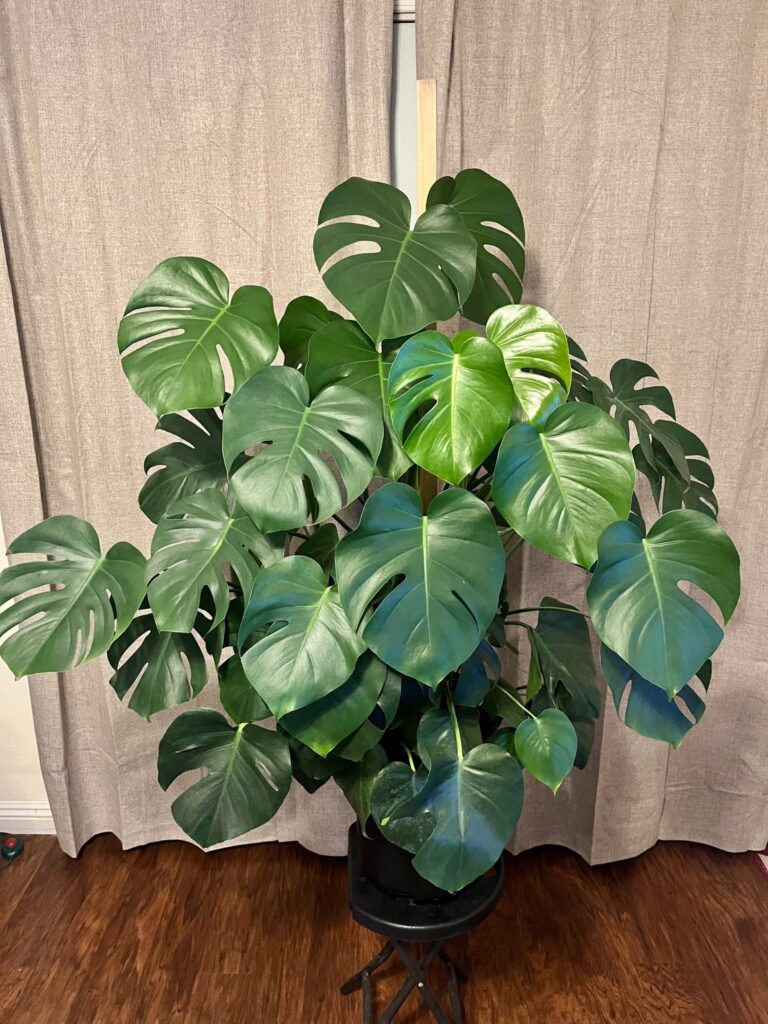
What Exactly Is a Monstera?
Monstera plants are native to the tropical forests of Mexico, Central America, and parts of northern South America. In the wild, they grow as hemiepiphytes, starting life on the forest floor and later climbing trees using aerial roots.
Their most famous trait is fenestration, the natural splits and holes that appear in mature leaves. According to the University of Wisconsin-Madison Division of Extension, these holes likely help leaves withstand wind and let light reach lower foliage in a crowded rainforest canopy.
Not every Monstera develops holes the same way. Some species split deeply along the leaf margin, others develop neat oval perforations, and a few, like Monstera peru, never fenestrate at all.
Most Monstera species are toxic if eaten. NC State Extension notes that Monstera adansonii carries calcium oxalate crystals that irritate the mouth and throat, and the same applies broadly across the genus.
ALSO READ: 15 Best Ornamental Plants to Grow in Any Bathroom (And How to Keep Them Healthy)
Now, let’s look at the varieties themselves.
Classic and Variegated Monstera Deliciosa Types
Monstera deliciosa is the plant most people picture when they hear the word “Monstera.” These varieties share the same core species but differ in leaf shape, size, or coloring.
1. Monstera Deliciosa
This is the original Swiss cheese plant, and it’s still the most widely grown Monstera in the world. In its native habitat, it can climb more than 50 feet up a tree trunk, according to University of Minnesota Extension.
Indoors, it stays far smaller, but a mature specimen can still reach ceiling height with proper support. Young leaves emerge solid, and the signature splits only appear once the plant matures, per NC State Extension.
I’ve grown one against a moss pole for three years now, and I’m still waiting on my first truly deep fenestration. That wait is normal, so don’t panic if your plant seems slow.
2. Monstera Deliciosa var. Borsigiana
Often confused with the standard deliciosa, borsigiana is a naturally occurring variety with smaller leaves and a faster growth rate. The leaf shape is very similar, so many nurseries mislabel one as the other.
One useful clue is the geniculum, the small joint where the leaf meets the stem. Borsigiana tends to have a shorter, less wrinkled geniculum than standard deliciosa.
It’s a good pick for anyone who wants the classic Monstera look without waiting years for a plant that reaches the ceiling.
3. Monstera Deliciosa ‘Albo Variegata’
This is the variety that sent Monstera prices soaring a few years back. Its leaves show unpredictable white patches, ranging from a few speckles to entire half-white leaves.
The variegation comes from a genetic mutation that stops chlorophyll production in parts of the leaf. That means the white sections can’t photosynthesize, so the plant grows more slowly and needs brighter light than an all-green deliciosa.
It’s a striking plant, but it’s also one of the more demanding types on this list. A leaf that reverts to solid white usually won’t survive long, since it can’t produce energy on its own.
4. Monstera Deliciosa ‘Thai Constellation’
Unlike Albo, Thai Constellation has stable, speckled cream variegation that rarely reverts. The pattern looks almost like a spray of stars scattered across dark green leaves, which is where the name comes from.
It was originally developed through tissue culture in Thailand, and it grows a little slower than a standard deliciosa. Because the variegation is stable, it’s considered easier to manage long term than Albo Variegata.
It’s still a pricier plant, but it’s become one of the more attainable variegated Monsteras thanks to wider tissue-culture propagation.
5. Monstera Deliciosa ‘Aurea’ (Marmorata)
This form displays yellow-gold variegation instead of white, giving it a warmer, sunnier look than Albo or Thai Constellation. The gold patches can appear as streaks, blocks, or fine marbling.
It’s rarer than the white-variegated forms and tends to command a similarly high price among collectors. Like other variegated Monsteras, it needs strong, bright light to keep the non-green sections from stalling the plant’s growth.
Because true Aurea is uncommon, it’s worth buying from a reputable seller who can show a rooted, actively growing specimen.
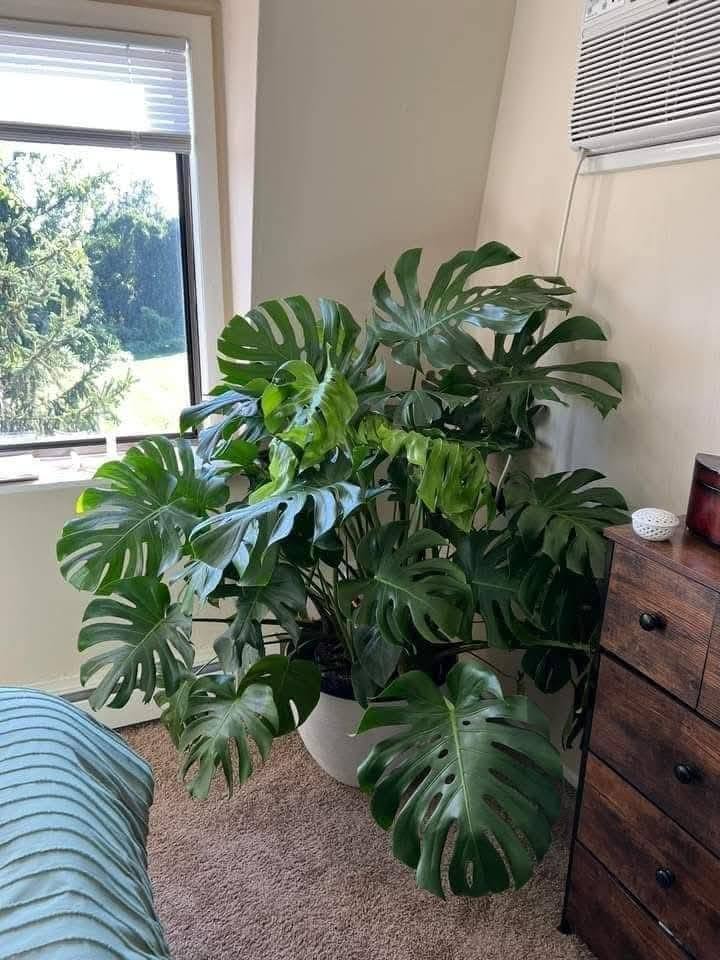
Swiss Cheese Vine: Monstera Adansonii Types
Monstera adansonii is the genus’s second most popular houseplant. It’s smaller, faster-growing, and better suited to hanging baskets than its bigger cousin.
6. Monstera Adansonii (Wide-Leaf Form)
This form has broader, more rounded leaves with generous oval holes scattered across the surface. NC State Extension describes it as a fast-growing climber that uses aerial roots to reach sunlight in its native rainforest habitat.
Indoors, it’s usually grown trailing from a hanging pot or trained up a small support. Given something to climb, the leaves tend to grow noticeably larger with more defined fenestrations.
It’s a forgiving plant for someone who’s killed a few houseplants before. Just don’t let it sit in soggy soil, since root rot is its most common problem.
7. Monstera Adansonii (Narrow-Leaf Form)
The narrow form has a more pointed, lance-like leaf shape compared to the rounder wide form. In juvenile plants, the difference can be hard to spot, but it becomes obvious as the leaves mature.
Both forms need the same basic care, so the choice mostly comes down to appearance. I find the narrow form looks a little wilder and less tidy, which some people prefer for a jungle-style shelf display.
Either type multiplies quickly from stem cuttings, making it one of the easiest Monsteras to propagate and share.
8. Monstera Adansonii ‘Variegata’ (Archipelago)
This variegated sport of adansonii shows white or cream sections mixed through the green foliage, similar in concept to Albo Variegata but on a smaller, faster-growing plant. The pattern can vary a lot from leaf to leaf.
Because the vine grows quickly, keeping variegation balanced takes some pruning discipline. Leaves that come in fully white should generally be trimmed back, since they drain energy without contributing much of their own.
It’s a good entry point for someone curious about variegated Monsteras but not ready for the price tag of a variegated deliciosa.
ALSO READ: 15 Best Plants for Your Office Desk (And Why They Actually Help You Work Better)
Rare and Unusual Monstera Species
These species rarely show up at big box stores. They’re the ones serious collectors chase, often through specialty growers or plant swaps.
9. Monstera Obliqua
This is often called the “holy grail” of the genus, and for good reason. True Monstera obliqua leaves are made up of more hole than leaf tissue, sometimes reaching 90 percent open space.
It’s incredibly delicate, with thin, papery leaves that tear easily and a growth rate that tests anyone’s patience. Much of what’s sold online as “obliqua” is actually a form of Monstera adansonii, so buying from a trusted source matters here more than with almost any other type.
If you do get a genuine one, expect a slow, humidity-hungry plant that rewards careful, consistent care rather than neglect.
10. Monstera Dubia
Dubia has a completely different look from most Monsteras on this list. As a juvenile, it grows flat against a support surface, forming a shingling pattern of small, dark green leaves with silvery variegation.
Once it matures and starts climbing higher, the leaves change shape entirely, becoming larger and more typically Monstera-like with visible fenestrations. That transformation is part of what makes it so appealing to collectors.
It needs a rough, moist surface like a totem or cork board to shingle properly. Without that support, it tends to sprawl untidily instead of pressing flat.
11. Monstera Siltepecana
Known for its silvery, arrow-shaped juvenile leaves with dark green venation, siltepecana looks almost nothing like a typical Monstera at first glance. As it matures and starts to climb, the leaves darken and eventually develop fenestrations.
It’s a fast grower for a Monstera, and its trailing habit makes it a popular choice for hanging planters. The silvery sheen tends to be more pronounced in brighter, indirect light.
I like using this one to add contrast next to darker green Monsteras, since the metallic tone stands out in a mixed display.
12. Monstera Siltepecana ‘Silver’
This form pushes the silvery coloring even further than the standard species, with leaves that can appear almost fully metallic under the right light. The dark green veins create a striking contrast against the pale background.
Selective growing and propagation have concentrated this trait, so named “Silver” cuttings tend to be more consistent in appearance than seed-grown plants. It shares the same climbing habit and care needs as the standard species.
Given a moss pole, it eventually transitions into the more typical mature Monstera leaf shape, though many growers keep it trimmed to preserve the silver juvenile look.
13. Monstera Karstenianum (Monstera Peru)
Despite the common name, this plant isn’t actually from Peru, and it never develops fenestrations at all. Instead, its appeal lies in texture: thick, glossy, dark green leaves with pronounced, almost rippled veining.
It’s compact, growing to about two to four feet indoors, and it tends to tolerate lower humidity and inconsistent watering better than most other Monsteras. That makes it a solid pick for beginners who want something in the genus without the fussier care needs.
Its tight, clustered growth can trap moisture around the leaves, so occasional airflow or misting helps prevent spider mites in dry indoor conditions.
14. Monstera Standleyana
This species has elongated, glossy, dark green leaves with a subtle sheen and light speckling that some describe as almost paint-splattered. It stays relatively compact for a climbing Monstera.
It’s a steady, unfussy grower that adapts well to a range of indoor light levels. Its leaves rarely fenestrate heavily, so it’s grown more for foliage texture and color than for dramatic holes.
Given a support to climb, it develops a fuller, more upright form rather than sprawling loosely.
15. Monstera Standleyana ‘Variegata’
This variegated form adds cream or white streaks across the same glossy, speckled leaves, creating a subtle, almost hand-painted look. The variegation pattern tends to be finer and less blocky than what’s seen in deliciosa cultivars.
It’s less common in general retail but does appear through specialty aroid sellers. Like other variegated Monsteras, it needs strong light to support the reduced chlorophyll in the pale sections.
Its more modest size makes it a manageable variegated option for growers without room for a large climbing specimen.
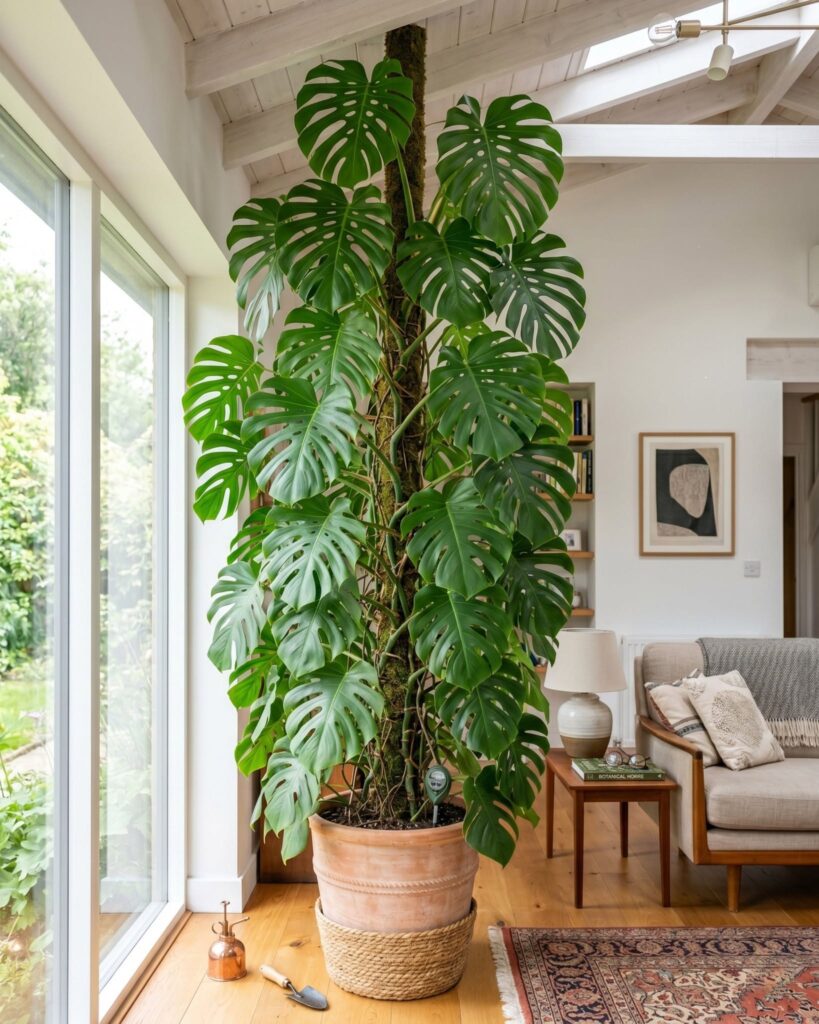
Climbing and Shingling Species
These species show off some of the genus’s strangest growth habits, from tightly pressed juvenile foliage to deeply divided, almost feather-like mature leaves.
16. Monstera Epipremnoides (‘Esqueleto’)
Commonly nicknamed the skeleton Monstera, this species develops long, narrow leaves with fenestrations that stretch almost to the leaf edge. The result looks more like a leaf skeleton than solid foliage.
It’s a larger-growing species that benefits from a sturdy support and plenty of humidity. Mature leaves can become quite dramatic, with narrow strips of green tissue separated by wide gaps.
Because it’s less common in mainstream nurseries, most growers source it through specialty tropical plant sellers.
17. Monstera Pinnatipartita
This species has deeply lobed, almost feathery leaves that look strikingly different from the rounder holes of deliciosa or adansonii. As it matures, the divisions become more pronounced and the leaf surface takes on a slightly quilted texture.
It’s a vigorous climber in the right conditions and does best with a moss pole or similar support to encourage larger, more mature leaf growth. Juvenile leaves are far more modest and don’t hint much at the mature form.
Patience really pays off with this one, since the transformation from juvenile to mature foliage is one of the more dramatic in the genus.
18. Monstera Acuminata
A smaller-leaved climbing species with thin, glossy, dark green foliage and small, elongated fenestrations. It tends to stay more compact than many other climbing Monsteras.
It’s a lesser-known species outside collector circles, but it shares the same basic epiphytic growth habit as its more famous relatives. Given a totem or bark support, it climbs steadily rather than sprawling.
Its modest size makes it a reasonable option for smaller spaces that still want a genuine climbing Monstera.
19. Monstera Lechleriana
This species produces broad, glossy leaves with irregular perforations that appear more scattered than the neat oval holes of adansonii. Mature specimens can develop quite large, leathery foliage.
It’s recognized by UF/IFAS Extension as one of several ornamental Monstera relatives grown alongside deliciosa in cultivation. It shares similar light and humidity preferences with its better-known cousins.
Because it’s not widely sold commercially, most specimens circulate through collector networks and specialty growers.
20. Monstera Punctulata
A slender-leaved climbing species with narrow fenestrations and a growth habit similar to epipremnoides, though generally more compact. Its leaves have a slightly leathery texture compared to the softer foliage of adansonii.
It thrives with consistent humidity and a climbing support, developing more defined perforations as it matures. Juvenile growth is far plainer and easy to overlook in a nursery setting.
Like many of the rarer species on this list, it’s mostly found through aroid specialty sellers rather than general garden centers.
ALSO READ: 25 Best Plants for an East-Facing Window (And Why They Thrive There)
Compact and Collector’s Species
These species tend to stay smaller or grow more slowly, making them popular among collectors working with limited shelf or windowsill space.
21. Monstera Spruceana
A climbing species with elongated, glossy leaves and a growth pattern that closely hugs its support surface while young. It transitions to a more open, sprawling habit as it matures.
It prefers consistent moisture and higher humidity than deliciosa, reflecting its origins deeper in the rainforest understory. Without adequate humidity, leaf edges can dry out and brown.
It remains relatively obscure outside dedicated aroid collecting communities.
22. Monstera Subpinnata
This species has finely divided, almost fern-like mature leaves, quite different from the broad, solid foliage most people associate with Monstera. The deep, narrow lobes give it a delicate, textured appearance.
It’s a slower grower and tends to stay more compact than species like epipremnoides or pinnatipartita. Bright, indirect light helps maintain strong leaf color and prevents leggy growth.
Because of its unusual leaf form, it’s often kept by collectors specifically for variety rather than for a dramatic size statement.
23. Monstera Tuberculata (Shingle Plant)
Known for its bumpy, textured leaf surface and shingling growth habit, this species presses flat against bark or a totem while young, similar to Monstera dubia. The raised, warty texture on the leaves is its most distinctive feature.
As it climbs and matures, the leaves increase in size and eventually develop small fenestrations. It needs high humidity and a rough, moist support to shingle properly indoors.
It’s a slow, patient-reward type of plant, prized more for its unusual texture than for fast growth.
24. Monstera Acacoyaguensis
A lesser-known species with broad, glossy leaves and irregular perforations, first formally described in botanical literature covering Mexican Araceae. It shares a similar general appearance to lechleriana, though the two are distinct species.
It grows as a climbing hemiepiphyte in its native range and follows similar care principles to other rainforest Monsteras: bright indirect light, consistent moisture, and a support to climb.
It remains rare in cultivation and is mostly known through botanical collections and specialist growers.
25. Monstera Dissecta
This species is recognized by UF/IFAS Extension as one of the ornamental Monstera relatives sometimes grown alongside deliciosa. Its leaves show deep, irregular cuts rather than the rounder holes typical of adansonii.
It shares the genus’s general preference for bright, indirect light and high humidity. Mature specimens develop a more dramatically lobed leaf shape than younger plants.
Like several species on this list, it’s more of a collector’s plant than something you’ll find at a typical garden center.
Botanical Rarities Worth Knowing
These final species round out the list. Most are known primarily through botanical descriptions and specialist collections rather than mainstream cultivation.
26. Monstera Barrieri
A climbing species with slender, elongated leaves, formally recognized among the roughly 60 currently accepted Monstera species. It follows the same rainforest habitat pattern as its relatives, starting on the forest floor before climbing toward the canopy.
It’s rarely available outside specialist collections, and detailed cultivation notes remain limited compared to popular houseplant species.
For collectors, part of the appeal is simply owning a piece of the genus that almost nobody else grows.
27. Monstera Membranacea
This species has thin, membranous leaves, as the name suggests, giving the foliage a more delicate, almost translucent quality compared to the leathery leaves of deliciosa. It grows as a climbing hemiepiphyte in humid tropical forest habitats.
Its light, papery leaf texture makes it more prone to damage from low humidity or rough handling than sturdier species. It benefits from a stable, humid growing environment.
Like many species on this list, it remains mostly in the hands of dedicated aroid collectors.
28. Monstera Gracilis
A more slender, delicate species compared to the larger, bolder Monsteras most people know. Its narrower leaf profile sets it apart from broader-leaved relatives like deliciosa or lechleriana.
It follows the genus’s typical climbing growth habit, using aerial roots to attach to trees in its native range. Consistent warmth and humidity support healthier, more vigorous growth.
It’s another species primarily found through specialty tropical plant trade rather than general retail.
29. Monstera Pittieri
This species has broader, textured foliage and is recognized as part of the wider Monstera species list maintained by botanical databases. Like most of its relatives, it grows as a hemiepiphytic climber in humid forest environments.
Detailed indoor care information is limited, since it isn’t widely cultivated as a houseplant. Growers who do keep it generally follow the same bright, indirect light and high humidity guidelines used for other rainforest Monsteras.
It’s a name collectors are more likely to encounter in taxonomic references than in a nursery catalog.
30. Monstera Praetermissa
One of the more recently described species in the genus, praetermissa reflects the ongoing taxonomic work being done on Monstera by researchers, including collaborators connected to the Missouri Botanical Garden. Its formal description adds to the expanding, still-growing list of recognized species.
As a newer addition to the genus’s official record, detailed long-term cultivation experience is still limited. It illustrates just how much is still being discovered about this genus, even now.
For plant lovers who enjoy the science side of collecting, species like this are a reminder that the Monstera story isn’t finished yet.
Popular vs. Rare Monstera Types
| Feature | Popular Types (Deliciosa, Adansonii) | Rare/Collector Types (Obliqua, Dubia, Subpinnata) |
| Availability | Garden centers, big box stores | Specialty aroid sellers, collectors |
| Growth speed | Moderate to fast | Often slow |
| Care difficulty | Beginner-friendly | Moderate to advanced |
| Typical price | Affordable | Often expensive |
| Leaf feature | Classic splits and holes | Unusual textures or extreme fenestration |
How to Care for Monstera Plants (The Short Version)
Care varies a little by species, but the fundamentals stay consistent across most of the genus.
Light should be bright and indirect. University of Wisconsin-Madison Extension notes that inadequate light is one of the main reasons mature leaves fail to develop proper fenestrations.
Watering works best when you let the top couple of inches of soil dry out between sessions. Overwatering is the most common cause of problems, according to guidance summarized from University of Minnesota Extension.
Humidity matters more for the rarer, thinner-leaved species than for tougher types like deliciosa or karstenianum. A pebble tray or occasional misting helps in dry indoor air.
Support encourages larger, more fenestrated leaves. Giving a young Monstera a moss pole or totem to climb, rather than letting it trail, generally produces bigger, more mature foliage over time.
Propagation is straightforward for most species. UMN Extension recommends cutting one inch below a node with sanitized shears, then rooting the cutting in water, perlite, or moist potting mix.
Why Monstera Plants Have Captured So Much Attention
Part of the appeal is visual. Those dramatic splits and holes look unlike almost anything else on a houseplant shelf, and no two mature leaves ever look quite the same.
There’s also a genuine sense of discovery involved. With new Monstera species still being formally described within just the past few years, collectors get the rare thrill of owning something science is still actively cataloging.
I think that’s part of why the genus has built such a devoted following. It’s not just decoration. It’s a small, living connection to an actively unfolding area of botanical research.
Common Problems to Watch For
Yellowing leaves usually point to overwatering rather than underwatering, especially in deliciosa and adansonii grown in heavy, slow-draining soil.
No fenestrations on a mature-looking plant often comes down to insufficient light. Even large, established plants will keep producing solid leaves if light levels stay too low.
Variegation reverting to solid green happens when all-green sections outcompete the slower-growing white or cream parts. Pruning fully green growth back can help rebalance a variegated plant.
Brown, crispy leaf edges typically signal low humidity, particularly in thinner-leaved species like membranacea, obliqua, or subpinnata.
Final Thoughts
Thirty types is still only a slice of what’s out there, but it covers the varieties you’re most likely to encounter, whether you’re shopping at a garden center or scrolling through a specialty aroid seller’s listings.
If you’re just starting out, I’d suggest picking up a standard Monstera deliciosa or an adansonii first. Once you’ve got a feel for how they grow, the rarer species on this list become a lot less intimidating.
Monstera plants reward patience more than almost any other houseplant group I’ve grown. That slow unfolding, leaf by leaf, is really the whole point.
References
- North Carolina State University Extension Gardener Plant Toolbox – Monstera deliciosa: https://plants.ces.ncsu.edu/plants/monstera-deliciosa/
- North Carolina State University Extension Gardener Plant Toolbox – Monstera adansonii: https://plants.ces.ncsu.edu/plants/monstera-adansonii
- University of Minnesota Extension – Propagating Monstera Deliciosa: https://extension.umn.edu/houseplants/propagating-monstera-deliciosa
- University of Florida IFAS Extension (EDIS) – Monstera Growing in the Florida Home Landscape (HS311): https://ask.ifas.ufl.edu/publication/HS311
- University of Wisconsin-Madison Division of Extension – Swiss-Cheese Plant, Monstera deliciosa: https://hort.extension.wisc.edu/articles/monstera-deliciosa/
- University of Connecticut Home & Garden Education Center – Monstera Deliciosa Fact Sheet: https://homegarden.cahnr.uconn.edu/factsheets/monstera-deliciosa/
- University of Oxford Botanic Garden, Plants 400 – Monstera deliciosa: https://herbaria.plants.ox.ac.uk/bol/plants400/Profiles/MN/Monstera

Tim M Dave is a gardening expert with a passion for houseplants, particularly cacti and succulents. With a degree in plant biology from the University of California, Berkeley, he has vast experience in gardening. Over the years, he has cultivated a vast collection of desert plants and learned a great deal about how to grow and care for these unique companions.