30 Types of Air Plants (Tillandsia Varieties With Pictures)
Tillandsia is the largest genus in the bromeliad family, with over 600 recognized species, according to North Carolina State University Extension’s Plant Toolbox. Some sources place the count closer to 650 to 700 when hybrids are included. That’s a lot of choice for one small houseplant category.
If you’re here, you’re probably wondering which type suits your space, your light, or your level of patience. Good news: there’s a huge amount of variety to choose from.
In this guide, I’ll walk you through 30 of the most popular and distinctive types of air plants. I’ll also cover where they come from, how they look, and how to keep them alive, because that part matters too.
What Exactly Is an Air Plant?
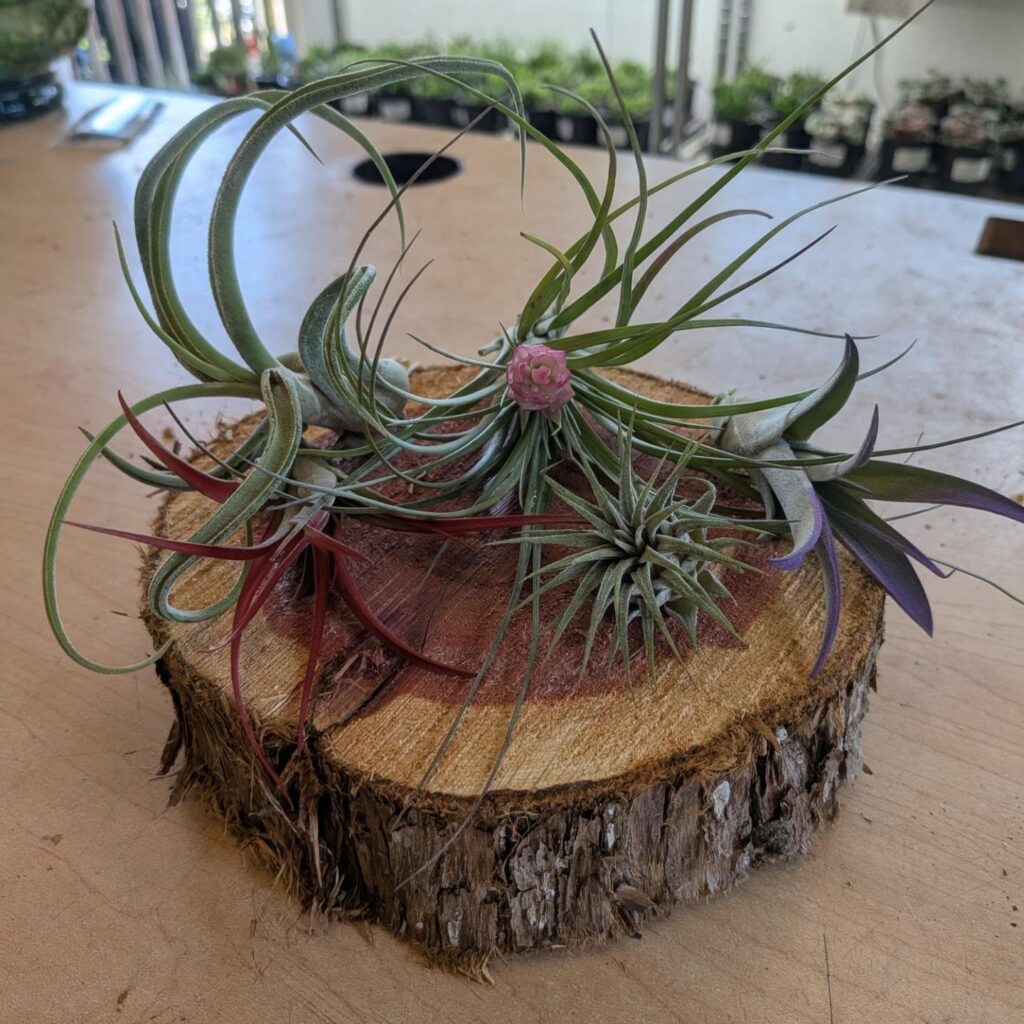
Air plants belong to the genus Tillandsia, part of the pineapple family, Bromeliaceae. They’re native to the southern United States, Mexico, Central America, South America, and parts of the Caribbean, growing in forests, deserts, and even on power lines.
Unlike most houseplants, air plants don’t need soil. Their roots exist mainly to anchor them to bark, rock, or other surfaces. Water and nutrients come instead through tiny structures on the leaves called trichomes, according to University of Vermont Extension.
This is why they’re called epiphytes. They live on other plants without harming them, borrowing support but not nutrients from a host.
Air plants generally fall into two groups: mesic (from humid rainforest regions) and xeric (from dry, desert-like habitats), as noted by Cornell Cooperative Extension. Knowing which group a species belongs to helps you water it correctly.
ALSO READ: Top 10 NASA Air Purifying Plants: Identification and Pictures
Now, let’s get into the varieties.
Silvery, Xeric-Type Air Plants (Desert Lovers)
These types tolerate bright light and drier conditions. Their leaves are often coated in dense, silvery trichomes that reflect sunlight and reduce water loss. Think of these trichomes as a built-in sunscreen and water tank rolled into one.
1. Tillandsia Xerographica
Often called the “king of air plants,” Xerographica has broad, curling silver leaves arranged in a striking rosette. It’s one of the largest species commonly sold, and a mature plant can spread wider than a dinner plate.
It grows slowly, so a mature specimen is worth the wait and usually costs more than smaller varieties. It can send up a flower spike one to three feet tall, according to NC State Extension, with bracts that stay colorful for weeks.
I’ve found it’s also one of the most forgiving species for beginners who tend to underwater. Its thick leaves store moisture well, so it tolerates a missed watering far better than most delicate mesic types.
2. Tillandsia Tectorum
This species looks almost otherworldly, covered in thick, wooly white trichomes that make it appear frosted or dusted in snow. Native to high-altitude regions of Peru and Ecuador, it grows where fog and mist provide most of its moisture.
Because of this background, Tectorum needs very little direct watering and actually suffers if it’s kept too wet. Good airflow matters more here than for almost any other type on this list.
Its shape stays fairly compact, making it a nice choice for shadow boxes or small mounted displays where a bulkier plant wouldn’t fit.
3. Tillandsia Streptophylla
Known for its twisting, curling leaves that coil tighter as the plant dries out, Streptophylla has real personality. Some growers describe the dry form as looking like a small green octopus caught mid-motion.
After a good soak, the leaves relax and unfurl into a looser, more open rosette. Watching that change happen over a few hours is honestly one of the more satisfying things about owning this species.
It’s a slower grower and can take a few years to reach a flowering size, but the reward is a tall, colorful bloom spike that lasts for weeks.
4. Tillandsia Butzii
With mottled, spotted leaves and a slightly reptilian appearance, Butzii is a favorite among collectors who want something unusual. The pattern on the leaves can vary quite a bit from plant to plant, so no two specimens look exactly alike.
It prefers slightly more humidity than typical xeric types, which places it somewhere between the two main categories. In drier homes, more frequent misting between soaks helps it stay plump.
Its bulbous base and long, tapering leaves make it a natural choice for mounting on wood, where the leaves can arch and trail freely.
5. Tillandsia Caput-Medusae
Named after the mythological Medusa, this plant’s leaves curl outward like snakes from a bulbous, swollen base. It’s one of the more instantly recognizable species even to people who don’t know much about air plants.
It’s tough, adaptable, and handles a wide range of indoor conditions without much complaint. That resilience is part of why it shows up so often in beginner plant kits.
When it blooms, it produces vivid red-and-purple flower spikes that contrast sharply against the green foliage, making it a favorite for photography.
6. Tillandsia Seleriana
This species has a swollen, bulbous base and thick, silvery leaves that fan outward in a loose, open shape. That bulbous base functions almost like a small reservoir, helping it cope with irregular watering.
It’s naturally adapted to store water, making it fairly drought tolerant compared to smoother-leaved types. In the wild, it often grows on exposed branches where rainfall is unpredictable.
Its compact size makes it easy to fit into mixed arrangements alongside taller or trailing species.
7. Tillandsia Fuchsii var. Gracilis
One of the most delicate-looking air plants, with hair-thin silver leaves that form a fine, feathery ball. From a distance, a mature cluster can almost look like a puff of silver smoke sitting on a shelf.
It’s small but visually dramatic in groupings, and it tends to multiply readily once established, forming dense little clumps over time. Because the leaves are so fine, it dries out quickly, which actually suits its drought-tolerant nature.
I like using this one in terrariums where its texture stands out against smoother, broader-leaved neighbors.
8. Tillandsia Bergeri
A clumping species from Argentina with soft green-silver leaves and violet-blue flowers. It’s one of the more cold-tolerant Tillandsias, which makes sense given its more temperate native range compared to tropical species.
It multiplies readily, forming attractive mounded clusters over time that can eventually fill an entire mount or dish. Established clumps often flower in waves rather than all at once.
For anyone wanting a low-maintenance display that fills in on its own, Bergeri is a solid, patient choice.
9. Tillandsia Argentea
Thin, wiry, silver leaves give this species a wispy, almost hair-like texture that catches light nicely near a window. It stays fairly small, rarely growing much larger than a golf ball at the base.
It’s compact and works well in small terrariums or glass displays where bulkier species would look out of place. Because of its size, it also dries out faster than larger types, so it benefits from slightly more frequent misting.
Its understated look makes it a good filler plant in mixed Tillandsia arrangements.
10. Tillandsia Andreana
A small, spiky species with narrow leaves that blush bright red before blooming. That color change is one of the most dramatic on this list relative to the plant’s small size.
It’s often mounted on driftwood for display, where its spiky, almost sea-urchin shape stands out against the smooth wood grain. It stays compact throughout its life, rarely needing much space.
Because it’s so small, a few missed waterings can stress it quickly, so it’s worth keeping on a more consistent schedule than some of the larger xeric types.
Green, Mesic-Type Air Plants (Humidity Lovers)
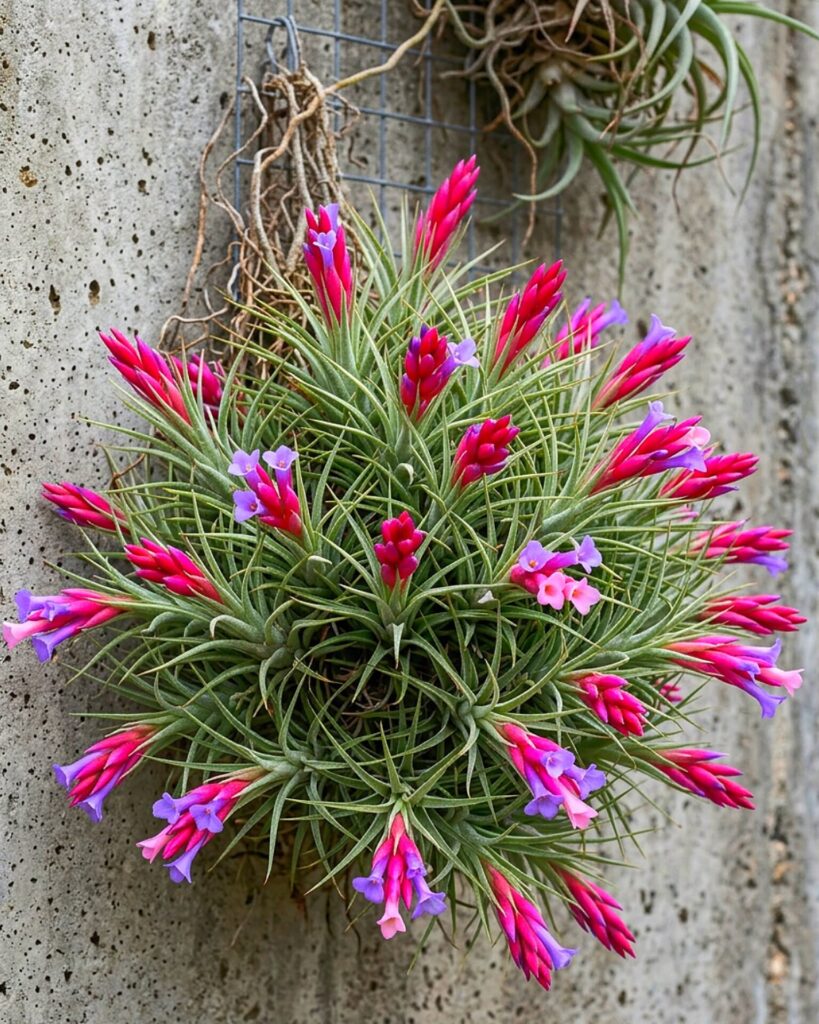
These species come from more humid environments and generally need more frequent watering. Their leaves tend to be smoother and greener rather than heavily silvered, since they don’t rely as heavily on trichomes for moisture storage.
11. Tillandsia Ionantha
Possibly the most popular air plant sold worldwide, Ionantha is small, hardy, and blushes a vivid red when it’s close to blooming. NC State Extension lists it among the most recognizable species available commercially, and it’s usually the first air plant most people ever buy.
It comes in several named forms, including “Fuego” and “Guatemala,” each with slightly different coloring and growth habits. Despite the variety, care requirements stay fairly consistent across the group.
It’s forgiving enough for beginners, tolerates a range of light levels, and produces pups readily, so a single plant often turns into a small cluster within a year or two.
12. Tillandsia Bulbosa
This one has a twisted, almost octopus-like form with a bulbous base and dark green, curling leaves that seem to reach out in every direction. It’s a striking centerpiece for hanging displays where its shape can be appreciated from below.
Bulbosa prefers more humidity than many other species, so it does best with regular misting between soaks, especially in dry indoor air. Its leaves can look a little wrinkled when thirsty, which is a useful visual cue for watering.
When it flowers, the bloom emerges from deep within the twisted leaves in a burst of red and violet.
13. Tillandsia Brachycaulos
Known for turning a deep red-orange across the whole rosette before flowering, this species puts on one of the more dramatic color shows in the genus. Unlike species that only blush at the tips, Brachycaulos often colors up almost entirely.
It stays relatively compact and adapts well to both mounted displays and loose arrangements in bowls or dishes. Bright, indirect light tends to intensify the color change more than lower light conditions.
Once the color fades after blooming, the plant usually produces several pups around its base.
14. Tillandsia Concolor
A narrow, upright species with green leaves and a tall, colorful flower spike in shades of red and purple. Its growth habit is more vertical than the typical wide rosette shape seen in many other Tillandsias.
It’s a good pick if you want height in a display, particularly in group arrangements where a mix of shapes adds visual interest. The flower spike can last for several weeks, which is longer than many comparable species.
Regular misting keeps the narrow leaves from curling excessively in drier rooms.
15. Tillandsia Harrisii
Native to Guatemala, this species has soft, silvery-green leaves in a neat, symmetrical rosette shape. It sits somewhere between the fully silver xeric types and the greener mesic types in both appearance and care needs.
It’s moderately easy to care for and holds its form well over time, without the excessive curling seen in some other species. Because of its neat shape, it photographs well and is a common choice for gift arrangements.
With consistent watering, it tends to stay compact and full rather than sprawling outward.
16. Tillandsia Capitata
Available in several color forms, including “Peach” and “Rubra,” Capitata has broad leaves and blushes beautifully before blooming. The color intensity can vary noticeably depending on the specific form and the amount of light it receives.
It’s a larger species compared to many mesic types, and mature plants can become genuine focal points in a collection. The flower spike is usually a striking shade of pink or red.
Because of its size, it benefits from a slightly longer soak than smaller species to make sure water reaches all the layered leaves.
17. Tillandsia Stricta
A compact, clumping species with fine leaves and vivid pink or purple flower bracts. It’s one of the more affordable and widely available types, often sold in bulk for craft projects and wreaths.
Despite the low price point, it’s a reliable bloomer and multiplies quickly under decent care. Its fine texture pairs nicely with bulkier, broad-leaved species in mixed displays.
It tolerates a range of humidity levels better than some other mesic types, which adds to its beginner-friendly reputation.
18. Tillandsia Juncea
With thin, rush-like leaves that grow upright, Juncea has a grassy, architectural look that’s different from the typical rosette shape most people picture when they think of air plants. It almost resembles a small tuft of ornamental grass.
Its upright form makes it useful for adding vertical contrast in group displays dominated by rounder, spreading species. It stays fairly narrow even as it matures, so it doesn’t take up much horizontal space.
Regular light watering keeps the thin leaves from drying out and curling too tightly.
19. Tillandsia Velutina
This species has a fuzzy texture and turns a deep burgundy red when preparing to bloom, similar in drama to Brachycaulos but with a slightly different leaf feel. The fine hairs on the leaves give it a soft, almost velvety look up close.
It thrives with regular moisture and doesn’t tolerate long dry spells as well as the more drought-adapted xeric species. Keeping it on a consistent weekly watering routine helps it maintain its color and shape.
Its dramatic color shift makes it a popular choice for anyone wanting a plant that visibly changes throughout the year.
20. Tillandsia Aeranthos
A clumping species from South America with narrow, upright leaves and vivid blue-purple flowers that stand out sharply against the green foliage. It naturally forms dense colonies when allowed to multiply undisturbed on a mount.
It’s cold-hardy compared to many other Tillandsias, tolerating cooler temperatures better than most tropical species on this list. That makes it a reasonable option for growers in slightly cooler climates who still want to keep plants outdoors part of the year.
Established clumps can produce multiple blooms across a single season, extending the display considerably.
ALSO READ: 15 Best Flowers for Pollinators: (Bees, Butterflies, Moths, Hummingbirds and More)
Unique and Statement Air Plants
These varieties stand out for their unusual growth habits, sizes, or novelty appeal. Some barely resemble what most people picture when they hear “air plant.”
21. Tillandsia Usneoides (Spanish Moss)
Yes, Spanish moss is technically an air plant. It has no true roots at all and grows in long, hanging strands, absorbing all its moisture and nutrients directly from the air, per NC State Extension. In the wild, strands can stretch for several feet as they drape across tree branches.
It’s one of the most widespread Tillandsia species in the southern United States, often seen hanging from live oaks and cypress trees. Despite its wild, tangled look, it’s actually quite easy to grow indoors as a hanging accent.
A light misting every few days keeps it from drying out and turning brittle, especially in air-conditioned rooms.
22. Tillandsia Recurvata (Ball Moss)
Another wild, rootless type often seen clinging to power lines and tree branches across the southern US. It forms small, tangled balls of gray-green foliage that can look almost like a bird’s nest from a distance.
Unlike Spanish moss, it grows in compact clumps rather than long trailing strands. It’s rarely sold commercially compared to other species on this list, but it’s easy to spot in the wild if you know what to look for.
Its toughness and tolerance for neglect make it one of the most resilient species in the genus, even though it’s not a common houseplant choice.
23. Tillandsia Cyanea
Unlike most air plants on this list, Cyanea is often grown in a pot with a soil-like bark mix rather than mounted or left loose. It produces a striking paddle-shaped pink flower spike with violet blooms that emerge one at a time over several weeks.
Its growing method sets it apart, but the core biology is still that of an epiphyte adapted to grow in pots for convenience. This makes it popular as a flowering houseplant sold in garden centers rather than specialty air plant shops.
Because it’s potted, its watering needs resemble a typical houseplant more than the misting or soaking routine used for mounted species.
24. Tillandsia Xerographica x Streptophylla (“Cotton Candy”)
A popular hybrid combining traits of both parent species, with curling leaves and vivid pink blooms that bridge the gap between the two parents’ appearances. Hybrids like this one are common in the specialty plant trade, bred for color and shape rather than found in the wild.
It tends to inherit the slow growth of Xerographica along with some of the curling drama of Streptophylla. That combination makes it a distinctive centerpiece plant for collectors who already own the parent species.
Care generally follows xeric guidelines, with less frequent watering than typical mesic types.
25. Tillandsia Funckiana
A thin, needle-like species that produces bright red-orange flowers directly from the leaf tips rather than a separate central spike. The flowering habit alone makes it easy to distinguish from almost every other species on this list.
It’s a favorite for mounting on wood in creative arrangements, since its trailing, needle-like leaves drape attractively over uneven surfaces. It also tends to bloom more readily than many other species, sometimes flowering more than once a year under good conditions.
Bright light seems to encourage both better color and more frequent blooming.
26. Tillandsia Melanocrater
A dramatic species with broad leaves that darken toward a near-black base near the center of the rosette. That contrast between the pale outer leaves and the dark center gives it a striking, almost painted appearance.
It stands out for its bold color contrast compared to the more uniformly colored species on this list. Mature plants can develop quite a large, full rosette shape given consistent care.
It’s less commonly available than some other species, so specialty growers or online sellers are usually the best places to find one.
27. Tillandsia Baileyi
Native to Texas and Mexico, this narrow-leaved species tolerates a wide range of conditions and has even naturalized in parts of Florida outside its original range. Its adaptability makes it one of the hardier choices for growers who travel often or forget waterings occasionally.
It forms a fairly upright, grass-like clump that slowly widens as it produces offsets. Its flowers are a soft pink to lavender, appearing at the tips of the upright leaves.
Because it handles neglect reasonably well, it’s a sensible option for offices or other spaces without much routine attention.
28. Tillandsia Circinata
Compact and clumping, with curling gray-green leaves, this species forms dense mats when left to multiply on a mount. Over several years, a single plant can spread into a full, textured cluster covering a significant area.
Its curling habit intensifies when the plant is dry, similar to Streptophylla, though on a smaller and less exaggerated scale. That responsiveness makes it easy to judge watering needs just by looking at the leaves.
It’s a patient grower’s plant, rewarding consistent care with a slowly expanding colony rather than fast, dramatic growth.
29. Tillandsia Flabellata
Known for its striking red flower bracts and green leaves, this Central American species is a strong bloomer compared to many others on this list. The flower spike tends to be broader and more colorful, staying showy for an extended period.
Its leaves stay relatively soft and pliable compared to the stiffer xeric types, reflecting its more humid native habitat. Regular watering keeps the foliage looking full and prevents the tips from browning.
It’s a good choice for anyone who wants reliable, visible blooms rather than just interesting foliage.
30. Tillandsia Gardneri
A soft, silvery species with thin, curling leaves that give it a delicate, almost windswept look, as though it’s permanently caught in a light breeze. Its texture sits somewhere between the fully silver xeric types and the smoother mesic species.
It’s a good choice for hanging or mounted displays, where its curling leaves can drape and move freely. It tends to stay small to medium in size, making it easy to fit into mixed collections without overwhelming its neighbors.
With moderate watering and bright, indirect light, it holds its soft, curling shape well over time.
Quick Comparison: Xeric vs. Mesic Air Plants
| Feature | Xeric Types | Mesic Types |
| Native habitat | Deserts, high altitude | Rainforests, humid regions |
| Leaf texture | Thick, silvery, fuzzy | Smoother, greener |
| Light needs | Bright, direct-tolerant | Bright, indirect |
| Watering frequency | Less frequent | More frequent |
| Examples | Xerographica, Tectorum | Ionantha, Bulbosa |
How to Care for Air Plants (The Short Version)
I won’t pretend air plants are completely fuss-free, but they are genuinely low-maintenance once you understand a few basics.
Watering is the part people get wrong most often. Clemson University’s Home & Garden Information Center recommends watering Tillandsia once a week, either by misting thoroughly or submerging the plant in water for 20 to 30 minutes.
After watering, shake off excess moisture and turn the plant upside down to dry. Water trapped in the base can cause rot, and that’s the single most common way air plants die.
Light matters more than people expect. University of Vermont Extension notes that most air plants prefer bright, indirect or filtered light, and do best in temperatures between 50°F and 90°F with good air circulation.
Fertilizing isn’t required, but it helps. Penn State Extension recommends diluting liquid fertilizer to about one-fourth the standard strength and adding it monthly during regular watering.
Bloom cycle is worth knowing before you buy. Most Tillandsia species flower only once in their lifetime. After blooming, the mother plant produces small offsets, called pups, before it gradually fades.
Why Air Plants Have Become So Popular
Part of the appeal is simply practical. Bromeliads, including Tillandsia, are considered among the better houseplants for filtering indoor air pollutants, according to Clemson University’s Home & Garden Information Center.
There’s also the design factor. Air plants don’t need pots, so they show up in glass terrariums, mounted on driftwood, tucked into shells, or simply left loose in a bowl of decorative stones.
I think that flexibility is really what sets them apart from most houseplants. You’re not committing to a container. You’re just finding a spot where the plant can breathe and dry properly.
Common Problems to Watch For
Root or crown rot happens when water sits too long in the base of the plant. Always let your air plant dry within about four hours of watering.
Weevil damage is a regional concern. The Mexican bromeliad weevil, first detected in Florida in 1989, has caused significant damage to native Tillandsia populations there, according to the University of South Florida’s Plant Atlas.
Fading color or curling leaves usually signal underwatering, not overwatering, especially in mesic species that come from more humid environments.
Final Thoughts
Thirty types barely scratches the surface of what’s out there, but this list covers the varieties you’re most likely to encounter at a nursery, plant shop, or online seller.
If I had to recommend a starting point, I’d say pick one xeric type like Xerographica and one mesic type like Ionantha. That way, you’ll quickly learn how different care needs actually feel in practice.
Air plants reward a little attention without demanding constant care. That balance, more than anything, is probably why they’ve earned such a devoted following among plant lovers.
References
- North Carolina State University Extension Gardener Plant Toolbox – Tillandsia: https://plants.ces.ncsu.edu/plants/tillandsia/
- North Carolina State University Extension Gardener Plant Toolbox – Tillandsia xerographica: https://plants.ces.ncsu.edu/plants/tillandsia-xerographica/
- University of Vermont Extension – Tillandsia: The Captivating World of Soil-Less Air Plants: https://www.uvm.edu/extension/news/tillandsia-captivating-world-soil-less-air-plants
- Clemson University Home & Garden Information Center – Air Plants: https://hgic.clemson.edu/factsheet/air-plants/
- University of New Hampshire Extension – How Do You Grow Air Plants?: https://extension.unh.edu/blog/2020/11/how-do-you-grow-air-plants
- Penn State Extension – Tillandsias as Houseplants: https://extension.psu.edu/tillandsias-as-houseplants
- University of South Florida, Institute for Systematic Botany – Plant Atlas: Tillandsia: https://florida.plantatlas.usf.edu/genus/1224

Tim M Dave is a gardening expert with a passion for houseplants, particularly cacti and succulents. With a degree in plant biology from the University of California, Berkeley, he has vast experience in gardening. Over the years, he has cultivated a vast collection of desert plants and learned a great deal about how to grow and care for these unique companions.