25 Best Plants for Hanging Baskets: Identification With Pictures
Hanging baskets are not the same as ground containers. They dry out faster, they are watched from below and the side, and their roots have almost no room to search for extra moisture.
Extension horticulturists at Iowa State University note that hanging baskets often contain several closely spaced small plants whose roots grow quickly in a light, well-drained potting mix, which means frequent watering is necessary, especially in summer.
That single fact should guide every plant choice you make. Drought tolerance, trailing habit, and continuous bloom matter more in a hanging basket than they do in a garden bed.
Professional growers use a simple design formula, and I use it every spring myself.
- Thriller – a taller, upright plant for the center
- Filler – rounded, bushy plants to fill space
- Spiller – trailing plants that cascade over the rim
Oregon State University Extension horticulturist Brooke Edmunds recommends this exact approach for baskets viewed from all sides, while suggesting that baskets hung high look best with trailing plants such as petunia, ivy geranium, calibrachoa, alyssum, lobelia, verbena, and fuchsia.
If your basket hangs above eye level, skip the thriller. Nobody sees the center anyway. Go for pure spillers instead, and let them cascade.
Choosing the Right Container Before You Choose Plants
The basket itself affects how often you will water, which in turn affects which plants will actually survive. This is a step many first-time gardeners skip, and I skipped it too, back when my petunia dried out daily.
Illinois Extension explains that classic wire baskets need to be lined with sphagnum moss or a coir fiber liner before planting, since the frame alone cannot hold soil on its own. Plastic containers, by contrast, are ready to fill and plant right away, with no lining step required.
Plastic pots hold moisture longer because they are non-porous, while moss and coir liners breathe more but dry out faster, especially in direct sun. If you tend to forget watering, lean toward plastic or a container with a built-in water reservoir.
Wood baskets sit somewhere in between, offering a natural look with moderate water retention. Whatever material you choose, confirm it has drainage holes. Standing water at the bottom of a basket is one of the fastest ways to rot roots, no matter how sun-loving or drought-tolerant the plant is.
Size matters too. A basket that is too small will need watering constantly by midsummer, while an oversized basket can be heavy and awkward for the hook it hangs from. A 10- to 14-inch diameter basket suits most of the plants on this list comfortably.
How Much Sun Does Your Basket Get?
Before buying a single plant, stand under the hook and watch the light for a day. This one step prevents 90% of hanging basket failures, in my experience.
Nebraska Extension divides plant choices cleanly by exposure. For shaded spots, they recommend impatiens, begonia, sweet alyssum, lobelia, New Guinea impatiens, fuchsia, pansy, Swan River daisy, nierembergia, and bougainvillea.
For full sun, they point to black-eyed Susan, geranium, petunia, nasturtium, portulaca, verbena, Dahlberg daisy, and annual vinca.
Keep that sun-versus-shade split in mind as you read through the 25 plants below.
Full Sun Hanging Basket Plants (1–15)
These plants want at least six hours of direct sun daily. In exchange, they reward you with nonstop color from late spring through the first frost.
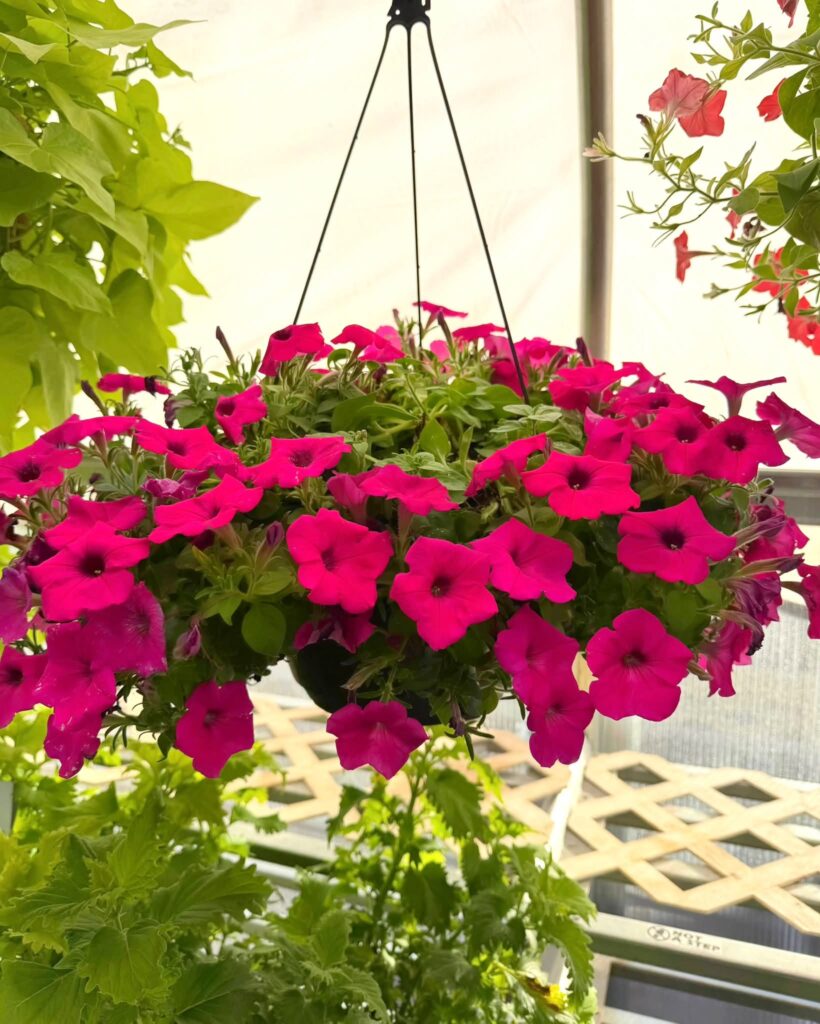
1. Petunia (Petunia x hybrida)
Petunias remain the classic hanging basket flower for good reason. They bloom in nearly every color, tolerate heat, and trail beautifully once established.
I find that trailing “Wave” or “Supertunia” varieties need almost no deadheading, unlike older bedding types.
2. Calibrachoa / Million Bells (Calibrachoa x hybrida)
Think of calibrachoa as a miniature petunia that refuses to quit. According to the Missouri Botanical Garden, calibrachoa does not typically decline during the heat of summer the way its petunia relatives can, and it produces compact, mounded stems reaching only 3 to 9 inches tall.
Deadheading is not required, which makes it one of the lowest-maintenance trailers you can plant.
3. Ivy Geranium (Pelargonium peltatum)
Glossy, ivy-shaped leaves and clusters of bright flowers make this a favorite for European-style window boxes. It handles heat and wind far better than upright geraniums.
Iowa State Extension lists ivy geranium among its top choices for full-sun hanging displays.
4. Verbena (Verbena x hybrida)
Verbena produces flat clusters of tiny flowers on wiry, trailing stems. It shrugs off heat and drought once it is established, and pollinators love it.
I have watched butterflies visit a single verbena basket dozens of times in one afternoon.
5. Bacopa (Sutera cordata)
Small white or lavender star-shaped flowers cover this delicate trailer nearly all season. It prefers consistent moisture, so pair it with thirstier neighbors rather than succulents.
Bacopa is often the “filler” that softens the edges between bolder blooms.
6. Lobelia (Lobelia erinus)
Lobelia offers some of the most intense blue tones available in the plant world. Iowa State University notes that smaller blooming plants like lobelia and sweet alyssum are generally self-cleaning, meaning deadheading is not necessary.
It prefers cooler temperatures and may pause flowering during peak summer heat.
7. Sweet Potato Vine (Ipomoea batatas)
This is a foliage powerhouse, not a flowering plant, and it earns its spot through sheer growth speed. Chartreuse, purple, or variegated leaves spill dramatically over basket edges.
One sweet potato vine can cover an entire basket rim by midsummer, so give it room.
8. Nasturtium (Tropaeolum majus)
Nasturtium is edible, fast-growing, and almost impossible to kill in poor soil. In fact, it flowers better when it is slightly neglected.
Both its round leaves and peppery flowers can be tossed into salads, which always surprises dinner guests.
9. Moss Rose / Portulaca (Portulaca grandiflora)
Michigan State University Extension highlights Portulaca as a succulent, drought-tolerant choice with thick, waxy leaves, noting that its brilliant array of colors makes baskets cheerful and bright all season.
If you tend to forget watering, this plant forgives you.
10. Fanflower / Scaevola (Scaevola aemula)
Scaevola produces fan-shaped purple or white flowers on tough, trailing stems. It holds up remarkably well in wind, heat, and neglect.
I have recommended it to friends who travel often, and it has never let them down.
11. Licorice Plant (Helichrysum petiolare)
Silvery, felted leaves cascade in soft waves, adding texture rather than color. It pairs beautifully with bold petunias or calibrachoa.
Iowa State University lists it among proven full-sun trailing foliage options for baskets.
12. Silver Falls Dichondra (Dichondra argentea ‘Silver Falls’)
This plant grows long, shimmering silver strands that can trail two feet or more by season’s end. It is grown purely for texture and shine, not flowers.
Pair it with bright colors for maximum visual contrast; the silver makes everything else pop.
13. Diamond Frost Euphorbia (Euphorbia ‘Inneuphdia’)
Tiny white flowers create a cloud-like, baby’s-breath effect all summer without deadheading. It tolerates heat and drought better than most flowering annuals.
I like using it to soften baskets that otherwise look too structured.
14. Black-Eyed Susan Vine (Thunbergia alata)
Cheerful yellow, orange, or white flowers with dark centers climb or trail depending on support. It grows quickly and blooms continuously in full sun.
Give it something to grip, even a few strands of twine, and it will happily wrap around the basket chains.
15. Bougainvillea (Bougainvillea spp.)
Bougainvillea delivers papery, vivid bracts in magenta, orange, or white on vigorous trailing branches. Nebraska Extension includes it among reliable basket choices for bright, warm locations.
It is more drought-tolerant than most basket plants, since overwatering is actually its biggest enemy.
Shade and Part-Shade Hanging Basket Plants (16–21)
Not every porch gets direct sun, and that is not a limitation. These plants actually perform better away from harsh afternoon rays.
16. Fuchsia (Fuchsia spp.)
Few plants match fuchsia’s drama, with drooping, bicolor flowers dangling like ornaments. The Missouri Botanical Garden notes that fuchsias are frost-tender, shade-loving, shrubby plants most commonly sold as container plants or in hanging baskets, and that weeping types with trailing stems are best suited for hanging displays.
Hummingbirds are drawn to fuchsia flowers almost immediately, which I consider a bonus, not a footnote.
17. Begonia (Begonia spp., including ‘Dragon Wing’ and tuberous types)
Begonias bloom reliably in shade where few other flowering plants will. Michigan State University Extension calls ‘Dragon Wing’ Begonia a “no-brainer” container plant with superior drought tolerance and abundant blooms.
Tuberous begonias, in particular, produce flowers the size of small roses.
18. Impatiens (Impatiens walleriana and New Guinea Impatiens)
Impatiens remain the go-to shade flower for a reason: nonstop color with almost no maintenance. New Guinea varieties tolerate slightly more sun and offer larger, more vivid blooms.
Both types are self-cleaning, so spent flowers simply drop away.
19. Sweet Alyssum (Lobularia maritima)
Tiny, honey-scented white or purple flowers form a dense carpet along basket edges. It tolerates part shade well and reseeds itself generously.
I keep alyssum near seating areas specifically for the fragrance, which carries on warm evenings.
20. Pansy and Viola (Viola x wittrockiana, Viola spp.)
Pansies thrive in cool, part-shade conditions during spring and fall, fading only in peak summer heat. Their cheerful “faces” make them a favorite for early-season baskets.
Nebraska Extension lists pansy among top picks for shade to part-shade hanging displays.
21. Coleus (Coleus scutellarioides)
Coleus is grown entirely for its foliage, which comes in combinations of red, lime, burgundy, and cream. Modern trailing varieties spill nicely over basket rims.
Pinch the growing tips regularly to keep the plant bushy rather than leggy.
Foliage and Texture Plants for Hanging Baskets (22–24)
Flowers fade, but foliage baskets hold their beauty for months, indoors or out. Mississippi State University Extension describes foliage baskets as bringing a sense of serenity and beauty to indoor and outdoor spaces.
22. English Ivy (Hedera helix)
English ivy trails gracefully in shade and tolerates neglect better than most flowering plants. It works equally well indoors near a bright window or outdoors on a covered porch.
I use it to fill gaps in mixed baskets where color has not yet filled in.
23. Boston Fern (Nephrolepis exaltata)
Feathery, arching fronds give Boston fern a lush, old-fashioned porch charm. Clemson University’s Home & Garden Information Center lists it among reliable shade-loving basket choices.
It prefers consistently moist soil and higher humidity, so it may need daily watering in dry climates.
24. Spider Plant / Airplane Plant (Chlorophytum comosum)
Mississippi State University Extension calls the spider plant one of its favorite foliage basket options, describing its linear leaves that are green or white striped and noting that it forms plantlets at the flowering nodes, creating a graceful, cascading habit.
It tolerates both indoor and outdoor conditions, making it one of the most versatile plants on this list.
An Edible Bonus for Sunny Baskets (25)
25. Trailing Rosemary (Salvia rosmarinus, trailing types)
Herbs deserve a place in hanging baskets too, and trailing rosemary is one of the best. Clemson HGIC notes that thyme, oregano, and rosemary are well suited to containers because they prefer soil that dries out between waterings.
Snip fresh sprigs straight into dinner all summer long, no garden bed required.
Care Tips That Actually Keep Baskets Alive
Choosing the right plant is only half the job. Here is what keeps these 25 species thriving through a full season.
Start with the right soil, not garden dirt. Nebraska Extension notes that hanging baskets from garden centers are usually planted in soilless mixes made from peat moss, bark, or sawdust combined with vermiculite, perlite, or sand.
These mixes drain well, stay lightweight, and arrive free of weed seeds, disease, and insects, which ordinary garden soil simply cannot offer in a hanging container. If you plant your own basket, buy a bagged soilless mix rather than digging soil from your yard.
Watering is the single biggest factor in basket survival. Nebraska Extension warns that during warm, sunny weather, some hanging basket plants may require watering two or three times daily, while the same plant may go days without water during a cool, cloudy stretch.
Always water until it runs freely from the drainage holes. Iowa State Extension explains that this ensures the entire soil ball has been moistened, rather than just wetting the surface.
Fertilizing matters more in baskets than in garden beds, because frequent watering washes nutrients out quickly. Nebraska Extension notes that container root systems cannot search for their own food, so nutrients must be supplied on a regular basis.
A slow-release granular fertilizer combined with a diluted liquid feed every two weeks works well for most of the plants above.
Prune mid-season, even if it feels wasteful. Michigan State University Extension recommends pruning trailing plants back by one-third to one-half partway through summer to push fresh growth and renewed blooming.
If a basket ever dries out completely, do not just water from the top. Iowa State Extension suggests placing the whole basket in a tub of water for one to two hours, allowing moisture to soak upward from the bottom, since this forces water to be absorbed slowly and rehydrates the entire root ball.
Choosing Plants by Climate Zone
Not every plant on this list survives winter outdoors, and most are grown as annuals regardless of zone. Still, knowing your zone helps with overwintering decisions, especially for fuchsia and bougainvillea.
The USDA Plant Hardiness Zone Map remains the standard reference. It defines zones based on the average annual extreme minimum winter temperature, displayed in 10-degree Fahrenheit zones and 5-degree half-zones. You can check your exact zone by entering your ZIP code at planthardiness.ars.usda.gov.
Fuchsia, for example, stays winter-hardy only in USDA Zones 10 to 11, according to the Missouri Botanical Garden, which is why most gardeners in cooler regions treat it as a seasonal annual or bring it indoors before frost.
Quick Selection Chart
| Light Needs | Top Picks |
| Full Sun | Petunia, Calibrachoa, Verbena, Portulaca, Scaevola, Bougainvillea |
| Part Shade | Sweet Alyssum, Pansy, Coleus, Nierembergia |
| Full Shade | Fuchsia, Begonia, Impatiens, Boston Fern, English Ivy |
| Drought-Tolerant | Portulaca, Scaevola, Dichondra, Diamond Frost Euphorbia, Rosemary |
| Fragrant | Sweet Alyssum, Rosemary, Nasturtium |
Frequently Asked Questions
How often should I water a hanging basket? In hot weather, expect to water daily, sometimes twice. Iowa State Extension advises watering whenever the soil surface feels dry to the touch, which in peak summer can mean once a day for most baskets.
Do hanging basket plants need deadheading? Some do, some do not. Older petunia and geranium varieties benefit from regular deadheading, while self-cleaning types such as lobelia, sweet alyssum, calibrachoa, and modern petunia hybrids rarely need it.
Can I mix sun and shade plants in one basket? Generally, no. Mixing plants with opposite light needs means one group will always struggle. Match every plant in a single basket to the same light category for the best results.
What is the best all-around plant for beginners? Calibrachoa and portulaca are close to foolproof. Both tolerate heat, need little deadheading, and forgive occasional missed waterings better than most flowering annuals.
How many plants should go in one basket? Most 10- to 14-inch baskets comfortably hold three to five plants, depending on their mature spread. Crowding too many plants into a small basket leads to intense root competition and faster drying, so it is worth checking the mature size on each plant tag before planting.
Why did my hanging basket look full in June but bare by August? This is usually a combination of root-bound plants, nutrient depletion, and heat stress. Refresh the fertilizer schedule, prune back leggy stems by about a third, and consider moving the basket to a slightly shadier spot during the hottest weeks of summer.
Are any of these plants toxic to pets? Yes, a few are. Begonia, English ivy, and bougainvillea can cause mild to moderate irritation if chewed by cats or dogs. If pets have access to your hanging baskets, prioritize petunia, calibrachoa, verbena, and nasturtium, which are considered lower risk.
Final Thoughts
A great hanging basket is really just the right plant matched to the right light, watered on a real schedule. Once I stopped fighting my sunny balcony with shade-loving plants, my baskets finally stopped wilting by noon.
Pick two or three species from this list that share the same sun requirements, combine a thriller, filler, and spiller, and feed them consistently. That combination, more than any single “miracle plant,” is what fills a porch with color from May through the first frost.
References
- University of Illinois Extension. Hanging Baskets: Container Gardens. https://extension.illinois.edu/container-gardens/hanging-baskets
- Iowa State University Extension and Outreach. Creating and Growing Hanging Baskets. https://yardandgarden.extension.iastate.edu/how-to/creating-and-growing-hanging-baskets
- Nebraska Extension in Lancaster County. Hanging Baskets. https://lancaster.unl.edu/hanging-baskets/
- Oregon State University Extension Service. Add Color and Lift with Hanging Baskets. https://extension.oregonstate.edu/news/add-color-lift-hanging-baskets
- Clemson University Home & Garden Information Center. Hanging Baskets and Window Boxes. https://hgic.clemson.edu/factsheet/hanging-baskets-window-boxes/
- Missouri Botanical Garden. Plant Finder: Calibrachoa and Fuchsia. https://www.missouribotanicalgarden.org/PlantFinder/PlantFinderDetails.aspx?taxonid=264585&isprofile=0
- USDA Agricultural Research Service. USDA Plant Hardiness Zone Map. https://planthardiness.ars.usda.gov/

Tim M Dave is a gardening expert with a passion for houseplants, particularly cacti and succulents. With a degree in plant biology from the University of California, Berkeley, he has vast experience in gardening. Over the years, he has cultivated a vast collection of desert plants and learned a great deal about how to grow and care for these unique companions.