30 Types of Spider Plants (Chlorophytum Varieties With Pictures)
My grandmother had a spider plant that never seemed to stop producing babies. Every few months, another cluster of little plantlets would dangle from the pot, and she’d hand them out to anyone who visited. That’s the plant most people picture when they hear “spider plant.”
But the genus behind it is a lot bigger than that one familiar houseplant. If you’ve ever wondered what else is out there beyond the striped leaves on your windowsill, you’re in the right place.
Chlorophytum, the genus that spider plants belong to, includes somewhere between 150 and 250 species, according to research published through the National Center for Biotechnology Information. Most are native to tropical Africa, with a smaller number found across Asia and Australia.
In this guide, I’ll walk you through 30 types of spider plants, from the familiar hanging-basket varieties to species most people have never come across. I’ll also cover care basics and a few statistics worth knowing.
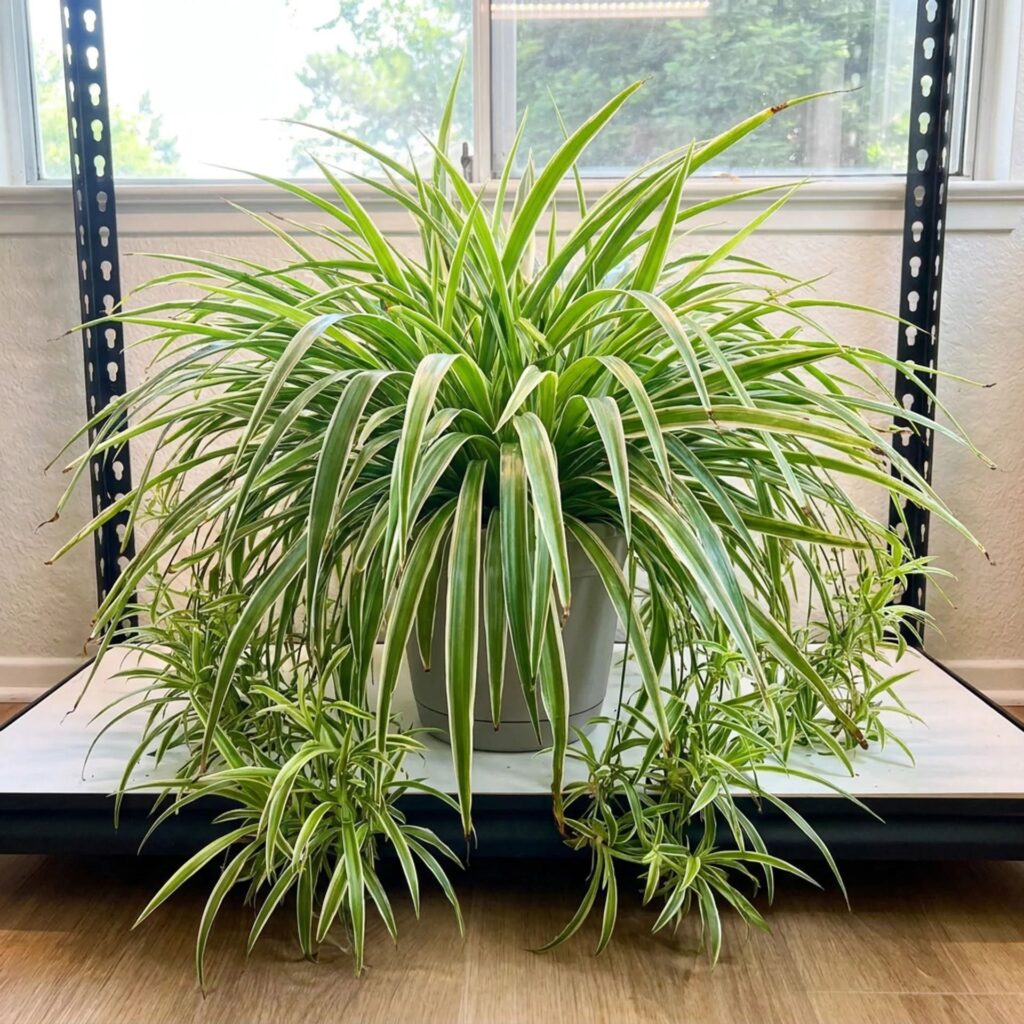
What Exactly Is a Spider Plant?
The common spider plant is botanically known as Chlorophytum comosum, a member of the Asparagaceae, or asparagus, family. According to North Carolina State University Extension, it’s native to a wide stretch of Africa, from tropical West Africa through Cameroon down to South Africa.
Its name comes from the way it reproduces. Long, wiry stems shoot outward and eventually produce small plantlets that dangle like spiders on a web, according to South Dakota State University Extension.
Spider plants are famous for their toughness. NC State Extension notes that the species tolerates deep shade, drought, and a wide range of indoor conditions, which explains why it’s survived on windowsills and in offices for generations.
They’re also widely believed to help with indoor air quality. In NASA’s 1989 Clean Air Study, spider plants removed about 95 percent of tested formaldehyde from a sealed chamber within 24 hours, according to reporting from the National Wildlife Federation.
That statistic came from controlled lab conditions rather than an average living room, so don’t expect a single plant to transform your home’s air quality overnight. Still, it’s part of why this plant became a houseplant staple in the first place.
ALSO READ: 25 Best Plants for Hanging Baskets: Identification With Pictures
Now, let’s get into the varieties.
Classic Chlorophytum Comosum Types (Hanging Basket Favorites)
These are the varieties most people already know, even if they’ve never learned the names. They’re widely sold, easy to find, and forgiving for beginners.
1. Chlorophytum Comosum (Common Spider Plant)
This is the plain green species form, without the white or yellow striping seen in most cultivated varieties. Interestingly, according to University of Florida IFAS research, the solid green species accounts for only about 10 percent of spider plant sales, since most growers prefer the variegated look.
It has the same satiny, medium to dark green leaves and arching growth habit as its more famous cultivars. Because it lacks variegation, it tends to grow a little more vigorously, since every part of the leaf can photosynthesize.
I actually like the plain green form for a more understated, jungle-style shelf display, where the striped varieties can look a bit busy.
2. Chlorophytum Comosum ‘Vittatum’
This is the most commonly grown spider plant in cultivation, according to UF/IFAS research. It has medium green, recurving leaves with a broad, creamy white stripe running down the center.
When allowed to mature fully, it tends to grow into the larger of the common cultivars, making it a favorite for big hanging baskets. Its stems produce plenty of plantlets once the plant reaches a decent size.
If you’ve ever bought a spider plant from a grocery store or garden center, there’s a good chance it was labeled ‘Vittatum.’
3. Chlorophytum Comosum ‘Variegatum’
Slightly smaller than ‘Vittatum,’ this cultivar has the stripe pattern reversed: green leaves edged with white or cream margins instead of a white center stripe. NC State Extension lists it as one of the most recognizable spider plant cultivars available.
It tends to stay a bit more compact, which makes it a good choice for smaller pots or desks that don’t have room for a sprawling hanging basket. Its care needs are identical to ‘Vittatum.’
Because the two cultivars look somewhat similar at a glance, checking whether the stripe is centered or on the margins is the easiest way to tell them apart.
4. Chlorophytum Comosum ‘Bonnie’
‘Bonnie’ is essentially a curly version of ‘Variegatum,’ with the same white-edged leaves but a tightly curling, almost ringlet-like growth habit. The curls give it a distinctly different look from the straight, arching leaves of the standard cultivars.
It’s grown under the same basic conditions as other comosum types and produces plantlets in the same way. Its compact, twisted shape makes it a popular choice for smaller containers or tabletop displays.
I find the curling habit especially fun in a hanging pot, since the leaves seem to spiral outward rather than simply drape down.
5. Chlorophytum Comosum ‘Bonnie Variegated’
This form combines the curling leaf habit of ‘Bonnie’ with a slightly different variegation pattern than the standard version. The curls tend to be a touch looser, and the white margins can appear a little wider on some specimens.
It’s less commonly available than plain ‘Bonnie,’ so it tends to show up more often through specialty growers than big box stores. Its care needs remain the same as any other comosum cultivar.
For collectors who already own a straight-leaved variegated spider plant, this curly counterpart adds nice textural contrast.
6. Chlorophytum Comosum ‘Milky Way’
This cultivar features broader leaves with a softer, more diffused variegation pattern than the crisp stripes of ‘Vittatum’ or ‘Variegatum.’ The overall effect looks a little like a milky wash across the leaf surface.
It’s recognized among the named cultivars listed by NC State Extension’s Plant Toolbox. Growth habits and care needs match the rest of the comosum group closely.
Because the variegation is subtler, it can be a nice option for someone who wants a lighter, less high-contrast look than the classic striped types.
7. Chlorophytum Comosum ‘Picturatum’ (Mandaianum)
Sometimes sold under the name Mandaianum, this cultivar is a compact form with a yellow stripe running down the center of shorter, curling leaves. It stays notably smaller than ‘Vittatum’ or ‘Variegatum.’
Its dwarf size makes it well suited to small pots, terrariums, or tight windowsill spots where a full-sized spider plant would quickly outgrow its space. The yellow coloring can shift in intensity depending on light exposure.
It’s a fun pick if you want the classic spider plant look on a smaller scale.
8. Chlorophytum Comosum ‘White Stripe’
This cultivar has a narrower white or cream line running along the center vein compared to the bolder stripe on ‘Vittatum.’ NC State Extension also notes that its flower stalks tend to be cream to yellowish rather than plain white.
The subtler striping gives it a slightly more refined look, especially in group plantings where too much bold contrast can feel busy. Its overall care and growth habit follow the same pattern as other comosum cultivars.
It’s a solid choice if you want variegation without quite as much visual weight.
9. Chlorophytum Comosum ‘Zebra’
Named for its banded, striped appearance, this cultivar has narrower leaves with more pronounced striping along the length rather than a single central band. The pattern can look almost woven up close.
It shares the same easy-care reputation as the rest of the comosum family, tolerating a wide range of light levels and occasional neglect. Its slightly narrower foliage gives it a grassier appearance overall.
It works well mixed into displays alongside broader-leaved cultivars for textural variety.
ALSO READ: 25 Best Plants for a North-Facing Window (Low Light, High Reward)
10. Chlorophytum Comosum ‘Ocean’
‘Ocean’ features leaves with a soft blue-green undertone alongside the usual white variegation, giving it a cooler overall color palette than the more common cultivars. The effect is subtle but noticeable in good light.
It grows and propagates the same way as other spider plant cultivars, producing plantlets on long, arching stems. Its slightly different coloring makes it a nice complement to warmer-toned green varieties in a mixed display.
Availability can vary by region, so it’s more often found through specialty plant sellers than general garden centers.
11. Chlorophytum Comosum ‘Atlantic’
This cultivar has a fuller, denser growth habit compared to some of the more open, arching forms. Leaves tend to be broader, giving the whole plant a lusher appearance in a hanging basket.
Like other cultivars in the group, it produces the characteristic dangling plantlets once mature. It’s a reliable grower for anyone who wants a fuller-looking spider plant without much extra effort.
Its bushier form makes it a solid centerpiece plant on its own, without needing much company to look complete.
12. Chlorophytum Comosum ‘Aureovariegatum’
This form leans toward golden-yellow variegation rather than the classic white or cream seen in most comosum cultivars. The warm coloring can brighten up a shaded corner nicely.
It shares the same basic care requirements as other spider plants, tolerating medium light and occasional dry spells. The gold tones tend to be most vivid under bright, indirect light.
It’s a good pick for anyone who wants something a little different from the standard white-striped look.
13. Chlorophytum Comosum ‘Reverse Variegatum’
As the name suggests, this cultivar flips the usual pattern, with variegation concentrated differently across the leaf compared to standard ‘Variegatum.’ The exact look can vary between growers and named strains.
It’s propagated and cared for the same way as its parent cultivar, through plantlet division or offsets. Because naming conventions for spider plant cultivars aren’t always consistent across sellers, it’s worth checking photos before buying if you want a specific pattern.
For collectors who enjoy small distinctions between cultivars, this is one of the more subtle variations to track down.
14. Chlorophytum Comosum ‘Variegatum Compactum’
This is a dwarf form of the standard ‘Variegatum’ cultivar, staying noticeably smaller and more tightly clustered. It’s a good option for anyone short on space who still wants the classic white-edged look.
Because it stays compact, it doesn’t need repotting as often as the larger cultivars and fits comfortably on a windowsill or small shelf. Its care requirements don’t differ from the standard version.
It’s a practical choice for apartment growers who love spider plants but don’t have room for a sprawling hanging basket.
15. Chlorophytum Viridescens ‘Hawaiian’ (Golden Glow)
Sometimes marketed simply as a spider plant cultivar, this variety is technically classified under Chlorophytum viridescens rather than comosum, according to plant reference sources. It has broad, glossy leaves with a bold yellow-gold stripe.
Its thicker, glossier foliage sets it apart visually from the thinner-leaved comosum cultivars. Care requirements stay similar, favoring bright, indirect light and well-drained soil.
Because naming can get muddled in the trade, it’s often simply sold as “Hawaiian spider plant” without much clarification on its exact classification.
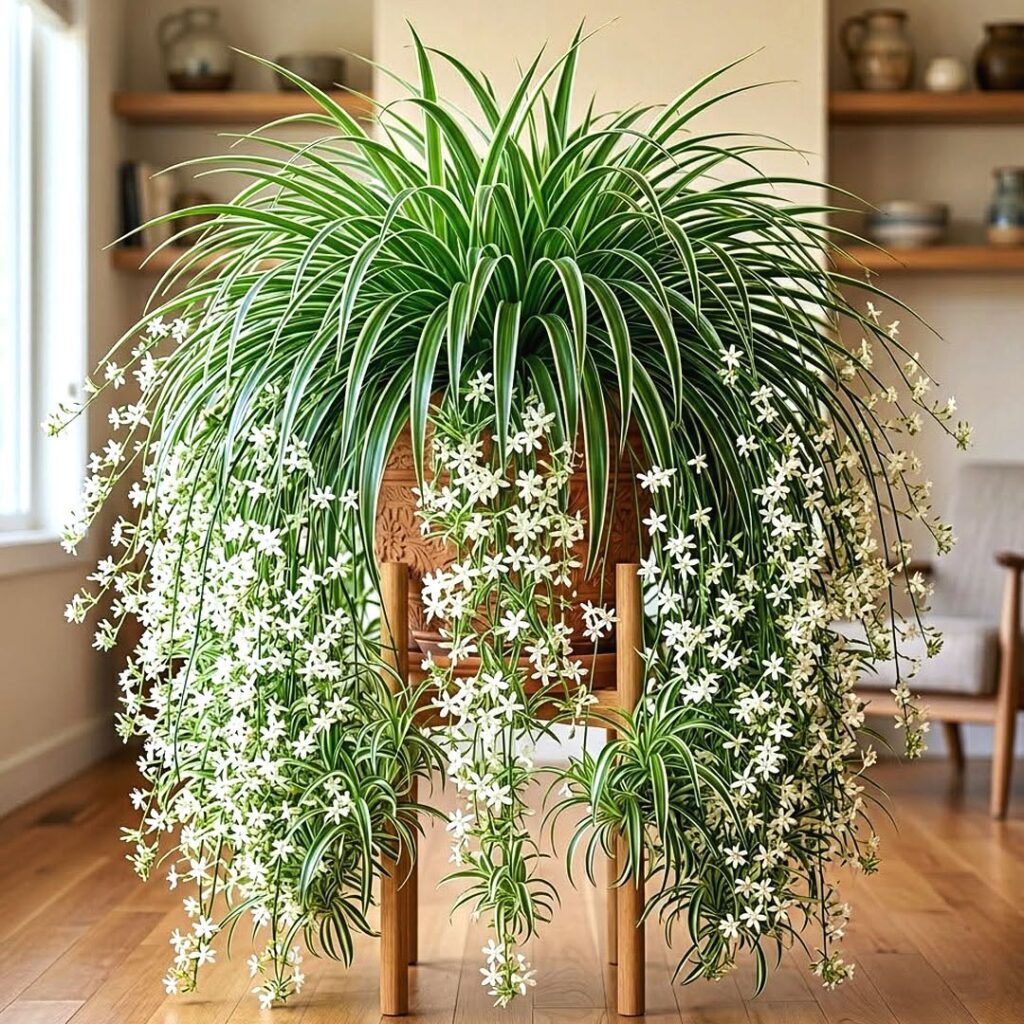
Colorful and Unusual Chlorophytum Relatives
These species step outside the classic white-striped look entirely. Some barely resemble the spider plant most people know.
16. Chlorophytum Orchidastrum ‘Fire Flash’
Also called the mandarin plant, this species has broad, glossy dark green leaves with a striking orange midrib and petiole. NC State Extension notes it’s native to the seasonally dry tropical regions of West Africa and prefers warmer, more humid conditions than the standard spider plant.
Unlike comosum, it grows in a tight rosette rather than an arching, cascading form, and it doesn’t produce dangling plantlets the same way. Its vivid color makes it a popular accent plant despite requiring slightly more attentive care.
I think of this one as the spider plant’s flashier cousin. It’s related, but it doesn’t act or look the part at first glance.
17. Chlorophytum Orchidastrum ‘Green Orange’
A close relative of ‘Fire Flash,’ this form has similarly vivid orange stems paired with wavy-edged green leaves. Small, cream-colored blooms occasionally emerge from the center of the rosette.
It shares the same warm-climate preferences as ‘Fire Flash,’ doing best in bright, indirect light with consistent moisture. Both are sometimes sold interchangeably under slightly different trade names.
Either variety adds a jolt of color that the classic striped spider plant simply doesn’t offer.
18. Chlorophytum Laxum ‘Bichetii’ (Bichetii Grass)
Known by several common names, including Bichetii grass and Siam lily, this species has narrower, more grass-like leaves than the broader comosum cultivars. It forms low, dense clumps rather than an arching rosette.
It’s widespread across tropical Africa, Asia, and Australia in the wild, according to botanical reference records. Its compact, grassy habit makes it a popular groundcover option in warm climates, alongside its use as a houseplant.
It’s a nice pick if you want the general spider plant care profile in a distinctly different shape.
19. Chlorophytum Capense (Cape Spider Plant)
Native to South Africa, this species has broader, more strap-like leaves than the common comosum cultivars and produces its own version of the classic white, star-shaped flowers. It’s sometimes called St. Bernard’s lily in older gardening references.
It tends to be hardier in cooler conditions than the tropical Chlorophytum species, reflecting its more temperate native range. Its overall care mirrors the standard spider plant routine.
It’s less common in general cultivation but occasionally turns up through specialty growers interested in the wider Chlorophytum genus.
20. Chlorophytum Saundersiae (Weeping Anthericum)
This species has narrower, more grass-like foliage and a low, spreading growth habit, quite different from the arching rosette of comosum. Its common name references its cascading, weeping growth pattern.
It’s often grown as a groundcover in warm climates and adapts reasonably well to container growing indoors. Like its relatives, it tolerates a range of light conditions without much fuss.
It’s a good option for anyone drawn to the genus but looking for a less typical growth shape.
21. Chlorophytum Borivilianum (Safed Musli)
Unlike the ornamental types on this list, this species is primarily grown for its tuberous roots, which have long been used in traditional Ayurvedic preparations. Its foliage is fairly plain compared to the showier ornamental cultivars.
It’s cultivated commercially in parts of India, largely for its roots rather than as a houseplant. Its growing requirements differ somewhat from the ornamental spider plants, favoring specific soil and climate conditions for root development.
It’s included here mainly to show just how differently members of this genus can be used.
22. Chlorophytum Filipendulum
A wild African relative of the common spider plant, this species has broader, somewhat leathery leaves and is found across a wide swath of equatorial Africa. It’s currently listed as a species of least concern by international conservation assessments.
It isn’t a common houseplant, but it represents the kind of species that gives rise to the cultivated forms most people recognize. Its natural habitat spans a range of tropical environments.
Species like this are a reminder that the popular houseplant varieties are really just a small, curated slice of a much larger genus.
23. Chlorophytum Debile
Native to western and southern tropical Africa, this species was first formally described in the late 1800s. It’s rarely cultivated outside botanical collections, but it’s a recognized part of the wider Chlorophytum family tree.
Its general growth habit follows the rosette pattern typical of the genus, though its foliage and flowers are considerably plainer than the ornamental cultivars.
Like several entries on this list, it’s more of a botanical curiosity than a houseplant you’d expect to find at a nursery.
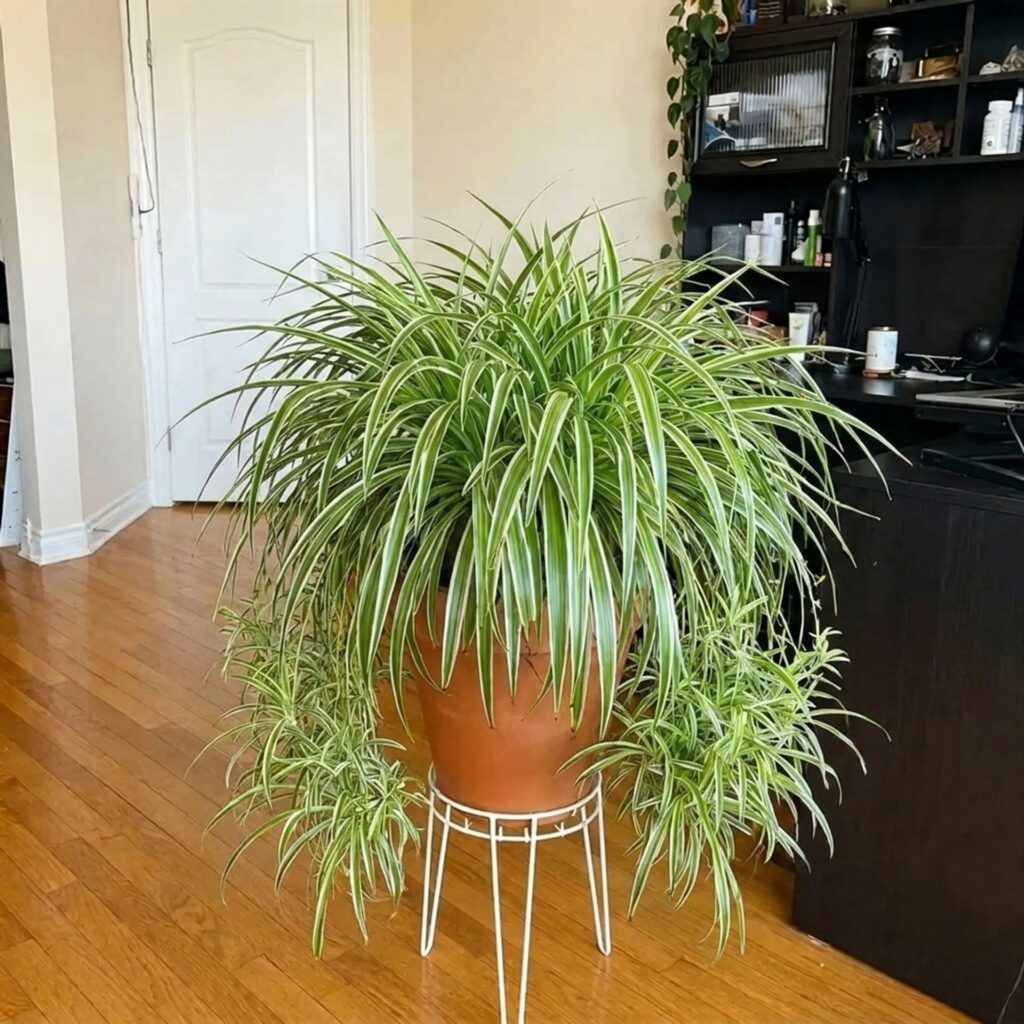
Rare and Botanical Chlorophytum Species
These final entries move further from the houseplant aisle and into the territory of botanical collections and field records. Most people, even dedicated plant collectors, will never come across them in person.
24. Chlorophytum Bowkeri
Found in damp grassland from South Africa’s Eastern Cape up into Zimbabwe, this species can grow surprisingly tall for the genus, reaching 80 to 160 centimeters in height. It often forms colonies rather than growing as a single isolated plant.
Its leaves are channeled, lance-shaped, and often slightly wavy along the edges. The short-lived white flowers appear in small clusters.
It’s a good example of how varied the genus becomes once you step outside the handful of species grown as houseplants.
25. Chlorophytum Nepalense
As the name suggests, this species is native to parts of Asia, including the Himalayan region, rather than Africa like most of its relatives. It has accumulated several taxonomic synonyms over the years as botanists have revised the genus.
It isn’t grown as an ornamental houseplant, and detailed cultivation information remains limited outside of botanical literature. Its existence highlights the genus’s surprisingly wide geographic range.
For plant taxonomy enthusiasts, species like this are part of what makes Chlorophytum such a genuinely complex genus to study.
26. Chlorophytum Macrophyllum
Recognized in Kew’s Plants of the World Online database, this species is one of many lesser-known Chlorophytum entries documented primarily through botanical surveys rather than cultivation records. Its name references its notably large leaves compared to some of its smaller relatives.
Detailed care information isn’t widely available, since it isn’t part of the ornamental plant trade. It remains primarily a subject of botanical interest.
Its inclusion here is mostly a nod to just how expansive this genus really is.
27. Chlorophytum Gallabatense
This species has drawn scientific attention for genomic research, with its chloroplast genome sequenced and compared to that of the common spider plant, according to a study published through the National Center for Biotechnology Information. That research places it within the same taxonomically complex African lineage as Chlorophytum comosum.
It isn’t cultivated as a houseplant, but it plays a role in helping researchers understand how the wider genus evolved. Genetic studies like this help clarify relationships between species that look quite different on the surface.
It’s a fitting example of how much scientific work continues behind the scenes of a plant most people just call “spider plant.”
28. Chlorophytum Blepharophyllum
Documented by botanical field researchers across a range spanning West through Central, East, and Southern Africa, this species grows either singly or in small clumps to around 50 centimeters tall. It emerges from a small rhizome rather than the more elongated roots seen in other species.
It isn’t part of typical cultivation, and most records come from field botany rather than garden settings. Its wide native range across the African continent reflects the genus’s broader diversity.
Species like this rarely make it into cultivation at all, remaining known mainly through herbarium records.
29. Chlorophytum Brachystachyum
Native across West through Central, East, and Southern Africa, this clumping species typically grows 30 to 45 centimeters tall from a short, vertical rhizome. Its leaves form a rosette pressed flat against the ground, with distinctly crisped margins.
Its roots are notably spongy, with elongated tuberous swellings, a trait shared with several of its African relatives. It produces a short, dense inflorescence of white flowers.
It’s another example of a Chlorophytum species that exists almost entirely outside the world of houseplant cultivation.
30. Chlorophytum Inornatum
This species holds a special place in the genus as its type species, the reference point against which all other Chlorophytum species are formally compared. It’s closely related to the familiar Chlorophytum comosum houseplant.
Beyond its taxonomic importance, research has identified compounds within the species linked to antimycobacterial activity, according to studies referenced in botanical literature. That research angle sets it apart from the purely ornamental entries on this list.
It’s a fitting plant to end on, since it quietly anchors the entire genus that gave us the houseplant so many of us grew up with.
ALSO READ: 25 Stunning Fake Plants for Living Room (Artificial Flowers That Look Completely Real)
Quick Comparison: Common vs. Rare Chlorophytum Types
| Feature | Common Types (Vittatum, Variegatum) | Rare/Botanical Types (Bowkeri, Nepalense) |
| Availability | Garden centers, grocery stores | Botanical collections, field records |
| Growth habit | Arching rosette, hanging plantlets | Varies widely, often clumping |
| Care difficulty | Very beginner-friendly | Largely undocumented for home growing |
| Typical use | Houseplant, hanging basket | Scientific and botanical study |
| Native range | Primarily tropical Africa | Africa and parts of Asia |
How to Care for Spider Plants
Care stays fairly consistent across the common cultivars, with a few adjustments for the more tropical relatives.
Light should be bright but indirect. NC State Extension notes that spider plants tolerate deep shade, but direct sun can scald the leaves.
Watering works best when the soil is kept moist during the growing season and reduced in winter. Clemson University’s Home & Garden Information Center recommends avoiding tap water where possible, since chlorine and fluoride can cause leaf tip burn.
Humidity matters more for tropical relatives like Fire Flash than for the tougher comosum cultivars. A pebble tray or occasional misting helps in dry indoor air.
Fertilizing should be kept light. Overfeeding is known to reduce plantlet formation, according to NC State Extension, so more isn’t better here.
Propagation is about as easy as houseplants get. Plantlets that develop along the flowering stems will root readily when they touch soil, or they can be snipped off and potted separately.
Why Spider Plants Remain So Popular
Part of the appeal is simple resilience. Few houseplants tolerate as much inconsistency in light, water, and general attention as the common spider plant does.
There’s also the multiplying factor. Watching a single plant send out stem after stem of new plantlets, ready to become entirely new pots, is genuinely satisfying in a way that few other houseplants match.
I think that’s really the heart of its appeal. It’s not just a plant you keep. It’s a plant you keep giving away, one dangling plantlet at a time.
Common Problems to Watch For
Brown leaf tips are usually caused by fluoride or chlorine in tap water, or by low humidity, according to Clemson University Extension.
Fewer plantlets than expected often points to overfertilizing, which NC State Extension identifies as a common cause of reduced offset production.
Root rot can develop if the soil stays consistently soggy, particularly in the denser, fuller cultivars like ‘Atlantic.’
Faded variegation typically means the plant isn’t getting enough light, since the white or cream sections need brighter conditions to stay vivid.
Final Thoughts
Thirty types barely scratches the surface of a genus with well over a hundred documented species, but this list covers the varieties you’re most likely to encounter, whether at a garden center or deep in a botanical database.
If you’re just getting started, a classic ‘Vittatum’ or ‘Variegatum’ is still the easiest entry point. Once you’ve got the basics down, exploring the wider Chlorophytum family becomes a lot more approachable.
Spider plants have a way of quietly multiplying into every corner of a home, and honestly, I don’t think that’s a bad thing at all.
References
- North Carolina State University Extension Gardener Plant Toolbox – Chlorophytum comosum (Spiderplant): https://plants.ces.ncsu.edu/plants/chlorophytum-comosum/common-name/spiderplant/
- North Carolina State University Extension Gardener Plant Toolbox – Chlorophytum orchidastrum (Fire Flash): https://plants.ces.ncsu.edu/plants/chlorophytum-orchidastrum/
- Clemson University Home & Garden Information Center – Spider Plant: https://hgic.clemson.edu/factsheet/spider-plant/
- South Dakota State University Extension – Spider Plants: Houseplant How-To: https://extension.sdstate.edu/spider-plants-houseplant-how
- University of Florida IFAS, Central Florida Research and Education Center – Spider Plant Production Guide: https://mrec.ifas.ufl.edu/foliage/folnotes/spider.htm
- University of Florida IFAS Extension – Chlorophytum comosum Fact Sheet FPS-126: https://hort.ifas.ufl.edu/database/documents/pdf/shrub_fact_sheets/chlcoma.pdf
- National Center for Biotechnology Information (National Institutes of Health) – Complete Chloroplast Genomes of Chlorophytum comosum and Chlorophytum gallabatense: https://www.ncbi.nlm.nih.gov/pmc/articles/PMC7154914/

Tim M Dave is a gardening expert with a passion for houseplants, particularly cacti and succulents. With a degree in plant biology from the University of California, Berkeley, he has vast experience in gardening. Over the years, he has cultivated a vast collection of desert plants and learned a great deal about how to grow and care for these unique companions.