25 Types of Passion Fruit (Plant Varieties, With Growing Details)
Passion fruit tastes like nothing else. The first time I cracked one open, I honestly didn’t know whether to be confused or delighted by that tangy, seed-flecked pulp. Turns out, that reaction is common, and it’s just the beginning of what this genus has to offer.
The genus Passiflora contains roughly 550 species, according to University of Florida IFAS Extension, though only a small fraction produce fruit worth eating. This guide walks through 25 types of passion fruit plants, covering flavor, appearance, hardiness zones, and what makes each one worth growing.
Purple vs. Yellow: The Two Main Cultivated Types
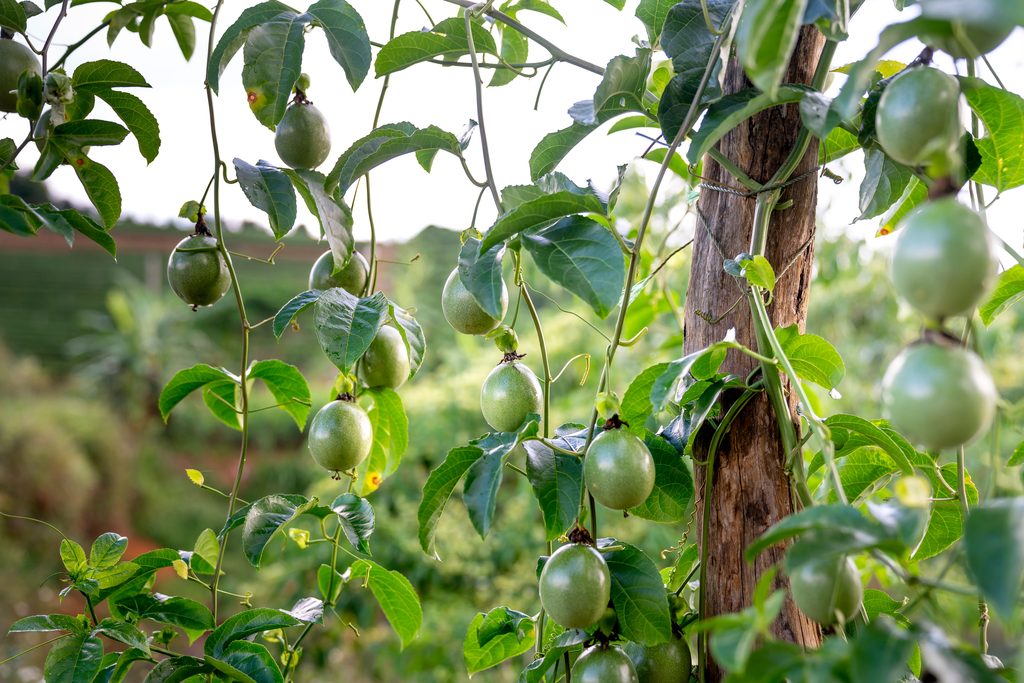
Before diving into the full list, it helps to understand the basics. Only two forms dominate commercial cultivation worldwide: purple passion fruit (Passiflora edulis) and yellow passion fruit (Passiflora edulis var. flavicarpa), according to UF/IFAS Extension.
Purple fruit tends to be smaller, sweeter, and less acidic, generally weighing around 35 grams. Yellow fruit runs larger, often closer to 80 grams, but carries a sharper, more acidic bite. Most modern cultivars are actually crosses between the two, blending size, flavor, and disease resistance.
With that foundation set, here are 25 distinct types worth knowing, spanning commercial cultivars and wild species alike.
1. Purple Passion Fruit (Passiflora edulis f. edulis)
This is the classic passion fruit most people picture: deep purple, wrinkled skin once ripe, with bright orange, aromatic pulp inside. It’s native to southern Brazil and remains the most widely cultivated form globally.
The flavor is sweeter and less acidic than its yellow cousin, making it the preferred choice for fresh eating rather than processing. Fruit size stays modest, generally around 30-45 grams per fruit.
Cold tolerance is its main weakness. Purple passion fruit struggles below USDA zone 9B and is also more prone to certain soil-borne diseases than the yellow type.
2. Yellow Passion Fruit (Passiflora edulis var. flavicarpa)
Yellow passion fruit is the workhorse of the commercial juice industry. It’s larger, more acidic, and notably more vigorous than purple varieties, which makes it the dominant type grown in Hawaii, Brazil, and much of the tropics.
This variety resists certain soil diseases that plague purple passion fruit, according to University of California Cooperative Extension in Ventura County, making it a safer bet in disease-prone soils.
The tradeoff is flavor: yellow passion fruit is less sweet on its own, which is exactly why it’s usually blended into juice rather than eaten straight from the shell.
3. ‘Possum Purple’
‘Possum Purple’ is a popular Florida cultivar, prized by home growers for its reliable fruit set and classic purple passion fruit flavor. It performs well in warm, humid climates typical of central and south Florida.
University of Florida’s Plantings of the Month program lists it among the top recommended cultivars for home gardeners in the state, alongside its resistance to some common regional pests.
If you’re gardening in a frost-free zone and want an authentic, sweet purple passion fruit experience, this cultivar is a dependable starting point.
4. ‘Panama Red’
‘Panama Red’ is a purple-red hybrid cultivar developed for both flavor and ornamental appeal. Its vivid reddish skin stands out on the vine, and the pulp carries a rich, tropical sweetness.
This cultivar is another Florida favorite, recommended by UF/IFAS Extension for home orchards due to its vigorous growth and consistent yields in subtropical conditions.
Gardeners growing for both looks and taste often gravitate toward ‘Panama Red’ since the vine doubles as an attractive flowering screen.
5. ‘Sweet Sunrise’
‘Sweet Sunrise’ is a yellow-leaning hybrid bred to soften the tartness typical of yellow passion fruit. It offers a milder, more approachable flavor while keeping the larger fruit size associated with yellow types.
UF/IFAS Extension names it among Florida’s popular cultivars, appreciated for balancing productivity with a flavor profile closer to what casual fresh-eaters expect.
It’s a solid pick for anyone who finds straight yellow passion fruit too sharp but still wants a vigorous, high-yielding vine.
6. Sweet Granadilla (Passiflora ligularis)
Sweet granadilla is an entirely different experience from typical passion fruit. Its shell is hard, orange, and speckled, more like a small pumpkin than a berry, and it doesn’t wrinkle when ripe.
Inside, the pulp is milder and sweeter than P. edulis, with a gentler floral note. It’s a high-altitude species, thriving in cooler tropical mountain climates across the Andes.
Because it needs cooler nights than most passion fruit types, sweet granadilla is rarely grown outside specialized tropical highland regions.
7. Giant Granadilla (Passiflora quadrangularis)
As the name suggests, this is the largest fruit in the genus, sometimes growing as big as a papaya, weighing several pounds. The vine itself is equally massive, with thick, square-shaped stems.
The pulp is mild and slightly sweet, often used in salads, drinks, or cooked as a vegetable when unripe. It’s a true tropical species, needing warm, humid, frost-free conditions to thrive.
If you have serious trellis space and a warm climate, giant granadilla makes an impressive, conversation-starting addition to a home orchard.
8. Banana Passionfruit (Passiflora tarminiana)
Banana passionfruit gets its name from its elongated, yellow, banana-shaped fruit, a striking departure from the round shape typical of most Passiflora species. The flavor is tart and aromatic.
Native to South American highlands, this species is cold-tolerant compared to tropical lowland types, and it has become naturalized, sometimes invasively, in parts of New Zealand and Hawaii.
Growers should check local regulations before planting, since banana passionfruit is considered a noxious weed in some Pacific regions due to its aggressive spread.
9. Water Lemon (Passiflora laurifolia)
Water lemon, also called yellow granadilla, produces smooth, yellow-orange fruit with a distinctly refreshing, watery-sweet pulp. It’s popular throughout the Caribbean for fresh eating and juice.
The vine is a vigorous climber with fragrant, showy flowers, often grown as much for ornamental value as for fruit production in home gardens.
It requires consistently warm, humid, tropical conditions and does not tolerate frost, limiting it largely to zones 10 and above.
ALSO READ: 17 Best Fruit Trees for Zone 7 (With Care Tips)
10. Maypop (Passiflora incarnata)
Maypop is North America’s native passion fruit, and it’s remarkably cold-hardy compared to its tropical relatives. It survives well into USDA zone 7B, according to UF/IFAS Extension, which is exceptional for this genus.
The fruit is a pale, yellow-green berry that literally “pops” when stepped on or crushed, hence the name. The flavor is mild, and Native American tribes historically used it for food, drink, and medicinal purposes, per USDA plant guide records.
This is the passion fruit for cold-climate gardeners. If you live outside the tropics and still want to grow something in this genus, maypop is likely your best bet.
11. Blue Passionflower (Passiflora caerulea)
Blue passionflower is grown almost entirely for its striking, intricate blue and white blooms rather than its fruit, which is small, orange, and only mildly palatable. It’s one of the most cold-hardy ornamental species available.
This vine tolerates temperatures down to around USDA zone 6 with some winter dieback, making it popular in temperate gardens across Europe and the southern United States.
If your goal is dramatic flowers rather than a fruit harvest, blue passionflower delivers more visual drama than almost any other type on this list.
12. Red Passionflower (Passiflora coccinea)
Red passionflower is a tropical species known for its vivid scarlet-red blooms, among the most vibrant in the entire Passiflora genus. The fruit is edible but generally considered secondary to the ornamental flowers.
Native to the Amazon basin, this species demands warm, humid, frost-free conditions and struggles outside true tropical zones.
Gardeners in zones 10-12 sometimes grow it purely as a specimen vine for its color, rather than for fruit production.
13. Passiflora antioquiensis (Red Banana Passionfruit)
This Colombian native produces elongated red-orange fruit similar in shape to banana passionfruit, but with a more vivid coloring and slightly different flavor profile, leaning sweeter and more aromatic.
It thrives at higher elevations in its native range, preferring cooler nights than lowland tropical species, similar to sweet granadilla in its climate preferences.
It remains relatively rare in cultivation outside South America, appealing mainly to specialty growers and passion fruit collectors.
14. Passiflora mollissima (Banana Poka)
Closely related to banana passionfruit, Passiflora mollissima produces similarly elongated, yellow fruit with a tart, tropical flavor. It’s a vigorous, fast-climbing vine suited to cooler highland tropics.
This species has become invasive in parts of Hawaii, where it smothers native forest canopy, prompting active removal efforts by conservation groups on the islands.
Anyone considering this species should verify local invasive species regulations first, since its aggressive growth habit can quickly outpace a garden trellis.
15. Passiflora alata (Winged-Stem Passionflower)
Passiflora alata is notable for its four-angled, winged stems and large, fragrant, deep red-purple flowers. The fruit is yellow, oval, and pleasantly sweet-tart, popular in parts of Brazil for fresh consumption.
This species prefers warm, humid, tropical conditions similar to standard purple and yellow passion fruit, generally suited to zones 10-11.
It’s grown both commercially in Brazil and ornamentally elsewhere, valued for combining strong fragrance with reliable fruiting.
16. Passiflora foetida (Stinking Passionflower)
Despite the unflattering name, referring to its musky-smelling foliage, this species produces small, edible orange fruit wrapped in a distinctive lacy, thread-like bract. It’s found widely across the tropics as a fast-spreading wild vine.
The fruit flavor is mild and somewhat bland compared to cultivated types, so it’s rarely grown commercially and is more often encountered growing wild along roadsides and disturbed land.
Some regions classify it as a weed due to its aggressive, opportunistic spreading habit in warm climates.
17. Passiflora quadriglandulosa (Giant Granadilla Relative)
This lesser-known tropical species produces large, elongated fruit similar in scale to giant granadilla, though it’s far less common in cultivation. Its flowers are notably large and deep red.
Native to Central and northern South America, it requires warm, consistently humid tropical conditions to thrive and rarely appears outside specialty botanical collections.
It’s primarily of interest to collectors and researchers studying Passiflora diversity rather than home gardeners seeking a reliable fruit crop.
18. Passiflora maliformis (Sweet Calabash)
Sweet calabash produces a hard-shelled, apple-shaped fruit, distinct from the typical wrinkled passion fruit skin. Inside, the pulp is aromatic and mildly sweet, popular in parts of the Caribbean and northern South America.
The vine is moderately vigorous and tolerates a range of tropical soil conditions, though it remains a niche crop compared to standard purple and yellow passion fruit.
It’s mostly grown in home gardens within its native range rather than exported commercially at any real scale.
ALSO READ: 17 Best Fruit Trees for Zone 5 (Identification, With Details)
19. Passiflora tripartita var. mollissima (Curuba)
Known locally as curuba in Colombia and Ecuador, this high-altitude species produces elongated, greenish-yellow fruit with a tart, refreshing flavor commonly used in juices and desserts throughout the Andes.
It requires cool nights and moderate elevation to fruit well, making it unsuitable for hot, humid lowland tropical gardens where standard passion fruit thrives.
Curuba juice is a genuine staple in Andean households, roughly comparable to how orange juice functions in North American kitchens.
20. Passiflora vitifolia (Crimson Passionflower)
Crimson passionflower is prized almost exclusively for its brilliant red, grape-leaf-shaped foliage and blooms, native to Central American rainforests. The fruit is edible but small and not particularly flavorful.
This species requires warm, shaded, humid rainforest-like conditions, making it a challenging but rewarding specimen plant for tropical greenhouse growers.
Hummingbirds are strongly drawn to its blooms, which makes it a popular choice for wildlife gardens in appropriate climates.
21. Passiflora edulis ‘Frederick’
‘Frederick’ is a purple passion fruit cultivar selected for improved cold tolerance relative to standard purple types, developed for growers pushing the edges of typical Passiflora hardiness zones.
It retains the classic sweet, aromatic purple passion fruit flavor while offering slightly better resilience against cooler snaps than unselected wild-type purple vines.
Specialty nurseries in the southeastern United States occasionally carry this cultivar for gardeners in zone 9 hoping to stretch their growing range.
22. Passiflora edulis ‘Nancy Garrison’
‘Nancy Garrison’ is a purple-fruited cultivar valued for its consistently high sugar content and strong, reliable fruit set. It’s a favorite among home growers focused purely on fresh-eating quality.
Like most purple cultivars, it needs warm, frost-free conditions and performs best in USDA zones 9B through 11.
Specialty fruit nurseries sometimes list it specifically for flavor-focused home orchardists rather than commercial-scale producers.
23. Passiflora edulis ‘Black Knight’
‘Black Knight’ is named for its exceptionally dark, near-black purple skin at full ripeness. The flavor stays true to classic purple passion fruit: sweet, aromatic, and rich.
This cultivar is popular in home garden circles for its striking visual appeal alongside dependable fruit production in appropriate tropical and subtropical climates.
As with most purple selections, frost sensitivity remains the main limiting factor for where it can realistically be grown outdoors.
24. Golden Passion Fruit Hybrid Cultivars
Several regional hybrid programs, particularly in Australia and Florida, have developed golden-skinned hybrids that combine yellow passion fruit’s vigor with milder, purple-like sweetness.
These hybrids are often bred specifically for home garden appeal, aiming to remove the sharp acidity that puts off casual fresh-eaters of standard yellow passion fruit.
Availability varies significantly by region, since many of these hybrids remain localized to specific breeding programs rather than being distributed nationally.
25. Ornamental-Only Hybrid Passionflowers
Beyond fruiting types, breeders have created dozens of hybrid ornamental Passiflora cultivars crossed purely for flower color and pattern, with fruit production treated as a secondary or nonexistent trait.
These hybrids range across a huge color spectrum, from nearly white to deep violet and fiery red, and are typically grown on arbors and trellises purely as flowering vines.
If fruit isn’t your priority and you simply want a dramatic flowering vine, an ornamental hybrid may suit a garden better than any fruiting variety on this list.
Choosing the Right Passion Fruit Plant for Your Climate
Climate is the single biggest factor in choosing a passion fruit type. Most commercial varieties, including purple and yellow Passiflora edulis, require USDA zones 9B through 11 and full sun, according to University of Florida IFAS Extension.
If you live in a cooler region, maypop (zone 7B) and blue passionflower (zone 6) are your realistic options. Everything else on this list needs warm, frost-free conditions to survive winter outdoors.
For fresh eating, purple types and their cultivars generally win on sweetness. For juice, cooking, and processing, yellow types and their high-acid relatives tend to perform better and yield more per vine.
ALSO READ: 20 Best Fruit Trees for Zone 6 (Identification, With Details)
A Quick Note on Flavor and Nutrition
Passion fruit pulp is intensely aromatic, and a little goes a long way in recipes. The seeds are entirely edible and are typically eaten right along with the pulp rather than removed.
Vines mature and begin flowering within about a year under good conditions, with productive fruiting generally lasting three to four years, according to University of Florida IFAS Extension research presentations.
Most vines need a strong trellis system. Passiflora species are vigorous climbers, some reaching 20 to 30 feet, so plan your support structure before planting rather than after.
Soil matters too. Well-drained soil is essential across nearly every species on this list, since standing water at the roots invites the fungal and soil-borne diseases that plague purple passion fruit in particular. Raised beds or sloped planting sites can help in heavier soils.
Full sun exposure is another near-universal requirement. Even the shade-tolerant crimson passionflower still benefits from bright, filtered light rather than deep shade, and fruiting types generally need at least six hours of direct sun daily to set a worthwhile crop.
Frequently Asked Questions
What is the difference between purple and yellow passion fruit? Purple passion fruit is smaller, sweeter, and less acid; yellow passion fruit is larger, more acidic, and more disease-resistant in the soil, according to UC Cooperative Extension.
Can passion fruit grow in a cold climate? Most tropical types cannot survive frost. Maypop (Passiflora incarnata) is the most cold-hardy edible option, surviving into USDA zone 7B.
How many species of passion fruit exist? The Passiflora genus includes roughly 550 species, though only a small number produce fruit that’s commonly eaten, according to UF/IFAS Extension.
Do passion fruit vines need another plant nearby to produce fruit? Yellow passion fruit flowers are self-sterile and typically need cross-pollination, while purple types are more often self-fertile, though yields usually improve with more than one vine present.
References
- University of Florida IFAS Extension. Plantings of the Month: Passion Fruit. https://sites.google.com/ufl.edu/plant-of-the-month/January/february/2023-passion-fruit
- University of California Cooperative Extension, Ventura County. Passion Fruit. https://ucanr.edu/county/cooperative-extension-ventura-county/passion-fruit
- University of Florida IFAS Extension. Passiflora edulis: Passion Fruit, Purple Granadilla. Ask IFAS. https://ask.ifas.ufl.edu/topics/passifloraceae
- University of Florida IFAS Extension. Passiflora incarnata: Wild Passion Flower, Maypop. Ask IFAS. https://ask.ifas.ufl.edu/publication/FP457
- USDA Natural Resources Conservation Service. Purple Passionflower (Passiflora incarnata) Plant Guide. https://plants.sc.egov.usda.gov/DocumentLibrary/plantguide/pdf/pg_pain6.pdf
- North Carolina State University Extension Gardener Plant Toolbox. Passiflora incarnata. https://plants.ces.ncsu.edu/plants/passiflora-incarnata/
- Alabama Cooperative Extension System. Native Fruits: Maypop. https://www.aces.edu/blog/topics/forestry/native-fruits-maypop/

Tim M Dave is a gardening expert with a passion for houseplants, particularly cacti and succulents. With a degree in plant biology from the University of California, Berkeley, he has vast experience in gardening. Over the years, he has cultivated a vast collection of desert plants and learned a great deal about how to grow and care for these unique companions.