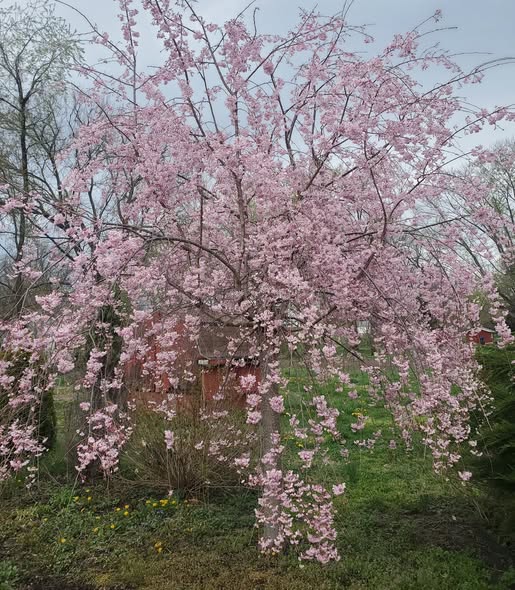
25 Trees That Are in The Rainforest (Names, With Details)
Walk into a tropical rainforest and the first thing you notice is the trees. They rise like pillars, wrapped in vines and dripping with moisture. I find it hard not to feel small in that setting.
Trees are the structure of the rainforest. They shape the climate, feed the animals and support millions of people. Knowing which trees live there helps us understand why these forests matter so much.
This guide covers 25 important rainforest trees from South America, Africa, Asia and Central America. Each one has a role, a story and a reason to be protected.
Why Rainforest Trees Matter
Tropical forests cover only about 7 percent of Earth’s dry land. Yet they probably hold about half of all species on Earth. That is a remarkable return for such a small area.
The Amazon alone shows how rich these forests are. Scientists estimate that Amazonia holds roughly 16,000 tree species, and only 227 of them make up half of all trees. Meanwhile, one hectare of forest typically contains about 250 species of large trees.
Most of those species are rare. A major study of museum specimens listed 11,676 Amazonian tree species, and botanists still find 50 to 200 new ones each year. So the list below is only a small sample of what exists.
How Rainforest Trees Are Organised
Rainforests have four main layers. Knowing them makes the list easier to follow.
- Emergent layer: The tallest trees rise above everything else, often over 45 metres.
- Canopy: A thick green roof that does most of the forest’s photosynthesis.
- Understory: A dim, humid zone with smaller trees and shrubs.
- Forest floor: Dark, damp and full of decomposers.
Many of the giants have shallow roots. They spread wide as buttresses to hold the trees upright in thin tropical soil.
25 Trees That Grow in the Rainforest
1. Kapok (Ceiba pentandra)
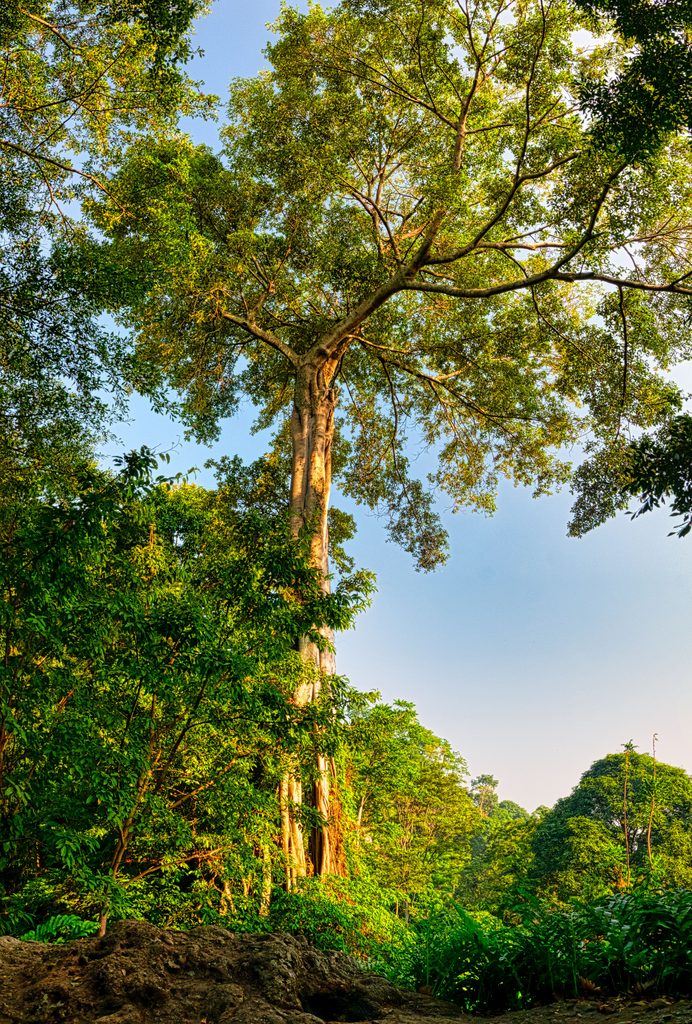
The kapok is often the first tree people name when they think of the rainforest. It has a smooth grey trunk and a wide, umbrella-shaped crown. It stands above the canopy like a lighthouse.
Records list it as growing up to 60 metres, and it can add as much as 4 metres a year. It grows in Central America, the Amazon and West Africa. Its huge buttress roots are an unforgettable sight.
Its seeds sit inside silky fibre, which gives the tree its common name. Birds, bats and insects use the crown for food and shelter. The USDA Forest Service has published a full profile of this species.
2. Brazil Nut Tree (Bertholletia excelsa)
The Brazil nut tree is a true Amazon giant. It grows tall and straight, with a crown that rises above the canopy. Some trees can live up to 1,000 years in undisturbed forest.
Its fruit looks like a hard, woody coconut. Inside are the nuts we eat, which are actually seeds. Only the agouti, a forest rodent, can gnaw the capsule open, and it buries some seeds that grow into new trees.
The tree also depends on large bees for pollination. These bees need certain orchids to survive. If the forest is cleared, the whole chain breaks down. For that reason, Brazil nuts are almost always harvested from wild forest, not plantations.
3. Bigleaf Mahogany (Swietenia macrophylla)
Bigleaf mahogany is one of the most valuable trees in the world. It grows from Mexico to Bolivia. In good conditions it reaches 30 to 40 metres, and sometimes more.
Its reddish-brown wood has been prized for furniture and boats for centuries. That demand led to heavy logging. As a result, international trade in the species is now controlled under CITES Appendix II.
I think mahogany shows both sides of the rainforest story. It is beautiful and useful, but a high price on a tree can threaten its survival. Today conservation programmes work to protect the remaining wild populations.
ALSO READ: 25 Trees to Plant in Memory of Someone (Names, With Pictures)
4. Pará Rubber Tree (Hevea brasiliensis)
The Pará rubber tree is native to the Amazon basin. It grows 20 to 30 metres tall in the wild. A cut in its bark releases a white, milky latex.
That latex became the base of the global rubber industry. Tyres, gloves, seals and many other products still rely on it. Today most natural rubber comes from plantations in Southeast Asia, not from the Amazon.
For the Amazon, rubber tapping once shaped whole communities. Tappers walked set trails through the forest each day. Their work showed that forests can produce income without being cut down.
5. Cacao (Theobroma cacao)
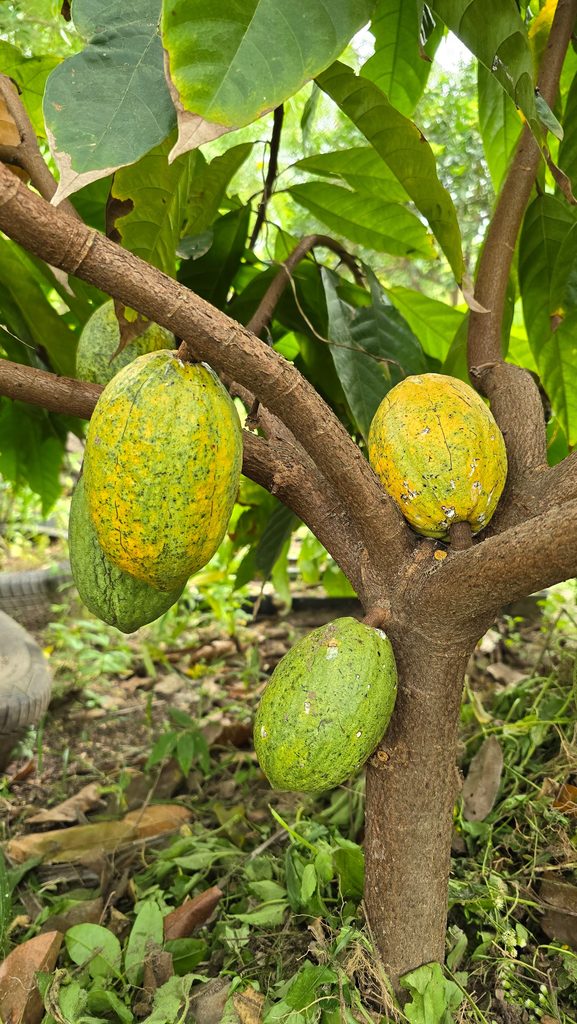
Every chocolate bar begins with this small understory tree. Cacao grows to about 4 to 8 metres and thrives in the shade of taller trees. It is native to the upper Amazon.
The pods grow straight from the trunk and branches. Inside is a sweet white pulp wrapped around the beans. Farmers ferment and dry the beans before turning them into chocolate.
The name Theobroma means “food of the gods” in Greek. Today millions of small farmers around the world depend on cacao. Shade-grown cacao can also protect forest cover and wildlife.
6. Strangler Fig (Ficus species)
Strangler figs begin life high in another tree. A bird or bat drops the seed in a branch fork. The young fig sends roots down to the ground and slowly wraps its host.
Over many decades the host may die and rot away. What remains is a hollow lattice of fig roots. It looks eerie, but it is also a perfect shelter for bats, birds and insects.
Figs are a keystone resource for the forest. More than 750 Ficus species feed over 1,200 species of birds and mammals. Many animals depend on figs when other fruit is scarce.
7. Cecropia (Trumpet Tree)
Cecropia is a fast-growing pioneer tree. It appears first when a gap opens in the forest, after a storm or a landslide. It can grow several metres in a single year.
Its large, hand-shaped leaves have pale undersides that flash silver in the wind. The hollow stems often house Azteca ants. The ants defend the tree from leaf-eating insects and climbing vines.
Sloths and monkeys eat the leaves and fruit. I enjoy spotting these trees along forest edges, because they signal a forest that is healing. They shade the soil until slower, longer-lived trees take over.
ALSO READ: 35 Trees That Grow Well in Clay Soil (With Planting Details)
8. Açaí Palm (Euterpe oleracea)
The açaí palm grows in clusters in the flooded forests of the Amazon estuary. Each stem is slender, and the tree can reach about 20 to 25 metres. The crown has feathery leaves.
Its small purple fruits became a worldwide health food. In northern Brazil, however, açaí has long been a daily staple. Families eat it with fish and manioc flour.
Harvesters climb the thin trunks barefoot, using a loop of cloth around their feet. The palm also produces heart of palm. Careful harvesting can give local people income while keeping the forest standing.
9. Balsa (Ochroma pyramidale)
Balsa is among the fastest-growing trees in the rainforest. In good conditions it can add several metres in a year. It is another pioneer that thrives in sunny gaps.
Its wood is extremely light and soft. That is why it is used for model aeroplanes, surfboards and insulation. It is also used in the cores of wind turbine blades.
Ecuador has long been the main source of commercial balsa. The tree lives only a few decades, so it is quickly replaced. Its big, showy flowers also feed bats and birds at night.
10. Cannonball Tree (Couroupita guianensis)
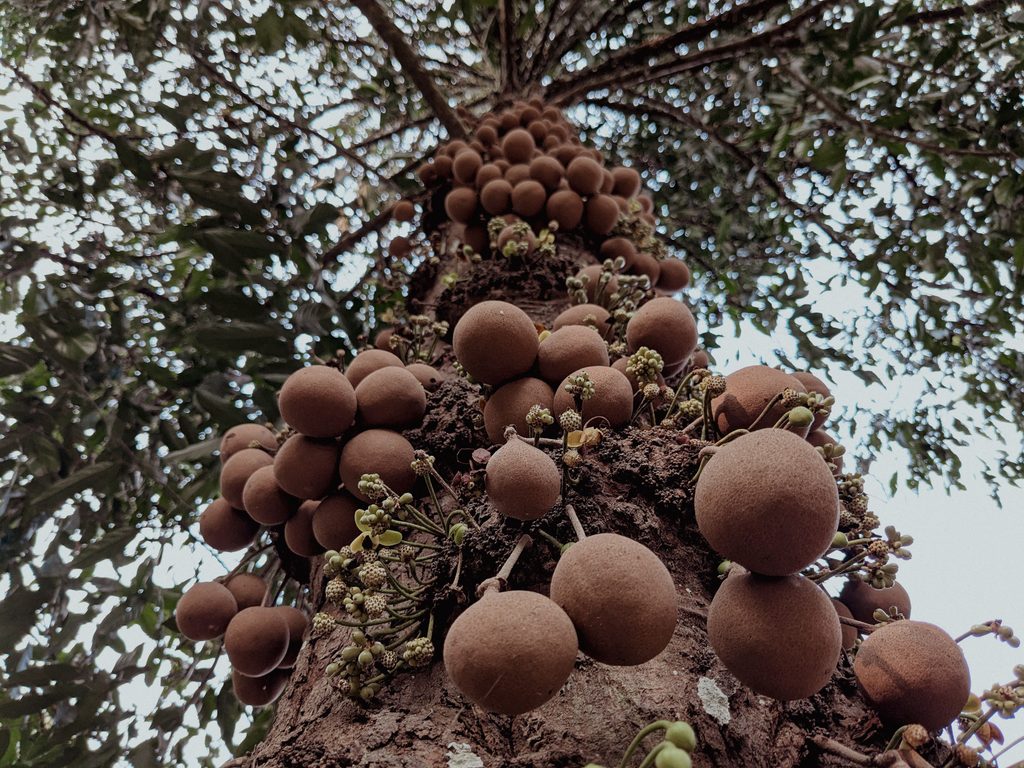
The cannonball tree is named for its round, brown fruits. They are about the size of a large grapefruit and hang in clusters. They can clatter loudly when they fall.
Its flowers are even more unusual. They grow directly from the trunk on long, tangled stalks. They are large, waxy and strongly scented, and they open mostly at night.
The tree belongs to the same family as the Brazil nut. It is native to northern South America. Many botanical gardens grow it, but seeing one in the wild is a special experience.
11. Annatto (Bixa orellana)
Annatto is a small tree, usually 5 to 10 metres tall. It grows in the understory and along forest edges. Its spiky red pods split open to show bright red seeds.
Indigenous peoples of tropical America have used those seeds for centuries. They made body paint, dye and medicine from them. Today annatto still colours cheese, butter and many traditional dishes.
It is a good reminder that useful rainforest plants are not always giants. Small trees like this one support food and culture as well. It also grows easily in home gardens across the tropics.
12. Greenheart (Chlorocardium rodiei)
Greenheart is a famous tree of the Guiana Shield, especially Guyana. It grows tall and straight, often reaching 30 to 40 metres. Its trunk is dense and heavy.
The timber is extremely hard and resists rot and marine borers. For that reason, it has been used for piers, docks and lock gates. Shipbuilders once valued it highly.
Because the wood is so dense, the tree grows slowly. That makes careful forest management essential. Greenheart reminds me that the strongest materials often come from the slowest growth.
13. Okoumé (Aucoumea klaineana)
Okoumé is a tall rainforest tree native to Gabon and nearby parts of Central Africa. It often grows 50 metres or more. Its trunk is long, straight and clear of branches.
The pinkish wood is light and easy to work. It is widely used for plywood and veneer. Gabon has long been a leading exporter of okoumé.
The tree needs open ground to regenerate, so selective logging can sometimes help it. Even so, good management is vital. Without it, harvest rates can outpace regrowth.
14. Iroko (Milicia excelsa)
Iroko is a large tree of West and Central African rainforests. It can reach about 50 metres. Many people call it African teak, though it is not a true teak.
Its golden-brown wood is durable and resists insects and decay. It is used for flooring, doors, boats and furniture. In many African cultures the tree also carries spiritual meaning.
Iroko has become less common in some areas because of heavy logging. It grows slowly and flowers only occasionally. Protecting mature trees is therefore very important.
15. Sapele (Entandrophragma cylindricum)
Sapele is a giant of the African rainforest. It can grow beyond 45 metres, and some trees are much taller. Its trunk is straight, with a broad buttressed base.
The wood has a ribbon-like grain and a deep reddish tone. It looks much like mahogany. Musicians know it well, because it is common in guitars and other instruments.
It is also a popular timber for doors and cabinets. Because trade is high, sustainability is a concern. Certified sources help make sure the tree is harvested more responsibly.
16. Moabi (Baillonella toxisperma)
Moabi is one of the largest trees in the Congo Basin. Mature trees can pass 50 metres and have very wide trunks. Some are centuries old.
Local communities value it for more than timber. The seeds give a rich edible oil. Bees feed on the flowers, and honey is gathered from nearby trees.
Moabi is slow to reproduce, so heavy logging puts it at risk. It is considered threatened in many areas. I think it is a strong example of a tree worth more alive than felled.
ALSO READ: 20 Evergreen Trees That Grow in Shade (With Growing Details)
17. Azobé (Lophira alata)
Azobé is a heavy, tough tree from West and Central Africa. It can grow around 50 metres tall. Its bark is dark and deeply furrowed.
The wood is among the hardest and densest in Africa. It is used in bridges, harbours and railway sleepers. Its strength helps it survive constant exposure to water.
The tree often grows in swampy and riverside forests. This makes it important for stabilising banks. It also shows that rainforest trees suit many different habitats.
18. African Oil Palm (Elaeis guineensis)
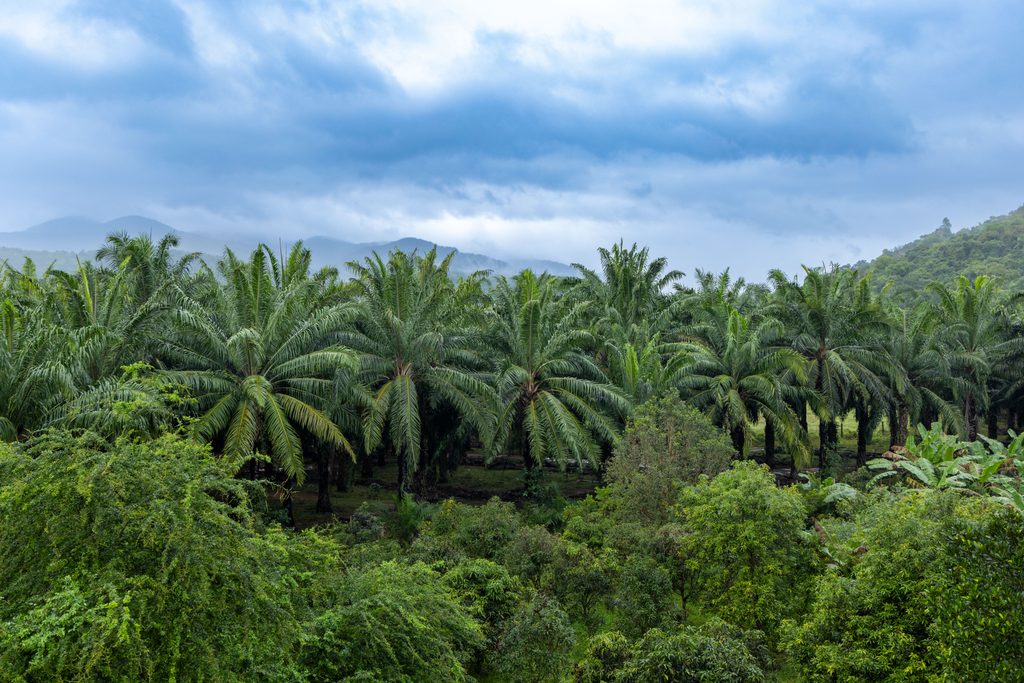
The oil palm is native to the forests of West and Central Africa. It grows 15 to 20 metres tall in the wild. Its fruit grows in heavy bunches.
People in Africa have used palm oil for thousands of years. Today it is one of the world’s most widely used vegetable oils. It is found in food, soap and cosmetics.
This tree has a complicated reputation. Large plantations have replaced rainforest, especially in Southeast Asia. Still, the tree itself is not the problem. The issue is how and where it is grown.
19. Tualang (Koompassia excelsa)
Tualang is a true emergent giant of Southeast Asia. It grows in Malaysia, Indonesia and Brunei. Some trees are reported to exceed 80 metres, making it one of the tallest tropical species.
Its pale, smooth trunk stands out against the dark forest. The branches are often covered in large honeycombs. Giant honey bees build their nests high in the crown.
Honey hunters have climbed these trees for generations. The tree is protected in many regions because of this tradition. It is also a vital habitat for birds and canopy animals.
20. Yellow Meranti (Shorea species)
Shorea trees belong to the dipterocarp family, which dominates lowland forests in Southeast Asia. Many species grow over 60 metres tall. They are the backbone of Borneo’s forests.
These trees often fruit together in mass events. Their winged seeds spin down like tiny helicopters. During these years, wildlife has a huge supply of food.
Meranti timber is used widely for plywood, joinery and furniture. Heavy logging has threatened many dipterocarps. As a result, several species are now listed as endangered.
21. Durian (Durio zibethinus)
Durian grows wild in the forests of Borneo and Sumatra. It is a large tree, often 25 to 40 metres tall. Its crown is open, and its bark is rough.
The fruit is covered in thorns and is famous for its strong smell. Some people love it and some cannot stand it. In Southeast Asia, it is called the “king of fruits”.
Bats pollinate the flowers at night. Wild animals, including orangutans and elephants, eat the fruit. Many forest durians still grow in the wild, which preserves valuable genetic diversity.
22. Bornean Ironwood (Eusideroxylon zwageri)
Bornean ironwood, known locally as belian, is a slow-growing tree of Borneo and Sumatra. It reaches about 35 to 50 metres. Its trunk is straight and very dense.
The wood is extremely hard and durable. It has been used for house posts and roofing shingles that last for decades. In some places, old buildings made of belian are still standing.
Because it grows slowly, overharvesting has caused sharp declines. It is now listed as vulnerable. This is a tree that cannot be replaced quickly once it is gone.
23. Mangosteen (Garcinia mangostana)
Mangosteen is a tropical evergreen of Southeast Asia. It is a smaller tree, often 6 to 25 metres. Its leaves are dark, glossy and leathery.
The fruit has a thick purple rind and sweet, white segments inside. People often call it the “queen of fruits”. It grows best in warm, humid, shaded conditions.
It grows slowly and may take years before bearing fruit. For that reason, it is valued in home gardens. It shows how many rainforest trees give food as well as shade.
24. Kapur (Dryobalanops aromatica)
Kapur is a tall dipterocarp from Sumatra, Malaysia and Borneo. It can rise to 60 metres or more. Its straight trunk makes it a major timber source.
The tree is also known as the camphor tree. Its resin contains camphor, which was once traded widely. Traders sent it across Asia for medicine, incense and ceremonies.
Today kapur is used for construction and flooring. Like other dipterocarps, it has suffered from heavy logging. Protected areas now play a key role in keeping the remaining stands intact.
25. Chicle Tree (Manilkara zapota)
The chicle tree grows in the rainforests of southern Mexico, Belize and Guatemala. It can reach about 30 to 40 metres. Its fruit is the sweet sapodilla.
The Maya tapped the milky latex of this tree long ago. They chewed it as a natural gum. Until synthetic bases arrived, it was the main ingredient in commercial chewing gum.
Chiclecros, as tappers are called, still work in some regions. Tapping leaves the tree alive, so it supports forest income. I find it fitting that a simple everyday habit comes from a rainforest giant.
ALSO READ: 25 Native Hawaiian Trees (With Growing Details)
The Threats Facing Rainforest Trees
Many of these trees face the same pressures. The main one is clearing land for farms and pasture. NASA notes that the biggest direct cause of tropical deforestation is turning the land into cropland and pasture.
Logging is another threat, especially for slow-growing hardwoods. Some trees, like moabi and ironwood, take generations to recover. Fire and climate change add further stress.
Many rare species are also poorly studied. Scientists cannot protect what they have not yet described. That is why continued research matters so much.
What You Can Do to Help
You do not need to travel to the Amazon to make a difference. Small choices add up.
- Buy certified wood and paper with FSC or similar labels.
- Choose shade-grown or certified cacao and coffee.
- Check palm oil sourcing in the products you buy.
- Support rainforest conservation groups and research projects.
- Share what you learn with friends, students and family.
Frequently Asked Questions
What is the tallest tree in the rainforest?
In Southeast Asia, the tualang is among the tallest, with reports of more than 80 metres. In the Amazon, the kapok and Brazil nut tree often reach 50 to 60 metres. Exact record heights vary by source and measurement method.
How many tree species live in the Amazon?
Scientists estimate about 16,000 tree species in Amazonia. Around 11,676 have been formally catalogued so far. Several thousand rare species still await discovery.
Which rainforest trees give us food?
Many do. Cacao gives chocolate, and the Brazil nut tree gives nuts. Açaí, durian, mangosteen and the chicle tree’s sapodilla fruit are also food sources, and the oil palm gives cooking oil.
Final Thoughts
These 25 trees show how varied and valuable rainforests are. Some give us food, some give us timber and some give shelter to countless animals. Others simply stand as living monuments.
I hope this guide helps you see the forest differently. Each tree here is part of a larger, connected system. Protect one, and you help protect many.
References
- USDA Forest Service, Treesearch. Ceiba pentandra (L.) Gaertn. Ceiba, Kapok, silk cotton tree. https://research.fs.usda.gov/treesearch/30402
- USDA Forest Service, Treesearch. Swietenia macrophylla King. Honduras mahogany. https://research.fs.usda.gov/treesearch/30214
- NASA, My NASA Data. Forests and tropical forest deforestation. https://mynasadata.larc.nasa.gov/print/pdf/node/253
- Harvard Medical School, BioNumbers. Fraction of tree species in Amazonia that account for half of all trees (ter Steege et al., Science, 2013). https://bionumbers.hms.harvard.edu/bionumber.aspx?id=112911
- UCLA Institute of the Environment and Sustainability. NASA-funded study brings together researchers to unravel mysteries of tropical forests. https://www.ioes.ucla.edu/news/elsa-ordway-and-virginia-zaunbrecher-for-down-to-earth-nasa-funded-study-brings-together-researchers-from-across-the-world-to-unravel-mysteries-of-tropical-forests
- Embrapa (Brazilian government agricultural research agency). The Pollination of Brazil Nut (Pollination Services for Sustainable Agriculture). https://www.alice.cnptia.embrapa.br/alice/bitstream/doc/1093487/1/I9201EN1.pdf
- University of South Florida, Digital Commons. Effect of Ficus tuerckheimii diameter, host tree presence, habitat and orientation on epiphyte diversity and abundance. https://digitalcommons.usf.edu/tropical_ecology/134

Tim M Dave is a gardening expert with a passion for houseplants, particularly cacti and succulents. With a degree in plant biology from the University of California, Berkeley, he has vast experience in gardening. Over the years, he has cultivated a vast collection of desert plants and learned a great deal about how to grow and care for these unique companions.