25 Native Hawaiian Trees (With Growing Details)
Hawaiʻi is one of the most botanically isolated places on Earth. Sitting over 2,000 miles from the nearest continent, the islands developed plants found absolutely nowhere else.
The numbers back this up. According to the University of Hawaiʻi, roughly 83% of the state’s plant species are endemic, meaning they evolved here and exist here alone. That is one of the highest endemism rates of any place on the planet.
I remember standing in a lava field on Hawaiʻi Island and watching a single ʻōhiʻa tree push up through solid rock. Nothing else moved in that landscape except its bright red flowers swaying in the wind. That image stuck with me.
This guide covers 25 native Hawaiian trees, all either endemic (found only in Hawaiʻi) or indigenous (native here and elsewhere, but arriving without human help). Each entry explains identification, habitat, and the cultural role the tree has played for centuries.
Why Hawaiʻi’s Native Trees Are So Unique
Hawaiʻi’s native plants arrived by what Native Hawaiians call nā ʻekolu M: moana (ocean), makani (wind), and manu (birds). No other method existed before human contact.
That isolation created astonishing diversity. The state’s Division of Forestry and Wildlife estimates roughly 1,400 native vascular plant taxa across the islands, and about 90% occur nowhere else in the world.
Sadly, isolation also creates fragility. Hawaiʻi is often called the endangered species capital of the world, and state wildlife officials report that more than 100 native plant taxa have already gone extinct, with over 200 down to 50 or fewer individuals in the wild.
Every native tree on this list, then, is worth a closer look. Some are common. Others are genuinely rare survivors.
1. ʻŌhiʻa Lehua (Metrosideros polymorpha)
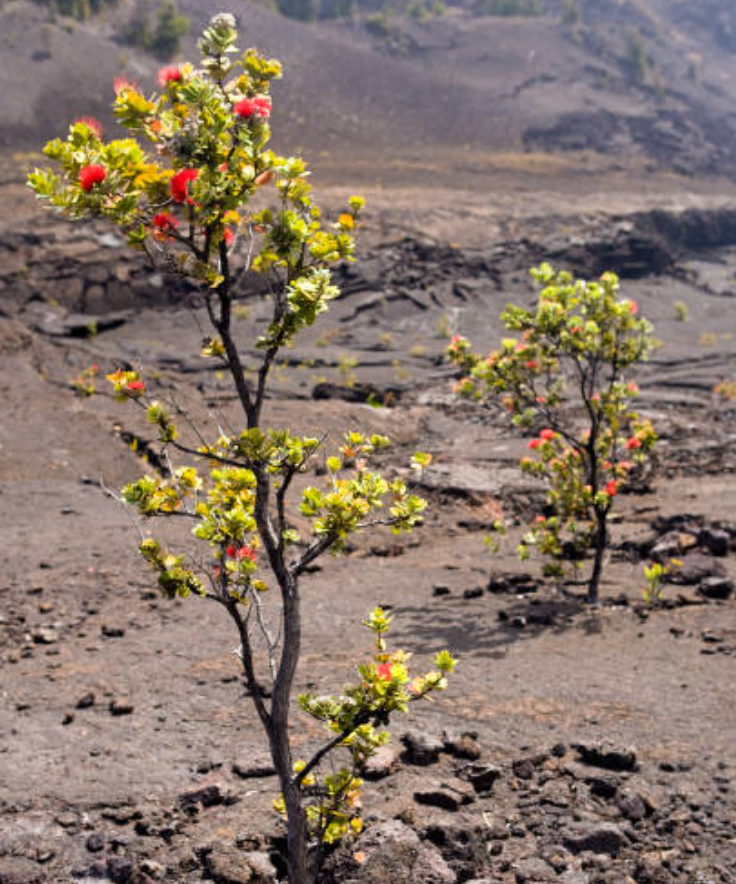
ʻŌhiʻa lehua is the most abundant native tree in Hawaiʻi and arguably its most iconic. According to the National Park Service, it is often the very first plant to colonize fresh lava flows.
Its bright red blossoms, made of long bristle-like stamens, gave the tree deep cultural meaning tied to the volcano goddess Pele. Flowers also appear in yellow and orange, depending on the variety.
ʻŌhiʻa can grow from sea level all the way up to 9,000 feet, taking wildly different shapes along the way. A single species growing as both a shrub and a 100-foot tree is not unusual here.
Unfortunately, a fungal disease called Rapid ʻŌhiʻa Death now threatens forests across the islands, making healthy stands more precious with every passing year.
2. Koa (Acacia koa)
Koa is Hawaiʻi’s premier timber tree, prized for wood that resembles mahogany in color and grain. Early Hawaiians used it almost exclusively for canoe hulls, some reportedly over 100 feet long.
Young koa trees grow feathery, fern-like compound leaves. As the tree matures, true leaves disappear and are replaced by sickle-shaped, flattened leaf stems called phyllodes.
This tree can reach 100 feet tall and acts as a nitrogen-fixing keystone species, improving soil fertility for everything growing nearby. More than 50 endemic insect species have coevolved specifically with koa.
Today, koa wood remains valuable for furniture and ukuleles, which has unfortunately driven heavy historic logging pressure on wild stands.
3. Wiliwili (Erythrina sandwicensis)
Wiliwili is one of Hawaiʻi’s few native deciduous trees, dropping its leaves during the dry summer months to conserve water. Clusters of curved, claw-shaped flowers appear afterward in orange, red, salmon, yellow, or white.
The tree’s name means “repeatedly twisted,” referring to how its seed pods twist open to reveal bright coral-red seeds. According to state forestry records, wiliwili nearly went extinct after an invasive gall wasp arrived in 2005.
A rescue effort released a parasitoid wasp as biocontrol in 2008, which successfully saved the species from collapse. That is a genuine conservation success story.
Because its wood is exceptionally lightweight, early Hawaiians used wiliwili for canoe outriggers and for papa heʻe nalu, the earliest surfboards.
4. Hala (Pandanus tectorius)
Hala is instantly recognizable by its stilt-like prop roots, which brace the tree against coastal winds. Long, spiny-edged leaves spiral around the branches in a distinctive pattern.
This species is indigenous, meaning it arrived in Hawaiʻi naturally and also grows elsewhere across the Pacific. It thrives from shorelines up to roughly 1,000 feet in elevation.
Hala leaves, called lauhala, have been woven into mats, baskets, and hats for generations. That weaving tradition remains actively practiced across the islands today.
Female trees produce large, pineapple-like fruit clusters that break apart into individual keys, which float and helped the species spread across Pacific islands naturally.
ALSO READ: 17 Best Fruit Trees for Zone 8 (With Care Tips)
5. Loulu Palm (Pritchardia species)
Loulu is Hawaiʻi’s only native palm genus, with roughly 19 to 24 species recognized across the islands, most found on just one or two islands each. Fan-shaped fronds distinguish it from any introduced palm.
Archaeological sediment records show loulu forests once dominated Hawaiʻi’s lowlands before Polynesian settlement introduced competing plants and land clearing.
The National Park Service notes that a relict loulu forest survives on Huelo Islet near Molokaʻi, offering a rare glimpse of what ancient lowland Hawaiʻi once looked like.
Most loulu species today are considered rare or endangered, making cultivated specimens in botanical gardens increasingly important for the genus’s survival.
6. Naio (Myoporum sandwicense)
Naio, sometimes called bastard sandalwood, grows across a huge elevation range, from coastal cliffs to nearly 8,000 feet on volcanic slopes. Small white or purplish flowers give way to fleshy fruit.
Its wood has a fragrance reminiscent of true sandalwood, which historically led some traders to substitute it during the sandalwood export boom of the early 1800s.
Naio populations at higher elevations have faced pressure from an invasive thrips insect in recent decades, prompting active monitoring by state forestry staff.
You will find naio growing alongside māmane in dry, high-elevation forest on Hawaiʻi Island, forming one of the state’s more distinctive native plant communities.
7. Māmane (Sophora chrysophylla)
Māmane is instantly recognizable by its bright yellow, pea-shaped flowers and compound leaves made of many small oval leaflets. It is one of the more fire-resistant native trees in Hawaiʻi.
This endemic species dominates high-elevation dry forest on Hawaiʻi Island, particularly around Mauna Kea, where it forms a critical food source for the endangered palila bird.
Early Hawaiians valued māmane’s exceptionally hard wood for adze handles, farming tools, and runners for hōlua sled racing down grassy slopes.
Because palila depend almost entirely on māmane seed pods for food, conservation of this tree is directly tied to the survival of one of Hawaiʻi’s most endangered honeycreepers.
8. Lama (Diospyros sandwicensis)
Lama belongs to the ebony family and was considered sacred in old Hawaiʻi. Its name means “light” or “torch,” and the wood was used to build shrines called hale o Laka, honoring the hula goddess.
Leaves are glossy and leathery, while small orange fruits ripen on female trees. The bark is typically smooth and pale gray.
This species grows in dry to mesic forest across most of the main islands, often as an understory tree beneath taller canopy species.
Because lama regenerates slowly and habitat has shrunk significantly, healthy mature stands are increasingly uncommon outside protected forest reserves.
9. Milo (Thespesia populnea)
Milo is a coastal indigenous tree with heart-shaped leaves and yellow hibiscus-like flowers that fade to a dusky pink or purple by evening. It tolerates salt spray remarkably well.
The reddish-brown wood was historically carved into calabashes and bowls, valued for its rich color and fine grain. Many surviving museum bowls in Hawaiʻi were carved from milo.
This tree grows naturally along shorelines throughout the tropical Pacific and Indian Ocean, not only in Hawaiʻi, which places it firmly in the indigenous rather than endemic category.
Milo remains a popular shade tree in coastal landscaping today, partly because of its resilience and partly out of respect for its traditional uses.
10. ʻIliahi, or Hawaiian Sandalwood (Santalum species)
ʻIliahi refers to several native sandalwood species found across different islands and elevations. The National Park Service notes that only one species, Santalum paniculatum, grows within Hawaiʻi Volcanoes National Park.
Its fragrant heartwood became a major export commodity in the early 19th century, briefly making sandalwood a chief trade good of the Hawaiian Kingdom.
That trade proved unsustainable. Overharvesting decimated wild populations within just a few decades, and many stands never fully recovered.
You can often spot ʻiliahi by its yellowish, light green leaves, which stand out clearly against the darker foliage of surrounding ʻōhiʻa trees.
ALSO READ: 17 Fruit Trees for Zone 9 (Identification, With Details)
11. Kolea (Myrsine species)
Kolea, sometimes called kolea lau nui or kolea lau liʻi depending on the species, produces small dark berries that feed native forest birds. Leaves often show a reddish tint when young.
Early Hawaiians extracted a red dye from the tree’s sap, which was used in traditional decoration and textile work.
This genus includes several endemic species distributed across wet and mesic forests on multiple islands, each adapted to slightly different elevation bands.
Kolea typically grows as a mid-canopy tree, filling the layer between towering ʻōhiʻa and the low ferns and shrubs of the forest floor.
12. Alaheʻe (Psydrax odorata)
Alaheʻe produces small, intensely fragrant white flowers that bloom in dense clusters, filling the surrounding forest with sweet scent during flowering season.
This indigenous species has extremely hard, dense wood, which early Hawaiians favored for making ʻōʻō, a digging tool used in traditional farming.
Glossy, deep green leaves make alaheʻe a popular choice in native landscaping today, valued for its low water needs and year-round attractive foliage.
It grows in dry to mesic forest across most main islands, often tolerating drought conditions that would stress many other native species.
13. Hōʻawa (Pittosporum species)
Hōʻawa includes multiple native species, most producing distinctive seed capsules that split open to reveal seeds coated in sticky, bright orange or black pulp.
Leaves cluster near branch tips in a whorled pattern, giving the tree a tidy, ornamental appearance that has made it popular in native garden design.
This genus shows strong diversification across the islands, with some species restricted to single valleys or mountain ranges, a pattern common among Hawaiʻi’s endemic plants.
Several hōʻawa species are considered rare, and habitat loss from invasive plants and grazing animals remains an ongoing conservation concern.
14. ʻŌhe Makai (Reynoldsia sandwicensis)
ʻŌhe makai is a striking endemic tree with a smooth, pale gray trunk and large, hand-shaped compound leaves that drop during the dry season.
The National Park Service highlights a rare stand of ʻōhe makai and wiliwili forest within Kauhakō Crater on Molokaʻi, describing it as one of the last windward examples of native lowland dry forest.
This tree’s deciduous habit closely mirrors wiliwili, and the two species are frequently found growing together in the same harsh, dry lowland habitats.
Because lowland dry forest has been reduced to a small fraction of its original extent statewide, surviving ʻōhe makai populations carry significant conservation value.
15. Uhiuhi (Caesalpinia kavaiensis)
Uhiuhi is one of Hawaiʻi’s rarest native trees, with only a small number of wild individuals remaining across dry forest sites on a few islands. It produces clusters of small red and yellow flowers.
The wood is exceptionally dense and heavy, historically prized for weapons and tools because it could hold a sharpened edge and resist wear.
This species is federally listed as endangered, and active outplanting programs work to reestablish uhiuhi in protected dryland forest reserves.
Seeing uhiuhi in the wild today is a genuinely rare experience, one that underscores how much of Hawaiʻi’s original dry forest has already disappeared.
16. Pāpala Kēpau (Pisonia species)
Pāpala kēpau produces an unusually sticky fruit coating, historically used by Native Hawaiians to trap birds for their feathers, which decorated capes and helmets for aliʻi, or chiefs.
Leaves are broad and often slightly glossy, growing on trees that can reach considerable height in wet to mesic native forest.
This genus appears on the current state forestry species list, reflecting its ongoing ecological and cultural relevance across several islands.
Because feather-gathering practices required live capture and release, pāpala kēpau represents a fascinating example of sustainable traditional resource use.
17. ʻAʻaliʻi (Dodonaea viscosa)
ʻAʻaliʻi is remarkably adaptable, growing as a small tree or shrub from coastal cliffs to high mountain slopes above 8,000 feet. Its papery, winged seed capsules turn a striking red or pink.
This indigenous species occurs naturally across many Pacific islands and beyond, not solely in Hawaiʻi, yet remains a defining part of native dryland landscapes here.
Early Hawaiians used the reddish seed capsules in lei making and extracted dye from the wood and fruit for kapa cloth decoration.
Because ʻaʻaliʻi tolerates poor soil, wind, and drought so well, it is one of the more commonly planted native species in modern xeriscaping projects.
ALSO READ: 17 Fruit Trees for Zone 10 (With Growing Details)
18. Naupaka Kahakai (Scaevola taccada)
Naupaka kahakai grows along beaches throughout Hawaiʻi, forming a tough, salt-tolerant shrub or small tree that helps stabilize coastal dunes against erosion.
Its unusual half-flower shape, appearing as though someone tore a normal flower in two, has generated a popular Hawaiian legend involving separated lovers.
White fruits float easily in seawater, which explains how this indigenous species spread naturally across so many Pacific island shorelines over time.
You will find naupaka kahakai on nearly every accessible beach in the islands, often forming dense coastal hedges just above the highest tide line.
19. Hala Pepe (Chrysodracon species, formerly Pleomele)
Hala pepe produces clusters of small, fragrant yellow-green flowers at the ends of its branches, followed by round orange fruit that birds readily consume.
This endemic genus includes several species, some critically rare. Research from the University of Hawaiʻi has documented shrinking wild populations tied to grazing pressure and limited natural seedling establishment.
Hala pepe held ceremonial importance in old Hawaiʻi, planted as one of five sacred plants on hula altars dedicated to the goddess Laka.
Its narrow, sword-like leaves radiate outward from branch tips, giving mature trees a somewhat palm-like silhouette despite being unrelated to true palms.
20. Māmaki (Pipturus albidus)
Māmaki is a member of the nettle family that lost its stinging hairs after arriving in Hawaiʻi, where no browsing predators required that defense. Leaves show prominent, easily visible veins.
Dried māmaki leaves have long been brewed into a mild, calming herbal tea, a tradition experiencing a strong revival in recent years across the islands.
This tree also served as an important fiber source for kapa cloth production, valued for producing a finer material than some other bark fiber sources.
According to the National Park Service, māmaki is a favored host plant for the pulelehua, or Kamehameha butterfly, one of only two butterfly species native to Hawaiʻi.
21. Olopua (Nestegis sandwicensis)
Olopua, sometimes called Hawaiian olive for its resemblance to the Mediterranean species, produces small dark fruit and glossy evergreen leaves.
This endemic tree grows in dry to mesic forest across most main islands, often reaching considerable size and age where undisturbed habitat remains.
Its wood is notably hard and durable, historically used by Native Hawaiians for tool handles and construction elements requiring strength.
Olopua often grows alongside lama and alaheʻe in mixed dryland forest, forming part of a native plant community that has become increasingly rare statewide.
22. Kauila (Colubrina oppositifolia)
Kauila produces exceptionally hard, dense wood, among the heaviest of any native Hawaiian tree species, historically shaped into weapons, spears, and digging implements.
This endemic species is now federally listed as endangered, with wild populations reduced to scattered individuals across dry forest remnants on a handful of islands.
Small greenish flowers appear inconspicuously, easy to overlook compared to the tree’s dramatic cultural and historical significance.
Conservation programs continue working to propagate kauila in nurseries for eventual reintroduction into protected native forest reserves.
23. Ahakea (Bobea species)
Ahakea includes several endemic species distributed across wet and mesic forest zones on different islands, each adapted to local elevation and rainfall patterns.
The wood was historically used by early Hawaiians for canoe gunwales, the raised side pieces that helped keep water out of voyaging and fishing canoes.
Small, tubular flowers give way to fleshy fruit favored by native forest birds, making ahakea a quietly important part of forest food webs.
Because ahakea often grows in the same wet forest zones threatened by invasive plant species, its long-term outlook depends heavily on ongoing habitat restoration work.
24. Pilo (Coprosma species)
Pilo includes at least five species found within Hawaiʻi Volcanoes National Park alone, according to the National Park Service, each with long, opposite-paired leaves.
Female pilo trees produce red or orange berries that serve as an important food source for native honeycreepers like the ʻōmaʻo.
This genus shows the kind of localized diversification typical of Hawaiian native plants, with different species often restricted to specific islands or elevation bands.
Pilo generally grows as a mid-story tree within wet native rainforest, filling ecological space between the tall ʻōhiʻa canopy and the forest floor.
25. Kokiʻo (Native Hawaiian Hibiscus, Hibiscus species)
Kokiʻo refers to several endemic Hawaiian hibiscus species, including kokiʻo keʻokeʻo (white) and kokiʻo ʻulaʻula (red), both featured on the state’s official native plant list.
These trees produce large, showy flowers considerably bigger than most ornamental hibiscus varieties commonly seen in gardens today.
Kokiʻo grows in dry to mesic forest, and several species or subspecies are considered rare, restricted to specific valleys or mountain slopes on individual islands.
As one of Hawaiʻi’s most visually striking native trees, kokiʻo remains a favorite for native garden restoration projects aiming to bring color back to dryland landscapes.
Final Thoughts
Twenty-five trees represent only a small slice of Hawaiʻi’s roughly 1,400 native plant taxa. Still, I hope this list gives you a genuine starting point for recognizing the forest around you.
Many of these species face real conservation pressure. Supporting native plant nurseries, volunteering with restoration groups, or simply learning to identify these trees all help keep Hawaiʻi’s botanical heritage intact.
These trees survived millions of years of isolation to become entirely their own. That is a story worth protecting, one forest at a time.
References
- Hawaiʻi Department of Land and Natural Resources, Division of Forestry and Wildlife – Plants in Hawaiʻi. https://dlnr.hawaii.gov/forestry/plants/
- Hawaiʻi Department of Land and Natural Resources – Wiliwili Species Profile. https://dlnr.hawaii.gov/forestry/plants/wiliwili/
- Hawaiʻi Department of Land and Natural Resources – Rare Plant Species, Native Ecosystems Program. https://dlnr.hawaii.gov/ecosystems/rare-plants/species/
- National Park Service – Trees, Hawaiʻi Volcanoes National Park. https://home.nps.gov/havo/learn/nature/trees.htm
- USDA Forest Service Research and Development – Common Forest Trees of Hawaii (Native and Introduced). https://research.fs.usda.gov/treesearch/33502
- University of Hawaiʻi at Mānoa, College of Tropical Agriculture and Human Resources – Wiliwili (Publication OF-10). https://www.ctahr.hawaii.edu/oc/freepubs/pdf/OF-10.pdf
- University of Hawaiʻi System News – Islands Host One-Third of Earth’s Plant Species, Conservation Needed. https://www.hawaii.edu/news/2024/10/16/islands-host-one-third-earths-plants/

Tim M Dave is a gardening expert with a passion for houseplants, particularly cacti and succulents. With a degree in plant biology from the University of California, Berkeley, he has vast experience in gardening. Over the years, he has cultivated a vast collection of desert plants and learned a great deal about how to grow and care for these unique companions.