25 Trees Native to Alaska (With Growing Details)
Alaska does not look like a place built for trees. Most people picture ice, tundra, and treeless mountains stretching to the horizon.
Yet the state holds roughly 129 million forested acres, according to the Alaska Forest Association. That is more forest than the size of California and Texas combined.
I found this surprising the first time I looked into it. Alaska’s forests split into two very different worlds, and that split shapes everything on this list.
The Interior boreal forest covers the cold, dry middle of the state. The coastal temperate rainforest hugs the Panhandle and Southcentral coast, soaked by up to 220 inches of rain a year.
Only 32 tree species are considered truly native to Alaska, according to the U.S. Forest Service’s official Guide to Alaska Trees. That is a small number for such a massive state.
This guide walks through 25 of the most important native trees, covering conifers, broadleafs, and the hardy shrubs that occasionally grow tall enough to count as trees.
Let’s get into it.
Quick Facts Before We Begin
Alaska’s forests are not evenly spread. Here are a few numbers worth knowing first.
- The Tongass National Forest covers nearly 17 million acres, making it the largest national forest in the United States.
- The Chugach National Forest spans 5.9 million acres, the second-largest in the country.
- Alaska has only 8 Tree City USA communities, a small figure that reflects how sparse urban forestry still is in the state.
- Only one invasive tree species is currently flagged as a serious concern statewide.
With that context set, here are the 25 native trees that define Alaska’s landscape.
1. Sitka Spruce (Picea sitchensis)
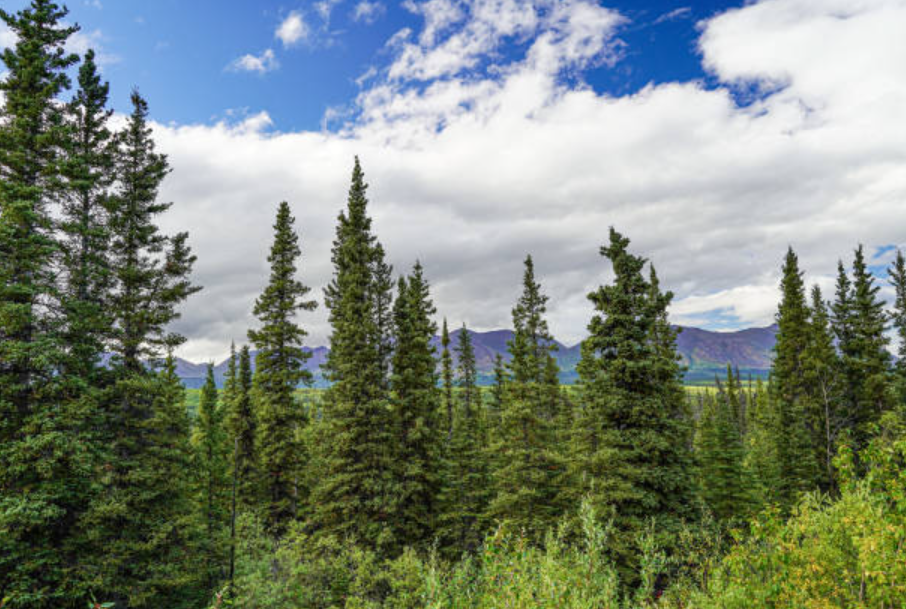
Sitka spruce is Alaska’s official state tree, and for good reason. It is the largest spruce species on Earth, often reaching 120 to 180 feet tall with trunks 3 to 5 feet wide.
Its native range runs from Kodiak Island in the north down to northern California. Some individual trees have been documented living over 700 years.
The bark is thin, purplish-gray, and scaly. Needles are stiff, sharp, and flattened, which makes them easy to tell apart from softer hemlock needles.
I think this tree earns its reputation. Standing beneath an old-growth Sitka spruce in the Tongass feels less like visiting a forest and more like standing inside a cathedral.
2. White Spruce (Picea glauca)
White spruce dominates the Interior uplands, where winters are brutally cold and summers are short. It tolerates permafrost-adjacent soils better than most conifers its size.
The needles have a distinct, somewhat unpleasant smell when crushed, which locals sometimes call a “skunk” odor. This is actually a handy identification trick.
Mature trees typically reach 40 to 100 feet, with a narrow, spire-like crown built to shed heavy snow. Cones are small, light brown, and hang downward.
White spruce is also a major timber species used for construction lumber and paper pulp across the Interior.
3. Black Spruce (Picea mariana)
Black spruce thrives where almost nothing else can. It grows in poorly drained bogs and permafrost wetlands, often stunted and scraggly compared to its cousins.
Its shallow root system adapts to shallow, frozen soil layers. Because of this, black spruce forests are sometimes called “drunken forests,” since trees lean at odd angles as the permafrost shifts beneath them.
Height rarely exceeds 30 feet in harsh sites, though better-drained locations allow taller growth. The small, tight cones can persist on branches for years.
This tree is a quiet survivor. It rarely gets the spotlight, but it holds together some of Alaska’s toughest wetland ecosystems.
4. Lutz Spruce (Picea × lutzii)
Lutz spruce is a natural hybrid between white spruce and Sitka spruce. It occurs where the two parent species’ ranges overlap, mainly on the Kenai Peninsula and Southcentral coast.
Identifying it takes practice, since it shows intermediate traits: needles softer than Sitka but stiffer than white spruce.
Foresters value Lutz spruce because it often combines the cold tolerance of white spruce with the growth rate of Sitka spruce.
It is a great example of how Alaska’s overlapping climate zones create unique botanical mixes you will not find anywhere else.
ALSO READ: 20 Types of Spruce Trees (Identification With Pictures, and Uses)
5. Western Hemlock (Tsuga heterophylla)
Western hemlock is the most common tree in Southeast Alaska’s rainforest, often growing alongside Sitka spruce. It can reach 150 to 200 feet, making it the largest hemlock species in the world.
Its northwestern range limit sits on the Kenai Peninsula, marking the edge of where coastal rainforest conditions still exist.
The needles are short, flat, and uneven in length, giving the branch tips a soft, feathery look. The drooping leader at the top of the tree is a reliable field mark.
Western hemlock wood is widely used for pulp and construction, and it supports a huge share of the Tongass timber economy.
6. Mountain Hemlock (Tsuga mertensiana)
Mountain hemlock takes over at higher elevations where western hemlock struggles. It tolerates heavy snowpack and shorter growing seasons better than its lowland relative.
Maximum height tops out around 140 feet, noticeably shorter than western hemlock under ideal conditions.
Its needles are bluish-green and arranged more evenly around the twig, unlike the flat spray pattern of western hemlock. Cones are also longer and more cylindrical.
You will often find this species forming the timberline boundary in Southeast and Southcentral Alaska’s mountains.
7. Alaska Yellow-Cedar (Callitropsis nootkatensis)
Alaska yellow-cedar, sometimes called Alaska cypress, produces some of the most durable, rot-resistant wood in North America. It grows slowly, which concentrates natural oils that repel decay.
It favors poorly drained, cool coastal sites, often alongside mountain hemlock and western redcedar.
Foliage droops in flattened, scale-like sprays with a slightly unpleasant odor when crushed. The bark peels in long gray-brown strips.
Unfortunately, this species faces a documented die-off problem across parts of Southeast Alaska, linked to reduced snowpack exposing roots to freeze damage.
8. Western Redcedar (Thuja plicata)
Western redcedar reaches its northern range limit in Southeast Alaska, generally not extending much beyond the southern Panhandle. It is culturally significant, historically used by coastal Indigenous peoples for canoes and totem poles.
The foliage grows in flat, glossy sprays with a pleasant, aromatic scent, distinct from the sharper smell of yellow-cedar.
Mature trees can live for over 1,000 years in ideal old-growth conditions, though Alaska’s populations tend to be younger due to the region’s more recent glacial history.
Bark is fibrous, reddish-brown, and easily stripped in long vertical shreds.
9. Shore Pine (Pinus contorta)
Shore pine is Alaska’s coastal variant of lodgepole pine. It grows in bogs, muskegs, and rocky coastal outcrops where soil is thin and poorly drained.
Trees are often twisted and stunted in exposed sites, rarely exceeding 30 to 40 feet in Alaska, compared to much taller inland lodgepole pine stands further south.
Needles grow in bundles of two, and cones are small with a slightly asymmetrical shape.
This is one of the few pine species that pushes this far north along the Pacific coast, making it a notable edge-of-range specialist.
10. Tamarack (Larix laricina)
Tamarack, also called Alaska larch, is unusual among conifers because it is deciduous. Its needles turn golden yellow in autumn and drop completely for winter.
It grows in Interior bogs and wetland margins, often alongside black spruce, and tolerates poor drainage well.
Soft needles grow in small clusters along the branches, giving the tree a delicate, feathery appearance in summer.
I always find tamarack a pleasant surprise for visitors who assume every Alaska conifer stays green year-round.
11. Subalpine Fir (Abies lasiocarpa)
Subalpine fir grows at higher elevations, mainly in parts of Southcentral and along mountain slopes bordering the coastal rainforest zone. It forms a narrow, spire-shaped crown adapted to heavy snow loads.
Needles curve slightly upward and feel soft to the touch, unlike the stiffer needles of spruce species.
Cones stand upright on the branches, a key identification feature separating true firs from spruce and hemlock.
This species marks some of Alaska’s highest-elevation tree growth before the landscape gives way to alpine tundra.
12. Pacific Silver Fir (Abies amabilis)
Pacific silver fir reaches its northern range limit in Alaska’s southern Panhandle, near Ketchikan. Beyond this point, conditions become too harsh for the species to persist.
It favors cool, moist forests with consistent snowpack, often growing beneath a canopy of larger hemlock and spruce.
Needles are flattened, glossy dark green above, with two white bands underneath, giving the tree its “silver” name.
Because its Alaska range is so limited, spotting this tree feels like finding the edge of a much larger Pacific Northwest ecosystem.
13. Quaking Aspen (Populus tremuloides)
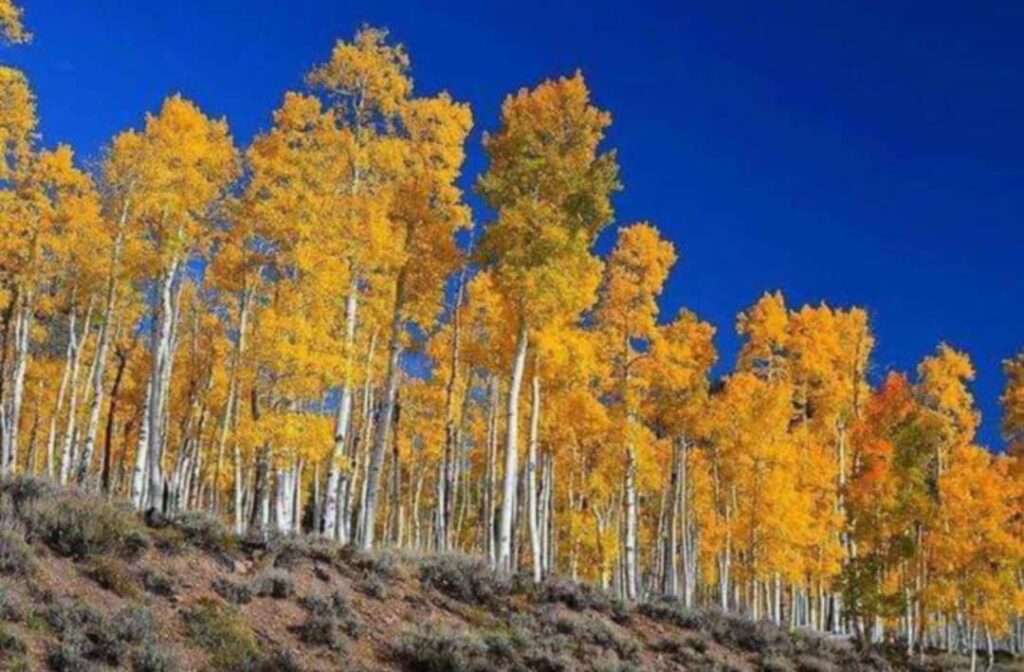
Quaking aspen is one of the most widely distributed trees in North America, and it plays a major role in Alaska’s Interior uplands. Its leaves flutter constantly in even light wind, thanks to flattened leaf stems.
Bark is smooth and pale greenish-white when young, darkening and roughening with age.
Aspen often spreads through root suckering, meaning a single genetic individual can form an entire connected grove.
Fall color turns brilliant gold, creating some of the Interior’s most photographed autumn scenery.
14. Balsam Poplar (Populus balsamifera)
Balsam poplar grows along Interior floodplains and riverbanks, where seasonal flooding creates fresh, disturbed soil ideal for seedling establishment. Its sticky, resinous buds release a strong, sweet fragrance in spring.
Mature trees can reach 60 to 80 feet, with a straight trunk and open, rounded crown.
Leaves are broad, dark green above, and pale underneath, turning yellow in fall.
This species is closely tied to river ecosystems, stabilizing banks and providing habitat along countless Interior waterways.
15. Black Cottonwood (Populus trichocarpa)
Black cottonwood is the largest broadleaf tree native to Alaska, and one of the largest hardwoods in North America. It grows mainly along Southcentral and coastal floodplains.
Trees can exceed 100 feet in height under favorable river-bottom conditions, with thick, deeply furrowed bark at maturity.
Its cottony seeds drift in massive numbers each early summer, sometimes described as “cottonwood snow” by locals.
This tree is closely related to balsam poplar, and the two are sometimes classified as subspecies rather than separate species.
16. Alaska Paper Birch (Betula neoalaskana)
Alaska paper birch is the Interior’s signature birch, easily identified by its peeling white bark. Indigenous communities historically used the bark for canoes, baskets, and shelter coverings.
It grows on well-drained upland slopes, often mixed with white spruce and aspen.
Leaves are oval with toothed edges, turning bright yellow in autumn.
Birch sap is also tapped commercially in parts of the Interior, supporting a small but growing syrup industry.
17. Paper Birch (Betula papyrifera)
Paper birch overlaps in range with Alaska paper birch and is closely related, sometimes causing identification confusion even among botanists. Both share the recognizable white, papery bark that peels in thin horizontal strips.
It favors similar upland, well-drained soils across the Interior and parts of Southcentral.
Mature height typically reaches 50 to 70 feet, with a slender trunk and open crown.
This species holds strong cultural and practical value, historically supplying bark for canoes and containers across northern North America.
18. Kenai Birch (Betula kenaica)
Kenai birch is a more localized species, concentrated on the Kenai Peninsula and nearby Southcentral areas. Some botanists consider it closely related to, or a variant of, paper birch.
It tends to grow in similar upland forest settings, often alongside white spruce and cottonwood.
Bark is white to pinkish-brown, peeling in thin curls, slightly different in tone from Interior paper birch populations.
Because its range is narrower, Kenai birch offers a good example of Alaska’s regional plant diversity within a single genus.
19. Red Alder (Alnus rubra)
Red alder grows almost exclusively in coastal Southeast and Southcentral Alaska, rarely extending into the Interior. It is a fast-growing pioneer species, often the first tree to colonize disturbed or logged ground.
Its roots host nitrogen-fixing bacteria, which enrich poor soils and prepare the ground for slower-growing conifers later on.
Bark is smooth and gray, often covered in pale lichen patches.
Red alder wood is prized locally for smoking salmon, giving the tree a strong culinary connection across coastal communities.
20. Sitka Alder (Alnus viridis ssp. sinuata)
Sitka alder often grows as a large shrub rather than a true tree, but it reaches tree size in favorable coastal and subalpine sites. It commonly forms dense thickets on avalanche slopes and disturbed hillsides.
Like red alder, it fixes nitrogen in the soil, helping stabilize slopes after landslides or avalanches.
Leaves are shiny, dark green, and sharply toothed, distinguishing it from the duller leaves of red alder.
This species plays an outsized ecological role in slope stabilization across mountainous coastal terrain.
21. Thinleaf Alder (Alnus incana ssp. tenuifolia)
Thinleaf alder is the Interior’s main alder species, growing along stream banks and floodplains across the boreal forest. It usually stays shrub-sized but can develop a small tree form in sheltered sites.
It shares the nitrogen-fixing trait common to the alder genus, improving soil fertility along waterways.
Leaves are dull green, oval, and finely toothed, with visible parallel veins.
Moose and other wildlife rely on thinleaf alder thickets for both browse and cover throughout the Interior.
22. Sitka Willow (Salix sitchensis)
Sitka willow grows along coastal streams and wetland edges, occasionally reaching small tree height in favorable conditions. Most Alaska willows stay shrubby, making Sitka willow one of the few that regularly qualifies as a tree.
Leaves are narrow, silvery underneath, with fine silky hairs.
It plays an important role stabilizing streambanks and providing early-season pollen for insects emerging from winter.
Its flexible branches were traditionally used for basketry among coastal Indigenous groups.
23. Bebb Willow (Salix bebbiana)
Bebb willow is widespread across Interior Alaska, growing along riverbanks, meadows, and disturbed sites. It can develop a small, multi-stemmed tree form under good growing conditions.
Leaves are dull green above and paler, slightly hairy underneath, with a distinctive net-like vein pattern.
This species is an important moose browse plant, especially in winter when other food sources become scarce.
Bebb willow’s adaptability to disturbed ground makes it one of the first species to recolonize burned or cleared land.
24. Scouler’s Willow (Salix scouleriana)
Scouler’s willow grows across both Interior and coastal Alaska, favoring drier upland sites compared to most willow species. It is one of the few willows that regularly reaches genuine small-tree stature.
Its fuzzy, gray-green catkins appear early in spring, making it a critical early pollinator resource before most other plants flower.
Leaves are broad, slightly leathery, with a pale, hairy underside.
Wildlife, including moose and grouse, rely heavily on this species for both browse and cover.
25. Feltleaf Willow (Salix alaxensis)
Feltleaf willow is the largest and most cold-tolerant willow in Alaska, ranging from Interior river valleys to the edges of Arctic tundra. It is one of the few woody plants that grows this far north and this large.
Leaves are covered in dense, felt-like white hairs, giving the species its name and helping it retain moisture in dry, windy environments.
It regularly reaches small tree size along major river corridors, sometimes exceeding 20 feet.
Feltleaf willow marks one of the true northern frontiers of tree growth in North America.
Frequently Asked Questions
How many tree species are native to Alaska? Roughly 32 species are officially recognized as native, according to the U.S. Forest Service’s Guide to Alaska Trees. This list covers 25 of the most widespread and ecologically important ones.
What is the tallest tree in Alaska? Sitka spruce holds this title. It regularly reaches 120 to 180 feet, and some coastal old-growth individuals have exceeded 200 feet in height.
Are there palm trees or oak trees in Alaska? No. Alaska’s climate is too cold for oaks, maples, or palms to grow natively. Its native trees are limited mainly to conifers, birches, poplars, alders, and willows.
Does Alaska have deciduous conifers? Yes. Tamarack, also called Alaska larch, is a conifer that drops its needles every autumn, unlike spruce, hemlock, or cedar species.
Final Thoughts
Alaska’s native trees tell a story of extremes. Some, like Sitka spruce, grow into 700-year-old giants along a soaked coastline.
Others, like feltleaf willow, barely qualify as trees at all, clinging to survival at the edge of the Arctic. Both belong equally to this remarkable, misunderstood landscape.
I hope this list changes how you picture Alaska. It is not a treeless wilderness. It is one of the most ecologically layered forest regions left in North America.
Next time someone assumes Alaska is all ice and tundra, you will have 25 good reasons to correct them.
References
- USDA Forest Service, Common Trees of Alaska — https://www.fs.usda.gov/media/240556
- USDA Forest Service, Tongass National Forest, About the Area — https://www.fs.usda.gov/r10/tongass/about-area
- USDA Natural Resources Conservation Service, Southeast Alaska Plant List — https://www.nrcs.usda.gov/sites/default/files/2022-10/Plant%20List%20Southeast.pdf
- U.S. Government Publishing Office, Guide to Alaska Trees, USDA Agriculture Handbook No. 472 — https://www.govinfo.gov/content/pkg/GOVPUB-A-PURL-gpo27157/pdf/GOVPUB-A-PURL-gpo27157.pdf
- University of Alaska Fairbanks Cooperative Extension Service, Landscape Plants for Alaska — https://www.uaf.edu/ces/garden/landscape-plants/
- Alaska Department of Natural Resources, Division of Forestry & Fire Protection — https://forestry.alaska.gov/
- Alaska Department of Natural Resources, About the Department — https://dnr.alaska.gov/commis/pic/about.htm

Tim M Dave is a gardening expert with a passion for houseplants, particularly cacti and succulents. With a degree in plant biology from the University of California, Berkeley, he has vast experience in gardening. Over the years, he has cultivated a vast collection of desert plants and learned a great deal about how to grow and care for these unique companions.