20 Types of Spruce Trees (Identification With Pictures, and Uses)
I have spent hours walking under spruce canopies, and one thing always strikes me: no two spruce trees feel quite the same. Some tower over 200 feet. Others sit in a garden bed no taller than a kitchen table.
That variety is exactly what makes the genus Picea so fascinating. Botanists recognize around 35 to 37 species of spruce worldwide, according to Plants of the World Online and Wikipedia’s botanical review of the genus.
The genus is found in the northern temperate and boreal regions of the Northern Hemisphere, and its needles are four-sided and attached singly to small persistent peg-like structures on the twigs.
This guide covers 20 of the most important and recognizable spruce species and varieties. You will find native range, height, identifying features, and practical uses for each one.
Let’s get into it.
What Makes a Tree a “Spruce”?
Before jumping into the list, it helps to know what separates spruce from pine, fir, or hemlock.
Spruce needles are short, stiff, and four-sided. You can roll them between your fingers, unlike the flat needles of fir trees.
Needles attach to woody pegs called pulvini. When needles drop, these pegs remain, giving the twig a rough, bumpy texture.
Cones hang downward and drop whole from the tree, unlike fir cones, which stand upright and disintegrate on the branch.
Keep these three traits in mind. They will help you identify almost any spruce on this list within seconds.
1. Norway Spruce (Picea abies)
Norway spruce is probably the most famous spruce on the planet. It is the classic Christmas tree species across much of Europe and North America.
Its common names include Norway spruce and European spruce, and there are no officially accepted subspecies, though many cultivars exist.
Native range: Northern and central Europe.
Height: Mature trees typically reach 60 to 120 feet, with long, drooping branchlets that give it a graceful, weeping appearance at maturity.
Interesting fact: A Norway spruce in Sweden, nicknamed “Old Tjikko,” has a root system estimated at over 9,500 years old, making it one of the oldest living trees ever documented, according to Scientific American’s coverage referenced in botanical literature.
I find Norway spruce easy to spot even from a distance. Its long cones, often 4 to 6 inches, are the largest of any spruce species in the wild.
2. White Spruce (Picea glauca)
White spruce dominates the boreal forest of Canada and Alaska. It is one of the most cold-hardy trees in North America.
White spruce grows as a medium-sized tree or as a shrub, typically averaging 80 feet tall, though mature trees may exceed 100 feet with trunk diameters of 24 to 36 inches on favorable sites.
Native range: Alaska, Canada, and the northern United States, including Montana’s Rocky Mountains.
Habitat: It commonly grows along seasonally flooding river channels, often alongside paper birch and balsam poplar.
Wildlife value: Seeds feed birds and small mammals, and dense stands offer winter shelter.
White spruce cone crops are unpredictable. Some years bring almost no cones at all, then a “mast year” produces an overwhelming abundance.
3. Black Spruce (Picea mariana)
Black spruce is the toughest tree in the boreal bog. It survives where almost nothing else can grow.
It is widespread across Canada, found in all 10 provinces and all 3 territories, and it is the official tree of Newfoundland and Labrador, where it is the most abundant tree species.
Height: Through most of its range, black spruce averages 15 to 50 feet tall, with a trunk 6 to 20 inches in diameter, though occasional specimens reach 98 feet.
Longevity: This species can live for 180 years or more under stable conditions.
Fun fact: Black spruce is known to hybridize naturally with Serbian spruce, producing a cross called Picea machala.
Black spruce wood matters commercially too. It is the primary source of pulpwood in Canada, and fast-food chopsticks are often manufactured from this species.
I always tell people that if they see a stunted, scraggly spruce standing alone in a peat bog, it is almost certainly black spruce.
4. Sitka Spruce (Picea sitchensis)
If you want the giant of the spruce world, Sitka spruce is your tree.
Sitka spruce trees normally reach 160 feet tall with diameters up to 5 feet, though a record specimen measured 216 feet tall with a diameter of 16.7 feet.
Native range: A narrow strip along the northern Pacific coast, from south-central Alaska to northern California.
Ranking: According to horticultural references, Sitka spruce is the largest of all spruce species and the fifth-largest conifer species on Earth.
Wood use: Thin panels of Sitka spruce are highly resonant, which is why the wood is prized for piano soundboards. It is also the preferred tonewood for many acoustic guitar tops.
I think this is the spruce species that best captures the sheer scale nature can produce. Standing beneath one genuinely changes how you see a forest.
5. Blue Spruce / Colorado Spruce (Picea pungens)
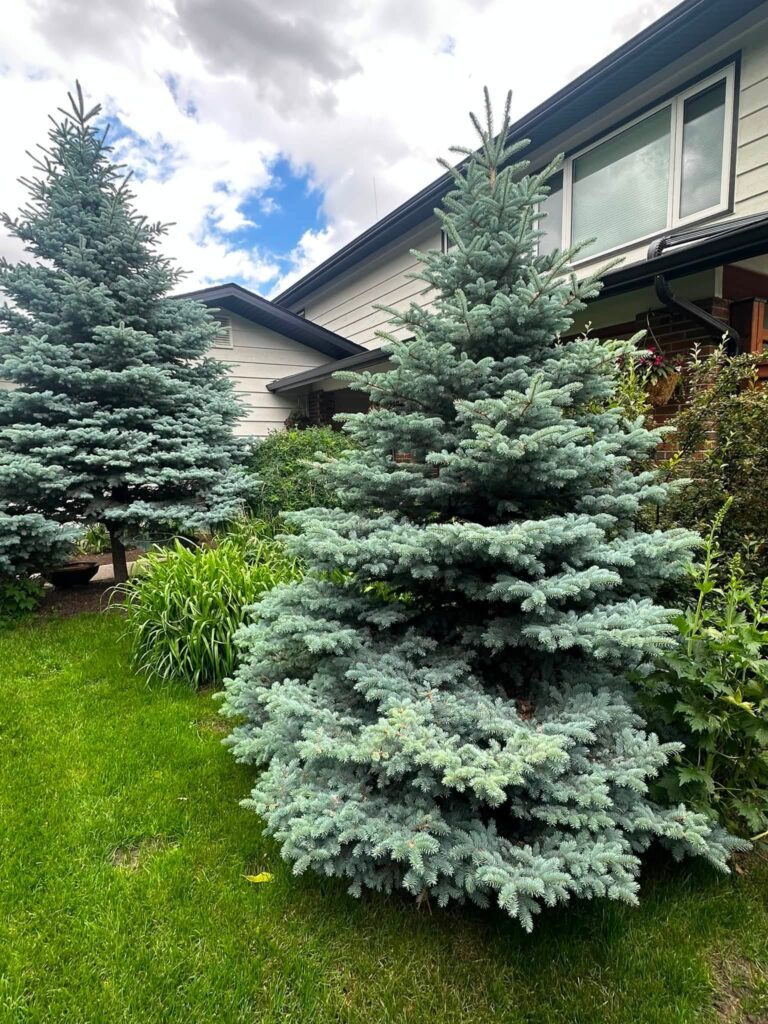
Blue spruce is the state tree of Colorado, and it is probably the most planted ornamental spruce in American yards.
Native range: Blue spruce is restricted to the central and southern Rocky Mountains, from scattered populations in eastern Idaho and western Wyoming to better developed stands in Utah and Colorado.
Identification: Waxy, blue-green, sharply pointed needles. The species name “pungens” literally means “sharply pointed.”
Height: Up to 75 feet in forests, though garden specimens usually stay near 50 feet.
Cultivars: More than 38 horticultural varieties of blue spruce have been developed for landscaping.
Fire vulnerability: Blue spruce has thin bark and shallow roots, making it easily killed by fire, and it is slow to self-prune its lower branches, so surface fires can climb into the crown.
If your neighbor has a bright silvery-blue conifer in the front yard, there is a good chance it’s this one.
6. Engelmann Spruce (Picea engelmannii)
Engelmann spruce lives at elevations where few other trees survive.
This is a large tree, averaging 30 inches in diameter and 90 feet in height, with a pyramidal crown that has a somewhat rounded top and limbs extending nearly to the ground.
Elevation range: It grows from 520 to 3,650 meters above sea level.
Native range: Widely distributed from British Columbia and Alberta south through the Rocky Mountains to New Mexico and Arizona.
Bark: Red to purple-brown, made up of thin scales, and noticeably thinner than blue spruce bark.
Threat: Bark beetle outbreaks have decimated large stands of Engelmann spruce across the western United States in recent decades.
I appreciate this species for its resilience. Living above 10,000 feet in a short growing season is no small feat for a tree.
7. Red Spruce (Picea rubens)
Red spruce is the backbone of Appalachian high-elevation forests, sometimes called West Virginia spruce or yellow spruce.
Native range: From eastern Canada down through New England and the Appalachian Mountains, reaching as far south as North Carolina and Tennessee at high elevation.
Identification: Reddish-brown twigs and bark, yellow-green needles, and small cones around 1.5 inches long.
Ecology: Red spruce often grows in mixed stands with balsam fir at higher elevations, forming the classic “spruce-fir forest” of the Appalachians.
Conservation note: Acid rain damaged red spruce populations severely in the 20th century, and recovery efforts continue in states like West Virginia and Vermont.
Spruce Knob, West Virginia’s highest point, takes its name directly from this species.
8. Serbian Spruce (Picea omorika)
Serbian spruce is a narrow, elegant tree that fits into small gardens far better than most of its relatives.
Native range: A very limited native range in the Drina River valley of Serbia and Bosnia, making it one of the rarest spruce species in the wild.
Shape: Narrow, spire-like crown, with branches that curve gracefully upward at the tips.
Height: Can reach 100 feet in the wild but stays more compact in cultivated landscapes.
Hybridization: Serbian spruce is known to hybridize naturally with black spruce.
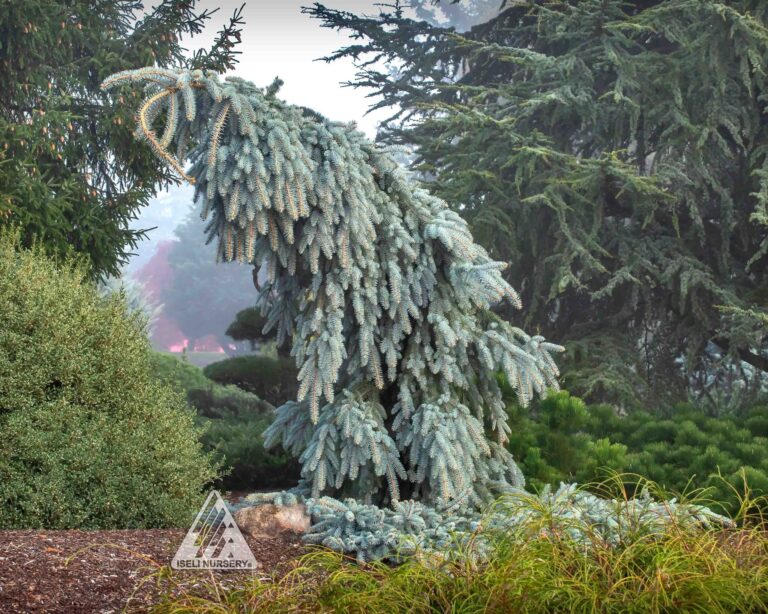
The weeping cultivar, Picea omorika ‘Pendula,’ is a favorite among landscape designers for its dramatic, cascading form.
9. Oriental Spruce / Caucasian Spruce (Picea orientalis)
This species carries some of the shortest needles in the entire genus, giving it an unusually dense, soft texture.
Native range: The Caucasus region and northeast Turkey.
Identification: Needles under half an inch long, glossy dark green, densely packed along the twig.
Landscape use: Highly valued as an ornamental for its fine texture and slow, dense growth habit.
Growth rate: Slower than most spruce species, which makes it popular for smaller landscape settings where a tree needs decades to outgrow its space.
I find Oriental spruce’s foliage almost velvety compared to the sharper needles of blue or Engelmann spruce.
10. Brewer Spruce / Weeping Spruce (Picea breweriana)
Brewer spruce might be the most visually striking spruce on this entire list, thanks to its long, curtain-like branchlets.
Native range: A relatively limited area on the steep slopes of the Siskiyou Mountains in southern Oregon and northern California.
Identification: Long, pendulous side branchlets that hang like green curtains from horizontal main branches.
Rarity: Considered one of the rarer native spruce species in the United States due to its restricted natural range.
Landscape appeal: Increasingly used as an ornamental specimen tree because of its dramatic weeping form.
Anyone who sees a mature Brewer spruce in person understands immediately why it earned the nickname “weeping spruce.”
11. Dragon Spruce (Picea asperata)
Dragon spruce comes from the mountains of western China and brings a rugged, textured bark to the landscape.
Dragon spruce is native to western China and includes several recognized varieties.
Identification: Stiff, sharply pointed needles and gray-brown, plate-like bark that peels in irregular flakes.
Height: Typically 100 to 150 feet in its native mountain habitat.
Landscape use: Increasingly planted outside China for its cold tolerance and ornamental bark texture.
This species does not get nearly the attention it deserves outside of botanical collections, but its bark alone makes it worth a second look.
12. Siberian Spruce (Picea obovata)
Siberian spruce is the eastern counterpart to Norway spruce, filling a massive range across northern Russia.
Native range: Northern Scandinavia and Siberia.
Cold tolerance: Among the most cold-hardy spruce species, surviving temperatures far below what most conifers can withstand.
Identification: Very similar in appearance to Norway spruce, with some taxonomists considering it a subspecies or close relative.
Ecological role: Forms a major component of the Siberian taiga, supporting wildlife across an enormous geographic range.
13. Korean Spruce (Picea koraiensis)
Korean spruce grows in the mountainous borderlands of Korea and northeast China.
This species is native to Korea and northeast China.
Identification: Bluish-green needles and reddish-brown young cones that mature to a dark purple-brown.
Height: Reaches around 100 feet in favorable mountain conditions.
Uses: Valued locally for timber and increasingly used in ornamental plantings for its attractive cone color.
14. Sargent’s Spruce (Picea brachytyla)
Sargent’s spruce is a lesser-known species from the mountains of southwestern China.
This species is native to southwest China.
Identification: Drooping branches and needles with a distinct silvery-white underside, giving the foliage a two-toned look.
Height: Can reach 130 to 150 feet in its native habitat.
Rarity: Uncommon outside of botanical gardens and specialist collections in the West.
15. Likiang Spruce (Picea likiangensis)
Likiang spruce hails from the high mountains of southwestern China, often growing alongside Sargent’s spruce.
This species is native to southwest China.
Identification: Purplish-red young cones that stand out sharply against blue-green foliage in spring.
Height: Typically 100 to 150 feet at maturity.
Notable trait: The vivid cone color makes this one of the more ornamentally distinctive spruce species when in cone.
16. Morinda Spruce / Himalayan Spruce (Picea smithiana)
Morinda spruce carries some of the most dramatically drooping foliage of any spruce species.
This species is native to the western Himalaya and eastern Afghanistan, extending into northern and northwestern India.
Identification: Long, weeping branchlets with needles that hang almost like tinsel from the branches.
Height: Can exceed 150 feet in the Himalayan foothills.
Landscape use: Occasionally planted as an ornamental specimen for its graceful, cascading silhouette.
17. Tiger-Tail Spruce (Picea torano)
Tiger-tail spruce is a Japanese native known for exceptionally sharp, stiff needles.
This species is native to Japan.
Identification: Extremely sharp, radiating needles that make the branch resemble a bottle brush, hence the common name.
Height: Generally 90 to 100 feet in native forest settings.
Growth habit: Slow-growing and long-lived, often used in Japanese gardens for its architectural branch structure.
Handle this one carefully. The needles are sharp enough to genuinely hurt if you grab a branch without thinking.
18. Alberta Spruce / Dwarf Alberta Spruce (Picea glauca ‘Conica’)
This dwarf cultivar of white spruce is a landscaping staple, especially for small yards, patios, and container gardens.
Origin: A naturally occurring dwarf mutation of white spruce, first discovered in Alberta, Canada, in the early 20th century.
Height: Extremely slow-growing, often reaching only 10 to 12 feet after several decades.
Shape: Dense, perfectly conical form that requires almost no pruning to maintain.
Popular use: A favorite for formal entryways, foundation plantings, and even as a living Christmas tree in a pot.
I have seen this exact cultivar used more often in suburban landscaping than almost any other conifer, dwarf or full-size.
19. Bird’s Nest Spruce (Picea abies ‘Nidiformis’)
Bird’s Nest spruce is a dwarf cultivar of Norway spruce, prized for its distinctive flat-topped, nest-like shape.
Origin: Selected from Norway spruce for its compact, irregular growth habit.
Height: Rarely exceeds 3 to 4 feet, with a wider spread than height.
Shape: A visible depression in the center of the plant genuinely resembles a bird’s nest.
Landscape use: Excellent as a low, textured shrub in foundation plantings, rock gardens, and mixed borders.
This is one of the easiest spruce varieties for beginner gardeners because it demands so little maintenance once established.
20. Black Hills Spruce (Picea glauca var. densata)
Black Hills spruce is a naturally occurring, denser variety of white spruce native to South Dakota’s Black Hills region.
Origin: A regional variety of white spruce, officially recognized for its tighter branching and slower growth compared to typical white spruce.
Height: Generally 40 to 60 feet at maturity, more compact than standard white spruce.
State significance: It is the official state tree of South Dakota.
Landscape use: A popular choice for windbreaks and privacy screens across the northern Great Plains, thanks to its dense, symmetrical form.
ALSO READ: 75 Types of Pine Trees: Identificatifying Popular Varieties, With Pictures
Quick Comparison: Height and Native Range
| Spruce Species | Typical Height | Native Region |
| Norway Spruce | 60–120 ft | Europe |
| White Spruce | 80–100+ ft | Canada, Alaska |
| Black Spruce | 15–50 ft | Boreal North America |
| Sitka Spruce | 160–216 ft | Pacific Coast (AK to CA) |
| Blue Spruce | 50–75 ft | Rocky Mountains |
| Engelmann Spruce | 90 ft | Western North America |
| Red Spruce | 60–80 ft | Appalachians, NE USA |
| Serbian Spruce | Up to 100 ft | Serbia, Bosnia |
| Oriental Spruce | 90–130 ft | Caucasus, Turkey |
| Brewer Spruce | 80–120 ft | Siskiyou Mountains |
| Dragon Spruce | 100–150 ft | Western China |
| Siberian Spruce | 65–100 ft | Scandinavia, Siberia |
| Korean Spruce | ~100 ft | Korea, NE China |
| Sargent’s Spruce | 130–150 ft | SW China |
| Likiang Spruce | 100–150 ft | SW China |
| Morinda Spruce | Up to 150 ft | Himalaya, Afghanistan |
| Tiger-Tail Spruce | 90–100 ft | Japan |
| Dwarf Alberta Spruce | 10–12 ft | Cultivar (Canada origin) |
| Bird’s Nest Spruce | 3–4 ft | Cultivar (Norway spruce) |
| Black Hills Spruce | 40–60 ft | South Dakota |
Why Spruce Trees Matter Beyond the Garden
Spruce is not just decorative. Spruce is a major producer of timber for construction and pulp for paper, and it serves as the standard material for the soundboards of stringed instruments such as acoustic guitars.
Notably, the Norway spruces of the Paneveggio “Violins Forest” in the Dolomites have supplied tonewood for centuries, reportedly including timber used by the violin maker Antonio Stradivari.
Beyond music and lumber, spruce forests store enormous amounts of carbon. Boreal black spruce peatlands, for instance, accumulate deep organic layers that lock away carbon for centuries, supporting climate regulation on a hemispheric scale.
Wildlife depends on spruce too. Seeds feed songbirds, grouse, and small mammals, while dense crowns provide winter shelter for deer, elk, and moose during harsh months.
Final Thoughts
Twenty species barely scratch the surface of what the spruce genus offers, yet this list covers the ones you are most likely to encounter, whether on a mountain hike, in a botanical garden, or in your own backyard.
I would encourage you to look closely next time you pass a spruce tree. Check the needles, note the cone shape, and notice how the branches hang. Once you know what to look for, telling a blue spruce from a white spruce becomes second nature.
References
- USDA Forest Service, Fire Effects Information System — Picea glauca (White Spruce) https://www.fs.usda.gov/database/feis/plants/tree/picgla/all.html
- USDA Forest Service, Fire Effects Information System — Picea pungens (Blue Spruce) https://www.fs.usda.gov/database/feis/plants/tree/picpun/all.html
- USDA Forest Service, Fire Effects Information System — Picea mariana (Black Spruce) https://www.fs.usda.gov/database/feis/plants/tree/picmar/all.html
- USDA Forest Service, Fire Effects Information System — Picea abies (Norway Spruce) https://www.fs.usda.gov/database/feis/plants/tree/picabi/all.html
- USDA Forest Products Laboratory — Picea sitchensis (Sitka Spruce) https://www.fpl.fs.usda.gov/documnts/TechSheets/SoftwoodNA/htmlDocs/piceasitchen.html
- Utah State University Extension, Forestry Program — Engelmann Spruce Tree Identification https://extension.usu.edu/forestry/tree-identification/spruces/engelmann-spruce
- Oregon State University, Landscape Plants Database — Picea engelmannii https://landscapeplants.oregonstate.edu/plants/picea-engelmannii

Tim M Dave is a gardening expert with a passion for houseplants, particularly cacti and succulents. With a degree in plant biology from the University of California, Berkeley, he has vast experience in gardening. Over the years, he has cultivated a vast collection of desert plants and learned a great deal about how to grow and care for these unique companions.