Understanding Joshua Tree (Yucca brevifolia): History, Lifespan, and Cultivation Details
There are very few plants on earth that stop you in your tracks the moment you see them. The Joshua tree is one of them.
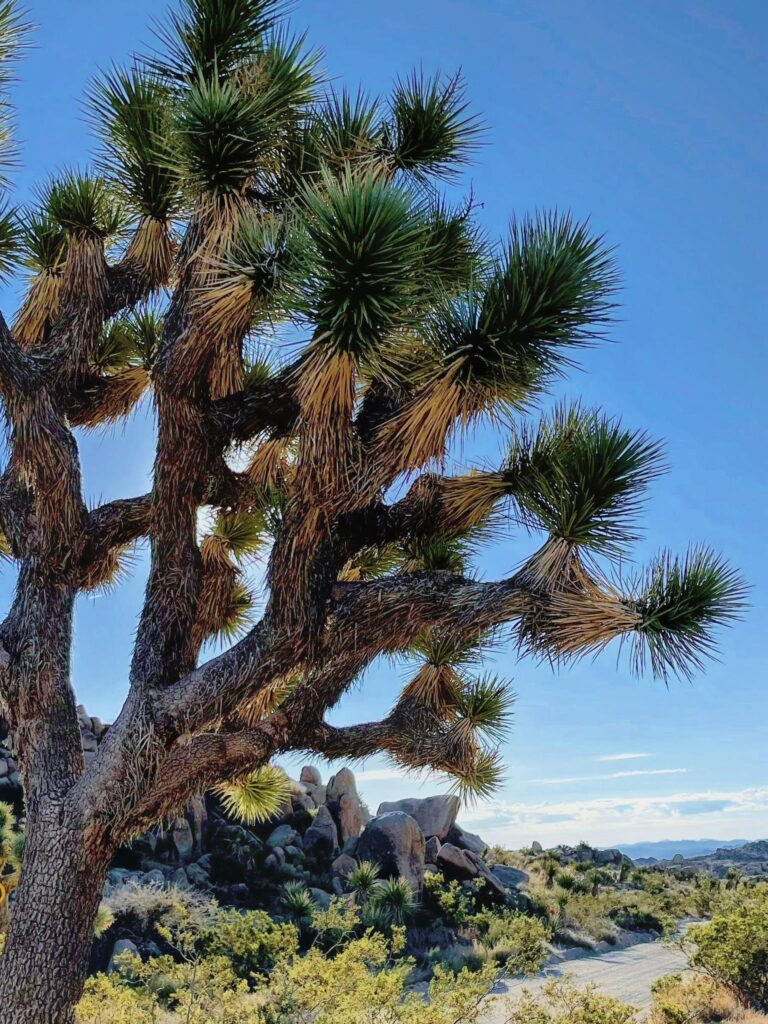
With its twisted, outstretched arms and shaggy silhouette set against a blazing desert sky, Yucca brevifolia is unlike anything else in the plant kingdom. It is ancient, resilient, and — right now — facing challenges that make understanding it more important than ever.
Whether you are a botanist, a traveler, a desert gardener, or simply someone curious about one of North America’s most beloved plants, this guide covers everything worth knowing about the Joshua tree — from its biology and ecology to its cultural significance and uncertain future.
What Exactly Is a Joshua Tree?
Despite what the name suggests, the Joshua tree is not actually a tree. It is a monocot — more closely related to grasses, orchids, and lilies than to oaks or pines. It belongs to the genus Yucca and the family Asparagaceae, which also includes agaves and asparagus.
The “tree” designation comes from its woody trunk and impressive stature. Botanically speaking, its trunk lacks the true wood tissue found in gymnosperms and angiosperms. Instead, it is supported by a dense matrix of fibrous tissue — strong, flexible, and remarkably durable.
Its scientific name, Yucca brevifolia, translates loosely from Latin as “short-leaved yucca.” This refers to its relatively short, stiff, spine-tipped leaves compared to other yucca species.
| Scientific Name | Yucca brevifolia Engelm. |
| Common Name | Joshua tree, yucca palm, tree yucca |
| Plant Family | Asparagaceae (formerly Agavaceae) |
| Native Range | Mojave Desert (California, Nevada, Utah, Arizona) |
| Elevation Range | 1,300 – 5,900 feet (400 – 1,800 m) |
| Average Height | 15 – 40 feet (4.5 – 12 m) |
| Maximum Recorded Height | ~49 feet (15 m) |
| Trunk Diameter | Up to 3 feet (0.9 m) |
| Lifespan | 150 – 1,000+ years (debated) |
| Bloom Period | Late winter to early spring (February – April) |
| Flower Color | Creamy white to pale green |
| Growth Rate | Very slow — approximately 3 inches per year |
| USDA Hardiness Zones | 6 – 9 |
| Conservation Status | Candidate for threatened status under U.S. ESA (2023) |
| Key Ecological Partner | Tegeticula moths (yucca moths) — sole pollinators |
| Soil Type | Sandy, rocky, well-drained desert soils |
| Water Needs | Very low (drought-adapted) |
| Sun Requirement | Full sun |
How Did the Joshua Tree Get Its Name?
The name “Joshua tree” is widely attributed to Mormon pioneers crossing the Mojave Desert in the 19th century. According to this well-known account, the tree’s upward-reaching branches reminded them of the biblical prophet Joshua raising his arms in prayer, guiding their path westward.
Whether that story is entirely accurate is debated by historians. What is certain is that the name stuck — and today it is inseparable from the identity of the Mojave Desert itself.
Indigenous peoples of the region — including the Cahuilla, Serrano, and Chemehuevi — had their own names and long-standing relationships with this plant, predating European contact by thousands of years.
Distribution: Where Joshua Trees Grow
Joshua trees are endemic to the Mojave Desert — meaning this is the only place in the world where they naturally occur. Their range spans portions of:
- California (the largest population, particularly the western and high Mojave)
- Nevada (southern and central Nevada)
- Utah (southwestern Utah)
- Arizona (the northwestern corner, near the Nevada border)
The heart of Joshua tree country sits at elevations between 2,000 and 4,500 feet, where winters are cold enough to trigger flowering and summers are hot but not lethally extreme for extended periods.
Joshua Tree National Park, straddling San Bernardino and Riverside counties in California, is perhaps the most famous home of these plants. The park protects over 800,000 acres and contains hundreds of thousands of individual trees — though their numbers have been declining.
Ecology: A Life Built Around Interdependence
The Yucca Moth: An Irreplaceable Partner
The Joshua tree has one of the most fascinating ecological relationships in the plant world. It can only be pollinated by yucca moths of the genus Tegeticula. No other insect, bird, or wind performs this role.
The relationship is what biologists call obligate mutualism — both species depend entirely on each other for survival.
Here is how it works: the female yucca moth visits a Joshua tree flower, deliberately collects pollen, and then flies to another flower. There, she lays her eggs inside the ovary and deposits the pollen — pollinating the flower in the process.
When the seeds develop, the moth’s larvae feed on a portion of them. Enough seeds survive to germinate, and the moth’s larvae get a meal.
Neither species can reproduce without the other. It is a deal that has held for millions of years.
Wildlife That Depends on Joshua Trees
The Joshua tree supports a remarkable web of desert life:
- Scott’s oriole nests among the leaves and feeds on flower nectar
- Ladder-backed woodpeckers excavate cavities in dead trunks
- Western scrub jays cache seeds in the ground (inadvertently planting new trees)
- Desert night lizards shelter beneath fallen branches and bark
- Cactus wrens and common ravens also nest in or near the trees
Fallen Joshua trees decompose slowly and provide critical habitat for termites, beetles, and dozens of invertebrate species. Even in death, they continue to sustain the ecosystem around them.
Growth and Lifespan: Slow, Steady, and Ancient
The Joshua tree grows with remarkable patience. In its early years, it produces a single, unbranched stem. Branching occurs only after the plant has flowered — and each branch tip bears the potential for future blooms and further branching.
This branching pattern, combined with its slow growth rate of roughly 2–3 inches per year, means that a large, heavily branched Joshua tree can be several centuries old.
Age estimation is genuinely difficult because Joshua trees do not form the annual growth rings typical of true trees. Researchers estimate age using height, branch complexity, and radiocarbon dating methods. Some specimens are believed to be 500–1,000 years old or more.
There is humbling thought in that. The Joshua tree standing in front of you may have been alive during the Middle Ages.
Flowering and Reproduction
Joshua trees bloom in late winter to early spring — typically between February and April, depending on elevation and rainfall. Flowering requires a cold winter period followed by adequate winter moisture. Without that trigger, the trees may not bloom at all in a given year.
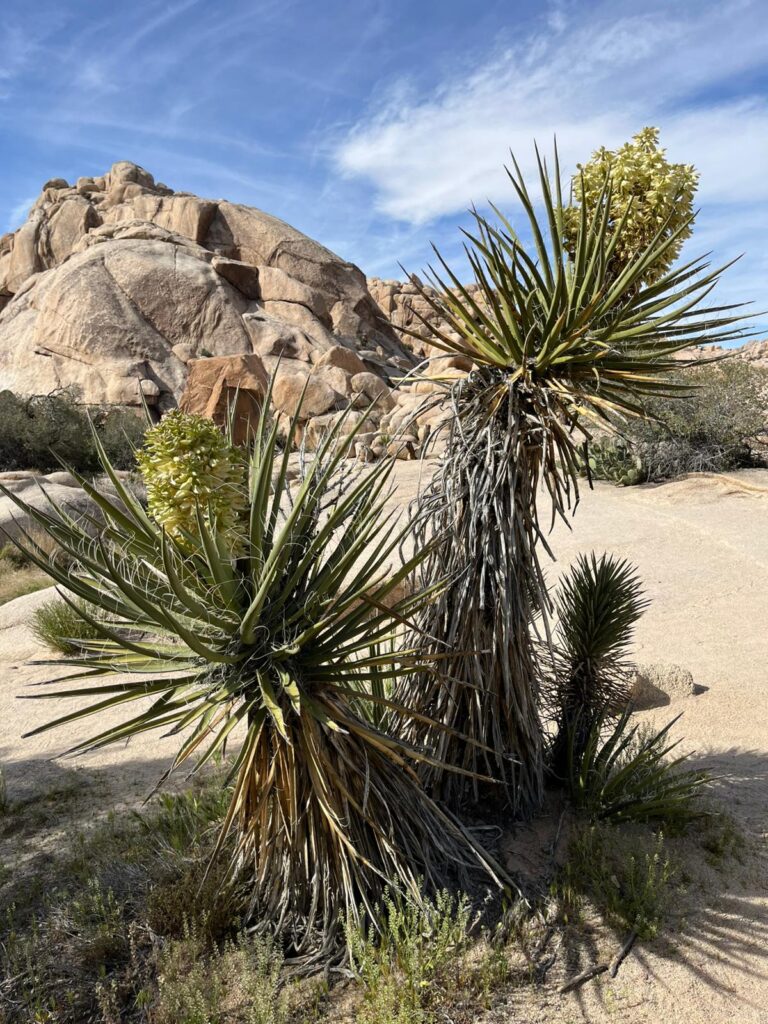
The flowers are creamy white to pale greenish-yellow, clustered in large, dense panicles at the tips of branches. Each individual flower is bell-shaped and faintly fragrant.
After pollination by yucca moths, the plant produces an egg-shaped fruit. Inside are numerous flat, black seeds. If conditions are right, the seeds can germinate — but seedling survival is extremely low.
Most Joshua tree seedlings die within their first year. Those that survive face decades of slow establishment before they become recognizable young trees.
This is one reason why the loss of mature, established Joshua trees is so ecologically significant. They cannot simply be replaced quickly.
Physical Characteristics: Reading a Joshua Tree
Leaves
The leaves are stiff, narrow, and sharply spine-tipped — a defense against herbivores. They grow in dense rosettes at the tips of branches, typically 8–14 inches long. Old leaves dry out and droop downward against the trunk, forming a shaggy skirt of dead foliage that can persist for years.
Trunk and Bark
The trunk is covered in rough, grayish-brown bark with a fibrous, spongy interior. There is no true hardwood. The fibrous structure allows the trunk to flex slightly in strong winds rather than snap.
Root System
Joshua trees develop both shallow lateral roots that spread widely to capture surface rainfall, and deeper roots that anchor the plant and access subsurface moisture. The root network can extend well beyond the canopy drip line.
Cultural Significance
Indigenous Uses
Native peoples of the Mojave region used virtually every part of the Joshua tree:
- Seeds and flower buds were eaten raw or roasted
- Leaf fibers were woven into baskets, sandals, and rope
- Roots were used to make red dye
- Wood was used for making tools and arrow points
For these communities, the Joshua tree was not just a landmark. It was a resource central to daily life.
Modern Culture
In the 20th century, the Joshua tree became a cultural icon far beyond the desert. It appeared in the photography of Ansel Adams, became the backdrop for countless road trip photographs, and gained global recognition when U2 released their landmark 1987 album The Joshua Tree — inspired by the Mojave landscape.
Today, Joshua Tree National Park draws over 3 million visitors annually. The tree’s silhouette is immediately recognizable worldwide, and it has become an enduring symbol of the American West.
Climate Change and Conservation: A Tree Under Pressure
Here is where the story becomes urgent.
Joshua trees are facing a threat they have never encountered in their long evolutionary history: rapid, human-caused climate change. The changes happening now are outpacing the ability of this slow-growing, slow-reproducing plant to adapt.
Shifting Range
Research shows that the suitable habitat for Joshua trees is moving northward and to higher elevations as temperatures rise. The southern and lower-elevation portions of the tree’s current range are becoming too hot and too dry for seedling survival. Areas that were once ideal are effectively becoming ecological dead zones for Joshua tree regeneration.
Fire Risk
Joshua trees did not evolve to survive wildfire. Historically, the Mojave Desert had too little vegetation between plants to carry fire easily.
But the invasion of non-native annual grasses — particularly red brome (Bromus rubens) — has created a continuous fuel load across the desert floor. When fires now move through the Mojave, Joshua trees burn and do not recover.
The 2020 Dome Fire in the Mojave National Preserve destroyed an estimated 1.3 million Joshua trees in a single event. That was a devastating loss.
Prolonged Drought
Extended drought conditions reduce seed germination success and increase seedling mortality. Combined with hotter temperatures, drought is narrowing the window during which young Joshua trees can successfully establish.
Conservation Status
In 2023, the U.S. Fish and Wildlife Service determined that listing the Joshua tree as a threatened species under the Endangered Species Act was “warranted but precluded” — meaning the threat is real but resources for formal listing were limited.
Advocacy groups and researchers continue to push for stronger federal protections.
California has already listed the Western Joshua tree (Yucca brevifolia var. brevifolia) as a threatened species under the California Endangered Species Act, offering some state-level protection.
Growing Joshua Trees: Is It Possible Outside the Mojave?
Many desert garden enthusiasts want to grow Joshua trees. The answer is — yes, with significant caveats.
Joshua trees can be grown outside their native range, but they are notoriously difficult to transplant or establish from seed. They require very specific conditions:
- Full sun all day — no exceptions
- Extremely well-drained soil — sandy or gravelly is ideal; clay will kill them
- Low water once established — overwatering is the fastest way to lose one
- Cold winters — they need cold temperatures to trigger flowering
- Low humidity — high humidity promotes root rot and leaf disease
If you live in a dry, sunny region with cold winters — parts of the U.S. Southwest, the Great Basin, or similar climates — growing a Joshua tree in a garden is realistic. Patience is non-negotiable. Do not expect rapid growth or dramatic changes in a few years. Think in decades.
Never collect Joshua trees from the wild. It is illegal in California and Nevada, and wild-collected specimens almost never survive transplanting. Purchase nursery-grown plants from reputable desert plant specialists.
Common Pests, Diseases, and Problems
Joshua trees are remarkably tough when in the right environment. Problems typically arise from conditions that diverge from their native habitat.
- Root rot — the most common issue, caused by overwatering or poorly drained soil. There is no recovery from advanced root rot.
- Scale insects — can colonize leaves and stems; treat with horticultural oil in mild infestations
- Agave snout weevil (Scyphophorus acupunctatus) — a serious pest that bores into the crown and can kill the plant
- Sunscald on transplanted trees — newly transplanted trees moved from shade to full sun can burn; acclimate gradually
In the landscape, the single most important preventive measure is proper drainage. Get that right, and most other problems become far less likely.
Interesting Facts Worth Knowing
- Joshua trees are not cacti. They are often assumed to be cacti due to their spiny appearance and desert habitat, but they belong to an entirely different plant family.
- The tallest known Joshua tree stands approximately 49 feet tall in the Mojave Desert.
- A Joshua tree’s flowers smell mildly sweet — almost mushroomlike — during evening hours to attract moths.
- In the 19th century, Joshua tree wood was used to make paper pulp and to fuel smelting furnaces — a practice that wiped out large populations before conservation efforts began.
- Scientists have identified two recognized varieties of Joshua tree: Yucca brevifolia var. brevifolia (the western form) and Yucca brevifolia var. jaegeriana (the eastern form), which some researchers propose are distinct enough to be treated as separate species.
- Western Joshua trees can hybridize with other yucca species where their ranges overlap.
Final Thoughts
The Joshua tree is not just a plant. It is a living monument to deep time, adaptation, and the intricate relationships that make desert ecosystems function.
Standing beneath one — watching the way the branches reach in every direction, knowing that this individual may have been growing for five hundred years — is one of those rare experiences that reframes how you think about time and resilience.
Protecting the Joshua tree means protecting the Mojave itself. The moths that pollinate it, the birds that nest in it, the lizards that shelter beneath it — they are all part of one interconnected system. When the Joshua tree thrives, the desert thrives with it.
There is still time to make a difference. Supporting conservation organizations, respecting protected lands, and understanding the ecological stakes is a meaningful place to begin.
References
- University of California, Berkeley — Jepson eFlora Yucca brevifolia Engelm. — Jepson Herbarium, UC Berkeley https://ucjeps.berkeley.edu/eflora/eflora_display.php?tid=79208
- Cal Poly San Luis Obispo — SelecTree: A Tree Selection Guide Yucca brevifolia — California Polytechnic State University Urban Forest Ecosystems Institute https://selectree.calpoly.edu/tree-detail/yucca-brevifolia
- University of Nevada, Reno — Cooperative Extension Water-Wise Landscaping and Native Desert Plants of the Mojave Region https://extension.unr.edu/publication.aspx?PubID=2848
- Wikipedia-Yucca brevifolia https://en.wikipedia.org/wiki/Yucca_brevifolia

Tim M Dave is a gardening expert with a passion for houseplants, particularly cacti and succulents. With a degree in plant biology from the University of California, Berkeley, he has vast experience in gardening. Over the years, he has cultivated a vast collection of desert plants and learned a great deal about how to grow and care for these unique companions.