Ravenala madagascariensis (Travellers Palm): Size, Growth Rate, Problems and Cultivation Details
Few plants command attention the way Ravenala madagascariensis does. Rising tall with a trunk like a palm and a crown of enormous leaves fanned out in a perfect geometric plane, the Traveller’s Palm looks like nature drew it with a ruler and a sense of drama.
It is one of the most photographed plants in the world — a symbol of tropical elegance, a fixture in luxury resort landscaping, and a living icon of Madagascar. Yet despite its fame, many people know surprisingly little about it.
It is not actually a palm. That alone surprises most people when they first hear it. And the story of why travellers once looked to this tree for survival is one of the most compelling plant legends in botanical history.
This article covers everything: the plant’s true identity, its remarkable biology, its cultural significance, how to grow and care for it, and why it deserves a respected place in tropical horticulture.
| Common Name | Traveller’s Palm, Traveller’s Tree |
| Scientific Name | Ravenala madagascariensis |
| Family | Strelitziaceae |
| Origin | Madagascar (Eastern rainforests) |
| Type | Monocot tree / large tropical plant |
| Mature Height | 20–30 ft (6–9 m); up to 50 ft in the wild |
| Spread (Fan Width) | Up to 20–30 ft across |
| Growth Rate | Moderate to fast (in ideal conditions) |
| Sun Requirement | Full sun to partial shade |
| Watering Needs | Moderate to high; consistent moisture |
| Soil Type | Rich, moist, well-draining loam |
| Hardiness Zones | USDA Zones 10–12 |
| Toxicity | Generally non-toxic to humans; low risk to pets |
| Bloom Color | White (similar to Bird of Paradise flower) |
| Fruit | Blue arils encasing dark seeds |
| Lifespan | Decades; clumping habit expands over time |
| Notable Feature | Fan-shaped leaf arrangement aligned east–west |
Botanical Identity: What Exactly Is the Traveller’s Palm?
It Is Not a Palm
Despite the common name, Ravenala madagascariensis is not a member of the palm family (Arecaceae). It belongs to the family Strelitziaceae — the same family as the Bird of Paradise flower (Strelitzia reginae) and the White Bird of Paradise (Strelitzia nicolai).
The resemblance to palms is purely superficial. The Travellers Palm has a trunk-like structure and large leaves, but its growth pattern, flower structure, and fruit type tell a completely different botanical story.
It is the only species in the genus Ravenala, making it truly one of a kind. The genus name comes from the Malagasy word ravinala, meaning “forest leaves.”
Taxonomic Classification
| Rank | Classification |
| Kingdom | Plantae |
| Order | Zingiberales |
| Family | Strelitziaceae |
| Genus | Ravenala |
| Species | R. madagascariensis |
The order Zingiberales also includes ginger, bananas, and heliconia — a group of predominantly tropical, moisture-loving plants. This heritage explains why the Traveller’s Palm thrives in warm, humid, high-rainfall environments.
The “Trunk” Explained
What appears to be a palm trunk is actually a pseudostem — a tightly packed column of old leaf bases stacked one on top of another, similar in principle to a banana plant’s pseudostem. As older leaves fall away, they leave distinctive scars on the trunk’s surface, creating a textured, ringed appearance that mimics true wood.
Over time, a genuine woody trunk does form at the base from the accumulation of fibrous tissue, giving mature specimens impressive structural stability. But the upper portion of tall plants remains largely pseudostem.
Origin and Natural Habitat
Where It Comes From
Ravenala madagascariensis is endemic to the eastern rainforests of Madagascar, particularly the humid lowland and montane zones along the island’s eastern coast.
Madagascar’s east coast receives heavy rainfall year-round, and the Traveller’s Palm has evolved to thrive in these conditions — rich, moist soils, warm temperatures, and high humidity.
In the wild, it is often found growing along riverbanks, forest edges, and disturbed areas where canopy gaps allow light to reach the ground. It is both a pioneer species (one of the first plants to colonize cleared land) and an important component of Madagascar’s secondary forest ecosystems.
Cultural Importance in Madagascar
In Madagascar, Ravenala holds deep cultural significance. It appears on the national emblem of Madagascar and is widely used in traditional construction.
The leaves are used as roofing material, the leaf bases collect rainwater, and the seeds provide a dye. For many rural communities, it is a multipurpose plant central to daily life.
The plant is so important that it has become a national symbol — arguably Madagascar’s most recognized botanical ambassador to the world.
Also Read: Madagascar Palm Plant (Pachypodium lamerei): Size, Growth Rate, Problems, and Care Details
The Legend of the Traveller’s Palm: Fact or Myth?
The common name “Traveller’s Palm” comes from an enduring legend: that lost travellers in the wild could always find clean, drinkable water stored at the base of the leaves, saving them from thirst.
The story is beautiful. And there is genuine truth behind it.
The large, sheath-like bases of the Traveller’s Palm leaves do indeed collect and hold significant quantities of rainwater — sometimes several litres per leaf axil in a mature specimen. Early travellers in Madagascar reportedly used this stored water as an emergency drinking source.
However, botanists and field researchers have raised nuances. The water is not always clean — it can contain debris, insects, and microbial growth. It may provide hydration in a true survival situation, but it is not reliably potable without treatment.
The more scientifically accepted explanation for the name is simpler: the plant’s fan almost always aligns in a north–south or east–west orientation relative to local geography. This natural compass-like alignment could have helped travellers orient themselves in unfamiliar terrain.
Whether the legend is literal or poetic, it has given this plant a narrative few others can claim. It is not just beautiful — it has a story.
Physical Characteristics: Anatomy of an Icon
The Fan Structure
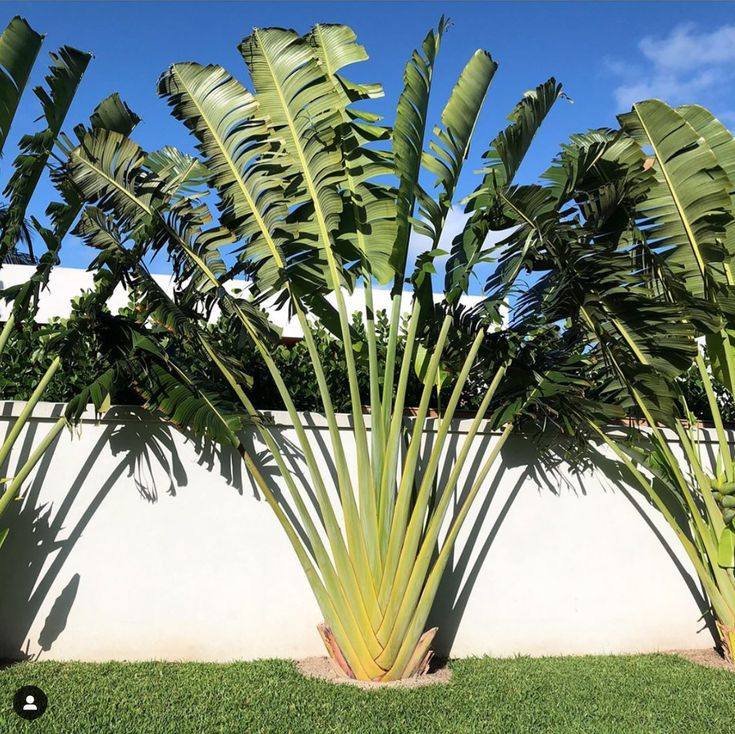
The defining feature of Ravenala madagascariensis is its spectacular fan of leaves, arranged in a single flat plane like an enormous oriental fan or a hand of playing cards.
This arrangement is called distichous phyllotaxy — meaning the leaves emerge alternately in exactly two opposite rows, always in the same geometric plane.
The result is a perfectly flat, two-dimensional crown that can span 20 to 30 feet across in mature specimens.
Viewed from the front, it is breathtaking. Viewed from the side, it almost disappears — just a single row of leaf stalks pointing skyward.
No other plant in the world produces quite this visual effect at this scale.
The Leaves
Each leaf consists of a long petiole (stalk) of up to 10–15 feet and a broad, paddle-shaped blade that can reach 8–10 feet in length. The leaves strongly resemble banana leaves — broad, bright green, and deeply veined.
Wind frequently shreds the leaf blades along the veins, giving older plants a characteristic tattered, feathery appearance. This is completely normal and does not indicate disease or poor health.
In fact, the shredding is thought to reduce wind resistance and prevent the large leaves from acting as sails that could topple the tree in storms.
The Flowers
The Traveller’s Palm produces white flowers that emerge from boat-shaped green bracts (protective sheaths) nestled within the leaf axils.
The flowers closely resemble those of the Bird of Paradise — narrow, white petals arranged in a distinctive structure that requires specific pollinators to access the nectar.
In Madagascar, the Black-and-white Ruffed Lemur (Varecia variegata) is one of the primary pollinators of Ravenala madagascariensis. This is a remarkable example of co-evolution: the plant’s flower structure has evolved alongside the lemur’s feeding habits, and the lemur relies on the plant’s nectar as an important food source.
This mutualistic relationship is one of the most studied plant-animal partnerships in Madagascar.
The Fruit and Seeds
After pollination, the plant produces woody capsule fruits that split open to reveal seeds enclosed in a striking vivid blue aril — a fleshy, intensely coloured coating. This brilliant blue is relatively rare in the plant world and is thought to attract specific bird species that disperse the seeds.
The blue aril is one of Ravenala’s most visually stunning — and botanically fascinating — features. Researchers have studied the aril’s colour-producing structures as part of broader research into structural colour in nature.
Also Read: Different Types of Palm Plants – Identification and Pictures
Growing Ravenala madagascariensis and Care
Climate and Hardiness
The Traveller’s Palm is a tropical plant that requires warmth year-round. It is suited to:
- USDA Hardiness Zones 10–12
- Regions with minimum temperatures above 50°F (10°C) at all times
- Areas with high humidity and abundant rainfall
In practice, this means it grows well outdoors in South Florida, Hawaii, Southern California coastal areas, the Caribbean, parts of Central and South America, sub-Saharan Africa, Southeast Asia, and the Pacific Islands.
In cooler climates, it can be grown in very large containers and overwintered indoors or in a heated greenhouse, though its size makes this increasingly challenging as it matures.
Frost is damaging and often fatal. Even a brief freeze can destroy the growing point and kill large specimens. If you live in a marginal zone, always have a protection plan in place.
Sunlight
Ravenala madagascariensis thrives in full sun and performs best with at least 6–8 hours of direct sunlight daily. In ideal conditions, full sun encourages:
- Faster, more vigorous growth
- Stronger pseudostem development
- Better flowering in mature plants
It will tolerate partial shade, particularly when young. In fact, young plants benefit from some afternoon shade protection in extremely hot, dry climates. However, heavy shade leads to weak, stretched growth and a less impressive fan structure.
Watering and Moisture
This plant has high water requirements compared to drought-tolerant tropical species. In its native eastern Madagascar, it receives heavy seasonal rainfall and grows in consistently moist soils.
Best practices:
- Water deeply and regularly during the growing season — typically 2–3 times per week in warm, dry climates
- Never allow the root zone to completely dry out for extended periods
- Mulch heavily around the base (4–6 inches of organic mulch) to retain soil moisture and moderate root temperature
- In periods of drought, increase irrigation frequency
- Ensure excellent drainage despite the high moisture needs — waterlogged, anaerobic soil leads to root problems
Finding the balance between consistent moisture and good drainage is the key challenge in growing Ravenala successfully.
Soil Requirements
The ideal soil for the Traveller’s Palm is:
- Rich in organic matter — incorporate compost or well-rotted manure before planting
- Moist but well-draining — never compacted or waterlogged
- Slightly acidic to neutral pH (6.0–7.0)
- Deep enough to accommodate a large, spreading root system
In sandy or nutrient-poor soils (common in Florida and Caribbean coastal areas), regular fertilization and organic amendment are essential for strong growth.
Fertilizing
Feed Ravenala madagascariensis with a balanced, slow-release granular fertilizer (such as 8-2-12 or similar palm and tropical fertilizer formulas) three to four times per year during the growing season.
Key nutrients:
- Potassium is critical for leaf health and overall plant vigour — deficiency shows as yellowing and necrosis on older leaves
- Magnesium supports chlorophyll production; deficiency causes yellowing between leaf veins
- Iron may be needed in alkaline soils where it becomes unavailable to the plant
Avoid high-nitrogen fertilizers that push rapid, weak growth at the expense of structural development.
Planting
When planting outdoors:
- Choose a site with ample space — a mature fan can be 20–30 feet wide, and the plant creates dense shade beneath it
- Dig a hole twice as wide as the root ball but no deeper
- Incorporate compost into the backfill soil
- Plant at the same depth as the nursery container — do not bury the base deeper than it was growing
- Water in thoroughly and apply a generous layer of mulch
- Stake young plants if the site is exposed to wind
Allow at least 15–20 feet of clearance from structures, power lines, and other large plants.
Pruning and Maintenance
The Traveller’s Palm is relatively low-maintenance once established. Routine care involves:
- Removing dead or fully brown leaves at the base of the fan — cut the petiole as close to the pseudostem as possible without damaging surrounding tissue
- Cleaning up leaf litter and fallen bracts around the base
- Managing suckers (offsets) — the plant produces basal offshoots. These can be left to create a multi-stemmed clump or removed to maintain a single-stemmed specimen
Do not remove green leaves unless they are clearly damaged or diseased. The large leaf surface area is essential for the plant’s photosynthesis and energy production.
Propagation
From Seed
Seed propagation is the most common method for Ravenala madagascariensis. Fresh seeds germinate more reliably than stored ones, as viability decreases significantly within months.
Steps:
- Soak fresh seeds in warm water for 24–48 hours to soften the seed coat
- Sow in a well-draining, moist seed-starting mix
- Maintain temperature between 75°F–85°F (24°C–29°C) — bottom heat is helpful
- Keep moist and in bright, indirect light
- Germination takes 4–8 weeks, sometimes longer
- Seedlings grow slowly in the first year; transplant carefully once established
From Offsets (Division)
Mature plants produce basal suckers that can be separated and replanted. This is the faster propagation method since you are working with already-established plant material.
- Remove offsets when they are at least 2–3 feet tall and have begun developing their own root system
- Use a sharp, clean spade or knife to sever the connection to the parent plant
- Pot up or plant in a prepared site and maintain consistent moisture until established
Common Problems and Solutions
Yellowing Leaves
Nutrient deficiency is the most common cause — particularly potassium or magnesium deficiency in sandy or alkaline soils. Apply a palm-specific fertilizer containing these micronutrients.
Other causes include overwatering (root suffocation), cold stress, or iron chlorosis in high-pH soils.
Leaf Shredding and Tattered Appearance
As mentioned earlier, wind shredding is completely normal in this species. It is not a sign of disease or poor care. The plant’s leaves are designed to shred along the veins to reduce wind resistance.
Slow Growth
In suboptimal conditions — insufficient light, poor nutrition, or cold temperatures — growth slows significantly. Ensure the plant is receiving full sun, adequate fertilization, and consistent water to encourage the best growth rate.
Root Rot
Caused by poor drainage or chronic overwatering. Signs include wilting despite moist soil, yellowing from the base upward, and a foul smell from the root zone. Improve drainage, reduce watering frequency, and treat with a fungicide if the problem is caught early.
Pests
Generally pest-resistant, but the following may occasionally appear:
- Scale insects — brown, waxy bumps on stems and petioles; treat with horticultural oil
- Spider mites — dry conditions promote infestations; increase humidity and apply neem oil
- Caterpillars — may feed on leaves in tropical climates; hand-pick or use appropriate insecticide
Landscape and Design Uses
Tropical Landscaping
The Travellers Palm is a premier specimen plant in tropical and subtropical landscaping. Its dramatic form makes it ideal as:
- A focal point or anchor plant in large garden designs
- An avenue tree planted in rows along driveways or pathways for a grand, symmetrical effect
- A backdrop plant behind swimming pools, water features, or resort-style spaces
- A privacy screen when planted in clusters or rows
Its geometric, architectural quality makes it equally at home in formal and naturalistic garden styles. Few plants bridge that gap as gracefully.
Architectural and Resort Use
Internationally, the Travellers Palm is virtually synonymous with luxury tropical hospitality. It appears in the landscaping of high-end resorts across Hawaii, the Maldives, Bali, Mauritius, and the Caribbean. Its silhouette is immediately associated with paradise, warmth, and tropical exclusivity.
For residential use, it works best on larger properties where its mature size can be accommodated without overwhelming the space.
Container Growing in Cooler Climates
Young Traveller’s Palms can be grown in large containers in cooler climates and moved indoors or into a heated conservatory during winter. This works for several years, but the plant’s eventual size makes long-term container culture challenging. It is best regarded as a temporary indoor solution in frost-prone areas.
Ecological Importance
Keystone Species in Madagascar
In Madagascar’s eastern rainforests, Ravenala madagascariensis is considered a keystone species — one whose presence supports a disproportionately large number of other species relative to its abundance.
The Ruffed Lemur’s dependence on Ravenala flowers for nectar, and the plant’s reliance on the lemur for pollination, represents one of the tightest co-evolutionary relationships documented between a plant and a mammal pollinator.
Several bird species also depend on the plant’s fruit for food, while the large leaf axils create microhabitats for insects, amphibians, and small reptiles.
Pioneer and Restoration Role
Because Ravenala readily colonizes disturbed ground and grows quickly relative to many forest trees, it plays an important role in forest recovery in Madagascar. It acts as a pioneer, stabilizing soil and creating shade conditions under which other forest species can establish.
However, in some degraded landscapes, it can dominate too thoroughly and suppress the recovery of more diverse native plant communities — a reminder that even ecologically valuable species require context-sensitive management.
Conservation Considerations
While Ravenala madagascariensis is not currently classified as endangered — it is actually very common in degraded and secondary landscapes across Madagascar — the broader ecosystem it belongs to is under severe threat.
Madagascar has lost an estimated 90% of its original forest cover due to slash-and-burn agriculture (tavy), charcoal production, and logging. While the Traveller’s Palm adapts to disturbance, the rich biodiversity of its native forest habitat is disappearing at an alarming rate.
Responsible cultivation worldwide plays a role: every Ravenala grown from nursery-propagated stock rather than wild collection represents a small positive contribution. Supporting conservation organisations working in Madagascar is another meaningful way to help.
Frequently Asked Questions
Q: How fast does Ravenala madagascariensis grow? Under ideal tropical conditions — full sun, rich moist soil, warm temperatures — it can grow 2–4 feet per year. In marginal conditions, growth is significantly slower.
Q: Can it survive indoors as a houseplant? Young plants can be kept indoors temporarily in very bright conditions, but the plant’s size, light demands, and moisture needs make it poorly suited as a permanent indoor houseplant in most homes.
Q: Why do the leaves always line up in one direction? The fan’s flat orientation is believed to be a light-capture adaptation — aligning the broad leaf surfaces to maximise sun exposure during the day. It has also been observed to tend toward an east–west or north–south axis depending on location, which may have helped travellers navigate.
Q: Is the water stored in the leaf bases safe to drink? The water is not reliably clean. It may contain debris, insects, and microorganisms. In a survival emergency it could provide hydration, but it is not recommended as a safe drinking source without purification.
Q: Is it the same as a Bird of Paradise? No, but they are close relatives. Both are in the family Strelitziaceae, and the Traveller’s Palm’s flowers do resemble those of the White Bird of Paradise (Strelitzia nicolai). They are different species with different growth habits and sizes.
Final Thoughts
Ravenala madagascariensis is genuinely one of the most remarkable plants on earth. It is not just a beautiful tree — it is a ecological partnership, a cultural symbol, a botanical legend, and a piece of living architecture all at once.
Growing one is not a casual undertaking. It demands space, warmth, and a commitment to its moisture and nutrient needs. But in the right climate, with the right conditions, few plants will transform a landscape as completely or as dramatically.
The first time I saw a mature Traveller’s Palm in full tropical sun — its fan perfectly symmetrical, its blue-arilled seeds glinting against the green — it was one of those moments where a plant stops being a garden feature and becomes something closer to a statement about the natural world.
If you are in a climate where it can thrive, plant one. Give it room. Give it sun and water. And watch over the coming years as one of nature’s most extraordinary designs slowly unfolds in your own garden.
References
- University of Florida IFAS Extension — Ravenala madagascariensis: Traveller’s Tree https://edis.ifas.ufl.edu/publication/ST534
- Missouri Botanical Garden — Ravenala madagascariensis Plant Finder https://www.missouribotanicalgarden.org/PlantFinder/PlantFinderDetails.aspx?kempercode=b879
- North Carolina State University Extension — Gardener Plant Toolbox — Ravenala madagascariensis https://plants.ces.ncsu.edu/plants/ravenala-madagascariensis/
- Smithsonian Tropical Research Institute — Tropicos Plant Database — Ravenala madagascariensis Sonn. https://tropicos.org/name/18400033
- University of Hawaii at Manoa — College of Tropical Agriculture and Human Resources (CTAHR) — Tropical Ornamental Plants for Hawaii Landscapes https://www.ctahr.hawaii.edu/oc/freepubs/pdf/OF-39.pdf

Tim M Dave is a gardening expert with a passion for houseplants, particularly cacti and succulents. With a degree in plant biology from the University of California, Berkeley, he has vast experience in gardening. Over the years, he has cultivated a vast collection of desert plants and learned a great deal about how to grow and care for these unique companions.