25 Trees Native to Georgia (With Growing Details)
Georgia wears its forests proudly, and the numbers back that up in a way few states can match.
Georgia holds more forestland than any other state in the South, roughly 24.8 million acres, covering about 65 percent of the state’s total land area, according to the Georgia Forestry Commission and USDA Forest Service data.
What amazes me most is the trajectory. Georgia’s forest cover today is actually greater than it was back in the 1930s, a genuine reversal after decades of aggressive agricultural clearing.
This guide covers 25 trees native to Georgia, chosen to represent the coastal live oak hammocks, the longleaf pine flatwoods, the Piedmont hardwoods, and the cooler mixed forests of the Blue Ridge Mountains.
Let’s get into it.
Why Native Trees Matter in Georgia
A quick note before the list begins.
Georgia is home to roughly 250 tree species, more than almost any other state, and its 33 native oak species alone outnumber the oak diversity found anywhere else in the country. That range reflects Georgia’s remarkable span of climate zones, from coastal plain to mountain summit.
Choosing native trees also makes practical sense for homeowners. These species already tolerate Georgia’s clay soils, humid summers, and occasional ice storms, which usually means less maintenance and far fewer surprises.
Now, on to the trees themselves.
25 Trees Native to Georgia
1. Southern Live Oak (Quercus virginiana)
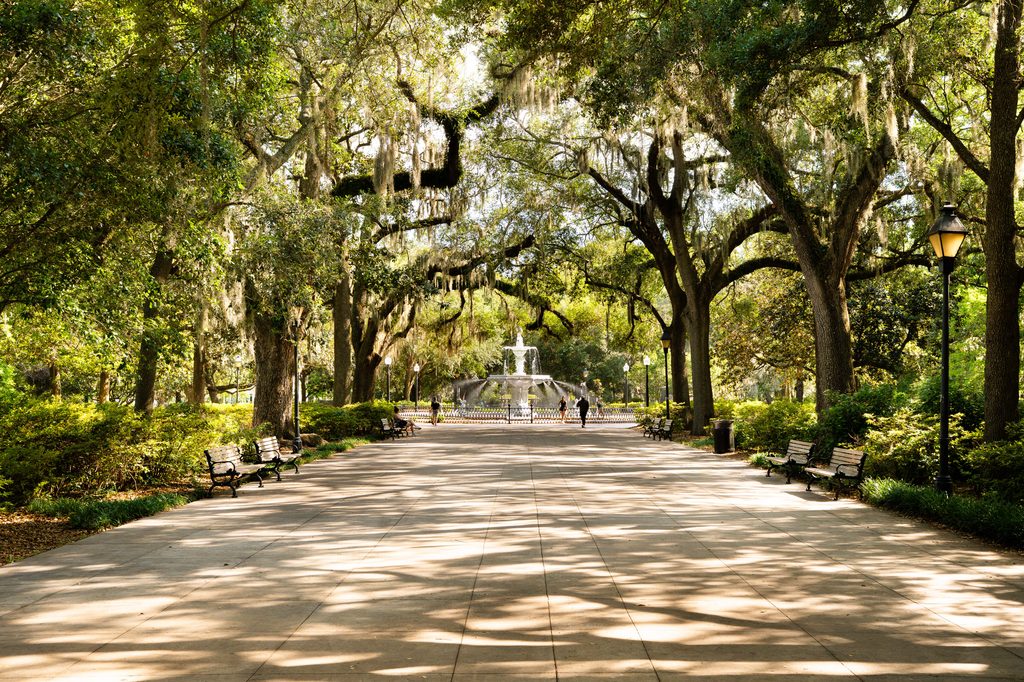
Live oak is Georgia’s official state tree, designated in 1937 in recognition of its deep ties to the state’s coastal history and early settlers along the shoreline.
Its low, twisting branches and evergreen leaves make it instantly recognizable, especially when draped in Spanish moss along historic streets in Savannah and other coastal towns.
This species is remarkably wind-resistant, a trait that has made it a favored shade tree in hurricane-prone coastal neighborhoods for generations.
Live oak grows slowly but can live for centuries, eventually developing a canopy spread that often exceeds its own height, given enough open space.
2. Longleaf Pine (Pinus palustris)
Longleaf pine once dominated tens of millions of acres across the Southeast, and Georgia’s remaining stands remain critical to the fire-dependent ecosystems found across the Coastal Plain.
Its exceptionally long needles, sometimes reaching 18 inches, and tall, clear trunks give this species a distinctive, almost sculptural silhouette in open savanna settings.
Young longleaf pines spend several years in a “grass stage,” where the seedling looks like a clump of grass before shooting upward rapidly once established.
Conservation groups across Georgia have invested heavily in longleaf restoration, recognizing its importance for red-cockaded woodpeckers and other fire-adapted wildlife.
3. Loblolly Pine (Pinus taeda)
Loblolly pine is Georgia’s most common tree by number of live trees statewide, accounting for roughly 39 percent of all trees measured in the state’s most recent forest inventory.
This fast-growing pine has long needles in bundles of three and reddish-brown, plated bark, and it forms the backbone of Georgia’s commercial timber industry.
Loblolly regenerates aggressively after logging, often forming dense, even-aged stands across former farmland throughout the Piedmont and Coastal Plain.
Because of its rapid growth, loblolly pine supports much of Georgia’s forestry economy, which the state credits with a multibillion-dollar annual impact.
4. Slash Pine (Pinus elliottii)
Slash pine thrives in Georgia’s wetter coastal soils, recognized by its robust needles in bundles of two or three and flaky, reddish bark on mature trunks.
This species grows quickly and produces high-quality resin and timber, making it a mainstay of south Georgia’s forestry operations for well over a century.
Slash pine tolerates occasional flooding better than loblolly pine, which explains its dominance in low-lying coastal plain forests and pine plantations near the shore.
Its glossy, dark green needles and straight form also make it a popular ornamental choice in southern Georgia landscaping.
5. Eastern White Pine (Pinus strobus)
Eastern white pine reaches its southern range limit in the mountains of north Georgia, recognized by its soft, blue-green needles bundled in groups of five.
This conifer can exceed 100 feet in height on good sites, standing out among the state’s other native pines for its exceptionally tall, straight form.
Historically, colonial shipbuilders prized straight white pines for masts, and the species remains valued today for its fast growth and clean, workable lumber.
White pine prefers cooler, well-drained mountain soils, which limits its natural range mostly to the higher elevations of north Georgia’s Blue Ridge region.
6. White Oak (Quercus alba)
White oak is one of the most valued hardwoods across Georgia’s uplands, recognized by its rounded leaf lobes and pale, blocky bark on mature trunks.
Mature trees can live several hundred years, and the species anchors much of the hardwood forest found across the state’s Piedmont and river terraces.
White oak acorns are sweeter than red oak acorns, making them a preferred winter food source for deer, wild turkey, and squirrels throughout Georgia’s forests.
Because it grows slowly and spreads wide, white oak needs generous open space, so plant it away from structures if you want it to reach full maturity.
7. Southern Red Oak (Quercus falcata)
Southern red oak grows quickly across Georgia’s dry uplands, valued for its brilliant red fall foliage and reliable summer shade in yards throughout the state.
Its deeply lobed leaves, often with a distinctive bell-shaped base, help separate it from Georgia’s other red oak species during identification walks in the woods.
This tree tolerates drought and poor soil better than many oaks, which explains its dominance on the drier ridges and sandy terraces of the Piedmont and Coastal Plain.
Southern red oak’s fast growth rate makes it a practical choice for homeowners wanting meaningful shade within a shorter timeframe than slower oak species.
8. Turkey Oak (Quercus laevis)
Turkey oak gets its name from leaves shaped like a turkey’s foot, with narrow, deeply cut lobes unlike any other Georgia oak species.
It thrives on dry, sandy soils and pine barrens, particularly across the Coastal Plain, where it often grows alongside longleaf pine in fire-adapted communities.
This species survives fire remarkably well, an adaptation shared with many of the plants and trees found in Georgia’s longleaf pine ecosystems.
Turkey oak rarely reaches large size, but its distinctive leaf shape makes it one of the easier native oaks to identify at a glance.
9. Water Oak (Quercus nigra)
Water oak grows throughout Georgia’s bottomlands and moist woodlands, recognized by its spatula-shaped leaves that lack the deep lobes of many other oak species.
This fast-growing tree is a popular shade choice in Georgia neighborhoods, valued for the quick canopy it provides compared to slower, longer-lived oaks.
Its acorns feed a wide range of wildlife, including deer, squirrels, and wood ducks, particularly in the bottomland hardwood forests common across the state.
Water oak tends to be shorter-lived than white oak or live oak, so property owners should factor eventual replacement into long-term landscape planning.
READ MORE: 30 Popular Types of Oak Trees (Different Varieties, With Pictures)
10. American Beech (Fagus grandifolia)
American beech is easy to spot thanks to its smooth, silver-gray bark, a surface that unfortunately tempts too many visitors to carve initials into the trunk.
Found throughout Georgia’s mature hardwood forests, particularly in the Piedmont and mountains, beech is considered indicative of an older, well-established woodland community.
This species takes around 40 years before producing a significant quantity of nuts, but once mature, beechnuts become a critical food source for wildlife.
Beech often holds onto its pale, papery leaves through much of winter, a trait called marcescence that adds visual texture to otherwise bare forests.
11. Tulip Poplar (Liriodendron tulipifera)
Tulip poplar, also called yellow-poplar, dominates much of Georgia’s Piedmont second-growth forests, with mature trees regularly exceeding 100 feet in height.
Its distinctive four-lobed leaves and greenish-yellow, tulip-shaped flowers make it one of the more elegant native hardwoods, though the blooms sit high in the canopy.
This species grows remarkably fast, often adding several feet of height per year while young, which explains its dominance across former agricultural land throughout the state.
Given deep, moist, well-drained soil and room to grow, tulip poplar rewards patience with one of the most impressive silhouettes in any Georgia forest.
12. Sweetgum (Liquidambar styraciflua)
Sweetgum blankets much of Georgia’s Piedmont alongside tulip poplar, recognized by its star-shaped leaves and the spiky, round seed pods that fall each autumn.
Its fall color runs an unusually wide range for a single species, sometimes showing yellow, orange, red, and purple on the same tree simultaneously.
This fast-growing hardwood tolerates a variety of soils and adapts well to disturbed land, which is why it colonizes former farmland so successfully across the state.
Sweetgum wood is used for furniture and plywood, and the tree remains one of the most recognizable native species found throughout Georgia’s suburbs and forests alike.
13. Flowering Dogwood (Cornus florida)
Flowering dogwood lights up Georgia’s Piedmont and mountain forests each spring, its white or pink bracts appearing from March through April depending on elevation.
North Georgia’s mountain roads are considered some of the best places in the Southeast to catch dogwood at peak bloom, typically arriving in mid-April.
In fall, dogwood offers a second performance: scarlet foliage paired with clusters of red berries that feed migrating songbirds moving through the state.
At just 15 to 25 feet tall, flowering dogwood fits comfortably into most home landscapes, making it one of Georgia’s most widely planted ornamental trees.
14. Eastern Redbud (Cercis canadensis)
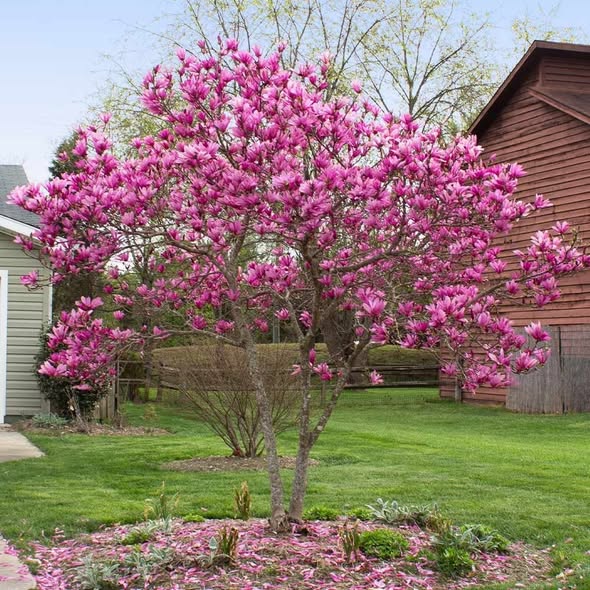
Eastern redbud announces spring across Georgia earlier than almost any other native tree, sometimes blooming as early as late February in the southern part of the state.
Its vivid magenta-pink flowers appear on bare branches well before the leaves emerge, creating one of the most striking early-season displays in Georgia forests.
This tree serves as an important early nectar source for emerging pollinators, arriving right when bees and other insects most need reliable food after winter.
Redbud develops a deep taproot early on, so it establishes best when planted young rather than transplanted once the root system has matured.
15. Sourwood (Oxydendrum arboreum)
Sourwood is a beloved native tree of Georgia’s mountains, producing drooping clusters of small, white, bell-shaped flowers in mid-summer, later than most other flowering trees.
Beekeepers across north Georgia prize sourwood blossoms heavily, since sourwood honey ranks among the most sought-after specialty honeys produced anywhere in the Southeast.
Fall color arrives early and dramatically, with leaves turning deep red to burgundy weeks before most surrounding hardwoods begin changing color in the mountains.
This tree grows slowly and rarely reaches great size, making it well suited to smaller mountain properties looking for both summer flowers and fall color.
16. Sassafras (Sassafras albidum)
Sassafras is one of Georgia’s more distinctive native trees, producing three different leaf shapes, oval, mitten-shaped, and three-lobed, sometimes all on a single branch.
Crushed leaves and roots release a strong, spicy-sweet fragrance historically used to flavor root beer and traditional teas, though modern research has limited its culinary use.
In fall, sassafras foliage turns brilliant shades of orange, red, and yellow, often ranking among the showiest color displays found along Georgia’s forest edges.
This tree spreads readily by root suckers, forming small colonies over time, making it better suited to naturalized areas than tightly controlled gardens.
17. Black Cherry (Prunus serotina)
Black cherry is cherished across Georgia’s mountain forests, ranking among the state’s more valuable native hardwoods thanks to its rich, reddish-brown grain.
In spring, drooping clusters of small white flowers cover the branches, followed by dark fruit that black bears, foxes, and songbirds consume heavily by late summer.
Mature bark breaks into small, curling dark plates, often compared to burnt potato chips, a helpful identification clue on older trees found throughout north Georgia.
Wilted leaves contain compounds toxic to livestock, so property owners with grazing animals should keep fallen branches and storm debris cleared promptly.
18. American Sycamore (Platanus occidentalis)
American sycamore lines Georgia’s rivers and floodplains, instantly recognizable by bark that peels away in patches, revealing a mottled white, gray, and tan pattern beneath.
This tree grows to an enormous trunk diameter, often larger than any other native hardwood in the state, with old specimens along waterways exceeding 100 feet.
Its extensive root system helps stabilize eroding riverbanks, making sycamore a natural choice for stream buffer and floodplain restoration projects across Georgia.
Because of its size, sycamore fits parks and large properties far better than small residential lots, where it can quickly outgrow the available space.
19. Black Walnut (Juglans nigra)
Black walnut grows across Georgia’s richer Piedmont soils and mountain valleys, prized by furniture makers for its dark heartwood and by foragers for its edible nuts.
The tree releases a chemical compound called juglone into the surrounding soil, which suppresses growth in many nearby plants, including tomatoes and certain fruit trees.
High-quality black walnut logs remain some of the most valuable timber harvested in Georgia, sometimes fetching premium prices at specialty auctions.
Its large compound leaves and thick, deeply furrowed bark make identification straightforward, especially once round, green-husked nuts begin dropping each autumn.
20. Shagbark Hickory (Carya ovata)
Shagbark hickory gets its name from bark that peels away from the trunk in long, curling strips, making mature trees identifiable even from a moving car.
This slow-growing species is common throughout Georgia’s Piedmont and mountain forests and can live well past 200 years once established in undisturbed woodland conditions.
Its sweet, edible nuts have fed wildlife and people for generations, and the wood remains a favorite for smoking meat because of its distinctive, rich flavor.
Georgia’s diverse hickory species, including shagbark, form an important part of the state’s oak-hickory forest communities found across the northern Piedmont.
21. American Holly (Ilex opaca)
American holly stands out in Georgia’s understory year-round, thanks to its glossy, spiny evergreen leaves and bright red winter berries beloved by holiday decorators.
This slow-growing tree thrives in the shade of larger hardwoods and pines, making it a common understory species across much of the state’s forested land.
Birds, including cedar waxwings and mockingbirds, rely heavily on holly berries as a winter food source when other fruit has already disappeared from the landscape.
Because only female trees produce berries, and only when a male tree grows nearby, gardeners hoping for winter color should plant both sexes if space allows.
22. Southern Magnolia (Magnolia grandiflora)
Southern magnolia is one of the most iconic evergreen trees associated with the Deep South, producing enormous, fragrant white flowers throughout the summer months.
Its large, glossy, dark green leaves stay on the tree year-round, giving southern magnolia a bold, formal presence in both wild forests and cultivated landscapes.
This species grows naturally across Georgia’s Coastal Plain and lower Piedmont, though it has been widely planted well beyond its native range throughout the state.
Southern magnolia’s slow growth and eventual large size mean it needs significant space, so plant it well away from structures and smaller garden beds.
23. Sweetbay Magnolia (Magnolia virginiana)
Sweetbay magnolia grows naturally in Georgia’s wetter Coastal Plain habitats, favoring swamps, bogs, and low-lying woods where its roots can access consistent moisture.
Its creamy white, lemon-scented flowers bloom through much of the summer, offering a longer bloom period than most native flowering trees found across the state.
Semi-evergreen in Georgia’s milder climate, sweetbay retains some foliage through winter, giving it more year-round structure than fully deciduous magnolias.
This compact, fragrant tree fits well into smaller landscapes, particularly in low or poorly drained spots where other ornamental species tend to struggle.
24. Bald Cypress (Taxodium distichum)
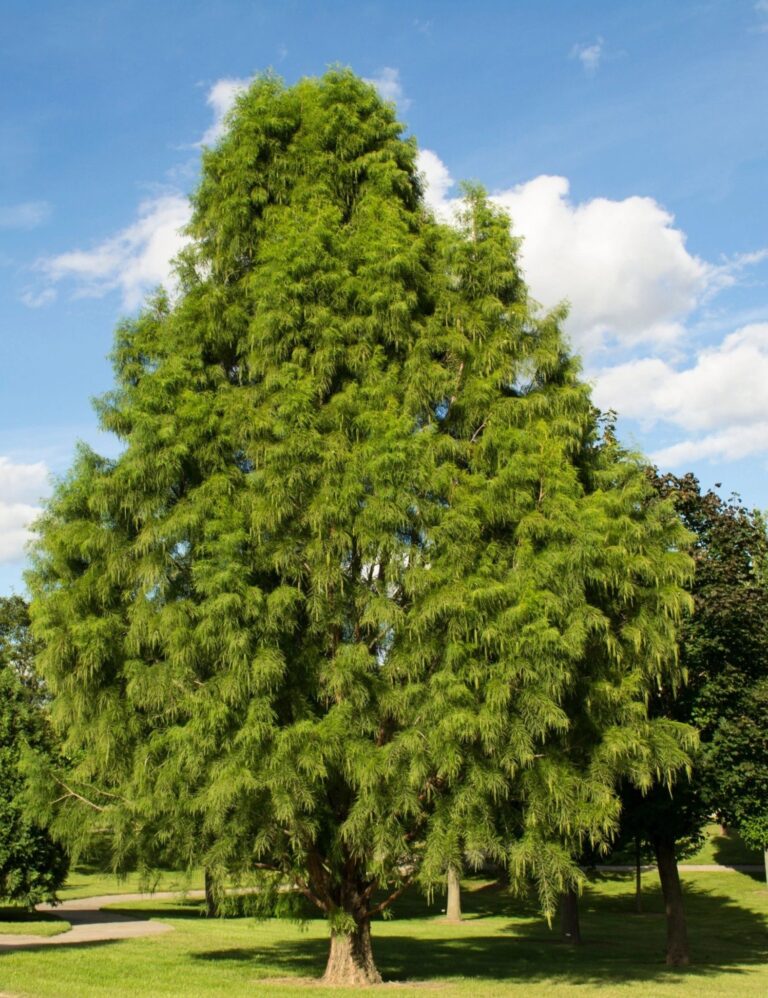
Bald cypress defines Georgia’s swamps and blackwater rivers, standing in standing water with distinctive knees rising from the roots, structures still debated among botanists.
Despite being a conifer, bald cypress drops its needle-like foliage every autumn, an unusual trait that gives the species its common name.
The Okefenokee Swamp in southern Georgia contains some of the most significant bald cypress stands remaining in the Southeast, some centuries old.
Bald cypress wood resists rot remarkably well, which historically made it valuable for boat building, shingles, and other applications exposed to constant moisture.
25. River Birch (Betula nigra)
River birch is one of the few native birches genuinely comfortable in Georgia’s warmer, wetter bottomland soils, thriving along creeks, rivers, and low-lying yards statewide.
Its peeling, salmon-pink to reddish-brown bark provides striking year-round visual interest, particularly attractive against the darker bark of surrounding hardwoods.
This species resists the bronze birch borer far better than paper or European white birch, making it a more resilient landscape choice across Georgia’s warmer climate.
Its extensive root system also helps stabilize eroding creek banks, which has made it a popular choice for rain gardens and stream buffer plantings statewide.
Quick Tips for Planting Native Georgia Trees
A few practical notes before you head to the nursery.
Match the tree to your region. Bald cypress and sweetbay magnolia favor Georgia’s wetter Coastal Plain, while sourwood and eastern white pine prefer the cooler mountains.
Buy from Georgia Forestry Commission resources when possible. The GFC’s own guides and county foresters can help match species to your specific soil and climate conditions.
Watch for storm and pest damage. Hurricane Helene alone affected nearly 9 million acres of Georgia forestland in 2024, a reminder to choose resilient, well-adapted native species.
Final Thoughts
Twenty-five trees only begin to capture what grows across Georgia’s 24.8 million forested acres. But this list covers the species you are most likely to encounter, plant, or simply want to name correctly on your next hike.
I hope it deepens your appreciation for the Peach State’s forests, and perhaps inspires you to plant one of these natives at home this season.
References
- Georgia Forestry Commission — Champion Trees Program: https://gatrees.org/learn-explore/champion-trees/
- Georgia Forestry Commission — Forests for Georgia, Georgia for Forests: https://gatrees.org/learn-explore/forests-for-georgia-georgia-for-forests/
- USDA Forest Service, Southern Research Station — Forests of Georgia, 2013 (Resource Update FS-38): https://www.srs.fs.usda.gov/pubs/ru/ru_srs038.pdf
- USDA Forest Service, Southern Research Station — Forests of Georgia (Resource Update FS-226): https://www.srs.fs.usda.gov/pubs/ru/ru_fs226.pdf
- USDA Forest Service, Southern Research Station — Georgia, 2011 Forest Inventory & Analysis Factsheet: https://www.srs.fs.usda.gov/pubs/su/su_srs053.pdf
- University of Georgia Cooperative Extension — Native Plants for Georgia, Part I: Trees, Shrubs, and Woody Vines (Bulletin 987): https://extension.uga.edu/publications/detail.html?number=B987&title=native-plants-for-georgia-part-i-trees-shrubs-and-woody-vines
- University of Georgia Extension / Georgia Forestry Commission — Native Trees of Georgia (Identification Manual): https://extension.uga.edu/content/dam/extension-county-offices/fayette-county/4h/competitions/forestry-judging-materials/Native%20Trees%20of%20Georgia.pdf

Tim M Dave is a gardening expert with a passion for houseplants, particularly cacti and succulents. With a degree in plant biology from the University of California, Berkeley, he has vast experience in gardening. Over the years, he has cultivated a vast collection of desert plants and learned a great deal about how to grow and care for these unique companions.