20 Trees Native to Louisiana (With Growing Details)
Louisiana’s forests cover about 15 million acres, nearly half the state’s total land area, according to the U.S. Forest Service. That makes forestry one of the state’s largest land uses, right alongside agriculture and wetlands.
Native trees anchor Louisiana’s fragile landscape in a way imported species cannot. Bald cypress and tupelo root systems, for example, slow coastal erosion and buffer storm surge during hurricane season.
Over 148,000 woodland owners manage private forestland across the state, based on figures from the Louisiana Department of Agriculture and Forestry. That is a massive number of people directly responsible for how these native species are protected and replanted.
Choosing native trees also means fewer pest problems long term. These species evolved alongside Louisiana’s humidity, flooding, and hurricane exposure, so they tend to recover faster after storm damage than trees brought in from elsewhere.
Native species also support the food web in ways ornamental imports rarely match. Migratory songbirds, wading birds, and game species all depend on the seeds, nuts, and insects that these trees host throughout the year.
Now, let’s walk through the list of trees native to Louisiana.
20 Trees Native to Louisiana
1. Bald Cypress (Taxodium distichum)

Bald cypress is Louisiana’s official state tree, and it earns that title honestly. It thrives in standing water, sending up knobby “knees” that poke above the swamp surface for stability and possibly extra oxygen.
Despite growing in wetlands, bald cypress is technically a conifer that drops its needles each fall, which explains the “bald” part of its name. Its rot-resistant wood has been prized for construction, decking, and boatbuilding for generations.
Some cypress trees in Louisiana swamps are estimated to be over 1,000 years old. Standing beneath one of these ancient giants, draped in Spanish moss, is an experience that photographs never quite capture.
The tree also plays a critical ecological role along the coast, where its dense root mat helps buffer storm surge and slow saltwater intrusion into freshwater marshes.
2. Southern Live Oak (Quercus virginiana)
Live oak defines the look of old Louisiana. Its massive, spreading limbs often grow wider than the tree is tall, sometimes touching the ground before curving back upward.
Unlike most oaks, live oak keeps its leathery, dark green leaves through winter, dropping and replacing them gradually each spring. That evergreen habit gives it the name “live” oak.
This tree can live for centuries and was historically prized for shipbuilding because of its dense, curved timber. Today, it is the signature tree of grand plantation avenues and city parks across south Louisiana.
Spanish moss, an air plant rather than a parasite, often drapes heavily from live oak branches, adding to the tree’s dramatic, timeless appearance.
3. Southern Magnolia (Magnolia grandiflora)
Southern magnolia produces some of the most recognizable flowers in the American South. Its creamy white blooms can stretch up to 12 inches across and release a lemony fragrance that carries across entire yards.
The leaves are glossy, dark green on top and rusty brown underneath, staying on the tree year-round. That texture makes magnolia a popular ornamental choice well beyond its native range.
Cone-like seed pods follow the flowers, splitting open to reveal bright red seeds that birds and small mammals eagerly eat. Magnolia grows naturally in moist woods throughout the southern half of Louisiana.
4. Water Tupelo (Nyssa aquatica)
Water tupelo grows in the same flooded swamps as bald cypress, often standing side by side with it. Its trunk swells dramatically at the base, tapering upward like an upside-down cone.
This adaptation helps the tree stay stable in saturated, unstable soil. Its wood is soft and lightweight, historically used for pulp, boxes, and novelty carvings.
Tupelo honey, a specialty product from bees that forage on the tree’s spring flowers, has become a regional delicacy. Water tupelo remains one of the best indicators of a healthy, functioning Louisiana swamp.
5. Sweetgum (Liquidambar styraciflua)
Sweetgum is instantly recognizable by its star-shaped, five-pointed leaves that turn brilliant shades of red, purple, and gold each fall. Few native trees put on a better autumn show in Louisiana.
Its spiky, round seed pods, often called “gumballs,” litter yards and sidewalks every winter. While a nuisance to rake, those seeds feed goldfinches, chickadees, and squirrels through the colder months.
Sweetgum grows fast in a wide range of soils, from moist bottomlands to drier upland sites. Its wood is used for furniture, plywood, and veneer throughout the southern timber industry.
Despite its reputation as a messy yard tree, sweetgum ranks among the most commercially valuable hardwoods harvested in Louisiana each year.
6. Loblolly Pine (Pinus taeda)
Loblolly pine dominates Louisiana’s commercial timber industry more than any other single species. Its long, straight trunk and fast growth rate make it the backbone of the state’s pulp and lumber operations.
Needles grow in bundles of three, reaching up to nine inches long, softer and more flexible than other southern pines. The bark forms reddish-brown plates that thicken with age, offering some resistance to low-intensity fire.
Loblolly stands provide critical habitat for red-cockaded woodpeckers and other wildlife in managed forests. This single species accounts for a large share of the timber harvested statewide each year.
Landowners across north and central Louisiana often replant loblolly after harvest, cycling through 25 to 35 year rotations depending on the intended market.
7. Longleaf Pine (Pinus palustris)
Longleaf pine once covered vast stretches of the southeastern coastal plain, including much of central Louisiana. Its needles are the longest of any native pine, sometimes reaching 18 inches.
This species spends its early years in a “grass stage,” looking more like a tuft of long needles than a young tree. That slow start protects the growing tip from fire while the root system develops underground.
Longleaf forests support an extraordinary range of wildlife, including gopher tortoises and rare orchids. Kisatchie National Forest, Louisiana’s only national forest, protects significant remaining stands of this once-dominant ecosystem.
Restoration groups across the state have worked for decades to bring longleaf pine back to former agricultural and pasture land, recognizing its value for both timber and biodiversity.
8. Shortleaf Pine (Pinus echinata)
Shortleaf pine grows across the drier, rolling uplands of north and central Louisiana. It is more fire-adapted than loblolly, thanks to a thick, insulating bark and the ability to resprout from its base after a burn.
Needles grow in bundles of two, occasionally three, and measure shorter than both loblolly and longleaf. This gives the tree its straightforward common name.
Shortleaf pine timber has long been valued for construction lumber and utility poles. Foresters increasingly favor it in restoration projects aimed at rebuilding fire-resilient pine ecosystems.
9. Water Oak (Quercus nigra)
Water oak is one of the most common oaks across Louisiana’s bottomlands, yards, and roadsides. Its leaves vary widely in shape, sometimes lobed, sometimes nearly oval, which can make identification tricky at first.
This tree grows fast and tolerates wet, poorly drained soil better than many other oaks. That adaptability comes at a cost, since water oak has a shorter lifespan and weaker wood than slower-growing species.
Its small acorns feed deer, squirrels, and wild turkeys throughout fall and winter. Water oak remains a familiar shade tree in cities from Shreveport to New Orleans.
10. Willow Oak (Quercus phellos)
Willow oak stands out among oaks for its narrow, willow-like leaves instead of the typical lobed shape. That slender foliage gives the canopy a fine, feathery texture unlike almost any other oak in the state.
It thrives in bottomland forests and along riverbanks, tolerating occasional flooding without much trouble. Its small, round acorns are a favorite food source for ducks feeding in flooded timber, a detail hunters know well.
Willow oak has become a popular street and park tree because of its symmetrical shape and relatively fast growth. It handles Louisiana’s urban heat and compacted soils better than many alternatives.
11. Cherrybark Oak (Quercus pagoda)
Cherrybark oak is considered one of the finest timber oaks in the South, prized for its tall, straight trunk and minimal taper. Its bark resembles black cherry bark, dark and blocky, which explains the common name.
This tree grows in rich, well-drained bottomland soils alongside green ash and pecan. Its large acorns provide a dependable food source for deer and turkey across Louisiana’s river floodplains.
Foresters often favor cherrybark oak in bottomland restoration projects because of its strong growth form. Furniture makers value the wood for its strength and attractive grain pattern.
12. Nuttall Oak (Quercus texana)
Nuttall oak thrives in the seasonally flooded bottomlands of the Mississippi River floodplain, an environment that would stress many other oak species. Its leaves resemble pin oak, with deep, pointed lobes.
This tree grows quickly and produces acorns at a relatively young age compared to other oaks. That trait makes it a favorite for reforestation projects aimed at restoring wildlife habitat in former agricultural fields.
Ducks and wading birds rely heavily on flooded Nuttall oak stands for food during winter. Wildlife managers across north Louisiana actively plant this species to rebuild bottomland hardwood forests.
13. Pecan (Carya illinoinensis)
Pecan holds a special place in Louisiana’s culinary identity, showing up in pralines, pies, and countless savory dishes. It is the largest of the native hickories, capable of towering over the rich floodplain soils it prefers.
Its oblong nuts sit inside thin, papery husks that split open in four sections when ripe. Wild pecan trees along the Mississippi River floodplain have fed people and wildlife for centuries.
Pecan wood is also valued for smoking meat, adding a distinct flavor prized throughout southern barbecue traditions. Many Louisiana homeowners grow pecan trees specifically for their annual nut harvest.
The tree can live well over a century, and older orchards throughout the state still produce reliable crops each fall.
14. Green Ash (Fraxinus pennsylvanica)
Green ash grows throughout Louisiana’s bottomland hardwood forests, often alongside cherrybark oak and pecan. Its compound leaves have seven to nine leaflets, and its bark forms a distinctive diamond pattern with age.
This tree tolerates wet, poorly drained soils that would stunt many other hardwoods. That flood tolerance made it a staple species in floodplain forests along the Mississippi and Red Rivers.
The emerald ash borer, an invasive pest first confirmed in Louisiana in 2015, now threatens green ash populations statewide. Foresters continue monitoring its spread while researching resistant strains for future replanting.
15. American Sycamore (Platanus occidentalis)
American sycamore is easy to spot from a distance thanks to its mottled, peeling bark that reveals patches of white, gray, and tan underneath. Few native trees have such a distinctive trunk.
It grows rapidly along riverbanks and floodplains, often reaching massive girths that dwarf neighboring trees. Its large, maple-like leaves provide dense shade during Louisiana’s long, hot summers.
Sycamore’s hollow, aging trunks frequently become nesting sites for owls, wood ducks, and other cavity-dwelling wildlife. This tree has anchored southern river bottoms for centuries.
16. American Elm (Ulmus americana)
American elm once lined streets across small-town Louisiana with its graceful, vase-shaped canopy. Dutch elm disease has reduced populations significantly, though scattered mature trees still survive in bottomland forests.
Its leaves are asymmetrical at the base with sharply toothed edges, a helpful identification trait. The tree naturally favors moist, alluvial soils near rivers and streams.
Disease-resistant elm cultivars are increasingly available for landscape planting. Seeing a healthy, mature American elm today feels like glimpsing a piece of the region’s pre-disease streetscape history.
17. Black Willow (Salix nigra)
Black willow grows fast along Louisiana’s riverbanks, streambanks, and lake margins, often forming dense thickets in disturbed, wet soil. Its narrow, elongated leaves give the canopy a soft, drooping texture.
This tree plays an important role stabilizing eroding banks with its extensive, fibrous root system. Beavers and other wildlife rely on its soft wood and bark as a food source.
Black willow has a relatively short lifespan compared to other bottomland trees, rarely exceeding a few decades. Even so, it performs valuable ecological work wherever it establishes itself.
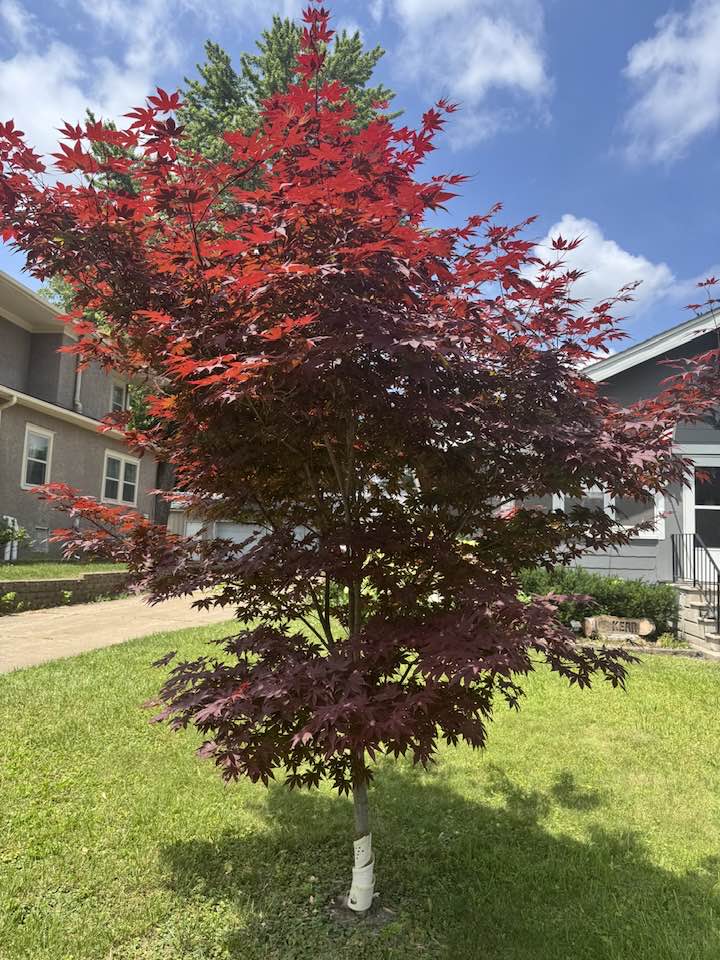
18. Red Maple (Acer rubrum)
Red maple earns its name honestly, showing red flowers in late winter, red leaf stems in summer, and fiery red foliage each fall. It adapts to an unusually wide range of soil types across Louisiana.
You will find it in swamps, uplands, and everywhere in between, a versatility rare among native trees. Its winged seeds, called samaras, spin down in spring and provide an early food source for squirrels and birds.
Red maple grows moderately fast and tolerates urban conditions reasonably well. It ranks among the most widely planted native shade trees in Louisiana yards today.
19. Eastern Redbud (Cercis canadensis)
Eastern redbud announces spring across Louisiana with clusters of small, pink-purple flowers that bloom directly on bare branches before the leaves emerge. Few native trees offer such an early, vivid display.
Its heart-shaped leaves follow the blooms, turning bright yellow in autumn. Redbud typically stays small, rarely topping 30 feet, which makes it a favorite understory and ornamental choice.
This tree naturally grows in wooded ravines, bluffs, and alluvial soils throughout southern Louisiana. Its flowers also serve as an early nectar source for native bees emerging from winter dormancy.
20. American Holly (Ilex opaca)
American holly stands out year-round with its spiny, evergreen leaves and bright red berries that persist through winter. It is one of the few native evergreen broadleaf trees found across Louisiana’s forests.
Only female trees produce the familiar red berries, and they need a nearby male tree for pollination. Those berries become critical winter food for songbirds when other options grow scarce.
Holly grows slowly in shaded understories beneath taller hardwoods and pines. Its dense, prickly foliage also makes it a popular choice for natural privacy screens and holiday decorations alike.
Wildlife managers often recommend planting American holly near feeders and hedgerows, since its year-round cover and winter fruit make it one of the most reliable native food sources for birds during Louisiana’s coldest months.
Final Thoughts
Twenty trees can only capture part of what makes Louisiana’s forests so distinctive. Between the flooded cypress swamps, the pine uplands, and the oak-shaded neighborhoods, this state offers one of the richest tree landscapes in the country.
If you are choosing a native tree to plant, start with your site’s water level. Wet, low ground favors bald cypress, tupelo, or willow oak. Drier upland soil suits longleaf pine or shortleaf pine far better.
Getting that match right early on saves years of frustration and replanting down the road.
Louisiana’s forests have survived hurricanes, floods, and disease outbreaks for centuries. Next time you pass a cypress knee poking through swamp water or a live oak stretching across a country road, you will know exactly what kind of survivor you are looking at.
That recognition changes how a drive across the state feels. What once looked like an unremarkable tree line along a highway becomes a record of storms weathered and soil held together, one root system at a time.
References
- Louisiana Department of Agriculture and Forestry – Office of Forestry: https://www.ldaf.la.gov/land/forestry
- USDA Forest Service, Southern Research Station – Forests of Louisiana, 2014 (PDF): https://www.srs.fs.usda.gov/pubs/ru/ru_srs117.pdf
- USDA Forest Service – Louisiana Forest Health Highlights 2022 (PDF): https://fs.usda.gov/foresthealth/docs/fhh/LA_FHH_2022.pdf
- USDA Forest Service – Kisatchie National Forest: https://www.fs.usda.gov/r08/kisatchie
- LSU School of Renewable Natural Resources – Research and Outreach: https://www.lsu.edu/agriculture/rnr/research/index.php
- LSU AgCenter – Native Tree Growing Guide for Louisiana (PDF): https://www.lsuagcenter.com/NR/rdonlyres/F5E6FA92-D84F-4716-9176-355A62765838/18167/pub2926NativeTreeGuide.pdf
- LSU AgCenter – Forestry Resources: https://www.lsuagcenter.com/topics/environment/forestry

Tim M Dave is a gardening expert with a passion for houseplants, particularly cacti and succulents. With a degree in plant biology from the University of California, Berkeley, he has vast experience in gardening. Over the years, he has cultivated a vast collection of desert plants and learned a great deal about how to grow and care for these unique companions.