25 Trees Native to New Jersey (With Growing Details)
New Jersey wears its nickname well. The Garden State carries roughly 2 million acres of forest, which covers about 42% of the entire state, according to U.S. Forest Service data. That is a remarkable figure for the most densely populated state in the country.
I have walked through the Pine Barrens in July and stood under 300-year-old oaks in the Highlands. Each time, I am struck by how much variety hides within such a small footprint.
New Jersey stretches from the Kittatinny Ridge in the north to the Cape May peninsula in the south, and that range in climate and soil gives rise to a genuinely diverse native tree population.
This guide walks through 25 trees native to New Jersey you should know. Let’s get into it.
Why New Jersey’s Native Trees Matter
Native trees support local wildlife in ways that imported ornamentals cannot match. Oaks alone host hundreds of species of caterpillars, which in turn feed songbirds through the nesting season.
Rutgers Cooperative Extension recommends keeping native plant cover above 70% in a home landscape to preserve this ecological function.
New Jersey’s forests split fairly cleanly by region. Northern counties like Sussex, Warren, and Morris favor northern hardwoods, white pine, and eastern hemlock.
Southern counties such as Cape May, Atlantic, and Burlington lean toward pitch pine and other southern yellow pines, especially within the Pinelands.
With that backdrop in mind, here are the 25 species worth knowing.
1. Northern Red Oak (Quercus rubra)

This is New Jersey’s official state tree, chosen by legislative resolution on June 13, 1950. Lawmakers picked it for its strength, structural beauty, and long life, and I think that description still holds up today.
The tree can live up to 300 years and reach 60 to 75 feet tall. Its bark shows distinctive shiny ridge stripes running down the trunk, which makes winter identification fairly easy.
Fall color turns a deep, dramatic red before the leaves drop in November. Acorns feed everything from mice to black bears, making this oak a genuine keystone species for New Jersey wildlife.
You will find it across the entire state, from the Highlands down through the Pinelands, thriving in acidic, well-drained soil.
2. White Oak (Quercus alba)
White oak is one of the two dominant forest types in New Jersey, paired often with red oak and hickory. Its light gray, flaky bark sets it apart from red oak’s ridged pattern almost at a glance.
This tree grows slowly but lives long, sometimes exceeding 400 years in undisturbed forest. Leaves have rounded lobes rather than the pointed lobes of red oaks.
White oak acorns are sweeter and lower in tannins than most oaks, which is why wildlife tends to eat them first. Deer, turkeys, and squirrels all rely heavily on this mast crop each autumn.
Look for it on drier upland sites throughout central and southern New Jersey.
3. Pin Oak (Quercus palustris)
Pin oak thrives in the wetter, poorly drained soils common across New Jersey’s coastal plain. Its lower branches droop noticeably toward the ground, a feature that makes the species easy to spot from a distance.
The leaves are deeply cut with sharp, bristled lobes. In fall they turn a russet-bronze color and often cling to the branches well into winter.
This oak grows relatively fast for the genus and is frequently planted along streets and in parks because of its tidy pyramidal shape when young.
4. Chestnut Oak (Quercus montana)
Chestnut oak favors rocky, dry ridgetops, particularly in the northern Highlands and the Kittatinny Ridge. Its deeply furrowed, dark bark is one of the thickest of any eastern oak.
Leaves resemble American chestnut foliage, with wavy, rounded teeth rather than sharp lobes. That resemblance gives the species its common name.
Because it tolerates thin, poor soil so well, chestnut oak often dominates ridge crests where few other large trees can establish themselves.
5. Scarlet Oak (Quercus coccinea)
Scarlet oak earns its name honestly. Its autumn foliage turns a brilliant, almost fluorescent red that rivals any tree in the eastern forest.
The species prefers dry, sandy soils and is common throughout the Pinelands and the sandy uplands of central New Jersey. Its deeply cut leaves have narrow, pointed lobes.
Growth is moderately fast, and mature trees can reach 70 to 80 feet. Scarlet oak acorns take two years to mature, a trait it shares with red and black oaks.
6. Eastern White Pine (Pinus strobus)
Eastern white pine is the tallest native conifer in the northeastern United States, and northern New Jersey’s forests still hold impressive stands. Soft, blue-green needles grow in bundles of five, a simple way to distinguish it from other pines.
Historic logging removed most old-growth white pine from the state, but second-growth stands now cover significant acreage in Sussex and Warren counties.
The wood was historically prized for ship masts because of its straight, lightweight grain. Today it remains popular for lumber and as a fast-growing ornamental screen.
7. Pitch Pine (Pinus rigida)
Pitch pine defines the Pine Barrens landscape more than any other species. Alongside white oak, it forms one of New Jersey’s two dominant forest types, according to state forestry surveys.
This tree has an unusual survival trick. Pitch pine can sprout new growth directly from its trunk and roots after a wildfire, which explains why it thrives in a region shaped by frequent burns.
Needles grow in bundles of three, and the bark is thick and deeply plated, offering real fire resistance. Cones can stay closed on the tree for years, waiting for heat to trigger seed release.
You will find the densest stands in Burlington, Ocean, and Atlantic counties.
8. Atlantic White Cedar (Chamaecyparis thyoides)
Atlantic white cedar grows almost exclusively in freshwater wetlands, and New Jersey’s Pinelands hold some of the largest remaining stands on the East Coast. Its scale-like, blue-green foliage and reddish-brown, fibrous bark make it distinctive among conifers.
The wood resists rot so effectively that colonial builders used it for shingles, boat hulls, and water pipes. Some of those uses continue in specialty markets today.
This species is considered globally significant for conservation, since Pinelands cedar swamps represent one of its healthiest remaining habitats anywhere.
9. Eastern Hemlock (Tsuga canadensis)
Eastern hemlock prefers cool, shaded ravines and stream banks, mostly in northern New Jersey. Short, flat needles with two white stripes underneath give it a soft, feathery appearance.
Unfortunately, the invasive hemlock woolly adelgid has damaged many New Jersey stands over the past several decades. State forestry agencies continue monitoring efforts to slow the pest’s spread.
Where healthy, hemlock forms dense canopies that keep stream water cool, which benefits native trout populations directly.
10. Shagbark Hickory (Carya ovata)
Shagbark hickory is unmistakable once you have seen one. Its bark peels away in long, curling plates that give the trunk a shaggy, almost unkempt look.
This tree can grow over 100 feet tall and produces sweet, edible nuts inside a thick husk. Wildlife from black bears to wood ducks rely on the fall nut crop.
I find it one of the more satisfying trees to identify precisely because the bark leaves no room for doubt. It grows well across upland forests statewide.
11. Pignut Hickory (Carya glabra)
Pignut hickory shares the same forests as shagbark but keeps tighter, more diamond-patterned bark rather than shaggy plates. The nuts are smaller and more bitter, which is how the species got its unflattering name.
It tolerates dry, rocky slopes better than most hickories, making it common on ridges throughout the Highlands and Piedmont regions.
Squirrels and chipmunks still eat the nuts readily, even if the flavor is less appealing to humans than shagbark’s.
12. American Beech (Fagus grandifolia)
American beech carries smooth, silver-gray bark that stays smooth even on old, mature trunks, unlike almost every other large native tree. That smoothness has unfortunately made it a magnet for carved initials in forests everywhere.
Leaves are glossy, with straight parallel veins ending in fine teeth. In autumn they turn a warm golden bronze and, on younger trees, often persist through winter.
Beech forms dense canopies in northern New Jersey’s richer, moist woodlands, frequently alongside sugar maple and hemlock.
13. Sugar Maple (Acer saccharum)
Sugar maple is the source of real maple syrup, and while New Jersey’s commercial syrup industry is small, the tree grows well in the state’s northern counties. Its five-lobed leaf is the same shape featured on the Canadian flag.
Fall color runs through brilliant orange and gold, often considered among the finest of any northeastern tree. Sugar maple prefers rich, well-drained soil and cooler microclimates.
Growth is slower than red maple, but the wood is dense and valued for furniture and flooring.
14. Red Maple (Acer rubrum)
Red maple may be the most widespread tree in New Jersey, tolerating everything from swampy lowlands to dry uplands. That adaptability explains why foresters often call it one of the most successful native trees in eastern North America.
Its red flowers appear in very early spring, sometimes weeks before other trees show any sign of life. Fall foliage ranges from yellow to a striking scarlet red.
Because it grows quickly and adapts to poor soil, red maple is a common choice for street plantings and residential yards across the state.
15. Tuliptree (Liriodendron tulipifera)
Tuliptree, also called tulip poplar, is one of the tallest native hardwoods in eastern North America, with straight trunks that can exceed 100 feet. Its unusual four-lobed leaf looks almost like a cat’s silhouette, and its greenish-orange flowers genuinely resemble tulips.
This tree grows remarkably fast for a hardwood, which made it valuable to colonial builders needing wide, straight lumber for barns and furniture.
You will find tuliptree throughout New Jersey’s richer forest soils, often growing alongside oaks and beech in mixed hardwood stands.
16. Sweetgum (Liquidambar styraciflua)
Sweetgum is instantly recognizable by its star-shaped, five-pointed leaves and its spiky, round seed pods that many people call “gumballs.” Fall color can shift through purple, red, orange, and yellow, sometimes all on the same tree.
It favors moist bottomland soils across southern and central New Jersey, though it adapts to drier sites as well.
The seed pods provide food for finches and other small birds through the winter months, even after most other seed sources are gone.
17. Black Cherry (Prunus serotina)
Black cherry produces small, dark fruit that ripens in late summer and disappears fast once birds find it. Its bark on mature trees looks almost like burnt potato chips, a texture unlike any other native species.
Wood from black cherry is prized by furniture makers for its rich reddish-brown color, which deepens further with age.
This tree grows throughout New Jersey’s forests and old fields, often as one of the first hardwoods to colonize abandoned farmland.
18. Flowering Dogwood (Cornus florida)
Flowering dogwood grows to about 33 feet and typically appears at forest edges or beneath taller canopy trees. Its white or pink spring bracts, often mistaken for petals, make it one of the most photographed native trees in the state.
Red berries appear in fall and are an important food source for migrating birds heading south.
Dogwood anthracnose disease has reduced wild populations in parts of the Northeast, so healthy specimens deserve extra appreciation where you find them.
19. Eastern Redbud (Cercis canadensis)
Eastern redbud announces spring with clusters of small, pink-purple flowers that bloom directly on bare branches before the leaves emerge. Heart-shaped leaves follow shortly after.
This small understory tree rarely exceeds 30 feet and fits comfortably into residential landscapes as well as woodland edges.
Native bees rely heavily on redbud’s early blooms, since few other food sources are available that early in the season.
20. Sassafras (Sassafras albidum)
Sassafras is one of the few native trees with three distinct leaf shapes on the same plant: oval, mitten-shaped, and three-lobed. Crushed leaves or twigs release a distinctive, slightly citrus-and-root-beer scent.
Historically, the root bark flavored root beer and traditional teas, though modern research led to restrictions on its use as a food additive.
Fall color turns a mix of yellow, orange, and scarlet, and the tree often forms dense colonies through root suckering in old fields.
21. Black Walnut (Juglans nigra)
Black walnut produces one of the most valuable native hardwoods in North America, prized for furniture and gunstocks alike. Its compound leaves have 15 to 23 leaflets, giving the canopy a fine, feathery texture.
The tree releases a chemical called juglone into surrounding soil, which suppresses many other plants nearby. Gardeners planning beds under a black walnut need to research juglone-tolerant species first.
Round green husks contain the nuts, which squirrels bury eagerly each fall across New Jersey’s floodplains and fertile lowlands.
22. American Holly (Ilex opaca)
American holly is New Jersey’s most recognizable native evergreen broadleaf tree, with spiny, glossy dark green leaves that stay on the tree year-round. Only female trees produce the classic red berries, and they need a male tree nearby for pollination.
The Pinelands region holds some of the largest wild holly stands in the northeastern United States.
Berries persist through winter and become critical food for songbirds once other sources run out, especially during hard freezes.
23. American Sycamore (Platanus occidentalis)
American sycamore is easy to spot from a distance because of its distinctive bark, which peels away in patches to reveal creamy white, gray, and green layers underneath. It is one of the largest native trees by trunk diameter in the eastern United States.
The tree favors riverbanks and floodplains, and mature specimens along the Delaware and Raritan rivers can reach truly massive proportions.
Large, ball-shaped seed pods dangle from bare winter branches, giving the species another common name: buttonwood.
24. Black Gum (Nyssa sylvatica)
Black gum, also called black tupelo, is often overlooked until autumn, when its glossy leaves turn one of the earliest and most intense reds of the season. Some individual trees can live for several hundred years.
It grows in both wet lowland sites and drier upland forests, showing a flexibility that surprises many people unfamiliar with the species.
Small blue-black fruits ripen in fall and provide high-fat, high-energy food for migrating birds preparing for long flights south.
25. River Birch (Betula nigra)
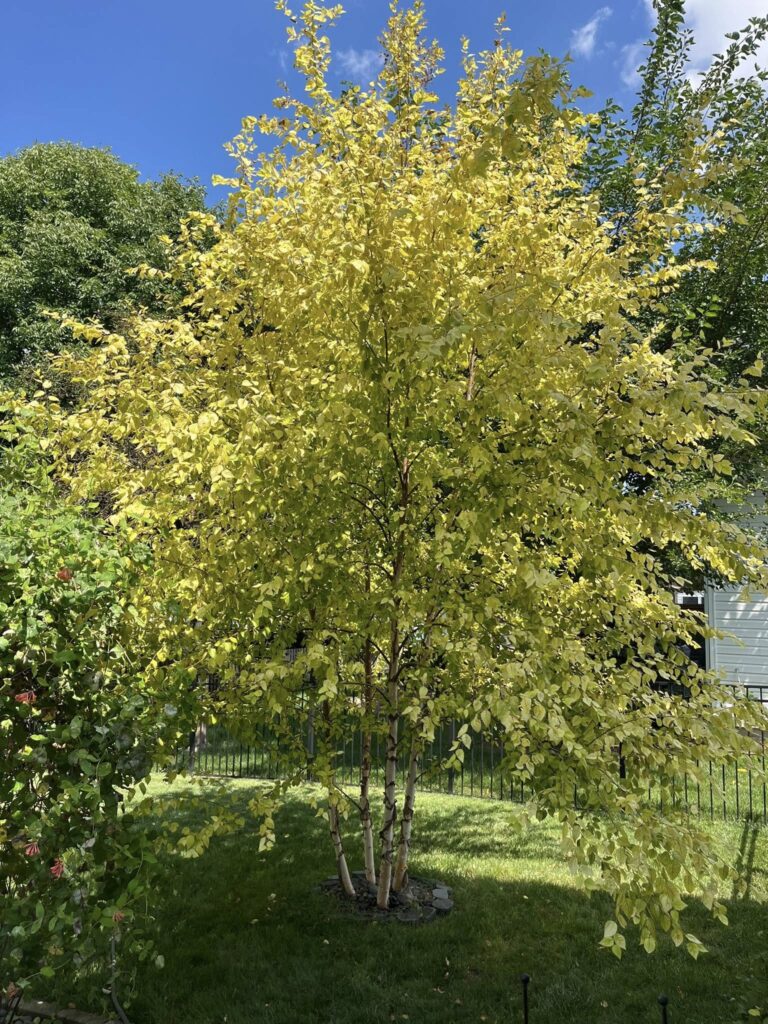
River birch is the only native birch adapted to New Jersey’s warmer floodplain habitats, unlike paper or yellow birch, which prefer cooler northern climates. Its peeling, salmon-pink to cinnamon bark stands out clearly, even from a moving car.
The tree tolerates wet soil and occasional flooding better than almost any other ornamental-quality native, which makes it popular for rain gardens and low-lying yards.
Fast growth and attractive year-round bark have made river birch one of the more commonly planted native trees in New Jersey landscaping today.
Final Thoughts
Twenty-five trees only scratch the surface of what grows across New Jersey’s 2 million forested acres. I hope this list gives you a solid starting point, whether you are identifying a backyard giant or choosing native species for a new planting bed.
If you want to go deeper, New Jersey’s Big Tree Conservation Program now tracks more than 400 record-sized trees statewide, up from just 150 in 2016. It is worth checking whether a champion of one of these species grows near you.
Native trees do more than look good. They feed wildlife, stabilize soil, and connect us to a landscape that predates the state itself. That feels worth protecting.
References
- New Jersey Department of Environmental Protection – Tree Books, State Forest Service. https://dep.nj.gov/parksandforests/conservation/tree-books/
- New Jersey Department of Environmental Protection – Big & Heritage Trees Program. https://dep.nj.gov/parksandforests/conservation/big-heritage-trees/
- New Jersey Department of Environmental Protection – About the NJ Big Tree Conservation Program. https://www.nj.gov/dep/parksandforests/forest/bigtrees/about.html
- USDA Forest Service – New Jersey Forest Health Highlights 2017. https://fs.usda.gov/foresthealth/docs/fhh/NJ_FHH_2017.pdf
- Rutgers New Jersey Agricultural Experiment Station – Incorporating Native Plants in Your Residential Landscape (FS1140). https://njaes.rutgers.edu/fs1140/
- Rutgers Cooperative Extension, Hunterdon County – Our New Jersey State Tree: Northern Red Oak. https://hunterdon.njaes.rutgers.edu/wp-content/uploads/2022/05/Our-New-Jersey-State-Tree.pdf
- New Jersey Pinelands Commission – Native Trees, Shrubs & Vines of the NJ Pinelands. https://www.nj.gov/pinelands/about/events/handouts/handouts/Pat%20Sutton/Pat%20Sutton’s%20Native%20Tree-Shrub-Vine-LIST%20-%20NJ%20Pinelands.pdf

Tim M Dave is a gardening expert with a passion for houseplants, particularly cacti and succulents. With a degree in plant biology from the University of California, Berkeley, he has vast experience in gardening. Over the years, he has cultivated a vast collection of desert plants and learned a great deal about how to grow and care for these unique companions.