Longleaf Pine vs Loblolly Pine: Understanding the Difference
The longleaf pine (Pinus palustris) and the loblolly pine (Pinus taeda) are arguably the two most culturally and ecologically significant conifers in the southeastern United States. Yet most people treat them as interchangeable.
They are not.
One built the South. The other is rebuilding it — though in very different ways. This guide will walk you through their differences, their histories, their uses, and why choosing between them can matter far more than you might expect.
Quick Comparison Table: Longleaf Pine vs Loblolly Pine
| Feature | Longleaf Pine (Pinus palustris) | Loblolly Pine (Pinus taeda) |
| Common Name | Longleaf Pine | Loblolly Pine |
| Native Range | Coastal Plain, SE United States | Eastern and SE United States |
| Mature Height | 60–100 ft (18–30 m) | 60–110 ft (18–33 m) |
| Needle Length | 10–18 inches (very long) | 6–9 inches |
| Needles per Bundle | 3 | 3 |
| Cone Length | 6–10 inches | 3–6 inches |
| Lifespan | 300–500+ years | 100–200 years |
| Growth Rate | Slow (grass stage in early years) | Fast |
| Wood Density | Very high (heavy, resinous) | Moderate |
| Fire Adaptability | Extremely fire-adapted | Moderate tolerance |
| Wildlife Value | Exceptional (red-cockaded woodpecker, gopher tortoise) | Moderate |
| Commercial Timber Use | High-quality, but limited supply | Most widely planted timber tree in the US |
| Conservation Status | Greatly reduced (3% of original range) | Abundant |
| Best Use | Restoration, high-quality lumber, wildlife habitat | Commercial forestry, pulpwood, fast biomass |
| Soil Preference | Well-drained, sandy, poor soils | Wide tolerance; thrives in moist soils |
The Historical Picture: Two Trees, Two Stories
To understand these trees today, you have to go back a few centuries.
Before European colonization, longleaf pine forests covered roughly 90 million acres across the southeastern United States — stretching from Virginia down through Florida and west into east Texas.
Travelers described the forests as cathedral-like: open, park-like stands with a sea of wiregrass beneath and a canopy so tall it felt otherworldly.
Then came the timber industry.
By the early 20th century, longleaf pine had been logged almost to commercial extinction. Its extraordinarily dense, resin-soaked wood was in high demand for ship building, railroad ties, flooring, and turpentine.
What the loggers left behind, the turpentine industry finished off. Today, longleaf pine covers only about 3 million acres — roughly 3% of its original range. It is considered one of the most endangered ecosystems in North America.
Loblolly pine stepped into the vacuum. Fast-growing, adaptable, and commercially productive, it became the dominant replanting choice across millions of logged acres.
Today, it is the most widely planted commercial timber tree in the United States, covering an estimated 30 million acres or more across the South. It transformed the region’s economy. It also changed the landscape permanently.
Understanding both trees means understanding this history. The differences between them are not just botanical — they are ecological, economic, and deeply tied to the future of Southern forests.
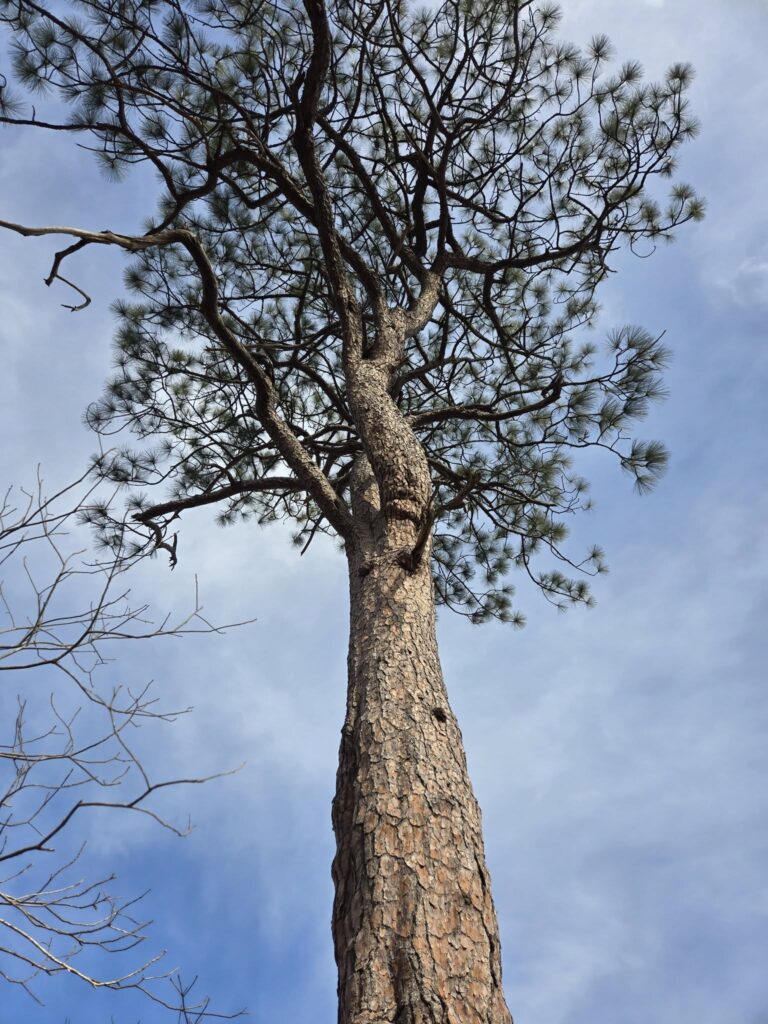
Physical Appearance: How to Tell Them Apart in the Field
Needle Length — The Most Reliable Field Clue
The single easiest way to distinguish these two species is to look at the needles.
Longleaf pine has needles that are genuinely striking in length — typically between 10 and 18 inches long, sometimes longer. When you hold a longleaf needle bundle in your hand, it droops gracefully under its own weight. The needles are dark green, slightly twisted, and grow in bundles of three.
Loblolly pine needles are also bundled in threes, but they are noticeably shorter — usually 6 to 9 inches — and they are slightly twisted and yellow-green in color. If you are standing beneath a pine and you pick up a fallen needle, a measurement longer than 10 inches almost certainly means longleaf.
Cones — Size Matters
Longleaf pine produces large, impressive cones that range from 6 to 10 inches in length. They are heavy, with thick, spine-tipped scales. Many people are surprised when they first hold one — it feels more substantial than most pine cones they have encountered.
Loblolly cones are smaller, typically 3 to 6 inches long, with thinner scales that also have a small spine at the tip. Both species produce cones that take two years to mature.
If you find large cones on the forest floor and long, drooping needles overhead, you are almost certainly in a longleaf stand.
The Grass Stage — Longleaf’s Unique Survival Trick
This is perhaps the most fascinating biological difference between the two species.
When a longleaf pine seed germinates, the seedling does not immediately grow upward. Instead, it spends anywhere from 2 to 7 years in what foresters call the “grass stage.”
During this period, the seedling looks like a dense clump of grass — no visible trunk, just a tuft of long, dark needles growing low to the ground. All of the plant’s energy is going into developing a deep, stout taproot and a large root collar.
This is a remarkable adaptation. The grass stage protects longleaf seedlings from fire, which historically swept through these forests every 1 to 5 years. The dense needle cluster insulates the apical bud, and the deep root system can sustain the plant even if fire burns the foliage entirely.
Once the root system is strong enough, the seedling bolts upward in what foresters call the “rocket stage,” growing as much as 3 to 5 feet in a single year.
Loblolly pine has no equivalent grass stage. Its seedlings grow upward immediately, which makes establishment faster in calm conditions but leaves them more vulnerable to fire damage in early years.
Growth Rate and Lifespan: Fast Money vs Long Investment
This is where the two species diverge most dramatically in practical terms.
Loblolly pine is a fast grower. Under favorable conditions, it can add 2 to 3 feet of height per year. Commercial loblolly plantations are typically harvested on rotations of 20 to 30 years, sometimes shorter for pulpwood.
This rapid growth is the primary reason it became the backbone of the Southern timber industry.
Longleaf pine grows slowly — especially in its first decade, when much of its energy is below ground. Once it exits the grass stage, growth accelerates, but it still cannot match loblolly’s pace. However, longleaf compensates with extraordinary longevity.
Old-growth longleaf pines routinely live 300 to 500 years, and some specimens have exceeded that considerably. The slow growth produces denser, more resin-saturated wood that is naturally resistant to rot, insects, and weathering.
In financial terms: loblolly is a short-term timber crop; longleaf is a generational investment.
Wood Quality: The Reason Longleaf Was Cut Down
There is a reason longleaf pine was logged so aggressively. Its wood is exceptional.
Longleaf heartwood is one of the densest and most resin-saturated pine woods in North America. Often called “heart pine” or “fatwood,” old-growth longleaf lumber was prized for its hardness, dimensional stability, and natural durability.
Many historic buildings across the South were built with longleaf heart pine flooring and framing — and some of that wood, now over a century old, is still in excellent condition.
The wood’s high resin content makes it naturally resistant to decay and insect attack, which is why it was so valued for applications like shipbuilding, bridge construction, railroad ties, and flooring.
When you see reclaimed heart pine flooring in a historic home, you are almost certainly looking at longleaf.
Loblolly wood is serviceable and commercially important, but it is measurably softer, less resinous, and less durable than longleaf. It is primarily used for lumber, plywood, pulpwood, and paper products. It is reliable. It is not exceptional.
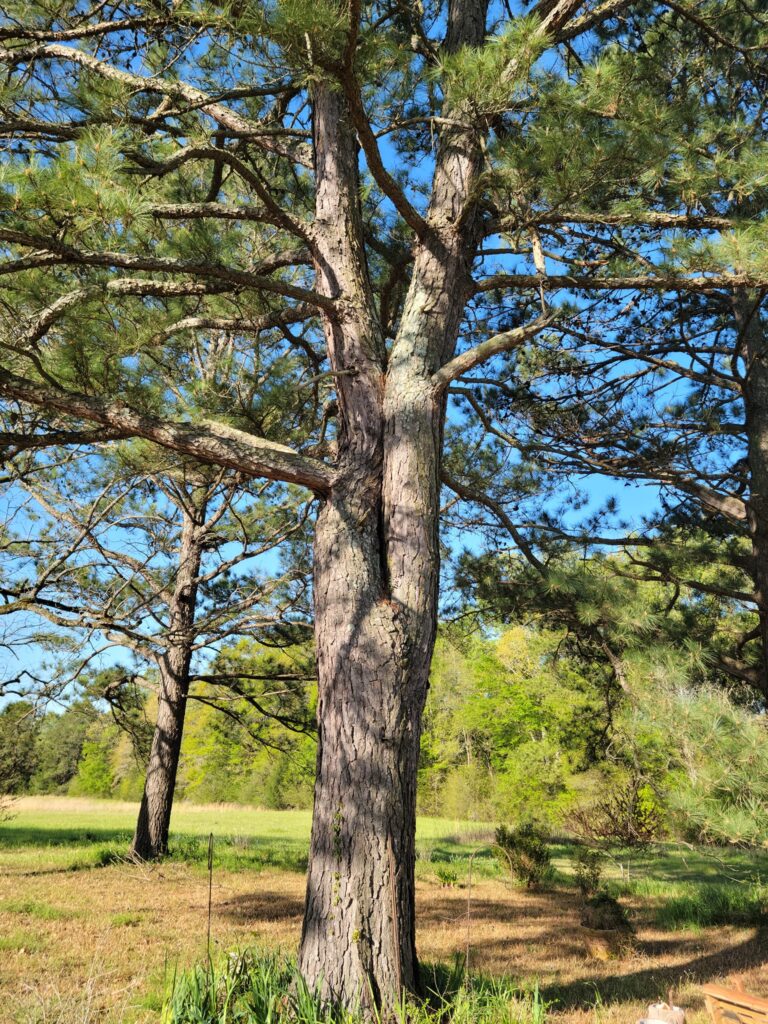
Ecological Value: A World of Difference
For wildlife and ecosystem health, the gap between these two species is enormous.
The Longleaf Pine Ecosystem
The longleaf pine ecosystem is one of the most biodiverse in North America, outside of tropical systems. It supports an estimated 900 plant species, many of which are rare or found nowhere else.
The open, fire-maintained understory — often dominated by wiregrass — creates habitat for dozens of threatened and endangered animals.
The red-cockaded woodpecker (Dryobates borealis) is perhaps the most famous longleaf-dependent species.
This federally endangered bird excavates nest cavities exclusively in living longleaf pines — typically old, resin-soaked trees that are easier to excavate due to red heart fungal infection. It cannot survive without old-growth or mature longleaf.
The gopher tortoise (Gopherus polyphemus) is another keystone species of the longleaf ecosystem. Its burrows provide shelter for over 300 other animal species, making it one of the most important ecosystem engineers in the Southeast.
It depends on the open, sunny conditions maintained by fire in longleaf stands.
Other longleaf-dependent or longleaf-associated species include the eastern indigo snake, the Bachman’s sparrow, and numerous rare plants including several carnivorous species like pitcher plants (Sarracenia spp.) and sundews (Drosera spp.).
The Loblolly Landscape
Loblolly pine plantations, by contrast, tend to be ecologically simplified. Dense planting, quick canopy closure, and frequent harvesting reduce structural diversity and limit the understory. The biodiversity found in longleaf ecosystems is largely absent from managed loblolly plantations.
That said, loblolly does provide habitat value — just of a different kind. Its seed production supports songbirds and small mammals. Older loblolly stands with structural complexity can support a moderate range of wildlife.
Loblolly is also capable of naturally regenerating on disturbed sites, providing quick ground cover that prevents erosion.
But it is not an ecological substitute for longleaf. The two are not equal, and the widespread replacement of longleaf by loblolly over the past century is considered a significant ecological loss.
Fire Ecology: Born in the Flames vs Tolerates Them
Longleaf pine evolved with fire — and in many ways, it needs fire to thrive.
The historical longleaf ecosystem was shaped by frequent, low-intensity fires ignited by lightning during summer thunderstorms. These fires cleared the understory, recycled nutrients, and kept the forest open.
Longleaf’s thick bark, deep root systems, grass-stage adaptation, and tall fire-resistant buds all reflect millions of years of co-evolution with fire.
Without fire, longleaf forests change. Hardwoods encroach, the understory closes, wiregrass and fire-dependent plants decline, and eventually the distinctive open park-like character of the longleaf ecosystem disappears.
Prescribed burning is now a central tool in longleaf restoration — managers must actively burn these landscapes to maintain their character.
Loblolly pine is moderately fire-tolerant once mature. Its bark thickens with age and provides some insulation.
However, young loblolly stands are vulnerable to fire, and loblolly plantations are typically managed without fire. Its ecological success has been largely in a fire-suppressed landscape — the very condition that prevented longleaf from regenerating naturally after logging.
Range and Habitat Preferences: Where Each Tree Grows Best
The two species overlap considerably in their ranges but differ in their preferred growing conditions.
Longleaf pine’s native range runs along the Atlantic and Gulf Coastal Plain — from southeastern Virginia, through the Carolinas, Georgia, Florida, Alabama, Mississippi, Louisiana, and into eastern Texas.
It reaches its best development on well-drained, sandy, often nutrient-poor soils — conditions that many other pines struggle with. Flatwoods, sandhills, and upland ridges were longleaf’s domain.
Loblolly pine’s range is broader, extending from New Jersey south through the Atlantic Coastal Plain, across the Piedmont, and throughout the South and into east Texas. Loblolly is more tolerant of wet, poorly-drained soils and can grow in loamy and even clay soils where longleaf would not naturally thrive.
It is one of the first trees to establish on abandoned fields, logging sites, and disturbed land across the Southeast.
In much of the Piedmont and transitional zones, loblolly has largely replaced longleaf — not just through deliberate planting, but through natural colonization of sites where longleaf once dominated before logging and fire suppression.
Commercial Use: Pulpwood vs Premium Lumber
The commercial timber industry in the American South runs substantially on loblolly pine. It is the primary source of:
- Structural lumber (framing, decking, dimension lumber)
- Plywood and oriented strand board (OSB)
- Pulpwood for paper and cardboard production
- Pine straw for landscaping mulch
- Bioenergy feedstocks
Loblolly’s fast rotation, high volume production, and adaptability to plantation management make it the ideal commercial species. Millions of acres of industrial timberland in the South are planted in loblolly.
Longleaf pine is commercially valuable too, but supply is extremely limited. Where it is available, longleaf produces some of the finest structural and flooring lumber in North America.
Reclaimed old-growth longleaf heart pine commands premium prices — often $8 to $15 per board foot or more, compared to $1 to $3 for standard loblolly lumber.
New-growth longleaf lumber is also entering the market as restoration plantings mature, though it will take several more decades before supply becomes significant.
Organizations like the Longleaf Alliance actively promote markets for longleaf pine products as part of broader restoration efforts.
Conservation and Restoration: The Longleaf Revival
One of the most important conservation efforts in the United States today is the restoration of the longleaf pine ecosystem.
Federal agencies, state governments, private landowners, and conservation organizations have committed to restoring longleaf pine across its historic range.
Programs like the America’s Longleaf Restoration Initiative and the USDA’s Working Lands for Wildlife program have helped increase longleaf acreage from about 3 million acres in the 1990s to over 5 million acres as of recent estimates — still far short of historical coverage, but a meaningful trend in the right direction.
Why restore longleaf rather than simply planting more loblolly? Because the ecosystem services longleaf provides are irreplaceable. Longleaf forests help:
- Filter and recharge groundwater in the Southeast’s aquifer systems
- Sequester carbon over extraordinarily long periods given the species’ lifespan
- Protect rare and endangered species that cannot survive in simplified plantation landscapes
- Reduce wildfire risk through prescribed burning programs that maintain low fuel loads
- Provide sustainable, premium timber over very long time horizons
Landowners in longleaf’s natural range who are interested in restoration can access technical assistance through the Natural Resources Conservation Service (NRCS) and various state forestry agencies.
Planting Considerations: Which Should You Choose?
If you are a landowner, forester, or conservationist trying to decide which species to plant, the answer depends heavily on your goals.
Choose loblolly pine if:
- Your primary goal is commercial timber production on a short rotation
- You need fast site coverage after disturbance
- Your soils are heavier, moister, or less sandy
- You are outside longleaf’s natural historic range
- You need pulpwood or biomass production
Choose longleaf pine if:
- You are within longleaf’s natural historic range
- You want long-term investment in high-quality timber
- Wildlife habitat and biodiversity are priorities
- You are willing to implement prescribed fire as a management tool
- You value ecological restoration and ecosystem services
- You want a tree that will still be standing generations after you are gone
One thing worth noting from a personal standpoint: there is something quietly moving about planting a longleaf pine.
You are unlikely to see it reach full maturity. You are planting it for a future you will not witness — which, in a world of fast returns and quarterly reports, feels like a genuinely radical act.
Common Questions About Longleaf Pine vs Loblolly Pine
Can longleaf and loblolly pine hybridize?
Natural hybridization between longleaf and loblolly is extremely rare due to differences in flowering time and genetic barriers. They are genetically distinct species and do not readily cross-pollinate under natural conditions.
Which pine grows taller?
At maturity, the two species reach similar heights — typically 60 to 100+ feet. Loblolly often grows taller faster. Longleaf may ultimately reach comparable or slightly greater heights in ideal conditions given sufficient time.
Is longleaf pine still commercially available?
Yes, though supply is limited. Reclaimed old-growth longleaf is available through specialty dealers. New-growth longleaf is increasingly available through producers in Georgia, Florida, Alabama, and the Carolinas who manage certified longleaf timberland.
Which pine is better for carbon sequestration?
Longleaf pine is increasingly recognized as superior for long-term carbon sequestration. Its extraordinarily long lifespan, dense wood, and the high carbon content of longleaf ecosystems make it a more effective long-term carbon sink than loblolly plantations managed on short rotations.
A Final Word
It would be unfair to cast loblolly pine as a villain. It has been economically essential to the South for a century, providing jobs, materials, and forest cover across millions of acres that would otherwise be farmland or development. It deserves credit as a workhorse.
But longleaf pine is irreplaceable in ways that loblolly simply cannot match. Its ecological complexity, its wood quality, its longevity, and its role as the foundation of one of North America’s most distinctive and biodiverse ecosystems set it in a category of its own.
The good news is that both trees can coexist in a well-managed Southern landscape. Loblolly can continue to serve commercial timber needs on appropriate sites. And longleaf can slowly, steadily reclaim the sandy ridges and coastal plains where it once stood for centuries.
The longleaf pine does not ask for much. Only patience, and a willingness to think beyond the next harvest.
References
- Virginia Tech College of Natural Resources and Environment — Pinus taeda (Loblolly Pine) Species Profile – Virginia Tech Department of Forest Resources and Environmental Conservation. https://dendro.cnre.vt.edu/dendrology/syllabus/factsheet.cfm?ID=2
- Wikipedia – Longleaf pine https://en.wikipedia.org/wiki/Longleaf_pine
- Wikipedia – Pinus taeda https://en.wikipedia.org/wiki/Pinus_taeda

Tim M Dave is a gardening expert with a passion for houseplants, particularly cacti and succulents. With a degree in plant biology from the University of California, Berkeley, he has vast experience in gardening. Over the years, he has cultivated a vast collection of desert plants and learned a great deal about how to grow and care for these unique companions.