Understanding Black Willow Tree: Growth Rate, Lifespan, Problems, and Cultivation Details
When people think of willows, the graceful, drooping weeping willow often comes to mind first. But the black willow (Salix nigra) is the true workhorse of North American wetlands — and arguably the more important tree.
It is the largest native willow species on the continent, and it has been doing critical ecological work long before restoration planting became fashionable.
I have always found the black willow to be one of those trees that rewards a second look. It is not showy. Its silhouette is irregular, sometimes leaning dramatically toward water as if drawn by gravity. But its toughness, adaptability, and ecological generosity place it in a category of its own.
This article covers everything from the tree’s physical characteristics and native habitat to its medicinal history, ecological importance, and practical applications in landscaping and environmental restoration.
| Common Name | Black Willow |
| Scientific Name | Salix nigra |
| Family | Salicaceae |
| Native Range | Eastern North America (Canada to Florida, west to Texas) |
| Average Height | 35–60 ft (10–18 m); can exceed 100 ft |
| Trunk Diameter | Up to 2–3 ft (0.6–0.9 m) |
| Leaf Type | Simple, alternate, narrowly lanceolate |
| Leaf Length | 3–6 inches (7–15 cm) |
| Bark Color | Dark brown to nearly black; deeply furrowed |
| Flowers | Catkins (male and female on separate trees) |
| Fruit | Small capsules with cottony seeds |
| Lifespan | 65–100 years (rarely up to 150) |
| USDA Hardiness Zones | 2–8 |
| Growth Rate | Fast (3–8 ft per year when young) |
| Soil Preference | Moist to wet; tolerates flooding |
| Sun Requirement | Full sun |
| Wildlife Value | High — supports birds, insects, beaver, deer |
| Primary Uses | Erosion control, bioremediation, charcoal, medicinal |
Taxonomy and Classification
The black willow belongs to the genus Salix, which contains more than 400 species worldwide. Salix nigra is the dominant native willow in eastern North America.
The species name nigra is Latin for “black,” a reference to the tree’s characteristically dark, almost black bark that distinguishes it from other willows.
The family Salicaceae also includes poplars and aspens, and all members share a tendency toward rapid growth, dioecious flowering (separate male and female trees), and affinity for moist habitats.
Several closely related species and natural hybrids can complicate identification. The sandbar willow (Salix exigua) and peachleaf willow (Salix amygdaloides) often grow alongside black willow in riparian zones, and the trees frequently hybridize where their ranges overlap.
Physical Description
Here is how to identify the black willow tree:
Bark and Trunk
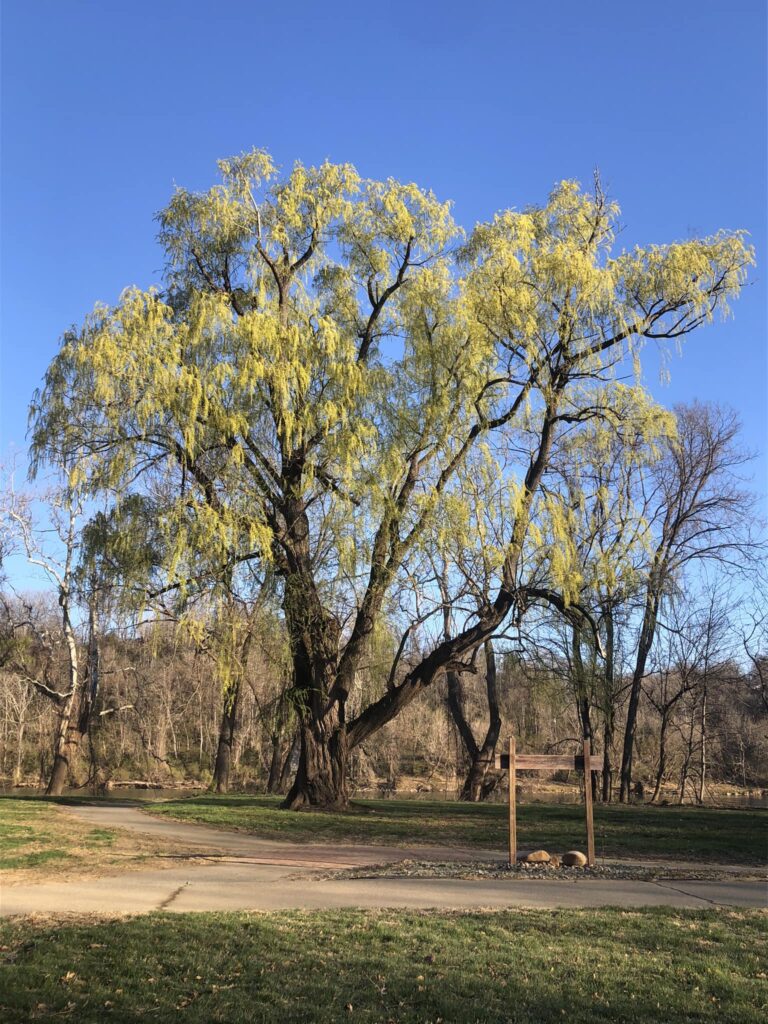
The bark of the black willow is one of its most recognizable features. On young trees, it starts out reddish-brown and relatively smooth. As the tree matures, it becomes deeply furrowed, interlacing, and nearly black — hence the common name. The ridges are irregular and rough to the touch.
The trunk is rarely straight. Black willows tend to lean, fork early, and develop multiple stems at or near the base. This growth habit gives mature trees a rugged, asymmetrical appearance quite different from the stately symmetry of oaks or maples.
Leaves
The leaves are narrowly lance-shaped (lanceolate), measuring 3 to 6 inches long and only about half an inch wide. They are bright green on the upper surface and slightly paler beneath, with finely toothed (serrate) margins. The base of each leaf is unequal — slightly off-center — which is a useful diagnostic feature.
Stipules (small leaf-like appendages at the base of the leaf stalk) are often prominent on black willow, another helpful identification clue. The leaves turn yellow briefly in autumn before dropping.
Flowers and Fruit
Like all willows, the black willow is dioecious — meaning individual trees are either male or female. Both sexes produce catkins, which are slender, cylindrical flower clusters that appear in spring alongside or just before the emerging leaves.
Male catkins are yellow and produce pollen; female catkins are green and produce seed capsules. When mature, the capsules split open to release tiny seeds attached to white, cottony fibers — much like cottonwood seeds — that travel far on the wind.
This mass seeding event can temporarily look like snow falling over riparian areas in late spring.
However, black willow seeds are short-lived. They must land on moist, bare soil within a few days or they will not germinate. This is why the tree is so consistently tied to disturbed, wet sites along rivers and streams.
Root System
The root system of the black willow is extensive, aggressive, and shallow. Roots spread widely from the trunk and actively seek out moisture.
This is a critical point for homeowners: planting black willow near septic systems, water lines, or foundations is inadvisable because roots will infiltrate and damage them.
That same aggressive root system, however, makes the tree invaluable for stabilizing stream banks and controlling erosion.
ALSO READ: 25 Popular Types of Willow Trees and Shrubs (Different Species, With Pictures)
Native Habitat and Range
The black willow is found across a wide swath of eastern North America — from southern New Brunswick and southern Ontario in the north, south to Florida, and west through the Great Plains to Texas, Nebraska, and parts of Kansas. It also appears in the mountains of northeastern Mexico.
Its preferred habitat is consistently wet. Look for black willows along:
- Stream and river banks
- Floodplains and bottomlands
- Pond and lake margins
- Swamp edges
- Roadside ditches with consistent moisture
The tree is extraordinarily tolerant of prolonged flooding. Studies have documented black willows surviving weeks of complete root inundation during spring floods — a tolerance that most trees simply cannot match.
Its ability to resprout vigorously after flood damage or cutting also gives it a competitive advantage in dynamic, disturbed riverine environments.
In terms of elevation, the black willow is mainly a lowland species. It rarely ventures above 2,000 feet (600 m) in the Appalachians.
Growth Rate and Lifespan
The black willow is one of the fastest-growing native trees in North America. Young trees can put on 3 to 8 feet of height per year under ideal conditions — moist soil and full sun.
This rapid growth makes it attractive for quick landscape screening or rapid restoration planting, but it also means the wood is relatively soft and brittle.
The downside of fast growth is a shorter lifespan. Most black willows live between 65 and 100 years, though some specimens in undisturbed floodplains have been estimated to be 150 years old. Compare this to oaks, which routinely live 300 to 500 years, and it is clear that willows trade longevity for speed.
Willows compensate for their shorter individual lifespans through prolific vegetative reproduction. Branches and even small stems that fall into the water or onto moist soil can root and establish new trees rapidly.
This is why willow wands (live cuttings) are a standard tool in stream bank stabilization projects.
Ecological Role and Wildlife Value
If there is one thing the black willow excels at, it is supporting life. It is a keystone species in riparian ecosystems — meaning its presence disproportionately shapes the community of organisms around it.
Supporting Insects
Black willows host an impressive array of insects. Research from the University of Delaware’s native plant work has highlighted willows (Salix spp.) as among the top five genera for supporting native caterpillar diversity in North America — second only to oaks.
Over 450 species of moths and butterflies use willows as larval host plants.
This insect abundance has cascading benefits. Where caterpillars thrive, insectivorous birds follow.
Birds
A willow thicket is a magnet for nesting and foraging birds. Yellow warblers (Setophaga petechia) are so closely associated with willow habitat that birders often call them “willow warblers” informally.
Willow flycatchers (Empidonax traillii) are, quite literally, named for their preference for willow shrub habitats. Other regular users include:
- Common yellowthroat
- Song sparrow
- American goldfinch (feeds on seeds)
- Woodpeckers (cavities in aging trees)
- Great blue heron (nests in tall black willows near water)
Mammals
Beaver depend heavily on willows — both for food and dam-building material. A stand of black willows near a stream is often a reliable sign that beaver are nearby, or were once present. Deer browse the twigs and young growth.
Muskrats feed on roots. Raccoons and river otters use overhanging branches as travel corridors.
Aquatic Ecosystems
Perhaps most underappreciated is the role black willow plays in supporting aquatic life. Overhanging branches provide shade that keeps stream temperatures cool — critical for cold-water species like trout.
Fallen leaves fuel the aquatic food web. Exposed roots along stream banks create hiding structure for fish. The tree’s root mats filter runoff and reduce sediment loads entering waterways.
Medicinal and Ethnobotanical History
Long before aspirin was synthesized in a laboratory, the bark of willow trees was used as a fever reducer and pain reliever. This is not folk medicine mythology — it is pharmacological history.
Willow bark contains salicin, a glycoside compound that the human body metabolizes into salicylic acid. The German chemist Felix Hoffmann synthesized acetylsalicylic acid (aspirin) in 1897, partly inspired by the long history of willow bark as a therapeutic plant.
Indigenous peoples across North America used black willow bark extensively, including:
- As a tea or infusion to reduce fever and relieve headaches
- As a poultice for skin inflammations
- As a treatment for rheumatic pain and joint swelling
- As a remedy for menstrual discomfort
Early American settlers adopted these practices. Black willow bark was listed in the United States Pharmacopoeia from 1882 to 1950 as a medicinal agent, sometimes prescribed as a tonic and mild sedative in addition to its analgesic properties.
Today, willow bark extract is sold as a natural supplement in health stores, marketed primarily for pain relief, anti-inflammatory effects, and fever reduction.
While it is milder than pharmaceutical aspirin, clinical trials have supported its effectiveness for lower back pain and osteoarthritis when taken at appropriate doses.
Commercial and Industrial Uses
Beyond medicine, black willow has been put to practical use in several industries.
Charcoal
The soft, lightweight wood of black willow was historically one of the preferred materials for making charcoal — particularly the high-grade charcoal used in gunpowder production. The wood burns evenly and produces a charcoal with desirable density characteristics.
Basket Weaving and Woodworking
The flexible young shoots of black willow have been used in basket weaving by Indigenous and settler communities alike.
The wood itself — while not prized for structural timber due to its softness — has been used for crates, boxes, and plywood, and was once commonly used for artificial limbs because it is lightweight, smooth, and non-irritating to skin.
Bioenergy
In recent decades, willows (including black willow) have been studied as short-rotation woody crops for bioenergy production. Their rapid growth, tolerance of poor soils, and ability to regrow after harvest (coppicing) make them attractive candidates for biomass feedstock.
Research programs in the United States and Canada have developed improved willow cultivars specifically for this purpose.
Bioremediation
One of the most exciting contemporary applications is phytoremediation — using plants to remove contaminants from soil and water. Black willow has demonstrated strong uptake of heavy metals, excess nutrients (nitrogen and phosphorus), and some organic pollutants.
It is increasingly planted at contaminated sites, wastewater treatment areas, and agricultural field margins to intercept and process runoff before it reaches streams.
Erosion Control and Streambank Stabilization
This is arguably the most widely used application of black willow today, and for good reason. The tree’s deep, spreading root system binds soil with remarkable strength, while its tolerance of flooding and disturbance means it can establish and survive conditions that would kill most other species.
Stream restoration practitioners frequently use live willow stakes — thick cuttings pushed directly into streambank soil during dormancy. These stakes root within weeks and begin stabilizing the bank almost immediately.
The technique is called bioengineering, and black willow is one of the most commonly used species in this approach across the eastern and central United States.
For landowners dealing with eroding pond banks, collapsing stream edges, or flood-scoured areas, planting black willow is often the single most cost-effective and ecologically beneficial action they can take.
Landscape and Garden Use
Black willow is not a typical garden tree, and that is worth stating clearly. Its aggressive roots, fast growth, brittle branches, and preference for very wet soils make it poorly suited to most residential landscapes. A black willow planted too close to a house will become a maintenance problem within a decade.
Where it excels in the landscape:
- Rain gardens and bioswales — where water accumulates seasonally
- Pond and lake borders — stabilizing banks while providing wildlife habitat
- Naturalized riparian buffers — along farm streams and drainage channels
- Large rural properties — as a fast windbreak or wildlife planting near wet areas
If you have the right conditions — consistently wet soil, adequate space, and no underground infrastructure nearby — black willow is a highly rewarding native planting. It establishes quickly, requires no irrigation, and begins providing wildlife habitat almost immediately.
Identifying Black Willow vs. Other Willows
Several willow species share similar habitat and appearance. Here are key distinguishing features of black willow:
| Feature | Black Willow | Weeping Willow | Sandbar Willow |
| Leaf width | Narrow but not hair-thin | Narrow | Very narrow, hair-thin |
| Stipules | Prominent, persistent | Small | Absent or tiny |
| Bark | Very dark, deeply furrowed | Gray-brown, rougher | Gray, shallowly furrowed |
| Tree form | Irregular, multi-stemmed | Strongly weeping | Shrubby, thicket-forming |
| Native to N. America | Yes | No (Asian origin) | Yes |
| Max. height | 60–100 ft | 40–70 ft | 10–20 ft |
The prominent stipules and very dark, furrowed bark are the two most reliable field identification features for black willow.
Threats and Conservation Considerations
The black willow is not currently listed as a threatened or endangered species across most of its range. It is common and, in some areas, opportunistically abundant following stream disturbance. However, several factors threaten healthy riparian willow communities:
Invasive species competition
In many watersheds, Japanese knotweed (Reynoutria japonica) and purple loosestrife (Lythrum salicaria) aggressively colonize the same moist, disturbed sites where black willow naturally regenerates, reducing successful establishment of native willows.
Stream channelization and bank hardening
When streams are straightened and their banks lined with riprap or concrete, the dynamic, sediment-rich conditions that black willow seeds require for germination are eliminated.
Beaver suppression
Counter-intuitively, removing beaver from watersheds can harm willow populations. Beaver activity creates disturbed, moist, open areas — ideal willow habitat. Where beaver have been trapped out, willow diversity and abundance often decline.
Climate change
Shifts in precipitation patterns, extended droughts, and altered flood timing all affect riparian zones where black willow lives. Long-term monitoring data suggest that willow community composition is shifting in response to hydrological changes in some regions.
Growing Black Willow: Practical Tips
If you are planting black willow, here is what to know:
- Propagation from cuttings is easy and reliable. Take 12–18 inch hardwood cuttings from dormant stems in late winter. Push them at least 6 inches into moist soil. Survival rates above 80% are typical.
- Seed germination is challenging. Seeds are viable for only a few days and require bare, wet soil. Direct seeding is rarely practical outside of controlled conditions.
- Plant in full sun. Black willow will tolerate partial shade but grows poorly and is more susceptible to disease in shaded conditions.
- Soil must be reliably moist. This is non-negotiable. A black willow planted in average, well-drained garden soil will struggle and likely die during summer dry spells.
- Space generously. Allow at least 30–40 feet between trees and at least 50 feet from any structures, underground lines, or septic systems.
- Expect some branch drop. The brittle wood means wind and ice storms regularly cause branch loss. This is normal and not a sign of disease.
Final Thoughts
The black willow does not demand attention. It does not produce spectacular autumn color or ornate flowers. It grows in the places most trees cannot — the flooded, scoured, muddy edges of rivers and ponds — and it does so reliably, generously, and with impressive ecological productivity.
It is, in many ways, the perfect example of how native trees function as ecological infrastructure — not just as individual plants, but as frameworks for entire communities of insects, birds, mammals, and aquatic organisms.
Whether you are a stream restoration professional, a land manager, a teacher, or someone who simply wants to do something meaningful with a wet corner of a property, the black willow is worth considering.
Plant it where it belongs, give it room to grow, and it will reward you — and the ecosystem — for decades.
References
- USDA Forest Service — Fire Effects Information System: Salix nigra A https://www.fs.usda.gov/database/feis/plants/tree/salnig/all.html
- Virginia Tech Dendrology Fact Sheet: Black Willow (Salix nigra) https://dendro.cnre.vt.edu/dendrology/syllabus/factsheet.cfm?ID=43
- NC State Extension — Plants: Salix nigra (Black Willow) https://plants.ces.ncsu.edu/plants/salix-nigra/

Tim M Dave is a gardening expert with a passion for houseplants, particularly cacti and succulents. With a degree in plant biology from the University of California, Berkeley, he has vast experience in gardening. Over the years, he has cultivated a vast collection of desert plants and learned a great deal about how to grow and care for these unique companions.