Sugar Pine (Tree that Produces Nearly Two-Foot-Long Cones): Growth Rate, Lifespan, Uses, and More
If you have ever walked through a Sierra Nevada forest and looked up to see a towering pine with impossibly long cones hanging from its highest branches like ornaments, you were almost certainly standing beneath a sugar pine.
The sugar pine (Pinus lambertiana) is the tallest and largest pine tree species in the world. It is also the holder of a remarkable record: its cones are the longest of any conifer on the planet. This is not a tree you simply walk past and forget. It commands attention.
John Muir, the famous naturalist and conservationist, was so struck by this tree that he called it “the king of conifers, king of all the world’s pines.” That is high praise from a man who spent a lifetime among trees, and anyone who has stood beneath a mature sugar pine would struggle to disagree.
This article takes a close, detailed look at the sugar pine — its biology, its habitat, its history, its uses, and the threats it currently faces.
| Common Name | Sugar Pine |
| Scientific Name | Pinus lambertiana |
| Family | Pinaceae |
| Type | Evergreen conifer |
| Height | 130–200 ft (40–60 m); record: 274 ft |
| Trunk Diameter | Up to 8–10 feet (2.4–3 m) |
| Cone Length | 10–26 inches (25–66 cm) — longest of any pine |
| Lifespan | 300–500 years; some exceed 600 years |
| Native Range | Western United States and northwestern Mexico |
| Primary Habitat | Sierra Nevada, Cascade Range, Coast Ranges |
| Elevation Range | 2,000–10,000 ft (610–3,050 m) |
| USDA Hardiness Zones | 5–8 |
| Wood Use | Timber, millwork, pattern-making |
| Conservation Status | Least Concern (threatened locally by blister rust) |
| Named By | David Douglas, 1826 |
| Named After | Aylmer Bourke Lambert, botanist |
Taxonomy and Classification
The sugar pine belongs to the genus Pinus, which includes all true pine trees. It falls within the subgenus Strobus, commonly known as the soft or white pines. This subgenus is distinguished by having five needles per fascicle (bundle), as opposed to the two or three needles found in hard pines.
Scientific classification:
- Kingdom: Plantae
- Division: Pinophyta
- Class: Pinopsida
- Order: Pinales
- Family: Pinaceae
- Genus: Pinus
- Species: P. lambertiana
The species was formally described and named by Scottish botanist David Douglas in 1827, after his expedition to western North America. He named it in honor of Aylmer Bourke Lambert, a prominent English botanist of the time.
The common name “sugar pine” comes from the sweet, crystallized resin that oozes from wounds in the bark — a resin that Indigenous peoples of the region reportedly enjoyed eating as a mild sweetener.
Physical Description: What Does a Sugar Pine Look Like?
Size and Form
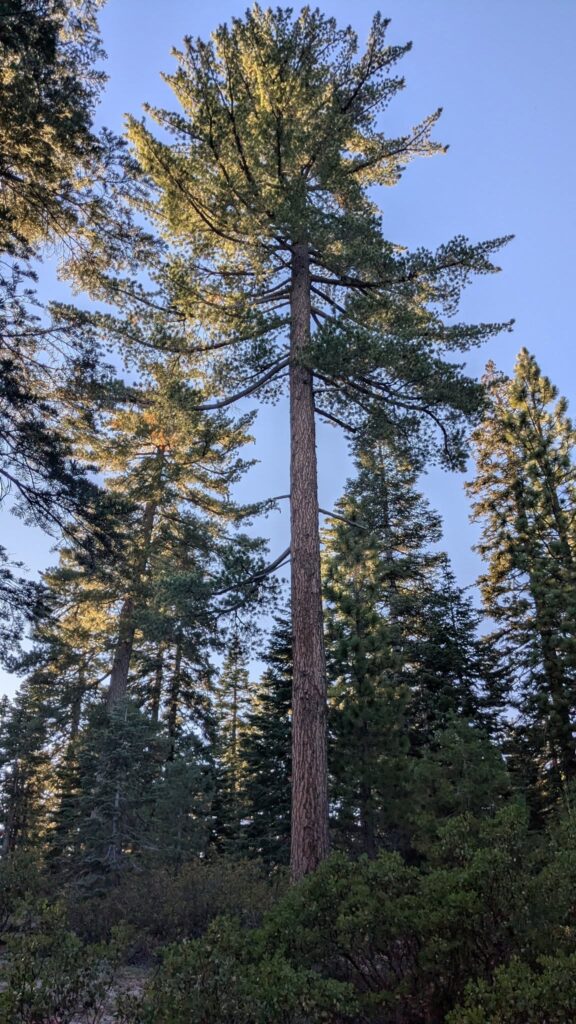
The sugar pine is a massive tree by any standard. Most mature individuals reach 130 to 200 feet (40 to 60 meters) in height, with some exceptional specimens climbing much higher. The tallest recorded sugar pine stands at approximately 274 feet (83.5 meters), located in Yosemite National Park. That is taller than a 25-story building.
The trunk is straight and cylindrical, often clear of branches for much of its lower height. Trunk diameters of 5 to 8 feet (1.5 to 2.4 meters) are common, with the very largest exceeding 10 feet across. The bark on young trees is smooth and gray-green.
As the tree matures, it develops long, reddish-brown, scaly, and deeply furrowed plates — a characteristic that gives older trees a rugged, ancient appearance.
The crown of the sugar pine is distinctive. In open-grown trees, the upper branches spread horizontally in a flat, irregular platform near the top. This gives the tree a somewhat layered look from a distance. In dense forest, the crown tends to be smaller and more compressed.
Needles
Sugar pine needles are 5 per bundle (fascicle), consistent with all white pines. Each needle is 2.5 to 4 inches (6 to 10 cm) long, blue-green to gray-green in color, slender, and slightly twisted. The needles persist on the tree for 2 to 3 years before falling.
Up close, if you run your fingers along a sugar pine needle, you will notice fine white lines of stomata (tiny pores for gas exchange) running along each side. These pale lines give the needles a frosted or silvery appearance, especially visible in bright light.
The Cones: A World Record Holder
This is where the sugar pine truly earns its fame. The cones of Pinus lambertiana are the longest of any conifer in the world.
Mature cones typically measure 10 to 20 inches (25 to 51 cm) in length, and some exceptional cones have been measured at 26 inches (66 cm) or more. They are slender and pendulous, hanging from the very tips of the highest branches like elongated Christmas ornaments.
The cones take two full years to mature after pollination. When they finally ripen, usually in the fall, the scales open to release the winged seeds. The cones then drop to the forest floor, where they quickly become prized finds for hikers and nature enthusiasts.
I have personally picked up fallen sugar pine cones during hikes in the Sierra Nevada, and they are genuinely extraordinary objects to hold — long, elegant, and surprisingly light. Finding one on the trail always feels like a small gift from the forest.
Seeds
The seeds of the sugar pine are oval, about ½ inch (12 mm) long, and equipped with a long papery wing. The wing helps the seed catch the wind and travel some distance from the parent tree, though most seeds fall within a short radius of the cone drop site.
Birds, particularly Clark’s nutcracker (Nucifraga columbiana), play a major role in seed dispersal. These birds harvest pine seeds, cache them in the ground, and often forget some caches — effectively planting future trees.
Natural Habitat and Geographic Range
Where Does the Sugar Pine Grow?
The sugar pine is native to western North America. Its range extends from the Cascade Range of Oregon and Washington in the north, through the Sierra Nevada of California, and south into the mountains of Baja California in Mexico.
It also occurs in smaller populations along parts of the California Coast Ranges and in the Transverse Ranges of southern California.
Within this range, the sugar pine is most abundant and reaches its greatest size in the central Sierra Nevada of California — in areas such as Yosemite, Sequoia, and Kings Canyon National Parks.
Elevation and Climate Preferences
Sugar pines grow at elevations ranging from approximately 2,000 to 10,000 feet (610 to 3,050 meters) above sea level. The ideal elevation varies by latitude.
In the southern Sierra Nevada, where the climate is drier and warmer, sugar pines are most common between 5,000 and 8,000 feet. Further north, they descend to lower elevations.
The tree thrives in a Mediterranean-montane climate — characterized by wet winters (usually as snow at higher elevations) and long, dry summers. It requires moderate to deep, well-drained soils and does not tolerate waterlogged or highly compacted ground.
Rainfall across the sugar pine’s core range typically falls between 30 and 70 inches (75 to 178 cm) per year, most of it arriving between November and April.
Associated Species
In the wild, sugar pines rarely grow in pure stands. They are typically mixed with other conifers, including white fir (Abies concolor), red fir (Abies magnifica), ponderosa pine (Pinus ponderosa), incense cedar (Calocedrus decurrens), and giant sequoia (Sequoiadendron giganteum).
This mixed-conifer forest type is one of the most productive timber-producing ecosystems in North America, and the sugar pine is one of its most commercially valuable members.
Growth Rate and Lifespan
How Fast Does a Sugar Pine Grow?
The sugar pine is not a fast grower by ornamental standards, but it is consistent. Under good conditions, young trees may grow 1 to 2 feet (30 to 60 cm) per year. Growth slows as the tree ages and as competition for light and nutrients increases in dense forest.
In managed timber stands where competition is reduced, growth rates can be significantly higher. Open-grown trees — such as those planted in parks or large gardens — also tend to grow faster than forest-grown individuals.
Lifespan
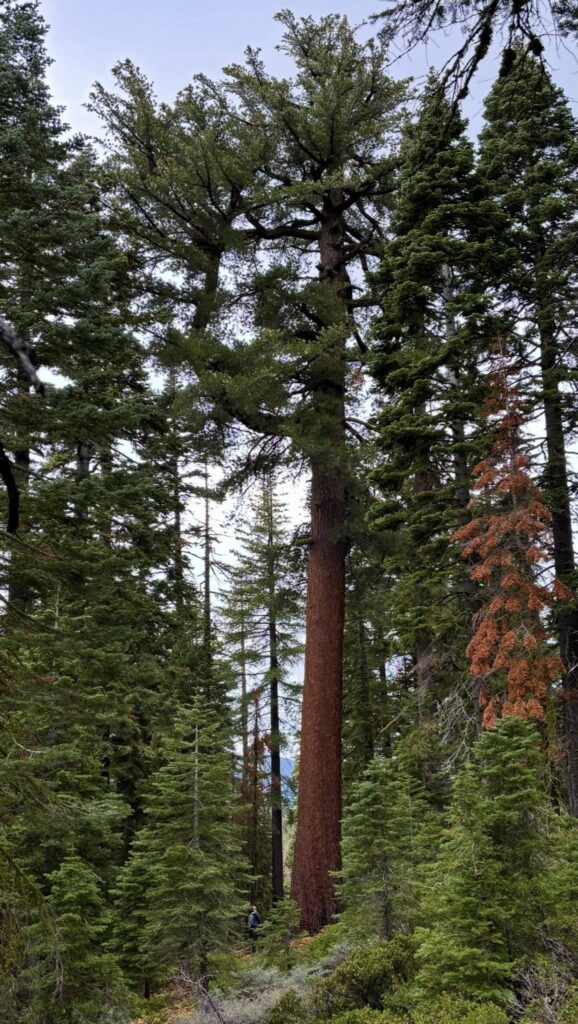
Sugar pines are long-lived trees. Most individuals in natural forests live for 300 to 500 years. Some trees have been documented at over 600 years old. The combination of large size, thick bark (which offers some protection from low-intensity fire), and natural decay resistance makes them well-suited to a long life.
The oldest reliably dated sugar pine cores suggest that some individuals were alive during the medieval period — a fact that puts human history into a humbling perspective.
Ecological Role
Fire and the Sugar Pine
Sugar pine evolved in a landscape shaped by frequent, low-intensity fires. The thick bark of mature trees provides significant protection against fire, allowing many large specimens to survive ground fires that kill smaller, thinner-barked trees.
This natural fire resistance helped sugar pines dominate mixed-conifer forests for millennia.
Fire also creates favorable conditions for sugar pine regeneration. Open, mineral-soil seedbeds exposed by burning are ideal for seed germination and early seedling growth.
The suppression of natural fire over the past century has, paradoxically, harmed sugar pine populations by allowing shade-tolerant species like white fir to overtop and outcompete young sugar pines.
Wildlife Interactions
The sugar pine supports a rich community of wildlife. Clark’s nutcrackers, as mentioned earlier, are perhaps the most important mutualistic partner. These birds and the sugar pine have a deeply co-evolved relationship. The nutcracker’s bill is perfectly shaped to pry open pine cones, and its specialized throat pouch allows it to carry dozens of seeds at once. Both species benefit: the bird gets food, and the tree gets its seeds planted.
Squirrels, particularly the chickaree (Douglas squirrel), also feed heavily on sugar pine seeds and cones. Black bears scratch the bark of sugar pines, apparently attracted to the sweet resin. Deer use sugar pine forests for both cover and forage.
Large, old sugar pines with cavities provide critical nesting sites for owls, woodpeckers, and many other cavity-nesting species.
Carbon Storage
As one of the largest trees in North America, the sugar pine is a significant carbon store. A single mature sugar pine can lock away several tons of carbon in its biomass.
In the context of climate change, the preservation of old-growth sugar pine forests represents an important carbon sink that, once lost, cannot be quickly replaced.
Traditional and Cultural Uses
Indigenous Use
Long before European settlers arrived, the indigenous peoples of California and the Great Basin made extensive use of the sugar pine.
The Miwok, Paiute, and other Sierra Nevada tribes gathered sugar pine seeds as a nutritious food source. The seeds are rich in protein and fat, much like the more widely known piñon pine nuts.
The sweet crystallized resin — the substance that gives the tree its common name — was eaten as a treat or used medicinally as a mild laxative. Bark was used to make various tools and utensils, and the long, straight trunk was valued for construction and boat-building.
Timber Use
Commercially, the sugar pine has been one of the most valuable timber trees in western North America since the 1850s. The wood is light, straight-grained, soft, and easily worked.
It is highly resistant to warping and shrinkage after drying — qualities that made it the preferred choice for pattern-making (used in metal casting), millwork, window frames, door panels, cabinetry, and musical instrument construction.
At the height of the California timber industry in the late 19th and early 20th centuries, millions of board feet of sugar pine were cut annually. Today, harvesting is much more regulated, and old-growth sugar pines are largely protected within national parks and wilderness areas.
Threats and Conservation
White Pine Blister Rust
The single greatest biological threat to the sugar pine today is white pine blister rust (Cronartium ribicola), an introduced fungal disease.
The fungus was accidentally introduced to North America from Europe around 1910. It requires two different host species to complete its life cycle: white pines (including sugar pine) and plants in the genus Ribes (currants and gooseberries).
The disease causes cankers on the bark, girdles branches and trunks, and eventually kills infected trees. Younger trees are particularly vulnerable, and the disease has dramatically reduced sugar pine populations in some parts of the Sierra Nevada.
Efforts to combat blister rust include selective breeding programs aimed at identifying and propagating naturally resistant sugar pine individuals. The U.S. Forest Service and various university programs have made significant progress, and resistant seed is now being planted in some restoration areas.
Mountain Pine Beetle
The mountain pine beetle (Dendroctonus ponderosae) is another serious threat. These native bark beetles periodically erupt in mass outbreaks, especially during prolonged drought or in forests with large numbers of old, stressed trees.
The beetles bore under the bark, introduce a blue-staining fungus, and collectively overwhelm the tree’s resin defenses.
Climate change is intensifying beetle outbreaks by creating warmer winters (which kill fewer beetle larvae), extended droughts (which stress trees), and longer warm seasons (which allow beetles to complete an extra life cycle per year).
Climate Change
Warming temperatures and altered precipitation patterns pose long-term threats to sugar pine habitat. Models suggest that suitable habitat for sugar pine may shift upward in elevation and northward in latitude as the climate changes over the coming decades. Lower-elevation stands are already showing signs of stress.
Increased frequency and severity of wildfire — driven by a combination of fuel accumulation (from past fire suppression) and climate warming — also threatens sugar pine populations, particularly since severe, stand-replacing fires kill even large, old trees.
Conservation Efforts
Conservation of the sugar pine involves multiple strategies: protection of existing old-growth stands within national parks and wilderness areas, restoration planting using blister rust-resistant stock, prescribed fire to reduce fuel loads and restore natural fire regimes, and ongoing monitoring of beetle populations.
The survival of the sugar pine is considered a priority by ecologists because of the tree’s ecological importance, cultural significance, and the many species that depend on it.
Cultivation and Landscaping
Can you grow a sugar pine outside its native range? Yes, with some care and the right conditions.
Sugar pine is occasionally cultivated in botanical gardens, arboretums, and large private estates in parts of the western United States, Europe, and elsewhere. It performs best in areas with cool winters, moderate rainfall, and well-drained, slightly acidic soils. It is not well-suited to hot, humid climates or areas with heavy clay soils.
Young trees require some protection from deer browse and may benefit from light mulching around their base. Once established, they are quite drought-tolerant. This is not a tree for a small urban garden — it needs space to express its full, magnificent form.
If you have the land and the patience, planting a sugar pine is a remarkable long-term investment. You are planting something that will outlive you, your children, and possibly your grandchildren.
Interesting Facts About the Sugar Pine
Here are some quick, fascinating facts worth knowing:
1. The longest cones of any conifer. Sugar pine cones regularly exceed 18 inches (46 cm) and can reach 26 inches (66 cm) — longer than a typical human forearm.
2. Named for its sweet resin. The crystallized resin that bleeds from wounds tastes mildly sweet, like a combination of pine sap and raw sugar.
3. John Muir risked his life to taste the seeds. In his writings, Muir described climbing a tall sugar pine during a windstorm so he could experience it swaying — a famously bold act that captures his love for wild nature.
4. One of the tallest trees in North America. Though not as tall as coast redwoods or Douglas firs, the sugar pine ranks among the tallest conifers in the world.
5. Clark’s nutcrackers remember thousands of seed caches. These birds may cache up to 100,000 seeds per season across a wide area — and their remarkable spatial memory allows them to retrieve most of them, inadvertently planting the ones they miss.
6. The tree’s wood was used for organ pipes. The resonant, stable quality of sugar pine wood made it a traditional choice for musical instrument making, including organ pipes and guitar soundboards.
7. Some individual sugar pines are over 500 years old. That means some living trees were already mature when Europeans first made contact with the Americas.
Conclusion
The sugar pine is far more than just a big tree. It is a keystone species in western American forests, a cultural touchstone for Indigenous peoples, a marvel of evolutionary biology, and a living symbol of the grandeur of wilderness.
Its extraordinary cones, towering stature, and centuries-long lifespan make it one of the most impressive organisms on Earth. Yet today, it faces real and serious threats — from introduced disease, insect outbreaks, and a rapidly changing climate.
Protecting the sugar pine is not merely a matter of forest management. It is a matter of preserving something irreplaceable. Once a 400-year-old tree is gone, no amount of reforestation can quickly replace what has been lost. The forest communities, the wildlife networks, the carbon stores — all of it takes centuries to rebuild.
For anyone fortunate enough to walk beneath a sugar pine, I would simply say this: look up, stay a while, and consider the long slow work of time that produced the tree standing above you. There are few better reasons to care about the natural world.
Resources
- U.S. Forest Service — Silvics of North America: Pinus lambertiana U.S. Department of Agriculture, Forest Service. This is the authoritative silvicultural reference for sugar pine biology, ecology, and management. https://www.srs.fs.usda.gov/pubs/misc/ag_654/volume_1/pinus/lambertiana.htm
- Virginia Tech Dendrology Fact Sheet — Sugar Pine (Pinus lambertiana) Virginia Polytechnic Institute and State University, Department of Forest Resources and Environmental Conservation. Provides botanical identification details, range maps, and habitat information. https://dendro.cnre.vt.edu/dendrology/syllabus/factsheet.cfm?ID=7
- Jepson eFlora — Pinus lambertiana (UC Berkeley) University of California, Berkeley — Jepson Herbarium. The authoritative botanical reference for California flora, including complete taxonomic and ecological data on the sugar pine. https://ucjeps.berkeley.edu/eflora/eflora_display.php?tid=38654

Tim M Dave is a gardening expert with a passion for houseplants, particularly cacti and succulents. With a degree in plant biology from the University of California, Berkeley, he has vast experience in gardening. Over the years, he has cultivated a vast collection of desert plants and learned a great deal about how to grow and care for these unique companions.