Understanding Loblolly Pine: History, Lifespan, Size, and Cultivation Details
If you have ever driven through the American South, you have seen loblolly pine. It lines highways, fills plantation forests, and edges small towns from Virginia to east Texas. It is, in many ways, the tree that built the modern American timber economy.
The loblolly pine (Pinus taeda) is the most commercially important tree in the United States. It accounts for more timber volume than any other single species in the country. Millions of hectares of Southern forests are dedicated to its cultivation, and it supports countless jobs, industries, and communities.
But the loblolly pine is more than a commercial product. It is an ecologically rich species that provides habitat for wildlife, filters water, stores carbon, and shapes the character of an entire region.
Understanding this tree means understanding the landscape — and the economy — of the American South.
This guide covers everything you need to know: its biology, ecology, growth habits, uses, threats, and how to grow or manage it properly.
| Scientific Name | Pinus taeda L. |
| Common Names | Loblolly pine, Arkansas pine, North Carolina pine, oldfield pine |
| Family | Pinaceae |
| Native Range | Southeastern United States (New Jersey to Texas) |
| Average Height | 20–35 meters (65–115 feet) |
| Maximum Height | Up to 55 meters (180 feet) |
| Trunk Diameter | 0.5–1.5 meters (1.5–5 feet) |
| Lifespan | 100–300 years (some exceed 300) |
| USDA Hardiness Zones | 6–9 |
| Bark Color | Gray-brown to reddish-brown, scaly plates |
| Needle Length | 15–23 cm (6–9 inches), in bundles of 3 |
| Cone Length | 6–13 cm (2.5–5 inches) |
| Soil Preference | Moist, clay or loam; tolerates poor drainage |
| Sun Requirement | Full sun (intolerant of shade) |
| Growth Rate | Fast (60–90 cm per year under good conditions) |
| Primary Use | Timber, pulpwood, resin, naval stores |
| Conservation Status | Least Concern (IUCN) |
What Is a Loblolly Pine? Taxonomy and Origins
The loblolly pine belongs to the genus Pinus, the true pines, within the family Pinaceae. Its full scientific name is Pinus taeda Linnaeus, with the species epithet taeda being a Latin word meaning “torch” or “resinous wood” — a fitting name given how resinous this tree truly is.
The common name “loblolly” comes from an old Southern word for a muddy or swampy depression. This reflects the tree’s early reputation for growing in low-lying, wet soils, though it actually thrives across a wide range of soil types.
Other common names include:
- Arkansas pine
- North Carolina pine
- Rosemary pine
- Oldfield pine
- Bull pine
The “oldfield pine” name is particularly meaningful. Loblolly was one of the first trees to colonize abandoned agricultural fields across the South during the 19th and 20th centuries. As farms were left fallow, loblolly moved in — fast, bold, and unapologetically productive.
Native Range and Distribution
The loblolly pine is native to the southeastern United States, ranging from southern New Jersey in the north to central Florida in the south, and extending west through Louisiana, Arkansas, and into east Texas.
It covers approximately 13.4 million hectares (33 million acres) of natural and plantation forest. This makes it one of the most widespread conifer species in North America.
The tree reaches its greatest density and ecological dominance in the following states:
- North Carolina
- South Carolina
- Georgia
- Alabama
- Mississippi
- Arkansas
- Louisiana
- Virginia
- Texas (eastern regions)
It has also been widely planted outside its native range, including in parts of the Midwest, the Pacific Coast, and internationally in countries such as Brazil, China, Australia, and South Africa, where its rapid growth makes it attractive for plantation forestry.
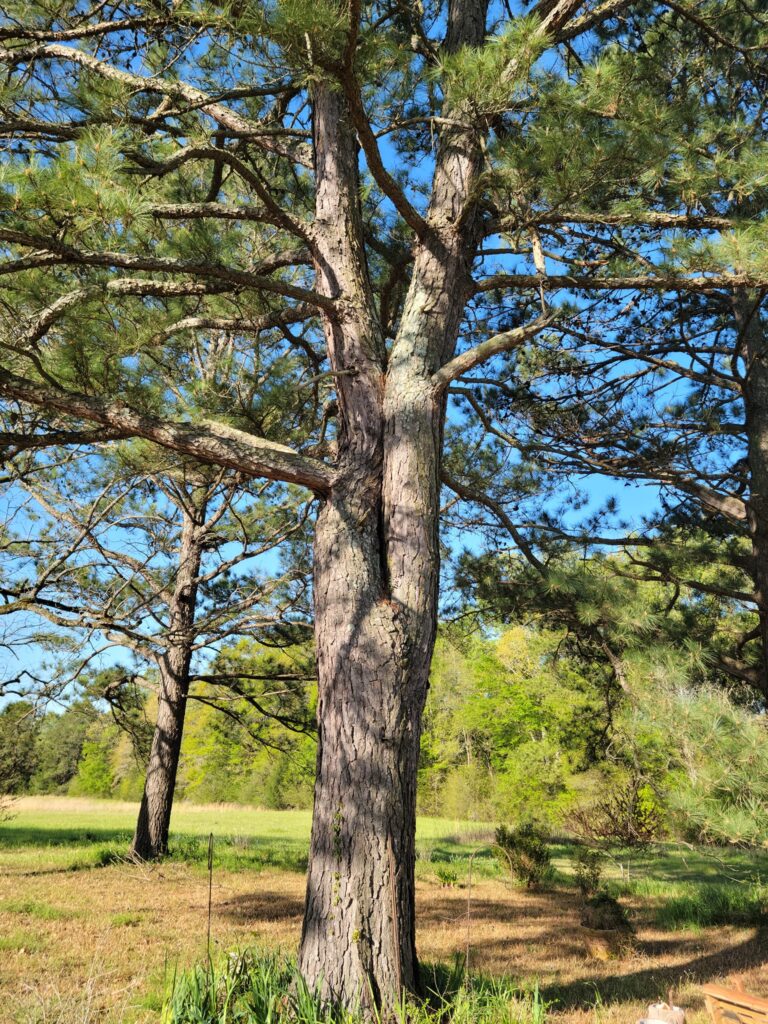
Physical Description: What Does a Loblolly Pine Look Like?
Here is how you can identify a loblolly pine:
Height and Form
The loblolly pine is a tall, straight-trunked tree. In a healthy forest stand, mature trees typically reach 20 to 35 meters (65 to 115 feet). Exceptional specimens, particularly in older growth forests, can exceed 50 meters (165 feet). The crown is conical in youth, becoming rounded and open with age.
The trunk is impressively straight, which is one of the primary reasons lumber mills prize this species. A single mature tree can yield substantial usable timber with very little waste.
Bark
The bark is one of the tree’s most recognizable features. On young trees, it is grayish-brown and relatively smooth. As the tree ages, the bark develops into large, irregular, flat-topped plates separated by deep furrows.
The color shifts to a distinctive reddish-brown or orange-brown on mature trees, especially in the upper portions of the trunk.
This thick, plated bark provides some protection against fire — an important adaptation in a region historically shaped by frequent natural burns.
Needles
Loblolly needles grow in fascicles (bundles) of three, occasionally two or four. This is a key identification characteristic. Each needle measures 15 to 23 cm (6 to 9 inches) in length, making them longer than most other Southern pines.
The needles are stiff, twisted slightly, and a rich yellow-green to dark green color. They remain on the tree for two to three years before dropping, giving the canopy a dense, layered appearance.
When you crush a loblolly needle between your fingers, the sharp, resinous scent is unmistakable — clean, piney, almost medicinal. It is one of those scents that stays with you.
Cones
The seed cones are 6 to 13 cm long (2.5 to 5 inches), oval to cylindrical in shape. They are reddish-brown when mature and bear stiff, short prickles on each scale. The cones open in late fall to disperse small, winged seeds that travel on the wind.
Pollen cones are small and appear in clusters, releasing large quantities of yellow pollen in early spring — enough to dust cars, porches, and ponds across entire neighborhoods.
Seeds
Each cone scale contains two seeds. The seeds are small — roughly 6 mm long — with a wing that allows wind dispersal over distances of several hundred meters. A single tree can produce thousands of seeds annually.
Growth Rate and Lifespan
Few trees in North America grow as quickly as the loblolly pine. Under optimal conditions, young trees can add 60 to 90 cm (2 to 3 feet) of height per year. In plantation settings with proper management, diameter growth of 2.5 cm (1 inch) per year is common.
This remarkable speed is precisely why the loblolly pine became the backbone of Southern timber plantations. Trees managed for pulpwood can be harvested in as little as 15 to 20 years. For sawtimber, rotations typically range from 25 to 35 years.
In natural stands without human intervention, loblolly pines can live 100 to 200 years, and some individuals in protected areas are documented to exceed 300 years. A living 300-year-old loblolly has witnessed more of American history than most buildings still standing.
Ecological Role: More Than Just Timber
Wildlife Habitat
The loblolly pine forest supports a rich community of wildlife. The red-cockaded woodpecker (Leuconotopicus borealis), a federally endangered species, depends almost exclusively on older, living loblolly pines for nesting cavities.
These birds excavate nest chambers in the heartwood of large, old trees — a habitat type that has become increasingly rare.
Other species closely associated with loblolly pine forests include:
- Northern bobwhite quail — benefits from the open understory of managed pine forests
- Wild turkey — uses pine stands for roosting
- White-tailed deer — finds cover and forage in pine-hardwood mixes
- Bachman’s sparrow — a species of conservation concern that nests in open, mature pine stands
- Brown-headed nuthatch — a small bird nearly restricted to longleaf and loblolly pine systems
Squirrels, raccoons, foxes, and dozens of raptor species all use loblolly pine stands throughout the year.
Carbon Storage
Loblolly pine forests are significant carbon sinks. Southern pine forests, dominated largely by loblolly, sequester an estimated 200 million metric tons of carbon per year. This represents a meaningful contribution to regional and national carbon budgets.
As climate change pushes governments and industries toward carbon markets, loblolly plantations are increasingly being enrolled in carbon credit programs. Landowners can now earn income for sequestering carbon, in addition to timber revenues.
Watershed Protection
Loblolly forests play an important role in watershed hydration and water quality. The dense canopy intercepts rainfall, reducing runoff and erosion. Root systems stabilize stream banks and filter sediment before it reaches waterways.
Many drinking water reservoirs in the Southeast are surrounded by loblolly pine forests that provide a natural buffer zone, reducing the cost of water treatment.
Soil Improvement
The needles dropped each year build up a deep litter layer that moderates soil temperature, retains moisture, and slowly decomposes to add organic matter. This litter also supports communities of fungi, insects, and microorganisms that sustain soil health over long timescales.
Timber and Commercial Uses
Lumber and Construction
Loblolly pine produces strong, dense, workable wood that is used across the construction industry. It is classified as Southern Yellow Pine (SYP), a grade that includes several closely related species. SYP lumber is among the strongest softwood lumber available in North America.
Common construction uses include:
- Structural framing (studs, joists, rafters, beams)
- Flooring
- Decking and outdoor structures
- Plywood and oriented strand board (OSB)
- Engineered wood products (glulam, LVL)
A large share of the lumber used to build American homes comes from loblolly pine. That is a fact worth pausing on. The walls around you may well have started life as a loblolly pine growing in Georgia or the Carolinas.
Pulp and Paper
The loblolly pine is the primary source of wood fiber for the pulp and paper industry in the southeastern United States. Its long wood fibers produce high-quality pulp suitable for printing paper, paperboard, tissue, and packaging.
The U.S. is one of the world’s largest producers of wood pulp, and loblolly pine is central to that position.
Naval Stores and Resin Products
Historically, loblolly and longleaf pine were the foundation of the naval stores industry — the production of tar, pitch, turpentine, and rosin from pine resin. These products were essential for waterproofing wooden ships.
Though the naval stores industry has largely faded, pine resin remains commercially valuable. It is used in adhesives, coatings, inks, rubber compounds, and food additives. Rosin, derived from pine resin, is used by musicians, athletes, and industrial manufacturers alike.
Biomass and Bioenergy
Loblolly pine residues — chips, bark, sawdust, and logging slash — are increasingly used as biomass fuel for electricity generation. Several major power plants in the Southeast co-fire pine biomass with coal or burn it exclusively to generate renewable energy.
Christmas Trees
Some loblolly pines are grown as Christmas trees, though they are less popular in this market than Fraser fir or Virginia pine. They grow quickly and fill out well, but their open form is less compact than consumers typically prefer.
How to Grow Loblolly Pine: Planting and Management
Site Selection
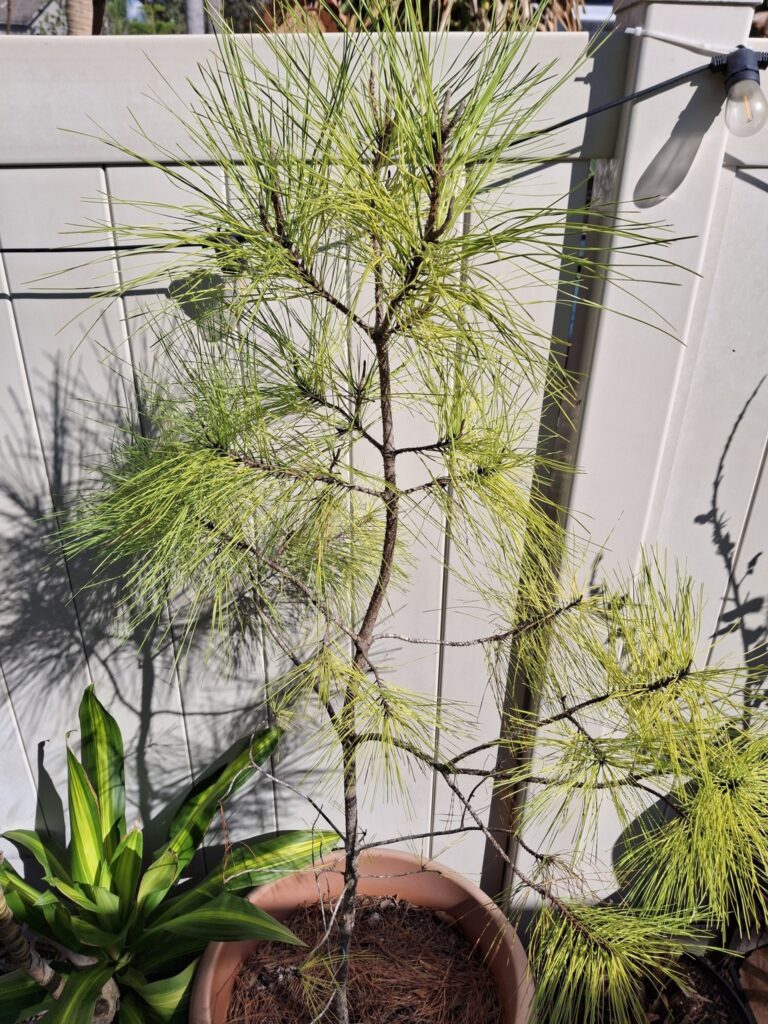
Loblolly pine is highly adaptable, but it performs best on well-drained to moderately wet, loamy or clay soils with a pH between 4.5 and 6.0. It tolerates poorly drained soils better than most pines, which explains its historical association with lowland sites.
It demands full sun. Loblolly is shade-intolerant, which means seedlings planted under a closed canopy will fail. Site preparation — removing competing vegetation before planting — is critical for successful establishment.
Planting
Loblolly pine is typically planted as bare-root or containerized seedlings in winter or early spring, from December through March across most of its range.
Recommended spacing depends on management objectives:
- Pulpwood: 1.8 x 1.8 m (6 x 6 feet), approximately 3,000 trees per hectare
- Sawtimber: 2.4 x 2.4 m (8 x 8 feet), approximately 1,700 trees per hectare
- Wildlife and aesthetics: 3.0 x 3.6 m (10 x 12 feet) or wider
State forestry agencies in the South often provide subsidized seedlings to private landowners through cost-share programs, making reforestation financially accessible.
Thinning
Thinning is essential in managed loblolly stands. Without it, trees become crowded, competition reduces growth rates, and the risk of bark beetle attack increases dramatically.
First thinning typically occurs at 10 to 15 years, when stand density begins to exceed optimal levels. Subsequent thinnings may follow at 5- to 8-year intervals. Thinning operations remove lower-quality trees and allow the remaining trees to grow larger and faster.
The removed trees — called “thinnings” — are sold as pulpwood, providing early income to the landowner while the remaining stand continues developing into higher-value sawtimber.
Prescribed Fire
Fire is a natural part of the loblolly pine ecosystem. Prescribed burning — the controlled application of fire under safe conditions — is one of the most important management tools for pine forests in the South.
Benefits of prescribed burning include:
- Reducing wildfire risk by removing accumulated fuels
- Controlling hardwood competition
- Improving wildlife habitat (bobwhite quail, deer)
- Maintaining native understory grasses and forbs
- Controlling brown-spot needle disease in young stands
Landowners are encouraged to work with state forestry agencies or professional foresters when planning prescribed burns.
Fertilization
Loblolly pine responds well to fertilization, particularly on nutrient-poor soils. Aerial application of nitrogen and phosphorus is common practice on commercial pine plantations, often applied once or twice during the rotation.
Fertilization can increase annual growth by 20 to 40 percent on responsive sites, making it one of the most cost-effective silvicultural investments in Southern forestry.
Pests and Diseases
Here are the challenges that this tree may face:
Southern Pine Beetle (Dendroctonus frontalis)
The southern pine beetle is the most destructive insect pest of loblolly pine. These small beetles (about 3 mm long) bore into the bark and inner bark, disrupting the flow of water and nutrients. Heavily infested trees die within weeks.
Outbreaks often begin in stressed trees — those weakened by drought, overcrowding, lightning, or physical damage — and can spread rapidly through dense, overstocked stands. Proper thinning is the most effective prevention.
Fusiform Rust (Cronartium quercuum f. sp. fusiforme)
Fusiform rust is a fungal disease that causes large, woody galls to form on the stems and branches of young loblolly pines. It is the most economically damaging disease of loblolly pine in the South.
The disease requires two hosts to complete its lifecycle — pine and oak — which is why managing oak populations within pine stands can reduce rust pressure. Resistant seedling varieties are now available and widely used in commercial planting programs.
Pitch Canker (Fusarium circinatum)
Pitch canker causes resinous cankers on branches and stems, killing affected tissues. It is more commonly a problem in nurseries and seed orchards than in forest plantations, but it can cause significant losses when it does occur.
Tip Moths (Rhyacionia spp.)
The Nantucket pine tip moth and related species attack the growing tips of young loblolly pines, killing new shoots and deforming tree form. Damage is most severe in the first several years after planting.
Insecticide applications and prompt thinning can reduce tip moth damage in high-value plantations.
Brown-Spot Needle Disease (Mycosphaerella dearnessii)
This fungal disease attacks longleaf pine seedlings most severely, but loblolly can also be affected in nurseries. Prescribed burning eliminates infected needles and interrupts the disease cycle.
Loblolly Pine and Climate Change
Climate change is already reshaping where loblolly pine grows and how it performs. Several trends are worth noting.
Warming temperatures are allowing loblolly pine to expand its range northward. Trees are establishing successfully in areas of Pennsylvania and New York that were previously too cold for reliable regeneration.
At the same time, increased drought stress in the southern and western portions of its range — particularly in Texas — is causing growth declines and increasing mortality in some areas. The species appears less resilient than longleaf pine to prolonged moisture deficit.
More frequent and intense hurricanes pose a major risk to loblolly pine plantations in coastal areas. The shallow root system of plantation-grown loblolly makes it vulnerable to windthrow. Hurricane-damaged stands face increased bark beetle pressure in the months following storms.
Researchers are actively developing drought-tolerant, disease-resistant loblolly genetic material through breeding programs at universities and USDA research stations. Planting improved seed sources is one of the most effective ways landowners can adapt to climate uncertainty.
Loblolly Pine in Culture and History
The loblolly pine has a long and intertwined history with human settlement in the American South. Indigenous peoples used pine resin medicinally and pine wood for construction and fire. European colonists quickly recognized the commercial value of Southern pines and established the naval stores industry in the 17th century.
Turpentine production from Southern pines — including loblolly — was one of the dominant industries of the 19th century South, employing large numbers of workers in North Carolina, Georgia, and Florida.
After the Civil War, as agriculture declined across large areas of the South, loblolly pine was one of the primary colonizers of abandoned fields. This natural reforestation eventually led to the managed timber economy that defines the region today.
North Carolina, historically one of the most important loblolly-producing states, was once so associated with turpentine production that its nickname, “The Tar Heel State,” directly references the pine resin industry.
Loblolly Pine vs. Other Southern Pines: Key Differences
Many people confuse loblolly pine with other members of the Southern pine group. Here is how to tell them apart.
| Feature | Loblolly Pine | Longleaf Pine | Slash Pine | Shortleaf Pine |
| Needles per bundle | 3 (occasionally 2) | 3 | 2–3 | 2 (occasionally 3) |
| Needle length | 15–23 cm | 25–45 cm | 18–30 cm | 7–14 cm |
| Cone prickle | Sharp, stout | Thick, curved | Sharp | Small, fine |
| Bark | Scaly, reddish-brown | Large, orange plates | Dark reddish-brown | Scaly, dark gray |
| Seedling stage | None (no grass stage) | Long grass stage | None | None |
| Range | Southeast U.S. (wide) | Southeast U.S. (coastal plain) | Florida, southeast | Appalachian region |
The longleaf pine is often considered ecologically superior to loblolly, and conservation efforts increasingly focus on longleaf restoration. However, loblolly’s commercial productivity and broad adaptability make it dominant across managed landscapes.
Conservation and Restoration Considerations
While loblolly pine itself is not threatened, the ecosystems it dominates face complex conservation challenges.
The conversion of diverse longleaf pine savannas to loblolly pine plantations has reduced biodiversity significantly across the Southeast. Loblolly monocultures support far fewer plant and animal species than the open, fire-maintained longleaf systems they replaced.
Conservation organizations now actively work to:
- Restore longleaf pine where it historically occurred
- Encourage more structurally diverse loblolly management
- Protect old-growth loblolly stands that remain
- Support the red-cockaded woodpecker through habitat management
For private landowners with loblolly stands, managing for multiple values — wildlife, water, timber, and carbon — rather than timber alone is increasingly recommended and financially supported through federal programs such as the Forest Stewardship Program and the Conservation Reserve Program.
Interesting Facts About Loblolly Pine
- Loblolly pine is the second most common tree species in the United States, behind only red maple when all trees are counted.
- A single mature loblolly pine produces enough oxygen for approximately two people per year.
- The wood of loblolly pine was used extensively in Civil War-era fortifications and military construction across the South.
- Loblolly pine plantations produce roughly 16 billion board feet of lumber per year — enough to build millions of homes annually.
- The species is one of the most studied trees in the world. Its genome was fully sequenced in 2014, making it the largest plant genome sequenced at that time (approximately 22 billion base pairs, seven times the size of the human genome).
- Loblolly pine roots associate with mycorrhizal fungi, which dramatically expand the tree’s ability to absorb water and nutrients — a key reason for its remarkable growth rates.
Conclusion
The loblolly pine does not always receive the reverence given to more charismatic trees — the redwood, the live oak, the sugar maple. It is often seen as merely a commercial crop, planted in rows and harvested on schedule.
But spend time with a mature loblolly. Stand under its canopy on a windy afternoon and listen to the deep, resonant hum the wind makes through its long needles. Watch the light filter through the canopy in long golden shafts.
Consider that this single tree has been quietly cleaning the air, filtering the water, storing carbon, sheltering wildlife, and — yes — providing the raw material for the homes, books, and packaging that sustain modern life.
The loblolly pine is, quietly, one of the most important trees on earth. Understanding it — its biology, its ecology, its history, its challenges — is essential for anyone who cares about forests, sustainability, and the American South.
References
- North Carolina State University (NC State) Extension Plant Toolbox Pinus taeda — Loblolly Pine NC State University, Department of Horticultural Science. https://plants.ces.ncsu.edu/plants/pinus-taeda/
- University of Florida IFAS Extension Pinus taeda: Loblolly Pine — Environmental Horticulture, Edward F. Gilman & Dennis G. Watson. University of Florida, Institute of Food and Agricultural Sciences. https://edis.ifas.ufl.edu/publication/ST448
- Virginia Tech Department of Forest Resources & Environmental Conservation Loblolly Pine Dendrology Factsheet — Pinus taeda Virginia Polytechnic Institute and State University (Virginia Tech). https://dendro.cnre.vt.edu/dendrology/syllabus/factsheet.cfm?ID=16
- USDA Forest Service — Silvics of North America Pinus taeda L. — Loblolly Pine, Silvics Manual Vol. 1 (Agriculture Handbook 654). United States Department of Agriculture, Forest Service, Southern Research Station. https://www.srs.fs.usda.gov/pubs/misc/ag_654/volume_1/pinus/taeda.htm

Tim M Dave is a gardening expert with a passion for houseplants, particularly cacti and succulents. With a degree in plant biology from the University of California, Berkeley, he has vast experience in gardening. Over the years, he has cultivated a vast collection of desert plants and learned a great deal about how to grow and care for these unique companions.