30 Types of Pears (Names, With Flavor Details)
Walk into any grocery store and you will see a few pears. Walk into an orchard and you will find hundreds. I still remember my first bite of a truly ripe pear. It was soft, sweet, and almost buttery, and it changed how I saw the fruit.
The world of pears is far larger than most shoppers realize. The USDA National Clonal Germplasm Repository in Oregon keeps 2,297 clonal pear accessions. They cover 36 Pyrus taxa from 55 countries.
Yet Ohio State University Extension notes something surprising. Thousands of pear varieties exist, but only about ten are grown and sold commercially.
This guide covers 30 types of pears. Some are famous, and some are hidden gems. For each one, you will learn how it tastes, how it feels, and how best to use it.
Quick Pear Facts Before You Start
Pears have a long history. Purdue Extension says people have cultivated them for nearly 4,000 years. They are also good for you.
One medium pear (178 g) gives about 101 calories and 6 g of fiber, according to Purdue’s FoodLink. It has no fat and almost no sodium.
The United States grows a lot of pears. The Northwest Horticultural Council reports that the Pacific Northwest produces 77% of the total U.S. pear crop. It also grows 85% of the fresh pears.
Here are the main groups you will meet in this guide:
- European pears: Soft, juicy, and often bell-shaped. They are usually picked firm and ripened off the tree.
- Asian pears: Round, crisp, and crunchy like an apple. Penn State Extension says they ripen on the tree and do not need cold storage.
- Warm-climate pears: Hybrids bred for places with mild winters, such as Florida.
How to Tell When a Pear Is Ripe
Pears do not ripen well on the tree. Growers pick them mature, and the fruit finishes ripening afterward. Purdue Extension suggests keeping them at 60 to 70°F in a paper bag.
Use the neck test. Press gently near the stem with your thumb. If it gives a little, the pear is ready.
Color is not always a guide. Anjou, Bosc, and Concorde pears do not change color much when ripe, says Ohio State. For these, always use the neck test.
Do not refrigerate unripe pears. Once they are ripe, you can chill them for up to five days to slow things down.
European Pears
1. Bartlett (Williams)
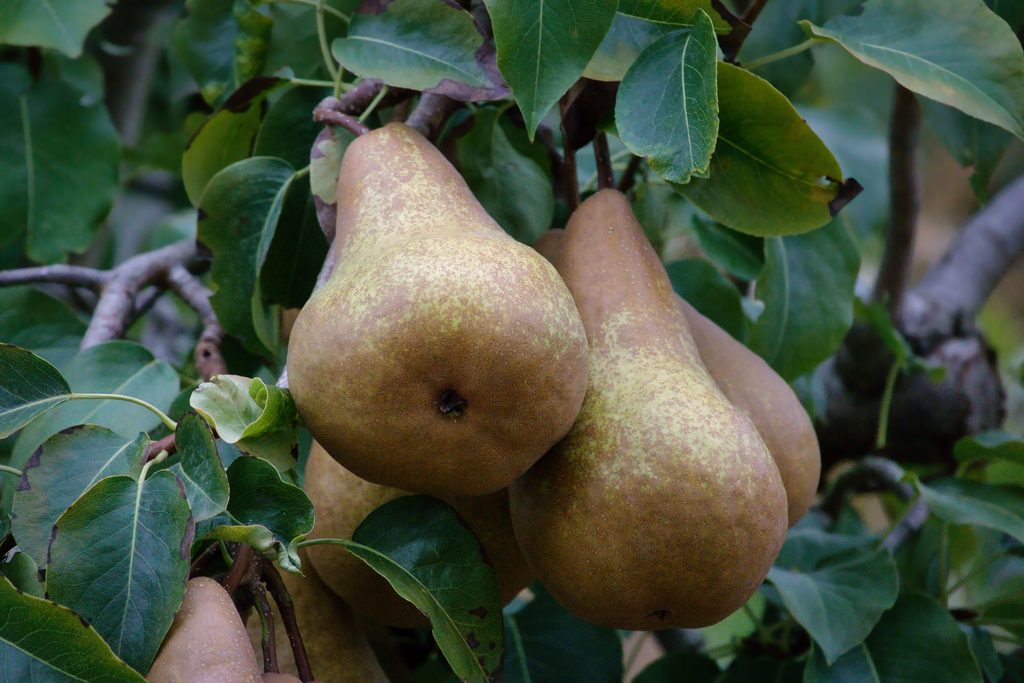
Bartlett is the classic pear of summer. It has the bell shape and sweet, juicy flesh most people expect. In many countries it is sold under the name Williams.
Ohio State lists it as a good pear for eating raw, for salads, and for canning. The skin turns from green to yellow as it ripens. That color change makes it easy to judge.
The Northwest Horticultural Council reports that growers sold about 3.47 million cartons of green Bartlett in 2024/25. Only Anjou sold more.
For backyard growers, Utah State Extension calls the tree very productive. It also says the tree bears well when young. One warning: Purdue Extension rates Bartlett as susceptible to fire blight.
2. Red Bartlett
Red Bartlett has the same shape and flavor as its green parent. The difference is the skin, which is a deep red. Ohio State says the color moves from dark red to bright red as the fruit ripens.
Purdue FoodLink calls it a summer pear with a floral fragrance. I find the aroma almost as pleasant as the taste.
Use it fresh, in salads, or for canning. The red skin looks lovely on a cheese board. Its sales are much smaller, though, at about 47,500 cartons in 2024/25.
3. Green Anjou (D’Anjou)
Green Anjou is the workhorse of the pear world. Purdue says it is the most abundant variety and is available almost all year. The Northwest Horticultural Council counted over 5.1 million cartons sold in 2024/25. That makes it the top seller.
The flavor is mild and sweet. The flesh is firm and not very juicy, according to Utah State. That firmness makes it a strong choice for baking and poaching.
Remember that Anjou does not change color when ripe. Use the neck test every time. Anjou also stores well, which explains its long season.
4. Red Anjou
Red Anjou tastes and feels like Green Anjou. Purdue says only the skin differs. The color is a burgundy red that stays red as the fruit ripens.
Because the skin hides the ripening clues, the neck test is even more important here. Press gently and wait for a slight give.
It works well in salads, on snack plates, and in baked dishes. In 2024/25, about 713,800 cartons of Red Anjou were sold. That is a solid third place among major varieties.
5. Bosc
Bosc is easy to spot. It has a long neck and warm, cinnamon-brown skin with russeting. Ohio State describes the flesh as crunchy and tender.
Utah State points to its strong, perfumed aroma. It also notes that Bosc is firm and crisp, which makes it especially good for cooking. Baked or poached, it keeps its shape well.
Bosc is one of my favorites for autumn desserts. It holds up in the oven better than most pears. Purdue rates it as susceptible to fire blight, so home growers should plan for care.
ALSO READ: 25 Fast Growing Fruit Trees (With Planting Details)
6. Comice (Doyenné du Comice)
Comice is the pear people give as a gift. Purdue FoodLink calls it the sweetest and juiciest of the common types. Its round body and short neck set it apart.
It is often known as the “Christmas Pear.” Only about 90,000 cartons were sold in 2024/25, so it is a specialty item.
Eat it fresh and soft. Serve it with a mild blue cheese or a little honey. Comice is too delicate for rough handling, so buy it ripe and eat it soon.
7. Concorde
Concorde was bred in England from a cross of Conference and Comice. Washington State University lists it as a winter pear. Its shape is like a bell with a long neck.
The skin is green and sometimes russeted. The flavor is sweet with a vanilla-like note. WSU says the flesh starts crisp and dense and turns juicier as it ripens.
It stores for about five months, according to WSU. Ohio State suggests using it raw, in salads, in baking, or for canning. Use the neck test, because the skin changes little.
8. Seckel
Seckel is the smallest common pear. Purdue calls it tiny and chubby, with olive-green skin that can look maroon. Ohio State says it is sweet and small.
Utah State praises it for having the finest aroma and flavor of home-garden pears. It is a great fruit for lunch boxes and for canning whole. Spiced whole Seckels make a pretty dessert.
It is also one of the tougher trees. Purdue rates Seckel as resistant to fire blight. Still, it is a small crop, with under 12,000 cartons sold in 2024/25.
9. Forelle
Forelle is a tiny, pretty pear. Purdue describes it as symmetrical and bell-shaped, with red freckles on the skin. Those freckles are called lenticels.
The flavor is sweet, and the flesh is crisp. Purdue calls it a good snacking pear. I like it for the crunch, since it stays firm even when ripe.
Slice it into green salads or serve it whole on a fruit plate. It looks lovely in a bowl. The small size makes it ideal for children.
10. Starkrimson
Starkrimson is a bright crimson pear with thick stems. Purdue says the flavor is mild and sweet. Ohio State notes that the color moves from deep crimson to bright crimson as it ripens.
That color change is helpful, because it gives a clear ripeness signal. Most red pears do not offer this.
Use it for salads or snacking. About 202,700 cartons were sold in 2024/25. That makes it one of the better-selling red pears in the Northwest.
11. Kieffer
Kieffer is a tough, hard pear. Ohio State says it is hard, yellow to golden, often with a red blush. It is best for baking and canning, not for eating raw.
Where it shines is in the garden. Purdue rates Kieffer as highly resistant to fire blight. That makes it useful where the disease is common.
The University of Florida lists it for north Florida. It needs about 350 to 400 chill hours and ripens from mid-August to September. It does not need another pear for pollination.
12. Harrow
Harrow is a sweet, juicy pear on the Ohio State list. It turns from yellow to yellow with a red blush as it ripens. Ohio State suggests it for eating raw and for salads.
It is less famous than Bartlett, but it is worth a look in cold climates. Home growers often search for pears that handle winter well.
I would treat Harrow as a pleasant fresh eating pear. Keep it at room temperature until it softens slightly, then enjoy it.
ALSO READ: 25 Fruit Trees That Grow in Shade (With Details Explained)
13. Magness
Magness is a pear for people who want flavor without fuss. NC State Extension describes it as medium, oval, and greenish-yellow with slight russet. It ripens about a week after Bartlett.
The flesh is sweet, soft, and juicy, with almost no grit cells. NC State also calls it very aromatic. It works well fresh and in jam.
Disease resistance is the big selling point. NC State calls the tree very resistant to fire blight. Purdue agrees, listing it as highly resistant.
14. Moonglow
Moonglow is an early pear. NC State says it ripens in early to mid August, about a week before Bartlett. The tree crops heavily early in the season.
The fruit is large and shaped like a Bartlett. The white flesh is soft and moderately juicy, with almost no grit. NC State calls it sweet and fragrant.
Moonglow resists fire blight, which is a major plus. It does need a second pear variety nearby for pollination. NC State also warns that early spring frost can damage its buds.
15. Conference
Conference is the pear of the United Kingdom. It was developed by Thomas Francis Rivers at Rivers Nursery in Hertfordshire. The name comes from its first prize at the National British Pear Conference in 1885.
It is long and bottle-shaped, with greenish-brown, russeted skin. The flesh is fine, soft, and sweet. Wikipedia notes it makes up around 90% of UK pears.
Stored cool, it can last until January. In France, Conference pears from Savoie earned an EU Protected Geographical Indication in 1996. That is a proud mark for a variety that is over a century old.
16. Rocha
Rocha is Portugal’s famous pear. It was first recorded in 1836 in Sintra. It grew by chance from a seed on a farm owned by Pedro António Rocha.
The fruit is medium-sized, with smooth yellow-green skin. The flesh is firm, crunchy, juicy, and sweet. That crunch is unusual among European pears.
Rocha pears from the Oeste region have had PDO status since 2003. About 9,450 producers grow them, and over 13.5 million kilograms were exported in 2004, according to Wikipedia.
17. Packham’s Triumph
Packham’s Triumph comes from Australia. Charles Packham made the cross in 1896 at Clifton, near Garra in New South Wales. He crossed Uvedale St Germain with Williams, the Australian name for Bartlett.
The pear is light green with a short neck and clear skin. An agriculture expert named W. J. Allen thought it the finest pear he had tasted, according to the Australian Dictionary of Biography.
It stores well after a March picking. That makes it a winter fruit that suits export. In 1996, a food writer called it still one of Australia’s principal pears.
18. Winter Nelis
Winter Nelis has a long and colorful history. It was raised from seed by the Flemish nobleman Jean-Charles de Nelis. It reached England in 1818 and the United States in 1823.
The fruit is medium-sized and not very pretty. It makes up for that in flavor. A famous 19th-century fruit manual called it one of the richest flavored pears. The flesh is buttery and sugary.
It is picked late in autumn and stores well. That makes it a true late-season dessert pear. It is also good for cooking. The tree is self-sterile and needs a pollinator.
Warm-Climate Pears
19. Pineapple
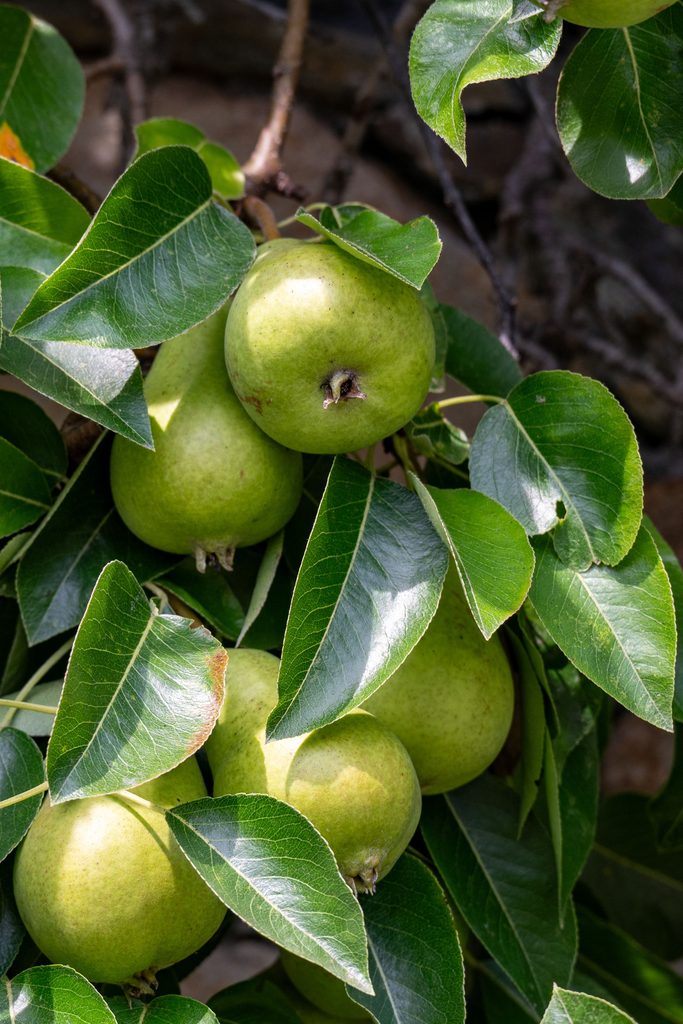
Pineapple pear is a hybrid made for hot regions. The University of Florida lists it for north and central Florida. It ripens in early August, and cooks use it for canning.
The tree is very resistant to fire blight, says UF/IFAS. It has moderate resistance to leaf spot. It needs partial cross-pollination for a good crop.
I think of it as a practical choice. It is not the sweetest pear you will taste. Yet in a hot climate, it gives you pears when European types will not.
20. Orient
Orient is another Florida favorite. UF/IFAS says it ripens from late July to early August. Like Pineapple, it is used for canning.
Its strengths are health and ease. The tree is very resistant to fire blight and resistant to leaf spot. It also does not need a second pear tree for pollination.
That makes it good for small home gardens where there is room for only one tree. Expect a firm, canning-style fruit rather than a soft dessert pear.
21. Flordahome
Flordahome was bred for places with mild winters. UF/IFAS lists it at only 150 chill hours. That is very low compared with most pears.
It ripens from July to August. UF says it works for both fresh eating and canning. It resists both fire blight and leaf spot.
Its parent is Hood, another early pear with a low chill need. UF reports that Flordahome only partly needs cross-pollination. For warm regions, this is a hard pear to beat.
Asian Pears
22. Nijisseiki (20th Century)
Nijisseiki has a wonderful story. In 1888, a 13-year-old boy named Kakunosuke Matsudo found a seedling in a neighbor’s garbage dump in Japan. Oregon State University Extension tells the tale.
The tree bore fruit about ten years later. In 1904, a magazine called it “the perfect pear,” and it was renamed 20th Century. It peaked at over 6,000 hectares in Japan between 1972 and 1988.
The fruit is yellow-green, sweet, and slightly tart. Utah State says it is a heavy producer. Both Purdue and Penn State warn that it is highly susceptible to fire blight.
23. Hosui
Hosui is a favorite among Asian pear fans. Penn State says it has yellowish-brown, russeted skin. Many people prefer its flavor. It ripens in mid to late August.
Hosui was bred from Nijisseiki, according to Oregon State. It is now one of the most planted Asian pears in Japan.
Growers must thin the fruit to get good size, says Penn State. Purdue also lists Hosui as susceptible to fire blight. Eat it fresh and cold, like a crisp apple.
ALSO READ: 15 Drought Resistant Fruit Trees: Identification and Growth Details
24. Kosui
Kosui is a small to medium, apple-shaped pear with brown skin. Penn State says it ripens in mid to late August. It is a close cousin of Hosui.
Oregon State notes that Kosui was bred from Nijisseiki. Oregon State says it is now one of the two most planted Asian pears in Japan, ahead of its own parent.
Gardeners should know that Purdue rates Kosui as resistant to fire blight. That makes it a safer pick than Nijisseiki or Hosui for many home orchards.
25. Shinseiki (New Century)
Shinseiki means “new century.” Penn State says the skin is yellow-green to yellow. The fruit is medium and round to oblong, with creamy white flesh.
The flavor is good to excellent and very sweet. It ripens early, in early to mid August. Utah State lists a similar pear, Shenseiki, as the earliest Asian pear to mature.
Penn State says it tends to be self-fruitful, but cross-pollination helps. Purdue lists it as susceptible to fire blight, so watch the trees closely.
26. Shinko (New Success)
Shinko is a seedling of Nijisseiki. Washington State University says it was bred in Japan in 1941. The fruit is large, about 14 to 20 ounces.
The skin is golden-brown russet, and the flesh is yellowish white. It is harvested in late fall. WSU reports that it can be stored for about four months.
Purdue rates Shinko as resistant to fire blight, which is helpful. I like this pear for its size. One fruit can be shared by two people.
27. Olympic (Korean Giant)
Olympic goes by many names. Penn State lists it as A-Ri-Rang and Korean Giant. It is large and round, with golden, russeted skin.
It ripens late and has the longest storage life of the Asian pears, says Penn State. That is a big advantage for fresh winter eating.
Its bloom overlaps with Bartlett, which makes it a good pollinizer for European trees. Purdue rates it resistant to fire blight. It is a very practical pear for home orchards.
28. Chojuro
Chojuro is an old Japanese pear with a lot of character. Utah State says it has a strong flavor, very firm flesh, and russet skin. It stores well.
To my palate, the taste has a faint hint of butterscotch. That is only my own impression.
Purdue lists Chojuro as resistant to fire blight. It is a dependable choice for gardeners who want crunch and flavor. It also pairs nicely with sharp cheese.
29. Ya Li
Ya Li is an Asian pear with Chinese origins. It is grown for its crisp, juicy fruit, and it appears in Purdue’s list of Asian varieties for the home orchard.
For gardeners, there is a puzzle. Purdue lists Ya Li under both resistant and susceptible to fire blight. The note says studies disagree about its resistance.
My advice is to ask a local extension office before planting. Fire blight can destroy a tree, and results vary by region. For fruit lovers, it is a fine pear to try fresh.
One Pear You Should Not Eat
30. Callery Pear (Bradford Pear)
Not every pear belongs in the fruit bowl. The Callery pear is an ornamental tree. University of Illinois Extension says it was brought from China in the early 1900s.
Growers sold it as a sterile street tree. Over time, different cultivars cross-pollinated and made seed. Birds spread the small fruits into wild areas, where the trees crowd out native plants.
The fruit is small and hard, about half an inch across. It is not a table fruit. South Carolina and Pennsylvania banned its sale as of 2024, according to the Illinois page. If you want a pear tree, plant an edible one from this list.
Quick Comparison: Which Pear Should You Choose?
| Pear | Type | Best use | Texture |
| Bartlett | European | Fresh, canning | Juicy, soft |
| Green Anjou | European | Baking, salads | Firm |
| Bosc | European | Baking, poaching | Crisp, tender |
| Comice | European | Fresh, cheese boards | Very juicy |
| Concorde | European | Fresh, baking | Crisp to juicy |
| Seckel | European | Snacking, canning | Small, firm |
| Forelle | European | Snacking | Crisp |
| Kieffer | European | Baking, canning | Hard |
| Conference | European | Fresh | Fine, soft |
| Rocha | European | Fresh | Crunchy, juicy |
| Orient | Warm-climate | Canning | Firm |
| Nijisseiki | Asian | Fresh | Crisp |
| Hosui | Asian | Fresh | Crisp, juicy |
| Shinko | Asian | Fresh | Crisp |
| Olympic | Asian | Fresh, storage | Firm |
How to Store and Use Pears
Good storage makes a big difference. Follow these simple steps.
Ripen at room temperature. Leave firm pears in a paper bag at 60 to 70°F until the neck gives slightly.
Chill ripe pears. Move them to the refrigerator to slow ripening. Purdue says they keep up to five days.
Preserve extras. Pears can be canned, frozen, or dried. Purdue links to home preservation guides for these methods.
Pair them well. Purdue suggests honey, rosemary, blue cheese, arugula, caramel, chocolate, and walnuts.
For quantity, Ohio State says one pound equals two or three medium pears. That is about two cups of sliced fruit. One bushel weighs about 50 pounds.
ALSO READ: 7 Best Homemade Pesticides for Fruit Trees: Organic Recipes That Actually Work
Frequently Asked Questions
What is the sweetest pear? Purdue calls Comice the sweetest and juiciest of the common types. Shinseiki is also very sweet.
Which pear is best for baking? Bosc and Anjou hold their shape well. Ohio State and Utah State both recommend them for cooking.
Do pears ripen on the tree? European pears ripen best after picking. Asian pears ripen on the tree, according to Penn State.
Which pear is easiest to grow at home? Choose varieties that resist fire blight, such as Magness, Moonglow, Seckel, and Kieffer. Purdue rates all four as resistant. Check with your local extension office for your region.
Final Thoughts
Pears are far more varied than the store shelf suggests. You can taste a buttery Winter Nelis, a crunchy Rocha, or a giant Shinko. Each one has its own story.
My simple advice is to try one new pear each season. Learn its neck test, give it time to ripen, and take note of what you like.
You may find, as I did, that one perfect pear is worth the wait.
References
- Ohio State University Extension. Selecting, Storing, and Serving Ohio Pears (HYG-5526). https://ohioline.osu.edu/factsheet/HYG-5526
- Purdue Extension. Pear, FoodLink. https://www.extension.purdue.edu/foodlink/food.php?food=pear
- Purdue Extension. Fire Blight on Fruit Trees in the Home Orchard (BP-30-W). https://extension.purdue.edu/extmedia/BP/BP-30-W.pdf
- Penn State Extension. Asian Pears in the Home Orchard: Variety Selection. https://extension.psu.edu/asian-pears-in-the-home-orchard-variety-selection
- Oregon State University Extension. Born in a Garbage Dump: The ’20th Century’ Asian Pear (EM 9636). https://extension.oregonstate.edu/catalog/em-9636-born-garbage-dump-20th-century-asian-pear
- University of Florida IFAS Extension. The Pear (Pyrus spp.) in Florida Home Gardens (HS1393). https://ask.ifas.ufl.edu/publication/HS1393
- USDA Agricultural Research Service. World Pear Collection, National Clonal Germplasm Repository, Corvallis, Oregon. https://www.ars.usda.gov/ARSUserFiles/20721500/Postman/NCGR%20Pear%20Collection%20Summary%2009-2016.pdf

Tim M Dave is a gardening expert with a passion for houseplants, particularly cacti and succulents. With a degree in plant biology from the University of California, Berkeley, he has vast experience in gardening. Over the years, he has cultivated a vast collection of desert plants and learned a great deal about how to grow and care for these unique companions.