15 Drought Resistant Fruit Trees: Identification and Growth Details
Water scarcity is no longer a distant concern. Across the globe — from the semi-arid regions of Sub-Saharan Africa to the sun-baked valleys of California and the Middle East — gardeners and smallholder farmers are rethinking what they grow.
The question is no longer just “what fruit do I want?” but rather, “what fruit can survive, and even thrive, when water is scarce?”
I have spent considerable time researching and growing fruit trees in challenging conditions, and one truth stands out clearly: choosing the right tree from the start saves more water than any irrigation system ever will.
Drought-resistant fruit trees do not merely tolerate dry spells — many of them actually produce better-quality fruit under mild water stress, concentrating sugars and flavor compounds in ways that well-watered trees often do not.
This guide covers 15 of the best drought-resistant fruit trees you can grow, including their water needs, ideal climates, and what makes them uniquely suited for dry conditions.
What Makes a Fruit Tree “Drought Resistant”?
Before diving into the list, it helps to understand what drought resistance actually means in horticultural terms.
A truly drought-resistant tree has adapted — structurally or physiologically — to survive extended periods of low soil moisture.
These adaptations may include deep taproot systems that reach underground water, thick bark or waxy leaves that reduce transpiration, the ability to enter dormancy during dry seasons, or cellular mechanisms that maintain function at low water potentials.
It is important to distinguish between drought tolerant and drought resistant. Drought-tolerant trees can endure dry periods without dying but may still need supplemental irrigation for good fruit production.
Truly drought-resistant trees can produce fruit with little to no irrigation once established — typically after two to three growing seasons.
Establishment is the critical phase. Almost all trees on this list require regular watering during their first one to two years. After that, most can largely fend for themselves in the right climate.
15 Best Drought-Resistant Fruit Trees
Fruit trees that thrive and produce with just little water include the following:
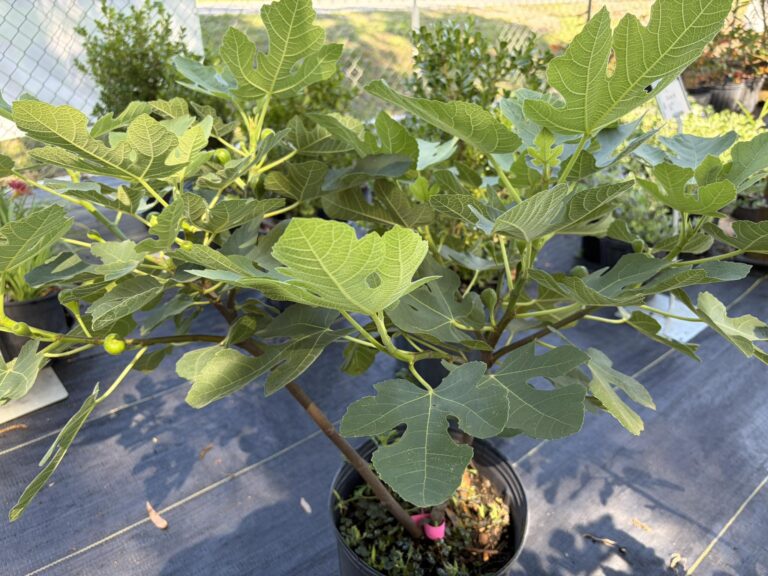
1. Fig (Ficus carica)
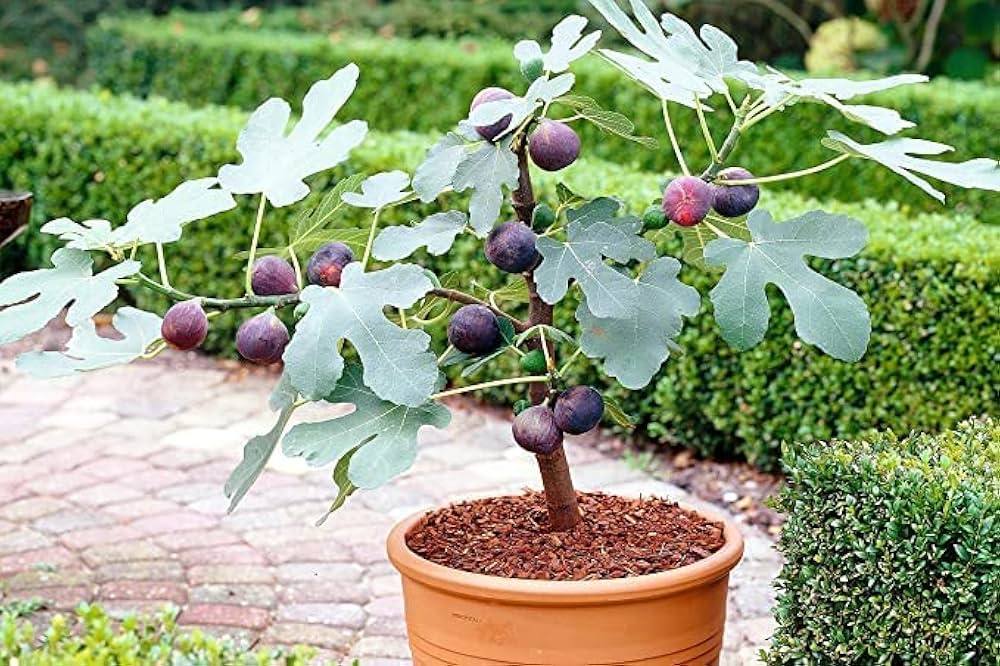
The edible fig is arguably the most drought-resistant edible fruit tree in the world. Originally from the dry hillsides of the Mediterranean and western Asia, it has evolved over thousands of years in environments where summer rain is rare or entirely absent.
Figs develop an extraordinarily deep and wide root system that searches aggressively for subsurface moisture. In some recorded cases, fig roots have been found 6 meters deep and extending 15 meters laterally. This makes them formidable survivors in rocky, sandy, and shallow soils.
Once established (usually after the second year), figs in USDA Zones 7–11 need almost no supplemental water. The fruit actually improves in dry conditions — the skins stay intact, the flesh becomes denser, and the sugar concentration rises noticeably.
- Best climates: Mediterranean, semi-arid, subtropical
- Annual water need (established): 250–500 mm rainfall equivalent
- Notable varieties: Brown Turkey, Kadota, Black Mission, Celeste
2. Olive (Olea europaea)
Few trees are as deeply associated with drought as the olive. It is not just a symbol of the Mediterranean — it is a biological product of it. Olive trees can survive on as little as 200 mm of annual rainfall, making them one of the most water-efficient fruit-producing trees on the planet.
The olive’s small, silver-green leaves are covered with tiny hairs that reflect sunlight and reduce water loss. Its thick, gnarled wood stores moisture efficiently. The tree also self-regulates by partially closing stomata during peak heat, limiting evapotranspiration.
Olives are long-lived — specimens over 1,000 years old still produce fruit in southern Europe and the Levant.
In commercial orchards, olives are increasingly farmed with deficit irrigation, meaning they are deliberately given less water than their maximum requirement, with no significant reduction in oil or fruit quality.
- Best climates: Zones 8–11; Mediterranean, semi-arid
- Annual water need (established): 200–400 mm
- Notable varieties: Arbequina, Picual, Frantoio, Manzanilla
3. Pomegranate (Punica granatum)
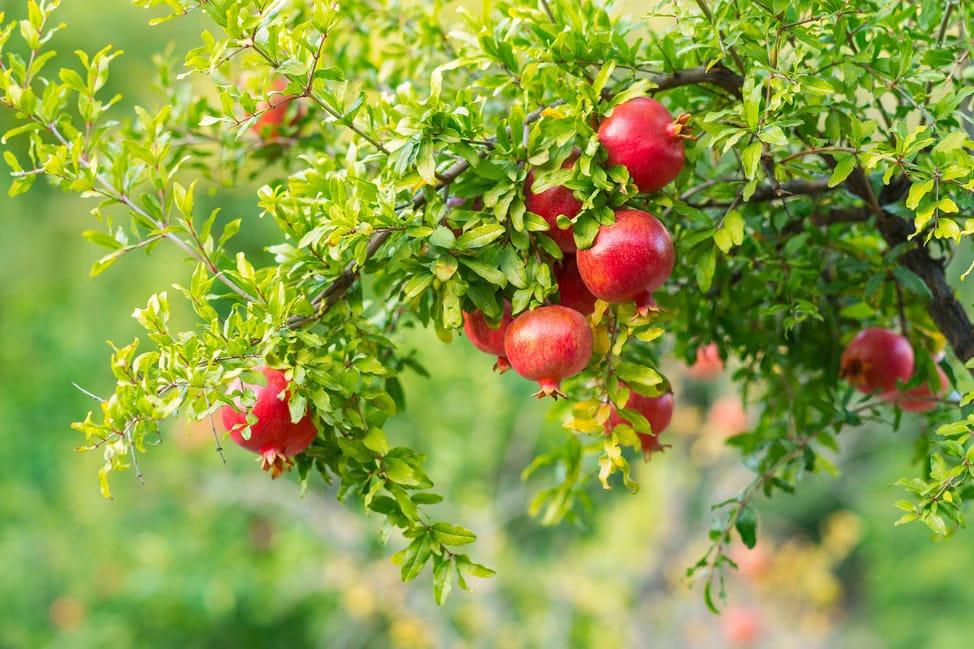
The pomegranate is one of the oldest cultivated fruit trees, with records tracing back over 4,000 years to ancient Persia and the Fertile Crescent. That longevity is not accidental. Pomegranate trees are tough, heat-loving, and remarkably water-efficient.
They thrive in hot, dry summers and can tolerate periodic drought once established. In fact, excess moisture can lead to fruit splitting and fungal problems — a clear sign that this tree prefers its roots on the drier side.
Pomegranates grow well in a wide range of soils, including calcareous, slightly saline, and clay soils where other fruit trees struggle. They are one of the best options for gardeners in hot, arid regions who want a visually attractive, productive tree.
The deep red flowers are ornamental, and the fruit is nutritionally dense.
- Best climates: Zones 7–12; arid and semi-arid tropics and subtropics
- Annual water need (established): 300–500 mm
- Notable varieties: Wonderful, Haku Botan, Parfianka, Sienevyi
4. Jujube (Ziziphus jujuba)
The jujube — also called the Chinese date — is one of the most underappreciated drought-resistant fruit trees in the world.
Native to China and widely cultivated across Central Asia and the Middle East, it has been grown in hot, dry climates for over 4,000 years.
Jujube trees thrive in heat, tolerate drought, and produce reliably in conditions that would stress most other fruit trees. They handle alkaline and saline soils with ease.
In Central Asia, they are planted specifically in eroded or degraded land because they improve soil structure while producing edible fruit.
The fruit can be eaten fresh (it tastes like an apple), dried (similar to a date), or processed into juice and tea. Nutritionally, jujubes are exceptionally rich in Vitamin C — gram for gram, significantly more than most citrus fruits.
- Best climates: Zones 6–11; arid and semi-arid continental climates
- Annual water need (established): 200–400 mm
- Notable varieties: Li, Lang, Honey Jar, Shanxi Li
5. Persimmon (Diospyros virginiana and D. kaki)
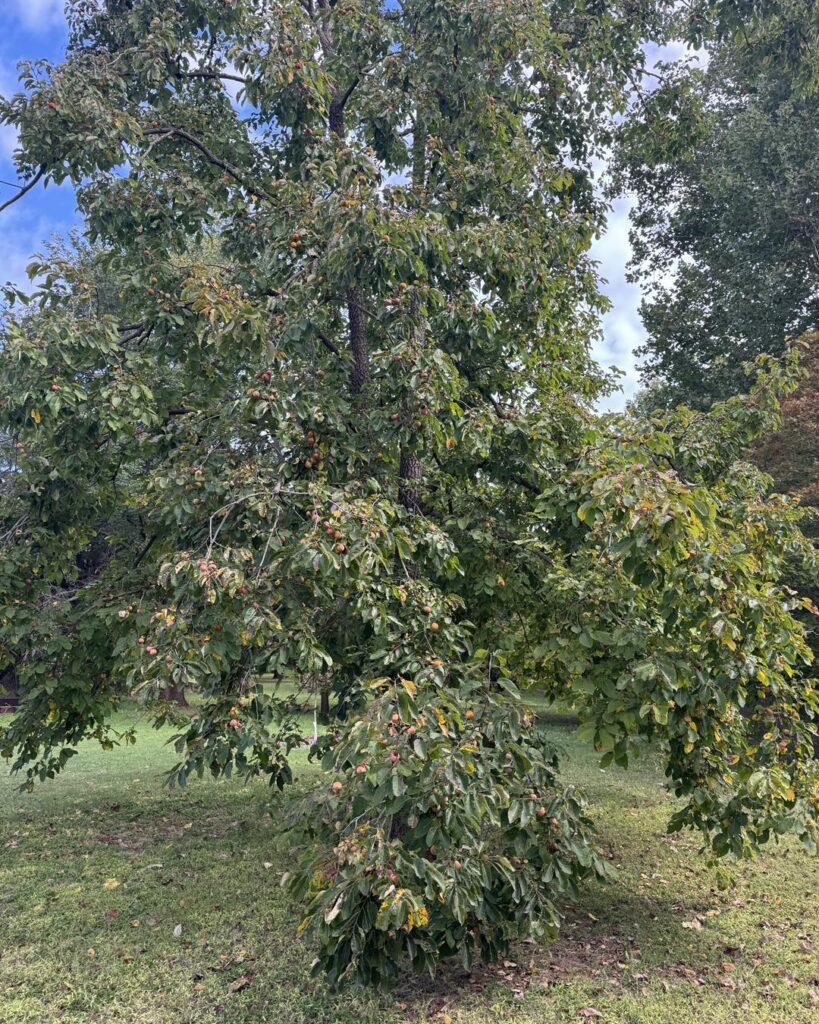
There are two main species of persimmon grown for fruit: the American persimmon (Diospyros virginiana) and the Asian persimmon (D. kaki). Both are impressively drought tolerant, but the American species deserves special mention for its toughness.
The American persimmon has a deep taproot that makes it exceptional at locating subsurface water. It grows wild across the eastern and central United States in poor, dry soils where few fruit trees would survive.
This tree is also cold-hardy well beyond most subtropical fruit trees, tolerating temperatures down to -25°C in some cultivars.
Asian persimmons are somewhat less cold-hardy but still perform remarkably in dry Mediterranean-type climates. Both types produce beautiful autumn color, making them ideal ornamental-edible trees for home landscapes.
- Best climates: Zones 5–10 (American); Zones 7–10 (Asian)
- Annual water need (established): 350–600 mm
- Notable varieties: Meader, Early Golden (American); Hachiya, Fuyu, Izu (Asian)
6. Quince (Cydonia oblonga)
Quince is an ancient fruit — older than the apple in cultivation — and it carries within it a resilience that modern gardeners often overlook. Native to rocky, dry hillsides of southwest Asia and the Caucasus, quince is remarkably well-adapted to poor soils, heat, and irregular rainfall.
It produces one of the most aromatic fruits in the plant kingdom. Though rarely eaten raw (the flesh is hard and astringent until cooked), cooked quince becomes a deep golden paste with a flavor that is floral, tart, and rich — unlike anything else.
Quince trees are compact, self-fertile, and relatively pest-resistant, making them excellent for small gardens in dry climates. They handle clay soils better than almost any other tree fruit, which is a practical advantage in many dry-land gardens where soils are heavy and compacted.
- Best climates: Zones 5–9; Mediterranean and continental semi-arid
- Annual water need (established): 350–600 mm
- Notable varieties: Champion, Pineapple, Smyrna, Serbian Gold
7. Mulberry (Morus alba, M. rubra, M. nigra)
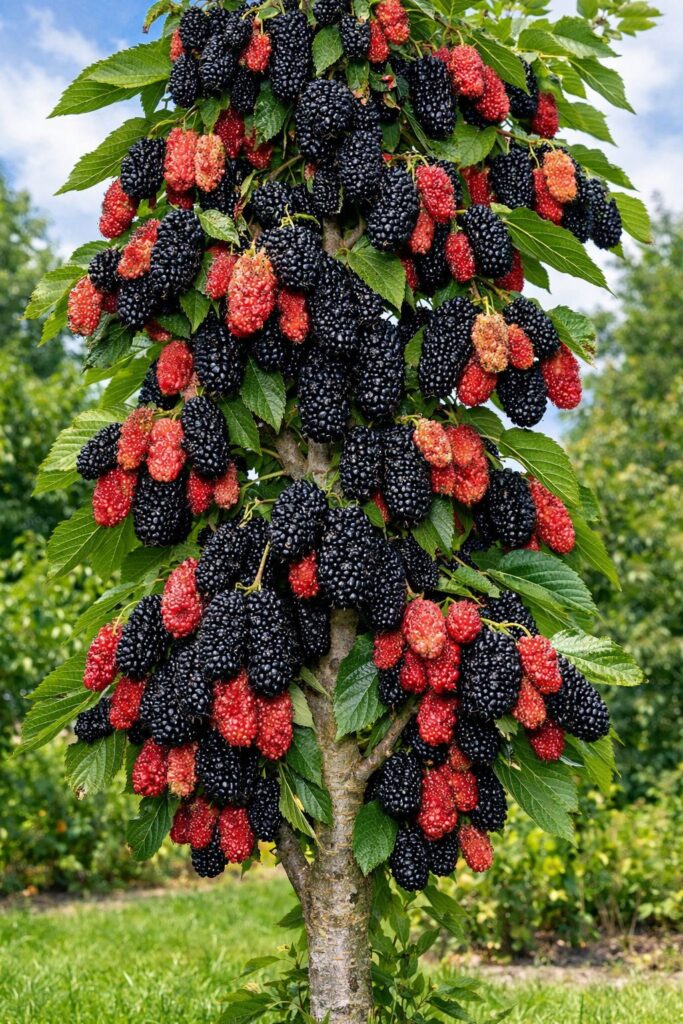
Mulberry trees grow fast, fruit heavily, and ask for very little in return. White mulberry (Morus alba) in particular is one of the most drought-adapted fruit trees available, having been cultivated across the dry interior of Asia for millennia.
The fruit ranges from sweet and mild (white and red varieties) to rich and complex (black mulberry). The trees are vigorous, establishing quickly and often fruiting within two to three years of planting.
In dry climates, mulberries serve a dual purpose: the fruit feeds people and wildlife, while the roots bind soil and reduce erosion. They are frequently used in agroforestry and food forest systems in arid and semi-arid regions because of their adaptability, speed of growth, and generous production.
- Best climates: Zones 5–10 (varies by species)
- Annual water need (established): 300–600 mm
- Notable varieties: Illinois Everbearing, Pakistan, Shangri-La, Black Persian
8. Carob (Ceratonia siliqua)
Carob is a truly exceptional tree for dry climates. Native to the eastern Mediterranean and widely naturalized across North Africa and the Middle East, it is perhaps the closest thing to a “set and forget” fruit tree. Mature carob trees can survive on virtually no irrigation, sustained only by the deep root system that penetrates rocky limestone soils.
The pods — long, dark, and leathery — contain a natural sugar-rich pulp used as a cocoa substitute. Carob flour, syrup, and chips are increasingly available in health food markets. The pods also make excellent livestock fodder.
Carob trees are slow to establish but extraordinarily long-lived. Some specimens in the Mediterranean are believed to be over 500 years old and still producing. For gardeners seeking a long-term investment in a genuinely water-efficient food tree, carob is hard to beat.
- Best climates: Zones 9–11; Mediterranean, semi-arid subtropical
- Annual water need (established): 250–450 mm
- Notable varieties: Santa Fe, Clifford, Tylliria
9. Loquat (Eriobotrya japonica)
Loquat is a small to medium evergreen tree that produces clusters of orange-yellow fruit in late winter or early spring — often when almost nothing else is fruiting. That off-season production makes it enormously valuable in home gardens.
Loquats are surprisingly drought-tolerant once established, performing well in Mediterranean climates, mild subtropical zones, and even coastal areas with dry summers. They prefer well-drained soils and full sun, tolerating periods of minimal rainfall with equanimity.
The fruit is sweet-tart, aromatic, and highly perishable — which is one reason it is rarely seen in commercial supermarkets. Growing your own is practically the only reliable way to enjoy loquats at peak freshness.
The tree is also ornamental, with large, deeply veined, dark green leaves that create an attractive, tropical-looking canopy.
- Best climates: Zones 8–11; Mediterranean, humid subtropical
- Annual water need (established): 400–700 mm
- Notable varieties: Big Jim, Gold Nugget, Mogi, Champagne
10. Date Palm (Phoenix dactylifera)
If there is one tree synonymous with desert fruit production, it is the date palm. Date palms are native to the Arabian Peninsula and North Africa, where temperatures regularly exceed 45°C and annual rainfall may be as low as 25 mm. They have co-evolved with arid conditions for thousands of years.
Dates require specific conditions to produce well: extremely hot, dry summers with very low humidity during the fruit ripening period. In high-humidity climates, the fruit does not ripen properly or tends to ferment on the tree. This specificity is actually useful — it tells you exactly where date palms will excel.
In the right environment (parts of the American Southwest, the Middle East, North Africa, and similar arid zones), a date palm is a nearly self-sufficient food tree once established. A single mature palm can produce 70–150 kg of dates per year.
- Best climates: Zones 9–11; hot arid desert climates
- Annual water need (established): 100–300 mm (with some deep watering in summer)
- Notable varieties: Medjool, Deglet Nour, Barhi, Zahidi
11. Apricot (Prunus armeniaca)
Apricot is the most drought-tolerant tree in the Prunus family — more so than peach, plum, or cherry. Native to the semi-arid regions of Central Asia and China, it evolved in a climate of cold winters and hot, dry summers — conditions it still strongly prefers.
Apricots actually require dry conditions during flowering and fruit set. Wet springs promote fungal diseases like brown rot that can devastate a crop. This makes apricots a particularly smart choice for gardeners in continental semi-arid climates where spring rains are unreliable or minimal.
The challenge with apricots is late frost sensitivity — they flower early and a single frost event can eliminate an entire season’s crop.
In dry-summer, cold-winter climates (like parts of the American interior, Central Asia, and highland East Africa), apricots are among the most reliable and productive orchard trees available.
- Best climates: Zones 5–9; continental semi-arid, Mediterranean
- Annual water need (established): 400–600 mm
- Notable varieties: Moorpark, Goldcot, Tilton, Blenheim, Katy
12. Feijoa / Pineapple Guava (Acca sellowiana)
Feijoa is a South American native that has quietly become one of the most valued edible landscape plants in warm-dry climates worldwide. It is evergreen, wind-resistant, salt-tolerant, and handles drought far better than its lush appearance suggests.
The fruit has a flavor that genuinely defies description — a blend of pineapple, guava, mint, and something floral and unique. The flesh is creamy and aromatic. The flowers are edible too, with a sweet, rose-petal-like taste.
Feijoa bushes or small trees are ideal for hedging, screening, or standalone specimens in gardens where water is limited. They perform well in coastal zones and are one of the few drought-tolerant fruiting plants that also tolerates occasional frost (down to approximately -8°C for established plants).
- Best climates: Zones 8–11; Mediterranean, temperate maritime
- Annual water need (established): 400–700 mm
- Notable varieties: Mammoth, Coolidge, Nikita, Apollo
13. Elderberry (Sambucus nigra and S. canadensis)
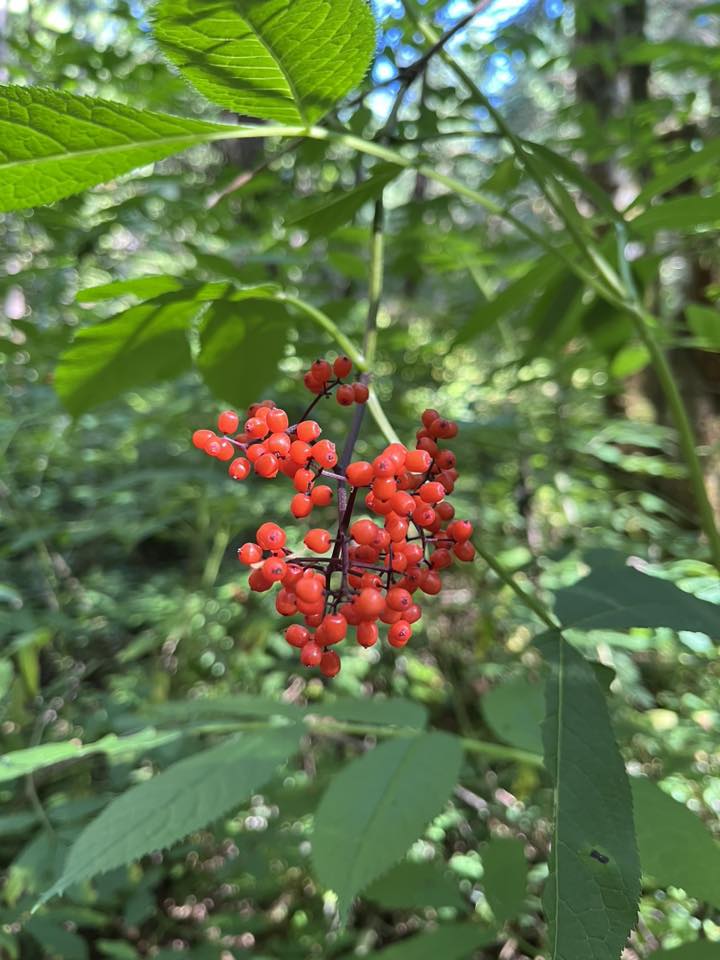
Elderberry might surprise some readers on this list. While it is not as dramatically drought-adapted as olive or fig, elderberry has a naturalistic toughness that allows it to thrive in poor, dry soils with minimal care.
It grows wild across a wide range of North American and European habitats, including disturbed, dry roadsides and hillsides.
Once established, elderberry is low-maintenance, pest-resistant, and productive. The small, dark purple-black berries are rich in antioxidants and flavonoids, and they have attracted substantial scientific attention for their immune-supporting properties.
The flowers — produced in large flat-topped clusters in late spring — can be made into elderflower cordial, one of the most delightful beverages imaginable.
Elderberries establish quickly and begin fruiting within one to two years, making them one of the fastest returns on investment among drought-tolerant food plants.
- Best climates: Zones 3–9; temperate, continental, and cool semi-arid
- Annual water need (established): 400–700 mm
- Notable varieties: Bob Gordon, Nova, Adams, York, Wyldewood
14. Hackberry (Celtis occidentalis and related species)
Hackberry is among the least-known edible trees on this list, yet it deserves far more attention from gardeners in challenging climates.
Native to much of North America, hackberry thrives in the most extreme conditions — from rocky ridges to river floodplains to dry, windswept plains.
The small, reddish-purple berries are sweet, nutritious, and rich in protein, fat, and carbohydrates — an unusual combination for a fruit.
Native American communities valued hackberries highly as a concentrated food source. Modern interest in hackberry has grown in foraging and permaculture communities.
Hackberry trees are virtually indestructible once established. They tolerate alkaline soils, compacted urban soils, drought, flooding, extreme heat, and cold. For gardeners in challenging conditions who struggle to establish any other tree, hackberry is worth serious consideration.
- Best climates: Zones 2–9; continental, semi-arid, temperate
- Annual water need (established): 300–600 mm
15. Prickly Pear Cactus (Opuntiaspp.)
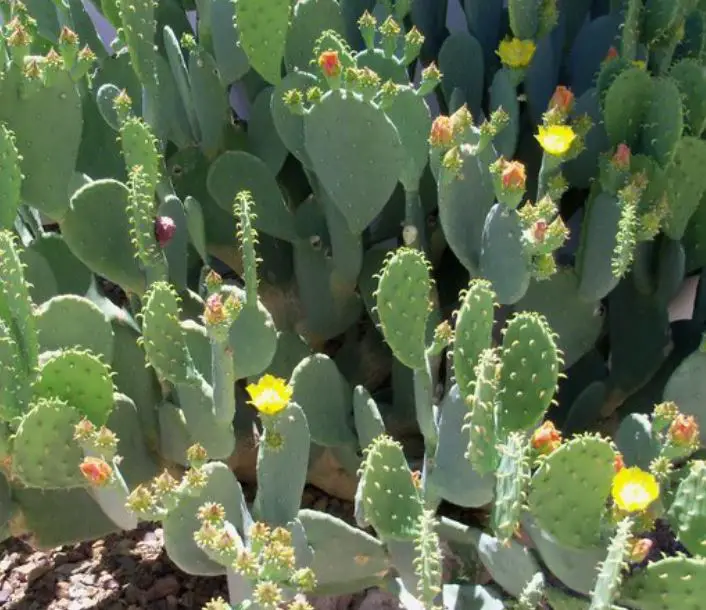
Strictly speaking, prickly pear is a cactus rather than a tree — but it is a woody, perennial, fruit-producing plant that functions exactly like a fruit tree in dry-land gardens, and it would be wrong to exclude it from this list.
No plant on earth produces edible fruit on less water than Opuntia. Native to the Americas, prickly pear has been naturalized across the arid zones of the Mediterranean, Africa, the Middle East, and Australia, where it often thrives with zero supplemental irrigation.
In the Sonoran Desert, it can survive on 150 mm of annual rainfall.
The fruit — called tunas in Spanish-speaking regions — is sweet, refreshing, and rich in Vitamin C and betalain antioxidants. The pads (nopales) are edible vegetables. The plant also supports pollinators and provides habitat for wildlife.
For gardeners in truly arid or desert climates, a well-placed stand of prickly pear can produce fresh fruit every summer with no irrigation whatsoever.
- Best climates: Zones 4–11 (cold-hardy species exist); arid, semi-arid, Mediterranean
- Annual water need (established): 150–300 mm (or even less)
- Notable species: Opuntia ficus-indica, O. engelmannii, O. humifusa
Tips for Establishing Drought-Resistant Fruit Trees
Knowing which trees to plant is only part of the equation. The way you plant and manage them in the early years determines whether they reach their drought-resistant potential.
1. Plant in autumn or early winter. This gives roots time to establish during cooler, moister months before the first dry season arrives. Trees planted in spring often struggle in their first summer.
2. Dig wide, not deep. A wide planting hole encourages lateral root spread. Breaking up compacted soil around the planting zone dramatically improves early establishment.
3. Mulch deeply. A 10–15 cm layer of organic mulch around the root zone — kept away from the trunk — reduces soil evaporation, moderates temperature, and improves soil biology. This single practice can cut irrigation needs by 30–50% during the establishment phase.
4. Water deeply and infrequently. Train roots to go deep by watering thoroughly but rarely. Frequent shallow watering creates shallow root systems that are vulnerable to drought. Deep, infrequent irrigation encourages deep root growth — which is precisely what you want.
5. Avoid over-fertilizing with nitrogen. High nitrogen promotes leafy growth that increases water demand. In dry climates, lean feeding encourages the hardier growth habit that drought-resistant trees naturally adopt.
A Note on Climate Matching
The most important factor in drought-resistant fruit growing is matching the tree to your specific climate. A pomegranate that thrives in Marrakech may struggle in coastal Oregon. A date palm that excels in Phoenix, Arizona will not fruit well in Athens, Greece if the summers are too humid.
Before selecting trees, identify your USDA or Köppen climate zone, your average annual rainfall and its seasonal distribution, your frost risk, and your soil type. With that information, the list above becomes a precise tool rather than a general suggestion.
I would also encourage you to connect with local agricultural extension services, botanical gardens, and experienced growers in your specific region. Local knowledge, accumulated over decades, is often more valuable than any written guide — including this one.
Final Thoughts
There is something deeply satisfying about a fruit tree that asks little but gives much. The trees on this list have evolved — or been selected by thousands of years of human cultivation — to produce in conditions that would stress or kill most modern hybrid varieties.
Drought-resistant fruit trees are not a compromise. Many of the most celebrated foods in the world — Medjool dates, extra-virgin olive oil, sun-dried figs, Persian pomegranate molasses — come from trees that thrive precisely because they are not coddled with water.
Planting these trees is also an act of environmental stewardship. Every liter of water not used in your garden is a liter available to ecosystems, rivers, and future generations.
In a world of growing water scarcity, choosing plants that work with your climate rather than against it is one of the most practical and meaningful things a grower can do.
Start with one or two trees from this list that match your climate, give them a strong establishment season, and watch what happens. In my experience, the results are almost always worth it.
References
- U.S. National Integrated Drought Information System (NIDIS) — U.S. Drought Portal https://www.drought.gov
- USDA PLANTS Database — Plant Profile and Ecological Range Data https://plants.usda.gov
- USDA Natural Resources Conservation Service (NRCS) — Plant Materials Program https://www.nrcs.usda.gov/plant-materials
- University of California Agriculture and Natural Resources (UC ANR) — Home Orchard: Growing Your Own Deciduous Fruit and Nut Trees. https://ucanr.edu
- University of Arizona Cooperative Extension — Fruit Trees in the Low Desert https://extension.arizona.edu
- Colorado State University Extension — Water-Wise Landscaping and Xeriscaping Principles https://extension.colostate.edu
- University of Florida IFAS Extension — Fruit Crops https://ifas.ufl.edu

Tim M Dave is a gardening expert with a passion for houseplants, particularly cacti and succulents. With a degree in plant biology from the University of California, Berkeley, he has vast experience in gardening. Over the years, he has cultivated a vast collection of desert plants and learned a great deal about how to grow and care for these unique companions.