25 Flowers That Look Like Sunflowers (Identification, With Pictures)
Sunflowers have a look that is hard to forget. Big golden petals, a dark center, and a face that seems to follow the sun across the sky. But here is something that surprised me when I first started gardening: plenty of flowers copy that exact look without being sunflowers at all.
Most of these look-alikes belong to the same giant plant family as the true sunflower, called Asteraceae. According to University of Illinois Extension, this family includes more than 32,000 known species of flowering plants, which is why the sunflower shape keeps showing up again and again in completely different genera.
The true sunflower genus, Helianthus, itself contains around 70 native North American species, as noted by NC State Extension. But beyond Helianthus, dozens of unrelated plants have evolved that same bold, daisy-like flower head with a golden or brown center.
In this guide, I have pulled together 25 flowers that look like sunflowers, with real names, growing details, and the small features that help you tell each one apart. Let’s dig in.
1. Black-Eyed Susan

Black-eyed Susan (Rudbeckia hirta) is probably the closest sunflower look-alike most people see in everyday life. It has golden-yellow petals wrapped around a dark brown, dome-shaped center, and it grows almost everywhere in North America.
According to USDA plant guide records, this species typically reaches one to three feet tall and blooms from summer into early fall. It is a native wildflower, often grown as an annual or short-lived perennial, and it self-seeds easily once established in a garden bed.
The main difference from a true sunflower is scale. Black-eyed Susan flowers rarely exceed three inches wide, much smaller than a cultivated sunflower head, and the plant itself stays far shorter and bushier overall.
2. False Sunflower
False sunflower (Heliopsis helianthoides) earns its name honestly. Its bright yellow petals and slightly raised center make it almost indistinguishable from a small sunflower at first glance.
This native perennial grows three to five feet tall and blooms from early summer through fall, according to native plant records used by university extension programs. It tolerates a wide range of soils and handles both drought and occasional wet spells without much trouble.
What sets it apart is the branching habit. Where a sunflower typically produces one dominant bloom per stem, false sunflower produces multiple smaller flowers on branching stems, giving the whole plant a bushier, more floriferous look.
3. Brown-Eyed Susan
Brown-eyed Susan (Rudbeckia triloba) looks like a smaller, more delicate cousin of the classic black-eyed Susan. Its flowers are only about one to two inches wide, but a single plant can produce hundreds of them at once.
This biennial or short-lived perennial grows two to five feet tall and blooms from midsummer into fall. It prefers full sun to partial shade and adapts well to average garden soil, making it a forgiving choice for less experienced gardeners.
I find the sheer flower count on this plant remarkable. Where most sunflower look-alikes produce a handful of blooms, brown-eyed Susan can cover itself in so many small flowers that the whole plant appears to glow yellow from a distance.
ALSO READ: 35 Flowers That Look Like Daisies (And How to Tell Them Apart)
4. Giant Coneflower
The giant coneflower (Rudbeckia maxima) takes the sunflower shape and stretches it to dramatic heights. This native perennial can grow five to seven feet tall, with large, paddle-shaped blue-green leaves at the base.
Its flowers have drooping yellow petals around a tall, cylindrical brown-black center cone, which can rise noticeably above the petals themselves. It blooms in summer and thrives in moist, well-drained soil under full sun.
The elongated cone is the real giveaway here. Rather than a flat or slightly domed center like most sunflower relatives, this plant’s cone stands up almost like a small tower, making it one of the most architectural flowers on this entire list.
5. Orange Coneflower
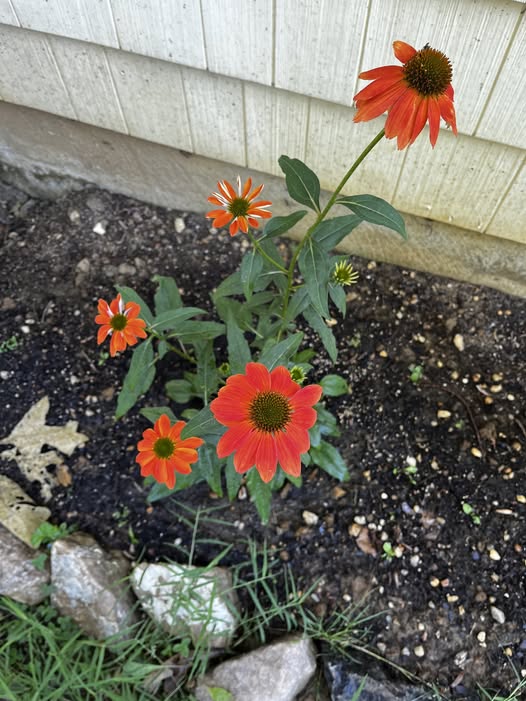
Orange coneflower (Rudbeckia fulgida), sometimes sold under the popular cultivar name ‘Goldsturm,’ produces vivid golden-orange petals around a dark, glossy center. According to NC State Extension, this plant belongs to the daisy family and spreads by underground rhizomes to form dense clumps.
It typically grows two to three feet tall and blooms from midsummer through fall, tolerating heat and humidity impressively well. It has become one of the most widely planted native perennials in American gardens over the past few decades.
Its reliability is what makes it so popular. Unlike some short-lived Rudbeckia species, this one comes back year after year, spreading gradually to fill garden beds with consistent color every single summer.
6. Mexican Sunflower
Mexican sunflower (Tithonia rotundifolia) has bold, velvety orange-red petals that practically glow in the garden. Despite the name, it belongs to a completely different genus than true sunflowers.
This fast-growing annual can reach four to six feet tall in a single season, with large, slightly fuzzy leaves and thick, sturdy stems. It thrives in hot, dry conditions and blooms nonstop from summer until the first frost.
Butterflies, especially monarchs, seem to love this flower more than almost anything else in my garden. If you are trying to attract pollinators during late summer migration season, Mexican sunflower is one of the most effective choices you can plant.
7. Blanket Flower
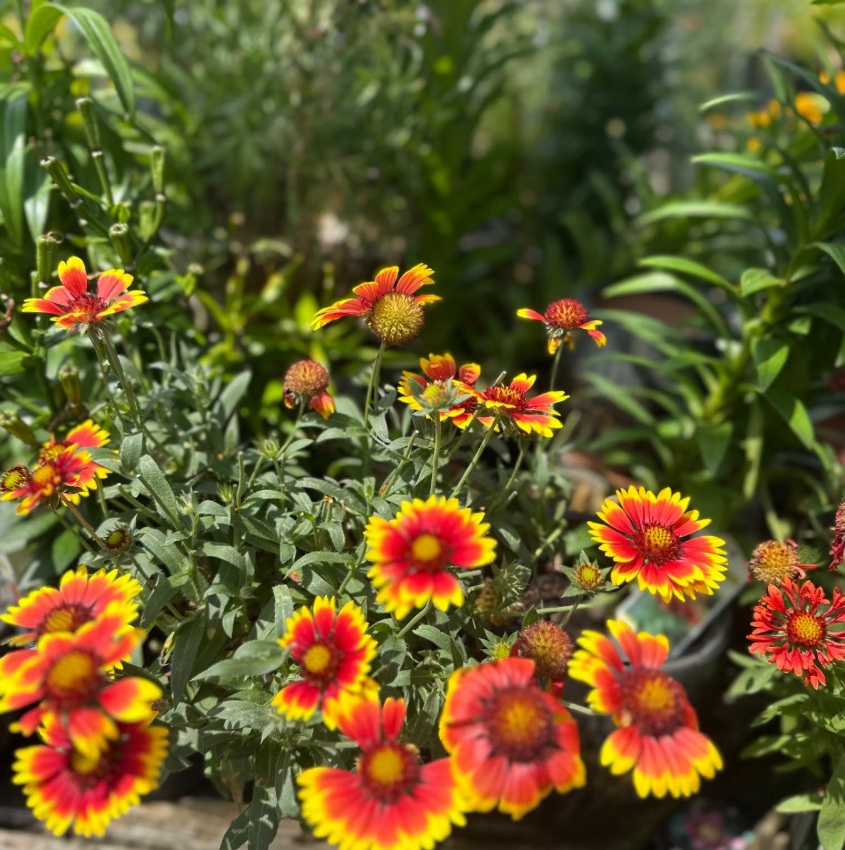
Blanket flower (Gaillardia pulchella and Gaillardia aristata) blends red, orange, and yellow into a single bloom, creating a warm, layered effect that resembles a small sunset. The center disc is often reddish-brown rather than pure yellow.
This perennial or annual grows one to two feet tall and is native to prairies across North America. It handles heat, drought, and poor soil extremely well, which makes it a favorite for low-maintenance and xeriscape gardens.
The two-toned petals are the clearest identifying feature. While true sunflowers stick to solid yellow, blanket flower blends multiple warm shades into every single petal, creating a striped or gradient look that stands out immediately.
8. Prairie Coneflower (Mexican Hat)
Prairie coneflower (Ratibida columnifera), commonly called Mexican hat, has an unmistakable shape. Its petals droop sharply downward from an unusually tall, cylindrical brown center, resembling a small sombrero.
This native perennial grows one to three feet tall, according to Oklahoma State University Extension, and blooms from June through November across much of the Great Plains. It tolerates poor, dry soil and full sun exceptionally well.
The elongated cone and drooping petals make this one nearly impossible to confuse with a true sunflower. It looks more like a coneflower crossed with a sunflower, which is exactly how many gardeners describe it at first sight.
ALSO READ: 25 Flowers That Look Like Bells (Details, With Pictures)
9. Cup Plant
Cup plant (Silphium perfoliatum) is a towering native perennial that produces sunflower-like blooms atop leaves that literally form a cup around the stem. That cup can hold rainwater, which birds and insects often drink from.
According to Ohio State University’s plant records, this species grows four to eight feet tall and produces three to four inch yellow flowers from July through September. It prefers moist, rich soil and full sun.
Michigan State University Extension notes that goldfinches are especially drawn to this plant, both for its seeds and the water pooled in its leaves. I think that detail alone makes cup plant worth growing, even before considering how striking its flowers look.
10. Compass Plant

Compass plant (Silphium laciniatum) is a close relative of cup plant, but its deeply cut, fern-like leaves are the real showstopper here. The sunflower-like blooms sit atop stems that can reach six to ten feet tall.
This native prairie perennial blooms in mid to late summer and prefers deep, well-drained soil, since it develops an exceptionally long taproot over time. It can take a few years to establish before flowering heavily.
Its name comes from an old belief that the leaves orient themselves north-south to reduce sun exposure at midday. Whether or not that is perfectly accurate, it remains one of the most fascinating tallgrass prairie natives in North America.
11. Sneezeweed
Sneezeweed (Helenium autumnale) has slightly drooping, notched petals in shades of yellow, orange, and copper, wrapped around a round, ball-like center. Despite the unfortunate name, it does not actually cause sneezing.
This native perennial grows three to five feet tall and blooms from late summer into fall, making it a valuable late-season nectar source for bees and butterflies. It prefers consistently moist soil and full sun.
The rounded, almost spherical center is what separates it from a true sunflower’s flatter disc. Once you notice that ball-shaped center, sneezeweed becomes very easy to identify, even from a distance.
12. Plains Coreopsis
Plains coreopsis (Coreopsis tinctoria) is a fast-growing annual wildflower with bright yellow petals, each marked with a distinctive reddish-brown blotch near the base. The center disc is typically dark red or brown.
This plant grows one to three feet tall and blooms heavily from summer through early fall, often reseeding itself generously in the same spot year after year. It thrives in poor soil and needs very little care once established.
The bicolor petals are the giveaway here. A true sunflower rarely shows this kind of sharp color contrast within a single petal, which makes plains coreopsis easy to spot in a mixed wildflower meadow.
13. Lanceleaf Coreopsis
Lanceleaf coreopsis (Coreopsis lanceolata) produces solid golden-yellow flowers on long, slender stems, with narrow, lance-shaped leaves at the base. Each bloom typically measures one to two inches wide.
This native perennial grows one to two feet tall and blooms from late spring through midsummer. It tolerates poor, sandy, or rocky soil extremely well and is often used in native wildflower meadows and pollinator gardens.
Compared to a sunflower, this plant is far more delicate in scale. The thin stems and smaller flower size give it a light, airy feel, quite different from the bold, heavy-headed look of true sunflowers.
14. Golden Marguerite
Golden marguerite (Anthemis tinctoria) produces solid yellow blooms, both petals and center, giving it an unusually uniform golden appearance. Its foliage is finely divided and almost fern-like in texture.
This perennial grows one to three feet tall and blooms heavily from early summer through fall, especially with regular deadheading. It tolerates poor, dry soil and is commonly used in cottage gardens and wildflower borders.
Historically, this plant was cultivated for a yellow dye extracted from its flowers, which explains the species name “tinctoria.” That small historical detail always makes me look at this humble little plant a bit differently.
15. Leopard’s Bane
Leopard’s bane (Doronicum orientale) is one of the earliest sunflower-shaped blooms to appear each year, often flowering before many other perennials have even emerged from winter dormancy. Its petals and center are both a matching bright yellow.
This plant grows one to two feet tall and prefers cooler conditions, often struggling or going dormant during peak summer heat. It does best in partial shade with consistently moist, well-drained soil.
Its early bloom time is what makes it special. While true sunflowers wait for the height of summer, leopard’s bane delivers that same sunny look weeks or even months earlier in the season.
16. Gazania
Gazania, often called treasure flower, produces bold, sunflower-like blooms in shades of yellow, orange, and bronze, frequently with dark rings or stripes near the center. It is native to South Africa.
This low-growing perennial, usually treated as an annual in cooler climates, reaches only six to twelve inches tall. It closes its petals at night and on cloudy days, opening fully only in direct sunlight.
The striking center markings are the easiest way to identify gazania. Where sunflowers keep their centers relatively plain, gazania often displays bold rings or spots that make each flower look almost hand-painted.
ALSO READ: 25 Flowers That Look Like Birds (With Details Explained)
17. Calendula (Pot Marigold)
Calendula (Calendula officinalis), commonly called pot marigold, produces cheerful golden-orange blooms that closely mimic a small sunflower. It has been cultivated for centuries, both as an ornamental and a medicinal herb.
This hardy annual grows one to two feet tall and blooms from spring through fall in cooler climates, often continuing well into late autumn. It tolerates light frost better than most flowers on this list.
Calendula petals are edible and have long been used in skin salves and herbal remedies. I always find it satisfying growing a flower that looks this cheerful while also serving a practical purpose in the garden.
18. African Marigold
African marigold (Tagetes erecta) produces large, dense, sunflower-colored blooms, though the petal structure is more layered and rounded than a true sunflower’s flat face. Flowers can reach three to four inches wide.
This annual grows one to three feet tall and blooms from summer until frost, tolerating heat exceptionally well. It is widely used in vegetable gardens as a companion plant, believed to help deter certain pests.
The dense, ruffled petal arrangement is the clearest difference from a sunflower. Where a sunflower has a flat ring of petals around an open center, African marigold petals stack tightly, hiding the center disc almost entirely.
19. Yellow Cosmos
Yellow cosmos (Cosmos sulphureus) has bright orange-yellow petals and delicate, feathery foliage, giving it a lighter and airier look than a true sunflower. Flowers typically measure one and a half to two inches wide.
This annual grows two to four feet tall and blooms from summer through the first frost, thriving in poor soil and full sun. It tends to produce fewer flowers if the soil is too rich or over-fertilized.
Its fine, thread-like leaves are the biggest visual difference from a sunflower’s broad, coarse foliage. From a distance, yellow cosmos almost looks like a sunflower photographed through a soft-focus lens.
20. Green and Gold
Green and gold (Chrysogonum virginianum) is a low, ground-hugging native perennial with small, star-shaped yellow flowers. Each bloom rarely exceeds one inch wide, making it one of the smallest plants on this list.
It grows only six to twelve inches tall and spreads slowly to form a dense mat, making it an excellent groundcover for shaded or partially shaded areas. It blooms from spring through early summer, with occasional repeat flowering in fall.
Its small size and shade tolerance separate it sharply from sun-loving sunflowers. This is a plant for the woodland edge rather than the open meadow, offering that same golden color in a completely different garden setting.
ALSO READ: 25 Different Types of Sunflowers: Tall, Dwarf and Other Major Varieties
21. Golden Crownbeard
Golden crownbeard (Verbesina encelioides), also called cowpen daisy, produces bright yellow, slightly ragged-looking petals around a golden center. It has a somewhat weedy, rough texture to its leaves and stems.
This fast-growing annual can reach one to three feet tall and thrives in disturbed soil, roadsides, and dry open areas across much of North America. It blooms from summer into fall and tolerates heat and drought with ease.
Farmers and ranchers sometimes consider it a weed, since it can spread aggressively in overgrazed pastures. Even so, its bright, cheerful flowers and long bloom season make it a genuine pollinator magnet wherever it grows.
22. Arrowleaf Balsamroot
Arrowleaf balsamroot (Balsamorhiza sagittata) is one of the most iconic wildflowers of the American West, often carpeting entire hillsides in gold each spring. Its large, arrow-shaped leaves are almost as recognizable as the flowers themselves.
This native perennial grows one to two feet tall and develops an extremely deep taproot, sometimes reaching several feet underground, which allows it to survive harsh, dry conditions. It blooms in April and May before summer drought sets in.
I have seen photographs of entire mountainsides turned gold by this plant, and it is genuinely breathtaking. Unlike garden sunflowers, this one blooms early and briefly, timing its entire life cycle around the short window of spring moisture.
23. Brittlebush
Brittlebush (Encelia farinosa) is a woody desert shrub native to the southwestern United States and Mexico. Its silvery-gray leaves contrast beautifully against bright yellow, daisy-like flowers held on long, bare stalks.
This drought-tolerant perennial grows two to five feet tall and blooms heavily from late winter through spring, especially after seasonal rains. It thrives in rocky, well-drained desert soil and needs almost no supplemental water once established.
Its silvery foliage is the clearest way to tell it apart from anything else on this list. Combined with its shrubby, woody growth habit, brittlebush looks more like a small desert bush than a typical soft-stemmed sunflower relative.
24. Curlycup Gumweed
Curlycup gumweed (Grindelia squarrosa) gets its unusual name from the sticky, resinous substance found on its flower buds before they open. The blooms themselves are bright yellow with narrow, slightly ragged petals.
This biennial or short-lived perennial grows one to two feet tall and tolerates poor, alkaline, and disturbed soils better than almost any other plant on this list. It blooms from midsummer through fall across much of central North America.
The sticky buds are the easiest identifying feature. Touch an unopened flower bud, and you will immediately notice the resinous coating, something no true sunflower or most other look-alikes on this list share.
25. Tickseed Sunflower
Tickseed sunflower (Bidens aristosa) produces abundant golden-yellow flowers in dense clusters, often covering wetland edges and ditches in solid sheets of color during late summer. Individual blooms measure about one to two inches wide.
This native annual or short-lived perennial grows two to five feet tall and thrives in consistently moist to wet soil, unlike most sunflower relatives that prefer drier conditions. It blooms from late summer into October.
Its preference for wet ground is the main distinguishing factor. While true sunflowers generally avoid soggy soil, tickseed sunflower actively seeks it out, making it a valuable native option for rain gardens and pond edges.
Quick Comparison: Spotting the Differences
With 25 flowers covered, a few quick checks make identification much easier.
Look at the center shape first. A tall, cylindrical cone almost always points to Ratibida or Rudbeckia maxima, while a flat or slightly domed center suggests Helianthus or Heliopsis.
Check the leaf texture. Coarse, sandpapery leaves are typical of true sunflowers and Silphium species, while feathery, finely divided foliage points toward cosmos or golden marguerite.
Consider the habitat. Plants thriving in wet soil, like tickseed sunflower, behave very differently from drought-loving species like brittlebush or balsamroot.
Final Thoughts
Putting this list together made me appreciate just how far a single flower shape can travel across the plant kingdom. From desert shrubs to prairie giants to tiny woodland groundcovers, 25 completely different plants have all landed on that same cheerful, golden sunflower look.
Whether you are planning a pollinator garden, exploring a native prairie, or simply trying to name a flower you spotted on a hike, I hope this guide makes the sunflower family feel a little more familiar and a lot more interesting.
References
- Oklahoma State University Extension – Annual Sunflower Plant Profile
https://extension.okstate.edu/programs/plant-id/plant-profiles/annual-sunflower - University of Illinois Extension – Sunflowers: Beloved Blooms, Secret Talents
https://extension.illinois.edu/sites/default/files/2023-05/vol_23_the_outsider_may_2023_lr.pdf - NC State Extension – Helianthus (Sunflower) Genus Profile
https://plants.ces.ncsu.edu/plants/helianthus/ - University of Arizona, Yavapai County Extension – Ratibida columnifera Plant Profile
https://yavapaiplants.extension.arizona.edu/ratibida-columnifera - The Ohio State University – Silphium perfoliatum (Cup Plant) Plant Profile
https://u.osu.edu/plants/silphium-perfoliatum - Michigan State University Extension – Cup Plant Native Plant Facts
https://www.canr.msu.edu/nativeplants/plant_facts/cup_plant - U.S. National Park Service – Silphium perfoliatum Species Profile (Cowpens National Battlefield)
https://irma.nps.gov/NPSpecies/Species/Profile/43584

Tim M Dave is a gardening expert with a passion for houseplants, particularly cacti and succulents. With a degree in plant biology from the University of California, Berkeley, he has vast experience in gardening. Over the years, he has cultivated a vast collection of desert plants and learned a great deal about how to grow and care for these unique companions.