35 Colorado Native Flowers (With Growing Details)
Colorado’s landscape shifts dramatically within just a few hours of driving, from dry eastern plains to alpine tundra above 12,000 feet. That range gives the state one of the most varied native flower collections in the country.
The Colorado Native Plant Society estimates the state holds more than 2,600 native plant species, shaped by elevation changes that few other states can match.
I have hiked from prairie to timberline in a single weekend, and the flower change along the way still amazes me every time. Few states offer that kind of variety in one trip.
This guide covers 35 native flowers worth knowing, whether you want to identify them on a trail or grow them at home. Each one is adapted to Colorado’s dry air, intense sun, and wide temperature swings.
The 35 Native Flowers of Colorado
1. Rocky Mountain Columbine (Aquilegia caerulea)
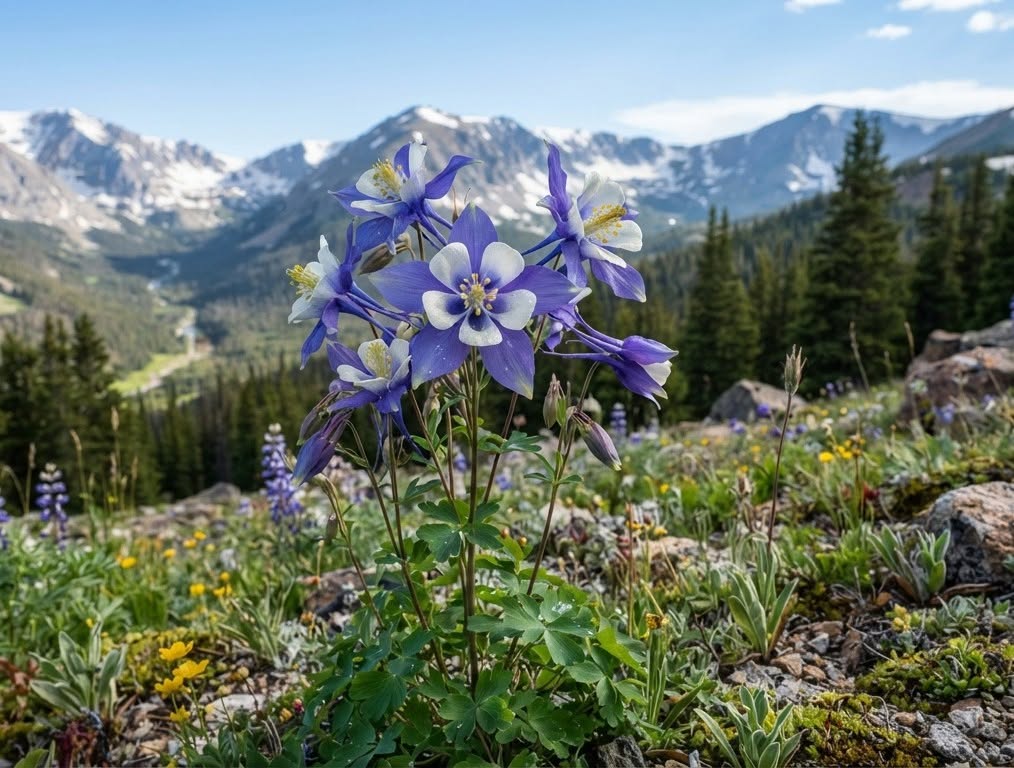
This is Colorado’s official state flower, adopted in 1899. Its blue and white blooms appear from June through August in montane meadows and forest edges.
Picking or uprooting it on public land is actually restricted under state regulation, since overharvesting once threatened wild populations.
It grows best in part shade with moist, well-drained soil, and it self-seeds readily once established in a garden.
2. Indian Paintbrush (Castilleja miniata)
Indian Paintbrush produces brilliant red-orange bracts, often mistaken for petals, blooming from June to August across meadows and open slopes.
It is a partial parasite, drawing some nutrients from nearby grass roots, which makes it notoriously tricky to transplant successfully.
Full sun and well-drained soil suit it best, ideally planted alongside native grasses it can partner with.
3. Fireweed (Chamaenerion angustifolium)
Fireweed sends up tall pink-purple flower spikes from July to September, often covering entire hillsides after wildfires clear the ground.
I once watched a burned slope turn almost entirely pink within two summers, which is exactly how this plant earned its name.
It tolerates disturbed soil well and spreads quickly by both seed and underground rhizomes.
4. Blanket Flower (Gaillardia aristata)
Blanket Flower produces warm red-and-yellow daisy-like blooms from June through September, thriving across dry plains and foothills.
Butterflies and native bees visit it steadily through its long bloom season, making it a dependable pollinator plant.
It tolerates poor, rocky soil and drought exceptionally well, needing almost no supplemental water once rooted.
5. Rocky Mountain Penstemon (Penstemon strictus)
This penstemon produces deep blue-purple tubular flowers from May to July, common across foothill and montane slopes.
Bumblebees favor it heavily, since the flower’s shape and depth suit their body size almost perfectly.
Full sun and sharp drainage are essential, since soggy soil quickly causes root rot in this species.
ALSO READ: 20 Colorado Native Shrubs (With Growing Details)
6. Scarlet Gilia (Ipomopsis aggregata)
Also called Skyrocket, this flower produces bright red, trumpet-shaped blooms from June to August, drawing hummingbirds directly.
It has a curious two-year cycle, forming only leaves in its first year before sending up its flower stalk the second year.
Dry, rocky soil and full sun mimic its natural foothill habitat best.
7. Pasque Flower (Pulsatilla patens)
Pasque Flower is one of the earliest bloomers in Colorado, opening pale lavender petals sometimes while snow still lingers nearby, in April and May.
Its feathery seed heads that follow are almost as striking as the flower itself, catching light like small silver plumes.
It prefers well-drained, gravelly soil and full sun on open slopes and meadows.
8. Prairie Smoke (Geum triflorum)
Prairie Smoke produces nodding, dusty pink flowers in May and June, followed by wispy, smoke-like seed plumes that give the plant its name.
The seed heads persist for weeks, adding texture to a garden bed long after the bloom itself fades.
It tolerates dry, poor soil and full sun, common across Colorado’s shortgrass prairie regions.
9. Colorado Four O’Clock (Mirabilis multiflora)
This sprawling plant produces trumpet-shaped magenta flowers that open in late afternoon, blooming from June through September.
Hawkmoths pollinate it after dusk, timing their activity to match the flower’s evening opening exactly.
It tolerates extreme heat and drought, thriving in sandy or rocky soil across the state’s lower elevations.
10. Sulphur Flower Buckwheat (Eriogonum umbellatum)
Sulphur Flower produces flat clusters of pale yellow blooms from June to August, often turning rusty orange as they age.
It serves as a host plant for several native butterfly species, including certain blues and coppers found at higher elevations.
Rocky, well-drained soil and full sun suit it perfectly, making it ideal for xeriscaped gardens.
11. Blue Flax (Linum lewisii)
Blue Flax produces delicate, sky-blue flowers from May to August, each lasting only a single day before dropping.
Despite the short individual bloom life, plants produce new flowers continuously, giving a near-constant blue haze across a meadow.
It tolerates poor, dry soil and full sun, requiring very little maintenance once established.
12. Fringed Gentian (Gentianopsis thermalis)
Fringed Gentian produces deep blue, fringed-petal flowers in August and September, among the last wildflowers to bloom before frost.
Finding one on a high mountain trail always feels like a small reward, since the bloom window is short and easy to miss.
Moist soil near streams or wet meadows at higher elevations suits it best.
13. Alpine Forget-Me-Not (Eritrichium nanum)
This tiny alpine flower forms dense cushions of sky-blue blooms in July and August, growing above 11,000 feet in rocky tundra.
It survives brutal wind and cold by hugging the ground tightly, rarely rising more than an inch or two in height.
It needs extremely well-drained, rocky soil and cannot tolerate typical garden conditions at lower elevations.
14. Mountain Bluebells (Mertensia ciliata)
Mountain Bluebells produce clusters of nodding blue, bell-shaped flowers from June to August, usually along mountain streams.
They often grow in dense colonies, turning entire creek banks blue during peak bloom in midsummer.
Moist, rich soil near water sources suits them best, along with partial shade.
ALSO READ: 25 Colorado Native Trees (With Growing Details)
15. Woods’ Rose (Rosa woodsii)
This native shrub rose produces simple pink, five-petaled flowers from June to July, followed by bright red hips through fall and winter.
Birds rely on those hips as a food source well into the cold months, when other options grow scarce.
It tolerates a wide range of soils and works well as a natural hedge or border planting.
16. Harebell (Campanula rotundifolia)
Harebell produces delicate, nodding blue-purple bell flowers from June through September, found from foothills up to alpine zones.
Its thin stems sway constantly in mountain breezes, which is likely where its common name originated.
It tolerates rocky, well-drained soil and light shade, making it adaptable across elevations.
17. Golden Banner (Thermopsis montana)
Golden Banner produces bright yellow, pea-like flower spikes from May to July, often carpeting entire mountain meadows.
It fixes nitrogen in the soil as it grows, quietly improving conditions for neighboring plants over time.
Full sun and average, well-drained soil suit it well, and it tolerates cooler mountain climates easily.
18. Gunnison’s Mariposa Lily (Calochortus gunnisonii)
This lily produces striking white to lavender flowers with purple markings, blooming from June to August across montane meadows.
Each bloom looks almost hand-painted, with delicate purple banding near the base of each petal.
Well-drained, rocky soil and full sun mimic its natural mountain habitat closely.
19. Rocky Mountain Iris (Iris missouriensis)
This wild iris produces pale blue-lavender flowers from May to July, growing naturally in wet mountain meadows and streambanks.
It spreads slowly by rhizomes, forming dense colonies over several seasons in the right conditions.
Consistently moist soil and full sun to part shade give the best bloom results.
20. Elephant’s Head (Pedicularis groenlandica)
This unusual wildflower produces tiny pink blooms shaped remarkably like an elephant’s head, complete with a curved trunk, blooming from June to August.
It grows in wet subalpine meadows, often alongside other moisture-loving alpine species.
Consistently damp soil near streams or seeps is essential for this species to establish.
21. Parry’s Primrose (Primula parryi)
Parry’s Primrose produces vivid magenta flowers from July to August, usually found near alpine streams and wet rock ledges.
The flower carries a notably unpleasant odor up close, which is a strange contrast to its striking color.
Consistently moist, cool soil at high elevation is required, making it a poor fit for typical home gardens.
22. King’s Crown (Rhodiola integrifolia)
King’s Crown produces dense clusters of deep red-purple flowers from July to August, found on rocky alpine slopes above treeline.
Its thick, succulent leaves help it store water through the short, harsh alpine growing season.
Rocky, well-drained soil at elevation suits it best, and it rarely survives outside true alpine conditions.
23. Queen’s Crown (Rhodiola rhodantha)
Closely related to King’s Crown, this species produces pale pink to white flower clusters, blooming from July to August in similar alpine terrain.
The two species often grow within feet of each other, creating a striking color contrast on the same rocky slope.
It needs the same rocky, well-drained, high-elevation conditions as its red-flowered relative.
24. Purple Locoweed (Oxytropis lambertii)
Purple Locoweed produces spikes of vivid purple-pink flowers from May to July, common across dry plains and foothills.
Despite its striking appearance, ranchers watch it closely, since it can poison livestock that graze on it in large quantities.
It tolerates poor, dry soil and full sun, thriving in conditions many other flowers cannot handle.
ALSO READ: 35 Trees That Grow Well in Clay Soil (With Planting Details)
25. Rocky Mountain Bee Plant (Cleome serrulata)
This tall annual produces pink-purple flower clusters from June to September, historically used by Indigenous communities for food and dye.
True to its name, bees visit it in impressive numbers, making it a strong choice near vegetable gardens needing pollination.
It tolerates disturbed, dry soil and full sun, often appearing along roadsides and old fields.
26. Showy Milkweed (Asclepias speciosa)
Showy Milkweed produces rounded clusters of soft pink, star-shaped flowers from June to August, serving as a key monarch host plant.
Monarch populations passing through Colorado depend on milkweed like this one for successful reproduction each summer.
It tolerates dry to average soil and full sun, spreading gradually by underground rhizomes.
27. Prairie Coneflower (Ratibida columnifera)
This flower produces drooping yellow petals around a tall, cone-shaped brown center, blooming from June to September.
It is remarkably drought-tolerant, often thriving in roadside conditions that would kill most ornamental plants quickly.
Full sun and poor, dry soil suit it perfectly, requiring almost no maintenance once established.
28. Aspen Daisy (Erigeron speciosus)
Aspen Daisy produces lavender-blue, daisy-like flowers from June to August, commonly found in aspen groves and montane meadows.
Its cheerful color against white aspen bark makes it one of the more photographed wildflowers in Colorado’s high country.
Part shade and moist, well-drained soil suit it best, mimicking its natural forest-edge habitat.
29. Silvery Lupine (Lupinus argenteus)
Silvery Lupine produces tall spikes of blue-purple, pea-like flowers from June to August, named for its soft, silvery-green foliage.
It fixes nitrogen in the soil, gradually improving conditions for surrounding plants over several growing seasons.
Well-drained soil and full sun suit it well, and it tolerates Colorado’s intense high-altitude sunlight easily.
30. Western Yarrow (Achillea millefolium var. lanulosa)
Western Yarrow produces flat clusters of small white flowers from June through September, found across nearly every elevation in the state.
It has a long history of medicinal use among Indigenous communities, valued for its astringent, healing properties.
It tolerates poor soil, drought, and heavy foot traffic, making it one of the toughest natives on this list.
31. Western Wallflower (Erysimum capitatum)
Western Wallflower produces bright orange-yellow flower clusters from May to July, often found on dry, rocky slopes and roadcuts.
Its fragrance carries a light, sweet scent that becomes noticeable on warm afternoons near a blooming patch.
It tolerates poor, rocky soil and full sun, needing very little water once established.
32. Shooting Star (Dodecatheon pulchellum)
Shooting Star produces distinctive pink flowers with petals swept sharply backward, blooming from May to July in moist meadows.
The unusual shape makes it instantly recognizable, even to hikers with little wildflower identification experience.
Moist, rich soil in part shade suits it best, often found near seasonal snowmelt streams.
ALSO READ: 20 Evergreen Trees That Grow in Shade (With Growing Details)
33. Nuttall’s Larkspur (Delphinium nuttallianum)
This early bloomer produces deep blue-purple flower spikes from April to June, common across foothill slopes and open woodlands.
It is toxic to livestock in large quantities, a fact ranchers across the state monitor closely each spring.
Well-drained soil and full to part sun suit it best, and it goes dormant again by midsummer.
34. Scarlet Globemallow (Sphaeralcea coccinea)
Scarlet Globemallow produces small, apricot-orange flowers from May to August, thriving across dry prairie and foothill terrain.
It survives grazing and drought better than most native wildflowers, often persisting where other plants fail entirely.
Full sun and poor, dry soil suit it perfectly, requiring virtually no care once rooted.
35. Alpine Sunflower (Tetraneuris grandiflora)
This list closes fittingly with Alpine Sunflower, which produces large yellow blooms above 11,000 feet, flowering from July to August.
Remarkably, plants often take several years to bloom just once, then die shortly after setting seed, a phenomenon botanists still study closely.
It requires rocky, well-drained alpine soil and cannot survive typical lower-elevation garden conditions.
Why Native Flowers Matter in Colorado
Growing native is not just a trend here. It is practical, given the state’s climate extremes.
According to the Xerces Society, native plants support up to 4 times more pollinator species than imported ornamentals. In a state with such short growing seasons at altitude, that support matters even more.
Other benefits include the following:
They handle drought well. Colorado averages under 17 inches of precipitation per year statewide, according to the National Weather Service, and native flowers evolved for exactly that scarcity.
They tolerate elevation swings. Many native species handle both intense high-altitude UV exposure and sudden overnight frosts, conditions that quickly kill non-native ornamentals.
They support pollinators under real pressure. Colorado is part of the migratory path for several bee and butterfly species already facing habitat loss statewide.
Final Thoughts
Thirty-five flowers cover an enormous range, from dry eastern plains to windswept alpine tundra.
Start by matching flowers to your actual elevation and soil type rather than trying to grow everything at once. A plains garden and a mountain garden need very different species.
Given Colorado’s short growing seasons and unpredictable weather, native flowers remain the most reliable choice for lasting color with minimal upkeep.
I still think about that hillside of fireweed turning pink after a wildfire. Colorado’s native flowers carry that kind of quiet resilience, season after season, no matter the elevation.

Tim M Dave is a gardening expert with a passion for houseplants, particularly cacti and succulents. With a degree in plant biology from the University of California, Berkeley, he has vast experience in gardening. Over the years, he has cultivated a vast collection of desert plants and learned a great deal about how to grow and care for these unique companions.