Understanding Fuchsia Flower: Identification, Growth Rate, and Cultivation Details
The fuchsia flower is one of those plants that seems almost too beautiful to be real. Its pendulous blooms — with their layered petals, contrasting colours, and long, graceful stamens — look as though a jeweller, not nature, designed them.
Fuchsia belongs to the genus Fuchsia, which contains over 110 recognised species and thousands of cultivated hybrids. The genus is part of the Onagraceae family, making it a distant relative of evening primrose and fireweed.
Most species are native to the mountainous regions of Central and South America, particularly the Andes, though a small number also occur naturally in New Zealand and Tahiti.
The plant was first described by the French botanist Charles Plumier in the 1690s during an expedition to the Caribbean island of Hispaniola.
He named the genus in honour of Leonhart Fuchs, a celebrated 16th-century German botanist and pioneer of herbal medicine. It is a fitting tribute — the fuchsia has since become one of the most recognisable flowering plants in the world.
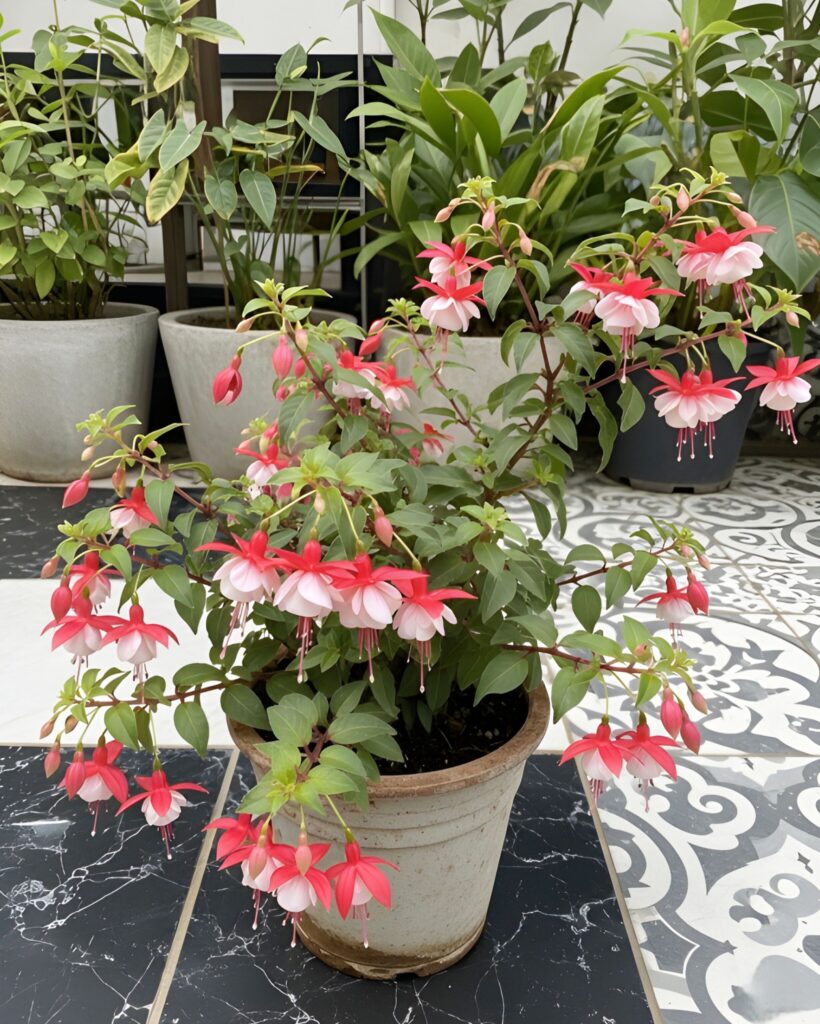
What makes the fuchsia flower instantly distinctive is its unique floral structure. The blooms typically consist of four sepals (the outer layer, often a contrasting colour) that reflex backwards to reveal a skirt of four or more petals in the centre.
Beneath the petals hang long stamens and a prominent pistil, giving the flower the dangling, earring-like appearance that earned it the charming nickname “Lady’s Eardrops.”

| Common Name | Fuchsia, Lady’s Eardrops |
| Scientific Name | Fuchsia spp. (genus with 110+ species) |
| Plant Family | Onagraceae (Willowherb family) |
| Native Region | Central and South America; New Zealand; Tahiti |
| Plant Type | Perennial shrub, annual, or trailing vine (climate-dependent) |
| Mature Size | 6 inches to 10+ feet depending on variety |
| Bloom Season | Late spring through autumn frost |
| Flower Colors | Pink, red, purple, white, orange, bi-colour combinations |
| Sun Requirement | Partial shade to filtered sunlight preferred |
| Watering Needs | Regular; consistent moisture without waterlogging |
| USDA Hardiness Zones | 6–11 (varies by species and variety) |
| Soil Type | Rich, moist, well-draining; slightly acidic (pH 6.0–7.0) |
| Toxicity | Non-toxic to humans and pets; berries are edible |
| Growth Rate | Moderate to fast |
| Common Uses | Hanging baskets, containers, borders, woodland gardens |
The History and Cultural Significance of Fuchsia
Fuchsia has a rich history that stretches across continents and centuries. Indigenous peoples of South America long made use of the plant — the berries of certain Fuchsia species were consumed as food, and the wood of larger shrubby varieties was used as timber.
European horticulturalists became enchanted with fuchsia in the early 18th century, and by the Victorian era, it had become a garden sensation.
The Victorians were particularly devoted to fuchsia, cultivating it in elaborate glasshouses, using it in intricate floral displays, and developing hundreds of new hybrids. The plant became a symbol of refined taste and botanical sophistication.
The word “fuchsia” has also transcended the garden to become a defining colour — a vivid, electric pink-purple that is now standard in fashion, design, and art. This is a rare distinction for any plant: to lend its name to an entire shade in the colour spectrum.
In the language of flowers — known historically as floriography — fuchsia symbolises confiding love, good taste, and amiability. It was often given as a gesture of affection and warmth, particularly between close friends.
Types and Popular Varieties of Fuchsia
The range of fuchsia varieties available to gardeners today is extraordinary. Whether you want something dramatic, delicate, trailing, or upright, there is a fuchsia cultivar to match.
Hardy Fuchsias
Hardy fuchsias can withstand frost and survive outdoors year-round in temperate climates. They are typically more vigorous and shrubby in growth habit.
‘Mrs. Popple’ is one of the most reliable hardy varieties. It produces masses of crimson and violet flowers from summer through autumn and can survive temperatures as low as -10°C (14°F) with a protective mulch.
‘Riccartonii’ is a classic hardy shrub, widely used for informal hedging in mild coastal climates, particularly in the British Isles where it grows with remarkable freedom. Its small red and purple blooms are beloved by bumblebees.
‘Tom Thumb’ is a compact, award-winning hardy variety ideal for rock gardens and the front of borders. It grows to only 12 to 18 inches tall and produces charming red and mauve flowers all summer long.
Tender/Half-Hardy Fuchsias
These are the showstoppers most people picture when they think of fuchsia — large, ruffled, extravagant blooms in hanging baskets and containers.
‘Dollar Princess’ is a double-flowered cultivar with cerise-red sepals and deep purple petals. It is exceptionally free-flowering and one of the easiest tender varieties for beginners.
‘Swingtime’ produces striking red-and-white double blooms that are large, voluminous, and incredibly showy. A perennial favourite in hanging basket competitions.
‘Pink Marshmallow’ is one of the largest-flowered fuchsias available. Its enormous, pale pink double blooms have an almost confectionery quality — soft, round, and utterly decorative.
‘Gartenmeister Bonstedt’ is a species-type fuchsia with long, tubular orange-red blooms and attractive bronze-green foliage. It is particularly loved by hummingbirds and is ideal for attracting pollinators.
Species Fuchsias
Fuchsia magellanica is one of the most cold-tolerant species, native to Chile and Argentina. It is the parent of many hardy hybrids and produces small, delicate red and purple blooms in great abundance. In mild maritime climates, it can form a substantial landscape shrub.
Fuchsia boliviana has striking clusters of long, tubular scarlet flowers hanging in dramatic bunches. It is a larger, more tropical species suited to warm gardens and conservatories.
Fuchsia procumbens is a prostrate, creeping species from New Zealand with tiny, fascinating upward-facing flowers of yellow, orange, and purple. It produces large pink berries that persist well into winter — an unusual and highly ornamental species.
Ideal Growing Conditions for Fuchsia
Light
This is perhaps the single most important factor in fuchsia success. Most fuchsias prefer bright, indirect light or partial shade. They are not full-sun plants in the way that roses or petunias are, and strong afternoon sun can scorch their leaves and cause flower drop.
A position that receives morning sun and afternoon shade — or dappled light beneath a deciduous tree — is often ideal.
In cooler climates or cloudy regions, some varieties will tolerate more direct sunlight. In hot, sunny climates such as the American South or the Mediterranean, shade is not optional; it is essential.
Temperature
Fuchsias are cool-weather plants at heart. They originated in the cool mountain forests of the Andes and perform best in temperatures between 55°F and 75°F (13°C–24°C). Temperatures above 85°F (29°C) cause significant stress, leading to bud drop, wilting, and reduced flowering.
This preference for cool conditions is why fuchsias are so associated with the mild, misty climates of the British Isles, the Pacific Northwest of North America, and New Zealand’s South Island.
Soil
Fuchsias need a rich, moisture-retentive but well-draining growing medium. In the ground, incorporate generous amounts of well-rotted compost or leaf mould before planting.
For container growing, use a high-quality peat-free potting compost — one with good moisture retention — mixed with some perlite for drainage.
The ideal soil pH is between 6.0 and 7.0, slightly acidic to neutral.
How to Plant Fuchsia Flower
In Containers and Hanging Baskets
Fuchsia is at its most spectacular in containers and hanging baskets, where the pendulous blooms can hang freely and be admired at eye level. Choose a container with excellent drainage. Line baskets with coir fibre or moss and fill with rich potting compost.
For hanging baskets, plant three to five trailing fuchsia plants around the edges of a 12- to 14-inch basket for a full, lush display by midsummer. You can mix trailing fuchsias with upright types in the centre for a more structured arrangement.
Water immediately after planting and position in a sheltered spot away from direct midday sun and strong winds.
In Garden Beds and Borders
Hardy fuchsias are excellent as permanent border plants in suitable climates. Plant in autumn or spring in enriched soil. Space shrubby varieties at least 2 to 3 feet apart to allow for mature spread.
Dig a hole twice as wide as the root ball, incorporate compost, and plant at the same depth as the nursery pot. Firm the soil well and water deeply. Apply a mulch of bark or leaf mould to retain moisture and protect the roots.
In Woodland Gardens
Fuchsias are a natural fit for woodland or shade gardens. Their preference for dappled light and moist, humus-rich soil mirrors woodland conditions. Hardy varieties underplanted with hostas, ferns, and astilbes create a lush, layered planting scheme that requires relatively little maintenance.
Watering Fuchsia
Consistent, regular watering is non-negotiable for fuchsia. These plants do not tolerate drought. Allow the growing medium to dry slightly between waterings, but never allow it to dry out completely — a wilted fuchsia drops its flower buds rapidly and may take weeks to recover.
In hanging baskets and containers, watering may be needed once or even twice daily in hot summer weather. Push your finger about an inch into the compost — if it feels dry, it is time to water.
Always water at the base of the plant rather than overhead, and water in the morning to allow foliage to dry before evening. This reduces the risk of fungal disease.
Use room-temperature water where possible. Cold water from a garden tap can shock the roots and trigger bud drop in sensitive varieties.
Feeding and Fertilising Fuchsia
Fuchsias are hungry plants and need regular feeding to produce the prolific blooms they are famous for. Begin feeding in early spring when active growth resumes, using a balanced liquid fertiliser to support root and shoot development.
Once flower buds begin to form — typically from late spring — switch to a high-potash fertiliser (such as tomato feed), applied every seven to ten days. Potassium encourages flower production, intensifies colour, and helps the plant cope with environmental stress.
In late summer, reduce feeding frequency. Stop fertilising entirely in autumn to allow the plant to begin preparing for dormancy.
Avoid fertilisers with excessive nitrogen during the flowering season — they will push the plant to produce foliage at the expense of flowers.
Pruning Fuchsia
Pruning is essential for maintaining a well-shaped, productive fuchsia. The approach differs slightly depending on whether you are growing a hardy or tender variety.
Tender Fuchsias
Tender fuchsias overwintered as dormant plants should be pruned hard in early spring, just as new growth begins. Cut all stems back to two or three leaf nodes. This seems severe, but fuchsias respond with vigorous new growth that will carry the season’s blooms.
During the growing season, pinch out the growing tips of young plants every two to three weeks to encourage branching. Each pinched stem will produce two new shoots, which means exponentially more flowers by midsummer.
Hardy Fuchsias
Hardy outdoor fuchsias should not be pruned in autumn. Leave the old stems intact over winter — they provide valuable frost protection for the crown.
In mid-spring, once the risk of hard frost has passed and new growth is visible from the base, cut back all the previous year’s stems to just above the new shoots emerging from the soil or lower stem.
Pests and Diseases
The following are major problems facing fuchsia flowers:
Common Pests
Fuchsia gall mite (Aculops fuchsiae) is the most serious pest fuchsia growers face. Introduced from South America, this microscopic mite distorts new growth into swollen, discoloured rosettes that never develop normally.
There is no effective chemical control for home gardeners in many countries — the only management strategy is prompt removal and destruction of affected growth. Resistant varieties such as ‘Delta’s Sara’ and ‘Ting-a-Ling’ are available.
Vine weevils are another significant threat. The adult beetles notch the leaf margins in a characteristic scallop pattern, but it is the grubs — which feed on roots below soil level — that cause the most damage.
Biological controls using nematodes, applied in late summer, are highly effective and environmentally sound.
Aphids cluster on soft new growth in spring, sucking sap and spreading viral diseases. A strong jet of water dislodges them; insecticidal soap deals with persistent infestations.
Whitefly is common, especially on greenhouse or indoor plants. Yellow sticky traps help monitor populations; insecticidal treatments may be needed for heavy infestations.
Common Diseases
Botrytis (grey mould) thrives in cool, damp conditions with poor air circulation. Remove infected plant material immediately and improve airflow around and between plants.
Rust appears as orange-brown pustules on the undersides of leaves. Remove affected foliage and apply a copper-based fungicide if the problem persists.
Root rot results from overwatering or compacted, poorly draining soil. Once advanced, it is very difficult to reverse — always prioritise good drainage from the start.
Propagating Fuchsia from Cuttings
Fuchsia is very easy to propagate from softwood cuttings, and this is the standard method for multiplying your favourite varieties.
Step 1: Take cuttings of 2 to 4 inches in late spring or early summer from healthy, non-flowering shoots. Ideally, take the cutting just below a leaf node. Each cutting should have two or three pairs of leaves.
Step 2: Remove the lower pair of leaves and pinch off any flower buds. Dip the cut end briefly in hormone rooting powder.
Step 3: Insert cuttings into small pots filled with a 50:50 mix of compost and perlite. Firm gently and water in.
Step 4: Cover with a clear polythene bag or propagator lid to maintain humidity. Place in a bright, warm spot — around 65°F to 70°F (18°C–21°C) — but out of direct sun.
Step 5: Roots typically develop within two to four weeks. Once cuttings show signs of new growth from the tips, they have rooted successfully. Gradually acclimatise them to open air over a week before moving to their final growing position.
Overwintering Fuchsia
Overwintering is where many beginners lose their tender fuchsia plants, but the process is straightforward once you understand what the plant needs.
Bring tender fuchsias indoors before the first frost — typically in September or October in temperate climates. Before bringing them in, inspect thoroughly for pests and treat if necessary to avoid introducing problems indoors.
Once inside, reduce watering sharply and stop feeding entirely. Store the plant in a cool, frost-free, dimly lit location — a garage, cellar, or unheated spare room is ideal. The plant will drop most or all of its leaves. This is completely normal.
Temperature during overwintering should stay between 40°F and 50°F (4°C–10°C) — cool enough to maintain dormancy without freezing. Check the compost every two to three weeks and water very sparingly, just enough to prevent the roots from desiccating completely.
In late February or early March, bring the plant into a warmer, brighter location. Resume light watering. As new shoots appear, prune hard, begin feeding, and watch the plant come back to life with remarkable vigour.
Fuchsia for Wildlife and Pollinators
One of the great virtues of fuchsia that is sometimes overlooked is its exceptional value for wildlife.
Hummingbirds are drawn irresistibly to fuchsia’s tubular blooms, which evolved in South America to attract these birds as pollinators. Gardeners in the western United States and Mexico report hummingbirds visiting Fuchsia magellanica and tubular-flowered species with great enthusiasm.
Bumblebees and long-tongued bees are equally fond of the flowers, pollinating them as they reach in for nectar. The hardy variety ‘Riccartonii’, in particular, is a bumblebee magnet in British gardens.
The berries that follow the flowers are edible and attractive to birds, extending fuchsia’s ecological value well into autumn. Fuchsia magellanica and F. procumbens are particularly notable for their fruit production.
Are Fuchsia Berries Edible?
Yes — fuchsia berries are edible and non-toxic to humans and most animals. They have a mild, slightly sweet, slightly tangy flavour with earthy notes. They are small and not particularly remarkable as a fruit, but they are safe to eat straight from the plant.
Some gardeners use them to make jams, jellies, or flavoured vinegars. The berries are also sometimes used as a garnish in culinary presentations. The leaves are not generally eaten.
Fuchsia in the Home: Indoor Growing Tips
Fuchsia can be grown as a houseplant with some success, though it is more demanding indoors than in a sheltered garden setting.
- Choose a bright, cool room — a north- or east-facing windowsill works well in summer. Avoid rooms that are consistently above 70°F (21°C), as heat accelerates bud drop. A conservatory or sunroom in spring and autumn can be ideal.
- Maintain high humidity by grouping plants together or placing the pot on a tray of damp gravel. Mist the foliage regularly, but avoid wetting the flowers themselves.
- Rotate the pot weekly to ensure even light exposure and prevent the plant from growing lopsidedly toward the light source.
Frequently Asked Questions
Why is my fuchsia dropping its buds? Bud drop in fuchsia is most commonly caused by heat stress, inconsistent watering, or draughts. Ensure the plant is in a cool, shaded position, water consistently, and shelter from strong winds.
Can fuchsia be grown in full sun? Most fuchsias prefer partial shade. A few modern varieties have been bred for better sun tolerance, but even these perform best with some afternoon shade, particularly in warm climates.
How long do fuchsia plants live? Hardy fuchsias can live for many decades as garden shrubs. Tender varieties, properly overwintered, can also live for many years — some prize-winning show plants are over 20 years old.
What is the difference between single and double fuchsia flowers? Single-flowered fuchsias have four petals in the centre corolla. Double-flowered varieties have eight or more petals, giving the bloom a fuller, more ruffled, voluminous appearance. Double flowers are generally heavier and create more spectacular hanging basket displays.
Are fuchsias deer-resistant? Fuchsias are not particularly deer-resistant and may be browsed in areas with high deer pressure. However, their preference for shaded, sheltered positions means they are often less exposed to deer activity than open-border plants.
Final Thoughts
There is something genuinely special about a fuchsia in full flower. Whether it is a modest ‘Tom Thumb’ at the edge of a shady border or a magnificent hanging basket loaded with hundreds of ‘Swingtime’ blooms, fuchsia never fails to draw attention and admiration.
Growing fuchsia is not without its demands — it needs regular watering, feeding, and protection from heat. But for gardeners willing to meet those needs, the reward is a plant that flowers with extraordinary generosity and colour from late spring until the first frosts arrive.
In a world of increasingly bold, low-maintenance garden trends, there is still something irreplaceable about the fuchsia. Its sheer elegance — those layered, jewel-coloured blooms hanging in the dappled shade — is a reminder that some of the best things in a garden are worth a little extra effort.
References and Further Reading
- USDA PLANTS Database — Fuchsia (genus) https://plants.usda.gov/home/plantProfile?symbol=FUCHI
- Royal Botanic Gardens, Kew — Fuchsia (Plants of the World Online). https://powo.science.kew.org/taxon/urn:lsid:ipni.org:names:30000079-2
- Wikipedia, uchsia https://en.wikipedia.org/wiki/Fuchsia

Tim M Dave is a gardening expert with a passion for houseplants, particularly cacti and succulents. With a degree in plant biology from the University of California, Berkeley, he has vast experience in gardening. Over the years, he has cultivated a vast collection of desert plants and learned a great deal about how to grow and care for these unique companions.