15 Cold Hardy Hibiscus Varieties (Identification, With Details)
I used to believe hibiscus belonged only in tropical gardens. Then I saw a hardy hibiscus with 10-inch flowers blooming in a garden that dips well below freezing every winter. I was surprised, and a little jealous.
The good news is simple. Some hibiscus are tough enough for cold climates. They die back to the ground in winter and return each spring, bigger than before.
This guide lists 15 cold hardy hibiscus plants, from compact types for small gardens to tall shrubs for hedges. You will also find zone ranges, bloom sizes and practical care tips. Let’s start with what “cold hardy” really means.
What Does “Cold Hardy Hibiscus” Mean?
Cold hardy hibiscus are plants that survive winter outdoors without being dug up or moved indoors. Most belong to two groups. The first is the perennial (hardy) hibiscus, which includes Hibiscus moscheutos and its hybrids. The second is the rose of Sharon, a woody shrub.
Do not confuse them with tropical hibiscus (Hibiscus rosa-sinensis). Clemson Extension notes that tropical hibiscus is only hardy in a small coastal zone 9 area of South Carolina. In colder places, it is grown as an annual or houseplant.
Hardiness is measured with the USDA Plant Hardiness Zone Map. The map is based on the average annual extreme minimum winter temperature. It uses 10-degree Fahrenheit zones and 5-degree half zones. Find your zone first, then choose your plant.
How to Choose the Right Hardy Hibiscus
Start with your zone. Most hardy hibiscus grow in zones 4 to 9, but a few need zone 6 or 7 and above. South Dakota State University Extension says some cultivars are root hardy to zone 4 with winter protection.
Next, think about space. Hardy hibiscus range from 2 feet tall to well over 8 feet. Compact types suit pots and borders. Tall types work as screens or back-of-border plants.
Finally, think about light and water. Hardy hibiscus love full sun and steady moisture. Colorado State Extension warns that all-day partial sun may reduce flowering. Remember that for every plant below.
ALSO READ: 35 Popular Types of Hibiscus Plants (Tropical, Hardy, and Exotic Varieties)
The 15 Best Cold Hardy Hibiscus
1. Rose Mallow (Hibiscus moscheutos)
Rose mallow is the parent of most hardy hibiscus sold today. It is native to wetlands and creek edges in the southeastern United States. Clemson Extension rates it hardy in zones 4 to 9, which covers a huge range of climates.
The plant grows 2 to 6 feet tall, according to NC State Extension. Flowers can reach 6 to 8 inches across, and the colors include white, pink, red and burgundy. Each bloom has a darker eye in the center. It is a bold sight in late summer.
This plant is easy to love. It tolerates wet soil, heat and humidity. It also feeds pollinators well. NC State reports that 28 species of butterflies and moths use it as a caterpillar host plant. Cut stems back in fall or late winter, and new growth will follow.
2. Texas Star Hibiscus (Hibiscus coccineus)
Texas Star, also called scarlet rose mallow, looks different from the rest. Its flowers are brilliant red, and the petals are spaced apart, which gives a star-shaped bloom. Clemson Extension lists it as hardy in zones 6 to 9.
The leaves are also unusual. They are deeply divided into narrow, finger-like lobes, so the plant has a lacy look. Established plants can reach about 7 feet in one growing season. That is fast growth for a perennial that dies back every winter.
Individual flowers last only a day, but new ones keep opening through summer and fall. It prefers full sun and moist soil. It also tolerates some flooding. I find it a great choice for rain gardens and pond edges.
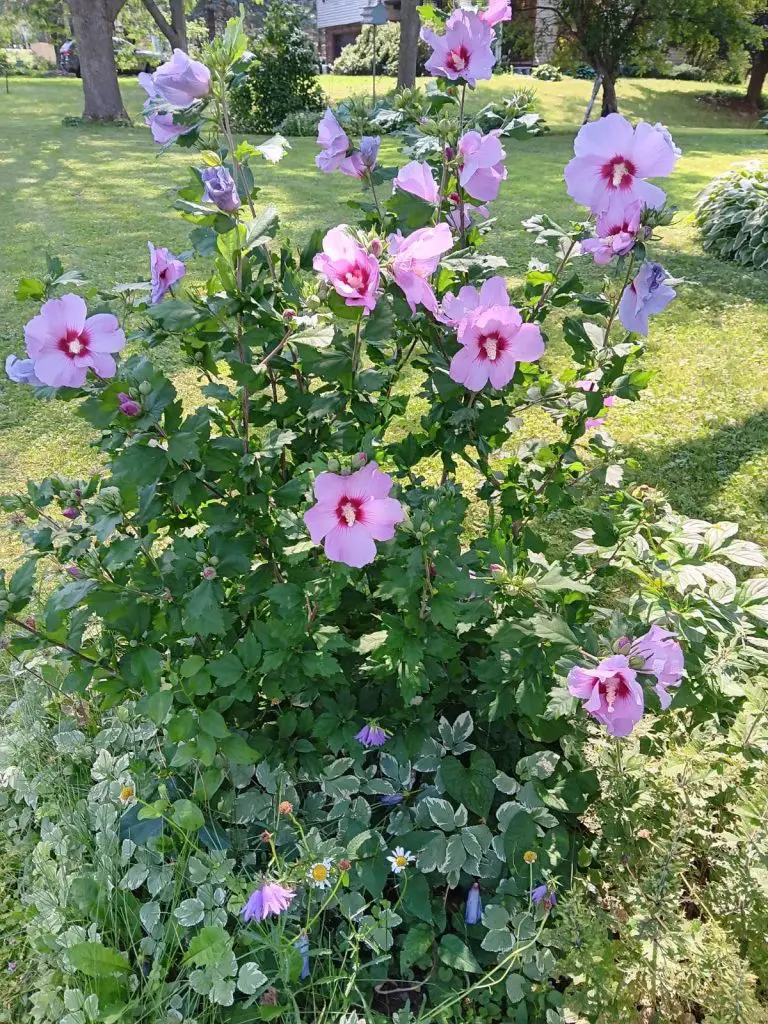
3. Rose of Sharon (Hibiscus syriacus)
Rose of Sharon is a different kind of hardy hibiscus. It is a woody, deciduous shrub, not a perennial that dies to the ground. Clemson Extension says it grows 8 to 10 feet tall and 6 to 10 feet wide, and lists it as hardy in zones 5 to 9.
It blooms during the hottest months, when many other shrubs have finished. Colors include white, pink, purple and lavender. Single and double forms are available. The plant is tough, durable and tolerant of many soils.
One warning is worth sharing. Some cultivars self-seed freely, and NC State notes that rose of Sharon has been reported invasive in some states. Choose low-seed cultivars and remove seed pods. Iowa State Extension adds that it leafs out late in spring, so be patient.
READ MORE ON: 25 Varieties of Rose of Sharon (Different Types, With Pictures)
4. ‘Lord Baltimore’ Hibiscus
‘Lord Baltimore’ is an old and much-loved variety. Clemson Extension describes crimson-red flowers on plants about five feet tall. The leaves are dark and deeply cut. They are even darker and more cut than those of its sister variety, ‘Lady Baltimore’.
As a Hibiscus moscheutos type, it follows the hardiness of its parent species, which is zone 4 to 9. Always check the plant tag, since breeders sometimes list slightly different zones. A zone check takes a minute and can save a plant.
The red blooms are a striking choice for a sunny border. Pair them with tall grasses or purple coneflowers. Plant in spring after frost. Water deeply during dry spells, because this plant is thirsty in summer.
5. ‘Lady Baltimore’ Hibiscus
‘Lady Baltimore’ is the softer partner of ‘Lord Baltimore’. Colorado State Extension describes it as 4 to 5 feet tall and up to 3 feet wide. Clemson Extension adds that the flowers are pink with red centers, and the leaves are deeply cut and dark green.
This plant has a classic, cottage-garden feel. The pink flowers look lovely next to white phlox or blue salvia. It also grows sturdy, woody stems. Colorado State notes that hardy hibiscus rarely needs staking.
Like all hardy hibiscus, it emerges late in spring. University of Illinois Extension warns that it is among the last perennials to wake up. Do not panic and do not dig it up. Wait until early summer before you judge it.
6. ‘Kopper King’ Hibiscus
‘Kopper King’ is a favorite for foliage lovers. Clemson Extension describes its coppery red, deeply cut leaves. The flowers are huge, about 12 inches wide, and light pink to white with a burgundy center. That is a rare mix of drama and elegance.
Pay attention to hardiness here. Clemson notes that it may not be fully hardy in the Upstate of South Carolina, which is a mild-winter region. Gardeners in colder zones should treat it with extra care. Mulch the crown well in late fall.
A sheltered spot helps a lot. Plant it where cold winter winds cannot hit it. Give it full sun and rich soil. It is a plant I would grow near a patio, where the big blooms and copper leaves can be enjoyed up close.
7. Disco Belle Series Hibiscus
The Disco Belle series is a good pick for smaller gardens. Clemson Extension describes compact plants that top out at 3 to 4 feet. NC State calls them semi-dwarf, and notes flower colors from pale pink to red and white, all with a red eye.
The flowers are still large. They are the full “dinner plate” size gardeners want. This is the best part of the series: big blooms on a plant that does not need much room. It fits well in foundation beds and mixed borders.
It also works in large containers, though pots need extra winter care. Roots are more exposed to cold in a pot, so move it to a sheltered spot. Cut stems back in late winter. Deadhead through summer to encourage more flowers.
8. Summerific Series Hibiscus
The Summerific series is a modern group of hybrids with many color choices. Clemson Extension says it contains at least a dozen cultivars, ranging from 3 to 4.5 feet tall. Flowers measure 7 to 9 inches across.
That variety makes it easy to match your garden color scheme. Some plants have red blooms, others have pink, white or bicolor flowers. Several have darker foliage. The compact habit keeps plants tidy and neat through the season.
Like other hardy hibiscus, they thrive in full sun with regular water. They are also bred to bloom reliably. If you want to try hardy hibiscus for the first time, this series is a safe starting point. Always confirm the zone range on the specific cultivar’s tag.
ALSO READ: 10 Reasons Your Hibiscus is Not Blooming + How to Fix
9. ‘Summerific Perfect Storm’ Hibiscus
‘Perfect Storm’ is one of my favorites in the Summerific group. Colorado State Extension describes it as compact and well branched, with dark purple foliage. It grows about 3 feet tall and 4 feet wide.
NC State describes the flowers as whitish-pink with a red central eye. The contrast against the dark leaves is beautiful. Even before the flowers open, the foliage adds interest to the border.
The wide, compact shape makes it a good filler plant. Place it in the middle of a bed, with taller plants behind it. Give it a sunny site and moist soil. A layer of mulch will keep the roots cool in summer and protected in winter.
10. ‘Robert Fleming’ Hibiscus
‘Robert Fleming’ is a compact variety with a deep red, velvety bloom. NC State says the flowers can reach 10 inches across, and the foliage is dark green. Colorado State Extension lists the plant at about 2 to 3 feet tall and wide.
That makes it one of the smallest plants on this list. It is perfect for small gardens, and for gardeners who dislike tall plants. The red flowers have real impact against a green background.
Its small size does not mean it is delicate. It still dies back and returns each year like its larger cousins. Plant it in full sun, water it well, and cut it back in late winter. It is a lovely choice near walkways and entrances.
11. Luna Series Hibiscus
The Luna series is one of the most compact groups of hardy hibiscus. NC State describes it as dwarf, with flowers in white, blush, pink, rose, red and pink swirl. It is also listed as a good choice for containers.
This makes it useful for patios, balconies and small yards. A large pot can hold a Luna hibiscus with space left for a few companion plants. The flowers are still bold, which surprises many first-time growers.
Container plants need care in winter. Cold air reaches the roots from all sides in a pot. Move the pot to an unheated garage or a sheltered corner. Water lightly during winter so the roots do not dry out completely.
12. ‘Anne Arundel’ Hibiscus
‘Anne Arundel’ is a taller, bolder variety. Clemson Extension describes nine-inch pink flowers on plants that can grow to five feet tall. It is a good choice when you want height and large blooms in the same plant.
Because of its size, it works well at the back of a border. It can also act as a summer screen. Plant it in front of a fence or wall for a flowering backdrop. Give it shelter from strong wind, since tall stems can snap.
Clemson advises that broken stems can be shortened, and new side shoots will form more blooms. So even damage is not a disaster. Water well, feed lightly in spring, and enjoy the show from midsummer into fall.
13. ‘Midnight Marvel’ Hibiscus
‘Midnight Marvel’ is a good option for very cold regions. South Dakota State University Extension features it in its list of hardy hibiscus recommended for the state. Its bright red flowers and dark foliage stand out in northern gardens.
SDSU Extension suggests looking for hardy hibiscus listed for USDA zone 4 if you garden in a cold climate. It also warns that strong winter winds and rapid temperature swings can stress the plants. Choose a sheltered site and mulch well.
Once established, hardy hibiscus is moderately drought tolerant, according to SDSU. Still, regular water gives the best flowers. Deadheading also helps. If you live in the northern plains or the upper Midwest, this plant deserves a place on your shortlist.
14. ‘Blue Bird’ Rose of Sharon
‘Blue Bird’ is a well-known rose of Sharon cultivar. NC State lists it among the common selections of Hibiscus syriacus. Its flowers are a cool blue-violet shade, which is less common among hibiscus.
As a rose of Sharon, it follows the species’ hardiness. Cornell’s Woody Plants Database lists Hibiscus syriacus as hardy to zone 5b. Iowa State Extension warns that temperatures of -20°F or lower can injure or kill these shrubs. So avoid exposed sites in the coldest areas.
Plant it in full sun and well-drained soil. Prune in spring, because the shrub flowers on new wood. Nebraska Extension also advises spring planting for best results. It can reach 8 to 12 feet over time, so allow room.
15. Confederate Rose (Hibiscus mutabilis)
Confederate rose is the most unusual plant on this list. Its flowers change color through the day. According to Clemson Extension, blooms open white and darken as they age. Varieties can be single or double, and range from white to pink to red.
It is best for milder cold climates. Clemson lists it as hardy in zones 7 to 9. In most of South Carolina, it behaves as a perennial and regrows from the base each spring. In warmer coastal areas, it may act as a shrub.
It can grow about 8 feet tall in the Upstate and up to 15 feet on the coast. It prefers loamy, well-drained soil and full sun to partial shade. Take cuttings in spring to share with friends. It is a classic pass-along plant.
How to Plant Cold Hardy Hibiscus
Plant in spring, after the last frost. Colorado State Extension recommends a full-sun spot with well-drained soil enriched with compost. Dig a hole as deep as the root ball and twice as wide. Water well after planting.
Space plants according to their mature size. Crowded plants get less air, and that increases the risk of leaf disease. NC State advises planting in a spot with good air circulation and protection from wind.
Mulch around the plant, but keep mulch away from the stems. Clemson Extension notes that mulch touching the stems may encourage southern blight. A two- to three-inch layer, kept back a few inches from the crown, is enough.
ALSO READ: When and How to Prune Hibiscus
Winter Care and Pruning Tips
Most hardy hibiscus die back to the ground in winter. This is normal. Do not worry when the stems turn brown. The roots are alive underground.
Cut stems back in late fall or late winter. Clemson suggests cutting old stems back to three to six inches above ground level for H. moscheutos. Illinois Extension suggests 3 to 4 inches after the season ends. Either works well.
You can also leave some stems standing through winter. NC State notes that native bees nest in hollow dead stems. If you want to help bees, leave stems 12 to 24 inches tall until spring. Add mulch over the crown in colder zones.
Common Problems and Simple Fixes
Japanese beetles are the most common pest. NC State also lists aphids, whiteflies and sawflies. Check leaves weekly in summer. University of Maryland Extension suggests that beetles are often easy to manage with a bucket of soapy water.
Leaf spots and other fungal problems can also appear. Clemson advises cleaning up plant debris and removing infected leaves. This is usually enough for control. Good spacing and morning watering help too.
Dry soil causes leaf scorch and droopy plants. Illinois and Purdue Extension both stress steady moisture. Water deeply once or twice a week in dry weather. Remember that hardy hibiscus is a thirsty plant, and it pays you back with flowers.
READ MORE: 10 Common Hibiscus Problems: Identification + Troubleshooting Tips
Frequently Asked Questions
Can hardy hibiscus survive zone 4 winters? Yes, many can. South Dakota State University Extension notes that some cultivars are root hardy to zone 4 with winter protection. Choose plants labeled for zone 4 and mulch the crown.
Why has my hibiscus not sprouted in spring? Be patient. Hardy hibiscus is one of the last perennials to emerge. University of Illinois Extension says it always returns, even when it looks dead in May.
How much sun does hardy hibiscus need? Aim for at least six hours of direct sun. NC State Extension says full sun gives better bloom production and better disease resistance.
Is hardy hibiscus the same as tropical hibiscus? No. Tropical hibiscus is a frost-tender shrub from Asia. Hardy hibiscus is a perennial that returns after freezing winters.
Final Thoughts
Cold winters do not have to mean the end of hibiscus. With the right variety, you can enjoy huge, tropical-looking flowers in a cold climate. The key is to know your zone and choose a plant that fits it.
If I had to start again, I would begin with a Summerific or Disco Belle plant for easy success. Then I would add a taller type, like ‘Lord Baltimore’ or a rose of Sharon, for height. Both groups will reward your patience.
Plant in full sun. Water well. Be patient in spring. By late summer, you may find yourself standing in front of a flower the size of a dinner plate, just as I once did.
References
- NC State Extension. Muenchhusia moscheutos (Hibiscus moscheutos), NC Extension Gardener Plant Toolbox. https://plants.ces.ncsu.edu/plants/muenchhusia-moscheutos/
- Clemson Cooperative Extension, Home & Garden Information Center. Hibiscus (HGIC 1179). https://hgic.clemson.edu/factsheet/hibiscus/
- USDA Agricultural Research Service. 2023 USDA Plant Hardiness Zone Map. https://planthardiness.ars.usda.gov/
- South Dakota State University Extension. Hardy Hibiscus. https://extension.sdstate.edu/hardy-hibiscus
- Colorado State University Extension, Pueblo County. Make Some Room for Hardy Hibiscus. https://pueblo.extension.colostate.edu/make-some-room-for-hardy-hibiscus/
- University of Illinois Extension. POTW: Perennial Hibiscus. https://extension.illinois.edu/blogs/hort-home-landscape/2014-08-05-potw-perennial-hibiscus
- University of Maryland Extension. Rosemallow (Hibiscus moscheutos). https://extension.umd.edu/resource/rosemallow

Tim M Dave is a gardening expert with a passion for houseplants, particularly cacti and succulents. With a degree in plant biology from the University of California, Berkeley, he has vast experience in gardening. Over the years, he has cultivated a vast collection of desert plants and learned a great deal about how to grow and care for these unique companions.