25 Types of Ivy (Popular Varieties With Pictures)
Ivy has clung to human culture for centuries, quite literally. Its image on old stone buildings became so associated with prestige that it inspired the term “Ivy League” for a group of long-established American universities.
The plant climbs using aerial rootlets rather than tendrils or twining stems. These rootlets grip onto bark, brick, and stone with a natural adhesive, which is part of why ivy-covered walls became such a lasting visual symbol.
Not every plant called ivy shares this climbing method, though. Many of the varieties on this list borrowed the name simply because they trail or spread in a visually similar way, without any true botanical relation to Hedera.
True ivies belong to the genus Hedera, part of the ginseng family, Araliaceae. Despite how many varieties show up in garden centers, the genus itself is smaller than most people expect.
Botanical sources place the true Hedera genus at roughly 12 to 15 recognized species, though some researchers count as few as 10 and others up to 21 once regional variants are included.
Let’s look at some of the popular varieties of Ivy plants.
Classic English Ivy (Hedera Helix) Varieties
English ivy is the plant most people picture first, and its many cultivars all share the same forgiving nature and climbing habit.
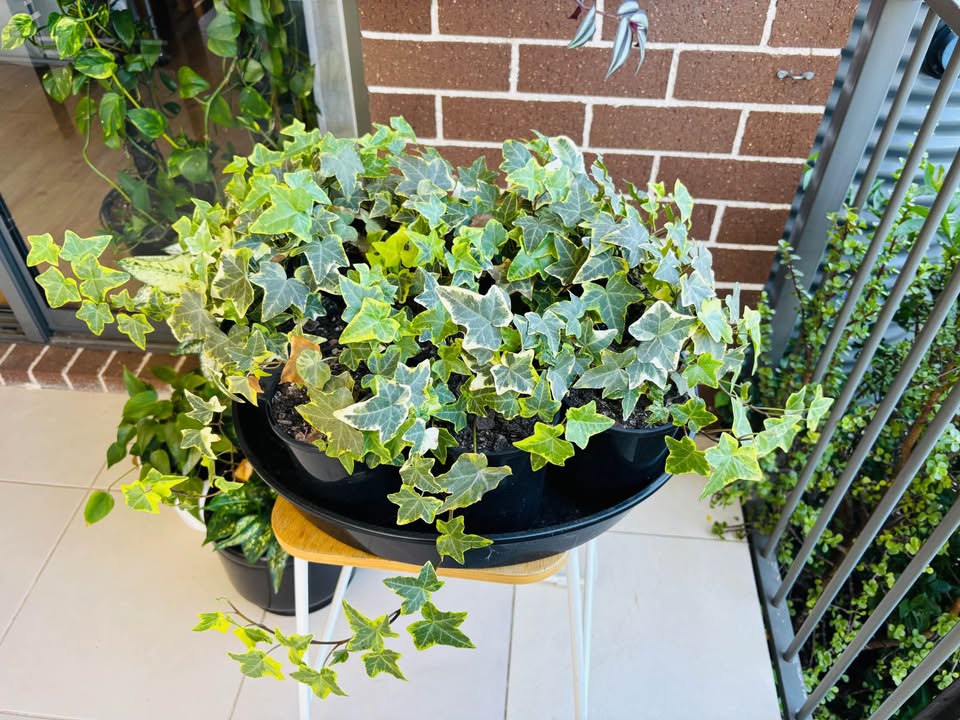
1. Hedera helix (Common English Ivy)
This is the species that gave the entire genus its popular identity. Its lobed, dark green juvenile leaves climb using aerial rootlets that grip almost any rough surface.
Left unchecked, it can climb well beyond twenty meters up a tree or wall. It is also listed as invasive in several U.S. states, so outdoor planting deserves some caution.
2. Hedera helix ‘Needlepoint’
Slender, narrow lobes give this cultivar a delicate, pointed look compared to the broader classic leaf shape. It stays compact enough for tabletop pots and small hanging baskets.
Growth habits mirror the species closely, just at a slightly smaller scale. It is a common choice for indoor arrangements where a finer texture is preferred.
3. Hedera helix ‘Ivalace’
Glossy, curled leaf edges give this cultivar a crimped, almost ruffled appearance that catches the light nicely. The curling becomes more pronounced as each leaf matures.
It grows at a manageable pace indoors and tends to stay tidier than the standard species, making it a popular pick for dish gardens.
4. Hedera helix ‘Glacier’
Gray-green leaves edged in creamy white give this cultivar a frosted, cool-toned appearance year-round. The variegation holds up well under moderate indoor light.
It trails nicely from a hanging pot and grows at a steady, unhurried pace, making it easy to keep looking neat with minimal pruning.
5. Hedera helix ‘Baltica’
Known as Baltic ivy, this cultivar produces smaller leaves with a purplish tint that deepens during colder months. It is notably more cold-hardy than many other English ivy forms.
Because of that hardiness, it has been used widely as an outdoor groundcover in cooler climates, though the same invasiveness concerns apply here as with the species.
Uniquely Shaped and Variegated Ivy Cultivars
These cultivars stand out for their leaf texture, shape, or coloring, offering more visual variety than the standard climbing form.
6. Hedera helix ‘Manda’s Crested’ (Curly Ivy)
Wavy, twisted leaf edges give this cultivar a curled, almost ornamental appearance that shifts color with the seasons. Leaves often take on a bronze or reddish tint in cooler weather.
It stays fairly compact and works well trailing from a shelf or hanging basket, where its texture is easiest to appreciate up close.
7. Hedera helix ‘Duckfoot’
Small, rounded, three-lobed leaves resemble tiny webbed feet, which is exactly where this cultivar gets its nickname. The compact leaf size makes it a favorite for miniature gardens.
Growth stays dense and low, and it tolerates close pruning well, making it easy to keep in a tidy, controlled shape.
8. Hedera helix ‘Sagittifolia’
Sharply pointed, arrow-shaped lobes set this cultivar apart from the broader, more rounded classic leaf. The narrow points give the whole plant a slightly spiky silhouette.
It climbs and trails at a moderate rate, and its distinctive leaf shape makes it easy to identify even among a mixed ivy collection.
9. Hedera helix ‘Gold Child’
Gray-green centers are framed by bold, bright gold margins, creating strong contrast against darker foliage nearby. The gold tone tends to intensify with more light exposure.
It grows at a similar pace to other variegated cultivars, generally slower than solid green forms, since variegated tissue produces less energy through photosynthesis.
10. Hedera helix ‘Atropurpurea’
Deep green leaves shift toward a rich purple-bronze tone once temperatures drop in autumn and winter. The seasonal color change is this cultivar’s main draw.
It performs best with consistent light throughout the year, since stronger light tends to intensify the purple shift once cooler weather arrives.
ALSO READ: 25 Best Plants for Hanging Baskets: Identification With Pictures
True Hedera Species Beyond English Ivy
English ivy gets most of the attention, but several other Hedera species have their own distinct leaf shapes, native ranges, and growth habits.
11. Hedera hibernica (Atlantic or Irish Ivy)
Often mistaken for English ivy, this species is native to the Atlantic coast of Europe and produces noticeably larger, more matte leaves. Its growth habit is also somewhat more vigorous.
Distinguishing it from Hedera helix usually requires a close look at leaf trichomes and chromosome counts, since the two species can hybridize and appear quite similar at first glance.
12. Hedera canariensis (Algerian or Canary Island Ivy)
Native to the Canary Islands and North Africa, this species produces broad, glossy, dark green leaves that are notably larger than typical English ivy foliage. Growth tends to be rapid once established.
It is more cold-sensitive than English ivy, which limits its outdoor use to milder climates, though it performs well as an indoor plant almost anywhere.
13. Hedera algeriensis (Algerian Ivy)
Closely related to Hedera canariensis, this species is best known through its popular cultivar ‘Gloire de Marengo,’ which displays gray-green marbling with creamy white margins. The variegated form is especially popular in hanging baskets.
Leaves are large and leathery, giving the plant a bold, substantial presence compared to the finer texture of many English ivy cultivars.
14. Hedera colchica (Persian Ivy)
Large, heart-shaped leaves with prominent veining make this species one of the most visually distinct members of the genus. Individual leaves can grow considerably larger than those of English ivy.
Native to the Caucasus region, it tolerates a range of light conditions and is often used where a bolder, larger-leaved groundcover is desired.
15. Hedera nepalensis (Himalayan Ivy)
Native to the Himalayan foothills, this species produces narrower, more elongated leaves than many of its European relatives. Its natural range gives it a somewhat different cold tolerance profile.
It grows as both a climber and groundcover in its native habitat, following the same general pattern of juvenile and adult leaf stages seen throughout the genus.
ALSO READ: 25 Best Plants for a North-Facing Window (Low Light, High Reward)
Vines Often Mistaken for True Ivy
These plants share visual traits or common names with Hedera species, which leads to frequent misidentification, especially in the fall when leaf color shifts.
16. Boston Ivy (Parthenocissus tricuspidata)
Despite the name, this vine belongs to the grape family, not Hedera. Its three-lobed leaves turn a brilliant red in autumn, which is part of why it became such a popular choice for covering brick buildings.
It climbs using adhesive tendril discs rather than the aerial rootlets true ivy relies on. This distinction is one of the clearest ways to tell the two apart.
17. Poison Ivy (Toxicodendron radicans)
This is not a true ivy at all, and confusing it with Hedera species can be genuinely painful. It belongs to the sumac family and produces compound leaves in groups of three.
Contact with its oil, urushiol, causes an allergic skin reaction in the vast majority of people exposed. The familiar warning “leaves of three, let it be” exists for good reason.
18. Grape Ivy (Cissus rhombifolia)
Also from the grape family rather than Hedera, this vine produces glossy, three-part leaflets with a slightly serrated edge. It climbs using tendrils instead of aerial roots.
It tolerates average indoor conditions well and is commonly grown as a low-maintenance houseplant rather than an outdoor groundcover.
19. Marine Ivy (Cissus trifoliata)
Native to parts of the southern United States and Mexico, this vine produces three-lobed, somewhat fleshy leaves and small, dark, grape-like berries. It is another grape family member rather than a true Hedera.
It tolerates heat and drought better than most true ivies, making it a practical groundcover choice in warmer, drier regions.
20. Kenilworth Ivy (Cymbalaria muralis)
This delicate, small-leaved trailing plant belongs to the plantain family, not Hedera. Its rounded, lobed leaves and tiny purple flowers give it a dainty appearance quite different from climbing ivy.
It spreads readily in cracks and crevices, often self-seeding along stone walls and pathways, and stays low to the ground rather than climbing upward.
Other Well-Known Plants Called “Ivy”
This final group borrows the ivy name loosely, usually because of a trailing or spreading habit, without any close botanical connection to Hedera.
21. Swedish Ivy (Plectranthus verticillatus)
Despite its name, this plant is native to southern Africa and belongs to the mint family. Its rounded, scalloped leaves and trailing stems make it a popular hanging basket choice.
It grows quickly indoors under bright, indirect light and roots easily from cuttings, which explains its long-standing popularity as a low-fuss houseplant.
22. Ground Ivy (Glechoma hederacea)
Also a member of the mint family, this low-growing plant produces small, scalloped, kidney-shaped leaves and a noticeable minty scent when crushed. It spreads aggressively along the ground.
Many gardeners consider it a lawn weed rather than an ornamental plant, since it roots at every node and can quickly overtake turfgrass if left unmanaged.
23. Devil’s Ivy (Golden Pothos, Epipremnum aureum)
One of the most recognizable houseplants worldwide, this species has heart-shaped, often variegated leaves and belongs to the arum family. It earned its nickname for its ability to survive almost total neglect.
It tolerates low light and irregular watering better than most houseplants, which has made it a staple in offices and homes with less-than-ideal growing conditions.
24. Cape Ivy (Delairea odorata)
Native to South Africa, this vine belongs to the daisy family and produces glossy, ivy-shaped leaves with clusters of small yellow flowers. It is considered invasive in parts of California and Australia.
It spreads rapidly along coastal areas and disturbed sites, often smothering native vegetation in a manner similar to true invasive Hedera species.
25. Parlor Ivy (Senecio macroglossus)
Sometimes called wax vine, this South African native produces thick, glossy, ivy-shaped leaves that closely resemble true Hedera at first glance. It belongs to the same daisy family as Cape ivy.
It tolerates indoor conditions well and is often grown as a hanging houseplant, prized for its resemblance to English ivy without the same outdoor spreading concerns.
ALSO READ: 50 Types of Christmas Flowers and Plants: Identification With Pictures
How to Choose the Right Ivy for Your Space
Before diving into the full list, think about where the plant will actually live. Ivy varieties differ more than their shared name suggests.
- If you want a groundcover for shade, classic English ivy and its close relatives handle low light well, though they need containment to avoid spreading too far.
- If you have a small pot or hanging basket, compact cultivars like ‘Needlepoint’ or ‘Duckfoot’ stay manageable without constant pruning.
- If you live in a region where English ivy is restricted, several non-invasive look-alikes on this list, such as Swedish ivy, offer similar trailing foliage without the ecological concerns.
- If you are trying to identify a plant in your yard, the final section on look-alike vines will help you tell true ivy apart from species you may actually want to remove.
Basic Care Tips for True Hedera Ivies
Most true ivy species and cultivars share similar care needs, which makes them approachable even for beginner growers.
Light: Bright, indirect light produces the fullest growth and the most vivid variegation. Deep shade is tolerated but slows growth noticeably.
Water: Allow the top of the soil to dry slightly between waterings. Consistently soggy soil encourages root and stem rot.
Temperature: Most cultivars thrive between 70°F and 90°F, with growth and quality declining once temperatures regularly exceed 95°F or drop below 65°F.
Humidity: Ivy tolerates average indoor humidity well, though higher humidity, generally between 60 and 100 percent, encourages the fullest foliage in commercial growing settings.
Pruning: Regular pinching keeps growth bushy rather than sparse and leggy. Trimmed stems can often be rooted into new plants.
Why Ivy Leaves Change Shape as They Grow
One detail surprises a lot of new growers. Ivy plants produce two distinct leaf types depending on their growth stage.
Juvenile leaves appear on young, climbing, or trailing stems. These are the familiar lobed shapes most people associate with ivy.
Adult leaves form later, usually high up on mature, flowering stems exposed to full sun. These leaves are typically unlobed, more oval, and easy to mistake for a different plant entirely.
This shift explains why a single ivy plant can look like two different species over its lifetime, depending on which growth stage you happen to be looking at.
Propagating Ivy from Cuttings
Nearly every true Hedera type on this list propagates easily from stem cuttings, which is part of why the genus spread so widely through cultivation.
Select a healthy stem with at least one visible node, since roots form most reliably at these points along the stem.
Root the cutting in water, moist soil, or a light propagation mix. Single-node cuttings are commonly used commercially, though double-node cuttings work as well.
Keep conditions consistent. Steady warmth and moderate humidity speed up rooting considerably compared to cool, dry conditions.
Problems to Watch For
Ivy is generally low-maintenance, but a few recurring issues are worth knowing before you plant one.
Invasiveness affects English ivy and several related species in parts of North America, Australia, and elsewhere. Some states restrict its sale entirely, so it is worth checking local guidance before planting it outdoors.
Pests such as aphids, mealybugs, spider mites, and scale occasionally affect ivy, particularly in hot, dry conditions or crowded indoor settings.
Skin irritation can occur from handling true ivy sap, though this is mild compared to poison ivy. Anyone with sensitive skin may want to wear gloves during pruning or propagation.
Toxicity to pets is worth noting as well. Ivy leaves and berries contain saponins that can cause vomiting, drooling, or abdominal discomfort if ingested by cats or dogs.
Frequently Asked Questions
How many types of true ivy exist? The Hedera genus itself is generally placed at around 12 to 15 species, though estimates range from as few as 10 to as many as 21 depending on the source and how regional variants are classified.
Is Boston ivy a true ivy? No. Boston ivy belongs to the genus Parthenocissus in the grape family, not Hedera. It only shares the common name because of its climbing habit and dense foliage.
Is poison ivy related to English ivy? No, and this is an important distinction. Poison ivy belongs to the sumac family and produces compound three-leaflet foliage, while true ivy has lobed single leaves and belongs to an entirely different plant family.
Why is English ivy considered invasive in some places? It spreads aggressively by seed and creeping stems, forms dense mats that block light to native plants, and can weigh down or damage trees it climbs. Several U.S. states restrict its sale for these reasons.
Can ivy grow well indoors? Yes. Most true Hedera cultivars adapt readily to indoor conditions and tolerate light levels as low as 100 footcandles, provided temperatures stay in a moderate, comfortable range.
What is the easiest ivy for a beginner to grow? Hedera helix, the classic English ivy, remains the most forgiving option thanks to its tolerance for a wide range of light, humidity, and watering conditions.
Final Thoughts
Twenty-five types barely scratches the surface of everything people casually call “ivy.” Between true Hedera species, their many cultivars, and the long list of unrelated look-alikes, this shared name covers a genuinely diverse group of plants.
Understanding the difference matters more than it might seem at first. Knowing a true ivy from a Boston ivy, or a harmless Hedera from an actual poison ivy plant, can save you from a damaged tree, a restricted-species fine, or an unpleasant rash.
Whichever type ends up on your windowsill or climbing your garden fence, take the time to identify it properly first. That small step of certainty makes the rest of the growing experience far more enjoyable.
References
- North Carolina State University Extension – Hedera helix Plant Toolbox. https://plants.ces.ncsu.edu/plants/hedera-helix/
- Clemson University Home & Garden Information Center – Ivy. https://hgic.clemson.edu/factsheet/ivy/
- University of Florida IFAS Extension – Cultural Guidelines for Commercial Production of Interiorscape Hedera. https://ask.ifas.ufl.edu/publication/EP243
- University of Maryland Extension – English Ivy. https://extension.umd.edu/resource/english-ivy
- University of North Carolina Herbarium, Flora of the Southeastern United States – Hedera. https://fsus.ncbg.unc.edu/main.php?pg=show-taxon-detail.php&taxonid=64884
- U.S. National Park Service, Olympic National Park – English Ivy. https://www.nps.gov/olym/learn/nature/english-ivy.htm
- Centers for Disease Control and Prevention, National Institute for Occupational Safety and Health – Poisonous Plants and Work. https://www.cdc.gov/niosh/outdoor-workers/about/poisonous-plants.html

Tim M Dave is a gardening expert with a passion for houseplants, particularly cacti and succulents. With a degree in plant biology from the University of California, Berkeley, he has vast experience in gardening. Over the years, he has cultivated a vast collection of desert plants and learned a great deal about how to grow and care for these unique companions.