25 Native Illinois Flowers (With Growing Details)
I have stood in restored prairie patches outside Chicago in July, surrounded by chest-high coneflowers and blazing star, and it is genuinely hard to believe how little of that landscape survives today. Illinois earned its nickname honestly, but the prairie itself is now the rarest thing in the state.
Only about one one-hundredth of one percent of Illinois’ original 21 million acres of tallgrass prairie remains today, according to the U.S. Forest Service. That number stops me every time I read it. What used to cover 60% of the entire state now survives in scattered fragments smaller than a city park.
This guide covers 25 native Illinois flowers, from the state’s official bloom to prairie giants and quiet woodland natives.
Why Illinois Native Flowers Still Matter
Native flowers here evolved alongside deep prairie soil, harsh winters, and a very specific set of pollinators. That relationship cannot be replaced by ornamental plants shipped in from other regions, no matter how well they photograph.
The historic Grand Prairie alone supported more than 300 plant species, 300 bird species, and 1,000 insect species, according to the Grand Prairie Friends conservation group. Protecting what remains of that system starts with knowing the flowers themselves.
Here is the full list.
25 Native Illinois Flowers
1. Common Blue Violet (Viola sororia)
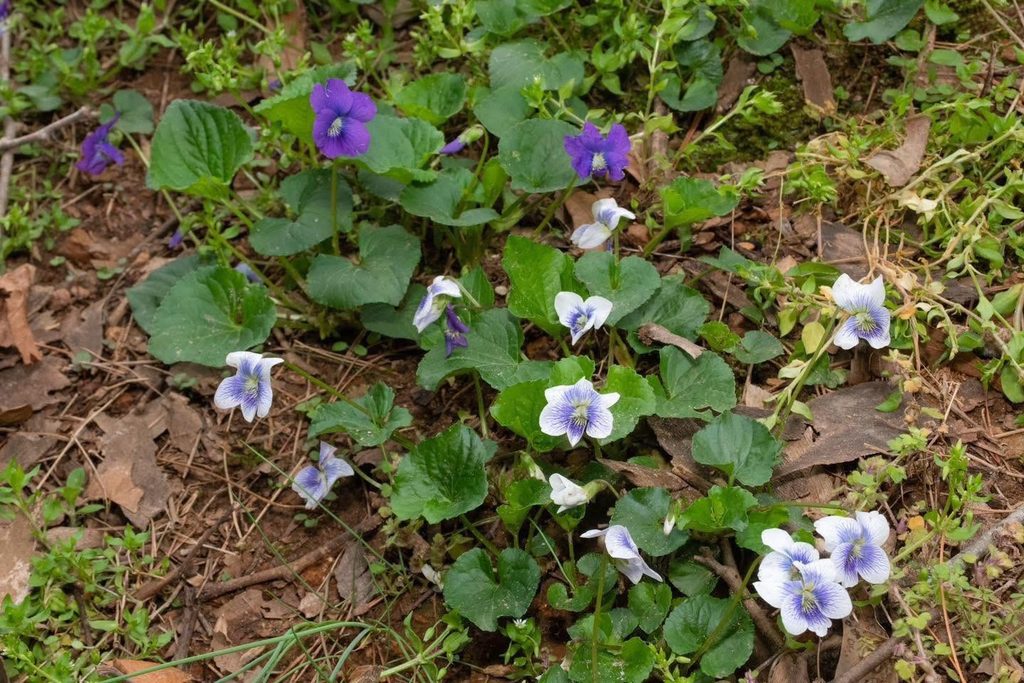
The common blue violet has been Illinois’ official state flower since 1908, and the story behind that choice is genuinely charming. Illinois schoolchildren voted for it in 1907, beating out the wild rose and goldenrod by a wide margin.
It grows almost everywhere in the state, from full sun to deep shade, in lawns, prairies, woodlands, and wetlands alike. Illinois hosts at least 30 violet species total, with 25 of those found in the Chicago area alone.
Interestingly, the plant produces two kinds of flowers. The showy purple blooms appear in spring, while small, closed flowers near the ground produce most of the actual seed later in the season.
Violet petals are also edible, and I have seen them used as delicate garnishes on cakes and drinks at Midwest farmers markets.
2. Purple Coneflower (Echinacea purpurea)
Purple coneflower produces drooping pink-purple petals around a spiky, copper-colored center that pollinators cannot seem to resist. It remains one of the most recognizable prairie flowers in the entire state.
It tolerates drought remarkably well once established, making it a reliable choice for both restored prairie and home gardens. Bloom season runs from June through August.
Goldfinches often perch directly on the seed heads well into fall, feeding long after the petals have faded. That extended usefulness is part of why restoration projects plant it so heavily.
3. Pale Purple Coneflower (Echinacea pallida)
Pale purple coneflower looks similar to its cousin but produces narrower, more delicately drooping petals in a softer pink-lavender shade. It blooms slightly earlier too, typically from May through July.
This species is considered a true prairie remnant indicator, meaning its presence often signals a patch of untouched, high-quality original prairie. Spotting one in the wild feels like finding a small piece of Illinois history still intact.
It grows in dry, well-drained soil and tolerates poor conditions that would challenge most other flowering perennials.
4. Black-Eyed Susan (Rudbeckia hirta)
Black-eyed Susan brings a familiar golden-yellow bloom with a dark brown center to roadsides, meadows, and disturbed soil across the entire state. It thrives in exactly the kind of rough ground other plants avoid.
As a short-lived perennial or biennial, it reseeds generously, which makes it a favorite for quick prairie restoration efforts. Bloom season stretches from June through September.
Bees and butterflies visit constantly throughout that long window, making it a dependable pollinator magnet in any native garden.
5. Compass Plant (Silphium laciniatum)
Compass plant is a genuine prairie giant, capable of reaching 8 to 10 feet tall with bright yellow, sunflower-like blooms. Its deeply cut leaves orient themselves north-south to reduce midday sun exposure, which is where the name comes from.
Below ground, its taproot can extend more than 10 feet deep, an adaptation that helped prairie plants survive drought and fire long before European settlement. That root system is part of why prairie soil historically held so much organic carbon.
It blooms from July through September and can live for decades once established in undisturbed prairie soil.
ALSO READ: 20 Illinois Native Shrubs (With Growing Details)
6. Prairie Dock (Silphium terebinthinaceum)
Prairie dock is a close relative of compass plant, recognized by its enormous, rough-textured basal leaves that can grow over a foot long. Its yellow flowers bloom atop bare stalks reaching 6 to 10 feet high.
Bloom time runs from July through September, and the plant’s deep taproot gives it the same drought resilience found in compass plant. Both species were once staples of the tallgrass ecosystem across central Illinois.
It grows best in full sun and moist to average prairie soil, often alongside big bluestem and other native grasses.
7. Prairie Blazing Star (Liatris pycnostachya)
Prairie blazing star sends up tall purple spikes that bloom from the top downward, an unusual pattern that sets it apart from most flowering plants. Watching it bloom in reverse over several weeks is oddly satisfying.
Monarch butterflies depend on it heavily during fall migration, since it blooms in August and September, right when monarchs most need fuel for their journey south. Its timing makes it a critical late-season nectar source.
It grows 2 to 5 feet tall and prefers full sun with moist to average soil, appearing regularly in Illinois prairie restoration plantings.
8. Rattlesnake Master (Eryngium yuccifolium)
Rattlesnake master looks unlike anything else on a tallgrass prairie, with spiky, yucca-like leaves and round, thistle-textured white flower heads. It stands out sharply against the softer shapes of surrounding grasses.
Despite its intimidating name, it has no real connection to snakes at all. Early settlers believed its root could treat snakebite, and the folklore name simply stuck around.
It blooms from July through September and draws a wide range of pollinators, including several specialized native bee species that favor it specifically.
9. Butterfly Milkweed (Asclepias tuberosa)
Butterfly milkweed produces bright orange flower clusters that stand out immediately against green prairie grass. Unlike common milkweed, its sap runs clear rather than milky, which often surprises first-time gardeners.
Monarch caterpillars rely entirely on milkweed species to survive, and documented population declines in recent decades make every planted patch genuinely valuable. It blooms from June through August.
It tolerates dry, sandy soil well, making it a low-maintenance choice for anyone starting a pollinator garden in Illinois.
10. Common Milkweed (Asclepias syriaca)
Common milkweed produces dusty pink flower clusters with a sweet fragrance that carries surprisingly far on a warm evening. It spreads through underground rhizomes, which can make it aggressive in a small garden bed.
Monarchs lay eggs almost exclusively on milkweed leaves, making this species a critical host plant across the entire Midwest. Losing milkweed to herbicide use and development is one of the documented pressures on monarch populations.
It blooms from June through August and tolerates a wide range of soil conditions across the state.
ALSO READ: 25 Trees Native to Illinois (With Growing Details)
11. Wild Bergamot (Monarda fistulosa)
Wild bergamot, also called bee balm, produces shaggy lavender flower heads with a sharp, minty fragrance when leaves are crushed. Bees, butterflies, and hummingbird moths all visit heavily during its bloom window.
It grows well in average to dry soil under full sun, blooming from July into September. Native communities historically used it as a medicinal herb, a history that predates any modern garden use.
Its long bloom period and steady pollinator traffic make it a strong anchor plant for any Illinois native flower bed.
12. New England Aster (Symphyotrichum novae-angliae)
New England aster provides purple, daisy-like blooms with bright yellow centers right up until the first hard frost. Its late bloom window, from August through October, fills a critical nectar gap for bees and migrating butterflies.
It can grow leggy without companions nearby, so pairing it with grasses or shorter perennials keeps a garden bed looking balanced. Full sun and average soil suit it well.
Few native flowers offer this much reliable color so late into the Illinois growing season.
13. Royal Catchfly (Silene regia)
Royal catchfly produces brilliant scarlet, star-shaped flowers that stand out dramatically against green prairie foliage. It is considered rare across much of its historic range, making surviving populations especially valuable.
Hummingbirds are its primary pollinator, drawn in by the deep red color and tubular flower shape. It blooms from July through August in dry to moist prairie soil.
Because it has become uncommon in the wild, conservation groups actively include it in Illinois prairie restoration seed mixes.
14. Prairie Trillium (Trillium recurvatum)
Prairie trillium produces deep maroon, upright petals above mottled leaves, a slightly different look from the classic white trillium found further east. It blooms from April through May in rich woodland soil.
Despite the name, it actually favors wooded areas and forest edges rather than open prairie itself. That naming quirk trips up a surprising number of people searching for it in the wrong habitat.
It takes years to reach flowering maturity, so mature colonies represent genuinely undisturbed woodland conditions.
15. Virginia Bluebells (Mertensia virginica)
Virginia bluebells produce clusters of pink buds that open into soft blue, bell-shaped flowers, creating a striking two-tone effect on a single plant. It grows in rich, moist floodplain soil, often along river bottoms in central and northern Illinois.
Bloom time runs from March through May, and large colonies can create sweeping blue carpets in the right habitat. Illinois River bottomlands are known for particularly dense displays some springs.
It goes dormant by early summer, so garden companions should fill the space it leaves behind.
16. Wild Columbine (Aquilegia canadensis)
Wild columbine produces red and yellow flowers with backward-curving spurs that hold nectar deep inside. Hummingbirds arrive almost as soon as it opens each spring.
It favors rocky outcrops and partially shaded slopes, often growing where soil looks too poor for most other flowering plants. Bloom time runs from April through June across the state.
Its nodding, bell-shaped blooms bring genuine character to woodland edges and rock gardens alike.
17. Shooting Star (Dodecatheon meadia)
Shooting star has an unmistakable shape, with petals swept sharply backward away from a pointed central cone. It looks almost like a tiny comet frozen mid-flight, which explains the common name.
It blooms in May and June across Illinois prairie remnants, then the foliage dies back completely by midsummer. That early dormancy is a common trait among prairie spring bloomers.
Because it disappears so early in the season, it pairs well with later-blooming natives that fill the space it leaves behind.
ALSO READ: 55 Flowers That Grow in Shade (With Growing Details)
18. Pasque Flower (Anemone patens)
Pasque flower is one of the earliest bloomers on Illinois’ remaining gravel and hill prairies, sometimes appearing while cold weather still lingers. Its lavender petals surround a bright yellow center, covered in fine silvery hairs.
That hairy coating actually traps a thin layer of warmer air around the bud, helping the flower survive unexpected cold snaps. It is a clever adaptation for such an early bloomer.
It grows almost exclusively on dry, sunny hill prairies, making it one of the rarer finds on this entire list.
19. Cardinal Flower (Lobelia cardinalis)
Cardinal flower produces the most intensely red blooms on this list, growing along stream banks and consistently moist ground. It stands 2 to 4 feet tall on a single spike.
Hummingbirds are drawn to it almost exclusively, since the deep tubular shape fits their bill perfectly. Bees rarely visit, which says something about how specialized this pollination relationship really is.
It blooms from July through September and needs reliably damp soil, making it a strong choice for rain gardens near Illinois rivers and creeks.
20. Great Blue Lobelia (Lobelia siphilitica)
Great blue lobelia is a close relative of cardinal flower, producing deep blue-purple blooms on a similar tall spike. It grows in the same moist habitats, often blooming right alongside its red cousin.
Bees, rather than hummingbirds, handle most of the pollination here, drawn in by the blue color and open flower shape. It blooms from August through October, extending color later into the Illinois growing season.
It tolerates wet soil well, making it a natural fit for rain gardens and low-lying native plantings.
21. Culver’s Root (Veronicastrum virginicum)
Culver’s root produces tall, narrow white flower spikes arranged in a candelabra-like pattern, standing 3 to 6 feet high in moist prairie and meadow habitat. It blooms from July through August.
Bees and beetles visit it steadily, drawn by the abundant small flowers packed along each spike. Its architectural shape also gives restored prairie plantings real visual structure through late summer.
It tolerates a range of soil moisture levels, from average garden soil to genuinely wet, low-lying ground.
22. Wild Quinine (Parthenium integrifolium)
Wild quinine produces flat clusters of small white flowers atop sturdy stems, giving prairie plantings a clean, structured look through midsummer. It blooms from June through September.
Its common name references historic medicinal use as a substitute for true quinine, though that practice belongs firmly to the past. Botanically, it remains valued today mainly for its drought tolerance and pollinator appeal.
It grows well in dry to average prairie soil and holds up remarkably well through Illinois summer heat.
23. Prairie Phlox (Phlox pilosa)
Prairie phlox produces clusters of soft pink to lavender flowers low to the ground, blooming from May through June across Illinois prairie remnants. Its color often appears in patches rather than isolated single stems.
Butterflies visit it steadily during its relatively short bloom window, making it a valuable early-summer nectar source. It grows well in average to dry prairie soil under full sun.
Because it blooms earlier than many prairie natives, it helps bridge the gap between spring wildflowers and peak summer bloomers.
24. Ohio Spiderwort (Tradescantia ohiensis)
Ohio spiderwort produces three-petaled blue-purple flowers that open in the morning and close by early afternoon, a timing quirk that surprises many first-time observers. It blooms from May through July.
Its grass-like foliage lets it blend easily into prairie plantings until the flowers open each day. Bees remain its primary pollinator, working the short daily bloom window efficiently.
It tolerates a range of soil types and grows well in both full sun and partial shade across the state.
25. Jack-in-the-Pulpit (Arisaema triphyllum)
Jack-in-the-pulpit closes out this list with one of the strangest silhouettes among Illinois woodland flowers, featuring a hooded, striped spathe curling over a central spadix. It blooms from April through June in moist, shaded forest soil.
Interestingly, individual plants can switch sex from year to year depending on stored energy reserves, favoring female flowers when resources are strong. That flexibility remains a genuinely unusual trait in the plant world.
By fall, it produces bright red berries that birds rely on, though the plant itself is toxic to humans if eaten.
Final Thoughts on Illinois’ Native Wildflowers
Walking through even a small restored prairie patch in Illinois carries a different kind of weight once you know the numbers. With less than a hundredth of a percent of original tallgrass prairie remaining, every blazing star, coneflower, and compass plant still standing represents something genuinely rare.
These 25 flowers reflect thousands of years of adaptation to Illinois’ specific soil, climate, and fire history. Planting even a handful of them in a home garden gives real, measurable support to pollinators that have increasingly nowhere else to turn.
Next time you pass a roadside patch of black-eyed Susans or a restored prairie preserve near Chicago, take a closer look. The Prairie State’s namesake landscape may be nearly gone, but its flowers are still fighting to hold their ground.

Tim M Dave is a gardening expert with a passion for houseplants, particularly cacti and succulents. With a degree in plant biology from the University of California, Berkeley, he has vast experience in gardening. Over the years, he has cultivated a vast collection of desert plants and learned a great deal about how to grow and care for these unique companions.