25 Succulent Plants That Look Like Roses (Names, With Pictures)
I still remember the first time I mistook a succulent for a flower. It sat on a nursery shelf, tightly layered and softly colored. I leaned in to smell it, and of course it had no scent. It was a plant with the beauty of a rose and almost none of the work.
That experience is common. Many succulents grow in tight rosettes that closely resemble roses. Their fleshy leaves stack in neat spirals. Some turn pink, plum or even near-black.
This guide covers 25 succulent plants that look like roses, explaining how they look, the origin and a few care points.
Why Do Some Succulents Look Like Roses?
The answer is rosette growth. Leaves grow from a central point in overlapping layers. The result looks very much like rose petals.
Most of these plants belong to the Crassulaceae family, also called the stonecrop family. Their thick leaves store water. According to Montana State University Extension, some succulents are 90 to 95 percent water. That is why they stay plump and firm.
Rose-like succulents also make practical sense. They need little water, grow slowly and rarely demand attention. You get the look of a flower bed without the pruning, spraying or daily watering.
Echeveria: The Classic Rose Succulents
Echeverias are the best-known rose lookalikes. They come from Mexico and Central America. Botanists recognize roughly 150 species, and growers have created hundreds of hybrids.
1. Echeveria elegans (Mexican Snowball)
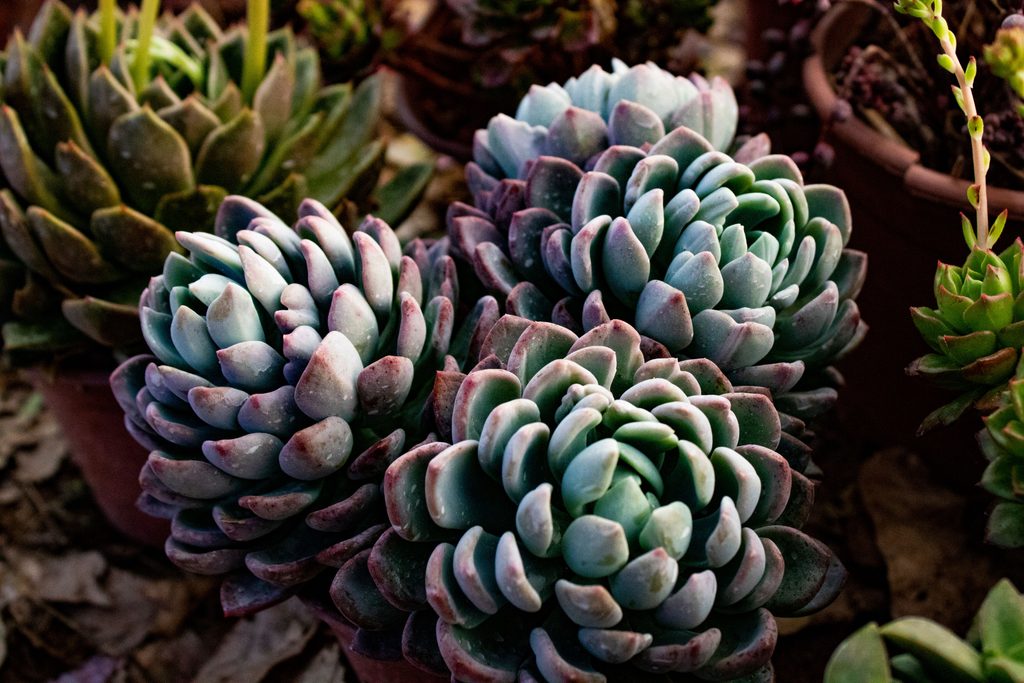
This is often the first rose succulent people buy. Echeveria elegans forms a tight, pale blue-green rosette. A soft white powder covers the leaves. It gives the plant a frosted look.
Each rosette stays small, usually a few inches wide. Over time it produces many offsets. A single pot can become a lovely cluster.
In spring, it sends up arching stems with pink and yellow bell-shaped flowers. I find this the easiest echeveria for beginners. Give it bright light and let the soil dry fully between waterings.
2. Echeveria ‘Perle von Nürnberg’
If you want a romantic rose-like succulent, this is it. The leaves blend lavender, pink and gray. The shades shift with the light and season.
The rosette is wide and open, with a pearly sheen. Strong sun deepens the pink tones. In low light, the colors fade to dull gray-green.
It grows slowly and stays compact. A shallow clay pot suits it well. Water only when the soil is completely dry.
3. Echeveria ‘Black Prince’
For a darker, moodier “rose,” try ‘Black Prince’. The leaves are deep maroon, close to black. They have pointed tips and form a dense rosette.
Color is strongest in bright light and cool weather. In shade, the plant turns greenish and loses its drama. I always place mine in the sunniest spot.
In late summer, it produces red flowers on short stems. The contrast with the dark leaves is striking. It looks excellent beside paler succulents.
ALSO READ: 15 Flowers That Look Like Roses: Identification and Pictures
4. Echeveria agavoides (Lipstick Echeveria)
This one looks like a half-opened rosebud with red-painted edges. The leaves are firm, pointed and green. Their tips blush red in strong sun, which explains the common name.
Unlike softer echeverias, this species has a sturdy, sculpted shape. The rosette can reach about eight inches across. It is also quite tolerant of heat.
Protect it from frost, as all echeverias are tender. Use a gritty, fast-draining mix and water sparingly. A bright south- or west-facing window works well indoors.
5. Echeveria ‘Blue Rose’
The name says it all. ‘Blue Rose’ has broad, blue-green leaves with wavy edges. The layers open slowly, much like a garden rose.
It is a large variety and makes a bold focal point. A mature plant can look like a sculpture. A soft, pale bloom coats the foliage, so avoid touching it.
Fingerprints leave marks on that powder. Water at the base of the plant and keep the rosette dry. Provide bright light for the best shape.
6. Echeveria ‘Lola’
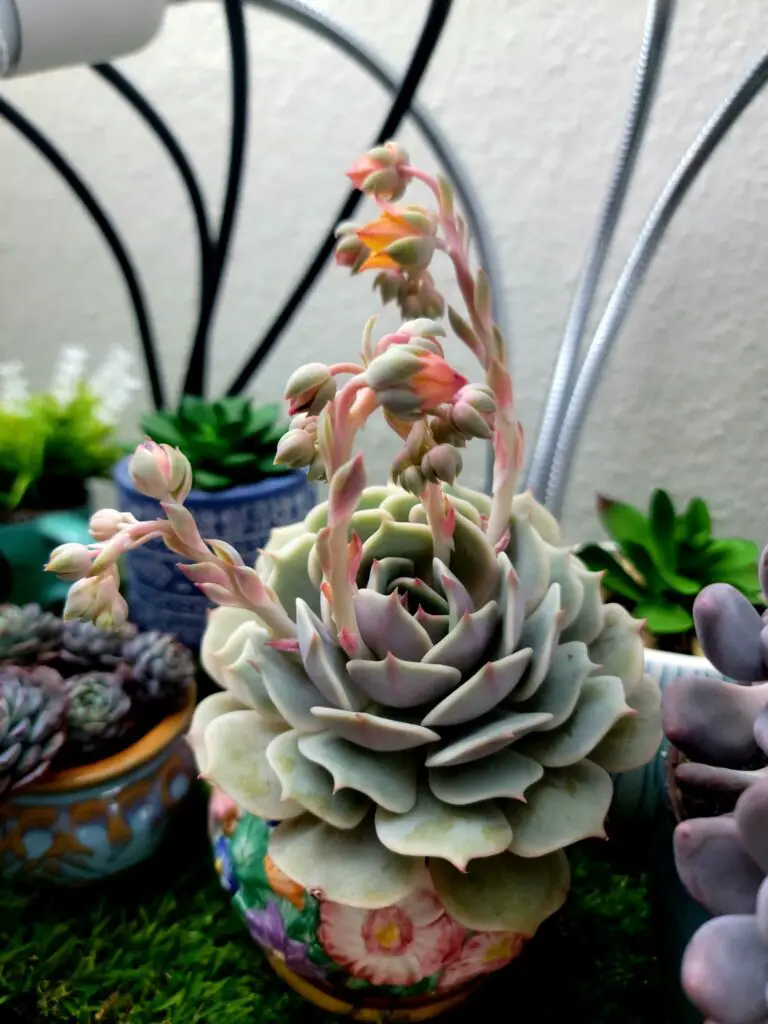
‘Lola’ is a pastel dream. Its leaves are pale lilac and pink, with a pearly finish. The rosette is neat, round and symmetrical.
Many gardeners call it one of the most elegant echeverias. It looks particularly fine in a white or terracotta pot. I often see it used in wedding centerpieces for that reason.
It grows moderately and offsets freely. Give it plenty of light to keep the pastel tone. Too little light turns it a flat green.
ALSO READ: 7 Simple Ways to Get Echeveria Lola to Bloom
7. Echeveria lilacina (Ghost Echeveria)
This species looks like a silver-gray rose carved from frost. The leaves are wide, smooth and slightly cupped. Faint pink edges appear in bright light.
It is a popular plant for collectors. The shape is open and elegant. Large plants can reach around eight inches across.
It grows well in containers. Keep it dry in winter and give it good airflow. Overwatering is the main risk, as with all echeverias.
8. Echeveria ‘Afterglow’
‘Afterglow’ is a large, graceful hybrid. Its leaves are soft lavender-pink with a dusty coating. They curve gently outward, like a wide-open rose.
It is one of the bigger echeverias and can fill a pot nicely. The ruffled, layered look catches the eye immediately. In late spring, it may send up tall flower spikes.
Bright light keeps the pink tones strong. Water deeply, then wait until the soil is dry. I treat it as a statement plant in mixed arrangements.
9. Echeveria ‘Topsy Turvy’
This one is the quirky cousin of the group. ‘Topsy Turvy’ has gray-green leaves that curl and twist backward. The rosette looks like a rose caught in a breeze.
The unusual form makes it stand out. It is also easy to propagate from leaves. I like how each rosette looks a little different.
Like other echeverias, it wants bright light and sharp drainage. Water sparingly. It handles small pots well and rarely needs repotting.
ALSO READ: 35 Popular Types of Echeveria Succulents (With Pictures, and Care Tips)
Aeonium: Rose-Like Rosettes with Drama
Aeoniums are native to the Canary Islands, northern Africa and nearby regions. The University of California Marin Master Gardeners note that the genus includes about 35 species in many colors. An important fact is that each rosette dies after it blooms. Cuttings let you keep the plant going.
10. Aeonium arboreum ‘Zwartkop’ (Black Rose)
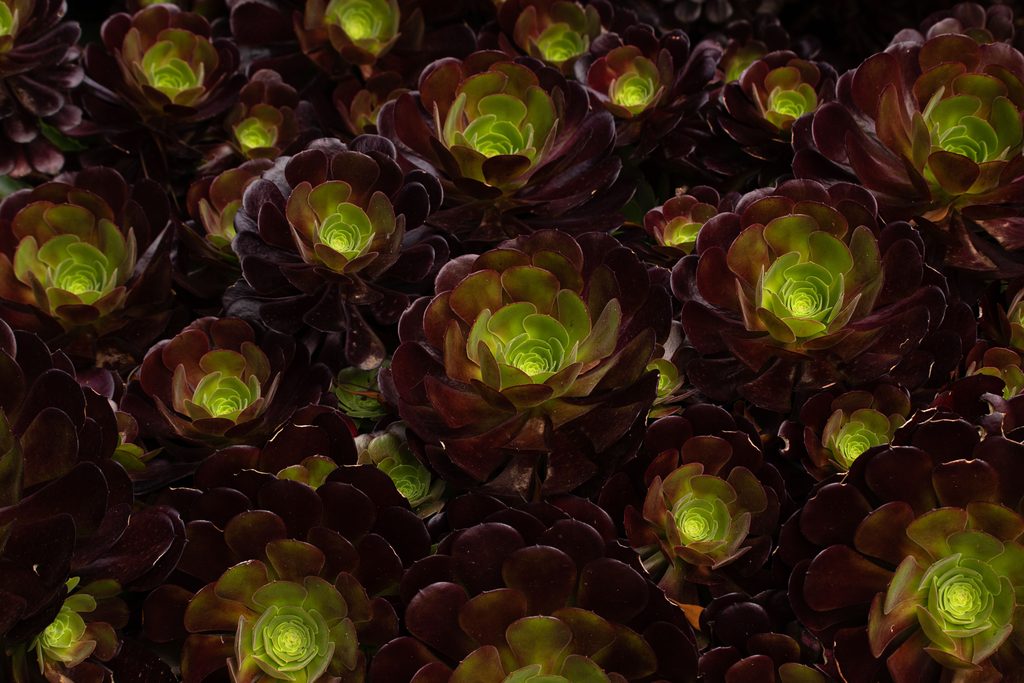
Few succulents earn the name “rose” as well as this one. ‘Zwartkop’ has glossy, dark purple-black leaves arranged in a perfect spiral. The center often glows green or deep burgundy.
It grows on a tall, woody stem, so each rosette sits on top like a flower. A mature plant can reach two to three feet. That height makes it a dramatic accent.
Give it bright light to keep the dark color. In shade, the leaves turn green. It likes cool, mild weather and may rest during hot summers.
11. Aeonium haworthii ‘Kiwi’ (Irish Rose)
Gardeners also call ‘Kiwi’ the Irish rose, and the name suits it. The petal-like leaves are soft green and creamy yellow. A pink or red ribbon borders each leaf.
University of California Master Gardeners describe it as an award-winning hybrid. It grows in USDA zones 9 to 11. It needs enough sun to develop its red edges.
The plant forms branching clumps up to two or three feet wide. Like all aeoniums, each rosette dies after flowering. You can transplant the pups to keep it going.
12. Aeonium tabuliforme (Dinner Plate Aeonium)
This succulent looks like a flat, green rose that has been pressed open. The leaves overlap in a tight, flat disc. Fine hairs line the edges.
The shape is unusual and very sculptural. It can grow quite wide, though it stays close to the ground. I would call it the most architectural plant on this list.
It prefers morning sun and afternoon shade in hot climates. Water moderately in the cool growing season. Keep it drier during summer rest.
13. Aeonium ‘Sunburst’
‘Sunburst’ is a bright, cheerful variety. Its large rosettes have variegated green and cream leaves. Coppery red edges frame each one.
The rosettes sit on stalks up to about 18 inches tall. The result looks like a bouquet of open roses. University of California Master Gardeners of Santa Clara County note that it likes cool weather and dislikes scorching sun.
Plant it where it gets gentle light. Water when the soil dries. It is a strong choice for large containers.
14. Aeonium canariense (Giant Velvet Rose)
The common name tells the story. Aeonium canariense forms large, soft rosettes covered in fine hairs. They look like velvety green roses.
It stays closer to the ground than some relatives. Each rosette can grow quite large. A mature plant makes a lush, full display.
The Santa Clara County Master Gardeners say it is hardy to about 25 to 30°F. In hot summers, the rosettes may close up like an artichoke. That is normal dormancy, so do not water at that time.
15. Aeonium diplocyclum (Rose-Like Greenovia)
This plant was once placed in the genus Greenovia, and many growers still use that name. It is one of the most rose-like succulents in the world. The rosette has layered, cupped leaves that look like an opening bloom.
The leaves are pale green with a soft, waxy coating. The shape is almost too perfect. I consider it a collector’s favorite.
It comes from the Canary Islands and prefers mild conditions. Give it bright light and very free drainage. Avoid overwatering, especially in warm weather.
Sempervivum: Hardy Rose Succulents for Cold Climates
Sempervivums, called hens and chicks or houseleeks, are the tough ones. North Carolina State Extension notes that the genus name means “live forever” in Latin. They grow well in cold climates where echeverias would die.
16. Sempervivum tectorum (Common Houseleek)
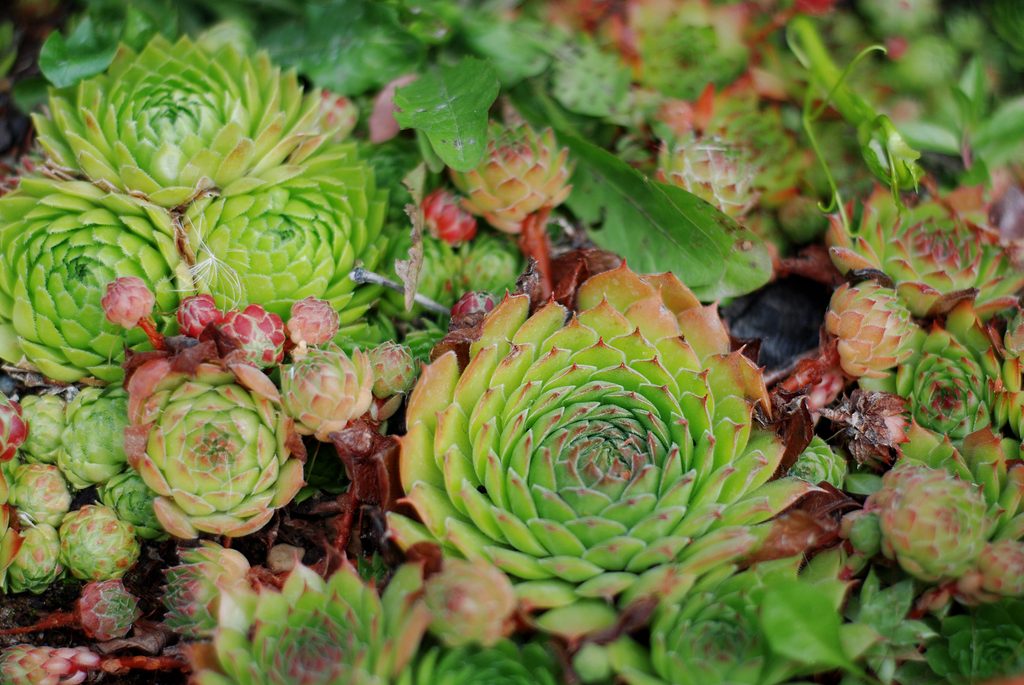
This is the classic hens and chicks plant. Sempervivum tectorum forms gray-green rosettes with purple-brown tips. The “hen” sits in the center, and the “chicks” spread around it.
NC State Extension explains that the species name means “of roofs.” Old traditions claimed it protected houses from lightning. Today, it is a favorite for rock gardens and containers.
It needs full sun and sharp drainage. It tolerates poor soil and some drought. Remove a rosette after it flowers, because that rosette dies.
17. Sempervivum arachnoideum (Cobweb Houseleek)
Imagine a small rose wrapped in spider silk. That is Sempervivum arachnoideum. Fine white threads stretch across the tips of the leaves, like cobwebs.
The rosettes are small and tight. They spread into dense mats over time. In full sun, the tips take on a red tint.
This plant loves rocky, dry conditions. Keep rain off the center if possible. Excess moisture can cause rot.
18. Sempervivum calcareum
This species forms neat, symmetrical rosettes of gray-green leaves. Magenta tips add a touch of color. The shape is very much like a closed rosebud.
University of California Master Gardeners describe it as a survivor. It is easy to grow indoors or outdoors, and pests rarely bother it. The chicks form in a circle around the mother plant.
Use a cactus mix or sandy loam. Provide full sun. Decorative pots show off the pattern well.
Other Rose-Like Succulents Worth Growing
These plants belong to other genera, but they share the same rosette beauty. Some are hybrids made by crossing different succulents.
19. Graptopetalum paraguayense (Ghost Plant)
The ghost plant has thick, pale gray-lilac leaves that form loose rosettes. The color looks soft and dusty. In strong light, it picks up pink and yellow shades.
It grows on trailing stems, so it works well in hanging baskets. The rosettes can reach a few inches across. It comes from Mexico and is very forgiving.
Leaves drop easily and root quickly. That makes propagation almost effortless. Bright light and very little water are all it needs.
20. Graptoveria ‘Debbi’
‘Debbi’ is a hybrid of Graptopetalum and Echeveria. The plant forms a wide, open rosette of pink-tinted leaves. It looks like a full-blown garden rose.
The color intensifies in strong sun. Cooler weather brings out deeper pinks. In shade, the shade fades fast.
It offsets readily and fills a container over time. Use a gritty mix and water only when dry. I find it one of the easiest hybrids to keep.
21. Graptosedum ‘California Sunset’
This hybrid combines Graptopetalum and Sedum. The rosettes are small and neat. Their leaves glow in shades of peach, pink and soft orange.
The warm tones suggest a rose at dusk. Bright light brings out the color. Plants kept indoors may turn a muted green.
It is easy to grow and spreads gently. It suits shallow dishes and mixed arrangements. Water sparingly and ensure good drainage.
22. Dudleya brittonii (Giant Chalk Dudleya)
This is a large, chalky white-blue rose. The leaves are thick and covered in heavy wax. The rosette can grow broad and bold.
It comes from the Baja California coast. Its pale color is a natural sun shield. Touching the wax leaves marks, so handle with care.
Dudleyas dislike summer water, especially overhead. Plant them in very sharp drainage. In my experience, they suit dry, sunny gardens best.
23. Dudleya farinosa (Bluff Lettuce)
The National Park Service describes Dudleya farinosa as a low-growing native plant. It grows on coastal cliffs and sandy bluffs in California. A mealy wax covers its leaves.
The triangular leaves form a tidy basal rosette. Pale lemon-yellow flowers rise on long reddish stalks. The NPS notes that it blooms from July to September.
It is also called “hen and chicks” locally. The plant is a good reminder that wild succulents can be as lovely as garden hybrids. Keep it dry and give it full sun.
24. Orostachys iwarenge (Chinese Dunce Cap)
This succulent forms tight, spiky rosettes that resemble small artichokes or tightly closed roses. The leaves are blue-green with sharp, pale tips. They give the plant a crisp look.
It is a hardy plant that tolerates cold. It spreads by runners and offsets. After a rosette flowers, it dies, but new ones fill in.
Give it full sun and sharp drainage. It does well in rock gardens and shallow troughs. I enjoy its architectural, almost frosted look.
25. Pachyveria ‘Blue Haze’
Our last choice is a hybrid of Pachyphytum and Echeveria. ‘Blue Haze’ forms a plump rosette of blue-gray leaves. A dusty bloom covers them.
The leaves are thick and smooth. Bright light adds a pink or lavender blush at the edges. The overall effect is soft and rose-like.
It grows slowly and stays compact. Handle it gently, as the powder marks easily. Water sparingly and provide strong light.
ALSO READ: 15 Stunning Succulents with White Flowers: (Pictures, Features and Care Tips)
How to Keep Rose-Like Succulents Healthy
Most of these plants share the same basic needs. A few simple habits make a big difference.
- Give them strong light. Light is one of the most limiting factors indoors, says Iowa State University Extension. Without enough, rosettes stretch and lose color. A bright south or west window is ideal.
- Use a fast-draining mix. University of Missouri Extension warns that all-purpose potting mixes hold too much water. They can cause root rot. A cactus mix with extra perlite or coarse sand works well.
- Water deeply, then wait. Illinois Extension says succulents generally need water every two to three weeks. The biggest mistake is overwatering. Check the soil first, and let it dry completely.
- Keep the air dry. Montana State University Extension notes that succulents prefer low humidity, around 10 to 30 percent. Avoid bathrooms and steamy kitchens.
- Watch the temperature. Missouri Extension suggests keeping succulents between 55 and 75°F for best results. Tender types like echeverias cannot tolerate frost.
Frequently Asked Questions
Which succulent looks most like a rose? Many gardeners point to Aeonium diplocyclum and Echeveria ‘Blue Rose.’ Their layered leaves open much like real petals.
Are rose-shaped succulents easy to grow? Yes, most are. Give them light, drainage and little water, and they will do well.
Can I grow them indoors? Absolutely. Place them in the brightest spot you have. If the rosette stretches, it needs more light.
Why does my succulent rosette die after flowering? Aeoniums and sempervivums are monocarpic. The flowering rosette dies, but offsets continue the plant.
Final Thoughts
Rose-like succulents offer beauty without the fuss. From the pale elegance of ‘Lola’ to the dark drama of ‘Zwartkop,’ there is a style for every taste. Some are hardy, and some are tender, so match your choice to your climate.
I suggest starting with one or two easy varieties. Echeveria elegans and Sempervivum tectorum are great first picks. Once you see how simple they are, I expect you will want more.
References
- Iowa State University Extension and Outreach. “Growing Succulents Indoors.” https://yardandgarden.extension.iastate.edu/how-to/growing-succulents-indoors
- University of Illinois Extension. “Did You Forget to Water Your Plants? Try Low-Maintenance Succulents.” https://extension.illinois.edu/news-releases/did-you-forget-water-your-plants-try-low-maintenance-succulents
- University of Missouri Extension. “‘Succulent Mania’ Takes Root.” https://extension.missouri.edu/news/succulent-mania-takes-root
- Montana State University Extension. “Growing Succulents.” https://fdn.montana.edu/extension/lila_extn/lila_winter_23/GrowingSucculents.html
- North Carolina State Extension. “Sempervivum tectorum.” https://plants.ces.ncsu.edu/plants/sempervivum-tectorum
- UC Marin Master Gardeners, University of California Agriculture and Natural Resources. “Aeonium.” https://ucanr.edu/site/uc-marin-master-gardeners/article/aeonium
- U.S. National Park Service, Presidio of San Francisco. “Liveforever (Dudleya farinosa).” https://home.nps.gov/prsf/learn/nature/liveforever.htm

Tim M Dave is a gardening expert with a passion for houseplants, particularly cacti and succulents. With a degree in plant biology from the University of California, Berkeley, he has vast experience in gardening. Over the years, he has cultivated a vast collection of desert plants and learned a great deal about how to grow and care for these unique companions.