25 Trees Native to Illinois (With Growing Details)
Illinois holds roughly 4.8 million acres of forest land, according to the U.S. Forest Service’s most recent Forest Inventory and Analysis report, spread mostly across the western river bluffs and the deep south near Shawnee National Forest.
I used to assume Illinois was mostly cornfields with a few scattered woodlots. Then I spent a weekend hiking the Shawnee Hills and realized how wrong that assumption was. Oak-hickory forest dominates huge stretches of the southern third of the state, and river bottoms along the Mississippi and Illinois Rivers hold some genuinely massive trees.
The University of Illinois Extension recognizes approximately 184 native tree and tree-sized shrub species statewide. This guide covers 25 of the most significant ones, the species you’re most likely to encounter on a hike, along a riverbank, or growing in your own backyard.
Why Illinois’s Forests Matter
A little context helps before jumping into the list. Illinois forests aren’t just scattered remnants. They support real ecological diversity and a modest but active timber economy.
Private landowners control the overwhelming majority of Illinois forest land, holding roughly 83 percent of the total, according to Forest Service ownership data. That’s a much higher private share than most states, which makes individual landowner decisions unusually influential here.
Hardwoods dominate almost completely. Oak-hickory and elm-ash-cottonwood forest types together make up 92 percent of Illinois forest land, per the Forest Service’s regional forest health reporting, with white oak, red oak, and hickory forming the backbone of the state’s largest timber stands.
The trend line is actually encouraging. Illinois forest coverage has increased by 67 percent since 1924, according to University of Illinois Extension’s Big Tree Register program, as farmland reverted to woodland and conservation efforts took hold across the state.
The 25 Native Trees of Illinois
The list below moves from the state’s iconic oaks and hickories through its distinctive bottomland and prairie-edge species.
1. White Oak (Quercus alba)
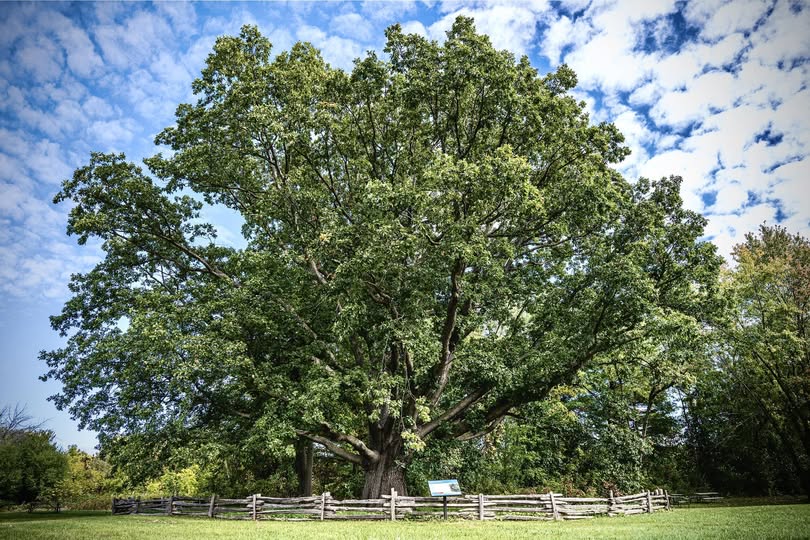
White oak is the official state tree of Illinois, and it earns that honor through both abundance and sheer usefulness. It’s the single most voluminous tree species in the state’s forests.
Look for rounded, finger-like lobes on the leaves, without the sharp bristle tips found on red oak family members, along with light gray, flaky bark.
This species can live for centuries, and its strong, tight-grained wood has long been prized for barrels, flooring, and shipbuilding. Illinois’s largest and oldest trees are frequently white oaks.
I always find it fitting that the state named for prairies picked a forest giant as its symbol. It says something about how much this tree matters here.
2. Bur Oak (Quercus macrocarpa)
Bur oak thrives on the prairie-forest border, tolerating fire, drought, and compacted soil better than almost any other native Illinois tree.
Its acorns sit inside a distinctive, deeply fringed cap that looks almost furry, one of the easiest identifying features among the state’s native oaks.
Thick, corky bark historically protected mature bur oaks from the low-intensity prairie fires that swept across Illinois before widespread settlement, allowing scattered “oak openings” to persist for generations.
3. Northern Red Oak (Quercus rubra)
Northern red oak grows faster than white oak and produces some of the most commercially valuable hardwood lumber harvested in the state.
Its leaves have pointed, bristle-tipped lobes, a quick way to separate it from the rounded lobes of white oak and bur oak in the field.
This species is increasingly threatened by oak wilt, a fungal disease that spreads through root grafts and can kill a mature tree within a single growing season.
4. Pin Oak (Quercus palustris)
Pin oak grows naturally in wet, poorly drained bottomlands, though it’s also one of the most widely planted street trees in Illinois cities and towns.
Its deeply cut leaves with sharp, bristled lobes and a distinctive pyramidal growth habit, with lower branches often drooping toward the ground, make it easy to spot from a distance.
Younger pin oaks sometimes hold their dead brown leaves through winter, a trait called marcescence that’s especially noticeable on the lower branches.
5. Swamp White Oak (Quercus bicolor)
Swamp white oak grows in wet floodplains and low-lying areas, tolerating occasional flooding better than most other oak species native to Illinois.
Its leaves show a two-toned effect, dark green on top and pale, almost whitish underneath, which is exactly how the tree got its common name.
This species has become increasingly popular for urban plantings, since it handles compacted, poorly drained city soils better than many alternatives.
6. Shagbark Hickory (Carya ovata)
Shagbark hickory is instantly recognizable, even from a moving car, thanks to bark that peels away in long, curling plates that seem to hang loosely off the trunk.
Its compound leaves typically have five leaflets, and the tree produces a sweet, edible nut favored by squirrels and historically gathered by Indigenous communities and settlers alike.
This species grows slowly but can live for several centuries, often found mixed with oaks across Illinois’s upland hardwood forests.
7. Bitternut Hickory (Carya cordiformis)
Bitternut hickory grows faster than shagbark hickory and lacks the dramatic peeling bark, making it a bit less flashy but far more common statewide.
Look for bright yellow buds at the branch tips, a distinctive feature not shared by other native hickory species in Illinois.
As the name suggests, the nuts taste extremely bitter and are rarely eaten by people, though wildlife still relies on them as a food source.
8. Pecan (Carya illinoinensis)
Pecan reaches its northern natural range limit in southern Illinois river bottoms, where it grows alongside cottonwood and sycamore in rich, fertile soil.
Its long, narrow compound leaves with 9 to 17 leaflets distinguish it from other hickories, along with its smooth, oblong, thin-shelled nuts.
Wild Illinois pecan trees rarely match the productivity of cultivated southern orchards, but they still provide a genuinely native food source for both wildlife and foragers.
9. Sugar Maple (Acer saccharum)
Sugar maple produces Illinois’s most vivid fall color and is the primary source for the modest amount of maple syrup produced in the state each spring.
Its leaves have five pointed lobes with smooth edges between the points, turning brilliant orange, red, and yellow before dropping in autumn.
This species dominates much of the state’s mesic upland forest, often growing in the shaded understory beneath taller oaks and hickories for decades before reaching the canopy.
10. Silver Maple (Acer saccharinum)

Silver maple grows fast and large, commonly found along rivers and floodplains across Illinois, where periodic flooding would kill less tolerant species.
Its deeply cut, silvery-backed leaves flash a distinctive two-toned shimmer in the wind, easy to spot from a distance on a breezy day.
By volume, silver maple ranks among the most abundant tree species in Illinois forests, according to Forest Service inventory data, second only to white oak in total wood volume statewide.
11. Red Maple (Acer rubrum)
Red maple tolerates a remarkably wide range of soil and moisture conditions, growing everywhere from wet bottomlands to drier upland sites across Illinois.
Look for small red flowers in early spring, appearing well before the leaves emerge, followed later by winged seed pairs that spin like helicopters when they fall.
Its adaptability has made it one of the most frequently planted native shade trees in Illinois yards and along city streets.
12. Boxelder (Acer negundo)
Boxelder is technically a maple, though its compound leaves confuse plenty of people who expect the classic single-lobed maple shape.
It’s one of the few native maples with leaves divided into three to five leaflets, closer in appearance to an ash tree than a typical maple leaf.
This tree grows almost anywhere, tolerates poor soil and disturbance well, and famously produces the boxelder bugs that swarm Illinois homes each autumn.
13. American Sycamore (Platanus occidentalis)
American sycamore is one of the largest native hardwoods in Illinois, commonly reaching massive girths along rivers and streams throughout the state.
Its mottled, peeling bark reveals patches of white, gray, and greenish inner bark, creating a distinctive camouflage pattern visible from a considerable distance.
Old, hollow sycamores historically provided shelter for wildlife and even early settlers, since a single mature trunk can hollow out into a surprisingly spacious cavity.
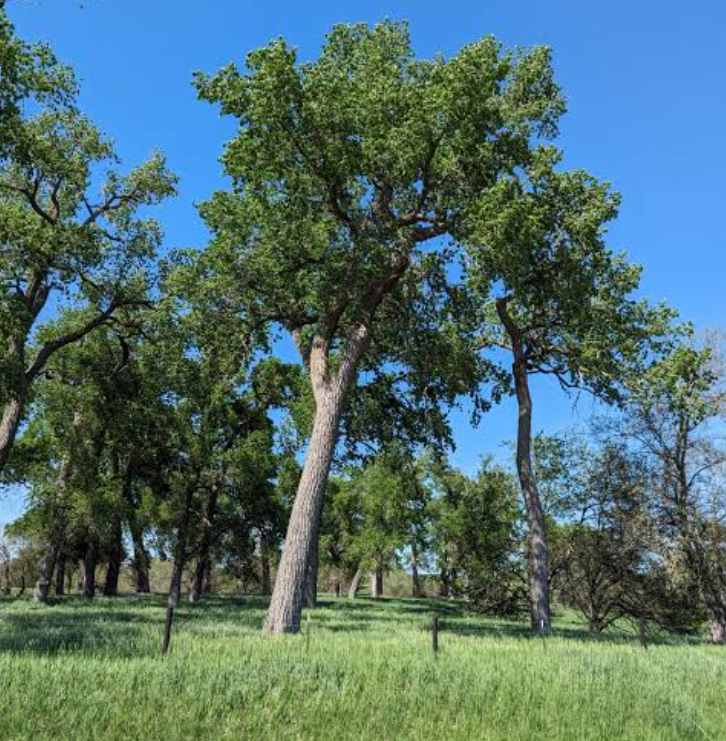
14. Eastern Cottonwood (Populus deltoides)
Eastern cottonwood grows into one of the tallest and fastest-growing native hardwoods in Illinois, commonly found along rivers, floodplains, and disturbed open ground.
Triangular leaves with coarsely toothed edges flutter noticeably in wind, and the tree produces enormous quantities of cottony seed fluff each early summer.
Fast growth and deep roots make this species valuable for stabilizing riverbanks, though its size and brittle wood mean it’s rarely planted intentionally near homes.
15. American Basswood (Tilia americana)
American basswood, sometimes called linden, produces small, fragrant flowers in early summer that attract enormous numbers of bees and other pollinators.
Its heart-shaped leaves are lopsided at the base, an easy identifying feature once you know to look for the asymmetry.
Beekeepers value this tree highly, since basswood honey has a distinctive, slightly minty flavor considered a regional specialty across the Midwest.
16. Tuliptree (Liriodendron tulipifera)
Tuliptree, also called tulip poplar or yellow poplar, reaches its western range limit in Illinois, growing mostly in the richer soils of the southern third of the state.
Its distinctive, squared-off leaves look almost like a cat’s silhouette, and the tree produces large, tulip-shaped yellow-green flowers each spring.
This species grows remarkably straight and tall, historically prized by builders and furniture makers for its light, easily worked wood.
17. Black Walnut (Juglans nigra)
Black walnut grows throughout Illinois and remains one of the most commercially valuable native hardwoods harvested in the state, prized for fine furniture and gunstocks.
Its compound leaves contain up to 23 leaflets, and crushed foliage or husks release a strong, distinctive citrus-like odor.
The tree produces a natural chemical called juglone that suppresses many nearby plants, so gardeners typically need to plan carefully around a mature specimen.
18. Kentucky Coffeetree (Gymnocladus dioicus)
Kentucky coffeetree is genuinely uncommon in the wild, though it grows naturally in Illinois river bottoms and has become a popular urban landscape tree.
Its huge, doubly compound leaves can span two to three feet, among the largest of any tree native to the state, giving it a bold, almost tropical appearance.
Early settlers reportedly roasted the tree’s large seed pods as a coffee substitute, though the raw seeds are toxic and require careful preparation before use.
19. Osage Orange (Maclura pomifera)
Osage orange holds a unique place in Illinois agricultural history, since farmers once planted it extensively as a living fence before barbed wire became widely available.
Its large, bumpy, chartreuse-green fruit looks almost like a brain, and the wood is exceptionally hard, rot-resistant, and historically prized for archery bows.
Sharp thorns along younger branches made this species ideal for containing livestock, and old hedgerows still mark property lines across rural Illinois today.
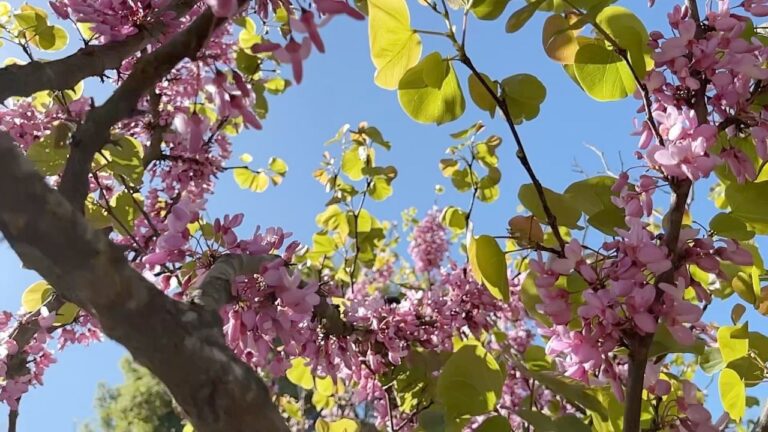
20. Eastern Redbud (Cercis canadensis)
Eastern redbud is one of the first native trees to bloom each spring, covering its bare branches in vivid pink-purple flowers before the leaves even emerge.
Its heart-shaped leaves unfurl shortly after the flowers fade, giving the tree a completely different look through the rest of the growing season.
This small understory tree grows naturally along woodland edges throughout Illinois and has become one of the most popular native ornamentals for home landscaping.
21. Flowering Dogwood (Cornus florida)
Flowering dogwood grows as a small, shade-tolerant understory tree, most common in the wooded ravines and bluffs of southern and western Illinois.
Its showy white “flowers” are actually modified leaf bracts surrounding a small cluster of true flowers at the center, a detail most casual observers never notice.
Bright red berries in fall provide an important food source for migrating birds, and the tree’s horizontal branching pattern makes it a favorite for landscape design.
22. Sassafras (Sassafras albidum)
Sassafras is one of the easiest native Illinois trees to identify, since a single tree can produce three completely different leaf shapes: oval, mitten-shaped, and three-lobed.
Crushed leaves or twigs release a distinctive spicy, root-beer-like fragrance, historically used to flavor the original root beer and traditional teas.
This species often spreads through root sprouts, forming small colonial thickets along woodland edges and fence rows across the state.
23. American Persimmon (Diospyros virginiana)
American persimmon produces a sweet, orange fruit that’s genuinely inedible until fully ripe, when frost or time finally softens its intensely astringent tannins.
Its distinctive, blocky, alligator-hide bark breaks into small square plates, one of the more reliable winter identification features among Illinois’s native trees.
Wildlife, from raccoons to deer, rely heavily on fallen persimmon fruit each autumn, and the wood has historically been used for golf club heads due to its density.
24. Pawpaw (Asimina triloba)
Pawpaw produces the largest edible fruit native to North America, with a custardy texture and tropical flavor that surprises most people who try it for the first time.
Its large, drooping leaves give the understory a distinctly tropical look, unusual for a tree that tolerates Illinois winters just fine.
This species often grows in dense colonial patches along stream bottoms, since it spreads readily through underground root suckers in the right conditions.
25. Bald Cypress (Taxodium distichum)
Bald cypress reaches its northern natural range limit in the swamps of far southern Illinois, particularly around the Cache River, one of the state’s most unusual native habitats.
It’s a deciduous conifer, dropping its soft, feathery needles each fall, and often grows distinctive knobby “knees” projecting up from the water around its base.
Some Cache River cypress trees are estimated to be well over a thousand years old, making them among the oldest living things anywhere in the Midwest.
Where to See These Trees in the Wild
You don’t need to travel far to see a solid cross-section of this list. A handful of well-known Illinois destinations concentrate an outsized share of the state’s tree diversity.
Shawnee National Forest, in the far south, offers the best look at mature oak-hickory forest, along with tuliptree, sassafras, and dogwood growing across dramatic sandstone bluffs and canyons.
The Cache River watershed, also in southern Illinois, protects some of the state’s last bald cypress and tupelo swamps, a genuinely rare wetland ecosystem this far north.
For prairie-edge bur oak and hickory, areas along the Mississippi and Illinois River bluffs still hold scattered remnant savanna, a landscape type that’s become increasingly uncommon across the Midwest.
A Quick Note on Identification
If you’re trying to identify a tree in the field, start with three things: leaf shape, bark texture, and habitat. Wet-loving species like pin oak and silver maple look very different from dry-site trees like bur oak and post oak, even when growing just miles apart.
Bark alone solves a surprising amount of confusion in winter, when leaves aren’t available. Shagbark hickory’s peeling plates and persimmon’s blocky bark are nearly unmistakable even from a moving vehicle.
Timing helps too. Spring flowers, summer leaf shape, and fall color each offer a different clue, so a tree that stumps you in July might be obvious again come October or November.
Frequently Asked Questions
What is Illinois’s official state tree? White oak, chosen for its size, longevity, and historical importance across the state’s forests.
How many native tree species does Illinois have? The University of Illinois Extension recognizes approximately 184 native tree and tree-sized shrub species statewide. This guide covers 25 of the most significant and widely recognized ones.
Which Illinois tree produces the most valuable timber? White oak and black walnut are generally considered the state’s most commercially valuable native hardwoods, prized for furniture, flooring, and fine woodworking.
Are all trees planted in Illinois native to the state? No. Many common landscape and street trees, including Norway maple and tree-of-heaven, were introduced from other continents and aren’t native to Illinois.
References
- University of Illinois Extension — Checklist of Illinois Native Trees — https://extension.illinois.edu/sites/default/files/checklist_of_illinois_native_trees_1.pdf
- Illinois Department of Natural Resources — Wild About Illinois Trees — https://dnr.illinois.gov/education/wildaboutpages/wildaboutplants/wildaboutplantstrees.html
- Illinois Department of Natural Resources — For Your Garden: Native Plants — https://dnr.illinois.gov/education/fygmain.html
- U.S. Forest Service, Northern Research Station — Forests of Illinois, 2020 (Resource Update FS-322) — https://www.fs.usda.gov/nrs/pubs/ru/ru_fs322.pdf
- U.S. Forest Service, Northeastern Area State and Private Forestry — Illinois Forest Health Highlights — https://www.fs.usda.gov/foresthealth/docs/fhh/IL_FHH_2016.pdf
- University of Illinois Extension — Big Tree Register — https://extension.illinois.edu/forestry/big-tree-register
- University of Illinois Extension — Illinois Tree Selection Guide — https://web.extension.illinois.edu/treeselect/index.cfm

Tim M Dave is a gardening expert with a passion for houseplants, particularly cacti and succulents. With a degree in plant biology from the University of California, Berkeley, he has vast experience in gardening. Over the years, he has cultivated a vast collection of desert plants and learned a great deal about how to grow and care for these unique companions.