15 Stunning Dwarf Japanese Maple Varieties (With Pictures and Growing Tips)
If you have ever stood in a garden and felt something shift — a quiet pull toward one single tree — chances are it was a Japanese maple. I felt that exact thing the first time I saw a weeping ‘Crimson Queen’ in a corner bed, its burgundy lace brushing the mulch like a curtain.
That moment sent me deep into the world of dwarf Japanese maples, and I have never looked back.
These compact ornamental trees are among the most beloved in gardening — and for good reason. Dwarf Japanese maples (Acer palmatum) combine extraordinary color, elegant form, and manageable size in a single plant. For gardeners with limited space, there is no better investment.
This guide covers 15 standout dwarf Japanese maple varieties, their key traits, care requirements, and exactly where each one fits in a landscape. Whether you are planting in a container on a patio or adding a focal point to a small yard, one of these trees belongs in your space.
What Is a Dwarf Japanese Maple?
Before diving into specific varieties, it helps to understand what “dwarf” actually means in this context.
Dwarf Japanese maples typically grow between 3 and 10 feet (1–3 meters) tall, which is considerably smaller than standard Japanese maples that can reach 20–25 feet. They are either naturally compact cultivars or have been selected and bred specifically for slow growth and smaller stature.
Acer palmatum is native to Japan, China, and Korea, and has been long cultivated in Japan. It was introduced into England in 1820 and was available from a California nursery as early as 1854. Centuries of careful selection have produced a remarkable range of forms.
Today, at least a thousand different forms of Acer palmatum are known. That number can feel overwhelming. This article cuts through the noise and focuses on 15 of the most garden-worthy dwarf varieties — each one proven, widely available, and genuinely beautiful.
Why Choose a Dwarf Japanese Maple?
The practical case is straightforward. Most modern gardens are smaller than they used to be. Patios, balconies, courtyard gardens, and townhouse lots all call for plants that deliver visual impact without taking over the space.
Beyond size, dwarf Japanese maples offer something few other trees can match:
- Year-round interest — spring leaf emergence, summer color, spectacular autumn display, and sculptural winter branches
- Low maintenance once established
- Versatility — they thrive in containers, raised beds, rock gardens, and open ground
- Exceptional foliage color — from deep burgundy to lime green, orange, and variegated pink
Japanese maples range from 2 to 30 feet tall in forms that can be weeping, rounded, dwarf, mounding, upright, or cascading. Dwarf forms sit firmly at the compact end of that spectrum, giving gardeners both flexibility and control.
ALSO READ: Japanese Maple Bonsai: History, Styling, and Caring for Acer palmatum in Miniature
15 Best Dwarf Japanese Maple Varieties
1. Acer palmatum ‘Crimson Queen’
Height: Up to 4 feet after 10 years | Spread: 5–6 feet | Zones: 5–8
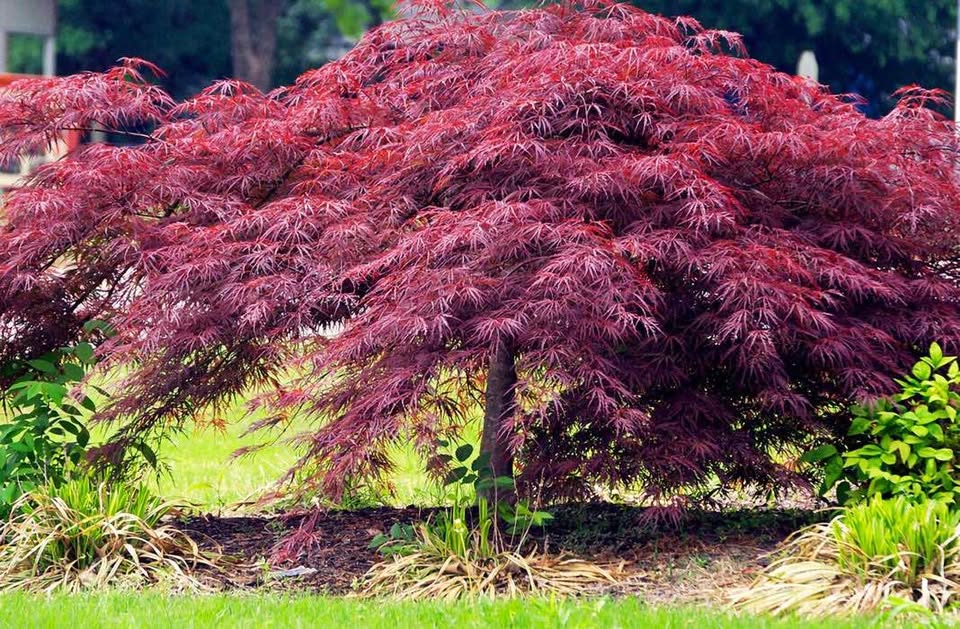
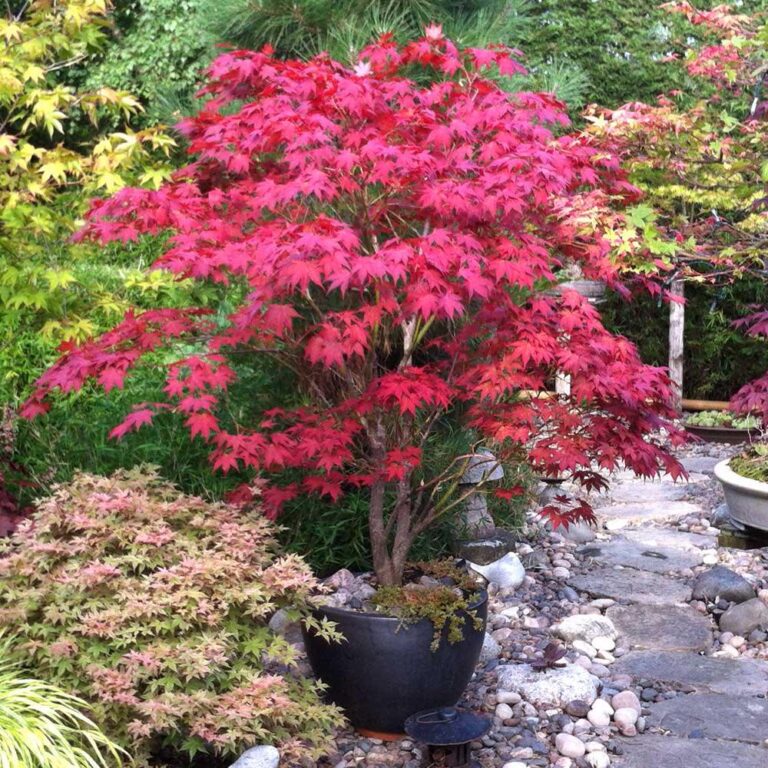
Crimson Queen is a dwarf American-bred variety, originating from a nursery in New Jersey. After a decade, it typically stands no taller than 4 feet and spreads 5–6 feet wide. From a young age, this maple quickly develops numerous lateral branches that droop, creating an immediate weeping effect.
What makes it special: Color retention. Unlike many red-leaved maples that shift to bronze-green in summer, Crimson Queen holds its deep red-maroon tone across all three growing seasons. The fall finale is a brilliant scarlet red.
This is one of the best choices for container growing and small patios. It is also an excellent option for gardeners who want a weeping form without waiting years for the pendulous effect to develop.
2. Acer palmatum ‘Red Dragon’
Height: 4–6 feet | Spread: Up to 6 feet | Zones: 5–9
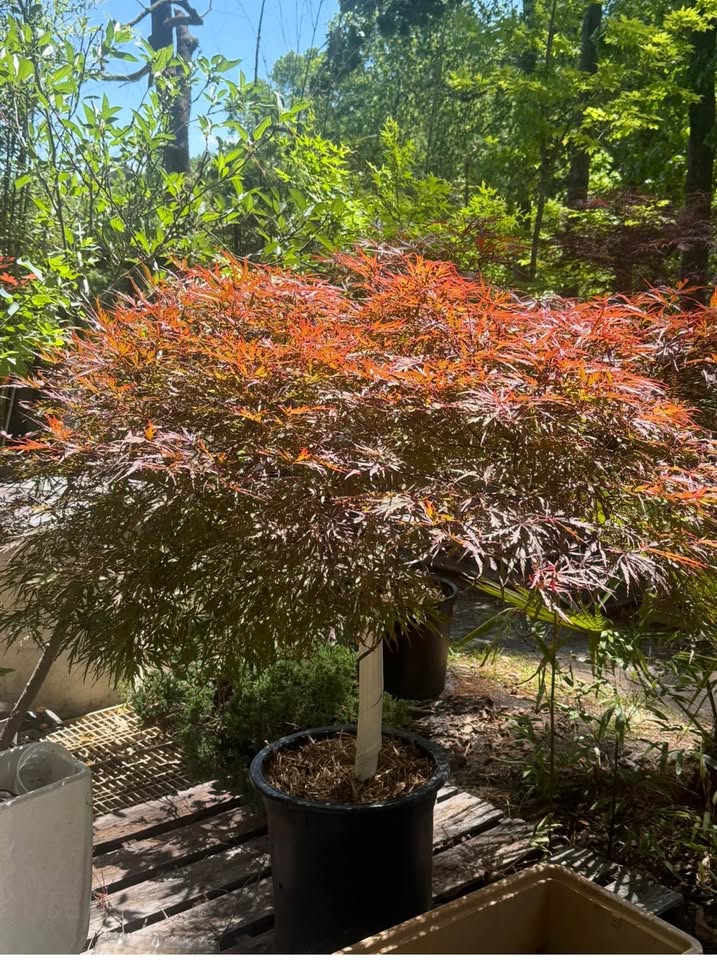
Acer palmatum ‘Red Dragon’ is a dwarf Japanese maple that is extremely popular for its brilliant red color. ‘Red Dragon’ will stay more red during summer than most varieties. The coarse leaves begin the spring dark red and become more red as temperatures increase.
Red Dragon is a captivating Japanese maple, especially known for its lacy leaves that resemble the silhouette of a dragon. The leaves are a rich burgundy on top, with the underside being a striking red or red-orange.
What makes it special: It is one of the few lace-leaf (dissectum) maples that holds its red color even as summer temperatures peak — when most other red cultivars have already shifted toward green. Fall color is a dramatic crimson.
Its growth habit is slightly more prostrate than other weeping types, which gives it a low, creeping silhouette that works beautifully in rock gardens.
3. Acer palmatum ‘Tamukeyama’
Height: Up to 6 feet | Spread: 8–12 feet | Zones: 5–9
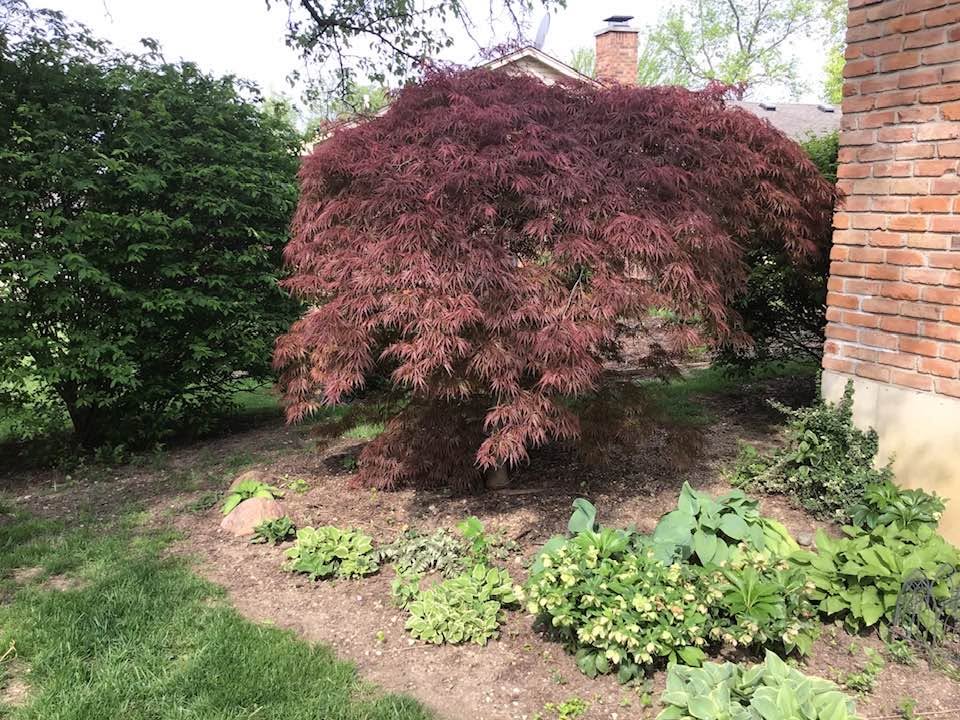
Acer palmatum ‘Tamukeyama’ has become known as one of the very best red lace leaf Japanese maples. This notoriety comes from its strong growth rate and spectacular red color throughout the year.
‘Tamukeyama’ is one of the fastest growing dwarf Japanese maples. ‘Tamukeyama’ grows slightly more irregular and upright than other lace leaf varieties. Acer palmatum ‘Tamukeyama’ has been grown in Japan for over 300 years.
What makes it special: Age and proven performance. Three centuries of cultivation is not an accident. It tolerates full sun even in hotter regions, making it one of the most resilient red lace-leaf maples available.
Vertrees wrote that ‘Tamukeyama’ was his favorite from this grouping. High praise from one of the foremost authorities on Japanese maples.
4. Acer palmatum ‘Orangeola’
Height: Up to 5 feet | Spread: Up to 4 feet | Zones: 5–8
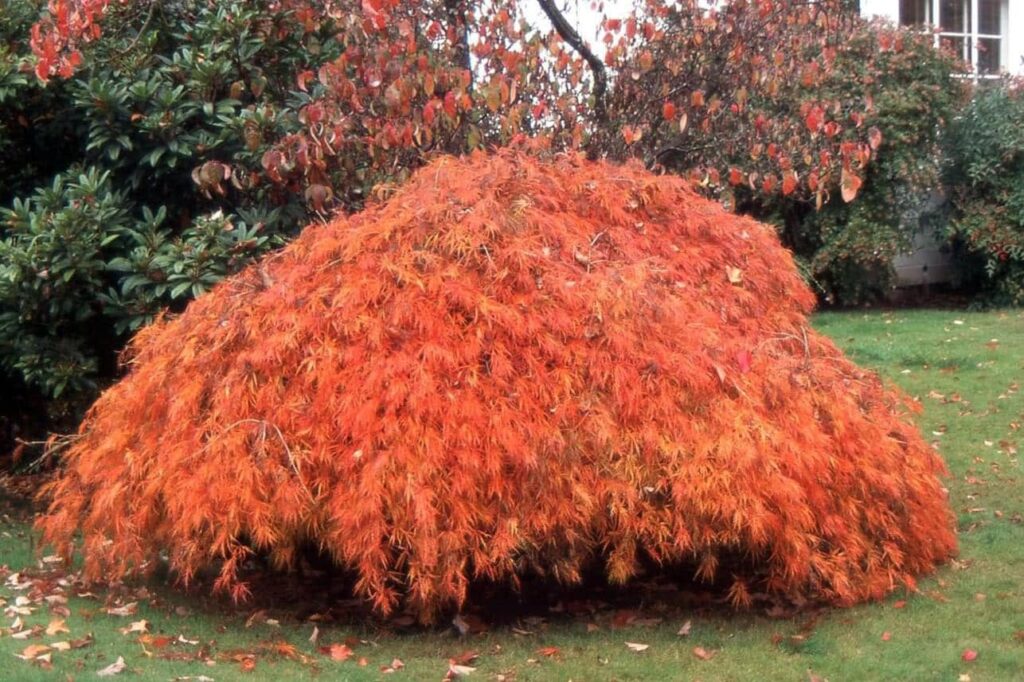
Acer palmatum ‘Orangeola’ is one of the fastest growing weeping dwarf Japanese maple varieties there is, but it still does not attain height very quickly. ‘Orangeola’ has a very pendulous habit and will have quite the waterfall look as it grows.
It emerges in the spring with heavily dissected leaves that have tones of green and orange in early spring and as the sun works its magic on the foliage it quickly turns brick red.
What makes it special: The seasonal color journey is genuinely theatrical. Spring brings orange-tinted green, summer transitions to brick red, and fall explodes into vivid orange. Few trees offer this much seasonal variety in such a small footprint.
Orangeola performs particularly well as a centerpiece plant or in a corner where its weeping form can be fully appreciated.
5. Acer palmatum ‘Garnet’
Height: Up to 5 feet | Spread: Up to 6 feet | Zones: 5–8
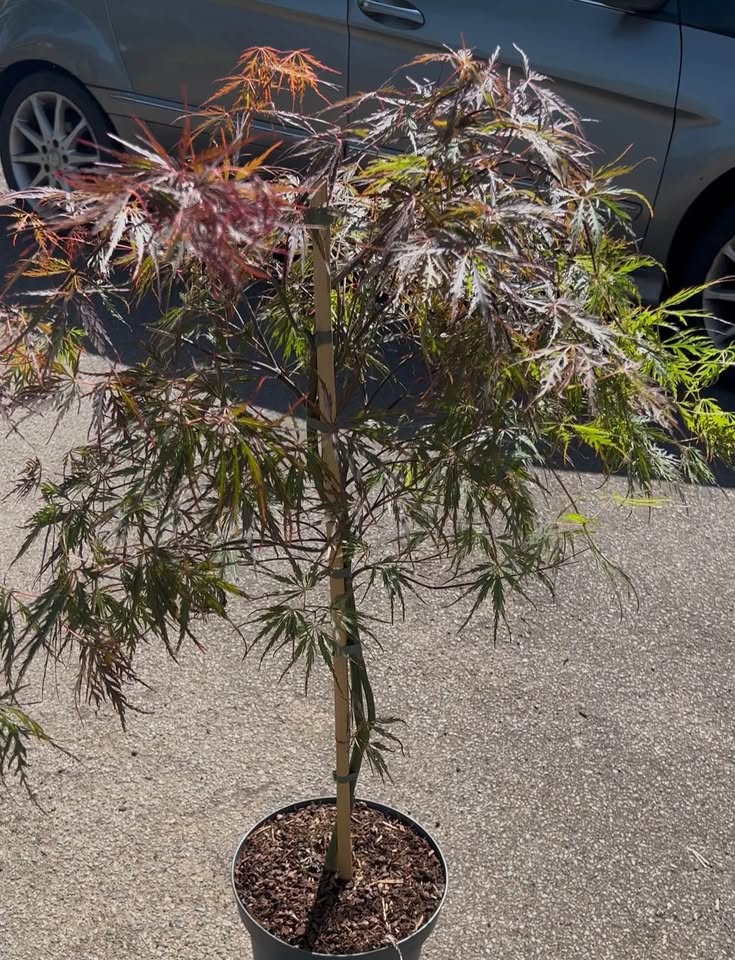
Garnet is a compact Japanese maple, reaching up to 5 feet in height and 6 feet in width. This small size makes it perfect for container planting or small gardens.
It features an umbrella-like, weeping growth pattern. The leaves of Garnet start off a bright red when young, gradually darkening to a burgundy hue as they mature.
What makes it special: The classic “gemstone” coloring — deep, saturated burgundy — paired with a tidy, umbrella-shaped canopy. Garnet is also more forgiving of sun exposure than many fine-leaved dissectum types, which can be prone to leaf scorch in full afternoon sun.
This variety is widely available, competitively priced, and genuinely low-fuss. A reliable first choice for beginner Japanese maple growers.
6. Acer palmatum ‘Viridis’
Height: 4–6 feet | Spread: Up to 7 feet | Zones: 5–8
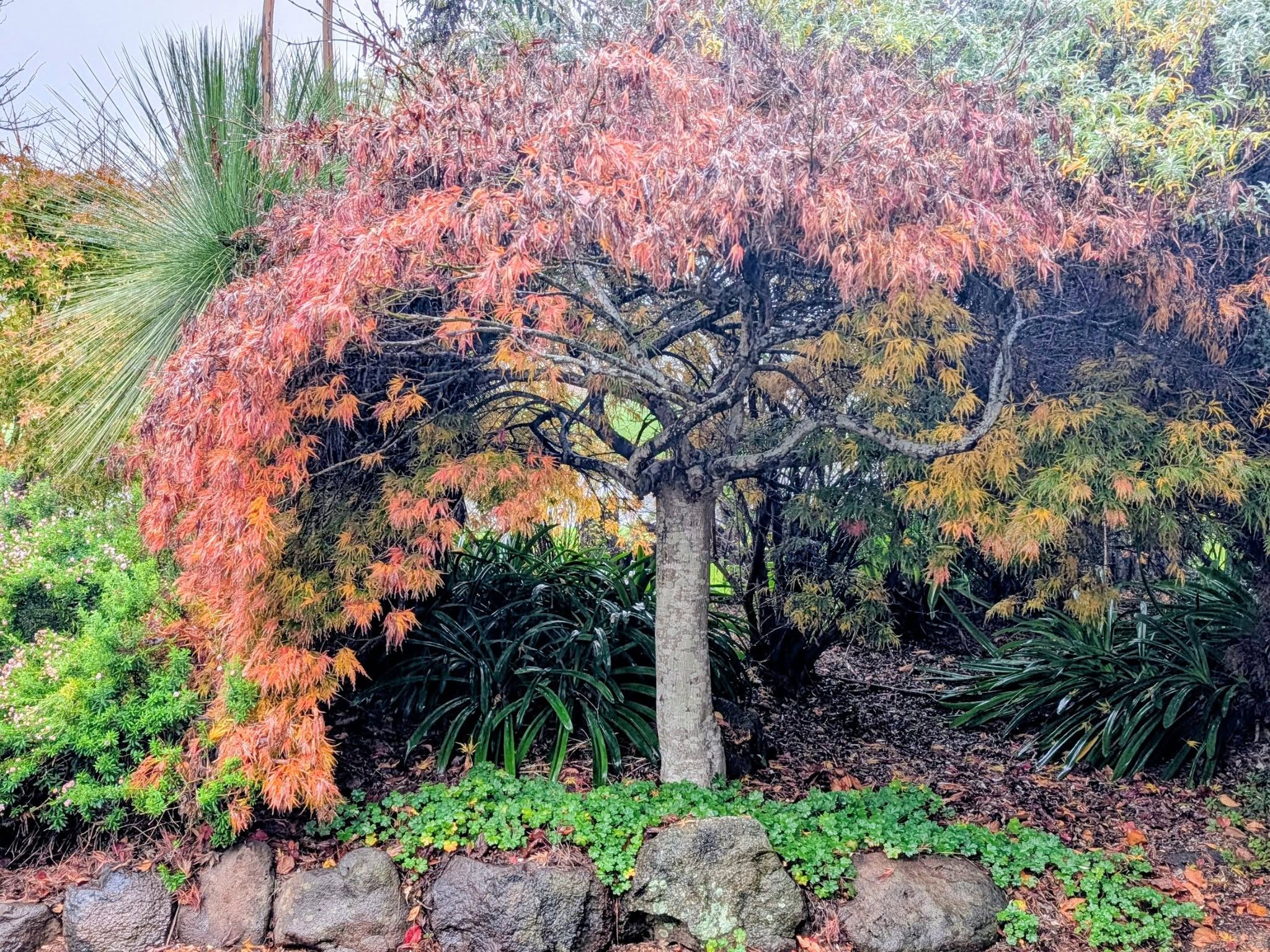
Acer palmatum ‘Viridis’ is a weeping dwarf Japanese maple with lacy green leaves. The name says it all — ‘Viridis’ means green in Latin and ‘Viridis’ is the standard by which all green lace-leaf Japanese maples are judged.
‘Viridis’ is a green lace-leaf Japanese maple with light green foliage in spring, that usually darkens in the summer. ‘Viridis’ turns to a bright yellow to gold color in the fall.
What makes it special: Among all green lace-leaf varieties, Viridis sets the benchmark. Its fall color is particularly rewarding — the transformation from deep summer green to luminous gold is one of the finest autumn displays in the dwarf maple world.
Size-wise, Viridis is a dwarf maple, not growing taller than 5 feet and spreading to about 7 feet wide. It has a broad shape and starts branching out early in its life. The weeping effect is more pronounced when grafted onto a high rootstock.
7. Acer palmatum ‘Waterfall’
Height: Up to 4 feet | Spread: Over 6 feet | Zones: 5–8
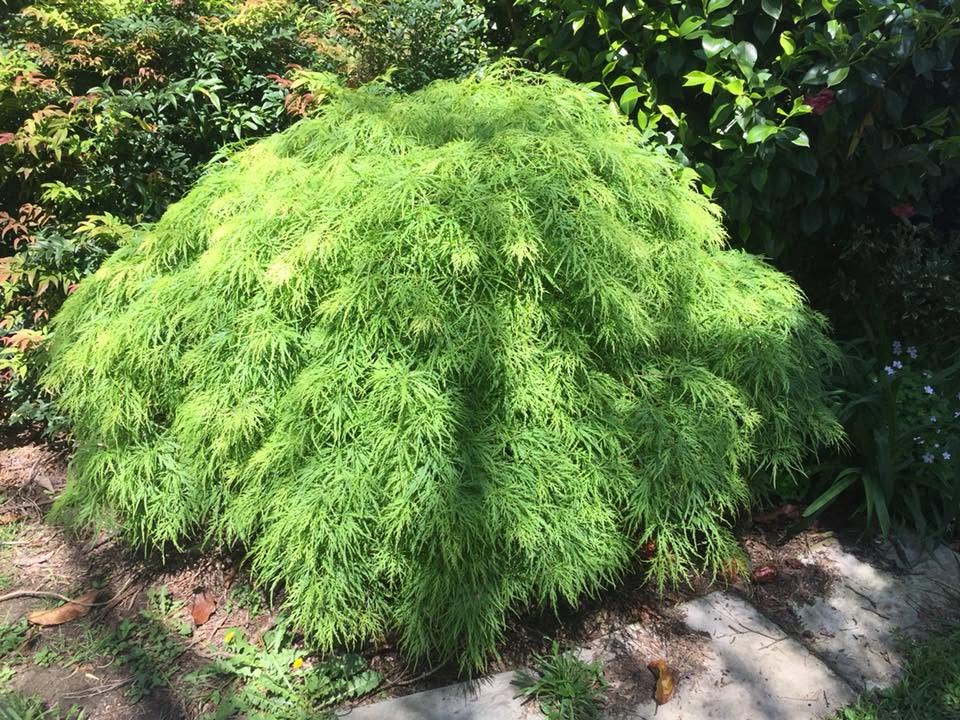
Waterfall is a charming dwarf weeping Japanese maple with green leaves. In spring, the new leaves emerge a light green, gradually deepening to a rich, darker shade. Come autumn, the transformation is striking. The leaves turn a vivid yellow, eventually shifting to bright orange by late fall.
Among the smallest weeping Japanese maples, Waterfall typically doesn’t exceed 4 feet in height after about a dozen years, but can spread to over 6 feet wide. It has a more uniform, umbrella-shaped crown compared to other varieties, with branches that lengthen and droop over time.
What makes it special: The name does not mislead. The cascading branches genuinely look like flowing water, especially when the fine-cut foliage catches a breeze. The orange autumn color is among the warmest and most vivid of any green-leaved dwarf maple.
Waterfall does not recommend itself for zone 9, as intense heat can damage the delicate foliage.
8. Acer palmatum ‘Mikawa Yatsubusa’
Height: Under 4 feet | Spread: Roughly equal to height | Zones: 5–8
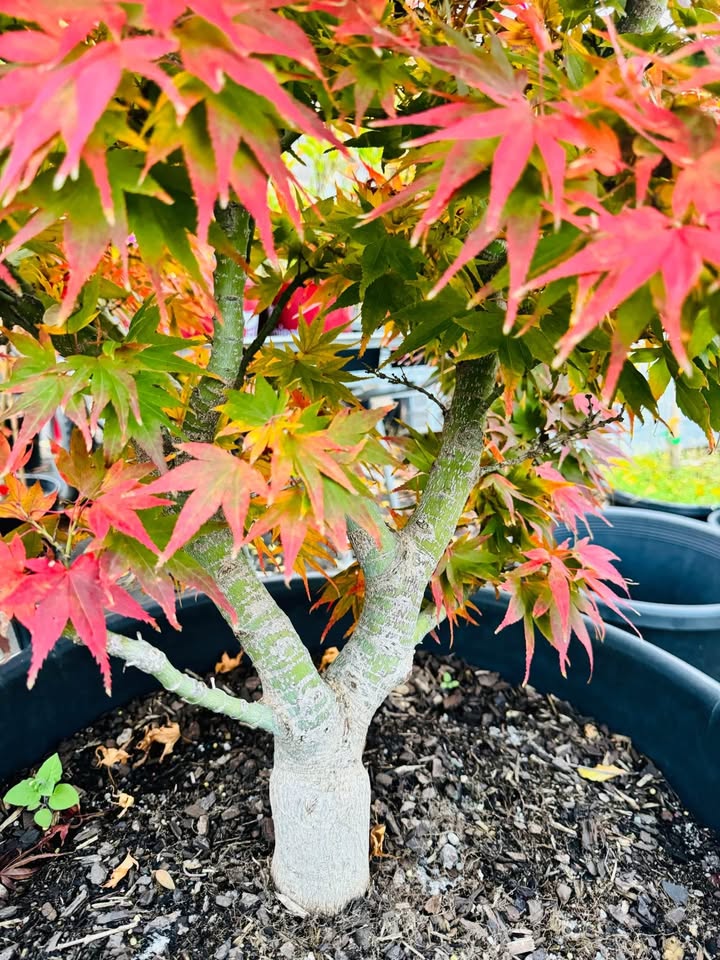
‘Mikawa Yatsubusa’ is a dwarf maple that stays under four feet tall, with tightly packed and layered green foliage.
This is a fascinating cultivar that breaks from the weeping mold. Rather than cascading branches, it forms a dense, compact, upright mound of neatly packed leaves arranged in distinct horizontal tiers. The growth pattern is almost architectural.
What makes it special: It is one of the few true miniature Japanese maples suitable for bonsai work. Its layered, cloud-like form also makes it a striking accent plant in Japanese-style garden designs where structured form matters as much as color.
Fall brings bright orange-red tones that contrast beautifully with the dense green summer foliage.
9. Acer palmatum ‘Dissectum Atropurpureum’
Height: Up to 8 feet over many years | Spread: Up to 8 feet | Zones: 6–8
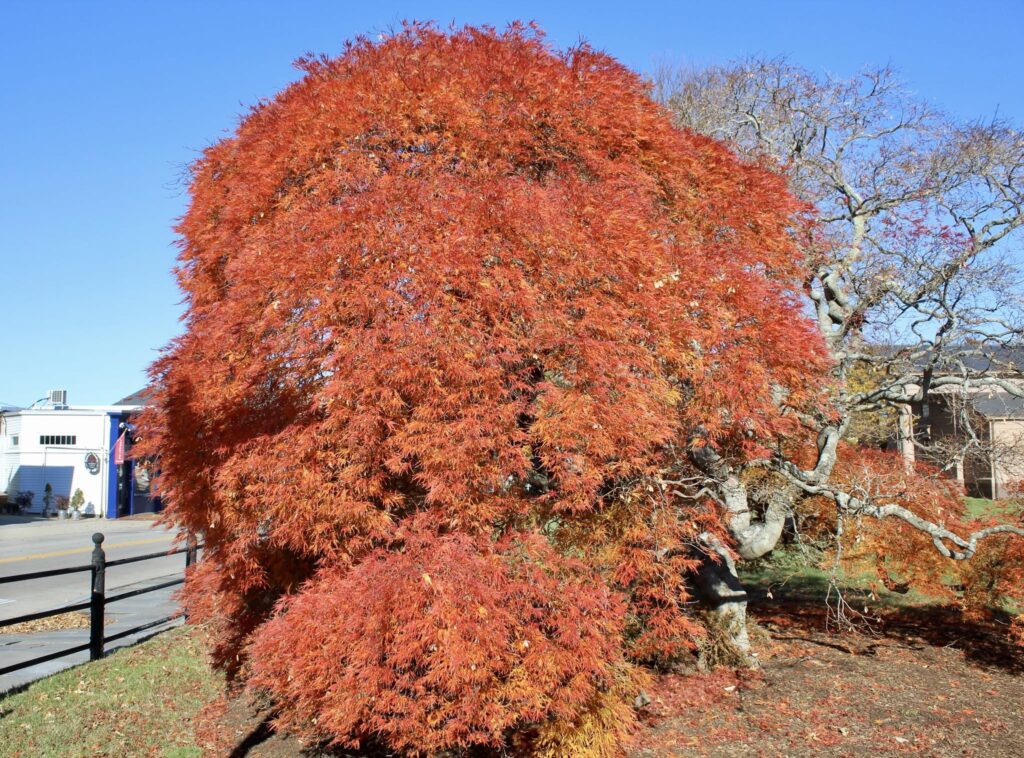
The outstanding features of the ‘Dissectum Atropurpureum’ are its brightly autumn colored red leaves and spreading cascading growth. When the maple loses its leaves in winter, you can enjoy the fascinating shapes of the crooked, twisting, and contorted branches.
The dwarf ‘Dissectum Atropurpureum’ takes many years to mature at 8 ft. (2.4 m) tall and wide.
What makes it special: The winter structure is exceptional. Once the leaves drop, the gnarled, sculpted branch framework becomes a focal point in its own right. Few plants offer this level of four-season interest.
The leaves emerge purple in spring, shift to bronze-green in summer, and then ignite into fiery orange-red in autumn. This is a variety worth the patience it demands.
10. Acer palmatum ‘Inaba Shidare’
Height: 6–8 feet | Spread: 8–10 feet | Zones: 5–8
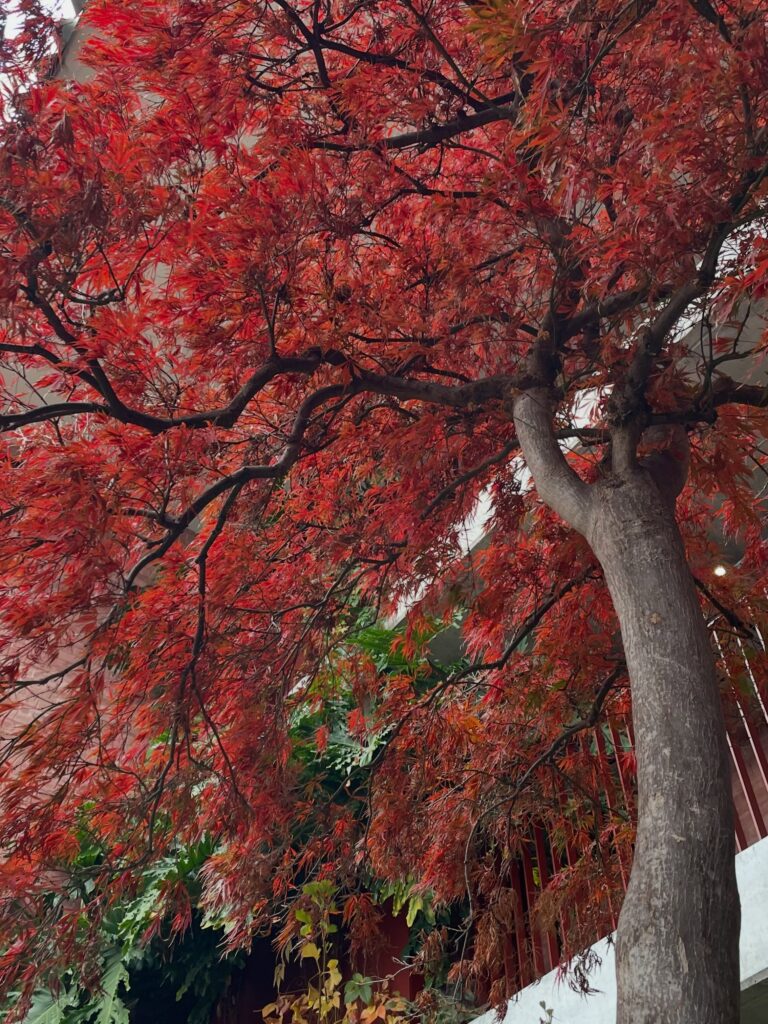
Inaba Shidare is one of the most celebrated weeping red dissectum cultivars in cultivation. The deeply cut, burgundy-red leaves hold their color well through summer and produce a spectacular scarlet display in fall.
What makes it special: It is widely regarded as one of the most heat-tolerant of the red lace-leaf maples, making it an ideal choice for gardeners in the warmer end of its zone range. The broad, mounding canopy creates a natural umbrella shape without any training.
Red Select is a seedling derivative of Inaba Shidare, characterized by smaller leaves than its parent. If Inaba Shidare appeals to you but you need something slightly more compact, Red Select is the logical next step.
11. Acer palmatum ‘Red Filigree Lace’
Height: 3–5 feet | Spread: 4–6 feet | Zones: 5–8
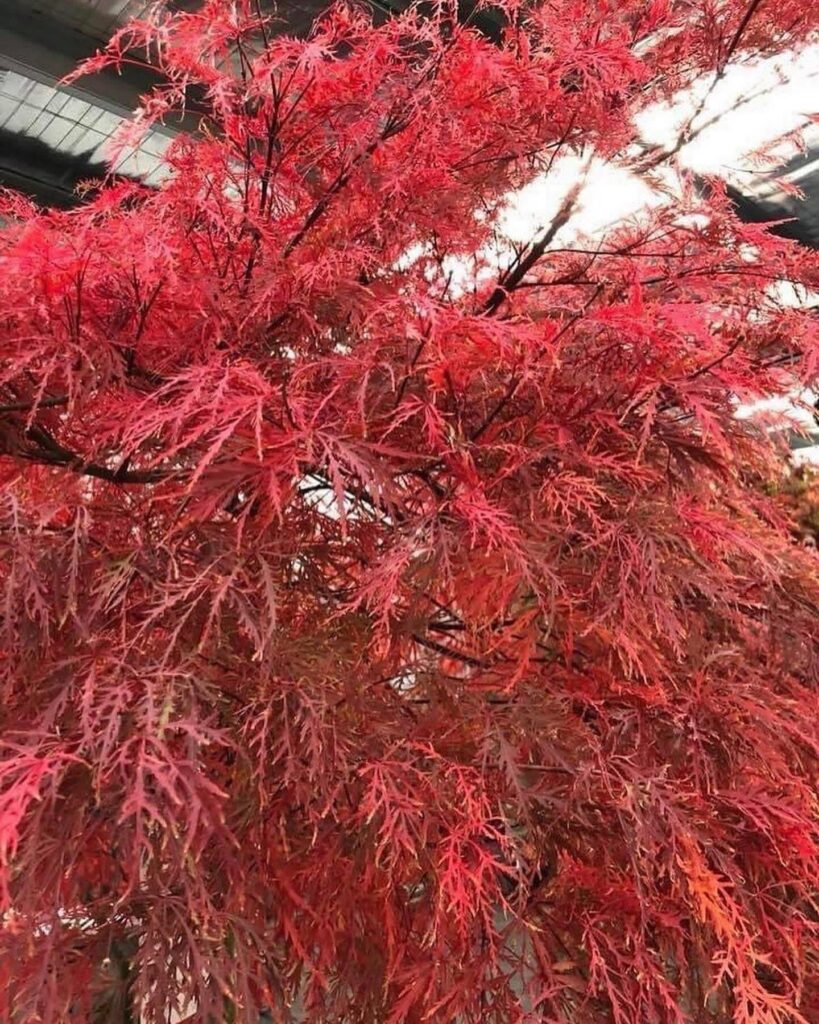
Red Filigree, an Italian selection, is a unique Japanese maple known for its exceptionally small and thin leaves. This trait sets it apart, as very few Japanese maple varieties feature such delicate foliage.
The color of Red Filigree’s foliage is a steady burgundy, maintaining this hue consistently from spring through fall. Its standout feature is its ability to thrive in deep shade without any detriment to its leaf color or shape, making it arguably the best dwarf weeping Japanese maple for shaded areas.
What makes it special: For gardeners dealing with shaded courtyard gardens or spots under dense tree canopies, Red Filigree Lace is exceptional. Most red-leaved maples require some direct sun to develop rich color — this one does not.
The tiny, thread-like leaves give the plant an almost moss-like texture from a distance, creating a truly distinctive visual effect.
12. Acer palmatum ‘Shishigashira’ (Lion’s Head Maple)
Height: 6–10 feet over time | Spread: Narrower than height | Zones: 5–8
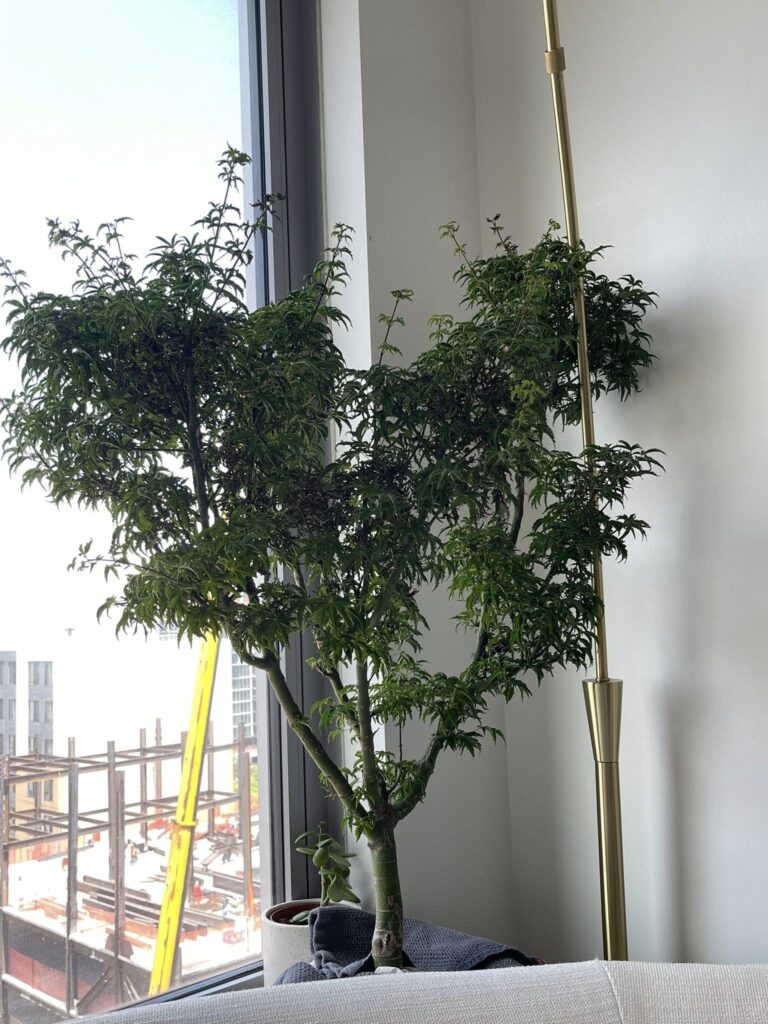
Shishigashira, which translates literally to “lion’s head,” is one of the most distinctive Japanese maples available. Unlike most compact forms, it is upright rather than weeping. The leaves are small and crinkled, clustering densely at the tips of the branches in thick, pom-pom tufts.
What makes it special: The upright form and unique textured foliage make it ideal as a vertical accent in narrow spaces — a context where most weeping or mounding dwarfs struggle. Fall color is a warm orange-yellow, sometimes developing streaks of red.
This is also a superb bonsai subject, and an excellent dwarf that is good for bonsai and great for growing in pots, with foliage that has bright green coloring in the springtime and a beautiful scarlet red in the fall.
13. Acer palmatum ‘Butterfly’
Height: Up to 10 feet | Spread: Up to 6 feet | Zones: 5–8
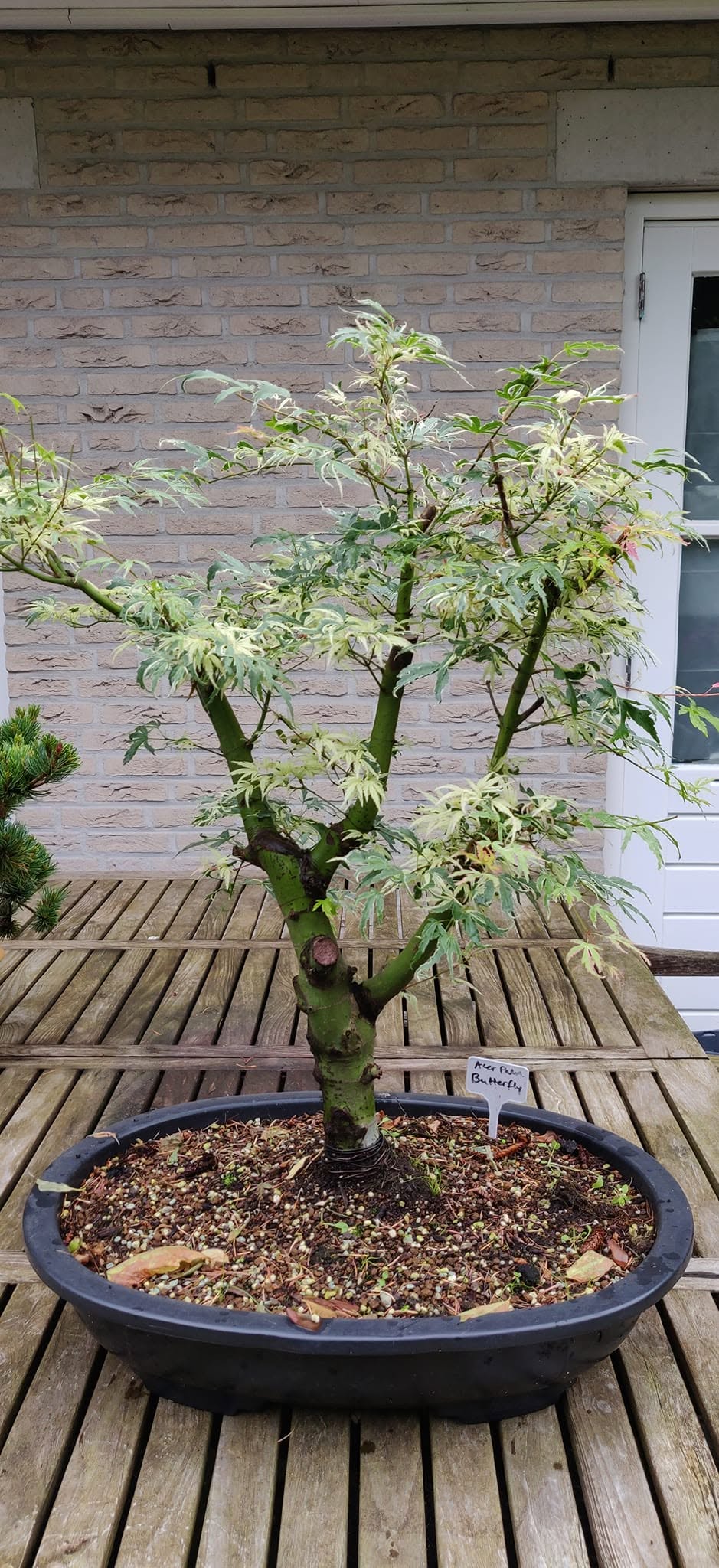
Butterfly is one of the most distinctive variegated dwarf Japanese maples. The leaves are small, with irregular margins of white, cream, and soft pink against a blue-green base. The color combination is subtle and elegant rather than loud.
What makes it special: Its compact, upright form (narrow width relative to height) makes it one of the few Japanese maples that works in genuinely tight spaces. A border between structures, a narrow side passage, or a formal entryway planting — Butterfly fits where most other maples cannot.
Variegated Japanese maples have leaves with streaks, blotches, or patches of different colors. Butterfly is among the finest examples of this group, and its restrained coloring means it pairs well with almost any neighboring plant.
14. Acer palmatum ‘Koto No Ito’
Height: 6–8 feet | Spread: 3–5 feet | Zones: 5–8
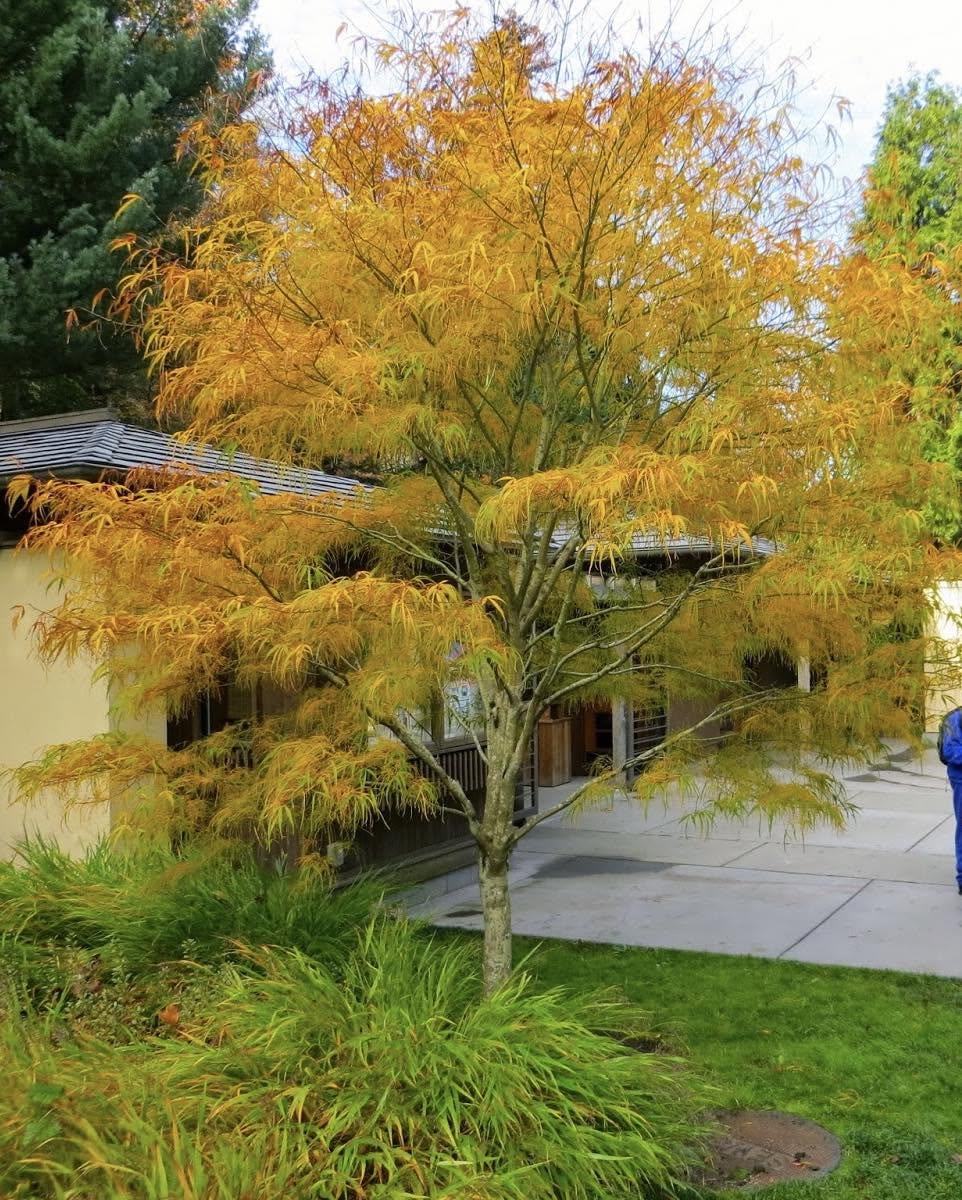
The name Koto No Ito translates to “harp strings,” a reference to the extraordinarily fine, thread-like leaves. Each leaf is divided so deeply that the individual lobes are almost wire-thin, creating a delicate, feathery canopy unlike anything else in the maple world.
‘Koto no ito’ has fine, thread-like leaves and forms a graceful, upright-to-vase-shaped habit. Fall color runs from yellow to warm orange.
What makes it special: Texture. While most Japanese maple conversation centers on color, Koto No Ito is about fine foliage texture. In a garden composition with bold-leaved plants, it provides extraordinary contrast. It is also surprisingly tolerant of wind compared to other fine-leaf types.
15. Acer palmatum ‘Osakazuki’
Height: 10–15 feet at full maturity (slow-growing dwarf phase) | Spread: 8–10 feet | Zones: 5–9
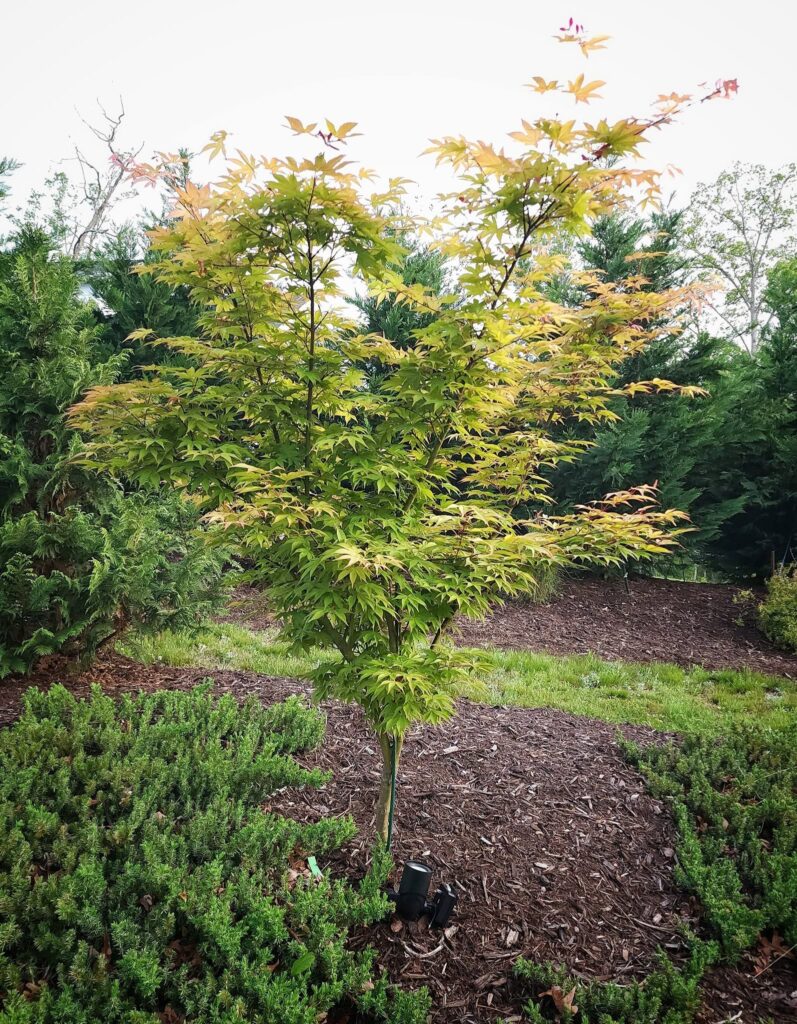
Osakazuki is technically capable of reaching larger sizes over many decades, but it grows so slowly that it spends the first 15–20 years of its life firmly in dwarf territory. More importantly, it is grown almost exclusively for one reason: the most spectacular fall color of any Japanese maple.
The seven-lobed, palmate leaves are a clean mid-green through spring and summer, entirely unremarkable. Then, in autumn, they shift to an almost implausibly vivid scarlet — a red so saturated it looks artificial in photographs.
What makes it special: The Royal Horticultural Society has awarded Osakazuki its prestigious Award of Garden Merit. For a single-season spectacle, nothing in the dwarf maple world rivals it.
Understanding USDA Hardiness Zones
Before selecting a variety, knowing your growing zone is essential. Most varieties are hardy in USDA zones 5 through 8, but some can tolerate colder or warmer conditions.
In gardens, Japanese maples are hardy from zone 5 to zone 8, with some being hardy into zone 9. Some varieties will thrive in zone 4 as well. In areas that are too cold, the branches may suffer damage in winter and die, although often the main stems will re-sprout.
Always check the specific zone rating for any cultivar you plan to plant. A tree that thrives in coastal Oregon may struggle in humid Alabama summers.
RECOMMENDED:
- 8 Main Bloodgood Japanese Maple Tree Problems: (And How to Fix Them)
- 7 Common Japanese Maple Bark Problems and How to Fix
- 8 Japanese Maple Tree Garden Ideas: A Complete Guide
How to Grow Dwarf Japanese Maples Successfully
Soil Requirements
Acer palmatum grows best in moist, organically rich, slightly acidic, well-drained soils in full sun to part shade. It grows well in sandy loams.
A soil pH between 5.5 and 6.5 is ideal. If your garden soil is alkaline, amending with sulfur or growing in containers with an ericaceous compost mix will produce much better results.
Sun and Shade
Japanese maples need partial shade to prevent the afternoon sun from scorching the foliage. Green-leaved forms tolerate full sun, but are best in dappled shade, as very bright conditions can sometimes cause scorch. Red- and purple-leaved cultivars need some sun to develop a rich leaf color.
The general rule: morning sun and afternoon shade is the safest position for most dwarf cultivars, especially those with fine, dissected leaves.
Watering
Consistency matters more than quantity. Young trees need regular watering during the establishment period — typically the first two growing seasons. Once established, most dwarf Japanese maples are reasonably drought-tolerant, though extended dry spells should be supplemented with deep, infrequent irrigation rather than shallow, frequent watering.
Overwatering is actually more common a mistake than underwatering. Waterlogged soil leads to root rot, which is one of the primary causes of failure in container-grown specimens.
Wind Protection
Plant in dappled shade and evenly moist, well-drained soil, protecting the tree from drying winds.
Wind is often underestimated as a risk factor. For lace-leaf varieties especially, strong or drying winds cause leaf margin burn and structural damage. A sheltered microclimate — against a wall, fence, or within a group planting — will produce noticeably healthier trees.
Fertilizing
Dwarf Japanese maples are light feeders. A single application of a slow-release, balanced fertilizer in early spring is all most established trees need. Over-fertilizing encourages rapid, soft growth that is more vulnerable to frost and disease.
Avoid high-nitrogen fertilizers. They push leafy growth at the expense of the compact, layered habit that makes these trees so attractive.
Pruning
Minimal pruning is the correct approach. Remove dead, crossing, or inward-facing branches in late winter before growth begins. Never prune in spring when sap is actively rising, as this can cause “bleeding” and weakens the tree.
Japanese maples can be propagated from seed, but named cultivars will not breed true. Layering in autumn or early spring is probably the easiest way of propagating named cultivars. Commercial nurseries graft maples, but this is not an easy technique for most home gardeners.
Growing Dwarf Japanese Maples in Containers
Container growing is one of the best ways to enjoy dwarf Japanese maples, particularly in urban gardens, on rooftops, or in paved courtyards.
Key points for success:
- Choose a large container — at least 18–24 inches in diameter for the tree to establish properly
- Use a freely draining mix — a blend of quality potting compost with added perlite or grit prevents waterlogging
- Repot every 2–3 years to refresh the growing medium and check root health
- Insulate the pot in winter — roots in containers are more exposed to freeze-thaw cycles than in-ground roots
Container trees typically need more frequent watering than in-ground specimens, particularly in summer. Mulching the top of the container with bark or grit helps retain moisture and moderate soil temperature.
Common Problems and Solutions
Leaf scorch (brown leaf margins): Usually caused by strong winds, excessive sun, or drought stress. Move containers to a more sheltered spot, or improve in-ground irrigation. Increase organic matter in soil.
- Verticillium wilt: A fungal disease that causes sudden wilting of branches. There is no chemical cure — affected branches must be pruned back to healthy wood with sterilized tools. Avoid planting in soil where wilt-susceptible plants have previously grown.
- Aphids: Often appear in spring on new growth. A strong jet of water removes most infestations. Persistent problems can be addressed with insecticidal soap.
- Poor fall color: Usually the result of insufficient light, excessive nitrogen fertilization, or unusually warm autumn temperatures. Review placement and feeding regimes.
Selecting the Right Dwarf Japanese Maple for Your Garden
A quick summary to simplify the decision:
| Need | Best Choice |
| Best red color retention | ‘Red Dragon’ or ‘Tamukeyama’ |
| Best for shade | ‘Red Filigree Lace’ |
| Best weeping form | ‘Waterfall’ or ‘Crimson Queen’ |
| Best for containers | ‘Garnet’ or ‘Butterfly’ |
| Best upright form | ‘Butterfly’ or ‘Shishigashira’ |
| Most dramatic fall color | ‘Osakazuki’ |
| Best for bonsai | ‘Mikawa Yatsubusa’ or ‘Shishigashira’ |
| Best seasonal color range | ‘Orangeola’ |
| Best for hot climates | ‘Tamukeyama’ or ‘Inaba Shidare’ |
Final Thoughts
Dwarf Japanese maples reward patience and thoughtful placement. They are not quick-fix shrubs — they are long-term companions that deepen in beauty every year.
The varieties in this list represent the best of a remarkable species: trees that have been refined over centuries by Japanese gardeners, Western botanists, and dedicated nursery professionals. Many of the best and most popular cultivars were developed in the West and have been introduced back into Japan. That cross-cultural dialogue has produced something exceptional.
Whether you choose a blazing ‘Red Dragon’ for a courtyard container, a graceful ‘Waterfall’ for a shaded corner, or the autumn-spectacular ‘Osakazuki’ for a lawn feature, you are adding one of the finest ornamental trees in the world to your garden.
Choose carefully, plant well, and enjoy the result for decades.
References
- North Carolina State University Extension — Acer palmatum Plant Profile North Carolina Cooperative Extension Service. Acer palmatum (Japanese Maple). NC State Extension Gardener Plant Toolbox. https://plants.ces.ncsu.edu/plants/acer-palmatum/
- Oregon State University — Landscape Plants Database Oregon State University College of Agricultural Sciences. Acer palmatum. OSU Landscape Plants. https://landscapeplants.oregonstate.edu/plants/acer-palmatum
- Missouri Botanical Garden — Plant Finder Missouri Botanical Garden. Acer palmatum. Plant Finder Database. https://www.missouribotanicalgarden.org/PlantFinder/PlantFinderDetails.aspx?taxonid=275408
- Royal Horticultural Society (RHS) — Japanese Maples Growing Guide Royal Horticultural Society. How to Grow Japanese Maples. RHS Growing Guide. https://www.rhs.org.uk/plants/acer/japanese-maples/growing-guide
- University of British Columbia Botanical Garden Forums — Acer palmatum Cultivars UBC Botanical Garden. Acer palmatum Cultivars (Photos). UBC Botanical Garden Forums. https://forums.botanicalgarden.ubc.ca/forums/acer-palmatum-cultivars-photos.208/
- University of Florida IFAS Extension — Japanese Maple Fact Sheet University of Florida Institute of Food and Agricultural Sciences. Acer palmatum: Japanese Maple. https://edis.ifas.ufl.edu/publication/ST025
- USDA PLANTS Database — Acer palmatum United States Department of Agriculture Natural Resources Conservation Service. Acer palmatum Thunb. USDA PLANTS Database. https://plants.usda.gov/home/plantProfile?symbol=ACPA3

Tim M Dave is a gardening expert with a passion for houseplants, particularly cacti and succulents. With a degree in plant biology from the University of California, Berkeley, he has vast experience in gardening. Over the years, he has cultivated a vast collection of desert plants and learned a great deal about how to grow and care for these unique companions.