The Crimson Queen Japanese Maple: History, Size, Growth Rate, Problems, and More
The Crimson Queen Japanese Maple is a cultivar of Acer palmatum var. dissectum — the lace-leaf group of Japanese maples distinguished by their finely cut, feathery foliage and weeping growth habit. Its full botanical name is Acer palmatum var. dissectum ‘Crimson Queen.’
It is widely regarded as one of the best red lace-leaf Japanese maples. What sets ‘Crimson Queen’ apart from other red dissectum cultivars is its exceptional color retention through summer heat.
Many red Japanese maples fade to a dull bronze-green by midsummer. ‘Crimson Queen’ maintains a rich, saturated burgundy-red through the warmest months, only deepening to brilliant scarlet in autumn.
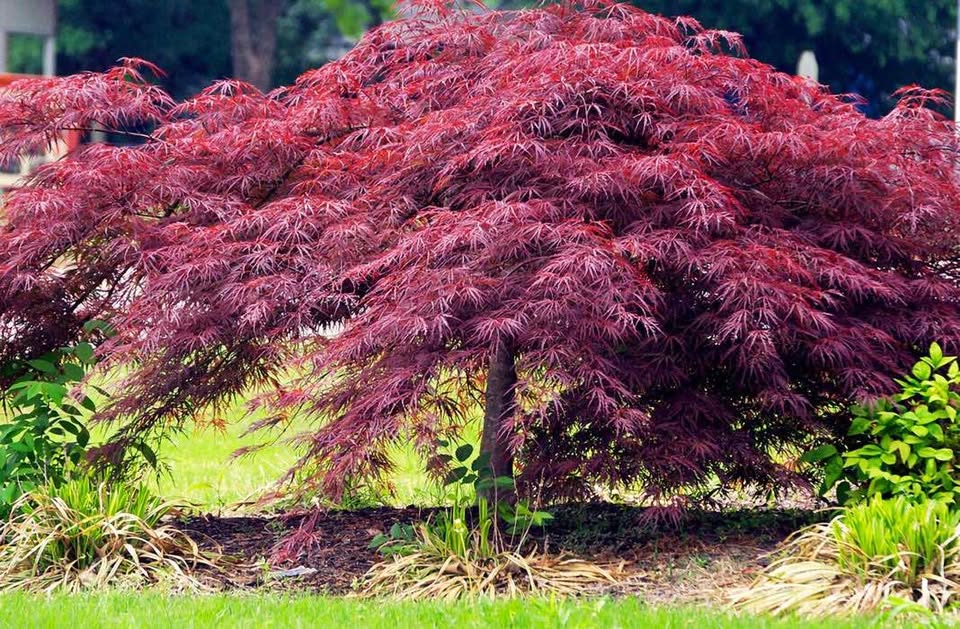
The tree’s form is equally distinctive. The weeping, cascading branches create a broad, dome-shaped mound that spreads wider than it grows tall — a growth habit that suits modern landscape design and small urban gardens particularly well.
| Common Name | Crimson Queen Japanese Maple |
| Scientific Name | Acer palmatum var. dissectum ‘Crimson Queen’ |
| Family | Sapindaceae |
| Origin | Cultivar developed from species native to Japan, China, and Korea |
| Type | Deciduous ornamental tree / weeping shrub |
| Mature Height | 8–10 feet (2.4–3 m) |
| Mature Spread | 10–12 feet (3–3.6 m) |
| Growth Rate | Slow to moderate — approximately 6–12 inches per year |
| USDA Hardiness Zones | 5–8 |
| Sun Requirements | Full sun to partial shade |
| Soil pH | 5.5–6.5 (slightly acidic) |
| Water Needs | Moderate; consistent moisture preferred |
| Bloom Time | Spring (small reddish-purple flowers, not ornamentally significant) |
| Foliage Color | Deep burgundy-red (spring/summer), bright scarlet-crimson (autumn) |
| Foliage Type | Lace-leaf; finely dissected, 7–9 lobes per leaf |
| Form | Weeping, cascading mound |
| Wildlife Value | Seeds consumed by birds; flowers attract early pollinators |
| Toxicity | Non-toxic to humans, dogs, and cats |
| Landscape Use | Specimen tree, container planting, water feature companion, slope planting |
| Notable Award | Pennsylvania Horticultural Society Gold Medal Plant |
A Brief History and Background
Acer palmatum as a species has been cultivated in Japan for at least 300 years, with historical records of ornamental maples in Japanese imperial gardens dating back centuries. Understandably, it is one of the popular dwarf Japanese Maple varieties.
The dissectum group — lace-leaf maples — has long been prized in Japanese garden design for their delicate texture and contemplative presence near water.
‘Crimson Queen’ is a relatively modern cultivar. It was introduced to Western horticulture in the mid-20th century and quickly became one of the most popular red dissectum selections due to its superior summer color retention.
Today, Acer palmatum cultivars collectively represent one of the most commercially significant groups of ornamental trees in the world.
According to the Oregon Department of Agriculture, the Willamette Valley in Oregon produces a substantial share of the Japanese maple plants sold in North America, with Japanese maples consistently ranking among the top-revenue ornamental woody plants in the state’s nursery industry — valued in the hundreds of millions of dollars annually.
‘Crimson Queen’ specifically has received the Pennsylvania Horticultural Society’s Gold Medal Plant Award, one of North America’s most respected horticultural endorsements, recognizing plants of proven performance and beauty in the landscape.
Foliage: The Defining Feature
The foliage of ‘Crimson Queen’ is, by any measure, extraordinary.
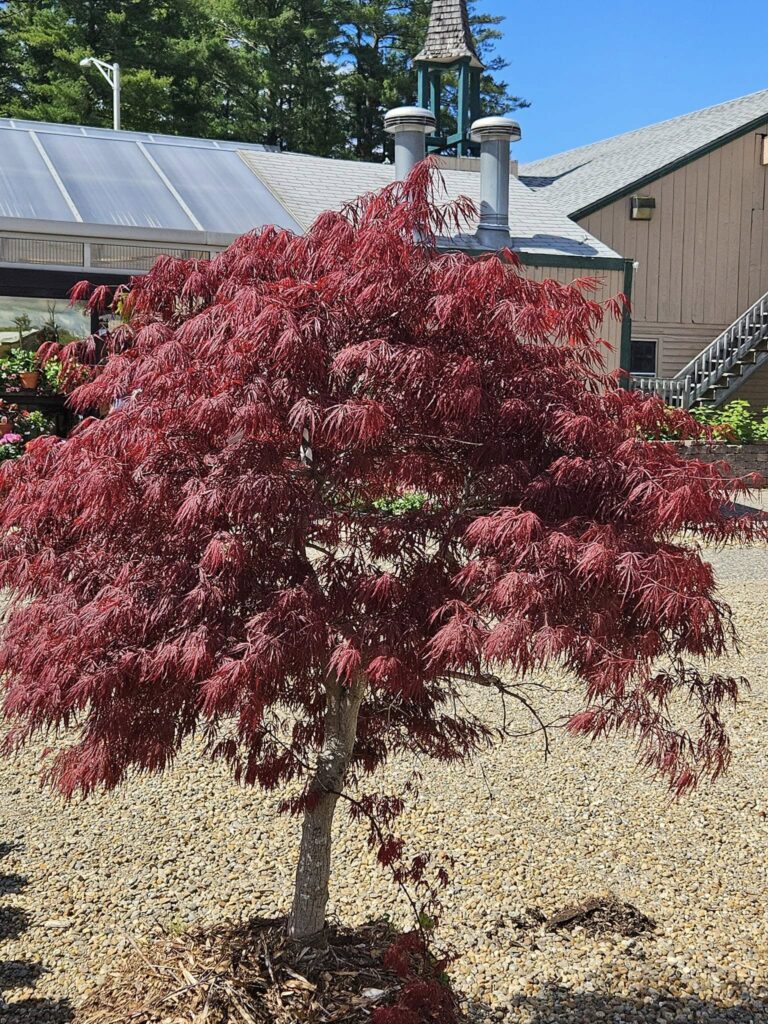
Each leaf is deeply dissected into 7–9 narrow, pointed lobes, which are themselves further divided — creating a lacy, almost fern-like texture that moves gracefully in the slightest breeze. The effect is more botanical sculpture than ordinary tree canopy.
Spring emergence is particularly striking. New leaves unfurl in a bright, almost luminous crimson-red, with the color often described as resembling freshly polished garnets when backlit by morning sun. As the season progresses, the foliage settles into a deep, consistent burgundy.
The summer color retention of ‘Crimson Queen’ is genuinely superior to many competing red dissectum cultivars. Even in Zone 7 and 8 summer heat, the foliage holds its depth. The Missouri Botanical Garden specifically notes this as a distinguishing quality of the cultivar.
Autumn transforms the tree entirely. The deep red of summer gives way to fiery scarlet and crimson — one of the most vivid autumn displays of any small ornamental tree. This seasonal culmination is worth planning your entire garden view around.
Ideal Growing Conditions
Climate and Hardiness Zones
‘Crimson Queen’ thrives in USDA Hardiness Zones 5–8, covering a broad temperate range across North America, the British Isles, much of Western Europe, and suitable pockets of Australia and New Zealand.
In Zone 5, the tree tolerates winter lows of approximately –20°F (–29°C) with appropriate site selection. In the colder end of this range, a sheltered position and winter mulching during establishment are prudent measures.
In Zones 7–8, summer heat and soil moisture management become the primary concerns. The tree’s dissected foliage increases its surface area relative to its mass, making it somewhat more susceptible to summer leaf scorch than solid-leaf Japanese maple cultivars in hot, dry conditions.
Sunlight Requirements
‘Crimson Queen’ grows in full sun to partial shade, but the ideal balance varies by climate zone.
In Zones 5–6, full sun (six or more hours of direct sunlight) produces the richest foliage color and the most defined, compact mounding form. Shade causes the foliage to take on more of a bronze-green cast and the canopy to become looser and less defined.
In Zones 7–8, afternoon shade is beneficial — ideally, morning sun and dappled shade from midday onward. This protects the delicate lace-leaf foliage from the most intense heat of the day, which can cause browning of leaf tips even in otherwise healthy trees.
A practical tip: dappled light under a high canopy often gives the best of both worlds — enough light for good color, with protection from direct midday sun intensity.
Soil
‘Crimson Queen’ performs best in well-drained, humus-rich, slightly acidic soil with a pH between 5.5 and 6.5. It will tolerate a range of soil types — from sandy loam to moderate clay — provided drainage is adequate.
Waterlogged soil is the single greatest threat to Japanese maples. Even brief periods of standing water around the root zone can promote root rot and Phytophthora infection. If your site has heavy clay that retains water, raise the planting area or amend extensively with composted organic matter and coarse grit.
The North Carolina State University Cooperative Extension notes that Acer palmatum cultivars are highly sensitive to poorly drained soils, and that improving drainage before planting is considerably more effective than treating root rot after the fact.
Water Needs
Consistent soil moisture during the growing season is important, particularly in the first two to three years after planting while the root system establishes.
Water deeply and infrequently rather than lightly and often. Deep watering encourages the root system to extend downward, increasing drought resilience. Shallow, frequent watering keeps roots near the surface where they are more vulnerable to heat and drought stress.
A 3–4 inch layer of organic mulch over the root zone is one of the most effective tools for maintaining soil moisture, moderating temperature, and suppressing competing weeds. Research consistently supports mulching as a high-return-on-effort practice for ornamental tree establishment.
Planting Guide
When to Plant
Early spring and early autumn are the optimal planting windows. Spring planting takes advantage of the full growing season ahead; autumn planting allows root establishment before winter dormancy, often resulting in a stronger first-season performance the following year.
Avoid planting during summer heat — transplant stress combined with high temperatures and potentially reduced soil moisture creates an unnecessarily difficult establishment period.
Site Selection
Choosing the right site before planting prevents many problems later. Consider the following:
Drainage first. If water pools in the proposed site after heavy rain, find a different location or raise the planting area. This is non-negotiable.
Room for the mature spread. ‘Crimson Queen’ spreads 10–12 feet at full maturity. Plant at least 6 feet from paths, walls, and structures to allow the natural weeping form to develop fully without restriction.
Backdrop consideration. The deep red foliage is most visually effective against a backdrop of green foliage or a light-colored wall or fence. Planting against a dark evergreen hedge or painting a nearby wall light grey or white will dramatically enhance the visual impact.
Water feature proximity. Japanese maples have a centuries-long association with water in garden design — and there is a reason for it. The reflection of a weeping lace-leaf maple in still water is genuinely one of horticulture’s finest visual effects.
Planting Steps
1. Dig a planting hole two to three times the width of the root ball, and the same depth. Wider is better; deeper is not.
2. Check drainage: fill the hole with water and observe. It should drain within an hour. If it does not, address the drainage before proceeding.
3. Position the tree so the root flare is at or slightly above the surrounding soil level. Planting too deep is a common and serious mistake — it causes trunk rot and reduces root oxygenation.
4. Backfill with the original soil, amended lightly with composted bark or leaf mold if necessary. Firm gently in layers to remove air pockets.
5. Water thoroughly immediately after planting.
6. Apply a 3–4 inch mulch ring, keeping mulch at least 4 inches clear of the trunk.
7. For grafted specimens, check the graft union — it should sit above soil level.
Fertilizing
Japanese maples are not heavy feeders. In good garden soil with an annual top-dressing of compost, supplemental fertilizing may be minimal.
When additional feeding is beneficial, apply a balanced, slow-release fertilizer (such as a 10-10-10 or a formula designed for acid-loving plants) in early spring as growth begins. One application per year is typically sufficient.
Avoid high-nitrogen fertilizers, which push rapid, soft growth that is more susceptible to aphid attack and less resistant to winter cold. Excessive nitrogen also tends to reduce foliage color intensity.
Stop all fertilizing by midsummer. Late feeding stimulates growth that cannot harden before autumn frosts, increasing the risk of winter dieback on stem tips.
The University of Minnesota Extension advises gardeners to prioritize soil organic matter improvement over synthetic fertilizing for ornamental trees — a long-term investment that improves soil structure, microbial activity, and nutrient availability simultaneously.
RECOMMENDED:
- 7 Common Japanese Maple Bark Problems and How to Fix
- 8 Japanese Maple Tree Garden Ideas: A Complete Guide
Pruning the Crimson Queen Japanese Maple
‘Crimson Queen’ requires less pruning than many ornamental trees. Its naturally elegant weeping form develops without significant intervention, and over-pruning is a common mistake that disrupts the tree’s characteristic silhouette.
When to Prune
Late winter, just before bud break, is the preferred time. The absence of foliage gives a clear view of the branch structure, and cuts heal quickly as the growing season begins.
Light thinning can also be done in mid-summer, after the initial flush of growth hardens. This improves air circulation and light penetration within the canopy. Avoid autumn pruning, which stimulates soft, vulnerable new growth heading into cold weather.
What to Prune
Focus on four categories:
Dead, damaged, or diseased wood — remove cleanly at the point of origin, or back to a healthy lateral branch. This is the first task in any pruning session.
Crossing or rubbing branches — where two branches contact each other, remove the weaker or more awkwardly positioned one to prevent wound development.
Upward-growing shoots — lace-leaf Japanese maples occasionally produce vigorous upward-growing shoots that disrupt the weeping silhouette. These can be removed or trained downward.
Interior congestion — removing a small number of inward-growing branches each year improves air circulation and reduces the risk of fungal issues within the dense canopy.
What Not to Do
Do not hard-prune or significantly reduce the size of an established ‘Crimson Queen.’ This tree’s beauty is entirely dependent on its form — aggressive cutting destroys what took years to develop. If size is a concern, proper initial site selection is far preferable to remedial pruning.
Do not use wound sealants. Current research from the USDA Forest Service confirms that wound paints do not improve healing and may trap moisture and pathogens. Leave clean pruning cuts to callous naturally.
Common Problems, Pests, and Diseases
Leaf Scorch
What it looks like: Brown, papery margins on leaves, often starting at the tips and working inward. In severe cases, whole leaves may turn brown and crisp.
Why it happens: Heat, wind, drought stress, or a combination of all three. The finely dissected foliage of lace-leaf maples has a high surface-area-to-volume ratio, making it more vulnerable than solid-leaf maples.
How to manage it: Improve irrigation consistency; ensure the mulch layer is maintained; consider whether the site is too exposed. In hot climates, afternoon shade is a significant preventive measure.
Verticillium Wilt
What it looks like: Sudden wilting and branch dieback, often on one side of the tree. The affected wood shows brown streaking in the outer sapwood when cut.
Why it happens: Infection by Verticillium dahliae or V. albo-atrum, soil-borne fungal pathogens that persist for years in contaminated soil.
How to manage it: No chemical cure exists. Prune affected branches well below the visible streaking; sterilize tools between cuts. Do not plant Japanese maples in soil previously occupied by solanaceous crops (tomatoes, potatoes) or other susceptible hosts. The American Phytopathological Society documents this as one of the most significant diseases affecting Acer species.
Aphids
What it looks like: Distorted, curling young leaves; sticky honeydew deposits on foliage and stems; possible black sooty mould growth on the honeydew.
Why it happens: Several aphid species target Japanese maples, most commonly in spring on soft new growth. Excessive nitrogen fertilizing encourages the lush, tender growth that aphids prefer.
How to manage it: Encourage beneficial predators (ladybirds, lacewings). A strong water jet dislodges light infestations. Insecticidal soap is effective for moderate infestations without harming beneficial insects.
Root Rot (Phytophthora spp.)
What it looks like: Gradual decline, yellowing foliage, reduced growth, and eventual death. Dark, water-soaked discolouration at the base of the trunk may be visible.
Why it happens: Consistently wet or waterlogged soil conditions.
How to manage it: Prevention only — ensure good drainage before planting. Once established, Phytophthora root rot is extremely difficult to reverse.
Tar Spot (Rhytisma acerinum)
What it looks like: Black, tar-like spots on the upper leaf surface from midsummer onward.
Why it happens: A fungal pathogen that infects maple leaves during wet spring conditions. It is largely cosmetic and rarely causes serious harm.
How to manage it: Rake up and dispose of fallen leaves in autumn (do not compost them) to reduce the inoculum for the following season. No chemical treatment is generally necessary.
Growing in Containers
‘Crimson Queen’ is an excellent container plant and one of the most popular Japanese maples for pot culture due to its compact, weeping form and relatively slow growth rate.
A container-grown specimen on a terrace or patio can become the visual anchor of an entire outdoor space. The cascading form is particularly effective in elevated containers — a raised pot or decorative urn allows the weeping branches to fall naturally below the rim.
Container size matters significantly. Start with a pot at least 18–24 inches in diameter and pot up by one size every two to three years as the root system fills the container. A pot that is too small restricts root development, dries out rapidly, and makes the tree more vulnerable to both summer heat and winter cold.
Use a free-draining, slightly acidic potting mix — a blend of quality potting compost with 30–40% added perlite works well. Ensure the container has adequate drainage holes; standing water in a pot is as damaging as standing water in the ground.
In Zone 5 and 6, protect container-grown trees in winter. The roots of container plants are more exposed to cold than in-ground roots. Move containers to an unheated but frost-free garage or outbuilding during the most severe cold spells, or wrap containers in horticultural fleece.
Landscape Uses and Design Ideas
Few ornamental trees offer the versatility of ‘Crimson Queen’ in the landscape. Some applications worth considering:
As a standalone specimen: Planted in a prominent lawn position or at the terminus of a garden path, a mature ‘Crimson Queen’ functions as living sculpture. It earns its position through every season.
Near water features: The traditional Japanese garden association of lace-leaf maples with ponds and streams is not merely cultural — the reflection of the weeping, red-foliaged canopy in still water is genuinely exceptional. Even a small ornamental pool nearby transforms the visual effect.
On slopes and banks: The broad, mounding form of ‘Crimson Queen’ makes it effective on gentle slopes, where the cascading branches follow the contour of the ground naturally.
As a container focal point: As discussed, a well-chosen container elevates this tree’s already-remarkable form into something almost architectural.
Companion planting: The deep red foliage creates strong contrast with chartreuse or gold-foliaged plants such as Spiraea japonica ‘Gold Flame’, Hosta ‘Sum and Substance’, or ornamental grasses with golden tones. Against a green lawn, the tree needs no companion at all.
Crimson Queen vs. Other Red Lace-Leaf Japanese Maples
Gardeners frequently ask how ‘Crimson Queen’ compares to other popular red dissectum cultivars. The most common comparisons:
‘Crimson Queen’ vs. ‘Garnet’
‘Garnet’ is slightly more vigorous and somewhat more upright in habit. Its foliage is a similar red but tends to bronze more readily in summer heat. ‘Crimson Queen’ holds its red color better through summer and has a more refined weeping form.
‘Crimson Queen’ vs. ‘Tamukeyama’
‘Tamukeyama’ is arguably the closest competitor for summer color retention — both cultivars are recognized for holding red foliage better than most. ‘Tamukeyama’ tends to be slightly more vigorous. The choice between them often comes down to personal preference and availability.
‘Crimson Queen’ vs. ‘Red Dragon’
‘Red Dragon’ offers exceptional heat tolerance and is sometimes recommended for Zone 8 and warmer Zone 7 gardens. However, ‘Crimson Queen’ has the longer track record and wider availability in most markets.
In the view of many horticulturalists and landscape designers, ‘Crimson Queen’ remains the benchmark red lace-leaf Japanese maple against which others are measured — a position it has held for decades.
Crimson Queen Statistical Facts
- Acer palmatum comprises more than 1,000 named cultivars, making it one of the most cultivated ornamental tree species globally. (Vertrees & Gregory, Japanese Maples, Timber Press)
- Oregon’s nursery industry — the primary source of Japanese maples in the U.S. market — generates over $900 million annually, with Japanese maples among the highest-value species. (Oregon Department of Agriculture, Nursery and Christmas Tree Report)
- Japanese maples can live for 100–300 years under optimal conditions; ancient specimens exist in Japanese temple gardens with documented ages exceeding 200 years.
- The global ornamental plant market was valued at approximately USD $112 billion in 2022 and continues to grow, with premium ornamental trees representing a significant and expanding segment. (Grand View Research, 2023)
- ‘Crimson Queen’ received the Pennsylvania Horticultural Society Gold Medal Plant Award, one of the most respected plant performance awards in North American horticulture.
Seasonal Care Calendar
| Season | Key Tasks |
| Early Spring | Apply slow-release fertilizer; inspect for overwintering pests; prune dead wood |
| Late Spring | Monitor for aphids on new growth; water during dry spells; admire spring foliage color |
| Summer | Maintain consistent irrigation; maintain mulch layer; watch for leaf scorch in hot climates |
| Autumn | Enjoy the scarlet foliage display; avoid fertilizing; consider new plantings |
| Winter | Protect containers in cold zones; plan any late-winter corrective pruning |
Buying Guide
When purchasing a ‘Crimson Queen,’ the following points will help you choose a quality plant:
Verify the cultivar name. The label should clearly state Acer palmatum var. dissectum ‘Crimson Queen.’ Plants sold as generic “red lace-leaf Japanese maple” or without a cultivar name may not have the specific qualities that make ‘Crimson Queen’ outstanding.
Check the summer foliage color. If purchasing in season, the foliage should be a deep, rich burgundy-red — not faded bronze-green. A plant with poor summer color at the nursery will not improve significantly in your garden.
Inspect the graft union. ‘Crimson Queen’ is almost always sold as a grafted plant. The union should be well-healed and clearly visible but firm and healthy. Avoid plants with cracked or weeping graft unions.
Assess the form. Even young plants should show a tendency toward the characteristic weeping, cascading habit. Upright, stiff-branched plants may not be true to type.
Buy from a reputable specialist nursery when possible. Japanese maples sold at general garden centers are often fine, but specialist nurseries tend to offer better-labeled, better-quality stock with more reliable provenance.
Frequently Asked Questions
How tall does the Crimson Queen Japanese Maple grow? At full maturity, ‘Crimson Queen’ typically reaches 8–10 feet in height with a spread of 10–12 feet. Growth is slow, and most plants take 10 or more years to approach mature size.
Does it keep its red color all summer? Yes — this is one of ‘Crimson Queen’s most valued traits. It maintains deep burgundy-red foliage through summer more reliably than most red dissectum cultivars, particularly in Zones 5–7.
Is it deer-resistant? No. Japanese maples are not reliably deer-resistant and young plants are particularly vulnerable. Use physical protection (tree guards or fencing) in high-deer-pressure areas during establishment.
Can I grow it in a pot indoors? Japanese maples are outdoor plants that require a cold dormancy period. They cannot be grown successfully as permanent indoor plants. Container culture on a patio or terrace is excellent, but the tree must experience its natural seasonal dormancy cycle.
How do I keep the weeping form? Primarily by not over-pruning. The weeping form is genetic — it develops naturally as the tree grows. Light corrective pruning to remove dead wood or improve air circulation is appropriate, but aggressive shaping will destroy the natural silhouette.
Final Thoughts
The Crimson Queen Japanese Maple rewards patience. It grows slowly, which means every inch of development feels earned — and every season delivers something new to appreciate.
Plant it where you can see it from a comfortable vantage point. This is a tree for looking at, not just walking past. In spring, those unfolding garnet leaves are worth a morning cup of tea outside. In autumn, the scarlet display is worth rearranging your garden seating to face it.
Give it good drainage, reasonable sun, consistent water in its early years, and the space to develop its natural form without interference. That is all this tree asks. In return, it will give you decades of beauty that genuinely improves with age.
References
- Missouri Botanical Garden — Acer palmatum var. dissectum ‘Crimson Queen’ Plant Finder: https://www.missouribotanicalgarden.org/PlantFinder/PlantFinderDetails.aspx?kempercode=a198
- North Carolina State University Cooperative Extension — Acer palmatum dissectum ‘Crimson Queen’: https://plants.ces.ncsu.edu/plants/acer-palmatum/crimson-queen/
- University of Minnesota Extension — Ornamental Trees: Fertilizing and Care: https://extension.umn.edu/trees-and-shrubs/planting-and-care-trees-and-shrubs
- United States Department of Agriculture (USDA) — PLANTS Database — Acer palmatum: https://plants.usda.gov/home/plantProfile?symbol=ACPA4
- American Phytopathological Society — Verticillium Wilt: https://www.apsnet.org/edcenter/disandpath/fungalasco/pdlessons/Pages/Verticillium.aspx
- Royal Horticultural Society (RHS) — Japanese Maples Growing Guide: https://www.rhs.org.uk/plants/acer/japanese-maples/growing-guide
- Pennsylvania Horticultural Society — Gold Medal Plants Program: https://phsonline.org/for-gardeners/gold-medal-plants

Tim M Dave is a gardening expert with a passion for houseplants, particularly cacti and succulents. With a degree in plant biology from the University of California, Berkeley, he has vast experience in gardening. Over the years, he has cultivated a vast collection of desert plants and learned a great deal about how to grow and care for these unique companions.