Shoal Creek Vitex Tree: Identification, Size, Problems, and Cultivation Details
There are plants you grow because you have to, and then there are plants you grow because you simply cannot imagine your garden without them. The Shoal Creek Vitex tree (Vitex agnus-castus ‘Shoal Creek’) falls firmly in the second category.
I have watched this tree stop visitors dead in their tracks — that long, cascading spike of violet-blue blooms rising above a cloud of grey-green foliage in the middle of summer heat tends to do that.
While most flowering trees struggle and sulk in blazing sun and dry soil, the Shoal Creek Vitex thrives. It blooms repeatedly. It grows quickly. It feeds pollinators generously. And it asks for very little in return.
Whether you are a homeowner looking for a low-maintenance focal point, or simply a gardener searching for something beautiful and dependable — this guide will tell you everything you need to know about the Shoal Creek Vitex tree.
| Common Name | Shoal Creek Vitex, Chaste Tree |
| Scientific Name | Vitex agnus-castus ‘Shoal Creek’ |
| Plant Family | Lamiaceae (Mint Family) |
| Plant Type | Deciduous multi-stem shrub-tree |
| Mature Height | 10–15 feet (3–4.5 m) |
| Mature Spread | 10–15 feet (3–4.5 m) |
| Growth Rate | Fast (up to 6 feet per year in ideal conditions) |
| USDA Hardiness Zones | 6–9 |
| Bloom Color | Deep violet-blue to lavender |
| Bloom Season | Late spring to early fall (repeat bloomer) |
| Sun Requirement | Full sun (6+ hours daily) |
| Soil Preference | Well-drained; tolerates poor, sandy, or rocky soils |
| Water Needs | Low to moderate; highly drought-tolerant once established |
| Native Range | Central Asia, Mediterranean (naturalized across Southern U.S.) |
| Wildlife Value | High — attracts butterflies, bees, and hummingbirds |
| Fragrance | Aromatic foliage and flowers |
| Toxicity | Generally non-toxic; foliage is deer-resistant |
| Landscape Uses | Specimen tree, privacy screen, pollinator garden, xeriscape |
What Is the Shoal Creek Vitex Tree?
The Shoal Creek Vitex is a selected cultivar of Vitex agnus-castus, commonly known as the Chaste Tree or Lilac Chaste Tree. The species itself has been cultivated for centuries — it appears in ancient Greek and Roman texts, often noted for its aromatic properties and symbolic associations.
The ‘Shoal Creek’ cultivar, however, is not ancient history. It was selected specifically for superior ornamental performance, particularly its notably deeper, more vivid violet-blue flower color and its vigorous, upright growth habit.
These traits make it one of the most commercially popular Vitex cultivars in American horticulture today.
Unlike the species, which can vary widely in color (from near-white to pale lavender), ‘Shoal Creek’ reliably delivers rich, saturated violet-blue flower spikes season after season. Nurseries and landscape professionals trust it because it performs consistently.
Is It a Tree or a Shrub?
This is a fair question — and the honest answer is both, depending on how you grow it.
In its natural habit, the Shoal Creek Vitex is a large, multi-stemmed shrub. Left alone, it will form a wide, arching mound of branches.
However, with selective pruning in the early years, it can be trained into a single- or multi-trunk small tree with a clearly defined canopy.
Many homeowners and landscape designers prefer this tree form for its cleaner appearance and greater visual impact.
Botanical Background and Classification
Understanding the plant’s botanical identity helps you understand its behavior in the landscape.
- Kingdom: Plantae
- Order: Lamiales
- Family: Lamiaceae (the mint family — yes, it is related to mint, basil, and lavender)
- Genus: Vitex
- Species: Vitex agnus-castus
- Cultivar: ‘Shoal Creek’
The genus Vitex contains over 250 species worldwide, most of them native to tropical and subtropical regions. Vitex agnus-castus is one of the most cold-hardy members of the genus, which is why it has become so widely naturalized — and in some areas, invasive — across the southern United States.
The species name “agnus-castus” comes from Latin and Greek roots meaning “pure” or “chaste.” This references the plant’s historical use in religious ceremonies and its folk reputation as a plant that reduced desire — a claim modern science has neither strongly confirmed nor dismissed.
The name “Shoal Creek” is believed to reference Shoal Creek, a waterway in Austin, Texas — fitting, since this cultivar performs exceptionally well in the Texas Hill Country climate.
Physical Description: What the Shoal Creek Vitex Looks Like
Flowers
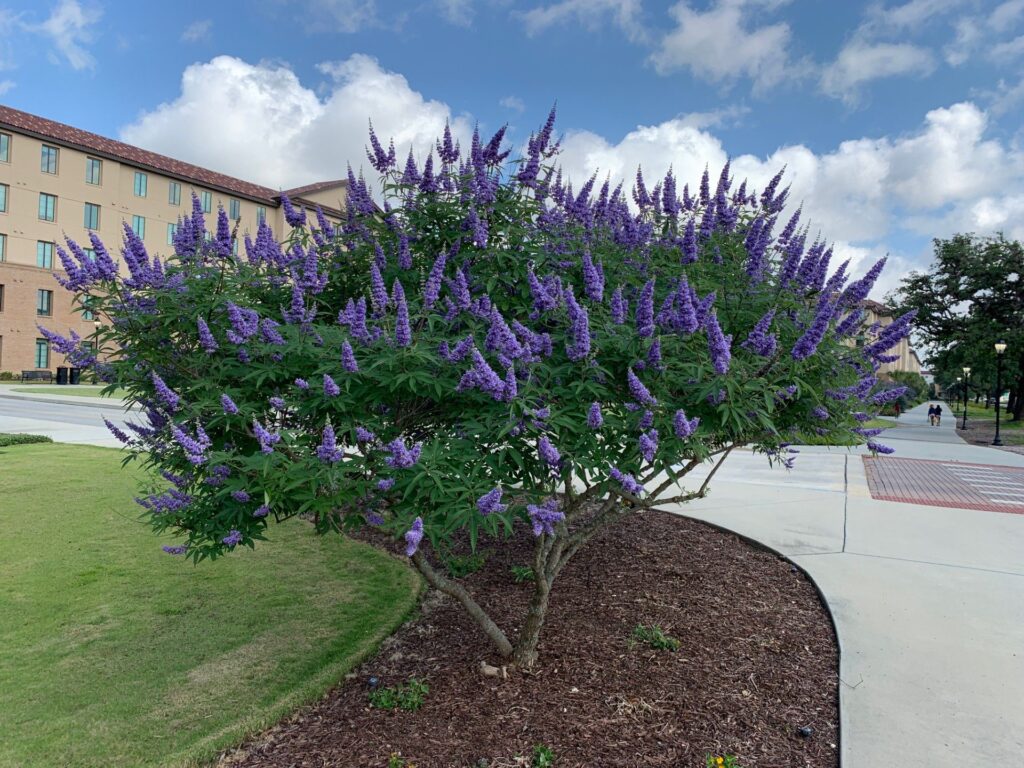
The flowers are, without question, the defining feature of this plant. They emerge as long, showy panicles (spikes), typically 12–18 inches in length, composed of dozens of small, tubular individual flowers.
The color is a rich, deep violet to bluish-purple — a rare and coveted color in the warm-season flowering tree world.
Blooming begins in late spring (often May or June depending on your climate) and continues through the summer with repeat flushes, particularly if spent spikes are removed.
In warm climates, bloom can persist well into September or even October. This extended season of color is one of the cultivar’s greatest advantages.
The flowers are mildly fragrant, emitting a soft, spicy-sweet scent that is pleasant without being overpowering.
On a warm, still morning, walking past a mature Shoal Creek Vitex in full bloom is a genuinely memorable sensory experience.
Foliage
The leaves are compound, with five to seven leaflets arranged in a palmate (hand-like) pattern — superficially similar to the foliage of Cannabis or a horse chestnut, though entirely unrelated.
Each leaflet is lance-shaped and grayish-green on the upper surface, with a paler, silvery underside covered in fine hairs.
When crushed or brushed against, the foliage releases a strong, aromatic scent — spicy and herbal, somewhat reminiscent of sage or oregano. This scent is a natural deterrent for deer, which rarely browse on Vitex.
The foliage is deciduous, meaning the plant drops its leaves in winter. The bare winter silhouette can be attractive in its own right, revealing the interesting, gnarled branching structure.
Bark and Stem Structure
Young stems are light gray and somewhat square in cross-section — a characteristic shared by many mint-family plants.
As the plant matures and stems thicken into trunks, the bark becomes grayish-brown, slightly furrowed, and develops attractive textural character.
When trained as a tree, the branching structure is open and somewhat irregular, creating a natural, informal appearance that suits cottage gardens and naturalistic landscapes equally well.
Growing Conditions and Requirements
This tree needs the following to thrive:
Sunlight
The Shoal Creek Vitex is a full sun plant — no compromises. It requires a minimum of six hours of direct sunlight per day, and it performs best with eight or more hours.
In partial shade, growth becomes weak and leggy, and flowering is dramatically reduced. Plant it in your sunniest spot.
Soil
One of the most valuable traits of this cultivar is its extraordinary soil adaptability. It grows well in:
- Sandy, fast-draining soils
- Rocky or gravelly soils
- Poor, nutrient-thin soils
- Alkaline soils (high pH)
- Clay soils, as long as drainage is adequate
It does not tolerate waterlogged or constantly wet soils. Root rot in saturated conditions is one of the few reliable ways to kill a Shoal Creek Vitex. Good drainage is non-negotiable.
Water
Once established — usually after its first full growing season — the Shoal Creek Vitex is remarkably drought-tolerant. It is widely used in xeriscape plantings and water-wise landscapes throughout the southern and southwestern United States for this reason.
During the first year after planting, water regularly (once or twice per week during dry spells) to support root development. After establishment, supplemental irrigation is rarely necessary except during prolonged drought.
Overwatering is, ironically, a more common problem than underwatering for established plants. When in doubt, hold back on water.
Temperature and Hardiness
The Shoal Creek Vitex is cold-hardy in USDA Zones 6 through 9. It can handle winter temperatures down to approximately -10°F (-23°C) in Zone 6, though the above-ground stems may die back in harsh winters.
The plant typically regrows vigorously from the root system even after severe die-back.
In Zone 7 and warmer, the woody stems usually survive winter intact. In Zones 8 and 9, the plant may retain some foliage through mild winters.
pH Preference
The Shoal Creek Vitex is highly adaptable in terms of soil pH, tolerating a range from approximately 5.5 to 8.0. This makes it suitable for both the acidic soils common in the southeastern United States and the alkaline soils found across the Southwest and Great Plains.
How to Plant a Shoal Creek Vitex Tree
Best Time to Plant
Spring is the ideal planting window, once the danger of frost has passed. This gives the plant an entire growing season to establish its root system before winter. Fall planting is also feasible in Zones 7–9, where winters are mild enough to allow some root growth before cold weather sets in.
Step-by-Step Planting Guide
1. Choose the right location. Select a site with full sun, good drainage, and enough space for a 15-foot-wide mature spread. Remember — this plant will grow large. Give it room.
2. Dig the planting hole. Make the hole two to three times wider than the root ball but no deeper than the root ball’s height. The crown of the plant (where the roots meet the stem) should sit at or slightly above the surrounding soil grade.
3. Amend sparingly. If your soil is extremely poor, you can mix a small amount of compost into the backfill. However, the Shoal Creek Vitex does not require or benefit from heavy soil amendment. Overly rich soil can actually reduce flowering and promote excessive vegetative growth.
4. Backfill and firm gently. Fill the hole with the original soil, gently firming it around the roots to eliminate air pockets.
5. Water thoroughly. Give the newly planted tree a deep, slow watering to settle the soil. Apply a 2–3 inch layer of organic mulch in a ring around the plant (but not touching the trunk) to conserve moisture and moderate soil temperature.
6. Stake only if necessary. In windy locations, a temporary stake for the first growing season may be helpful. Remove stakes after one year to avoid trunk girdling.
Pruning the Shoal Creek Vitex: The Most Important Maintenance Task
Pruning is where many gardeners make critical mistakes with the Shoal Creek Vitex — and it is also where the greatest opportunity exists to shape and enhance this plant’s performance.
When to Prune
Prune in late winter or early spring, just before new growth emerges. In most of the southern United States, this means late February through March.
The timing is important: the Shoal Creek Vitex blooms on new wood (growth produced in the current season), so late-winter pruning removes no flower buds and sets the stage for maximum summer bloom.
Do not prune in fall. Late-season pruning can stimulate tender new growth that is then damaged by winter cold, and it removes the plant’s natural insulation from dead stems.
How Hard to Prune
This is where personal preference and intended use come into play.
- For a shrub form: Cut the plant back by one-third to one-half its height each year. This maintains a compact, dense habit and encourages vigorous new flowering shoots.
- For a tree form: Remove lower branches to raise the canopy and select two to five main trunks. Do annual thinning cuts to open the canopy and remove crossing or rubbing branches.
- For maximum flowers: Some growers cut the plant back very hard — almost to the ground — each spring. This “coppicing” approach produces very vigorous new shoots and an exceptionally heavy flower display, though it keeps the plant shorter than it would otherwise grow.
Deadheading for Repeat Bloom
During the growing season, removing spent flower spikes (a practice called deadheading) encourages the plant to produce additional flushes of bloom.
This is one of the most effective ways to extend the flowering season from a single display into a multi-month spectacle.
Fertilization: Less Is More
The Shoal Creek Vitex is not a heavy feeder. In most landscape situations, no supplemental fertilization is needed once the plant is established. Overfertilization — particularly with high-nitrogen products — promotes lush, soft vegetative growth at the expense of flowers.
If your soil is extremely poor and the plant shows signs of nutrient deficiency (yellowing leaves, stunted growth), a light application of a balanced, slow-release fertilizer in early spring is appropriate.
Do not fertilize after midsummer, as this can stimulate growth that will not harden off before winter.
Common Pests and Diseases
The Shoal Creek Vitex is remarkably resistant to most pests and diseases — one of its most practical advantages in the landscape. It is deer-resistant, largely insect-resistant, and highly disease-tolerant.
The few issues that occasionally occur include:
- Root rot (Phytophthora spp.): The primary disease threat, caused by overwatering or planting in poorly drained soil. Prevention through proper site selection is the best approach.
- Scale insects: Occasionally found on stems, but rarely at damaging levels. Horticultural oil spray addresses infestations effectively.
- Powdery mildew: Rare, but possible in humid climates with poor air circulation. Proper spacing and pruning for airflow minimize the risk.
No serious pest or disease is known to regularly threaten the ‘Shoal Creek’ cultivar under normal growing conditions.
Wildlife and Ecological Value
Few ornamental trees deliver ecological value as reliably as the Shoal Creek Vitex. Its extended bloom season coincides precisely with the peak foraging period for pollinators, making it an exceptional garden plant for biodiversity.
Bees — including honeybees, bumblebees, and numerous native bee species — are particularly attracted to the nectar-rich flowers. A mature Vitex in full bloom can host dozens of visiting bees simultaneously, and it is sometimes called the “Butterfly Bush of the South” for the sheer volume of bee activity it sustains.
Butterflies — including swallowtails, skippers, and monarchs — visit the flowers regularly for nectar. The plant is widely recommended for butterfly garden designs throughout the southeastern United States.
Hummingbirds also visit the blooms, drawn by the tubular flower shape and rich nectar content.
Birds feed on the small, berry-like fruits that follow the flowers in late summer and fall. These fruits persist on the plant for some time, providing winter food for seed-eating species.
Landscape Uses and Design Ideas
The Shoal Creek Vitex is one of the most versatile plants available to southern landscape designers. Here are some of the best ways to use it.
As a specimen tree: Trained to a single or multi-trunk tree form, it makes a stunning focal point in a lawn or garden bed. The violet-blue flowers against summer’s green backdrop are visually arresting.
As a privacy screen or informal hedge: A row of Shoal Creek Vitex shrubs, spaced 8–10 feet apart, creates a dense seasonal screen. While not evergreen, the summer canopy provides substantial privacy during the months when outdoor living is most active.
In a pollinator garden: Few plants attract as wide a range of pollinators. Include it as the centerpiece of a pollinator habitat planting, surrounded by complementary natives and perennials.
In a xeriscape design: The Shoal Creek Vitex is an ideal xeriscape anchor plant — large, showy, and remarkably drought-tolerant once established.
Paired with complementary plants: The violet-blue flowers combine beautifully with yellow-flowered plants such as black-eyed Susans (Rudbeckia spp.) and goldenrod (Solidago spp.), as well as with ornamental grasses that echo its airy texture.
Invasive Potential: An Important Consideration
It would be incomplete to discuss the Shoal Creek Vitex without addressing its invasive potential in some regions.
The species Vitex agnus-castus has naturalized across much of the southeastern United States and is considered an invasive plant in some states — particularly in riparian (streamside) areas where it can outcompete native vegetation.
The ‘Shoal Creek’ cultivar does produce viable seed, which can be dispersed by birds and water. Deadheading spent flower clusters before seeds mature is the most effective way to limit self-seeding and reduce the plant’s spread beyond intended areas.
Gardeners in states where Vitex is listed as invasive should consult local extension resources before planting. In most garden settings where seed dispersal can be managed, the plant remains a valuable and responsible landscape choice.
However, avoid planting it adjacent to natural waterways or wild areas where escaped seedlings could cause ecological problems.
Propagation
The Shoal Creek Vitex is relatively straightforward to propagate through both seeds and cuttings.
From seed
Collect seeds from ripe fruit clusters in fall and plant them in well-drained seed-starting mix. Seeds germinate reliably and quickly under warm conditions. Note that seedlings may not exactly replicate the parent plant’s flower color or habit.
From stem cuttings
Semi-hardwood cuttings taken in midsummer root readily when treated with rooting hormone and placed in a warm, humid environment. This method preserves the cultivar’s characteristics exactly, making it the preferred method for propagating ‘Shoal Creek’ true to type.
The Shoal Creek Vitex Compared to Other Vitex Cultivars
The chaste tree market offers several popular cultivars. Here is how ‘Shoal Creek’ stacks up against notable alternatives:
| Cultivar | Flower Color | Height |
| ‘Shoal Creek’ | Deep violet-blue | 10–15 ft |
| ‘Montrose Purple’ | Purple | 10–12 ft |
| ‘Silver Spire’ | White | 8–10 ft |
| ‘Blue Diddley’ | Medium blue | 4–6 ft |
| ‘Delta Blues’ | Blue-purple | 10–20 ft |
Among these, ‘Shoal Creek’ remains the benchmark cultivar — the one against which others are typically compared — because of its combination of superior flower color, reliable performance, and wide climate adaptability.
Historical and Cultural Significance
The chaste tree has one of the longest documented histories of any ornamental plant in cultivation. Ancient Greeks associated it with Hera, goddess of marriage, and monks in medieval Europe reportedly used it to suppress physical desire — hence the name “chaste tree.”
In traditional medicine systems across Europe and Asia, the dried fruits of Vitex agnus-castus have been used for centuries to treat hormonal imbalances, menstrual irregularities, and premenstrual symptoms.
Modern clinical research has explored these applications with some supporting evidence, though this use falls outside the scope of landscape horticulture and should be approached through qualified medical guidance.
From a purely horticultural standpoint, the plant has been cultivated in American gardens since the colonial era and has proven itself as one of the most reliable summer-flowering trees for hot, dry conditions.
Frequently Asked Questions
How fast does a Shoal Creek Vitex grow? Very fast. Under good conditions — full sun, adequate water during establishment — it can add 4–6 feet of growth per year. A newly planted sapling can reach mature flowering size within two to three years.
Does the Shoal Creek Vitex lose its leaves in winter? Yes. It is fully deciduous and drops its leaves in fall. New leaf growth emerges in mid-to-late spring, often making it one of the last trees to leaf out in spring — do not panic if it appears dead in early spring. Patience is rewarded.
Is it safe to plant near a pool or driveway? The root system is generally non-invasive and unlikely to damage hardscaping. However, fallen flower spikes and fruit clusters can create some litter near paved surfaces. A minimal buffer planting distance of 5–8 feet is advisable near pools or driveways.
Can I grow the Shoal Creek Vitex in a container? Yes, though its vigorous growth rate means it will outgrow most containers within a few years. Container culture requires excellent drainage, regular watering, and periodic root pruning or repotting to remain manageable.
Why isn’t my Vitex blooming? The most common causes of poor bloom are insufficient sunlight, overwatering, excessive nitrogen fertilization, or pruning at the wrong time (fall or early spring after buds form). Address whichever factor applies and the plant will typically respond with improved flowering the following season.
Final Thoughts
The Shoal Creek Vitex tree is not a plant that requires much convincing. Its extraordinary summer flower display, its remarkable resilience in heat and drought, its generous support for pollinators, and its undemanding nature make it one of the most satisfying landscape plants available to gardeners across USDA Zones 6–9.
Is it perfect? Not entirely — its deciduous habit leaves a gap in winter interest, and its potential invasiveness in some ecological settings warrants awareness and management.
But for a garden that needs color, life, wildlife, and beauty in the hottest months of the year, the Shoal Creek Vitex delivers more than almost anything else you could plant.
If you have a sunny, well-drained spot and space for a 15-foot specimen — plant one. You will not regret it.
References and Further Reading
- NC State Extension — Plants Database: Vitex agnus-castus https://plants.ces.ncsu.edu/plants/vitex-agnus-castus/
- USDA PLANTS Database — Vitex agnus-castus Profile https://plants.usda.gov/home/plantProfile?symbol=VIAN
- United States Forest Service (USDA Forest Service) — Invasive Plant Information: Vitex agnus-castus https://www.fs.usda.gov/database/feis/plants/shrub/vitagn/all.html
- University of Georgia Cooperative Extension — Landscape Plants for Georgia https://extension.uga.edu/publications/detail.html?number=B987

Tim M Dave is a gardening expert with a passion for houseplants, particularly cacti and succulents. With a degree in plant biology from the University of California, Berkeley, he has vast experience in gardening. Over the years, he has cultivated a vast collection of desert plants and learned a great deal about how to grow and care for these unique companions.