Understanding Yucca Rostrata: Identification, Size, Lifespan, and Cultivation Details
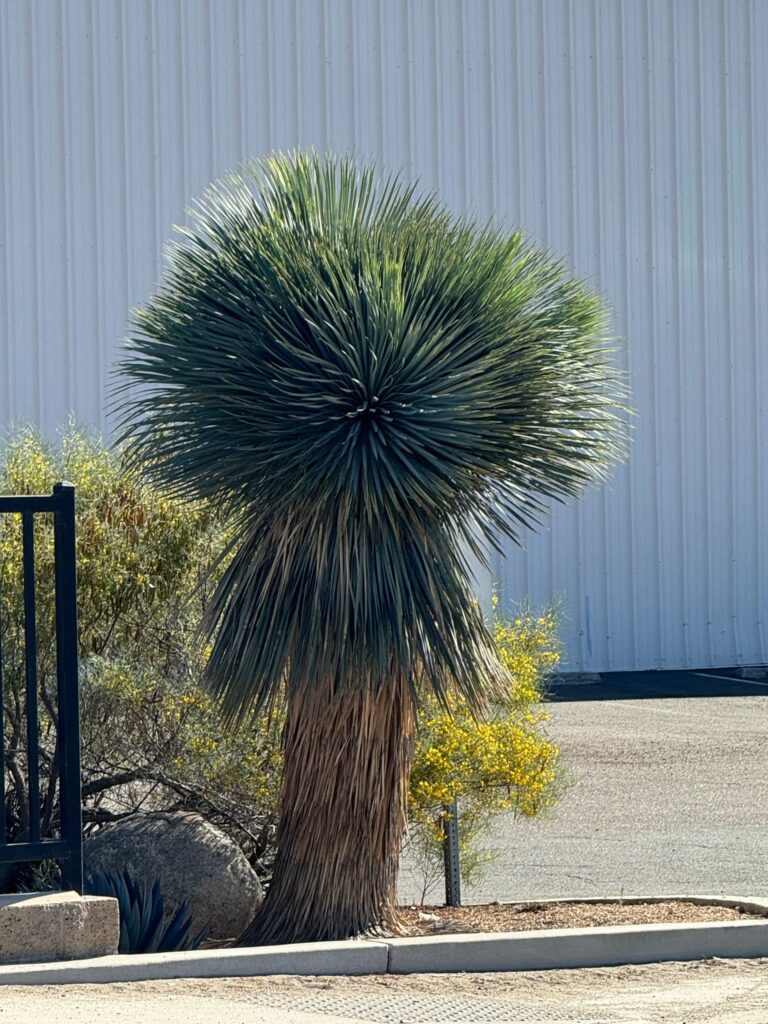
If you have ever spotted a sculptural, silver-blue tree standing alone in a dry garden — its trunk wrapped in a skirt of golden straw and its crown exploding in sharp, fine-tipped leaves — you were almost certainly looking at Yucca rostrata.
I remember the first time I saw one in a southwestern landscape. It stopped me in my tracks. There is something almost otherworldly about it. It looks designed rather than grown.
This guide covers everything you need to know about Yucca rostrata — from its native habitat and botanical identity, to how to grow, care for, and use it in the landscape.
| Common Name | Beaked Yucca, Big Bend Yucca |
| Scientific Name | Yucca rostrata Engelm. ex Trel. |
| Plant Family | Asparagaceae (formerly Agavaceae) |
| USDA Hardiness Zones | 5b – 11 |
| Mature Height | 6 – 15 feet (1.8 – 4.5 m) |
| Mature Spread | 4 – 6 feet (1.2 – 1.8 m) |
| Growth Rate | Slow (2 – 4 inches per year) |
| Leaf Color | Blue-green to silver-blue |
| Flower Color | Creamy white |
| Bloom Time | Late spring to early summer (May – June) |
| Sun Requirement | Full sun |
| Water Needs | Very low (drought-tolerant) |
| Soil Preference | Well-draining, sandy or rocky soil |
| Toxicity | Mildly toxic to pets and humans if ingested |
| Wildlife Value | High — supports yucca moths, birds, small mammals |
| Lifespan | 100+ years |
What Is Yucca Rostrata?
Yucca rostrata is a tree-forming yucca species native to the Chihuahuan Desert region of North America. It grows primarily in the Trans-Pecos area of west Texas — particularly in and around Big Bend — and extends into the Mexican states of Chihuahua and Coahuila.
The name rostrata comes from the Latin word rostrum, meaning “beak.” It refers to the distinctive beaked capsule of the plant’s fruit. This is why the plant is most commonly called the Beaked Yucca.
Unlike many yuccas that remain low and shrubby, Yucca rostrata develops a visible, stately trunk over time.
This gives it a tree-like presence that very few other yuccas achieve. That quality alone has made it one of the most sought-after ornamental plants in xeriscape and architectural garden design worldwide.
Botanical Classification and Taxonomy
Yucca rostrata belongs to the family Asparagaceae, in the subfamily Agavoideae. For many years, yuccas were placed in the family Agavaceae, but modern molecular taxonomy has reorganized them.
The species was first formally described by George Engelmann, a nineteenth-century American botanist who contributed enormously to the understanding of southwestern U.S. flora. It was later treated by William Trelease, who published a thorough monograph on the genus Yucca in 1902.
There are no widely accepted subspecies of Yucca rostrata, though some horticultural selections exist that favor specific leaf colors or growth habits.
The plant is monocarpic per rosette — each individual rosette blooms once and then that rosette slowly declines, but the plant itself continues through offsets or other growth points.
Natural Habitat and Ecology
Where Does Yucca Rostrata Grow Naturally?
In the wild, Yucca rostrata grows in rocky slopes, limestone ridges, desert flats, and canyon walls at elevations ranging from about 2,000 to 6,000 feet (600 – 1,800 m). These are harsh environments — hot summers, cold winters, minimal rainfall, and thin soils.
The Chihuahuan Desert, where Yucca rostrata thrives naturally, receives most of its rainfall in summer. This means the plant is adapted to infrequent but deep monsoon rains, followed by long dry spells. This ecology shapes everything about how the plant should be cared for in cultivation.
Ecological Role
Yucca rostrata plays a meaningful role in its native ecosystem.
- Yucca moths (Tegeticula spp.) are its exclusive pollinators. The relationship is obligate — neither can reproduce without the other. The moth collects pollen and intentionally places it on the stigma, then lays eggs in the flower. Her larvae eat some (but not all) of the developing seeds. It is one of the most studied examples of obligate mutualism in plant biology.
- Birds use the dried leaf skirts as nesting material and shelter. Species including the Scott’s Oriole have been documented nesting in Yucca plants in the desert southwest.
- Deer and javelinas browse the flowers, and rodents cache the seeds. Even after death, Yucca trunks provide insect habitat, supporting the food web.
This web of relationships makes Yucca rostrata more than a pretty plant. It is a keystone organism in its native landscape.
Physical Description
The Trunk
One of the most visually distinctive features of Yucca rostrata is its trunk. Over decades, the plant builds a fibrous, woody stem that can reach heights of 15 feet (4.5 m) or more. The trunk is covered in a dense “petticoat” of old, dried leaves that hang downward like a thatch skirt.
This natural armor protects the trunk from temperature extremes and physical damage. In garden settings, some people remove the dead leaves for a cleaner look, though this exposes the grey-brown fibrous trunk underneath — which is also attractive in its own right.
The Leaves
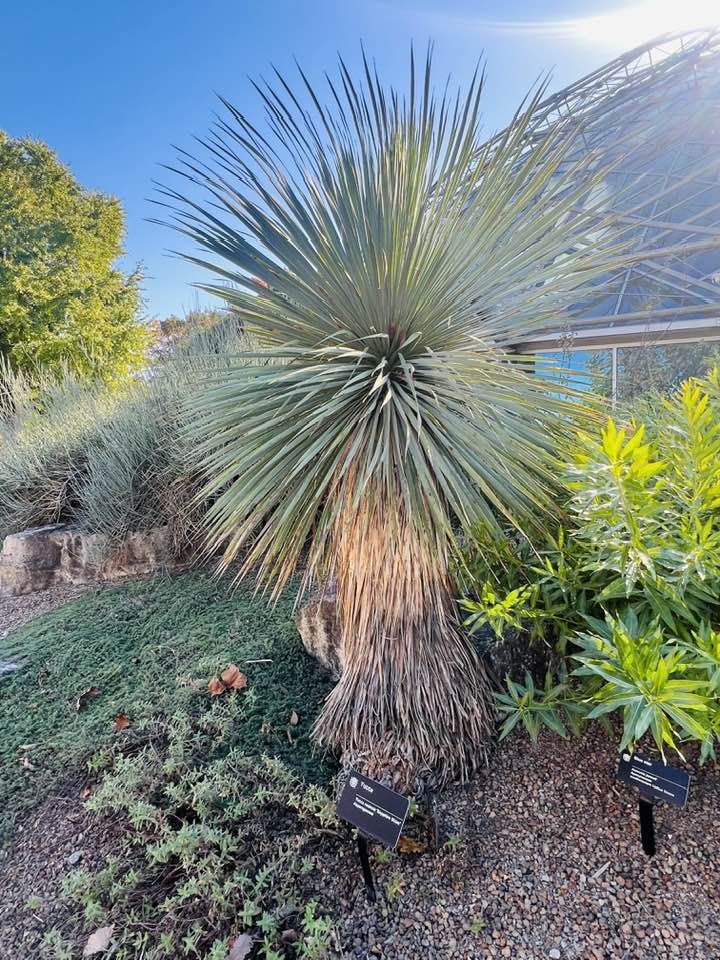
The crown of Yucca rostrata is a dense rosette of narrow, stiff, blue-green to silver-blue leaves. Each leaf is typically:
- 12 – 24 inches (30 – 60 cm) long
- Less than half an inch wide
- Edged with fine, white fibrous threads
- Tipped with a sharp, rigid spine
The leaf color is one of the plant’s greatest ornamental assets. The silver-blue hue intensifies in full sun and makes the plant stand out dramatically against warm-toned soils, gravel, or other plants.
The Flowers
Yucca rostrata produces a spectacular erect flower spike that rises 3 – 5 feet above the leaf rosette, sometimes reaching 6 feet in total height. The spike is densely packed with creamy white, bell-shaped flowers, each about 1.5 to 2 inches across.
Flowering typically occurs in late spring to early summer, and the show lasts several weeks. The flowers are mildly fragrant, particularly in the evening, which helps attract their nocturnal moth pollinators.
Not every rosette blooms every year. In cultivation, plants in full sun with good drainage tend to flower more reliably than those grown in shadier or wetter conditions.
The Fruit
After pollination, the flowers develop into oval, beaked capsules — the source of the plant’s Latin name. The capsules ripen in late summer to fall, turning from green to tan. Inside, each capsule contains flat, black seeds arranged in stacked rows.
The seeds are viable and can be used for propagation, though germination is somewhat slow and irregular.
How to Grow Yucca Rostrata
Climate and Hardiness
This plant is surprisingly cold-hardy for a desert species. It tolerates temperatures down to about -15°F (-26°C), placing it in USDA Hardiness Zone 5b. This makes it growable in a far wider range of climates than most people expect, including parts of the UK, northern Europe, and the central United States.
However, the key caveat is moisture during cold periods. Yucca rostrata tolerates dry cold extremely well, but wet cold can be fatal. In climates with cold, wet winters, growing it under a protective overhang or providing very sharp drainage is essential.
Sunlight
Full sun is non-negotiable. Plant Yucca rostrata in a spot that receives at least 6 – 8 hours of direct sunlight daily. More sun is always better. In part shade, the plant grows slowly, the blue color diminishes, and flowering becomes rare.
Soil
The single most important soil requirement is excellent drainage. Yucca rostrata despises wet feet. It thrives in:
- Sandy soils
- Rocky or gravelly soils
- Amended clay soils with added grit (at least 50% grit by volume)
- Raised beds
- Sloped sites where water drains freely
pH is flexible — the plant tolerates both slightly acidic and alkaline soils, which reflects the varied chemistry of its native limestone and igneous substrates.
Watering
Once established (typically after 1 – 2 growing seasons), Yucca rostrata is highly drought-tolerant. In its native habitat, it receives 8 – 14 inches of rainfall annually, mostly in summer.
In cultivation:
- Year 1: Water every 1 – 2 weeks during the growing season to encourage root establishment.
- Year 2 onward: Reduce to once or twice a month in summer. In cool seasons, water rarely or not at all.
- In wet climates: Ensure drainage is doing the work. Do not supplement rainfall unless there is a prolonged dry spell.
Overwatering is the most common way to kill this plant. Root rot sets in quickly when drainage is poor.
Fertilizing
Yucca rostrata does not need regular fertilizing. In native, nutrient-poor soils, it is perfectly content. If you wish to encourage growth, a light application of a balanced, low-nitrogen fertilizer in early spring is sufficient. Avoid high-nitrogen feeds, which promote lush but weak growth.
Planting Tips
- Plant in spring after frost risk has passed, to give the plant a full growing season for root establishment before its first winter.
- Dig a planting hole no deeper than the rootball but twice as wide.
- Mix extracted soil with coarse grit or gravel to improve drainage.
- Do not bury the crown. Keep the base of the rosette at or slightly above soil level.
- Mulch with gravel, not organic mulch, to keep moisture away from the trunk base.
Pruning and Maintenance
Yucca rostrata is among the lowest-maintenance landscape plants available. Once established, it essentially looks after itself.
Removing Dead Leaves
The dried leaf skirt is natural and protective. However, if you prefer a tidier appearance:
- Remove dead leaves by pulling them downward — they typically detach cleanly.
- Use heavy gloves to protect your hands from the leaf-tip spines.
- Do not cut living leaves unless they are damaged.
After Flowering
After blooming, the spent flower spike can be cut at its base once it has fully dried. This keeps the plant looking tidy and may slightly redirect energy to the remaining rosettes.
Division and Offsetting
Mature plants may produce offsets (pups) at the base. These can be removed in spring or early summer:
- Use a sharp, clean spade to sever the offset from the parent.
- Allow the cut surface to dry (callous) for 24 – 48 hours.
- Plant in well-draining soil and water sparingly until established.
Propagation
From Seed
Yucca rostrata seeds germinate best with these conditions:
- Sow in spring, in a mix of 50% seed compost and 50% perlite or coarse sand.
- Sow seeds 1/4 inch (6 mm) deep.
- Keep at 70 – 80°F (21 – 27°C) with consistent moisture until germination.
- Germination takes 3 – 6 weeks, sometimes longer.
- Grow seedlings in full sun once they have their first true leaves.
- Expect slow progress — seedlings may take 5 – 10 years to develop a trunk.
From Offsets
This is faster and more reliable than seed. Offsets are genetically identical to the parent plant, so you preserve any desirable traits.
Stem Cuttings
In some cases, sections of the trunk can be rooted, though this is less common in home cultivation and works best in warm, dry conditions with bottom heat.
Landscape and Design Uses
Yucca rostrata has become a global garden celebrity — and for good reason. Its architectural form, striking color, and minimal needs make it one of the most versatile plants for contemporary landscape design.
Focal Points and Specimen Planting
A single mature Yucca rostrata commands attention. Plant it as a specimen in a gravel garden, courtyard, or front landscape where its full form can be appreciated from multiple angles.
Dry and Mediterranean Gardens
It pairs magnificently with other drought-tolerant plants. Effective companions include:
- Agave species — for contrasting bold forms
- Penstemon — for soft color against the silver-blue leaves
- Salvia species — for seasonal flower color
- Ornamental grasses such as Nassella tenuissima — for texture contrast
- Lavender and Rosemary — for fragrance and fine texture
- Euphorbia species — for contrasting green foliage
Rock Gardens and Sloped Sites
The plant’s preference for rocky, free-draining soil makes it a natural choice for rock gardens. On slopes, it thrives where other plants struggle, and its roots help stabilize the soil.
Container Growing
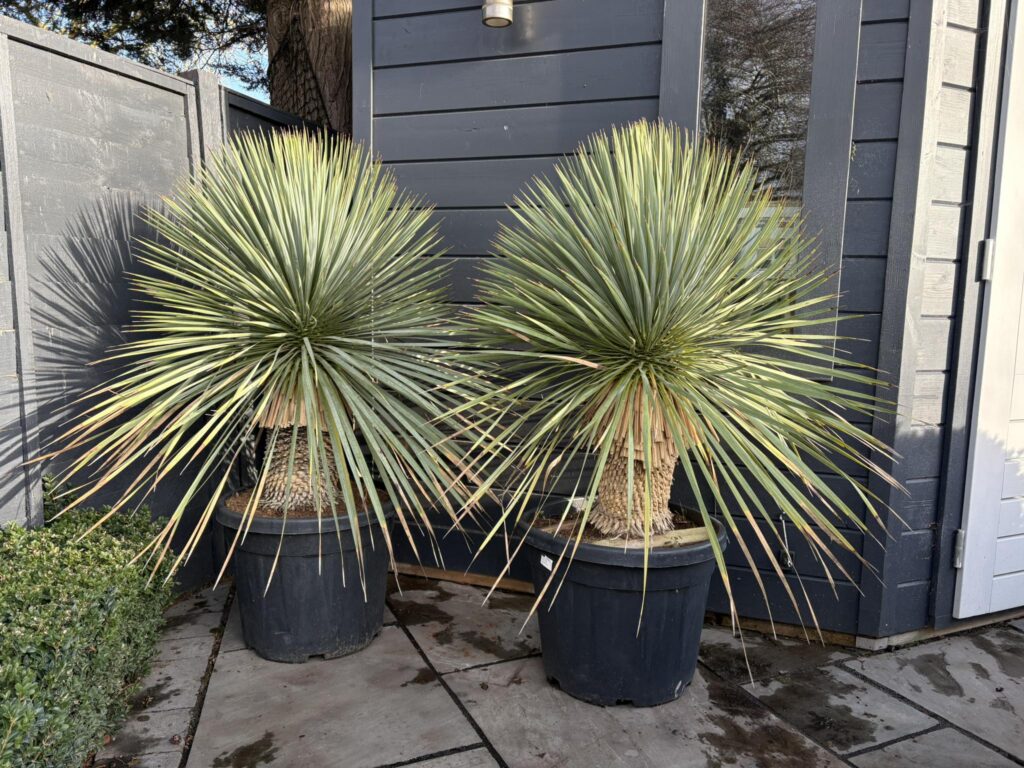
Young plants grow well in large containers with a gritty growing mix. Container culture allows gardeners in cold, wet climates to move the plant under cover during winter. Use terracotta pots, which breathe better than plastic, and ensure the pot has generous drainage holes.
Architectural and Urban Landscapes
The bold silhouette of Yucca rostrata suits modernist, minimalist, and contemporary garden styles. Paired with concrete, steel, or pale gravel, it looks striking and deliberate.
Many public gardens and streetscapes in southern Europe and the American Southwest have adopted it for its structural impact and low maintenance.
Pests and Diseases
Common Pests
Yucca rostrata is largely pest-resistant. However, watch for:
- Yucca weevils (Scyphophorus acupunctatus): The adult lays eggs in the plant’s base. Larvae tunnel through the crown and trunk, causing collapse. This is the most serious pest of yuccas. Inspect regularly and remove affected tissue. Systemic insecticides can be used in severe cases.
- Scale insects: Occasional infestations on leaves. Treat with horticultural oil if severe.
- Agave snout-nosed weevil: Occasionally attacks yuccas, especially stressed plants.
Common Diseases
- Root rot (Phytophthora and Pythium spp.): Caused almost exclusively by overwatering or poor drainage. The best prevention is the best cure — plant in fast-draining soil and water conservatively.
- Leaf spot fungi: Rare in dry climates, more common in humid ones. Improve air circulation and reduce overhead watering.
Healthy, well-sited plants seldom suffer serious pest or disease problems. Most issues arise from growing the plant in unsuitable conditions.
Yucca Rostrata vs. Similar Species
Gardeners sometimes confuse Yucca rostrata with related species. Here is a brief comparison:
| Feature | Y. rostrata | Y. rigida | Y. thompsoniana |
| Leaf color | Blue-silver | Blue-white | Blue-green |
| Leaf width | Narrow | Narrow | Narrow |
| Trunk | Prominent | Prominent | Moderate |
| Cold hardiness | Zone 5b | Zone 7 | Zone 6 |
| Mature height | 6 – 15 ft | 6 – 12 ft | 6 – 10 ft |
| Native range | TX / Mexico | Chihuahua | TX / Mexico |
Y. rostrata is generally considered the most ornamental of the three, due to its superior cold hardiness, dramatic trunk, and vivid silver-blue coloration.
Cultural Significance and Historical Uses
For indigenous peoples of the Chihuahuan Desert region, yuccas were indispensable. While Y. rostrata specifically is not as heavily documented as the common yucca (Y. elata or Y. baccata), related species were used for:
- Fiber: Leaves were processed into rope, baskets, sandals, and cloth.
- Food: Flowers, fruits, and young stalks were eaten — roasted, boiled, or raw.
- Soap: The roots contain saponins, natural surfactants used as shampoo and soap.
- Medicine: Various parts were used in poultices and preparations for skin conditions and joint pain.
The plant’s enduring presence in a harsh landscape made it a symbol of resilience and survival in desert cultures.
Conservation Status
Yucca rostrata is not currently listed as threatened or endangered. However, habitat loss, illegal collection from the wild, and overgrazing in parts of its native range are ongoing pressures. In Mexico especially, some populations face habitat degradation.
The plant is propagated commercially in large numbers, which helps reduce collection pressure. When purchasing, always buy from a reputable nursery that grows its stock from seed or cuttings, rather than from wild-collected sources.
Frequently Asked Questions
How fast does Yucca rostrata grow? Slowly. Expect 2 – 4 inches of trunk growth per year under ideal conditions. A plant with a 3-foot trunk is likely 15 – 20 years old.
Can Yucca rostrata grow in the UK? Yes, in many parts of the UK — particularly in the south and southwest — Yucca rostrata grows successfully outdoors. It tolerates the cold but needs sharp drainage to survive wet winters.
Is Yucca rostrata toxic? The plant contains steroidal saponins, which are mildly toxic if consumed in quantity. Keep pets and children away from the berries and leaves. The sharp leaf tips are also a physical hazard.
How do I know if my Yucca rostrata is dying? Yellow, soft, or mushy leaves at the base, a foul smell from the crown, or a collapsing rosette often indicate root rot or weevil damage. Act quickly — remove affected tissue, improve drainage, and apply a systemic treatment if needed.
Does Yucca rostrata need a lot of space? The plant’s spread is modest (4 – 6 feet), but the sharp leaf tips need clearance from pathways, seating areas, and children’s play spaces. A buffer of at least 3 feet from walkways is advisable.
Where to Buy Yucca Rostrata
Yucca rostrata has become widely available from specialist nurseries in the United States, the UK, and continental Europe. Look for:
- Specialty yucca and agave nurseries — often the best quality and widest selection
- Online specialist retailers — check reviews and verify that plants are nursery-grown
- Regional desert plant sales and botanical garden plant sales
When buying, choose a plant with firm, upright leaves, no yellowing at the base, and a healthy root system. Avoid any plant with soft or mushy tissue at the crown.
Conclusion
Yucca rostrata is, without exaggeration, one of the most remarkable plants you can grow. It is ancient in origin, extraordinary in appearance, and almost embarrassingly easy to care for once it is planted in the right spot. Give it sun, give it drainage, and mostly leave it alone — and it will reward you with decades of striking beauty.
For gardeners trying to reduce water use, create a low-maintenance landscape, or simply grow something genuinely unusual and memorable, Yucca rostrata deserves a place at the top of the list.
It is more than a plant. It is a statement.
References and Further Reading
- USDA Natural Resources Conservation Service — PLANTS Database Yucca rostrata Engelm. ex Trel. — Beaked Yucca https://plants.usda.gov/home/plantProfile?symbol=YURO
- USDA Forest Service — Fire Effects Information System (FEIS) Yucca species ecology, fire response, and habitat relationships in the Chihuahuan Desert https://www.fs.usda.gov/database/feis/plants/shrub/yucros/all.html
- Texas A&M AgriLife Extension — Horticulture Drought-tolerant ornamental plants for Texas landscapes, including Yucca species profiles https://aggie-horticulture.tamu.edu/ornamental/
- Lady Bird Johnson Wildflower Center — The University of Texas at Austin https://www.wildflower.org/plants/result.php?id_plant=YURO

Tim M Dave is a gardening expert with a passion for houseplants, particularly cacti and succulents. With a degree in plant biology from the University of California, Berkeley, he has vast experience in gardening. Over the years, he has cultivated a vast collection of desert plants and learned a great deal about how to grow and care for these unique companions.