25 California Native Trees (With Growing Details)
California does not do things halfway. It grows the tallest tree on Earth, the largest tree by volume, and the oldest living tree — all within its own borders. I have spent time walking under many of these giants, and I can tell you that no photo prepares you for standing next to one.
According to the California Native Plant Society, California is home to more than 6,500 native plant species, and a good share of them are trees that exist nowhere else in the wild.
This guide covers 25 California native trees you should know, whether you are a hiker, a gardener, a student, or simply curious about the state’s natural heritage.
Let’s get into it.
25 California Native Trees
Native trees support local wildlife, resist regional pests, and need far less water than imported species. Planting native is one of the simplest ways to help California’s ecosystems recover.
Many of these species also shaped the state’s history. Redwoods built San Francisco. Oaks fed Indigenous communities for thousands of years. Sycamores marked the only shade along dry riverbeds.
Now, the list.
1. Coast Redwood (Sequoia sempervirens)
The coast redwood is the tallest tree species on the planet. The current record holder, a redwood named Hyperion, measures over 380 feet tall and grows in Redwood National Park.
These trees grow naturally only along a narrow coastal strip from southern Oregon to central California. They depend on fog for moisture during dry summers, which is why they never grow far from the coast.
Coast redwoods can live for more than 2,000 years. Their thick, fibrous bark can be over a foot deep, which helps them survive wildfires that would kill almost any other tree.
I still remember craning my neck and never actually finding the top of one. That alone tells you something about scale here.
2. Giant Sequoia (Sequoiadendron giganteum)
While the coast redwood wins on height, the giant sequoia wins on sheer bulk. General Sherman, located in Sequoia National Park, is the largest known tree on Earth by volume, at roughly 52,500 cubic feet.
Giant sequoias grow only on the western slopes of the Sierra Nevada, usually between 5,000 and 7,000 feet in elevation. Unlike coast redwoods, they need fire to reproduce, since their cones only release seeds after heat cracks them open.
Some living giant sequoias are believed to be over 3,000 years old. Their reddish, spongy bark can reach two feet in thickness.
3. Bristlecone Pine (Pinus longaeva)
This is the oldest known living tree on Earth. A bristlecone pine in the White Mountains, nicknamed Methuselah, is estimated to be roughly 4,850 years old.
Bristlecone pines thrive in harsh, high-altitude conditions where almost nothing else survives. Their twisted, weathered trunks look almost sculpted rather than grown.
Slow growth is the secret to their longevity. Dense wood resists rot, insects, and fungal decay for thousands of years, even long after the tree dies standing.
ALSO READ: 60 California Native Flowers (With Growing Details)
4. Valley Oak (Quercus lobata)
The valley oak is California’s largest native oak species, sometimes reaching over 100 feet in height with a canopy spread just as wide. It once dominated the Central Valley before agriculture cleared most of its habitat.
This deciduous oak has deeply lobed leaves and produces some of the largest acorns of any oak in North America. Indigenous Californian communities relied on these acorns as a dietary staple for generations.
Valley oaks can live for 600 years or more. Sadly, less than 1% of the original valley oak woodland is thought to remain intact today.
5. Coast Live Oak (Quercus agrifolia)
Unlike the valley oak, this species is evergreen, keeping its small, holly-like leaves year-round. It grows naturally along the California coast from Mendocino County down into Baja California.
Coast live oaks develop broad, sprawling canopies and thick, gnarled trunks. Mature trees often look like they are reaching sideways rather than upward, especially in windy coastal areas.
These oaks provide food and shelter for dozens of bird and mammal species. A single mature oak can support hundreds of insect species, making it a keystone tree for local biodiversity.
6. Blue Oak (Quercus douglasii)
Blue oaks earn their name from the faint blue-gray tint of their leaves. This species is found only in California, mostly in the foothills ringing the Central Valley.
It is remarkably drought-tolerant, surviving in areas that receive as little as 12 inches of rain per year. Growth is slow, but individual trees can live for several centuries.
Blue oak woodlands are considered one of the most threatened oak habitats in the state due to limited natural regeneration.
7. California Black Oak (Quercus kelloggii)
This deciduous oak turns a striking gold and orange in autumn, standing out against the evergreen conifers it often grows alongside in mountain forests. It ranges from southern Oregon through the Sierra Nevada and into the mountains of Southern California.
Its acorns were historically one of the most prized by Indigenous communities because of their higher oil content compared to other oak species. Black oaks can grow to 80 feet with straight, tall trunks.
They typically grow between 1,000 and 8,000 feet in elevation, often mixed with ponderosa pine and Douglas fir.
8. Canyon Live Oak (Quercus chrysolepis)
Also called maul oak, this species is known for producing some of the hardest wood among California oaks. It grows in canyons, on rocky slopes, and along ridgelines across much of the state.
Its acorn cups are covered in a golden, felt-like fuzz, which makes it easy to distinguish from other oak species. Leaves vary widely in shape, even on the same tree, ranging from smooth-edged to sharply toothed.
Canyon live oaks can survive at elevations up to 9,000 feet, tolerating both drought and cold better than most oaks.
9. Engelmann Oak (Quercus engelmannii)
This is one of California’s rarest native oaks, found mainly in San Diego, Riverside, and Orange counties. Its total range barely extends beyond Southern California and a small part of Baja California.
Engelmann oaks are semi-deciduous, meaning they may drop leaves depending on rainfall rather than season alone. Urban development has significantly reduced their historic range over the past century.
Conservation groups now consider this species a priority for habitat protection in Southern California.
10. California Sycamore (Platanus racemosa)
Known for its pale, mottled bark that peels in patches, the California sycamore is easy to spot along riverbanks and dry creek beds. It often grows in a leaning or twisting form rather than perfectly upright.
This tree can reach heights of 80 to 100 feet and is one of the few deciduous native trees that thrives in California’s hot inland valleys. Its large, maple-like leaves provide dense shade during summer.
Sycamores are considered an indicator species for healthy riparian zones, since they need consistent groundwater access to survive.
11. Big Leaf Maple (Acer macrophyllum)
This is the largest native maple in western North America, with leaves that can grow up to 12 inches wide, among the biggest of any maple species worldwide. It grows in moist forests along the coast and in the Sierra Nevada foothills.
In autumn, its leaves turn a brilliant yellow-gold, offering one of the few strong fall color displays in California’s native tree palette. Mature trees typically reach 50 to 100 feet tall.
Big leaf maples often host thick mats of moss and licorice fern on their branches, thriving in the humid microclimates the tree creates.
12. California Bay Laurel (Umbellularia californica)
Crush a leaf from this tree and you will notice immediately — the scent is sharp, almost medicinal, and unmistakable. It is sometimes called headache tree because of this pungent aroma.
This evergreen species grows from southern Oregon to Southern California, often in mixed forests alongside oaks and redwoods. It produces a fruit resembling a small olive, historically used by Indigenous groups for food and medicine.
Research has linked California bay laurel to the spread of sudden oak death, since the fungus that causes the disease uses bay leaves as a host without killing the bay tree itself.
13. Douglas Fir (Pseudotsuga menziesii)
Despite its name, this tree is not a true fir. It is one of the most commercially important timber trees in North America and grows naturally in California’s northern and coastal mountain ranges.
Douglas firs can reach heights over 300 feet, making them among the tallest conifers in the world after redwoods. Their cones have a distinctive three-pointed bract that sticks out from between each scale.
This species plays a major role in California’s timber industry and is also a popular choice for Christmas trees nationwide.
14. Ponderosa Pine (Pinus ponderosa)
Ponderosa pines are known for their thick, puzzle-piece bark that smells faintly of vanilla or butterscotch when warmed by the sun. I always tell people to press their nose right against the bark — it genuinely surprises most first-timers.
This pine grows widely across the Sierra Nevada and other California mountain ranges, typically between 1,000 and 7,000 feet. Mature trees can reach 200 feet in height with long, straight trunks.
Ponderosa pine forests depend on periodic low-intensity fire to clear undergrowth and encourage seedling growth.
15. Jeffrey Pine (Pinus jeffreyi)
Closely related to the ponderosa pine, the Jeffrey pine is often confused with it, though its cones lack the sharp, outward-pointing prickles found on ponderosa cones. Its bark has a similar vanilla-like scent.
This species grows at higher elevations than ponderosa pine, often above 6,000 feet, and is common in the Sierra Nevada and southern Cascade ranges. It tolerates poor, rocky soils better than most conifers.
Jeffrey pines can live for several hundred years and typically reach 100 to 180 feet tall.
16. Sugar Pine (Pinus lambertiana)
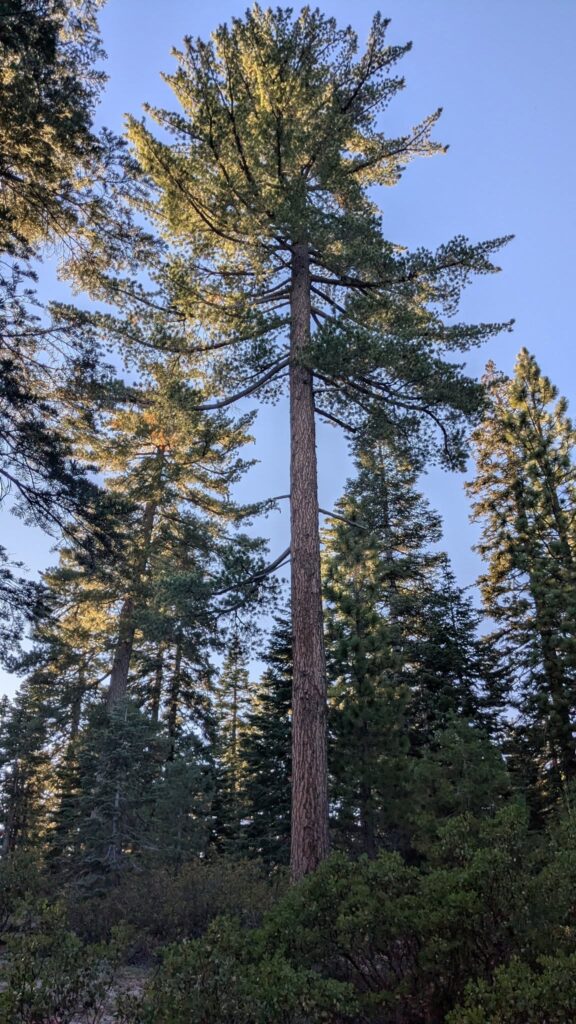
Sugar pines produce the longest cones of any conifer in the world, sometimes exceeding 20 inches in length. Early botanist David Douglas documented this species during his California expeditions in the 1820s.
This is also the tallest pine species on Earth, with some individuals reaching over 250 feet. It grows mainly in the Sierra Nevada and parts of the Klamath Mountains.
Sugar pine populations have declined due to white pine blister rust, an introduced fungal disease that has affected several pine species across western North America.
17. Torrey Pine (Pinus torreyana)
This is considered the rarest native pine species in the United States. Wild populations exist in only two locations: a small area near San Diego and Santa Rosa Island off the coast.
Torrey pines have long, thick needles grouped in bundles of five, unlike most California pines. The total wild population is estimated at only a few thousand mature trees.
Torrey Pines State Natural Reserve was established specifically to protect this species from coastal development pressure.
18. Monterey Cypress (Cupressus macrocarpa)
Famous for its windswept, sculptural shape along the Monterey Peninsula, this cypress naturally grows in only two small groves on the entire planet. Its twisted branches result from constant exposure to strong coastal winds.
Despite its extremely limited native range, Monterey cypress has been widely planted around the world as an ornamental and windbreak tree, particularly in coastal regions with similar climates.
The iconic Lone Cypress near Pebble Beach is estimated to be over 250 years old and remains one of the most photographed trees in California.
19. Incense Cedar (Calocedrus decurrens)
This conifer has a distinctive, spicy fragrance and reddish-brown, fibrous bark similar in appearance to giant sequoia bark. It grows widely across the Sierra Nevada and Klamath mountain ranges.
Incense cedar wood has historically been used for pencil manufacturing due to its softness and ease of sharpening. Mature trees can reach 150 feet with broad, buttressed trunks.
This species is highly shade-tolerant, allowing it to thrive in the understory of mixed conifer forests alongside taller pines and firs.
20. White Fir (Abies concolor)
White fir is easily identified by its soft, blue-green needles and smooth, gray bark on younger trees. It grows throughout California’s mountain ranges, typically between 3,000 and 9,000 feet elevation.
This species is a popular choice for Christmas trees due to its symmetrical shape and needle retention. Mature white firs can exceed 150 feet in height.
White fir forests provide critical habitat for numerous mountain bird species, including several owl species that nest in cavities of older trees.
21. Western Redbud (Cercis occidentalis)
This small, deciduous tree puts on one of California’s most dramatic spring displays, covering its bare branches in bright magenta-pink flowers before the leaves even emerge. It rarely exceeds 20 feet in height.
Western redbud grows in canyons and foothill woodlands throughout much of California, often alongside oaks and chaparral shrubs. Its heart-shaped leaves turn yellow to reddish-orange in fall.
This tree is highly valued in native landscaping for its drought tolerance and its ability to attract pollinators during early spring bloom.
22. California Fan Palm (Washingtonia filifera)
This is the only palm species native to the western United States, found naturally in desert oases across Southern California, particularly in areas like Palm Springs. It can grow over 60 feet tall.
Unlike introduced ornamental palms, this species requires a reliable underground water source, which is why its wild groves cluster tightly around desert springs and seeps.
Older, unpruned specimens develop a thick “skirt” of dead fronds hanging down the trunk, which historically provided shelter for desert wildlife.
23. Fremont Cottonwood (Populus fremontii)
This fast-growing deciduous tree lines rivers and streams throughout California’s lower elevations. It can grow 6 feet or more in a single year under good conditions, among the fastest growth rates of any native tree.
Its heart-shaped leaves shimmer in the wind due to flattened leaf stems, creating a shimmering, rustling effect that is distinctive along riverbanks. Mature trees often exceed 80 feet.
Fremont cottonwoods are essential to riparian ecosystems, providing nesting habitat for numerous bird species, including the threatened western yellow-billed cuckoo.
24. Pacific Madrone (Arbutus menziesii)
Few California native trees are as visually striking as the Pacific madrone, with its smooth, reddish bark that peels away in curling strips to reveal a pale green trunk underneath. It grows along the coast and into the Sierra Nevada foothills.
This evergreen tree produces clusters of white, urn-shaped flowers in spring, followed by bright red-orange berries in fall that attract numerous bird species. It typically reaches 20 to 80 feet in height.
Pacific madrone is notoriously difficult to transplant successfully, which is why most nurseries recommend growing it from seed rather than moving established saplings.
25. Joshua Tree (Yucca brevifolia)
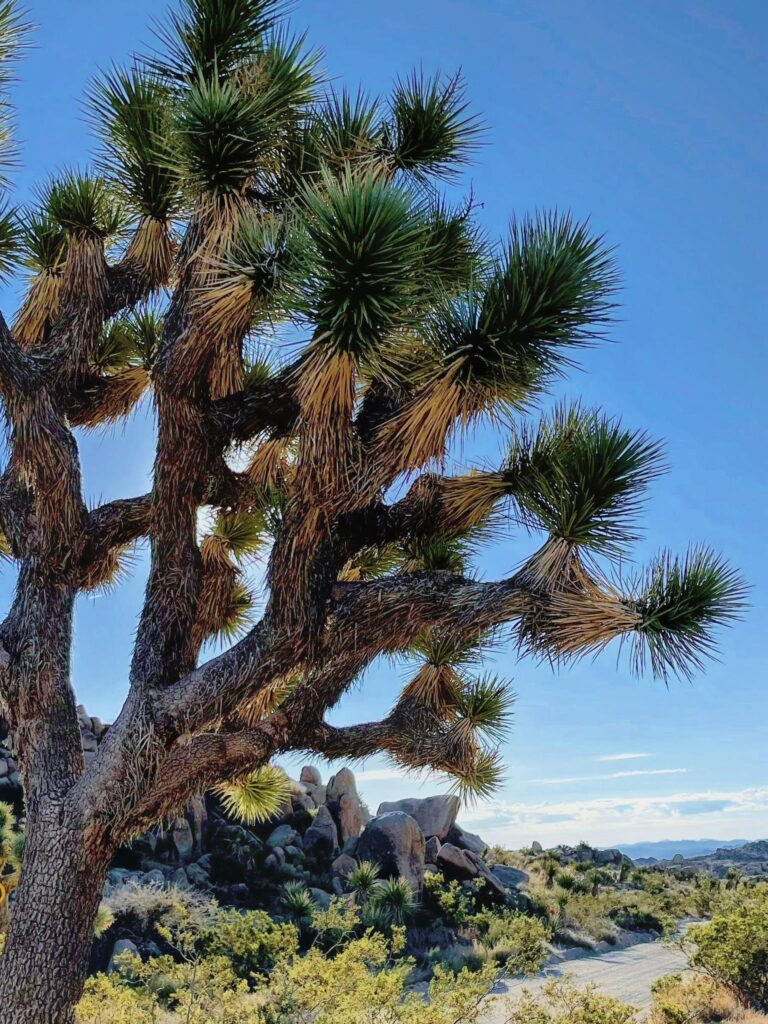
Though technically a species of yucca rather than a true tree botanically, the Joshua tree is universally recognized as one of California’s most iconic native plants. It grows almost exclusively in the Mojave Desert.
This unusual, spiky-limbed plant can live for 150 years or more, and some individuals are estimated to exceed 300 years of age. Growth is extremely slow, often less than 3 inches per year.
Joshua Tree National Park, established to protect this species, spans over 790,000 acres. Rising temperatures and shifting rainfall patterns have raised concern among researchers about the species’ long-term survival in parts of its historic range.
Final Thoughts
California’s native trees tell a story that stretches back thousands of years, long before the state had a name. From the tallest tree on Earth to the oldest living organism known to science, this land holds records that few other places can claim.
If you plan to plant natives in your own garden, choose species suited to your specific region and rainfall pattern. A blue oak that thrives in the foothills will struggle badly in a coastal fog belt, and a redwood planted in the desert simply will not survive.
Walking among any of these species, even once, tends to change how a person sees California. I know it changed how I see it.

Tim M Dave is a gardening expert with a passion for houseplants, particularly cacti and succulents. With a degree in plant biology from the University of California, Berkeley, he has vast experience in gardening. Over the years, he has cultivated a vast collection of desert plants and learned a great deal about how to grow and care for these unique companions.