15 Types of Elderberry (Popular Varieties, and Their Uses)
Elderberry is not just one plant. It is a whole family of shrubs and small trees, spread across nearly every continent.
I have spent a good deal of time digging through botanical records and extension guides while researching this piece, and one thing struck me: most people know only one or two elderberry types, usually the ones sold as syrup at the pharmacy.
There is far more to this plant. Some types are prized for immune-supporting syrup. Others are toxic and strictly ornamental. A few are so rare that only botanists have seen them growing in the wild.
This guide walks through 15 types of elderberry, covering true species and the most popular cultivated varieties. You will also find safety notes, nutrition facts, and verified government and university sources at the end.

What Is Elderberry, Exactly?
Elderberry belongs to the genus Sambucus, part of the Adoxaceae (moschatel) family. The genus includes roughly 20 to 30 recognized species, depending on the botanical source, growing as shrubs or small trees across temperate and subtropical regions.
Most elderberries produce clusters of small white or cream flowers in late spring. These give way to berry-like drupes in summer or early autumn.
Not every elderberry is edible. Some species carry toxic compounds in their raw berries, leaves, bark, and roots. Knowing which type you have matters, especially before eating anything from the plant.
With that groundwork laid, let’s look at the 15 types.
1. American Elderberry (Sambucus canadensis)
American elderberry is the species most home growers in the United States plant for fruit.
It produces large, flat-topped clusters of white flowers in June, followed by small, dark purple berries by late summer. The shrub typically reaches 5 to 12 feet tall.
This species is native across eastern and central North America, thriving along stream banks, fence rows, and woodland edges.
Cooked berries go into syrup, jam, wine, and pie filling. Raw berries, leaves, and stems contain compounds that can cause nausea, so cooking is not optional here.
Many botanists now classify American elderberry as a subspecies of black elder, written as Sambucus nigra subsp. canadensis. You will see both names used interchangeably in nursery catalogs.
2. European Black Elderberry (Sambucus nigra)
If you have bought elderberry syrup, gummies, or extract from a store, there is a strong chance it came from this species.
Sambucus nigra is native to Europe, western Asia, and North Africa. It is also the species behind most published elderberry research, including the widely cited studies on flu symptom relief.
The shrub can grow into a small tree, reaching over 20 feet in ideal conditions. Its dark purple-black berries ripen in late summer.
Traditional European households have used the flowers for cordial and the berries for wine and syrup for centuries. Herbalists still favor this species above nearly all others.
As with American elderberry, raw berries and other plant parts should never be eaten uncooked.
3. Blue Elderberry (Sambucus cerulea, also listed as S. nigra subsp. cerulea)
Blue elderberry grows wild across the western United States, from California up into British Columbia.
Its berries look genuinely blue, thanks to a natural waxy bloom that coats the dark purple fruit skin. Wipe that bloom away and the true purple-black color shows underneath.
This species tolerates drought better than its eastern cousin. It is a familiar sight along dry hillsides, canyons, and open woodlands throughout the American West.
Indigenous communities across the region have long used blue elderberry for food, dye, and traditional medicine, and it remains a valued food and wildlife plant today.
Cooked fruit works well in syrup and jam, following the same preparation rules as other edible elder species.
4. Red Elderberry (Sambucus racemosa)
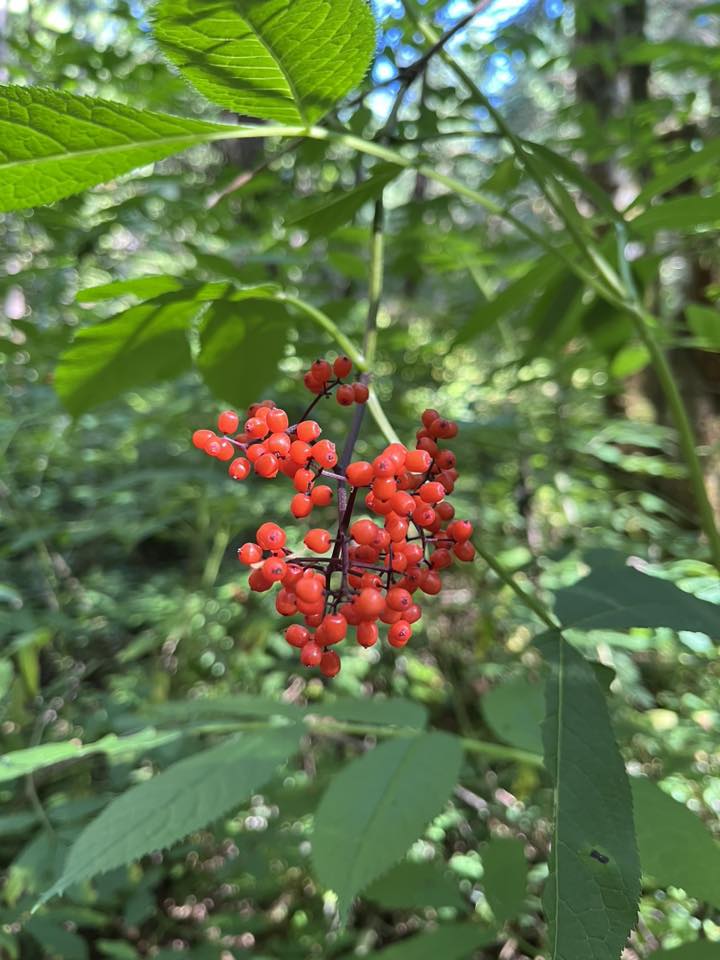
Red elderberry stands apart visually. Its berries ripen to a bright, glossy red rather than the typical dark purple.
Found across North America, Europe, and parts of Asia, this species favors cooler, moist, and often mountainous or coastal habitats.
Here is the important caution: red elderberry fruit is more toxic than black or blue types, and even cooked berries carry higher risk if seeds and skins are not properly processed and strained.
Most home foragers and gardeners grow red elderberry for wildlife value rather than the kitchen. Birds rely heavily on the fruit, and the shrub offers strong early-season nectar for pollinators.
If you forage in the wild, this is one species where caution should outweigh curiosity.
5. Dwarf Elder or Danewort (Sambucus ebulus)
Dwarf elder looks different from the rest of the genus at first glance. It grows as an herbaceous perennial, dying back to the ground each winter rather than staying woody.
Native to Europe, this species has naturalized in parts of northeastern North America. Old herbal texts describe it as having a stronger, more aggressive medicinal action than common elder.
This species is not used as food. Historical herbalists reserved dwarf elder for external or highly limited internal preparations, and its berries are considered unsuitable for eating.
Gardeners today mostly avoid planting it near edible landscapes, precisely because it can be confused with safer elder species by an inexperienced eye.
6. Chinese Elderberry (Sambucus javanica, also called S. chinensis)
Chinese elderberry grows natively across East and Southeast Asia, including China, Japan, and parts of the Philippines.
It produces fragrant white flowers followed by small red or dark berries, depending on the regional variety.
Traditional Asian medicine systems have used parts of this plant for generations, particularly for joint discomfort and circulation support.
Western researchers have studied this species far less than European or American elder, so less clinical evidence exists to confirm traditional claims.
It remains primarily a regional plant, rarely sold outside Asian nurseries and specialty growers.
7. Yellow Elderberry (Sambucus australasica)
Yellow elderberry is native to eastern Australia, growing along rainforest margins and moist gullies.
True to its name, this species produces bright yellow fruit instead of the purple or red seen in most other elders. Its foliage tends toward a lighter, brighter green as well.
Little formal nutritional or medicinal research exists on this species. It functions mainly as a native ornamental and wildlife plant within its home range.
Outside Australia, yellow elderberry is rarely cultivated, making it one of the more obscure entries on this list.
8. Himalayan Elderberry (Sambucus adnata)
This species grows at elevation across the Himalayan region, including parts of India, Nepal, and China.
It produces small, creamy-white flowers and red berries, and local communities have long used it within traditional medicine practices.
Because of its remote native range, Himalayan elderberry has received limited scientific study compared to European black elder.
It is not commonly available through Western nurseries, and most information about it comes from regional botanical and ethnobotanical surveys rather than commercial horticulture sources.
9. Canary Island Elderberry (Sambucus palmensis)
Canary Island elderberry is a genuinely rare species, native only to a handful of locations in the Canary Islands.
It carries white flowers and small black berries, similar in general appearance to European black elder, but on a smaller, more localized population.
Conservationists list this species as threatened, largely due to habitat loss and grazing pressure on the islands where it survives.
Most people will never encounter this elder outside a botanical garden or conservation nursery. I include it here simply because elderberry’s diversity deserves recognition, not just the commercially useful types.
10. South American Elderberry (Sambucus australis)
South American elderberry grows natively across parts of Brazil, Argentina, Paraguay, and neighboring countries.
It shares the familiar white flower clusters and dark, almost black berries common to many elder species worldwide.
Folk medicine traditions throughout the region have used this plant for generations, often in ways that parallel European elder use, for coughs, colds, and skin complaints.
Formal scientific literature on this specific species remains limited compared to Sambucus nigra, though its close botanical relationship suggests similar phytochemical properties.
11. African Elderberry (Sambucus africana)
African elderberry grows across parts of sub-Saharan Africa, adapted to warmer climates than most of its northern relatives.
This species produces dark berries and has a documented history in regional traditional remedies for various ailments.
As with several other lesser-known species on this list, peer-reviewed research remains sparse. Much of what is known comes from ethnobotanical documentation rather than controlled clinical studies.
African elderberry is worth knowing about simply because it shows how widely this genus has adapted, from Arctic-adjacent regions all the way to tropical Africa.
12. ‘Adams’ Elderberry (Sambucus canadensis ‘Adams’)
Now we move into named cultivars, bred and selected for specific garden performance.
‘Adams’ is one of the oldest and most trusted American elderberry cultivars, developed in New York decades ago and still widely sold today.
It produces large fruit clusters and reliable yields, making it a favorite for home syrup and jam makers who want consistent harvests year after year.
Growers often pair ‘Adams’ with a second variety nearby, since cross-pollination improves fruit set in most elderberry cultivars.
13. ‘York’ Elderberry (Sambucus canadensis ‘York’)
‘York’ is another American elderberry cultivar, prized specifically for its exceptionally large berries, some of the biggest among commercial varieties.
It tends to ripen slightly later than ‘Adams,’ which makes the two a natural pairing for extending the harvest window.
Commercial growers and small-scale orchardists frequently choose ‘York’ when berry size and juice yield matter more than early ripening.
Like other American elderberry cultivars, cooking is required before eating the fruit.
14. ‘Nova’ Elderberry (Sambucus canadensis ‘Nova’)
‘Nova’ originated in Canada and has become popular for its compact growth habit and early ripening.
Home gardeners with smaller yards often prefer ‘Nova’ over larger cultivars, since it stays more manageable while still producing generous fruit clusters.
It also pairs well as a pollination partner for other American elderberry cultivars, improving overall yield across a planting.
Extension services across colder growing zones frequently recommend ‘Nova’ for its reliable cold hardiness.
15. ‘Black Lace’ Elderberry (Sambucus nigra ‘Black Lace’)

‘Black Lace’ represents the ornamental side of elderberry breeding entirely.
This cultivar was bred from European black elder for its striking, deeply cut, almost black-purple foliage, resembling Japanese maple leaves more than a typical elder shrub.
Pink flowers appear in late spring, contrasting sharply against the dark leaves, followed by small dark berries later in the season.
Landscapers plant ‘Black Lace’ purely for visual impact in mixed borders and specimen plantings. It is not typically grown or harvested for fruit production, even though the berries are technically edible when cooked.
READ MORE ON: Black Lace Elderberry: Identification, Size, Shape, and Growth Details
A Short History of Elderberry Use
Elderberry has followed humans through history far longer than most people realize.
Early European folklore treated the elder tree with genuine reverence, sometimes calling it a guardian plant that protected the home from harm. Households would plant it near doorways and rarely cut it down without asking the tree’s permission, at least according to old tradition.
Indigenous peoples across North America used various elderberry species long before European settlers arrived, drying berries for winter stores and using flowers, bark, and roots in traditional wellness practices passed down through generations.
By the time modern science entered the picture, elderberry already had centuries of recorded use behind it. Researchers simply began testing what traditional practice had long assumed.
That research eventually concentrated almost entirely on one species, European black elder, which explains why Sambucus nigra dominates today’s supplement shelves while dozens of its relatives remain largely unstudied.
Comparing the Main Edible Elderberry Types
Not every type on this list belongs in the kitchen, so here is a quick side-by-side look at the species most commonly grown for fruit.
American elderberry offers moderate-sized berries, strong cold hardiness, and wide availability across U.S. nurseries, making it the default choice for most backyard growers.
European black elderberry produces the richest, most research-backed berries, along with a taller growth habit that suits larger properties or hedgerow plantings.
Blue elderberry trades some cold tolerance for drought resistance, a fair swap for gardeners in the western United States dealing with dry summers.
Red elderberry, by contrast, sits outside this comparison entirely. Its higher toxicity risk keeps it out of most food gardens, regardless of how attractive its bright red fruit clusters look.
When choosing between the three edible options, climate and available space usually matter more than any small difference in flavor.
READ MORE ON: 60 Types of Berries: Every Variety Explained With Pictures
Elderberry Nutrition: What the Numbers Actually Show
Elderberries carry a genuinely impressive nutritional profile, and the numbers back that up.
According to USDA nutrient data, one cup of raw elderberries contains around 106 calories, along with roughly 27 grams of carbohydrates and less than a gram each of fat and protein.
Independent lab analysis has measured elderberry’s antioxidant capacity at roughly 10,775 ORAC units per 100 grams, nearly double the value reported for blueberries in the same comparison.
That antioxidant strength comes largely from anthocyanins, the same pigments responsible for the fruit’s deep purple-black color.
A peer-reviewed accession study analyzing fourteen American elderberry samples found anthocyanin content ranging from about 1,308 to 4,004 micrograms per gram on a fresh-weight basis, showing just how much variation exists even within a single species.
Are All Elderberry Types Safe to Eat?
No, and this point deserves real emphasis.
Raw or unripe elderberries, along with the leaves, stems, bark, and roots of most species, contain cyanogenic glycosides. These compounds can trigger nausea, vomiting, and digestive upset if consumed without cooking.
Cooking neutralizes these compounds in edible species like American, European, and blue elderberry. This step is not optional; it is the difference between a safe syrup and a stomach ache.
Certain types, particularly red elderberry and dwarf elder, carry higher risk even after cooking, and are generally better left for wildlife and ornamental value rather than the kitchen.
If you forage elderberry from the wild, positive identification matters enormously. Several unrelated plants, including some genuinely toxic ones, can resemble elder at a glance.
How to Choose the Right Elderberry Type for Your Garden
If your goal is homemade syrup or jam, American and European black elderberry cultivars remain the safest, best-documented choices.
Pairing two different cultivars, such as ‘Adams’ and ‘York,’ or ‘Nova’ with another variety, typically boosts fruit production through cross-pollination.
Gardeners chasing visual drama over harvest volume often gravitate toward ‘Black Lace’ or similar ornamental cultivars bred from European black elder.
Those in western states with drier conditions may find blue elderberry better suited to local rainfall patterns than eastern American varieties.
Whatever you choose, give elderberry full sun to light shade, moist well-drained soil, and room to spread. Most types respond well to occasional pruning of older canes to keep the shrub productive.
Frequently Asked Questions
How many species of elderberry exist worldwide? Botanists generally recognize somewhere between 20 and 30 species in the Sambucus genus, though taxonomy continues to shift as researchers study regional populations more closely.
Which elderberry type is used in commercial syrup? Most commercial elderberry syrup, extract, and gummy products rely on European black elderberry, Sambucus nigra, the species behind the majority of published clinical research.
Can I eat elderberries straight off the bush? Raw berries from most species should be avoided. Cooking is required to neutralize naturally occurring compounds that can otherwise cause digestive upset.
Is red elderberry safe to use like black elderberry? No. Red elderberry carries a higher toxicity risk even after cooking, and most growers treat it as a wildlife and ornamental plant rather than a food source.
Final Thoughts
Fifteen types barely scratches the surface of what the Sambucus genus offers, yet this list covers the species and cultivars people actually search for, ask about, and plant in their own yards.
Whether you are drawn to elderberry for its immune-supporting reputation, its garden appeal, or simply its remarkable variety, knowing exactly which type you are dealing with makes all the difference in how you use it safely.
References
- National Institutes of Health, National Library of Medicine — Bioavailability of elderberry anthocyanins. https://pubmed.ncbi.nlm.nih.gov/12044949/
- National Institutes of Health, PMC — Total phenolic, anthocyanin contents and antioxidant capacity of selected elderberry (Sambucus canadensis L.) accessions. https://pmc.ncbi.nlm.nih.gov/articles/PMC2950382/
- United States Department of Agriculture, Agricultural Research Service — Anthocyanins and other polyphenolics in American elderberry and European elderberry cultivars. https://www.ars.usda.gov/ARSUserFiles/1718/pdf/2007/anthocyaninsandotherpolyphenolicsinamericanelder.pdf
- United States Department of Agriculture, PLANTS Database — Sambucus nigra L. plant profile. https://plants.usda.gov/plant-profile/SANI4
- United States Department of Agriculture, Forest Service — American Black Elderberry, Wildflower of the Week. https://www.fs.usda.gov/wildflowers/plant-of-the-week/sambucus_nigra_l.shtml
- North Carolina State University Extension, Gardener Plant Toolbox — Sambucus canadensis profile. https://plants.ces.ncsu.edu/plants/sambucus-canadensis/
- University of California, Agriculture and Natural Resources — Health, Nutrition and Flavor of California Elderberries. https://ucanr.edu/site/california-elderberries/health-nutrition-flavor

Tim M Dave is a gardening expert with a passion for houseplants, particularly cacti and succulents. With a degree in plant biology from the University of California, Berkeley, he has vast experience in gardening. Over the years, he has cultivated a vast collection of desert plants and learned a great deal about how to grow and care for these unique companions.