45 Ohio Native Flowers: (With Growing Details)
Ohio holds one of the most diverse native plant collections in the Midwest. The state is home to nearly 1,800 native vascular plant species, according to Ohio Department of Natural Resources records, and a large portion of them produce showy, garden-worthy flowers.
I grew up walking Ohio’s woodlots and prairie remnants, and every season still surprises me. A patch of trillium in April, then goldenrod by September, feels like the state’s own calendar.
Interestingly, Ohio’s official state flower is the scarlet carnation, adopted in 1904 in honor of President McKinley. It is not native to Ohio at all. This guide instead focuses on 45 true native wildflowers, the ones that actually belong in Ohio’s soil.
The 45 Native Flowers of Ohio
1. Large-Flowered Trillium (Trillium grandiflorum)
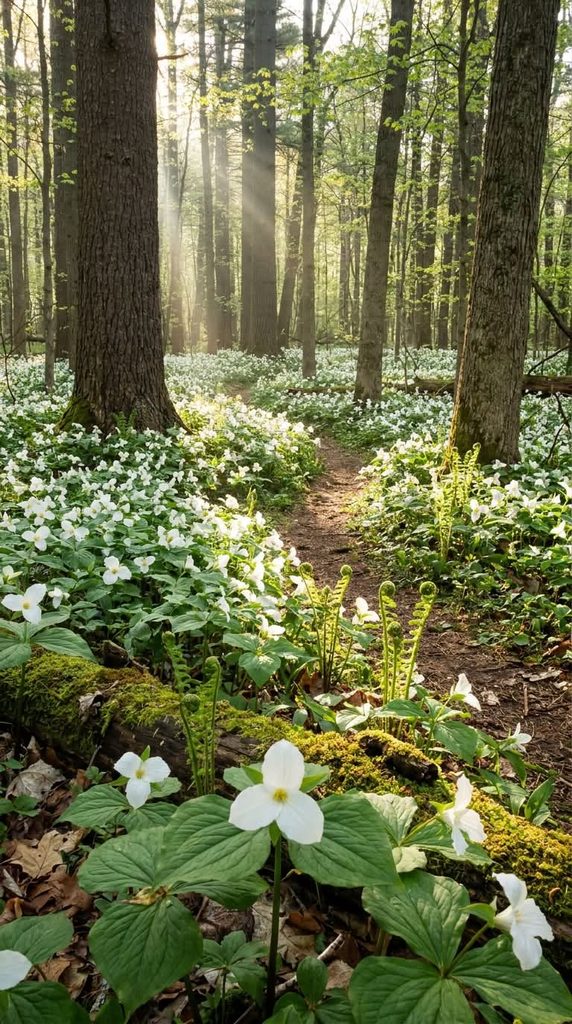
Large-Flowered Trillium’s large white flower opens in April, then slowly fades to pink with age.
I still remember the first hillside of trillium I found as a kid, so thick it looked like leftover snow.
It needs rich, undisturbed woodland soil and can take years to bloom from seed, so buy established plants when possible.
2. Cardinal Flower (Lobelia cardinalis)
Cardinal Flower produces tall spikes of brilliant red blooms from July through September. Hummingbirds visit it almost exclusively.
It thrives in consistently moist soil, making it ideal near ponds, streams, or rain gardens.
Once established, it often self-seeds, giving you new plants each following year without extra effort.
3. Great Blue Lobelia (Lobelia siphilitica)
This cousin of Cardinal Flower produces deep blue spikes instead of red, blooming from August to October.
Bumblebees are its main pollinator, since the flower shape suits their body size perfectly.
It prefers moist, part-shaded soil and pairs beautifully alongside Cardinal Flower for color contrast.
4. Purple Coneflower (Echinacea purpurea)
Purple Coneflower is one of the most recognized native prairie plants, blooming from June through August with pink-purple petals.
Goldfinches feed on the seed heads through fall and winter, so I leave mine standing rather than cutting them back.
It tolerates drought, poor soil, and full sun, making it one of the easiest native flowers to establish.
5. Black-Eyed Susan (Rudbeckia hirta)
Black-Eyed Susan brings golden, daisy-like blooms from June to September and appears naturally across Ohio meadows and roadsides.
It handles poor soil and neglect better than almost any native flower on this list.
Bees and butterflies visit steadily throughout its long bloom period, making it a reliable pollinator magnet.
6. Butterfly Milkweed (Asclepias tuberosa)
This bright orange milkweed blooms from June to August and serves as a host plant for monarch butterfly eggs.
Unlike other milkweed species, it stays compact and does not spread aggressively.
It prefers dry, sandy soil and full sun, and it rarely needs staking or support.
ALSO READ: 20 Ohio Native Shrubs (With Growing Details)
7. Common Milkweed (Asclepias syriaca)
Common Milkweed produces fragrant, dusty pink flower clusters from June to August and remains monarchs’ primary host plant across the Midwest.
Ohio conservation groups actively encourage planting it, given its direct role in monarch reproduction along the migration route.
It spreads by rhizomes, so give it room to expand naturally over a few seasons.
8. Swamp Milkweed (Asclepias incarnata)
This milkweed prefers moist to wet soil, blooming with pink-mauve clusters from June through August.
It supports monarchs just like its relatives, but it stays better behaved in garden settings.
Rain gardens and low, damp spots in the yard suit it particularly well.
9. Wild Bergamot (Monarda fistulosa)
Wild Bergamot, also called Bee Balm, produces lavender blooms from June to August with a faint minty scent when brushed.
Bumblebees, butterflies, and hummingbird moths all compete for space on this plant during peak bloom.
It spreads by rhizomes, so plant it where some spreading is welcome rather than a problem.
10. Joe-Pye Weed (Eutrochium purpureum)
Joe-Pye Weed grows tall, often 5 to 7 feet, with dusty pink flower clusters blooming in late summer.
Swallowtail butterflies gather on it in large numbers, sometimes a dozen or more at once.
It prefers moist soil and works best toward the back of a border or along a damp fence line.
11. New England Aster (Symphyotrichum novae-angliae)
This aster produces masses of purple, daisy-like flowers from September into October, right as most other blooms fade.
It serves as one of the last significant nectar sources before frost, critical for bees stocking up for winter.
Full sun and average soil suit it well, and cutting it back in June keeps growth compact.
12. Blue Wood Aster (Symphyotrichum cordifolium)
This shade-tolerant aster blooms later, from September to October, with pale blue-lavender flowers.
It handles dry shade better than most native asters, making it valuable under mature trees.
Part to full shade and average soil keep it thriving each fall season.
ALSO READ: 25 Ohio Native Trees (With Growing Details)
13. Canada Goldenrod (Solidago canadensis)
Goldenrod often gets blamed unfairly for hay fever, though that is really ragweed’s doing, since goldenrod pollen is too heavy to travel by wind.
It blooms in bright yellow plumes from August through October, feeding pollinators right before winter arrives.
It grows in nearly any soil and full sun, though it can spread aggressively without some management.
14. Ohio Goldenrod (Solidago ohioensis)
This goldenrod carries the state’s name directly and grows naturally in Ohio’s wet prairies and fen habitats.
It blooms from August to September, slightly earlier than Canada Goldenrod, with flatter flower clusters.
Moist, alkaline soil and full sun best mimic its native fen conditions.
15. Wild Geranium (Geranium maculatum)
Wild Geranium produces soft pink-purple flowers from April through June in woodland settings across Ohio.
It works as a reliable groundcover under trees, spreading slowly without becoming invasive.
Part shade and average, well-drained soil are all this flower really requires.
16. Virginia Bluebells (Mertensia virginica)
Despite the name, Virginia Bluebells grow abundantly across Ohio’s floodplain forests, blooming in early-to-mid spring.
The nodding flowers shift from pink buds to true blue as they open, a detail I always look forward to each March.
The whole plant disappears by early summer, so plan companion plants around its dormant season.
17. Trout Lily (Erythronium americanum)
Trout Lily’s mottled leaves resemble a trout’s skin pattern, with yellow, nodding flowers appearing briefly in early spring.
It is a true ephemeral, meaning it vanishes completely by early summer once it finishes blooming.
Rich, moist woodland soil and dappled shade give it the best chance to spread over time.
18. Bloodroot (Sanguinaria canadensis)
Bloodroot produces a single white flower with a golden center, one of the earliest bloomers of late March to April.
Its name comes from the red-orange sap inside its roots, historically used by Indigenous communities for dye.
It prefers rich, well-drained woodland soil and goes dormant again by midsummer.
19. Jack-in-the-Pulpit (Arisaema triphyllum)
This unusual flower forms a hooded spathe around a spadix, blooming in April and May across shaded woodlands.
It always startles first-time visitors, since it looks almost artificial against the plain forest floor.
Moist, shaded soil suits it best, and it produces bright red berry clusters by fall.
20. Mayapple (Podophyllum peltatum)
Mayapple forms umbrella-like leaf pairs that hide a single white flower underneath, blooming in April and May.
The bloom is easy to miss unless you crouch down and look beneath the leaves directly.
It spreads into dense colonies in moist, shaded woodlands by early summer.
21. Dutchman’s Breeches (Dicentra cucullaria)
This delicate flower resembles tiny pairs of pantaloons hanging upside down, blooming in April.
It is a favorite of early-season bumblebee queens, which have the tongue length needed to reach its nectar.
Rich, moist, well-drained woodland soil in part shade suits it best.
22. Wild Columbine (Aquilegia canadensis)
Wild Columbine produces red and yellow nodding flowers shaped like tiny lanterns, blooming in April and May.
Hummingbirds tend to arrive just as columbine opens each spring, timing that feels almost too precise to be chance.
It grows well in rocky, partly shaded spots and self-seeds gently without turning invasive.
ALSO READ: 15 Ground Cover Plants With Yellow Flowers That Will Light Up Your Garden
23. Foamflower (Tiarella cordifolia)
Foamflower produces fluffy white flower spikes above heart-shaped leaves, blooming in April and May.
Its leaves often turn bronze in fall, adding a second season of visual interest after the blooms fade.
It works well as a shade groundcover, spreading by runners to fill bare patches under trees.
24. Solomon’s Seal (Polygonatum biflorum)
Solomon’s Seal produces small, bell-shaped, greenish-white flowers hanging beneath arching stems, blooming in April and May.
Blue-black berries follow in fall, extending the plant’s visual appeal well past the bloom period.
Shaded, moist soil suits it best, often paired with ferns and hostas in a woodland bed.
25. False Solomon’s Seal (Maianthemum racemosum)
Unlike its true namesake, this plant produces a plume of small white flowers at the stem’s tip, blooming in May and June.
Red, speckled berries follow in fall, adding late-season color to shaded garden corners.
It tolerates dry shade reasonably well, once established in rich woodland soil.
26. Wild Ginger (Asarum canadense)
Wild Ginger’s flower is a curious, brownish-red cup hidden beneath heart-shaped leaves, blooming in April.
Most gardeners never notice the bloom unless they lift the foliage, since it sits right at soil level.
It forms a dense, shade-loving groundcover in rich, moist forest soil.
27. Spring Beauty (Claytonia virginica)
Spring Beauty covers woodland floors with tiny pink-striped white flowers in March and April, often in massive numbers.
Native bees specialize on this flower almost exclusively, timing their emergence to match its short bloom window.
It disappears entirely by late spring, so it works best mixed among later-blooming groundcovers.
28. Round-Lobed Hepatica (Anemone americana)
Hepatica produces delicate lavender, pink, or white flowers among last year’s leathery leaves, blooming in March.
It is often one of the very first wildflowers to appear each year, sometimes even before snow fully melts.
Rich, well-drained woodland soil and part shade suit it best.
29. Blue Flag Iris (Iris versicolor)
This wetland iris produces striking blue-purple flowers with yellow and white markings, blooming in May and June.
It grows naturally along Ohio’s pond edges and marshes, tolerating standing water without issue.
Full sun to part shade and consistently wet soil give the best bloom results each year.
30. Tall Ironweed (Vernonia gigantea)
Ironweed produces deep purple flower clusters atop tall stems, often 6 to 8 feet high, blooming from August to October.
Swallowtail butterflies treat it as a favorite late-season nectar stop before migration begins.
It grows in wet meadows and roadside ditches, tolerating heavy, poorly drained soil well.
31. White Turtlehead (Chelone glabra)
Turtlehead’s white to pale pink flowers resemble a turtle’s open mouth, blooming from August to October.
It serves as the host plant for the Baltimore Checkerspot butterfly, an increasingly uncommon species regionally.
Shade to part sun and consistently wet soil suit it best, often near streams or ponds.
32. Blazing Star (Liatris spicata)
Blazing Star sends up tall purple flower spikes that open from the top down, blooming from July to September.
Monarchs migrating through Ohio use it heavily as a nectar source during late summer travel.
It tolerates average to moist soil and full sun, working well in both formal and wild garden styles.
33. Cup Plant (Silphium perfoliatum)
Cup Plant grows quite tall, often over 6 feet, with yellow, sunflower-like blooms from July to September.
Its leaves fuse around the stem, forming small cups that hold rainwater, useful to birds and insects alike.
It prefers moist, rich soil and full sun, and it needs plenty of space to spread out.
34. Prairie Dock (Silphium terebinthinaceum)
Prairie Dock produces tall yellow flower stalks, sometimes reaching 8 feet, from large basal leaves close to the ground.
Its long taproot allows it to survive drought conditions that would wilt shallower-rooted plants quickly.
Full sun and deep, well-drained soil suit this dramatic prairie plant best.
35. Wild Blue Phlox (Phlox divaricata)
Wild Blue Phlox covers woodland floors with fragrant, pale blue-purple flowers in April and May.
I have caught its scent on the breeze before ever spotting the flowers themselves.
It prefers moist, rich soil in part shade, attracting early-season butterflies and moths.
36. Ohio Spiderwort (Tradescantia ohiensis)
This flower carries Ohio’s name directly, with three-petaled blue-purple blooms opening in May through July.
Each flower lasts only a single morning, closing by early afternoon, a detail that always feels oddly poetic.
It tolerates a wide range of soils and light conditions, from full sun to partial shade.
ALSO READ: 15 Stunning Purple Flowers That Look Like Bells — Vibrant Choices for Your Garden
37. Rattlesnake Master (Eryngium yuccifolium)
Despite its yucca-like leaves, this is a true native prairie plant, producing round, spiky white flower heads from July to September.
It supports a wide range of small native bees and wasps that visit its unusual flower clusters.
Full sun and well-drained soil suit it best, and it tolerates drought once established.
38. Sundial Lupine (Lupinus perennis)
Sundial Lupine produces tall spikes of blue-purple, pea-like flowers, blooming in May and June on dry, sandy sites.
It serves as the host plant for the endangered Karner Blue Butterfly, though sightings remain rare in Ohio today.
Well-drained, poor soil and full sun mimic its natural sandy prairie habitat.
39. Fire Pink (Silene virginica)
Fire Pink produces brilliant red, star-shaped flowers from April to June, standing out sharply against green woodland foliage.
Hummingbirds visit it frequently, drawn by both the color and the tubular flower shape.
It grows best on rocky slopes or well-drained soil in part sun to light shade.
40. Marsh Marigold (Caltha palustris)
Marsh Marigold produces bright yellow, buttercup-like flowers in April, often growing directly in shallow water or mud.
It is one of the earliest wetland flowers to bloom each spring, signaling that winter has truly ended.
Consistently wet soil or shallow standing water suits it perfectly.
41. Obedient Plant (Physostegia virginiana)
This flower gets its name from a quirky trait: push a bloom sideways, and it stays in place, blooming from July to September.
Bees and hummingbirds both visit its pink, tubular flowers regularly through summer.
It spreads by rhizomes in moist soil and full sun, so give it room to expand.
42. Partridge Pea (Chamaecrista fasciculata)
Partridge Pea produces cheerful yellow flowers from July to September and fixes nitrogen in the soil as it grows.
It serves as a host plant for sulphur butterflies and provides seeds that quail and other birds rely on.
It tolerates poor, dry soil and full sun, making it a strong choice for restoration projects.
43. Culver’s Root (Veronicastrum virginicum)
Culver’s Root sends up tall, narrow white flower spikes from July to August, standing out sharply in a prairie planting.
Native bees and small butterflies visit it steadily, drawn by its long bloom period.
It prefers moist, rich soil and full sun to part shade, and it rarely needs staking.
44. Wild Petunia (Ruellia humilis)
Wild Petunia produces lavender, trumpet-shaped flowers from June through September, resembling garden petunias despite no close relation.
Each flower lasts only a day, but the plant produces new blooms continuously through the season.
It tolerates dry, poor soil and full sun, making it low-maintenance once established.
45. Nodding Onion (Allium cernuum)
This list closes with Nodding Onion, which produces drooping clusters of pink-purple flowers from July to August.
Bees and butterflies visit it steadily, and the foliage carries a mild onion scent when crushed.
It tolerates dry, rocky soil and full sun, working well along garden borders or rock gardens.
Why Native Flowers Matter for Ohio Gardens
Native flowers are not simply a nostalgic choice. They solve real problems.
They conserve water. Once established, native perennials rarely need supplemental irrigation, since they evolved for Ohio’s rainfall patterns.
They support struggling pollinators. Monarch butterfly populations have fallen by close to 80% since the mid-1990s, according to the World Wildlife Fund. Ohio sits directly on the monarch migration corridor, so native milkweed here matters nationally.
They resist local pests naturally, having developed alongside Ohio’s insects and soil fungi over thousands of years, unlike many imported garden varieties.
Final Thoughts
Forty-five flowers is a long list, and no one needs to plant them all in a single season.
Start with three or four species that suit your existing soil and light conditions. Expand gradually as you learn what performs well in your specific yard.
Given that pollinator numbers keep declining nationwide, every native flower planted counts as a small, practical contribution toward recovery.
I still think about that first hillside of trillium from childhood. A garden built on Ohio’s own native species can offer moments like that, season after season, for years to come.

Tim M Dave is a gardening expert with a passion for houseplants, particularly cacti and succulents. With a degree in plant biology from the University of California, Berkeley, he has vast experience in gardening. Over the years, he has cultivated a vast collection of desert plants and learned a great deal about how to grow and care for these unique companions.