20 Ohio Native Shrubs (With Growing Details)
Native shrubs evolved alongside Ohio’s soils, seasons, and local wildlife over thousands of years. That relationship means less watering, less fertilizing, and fewer pest problems once a plant settles into a well-matched site.
OSU Extension frames this as the “right plant, right place” principle: even a native species will struggle if a shade-loving shrub is dropped into full, dry sun, so matching site conditions matters just as much as choosing native genetics.
Ohio also hosts a diverse population of pollinators that depend on native shrubs. OSU Extension notes the state is home to an estimated 450 species of wild bees, and roughly 100 of those are pollen specialists, meaning they rely on a narrow range of native plants to feed their young at all.
Every native shrub planted is a small patch of that habitat restored.
20 Ohio Native Shrubs to Plant
1. Buttonbush (Cephalanthus occidentalis)
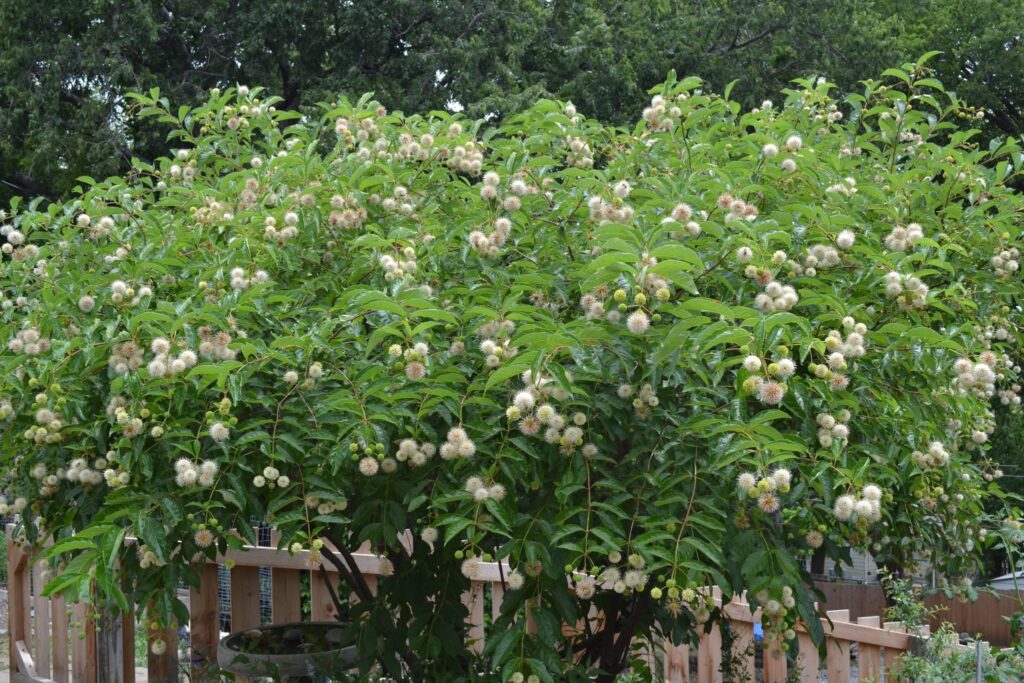
Buttonbush produces one of the most unusual flowers in the Ohio native lineup: round, creamy-white ball-shaped clusters that bloom on young stems in late summer, giving the plant its old nickname, “honeyball.”
OSU Extension notes it prefers moist or wetland soils but adapts well to average garden conditions, having succeeded even in full-sun plantings at Ohio turnpike rest stops.
The shallow individual flowers make nectar easy to reach for short-tongued pollinators, including small bees, wasps, and flies, and the plant serves as a larval host for about two dozen moth species, including the Titan sphinx moth.
When grown along a pond edge, its nutlets also feed ducks and other waterfowl through fall and winter.
2. Chokeberry (Aronia arbutifolia and Aronia melanocarpa)
Chokeberry comes in two native Ohio forms: red chokeberry, with clusters of bright red fall fruit, and black chokeberry, known for dark purple berries and equally strong fall color.
OSU Extension describes both as adaptable to drier landscapes and low-fertility sites, though neither performs well in alkaline soil, a detail worth checking before planting.
White spring flower clusters attract bees, and the fruit that follows feeds birds and mammals through fall, along with roughly two dozen caterpillar species that use the foliage as a larval host plant.
Its spreading, suckering habit makes chokeberry a natural choice for naturalized plantings that double as nesting cover for songbirds.
3. Winterberry Holly (Ilex verticillata)
Winterberry holly drops its leaves in autumn, unlike most hollies, which only makes its bright red berries more striking against bare winter branches.
OSU Extension explains the species is dioecious, so a single male plant is usually enough to pollinate several nearby female shrubs, which are the ones that actually produce the visible berry display.
Ilex pollen is essential for certain specialist bee species, and the foliage supports the larval development of about 40 moth species, including the io moth and polyphemus moth.
It grows best in moist, acidic soil, and while it tolerates partial shade, full sun produces the heaviest berry set.
4. Spicebush (Lindera benzoin)
Spicebush is a shade-loving understory shrub, often first noticed either when its small yellow flowers open in early spring or when its berries ripen to bright red by late summer.
OSU Extension confirms it serves as the larval host for the spicebush swallowtail, the eastern tiger swallowtail, the imperial moth, the promethea moth, and about eight additional moth species.
Its leaves and stems release a spicy, citrus-like fragrance when crushed, which is exactly where the plant’s common name comes from.
It requires moist, organically rich soil that mirrors its native forest-floor habitat, making it a natural fit beneath established shade trees.
5. Shrub Dogwoods (Cornus spp.)
Ohio’s native shrub dogwoods are remarkably adaptable, useful in hedges, mixed borders, or as standalone specimens, and OSU Extension recommends three species in particular for home landscapes.
Silky dogwood (Cornus amomum) suits wet sites and produces blue-to-black fruit, while gray dogwood (Cornus racemosa) is drought tolerant and produces white fruit on striking red stalks.
Red-osier dogwood (Cornus sericea) works in both wet and average soils, and its red winter stems provide some of the best cold-season color of any native shrub.
Together, these dogwoods serve as the larval host for about 100 moth and butterfly species, including the spring azure butterfly, and their fruit is a favorite of songbirds statewide.
6. Ninebark (Physocarpus opulifolius)
Ninebark earns its name from its exfoliating, multi-layered bark, which peels away in thin strips to reveal different shades underneath, giving the shrub real winter interest.
OSU Extension notes it tolerates a wide range of soil types and grows well in either full sun or partial shade, adapting reasonably well to drought once established.
Clusters of white flowers appear in late spring and attract an assortment of pollinators, while the shrub itself hosts about three dozen caterpillar species, including the io moth and cecropia moth.
One caution: research cited by OSU Extension found that colorful-leaved cultivars may be less palatable to caterpillars than the straight species, so a native, green-leaved form supports more wildlife.
7. Elderberry (Sambucus canadensis and Sambucus racemosa)
American elderberry produces flat, creamy-white flower clusters in spring, followed by dark purple fruit that ripens by late summer and disappears quickly once birds discover it.
Red elderberry, a related native species, follows a similar pattern but produces red fruit instead, and both species tolerate some shade, though they flower and fruit best in full sun.
OSU Extension notes the fruit is edible once cooked, commonly used in jelly, pies, and wine, though raw berries and other plant parts should be avoided.
The foliage supports more than two dozen moth species, including the polyphemus and cecropia moths, and broken stems provide nesting sites for solitary tunnel-nesting bees.
8. Viburnum (Viburnum species)
Ohio is home to several excellent native viburnums, and OSU Extension highlights at least five worth growing, each with a slightly different look and habitat preference.
American cranberrybush offers lacecap flowers and drooping red fruit, while blackhaw viburnum can be grown as a small tree with blue-black, edible fruit and strong purple-to-red fall color.
Mapleleaf viburnum tolerates shade well, nannyberry grows into a large, upright, suckering shrub, and southern arrowwood produces smaller berries that birds particularly favor.
Across the genus, viburnums serve as larval hosts for species like the spring azure and hummingbird clearwing moth, making the whole group a strong wildlife investment.
9. Sumac (Rhus glabra and Rhus typhina)
Smooth sumac and staghorn sumac are large, suckering, tree-like shrubs with stout, fuzzy twigs and dramatic, cone-shaped flower and fruit clusters that stand upright at branch tips.
OSU Extension notes their fruit is not preferred by birds until winter, when it becomes an important food source once easier options have already been picked clean elsewhere.
Large flower clusters draw in many short-tongued bees, wasps, and flies during bloom, and the pithy stems later provide nesting sites for solitary tunnel-nesting bees.
Sumacs also host dozens of butterfly and moth species, including the luna moth and cecropia moth, both spectacular giant silk moths native to Ohio.
10. Blueberry (Vaccinium angustifolium and Vaccinium corymbosum)
Blueberries rank among the very best native shrubs for wildlife, according to OSU Extension, supporting songbirds with food, cover, and nesting sites all at once.
Their spring flowers attract bumble bees, honey bees, and more than a dozen specialist bee species, while the foliage serves as a larval host for roughly 200 species of butterflies and moths, including the red-spotted purple.
Lowbush blueberry stays compact, while highbush blueberry grows taller and produces the larger berries most gardeners recognize from grocery store shelves.
Both prefer full sun and acidic, well-drained soil rich in organic matter, and fall foliage turns brilliant shades of red, orange, and yellow.
11. Azalea and Rhododendron (Rhododendron species)
Ohio’s native azaleas and rhododendrons are shade-tolerant shrubs that thrive in moist, acidic, well-drained soil rich in organic material, quite different from the sun-loving hybrids sold at most garden centers.
OSU Extension recommends several true natives, including flame azalea, rosebay rhododendron, pink azalea, and early azalea, each offering a slightly different bloom color and season.
Spring flowers draw in bumble bees and occasionally hummingbirds, and the leaves feed dozens of caterpillar species, including the striking promethea silk moth.
Azalea pollen is also essential for one specific species of specialist bee, underscoring just how tightly some pollinators depend on particular native plants.
12. Bottlebrush Buckeye (Aesculus parviflora)
Bottlebrush buckeye is a large, multi-stemmed shrub that produces dramatic flower spikes, often 12 inches or longer, covered in creamy, bottlebrush-shaped blooms through mid to late summer.
OSU Extension notes it attracts native bees, butterflies, and hummingbirds during that extended bloom period, making it one of the better late-season nectar sources in the state.
Mature plants reach up to 12 feet tall and wide, and once established, the shrub suckers at the base to form a flowering colony rather than staying as a single specimen.
It tolerates both sun and shade in moist, well-drained soil, and its leaves turn a soft yellow before dropping in fall.
13. Brambles (Rubus species)
Brambles include several true Ohio natives, among them smooth blackberry, red raspberry, and purple-flowering raspberry, all of which offer far more than just edible fruit.
OSU Extension notes bramble flowers attract a variety of pollinators, including several bumble bee species, while songbirds and mammals eat the ripening berries throughout summer.
These shrubs also provide excellent nesting cover, particularly blackberry and black raspberry, and their hollow or pithy stems are sometimes used by tunnel-nesting bees.
More than a hundred butterfly and moth species use brambles as caterpillar host plants, including the Isabella tiger moth and the cecropia silk moth.
14. Roses (Rosa species)
Ohio’s native wild roses include smooth rose, pasture rose, swamp rose, and prairie rose, each offering simple, five-petaled flowers that differ meaningfully from cultivated garden roses.
OSU Extension notes these blooms provide only pollen, not nectar, as a reward, which still draws in an assortment of native bees, particularly bumble bees, throughout the flowering season.
Shrubs offer protective and nesting cover for birds, and stems provide nesting sites for solitary bees once the plant matures into a denser thicket.
About 100 butterfly and moth species depend on native roses as caterpillar food, including the io moth and the polyphemus moth.
15. Shrub Willows (Salix species)
Shrub willows bloom astonishingly early, offering some of the very first pollen and nectar of the season to queen bumble bees and solitary mining bees emerging from winter dormancy.
OSU Extension recommends several species for landscape use, including pussy willow, prized for its fuzzy winter buds, and sandbar willow, useful for erosion control and bank stabilization projects.
Willow pollen is essential for about a dozen specialist bee species, and the plants collectively serve as host to roughly 300 species of caterpillars, including the viceroy and mourning cloak butterflies.
Most native willows tolerate moist-to-wet soils and occasional flooding, making them a strong pick for a low, damp corner of an Ohio yard.
16. Mountain Laurel (Kalmia latifolia)
Mountain laurel grows naturally in Ohio’s acidic, forested regions, particularly in the state’s eastern and southeastern counties, where it forms dense evergreen understory thickets.
Its pink and white, cup-shaped flowers bloom in late spring, covering the shrub in clusters dramatic enough to stop hikers mid-trail across much of Appalachian Ohio.
The glossy, leathery leaves stay green through winter, giving the plant genuine four-season structure beneath taller native trees in a shaded garden setting.
Every part of the plant is toxic if ingested, so site it thoughtfully in any yard used regularly by pets or young children.
17. Witchhazel (Hamamelis virginiana)
Witchhazel is Ohio’s latest-blooming native shrub, producing thin, spidery yellow flowers in October and November, often well after the surrounding leaves have already dropped for the season.
It appears repeatedly on Extension-recommended lists of native flowering shrubs for Ohio landscapes, prized specifically for that unusual, cold-weather bloom timing.
Because it flowers so late, it offers one of the last available nectar sources for any pollinators still active before winter fully arrives.
It tolerates both full sun and shade, and grows into a large, multi-stemmed shrub or small tree depending on how it is pruned over time.
18. Shrubby St. John’s Wort (Hypericum prolificum)
Shrubby St. John’s wort is a compact, rounded native shrub that produces bright yellow, star-shaped flowers with prominent, showy stamens through mid to late summer.
It appears on Ohio State University’s Ask Extension list of native flowering shrubs recommended for the northeastern part of the state, valued in part for being less appealing to browsing deer.
The dense, twiggy branching habit provides useful low cover for small birds and ground-feeding wildlife, even outside the blooming season.
It tolerates poor, dry soil and full sun without much complaint, making it a strong choice for a low-maintenance border or foundation planting.
19. Wafer Ash (Ptelea trifoliata)
Wafer ash, sometimes called hoptree, is a large native shrub or small tree with distinctive three-parted leaves and small, fragrant, greenish-white flowers in late spring.
It is recognized as a deer-resistant option on Ohio State University’s Ask Extension recommendations for native flowering shrubs suited to the northeastern part of the state.
The papery, wafer-like seed pods that follow the flowers give the plant its common name and persist on the branches well into fall, adding texture to the winter landscape.
It tolerates both drought and shade reasonably well, making it a flexible choice for a mixed native border or a woodland-edge planting.
20. Meadowsweet (Spiraea alba)
Meadowsweet is a native Ohio spirea, producing upright spikes of small, fragrant white flowers in mid to late summer, quite different from the flat-topped Asian spireas common in commercial landscaping.
It thrives in moist to wet soils and full sun, often found naturally along stream banks, wet meadows, and roadside ditches across much of the state.
Bees and other pollinators visit the flower spikes heavily during bloom, and the plant’s spreading, suckering habit makes it useful for stabilizing damp, disturbed ground.
It pairs well with buttonbush and shrub dogwoods in a rain garden setting, since all three share similar moisture preferences and bloom at complementary times.
Final Thoughts
Building a native shrub garden in Ohio really comes down to matching each plant to its preferred site conditions. A shade-loving spicebush will sulk in a hot, dry corner, and a sun-loving blueberry will underperform tucked beneath a dense canopy.
Start by observing your yard’s actual sun exposure and soil moisture before choosing plants. That one step prevents most of the frustration new native gardeners run into during their first season.
If you want a forgiving entry point, chokeberry, ninebark, and shrub dogwood are about as easygoing as Ohio natives get, and all three show visible wildlife activity within the first year or two.
Your local birds, bees, and butterflies are already looking for these plants. Give them a reason to stay in your yard instead of passing it by.
References
- Ohio State University Extension, Ohioline. Native Shrubs: Creating Living Landscapes for Birds, Butterflies, Bees, and Other Beneficials (HYG-5813). https://ohioline.osu.edu/factsheet/hyg-5813
- Ohio State University Extension, Ohioline. Native Trees: Creating Living Landscapes for Birds, Butterflies, Bees, and Other Beneficials (HYG-5815). https://ohioline.osu.edu/factsheet/hyg-5815
- Ohio State University Extension. Native Trees & Shrubs for Ohio Landscapes. https://u.osu.edu/fairfieldmg/2024/02/23/native-trees-shrubs-for-ohio-landscapes/
- Ohio State University Extension Publishing. Native Plants of Ohio. https://extensionpubs.osu.edu/native-plants-of-ohio/
- Ohio State University Extension. Native Landscaping for Birds, Bees, Butterflies, and Other Beneficial Insects. https://woodlandstewards.osu.edu/sites/woodlands/files/imce/0013.pdf
- Ohio State University Extension, Ask Extension. Flowering Shrubs Native to Northeast Ohio. https://ask.extension.org/kb/faq.php?id=750786
- Ohio State University Extension, Franklin County. Almost-Perfect Flowering Shrubs for Central & Western Ohio. https://franklin.osu.edu/sites/franklin/files/imce/Program_Pages/ANR/Almost%20Perfect%20Flowering%20Shrubs%20Central%20Western%20Ohio%20part2%20%20revised.pdf

Tim M Dave is a gardening expert with a passion for houseplants, particularly cacti and succulents. With a degree in plant biology from the University of California, Berkeley, he has vast experience in gardening. Over the years, he has cultivated a vast collection of desert plants and learned a great deal about how to grow and care for these unique companions.