25 Michigan Native Shrubs (With Planting Details)
Michigan’s landscape holds more than towering maples and pine forests. Beneath that canopy, and often out in the open, grows a rich layer of native shrubs.
These plants rarely get the spotlight. Yet they feed pollinators, hold riverbanks together, and shelter birds through brutal winters.
Michigan has 20.3 million acres of forest land, according to the U.S. Forest Service’s Forest Inventory and Analysis program. That is 54 percent of the entire state.
Shrubs fill the gaps within that forest and beyond it, growing in prairies, wetlands, dunes, and roadside edges across both peninsulas.
I have always thought native shrubs get overlooked simply because they are not as dramatic as a hundred-foot oak. That is a mistake. Many of the plants on this list do more ecological work per square foot than most trees.
This guide covers 25 shrubs native to Michigan, chosen for their wide distribution, ecological value, and relevance to home gardeners, land managers, and curious residents alike.
Let’s dig into what actually grows here.
Why Native Shrubs Matter in Michigan
Native shrubs are adapted to Michigan’s freeze-thaw cycles, clay and sandy soils, and unpredictable rainfall. That adaptation means less maintenance and higher survival rates than non-native alternatives.
They also support local food webs. Native shrubs often host far more caterpillar and insect species than ornamental imports, which directly affects bird populations, since most songbirds feed insects to their young.
Michigan State University Extension notes that native shrubs can be worked into small home landscapes just as easily as large properties, without sacrificing seasonal interest.
With that context established, here are the 25 shrubs that define Michigan’s native plant communities.
1. Fragrant Sumac (Rhus aromatica)
Fragrant sumac grows 6 to 12 feet tall and spreads 4 to 6 feet wide, forming a dense, low mound. Crushed leaves release a strong citrus-like scent, which helps separate it from other sumacs.
It thrives in a wide range of soils, from dry prairies to rocky slopes, and tolerates both full sun and full shade.
Bright red berries appear by late summer and persist on the branches into March, giving winter birds a reliable food source.
Fall color runs through orange, red, purple, and yellow, making it a strong four-season landscape choice.
2. Staghorn Sumac (Rhus typhina)
Staghorn sumac gets its name from the dense, velvety hairs on young branches, which resemble a deer’s antlers in velvet. It grows taller than fragrant sumac, often reaching 15 to 25 feet.
This shrub spreads aggressively through root suckers, forming large colonies along roadsides, field edges, and disturbed ground.
Its upright, cone-shaped fruit clusters turn deep red in late summer and remain through winter, feeding grouse, robins, and other birds when little else is available.
Because of its spreading habit, it works best in naturalized areas rather than small formal gardens.
3. Common Witchhazel (Hamamelis virginiana)
Common witchhazel is one of the few Michigan shrubs that blooms in late autumn, producing thin, ribbon-like yellow flowers after most other plants have gone dormant.
It typically reaches around 15 feet, growing as a multi-stemmed, vase-shaped shrub that can also be pruned into a small understory tree.
It tolerates diverse site conditions but performs best in moist, shady locations, often found along woodland edges.
Its leaves turn a clear lemon-yellow in fall, right before the unusual flowering display begins.
4. American Hazelnut (Corylus americana)
American hazelnut is a multi-stemmed shrub reaching 8 to 12 feet, producing edible nuts inside distinctive leafy husks each autumn. It grows well along woodland edges and old fields.
Its early spring catkins are among the first pollen sources available to emerging insects, making it valuable before most other plants flower.
The nuts are a major food source for squirrels, blue jays, and woodpeckers throughout the fall and winter.
Historically, American hazelnut was also gathered by Indigenous communities across the Great Lakes region.
ALSO READ: 25 Stunning Bushes That Attract Butterflies (With Pictures, and Care Tips)
5. Nannyberry (Viburnum lentago)
Nannyberry is one of Michigan’s largest native viburnums, often growing 12 to 18 feet tall with an upright, suckering form. It can be trained into a small tree with pruning.
Creamy white flower clusters appear in late spring, followed by blue-black fruit that ripens in early fall and persists into winter.
It grows well in both sun and partial shade, tolerating a range of soil types from moist to moderately dry.
The fruit is edible for humans in small amounts, though it is primarily valuable as winter forage for birds.
6. Blackhaw Viburnum (Viburnum prunifolium)
Blackhaw viburnum reaches 12 to 15 feet, offering creamy-white flower clusters in May followed by pinkish-rose fruit that ripens to black by early fall.
Fall color runs from purplish to bright shining red, giving this shrub strong multi-season appeal.
It grows best in full sun to moderate shade and adapts to a variety of soil conditions once established.
Like several other viburnums, it can be trained into a small, informal tree shape over time.
7. Arrowwood Viburnum (Viburnum dentatum)
Arrowwood viburnum is a medium-sized shrub, usually growing 6 to 10 feet tall, with glossy, toothed leaves that give the species its name. Its straight young stems were historically used for arrow shafts.
Clusters of white flowers bloom in late spring, followed by blue-black berries that attract a wide range of songbirds.
It tolerates wet soils better than many other viburnums, making it a common choice for rain gardens and streamside plantings.
Fall foliage typically shifts to deep red or maroon, adding strong autumn interest.
ALSO READ: 15 Stunning Viburnum Varieties: Identification Features and Care Details
8. Maple-Leaf Viburnum (Viburnum acerifolium)
Maple-leaf viburnum is a smaller, shade-tolerant shrub, generally reaching 4 to 6 feet tall and 3 to 4 feet wide. Its leaves closely resemble maple foliage, hence the name.
Small clusters of white flowers bloom from spring into summer, followed by blue-black berries that attract birds through fall.
It grows well in both moist and dry acidic soils, and tolerates deep shade better than most flowering shrubs on this list.
Fall color shifts through vibrant shades of red, purple, and pink, brightening the forest understory.
9. American Highbush Cranberry (Viburnum opulus var. americanum)
American highbush cranberry is often confused with the non-native European highbush cranberry, but the native variety has smoother leaf edges and a more open growth habit.
It typically grows 8 to 12 feet tall, producing white flower clusters in late spring and bright red, tart berries by early fall.
The berries persist through winter and are an important food source for waxwings and other fruit-eating birds.
It prefers moist to wet soils, often growing naturally along stream banks and wetland margins across the state.
10. Gray Dogwood (Cornus racemosa)
Gray dogwood forms dense colonies through root suckering, typically reaching 6 to 10 feet tall. It adapts to a wide range of soil types, from wet to relatively dry.
White flower clusters bloom in late spring, followed by white berries on distinctive red stalks, a combination that makes this shrub easy to identify in late summer.
It provides excellent cover and food for birds, and its thicket-forming habit makes it useful for erosion control on slopes.
This shrub also tolerates urban conditions better than many native alternatives, appearing frequently in city parks and preserves.
11. Red-Osier Dogwood (Cornus sericea)
Red-osier dogwood is best known for its bright red winter stems, which stand out dramatically against snow. It typically grows 6 to 9 feet tall, spreading through underground stems.
It favors consistently moist soils and is commonly found along streambanks, pond edges, and wetland margins throughout Michigan.
White flower clusters appear in late spring, followed by white to pale blue berries that ripen by late summer.
This shrub is a favorite for rain gardens and stormwater plantings because of its tolerance for periodic flooding.
12. Ninebark (Physocarpus opulifolius)
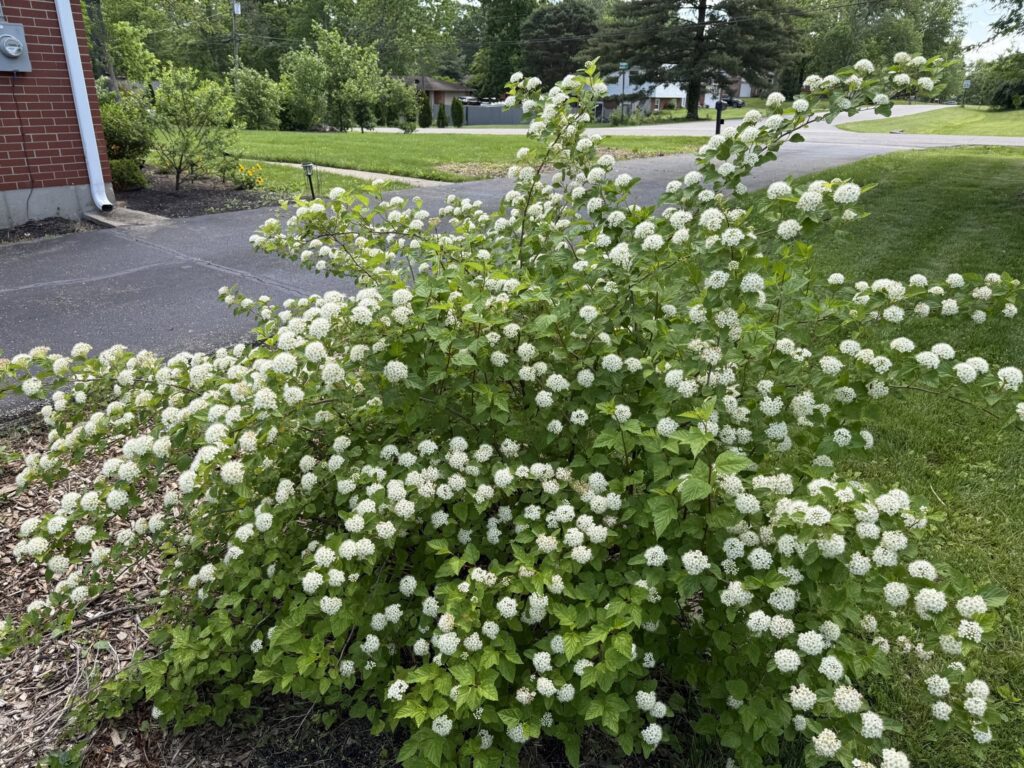
Ninebark gets its name from its peeling, multi-layered bark, which reveals several colored layers as it exfoliates with age. It typically reaches 5 to 8 feet tall.
Clusters of small white to pinkish flowers bloom in late spring, followed by reddish seed capsules that add fall interest.
It tolerates wet soils, drought, and poor soil conditions equally well, making it one of the most adaptable native shrubs on this list.
Ninebark also serves as a larval host plant for several native moth species.
ALSO READ: 15 Types of Ninebark Shrubs (With Pictures, and Care Tips)
13. Buttonbush (Cephalanthus occidentalis)
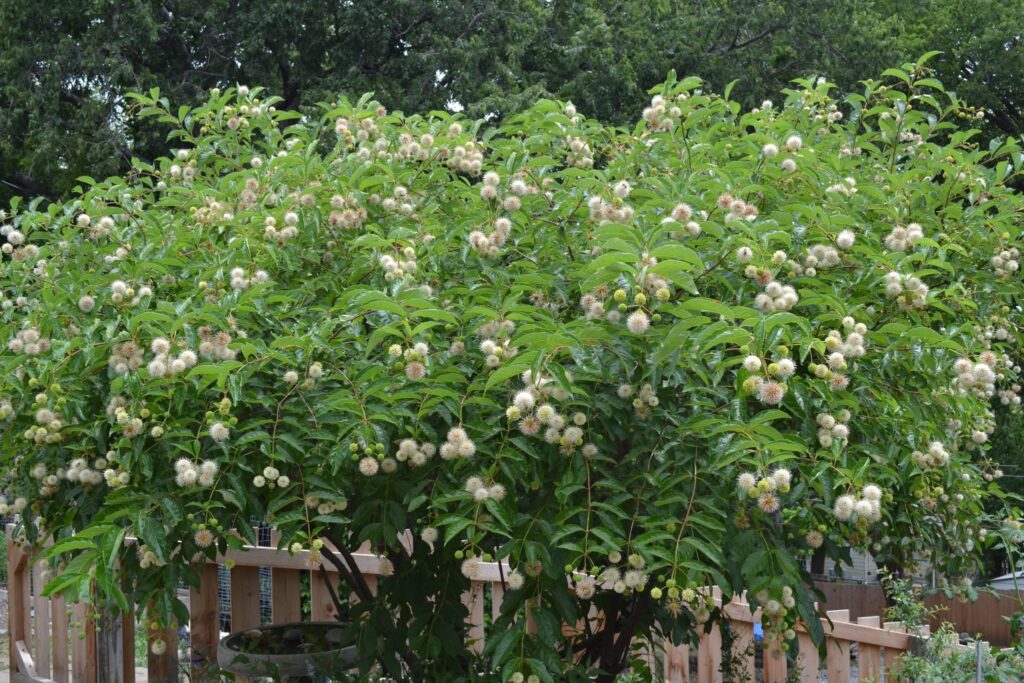
Buttonbush produces unmistakable spherical white flower clusters in mid to late summer, resembling small pincushions. It typically grows 6 to 12 feet tall.
It is one of the most wetland-dependent shrubs native to Michigan, thriving in standing water, pond edges, and swampy soils.
The flowers are a major nectar source for butterflies, including several swallowtail species, and the seeds feed waterfowl through fall and winter.
Because of its tolerance for standing water, buttonbush is a top choice for constructed wetlands and stormwater basins.
14. Winterberry, Also Called Michigan Holly (Ilex verticillata)
Winterberry is a deciduous holly, meaning it drops its leaves in fall, unlike the evergreen hollies most people picture. It typically reaches 6 to 10 feet tall.
Female plants produce bright red berries that persist through winter, since the shrub requires a male pollinator plant nearby to fruit.
It grows naturally in wet woods, bogs, and swamp margins, tolerating standing water better than most ornamental shrubs.
The berries are mildly toxic to humans but provide critical winter food for robins, bluebirds, and cedar waxwings.
15. Spicebush (Lindera benzoin)
Spicebush is an aromatic understory shrub, typically growing 6 to 12 feet tall in the moist, shaded woodlands of southern and central Michigan. Crushed leaves and twigs release a spicy, citrus-like fragrance.
Small yellow flowers appear very early in spring, before leaves emerge, providing an early nectar source for native bees.
It serves as the primary host plant for the spicebush swallowtail butterfly, whose caterpillars feed exclusively on its leaves.
Bright red berries ripen in early fall, offering high-fat food for migrating songbirds preparing for long flights south.
16. Common Juniper (Juniperus communis)
Common juniper is one of Michigan’s few native evergreen shrubs, typically growing low and spreading, rarely exceeding 4 feet in height. It favors dry, open, rocky, or sandy sites.
Its needle-like foliage stays blue-green year-round, offering rare winter structure in native landscapes.
Female plants produce small blue-gray berry-like cones, which take up to two years to mature and are used by numerous bird species.
This shrub grows slowly and can live for many decades in undisturbed, well-drained sites.
17. Shrubby Cinquefoil (Dasiphora fruticosa)
Shrubby cinquefoil is a compact, mounding shrub, usually growing 2 to 4 feet tall, with small yellow flowers that bloom continuously from early summer through fall.
It tolerates poor, dry, and rocky soils exceptionally well, and is naturally found in fens, prairies, and open rocky sites across northern Michigan.
Michigan State University’s pollinator research lists this species among the most highly attractive native plants for insects, based on measured visitation rates.
Because of its long bloom period, it provides a consistent nectar source through much of the growing season.
18. Lowbush Blueberry (Vaccinium angustifolium)
Lowbush blueberry is a low, spreading shrub, typically reaching only 6 to 24 inches tall, forming dense mats through underground rhizomes.
It requires acidic, well-drained soil and is commonly found in Michigan’s sandy jack pine plains and open woodland clearings, especially in the northern Lower Peninsula.
Small white to pinkish bell-shaped flowers bloom in spring, followed by sweet, edible blueberries by mid-summer.
Wild blueberries support a wide range of wildlife, from songbirds to black bears, and remain an important foraged food across the state.
19. American Elderberry (Sambucus canadensis)
American elderberry grows 6 to 12 feet tall, with large, flat-topped clusters of white flowers appearing in early summer. It favors moist soils along ditches, field edges, and streambanks.
The flowers are followed by clusters of small, dark purple berries by late summer, which are edible when cooked but should not be eaten raw.
Elderberry spreads readily and can form loose colonies over time, making it useful for naturalizing wet, disturbed sites.
Its berries are heavily used by birds, and its flowers attract a wide range of pollinating insects through the growing season.
ALSO READ: 15 Types of Elderberry (Popular Varieties, and Their Uses)
20. Prickly Ash (Zanthoxylum americanum)
Prickly ash grows as a large shrub or small tree, often reaching 10 to 20 feet, identifiable by the stout, paired prickles running along its stems. It favors moist, open old fields or shaded sites.
Yellowish flowers appear in early spring before the leaves emerge, drawing early-season pollinators.
This species is the sole larval host plant for the giant swallowtail, Michigan’s largest butterfly species.
Crushed leaves release a distinctive citrus fragrance, and the plant’s bark and fruit were historically chewed by Indigenous peoples to relieve toothaches.
21. Carolina Rose (Rosa carolina)
Carolina rose is Michigan’s smallest native rose, typically growing 1 to 3 feet tall with erect, prickly stems. It thrives in dry prairies and open woods.
Large, deep pink flowers bloom in early summer, followed by small red rose hips that persist into winter.
Its compact size makes it a practical addition to perennial borders, unlike larger, more sprawling rose species.
Foliage shifts from light green in summer to yellow-orange in fall, adding seasonal color to naturalized plantings.
22. Steeplebush (Spiraea tomentosa)
Steeplebush is a small native shrub found throughout southern Michigan, favoring wet soils and boggy or swamp-like conditions. It grows in dense colonies from underground stems.
Small pink flowers bloom in tight, elongated, cylindrical clusters, with both leaves and flower heads covered in dense, fine hair.
This plant was historically used medicinally as a tea for digestive issues and as a poultice for skin ailments.
Large plantings make the strongest visual impact, since individual stems are relatively narrow and upright.
23. Meadowsweet (Spiraea alba)
Meadowsweet closely resembles steeplebush but produces white to pale pink flower spikes instead of deep pink. It typically grows 3 to 4 feet tall in wet meadows and prairie edges.
It is ranked among the most insect-attractive native plants in Michigan State University’s pollinator studies, drawing large numbers of bees and beetles during its summer bloom.
The shrub spreads through rhizomes, forming loose colonies useful for stabilizing wet, open ground.
Its narrow, upright form works well massed along pond edges or rain garden margins.
24. Running Strawberry Bush (Euonymus obovatus)
Running strawberry bush is a low, creeping shrub or trailing vine, found in moist, shady, wooded locations across Michigan. It rarely exceeds a foot in height, making it useful as a native ground cover.
Its glossy, dark green leaves turn crimson red in fall, adding late-season color to the forest floor.
Sparse fruit capsules appear in autumn, showing a distinctive pink outer shell with scarlet seeds inside.
Because of its low, spreading habit, it works well filling gaps beneath taller native shrubs and trees.
25. American Bladdernut (Staphylea trifolia)
American bladdernut is a lesser-known understory shrub, typically reaching 10 to 15 feet, found in moist woods and along stream corridors. Its name comes from its unusual inflated seed capsules.
Small white bell-shaped flowers hang in drooping clusters during spring, appearing before most of the surrounding canopy has fully leafed out.
The papery, three-lobed seed pods persist into winter, rattling audibly in the wind, which makes this shrub easy to identify even without leaves.
It tolerates shade well, making it a good option for naturalizing under larger native trees in wooded landscapes.
Frequently Asked Questions
What is the most common native shrub in Michigan? Gray dogwood and staghorn sumac are among the most widespread, since both tolerate poor soil and disturbed sites across the state.
Are native shrubs harder to find at nurseries? Not anymore. Groups like the Michigan Native Plant Producers Association work directly with regional nurseries to supply these species.
Do native shrubs need fertilizer? Generally, no. Most species on this list are adapted to Michigan’s native soil fertility and can suffer from over-fertilization.
Which shrub is best for wet, swampy ground? Buttonbush and winterberry are two of the most reliable choices for consistently wet or flooded soils.
Final Thoughts
Michigan’s native shrubs rarely make headlines, but they hold the state’s ecosystems together in quiet, essential ways. Some stabilize riverbanks. Others feed birds through the harshest months of winter.
I find something reassuring about that. These plants do not need constant attention once established, because they were built for Michigan’s soil and Michigan’s weather from the start.
Whether you are restoring a wetland, planting a backyard border, or simply trying to identify what is growing along a trail, this list of 25 shrubs is a solid starting point.
Choose based on your site conditions first. A shrub built for a dry prairie will struggle in standing water, and vice versa.
References
- Michigan State University Extension, Native Plants for Michigan Landscapes: Part 2 – Shrubs — https://www.canr.msu.edu/news/native_plants_for_michigan_landscapes_shrubs
- Michigan State University Extension, Native Plants and Ecosystem Services, Regional Plant Lists — https://www.canr.msu.edu/nativeplants/plant_facts/local_info/index
- City of Ann Arbor, Natural Area Preservation, Native Shrubs — https://www.a2gov.org/parks-and-recreation/natural-area-preservation/native-plants/native-shrubs/
- USDA Forest Service, Northern Research Station, Michigan Forests 2014 — https://www.fs.usda.gov/nrs/pubs/rb/rb_nrs110.pdf
- Michigan Natural Features Inventory, Michigan’s Natural Communities — https://mnfi.anr.msu.edu/communities/
- Michigan Department of Natural Resources, Plants & Trees — https://www.michigan.gov/dnr/education/michigan-species/plants-trees
- U.S. Fish & Wildlife Service, Michigan Natural Features Inventory Partner Page — https://www.fws.gov/partner/michigan-natural-features-inventory

Tim M Dave is a gardening expert with a passion for houseplants, particularly cacti and succulents. With a degree in plant biology from the University of California, Berkeley, he has vast experience in gardening. Over the years, he has cultivated a vast collection of desert plants and learned a great deal about how to grow and care for these unique companions.