15 Best Climbing Vines for Pergolas: Picks That Will Transform Your Outdoor Space
There is something almost magical about a pergola draped in flowering vines. What begins as a bare wooden or metal frame — functional, perhaps, but architecturally cold — becomes something entirely different once the right vine takes hold. Dappled light filtering through a canopy of leaves. Clusters of fragrant blooms hanging at eye level. A sense of enclosure that somehow feels open and free at the same time.
I have spent years helping people get this right in their own gardens, and the single most common mistake I see is choosing a vine based purely on looks without considering the structure, the climate, or the long-term growth habit.
Choosing the right climbing vine for a pergola is one of the most consequential planting decisions a gardener makes. Get it right, and the vine becomes a permanent, living feature that adds beauty and value for decades. Get it wrong, and you may find yourself dealing with a vine that rips the structure apart, takes over the neighborhood, or dies after the first winter.
This guide covers 15 of the best climbing vines for pergolas, with honest detail on growth habits, climate suitability, care requirements, and what makes each one a good — or particularly outstanding — choice for a pergola specifically.
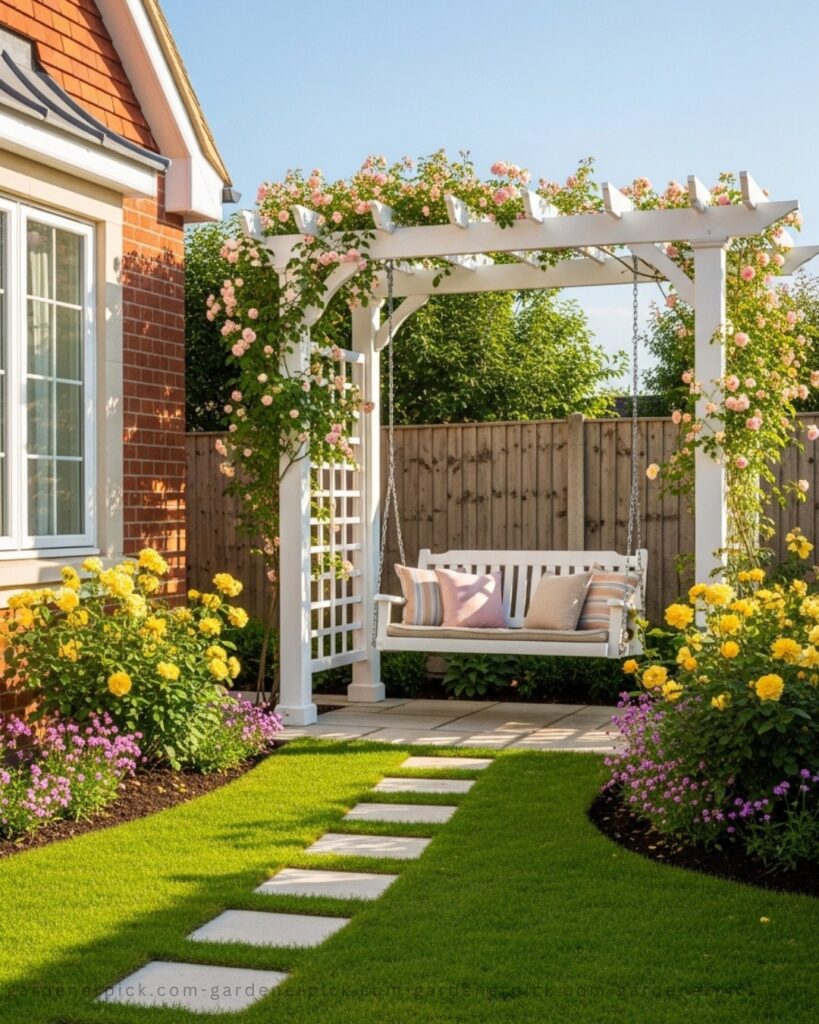
What Makes a Vine Ideal for a Pergola?
Not every climbing plant is a good pergola vine. Before the plant list, it helps to understand the qualities that make a vine truly pergola-worthy.
Coverage and canopy density
A pergola vine should be able to cover the overhead beams and rafters with enough foliage to create meaningful shade and visual enclosure. Sparse climbers may be beautiful but functionally disappointing on a pergola structure.
Appropriate vigor
There is a fine line between a vine that covers a pergola well and one that consumes it. Extremely vigorous vines can exert enough physical force on wooden structures to cause real damage over time. The best pergola vines grow with purpose but remain manageable with annual pruning.
Attachment method
Pergolas have horizontal beams and vertical posts. Twining vines and tendril climbers work well with this structure. Vines that rely purely on adhesive rootlets (like English Ivy) tend to work better on walls than on open pergola frames.
Seasonal interest
The best pergola vines offer more than a single moment of glory. Flowers, fragrance, fall color, interesting seed heads, or attractive winter structure all extend the period of interest beyond a single blooming season.
Climate adaptability
A pergola vine needs to thrive in your specific USDA Hardiness Zone and regional climate — not just survive.
Best Climbing Vines for Pergolas
With the above criteria in mind, here are the 15 best options.
1. Wisteria — Native American Varieties (Wisteria frutescens and Wisteria macrostachya)
If there is one vine that most people picture when they imagine a flowering pergola, it is Wisteria. The cascading purple flower clusters, intoxicating fragrance, and lush summer canopy make it one of the most spectacular pergola vines in existence. However, there is a critical distinction that every gardener must understand: the Asian species — Chinese Wisteria (Wisteria sinensis) and Japanese Wisteria (Wisteria floribunda) — are invasive in many US states and capable of damaging wooden pergola structures with their powerful, girdling stems.
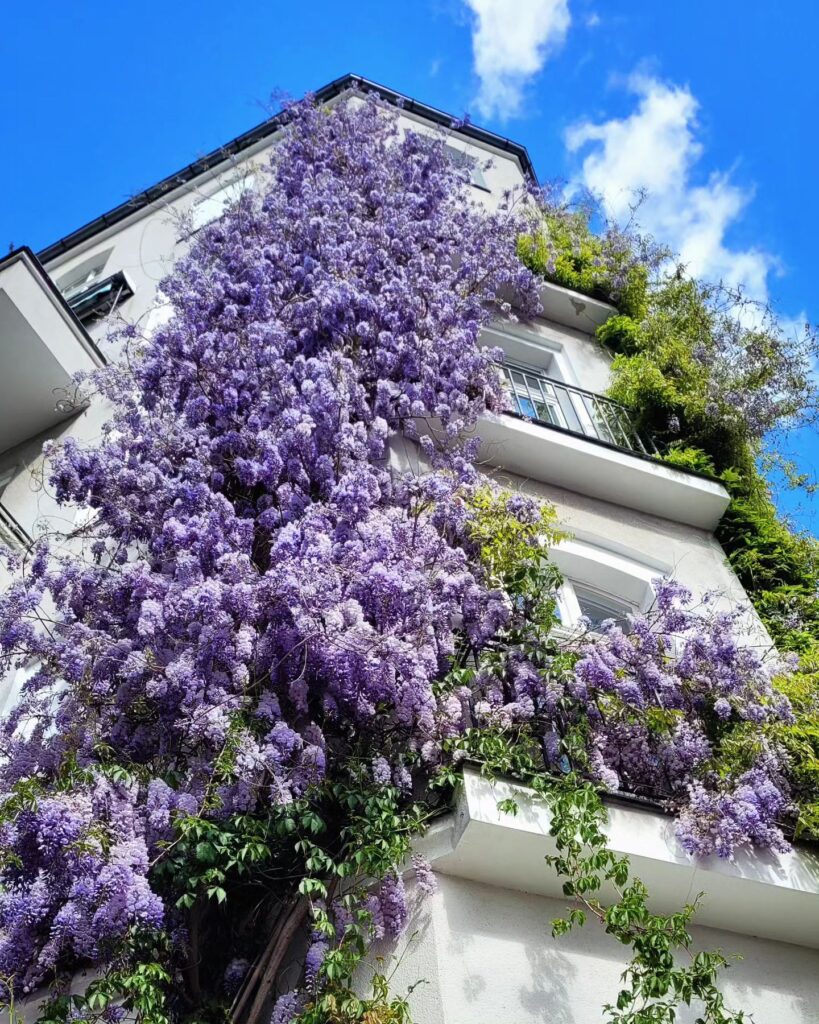
The native American alternatives are the responsible and structurally safer choice. ‘Amethyst Falls’ (Wisteria frutescens) and ‘Blue Moon’ (Wisteria macrostachya) both produce beautiful lavender-blue flower clusters, bloom on new wood (meaning they can be pruned more freely), and are significantly less aggressive than their Asian counterparts.
- Best USDA Zones: ‘Amethyst Falls’ — Zones 5–9; ‘Blue Moon’ — Zones 3–9
- Sun requirement: Full sun
- Mature coverage: 15–25 feet
- Special feature: ‘Blue Moon’ is one of the few wisterias that reblooms reliably in a single season
2. Climbing Hydrangea (Hydrangea anomala subsp. petiolaris)
Climbing Hydrangea is the gold standard for pergolas in partial shade — a situation where many other flowering vines struggle or fail entirely. It is a slow starter, famously so, with growers often joking that it “sleeps, creeps, then leaps” in its first few years. But once established, it produces a breathtaking display of flat-topped white flower clusters against deep green, glossy foliage.
The exfoliating cinnamon-colored bark is attractive through winter, and the dried flower heads persist into the cold months as well, providing year-round structure. This is one of the few vines that genuinely earns the description “four-season interest.”
- Best USDA Zones: 4–7
- Sun requirement: Partial shade to full shade (rare and valuable for shaded pergolas)
- Mature coverage: 30–80 feet at full maturity (very large and long-lived)
- Special feature: Exceptionally long-lived — established plants persist for generations
3. Trumpet Vine (Campsis radicans)
Few vines match the hummingbird-attracting power of Trumpet Vine. Its large, trumpet-shaped flowers in vivid orange-red bloom reliably from midsummer through fall, covering the pergola in color during the hottest months when many other flowering vines are past their peak. It is heat-tolerant, drought-tolerant once established, and nearly indestructible in Zones 4 through 10.
The caution with Trumpet Vine is its vigor. It is a powerful grower that requires a sturdy pergola structure — lightweight aluminum or thin wood frames are not adequate. Annual hard pruning is essential to keep it in bounds. Given the right structure and a committed pruning schedule, however, it is one of the most rewarding summer-blooming pergola vines available.
- Best USDA Zones: 4–10
- Sun requirement: Full sun
- Mature coverage: 30–40 feet
- Special feature: Exceptional hummingbird and pollinator magnet throughout summer
4. Coral Honeysuckle (Lonicera sempervirens)
Coral Honeysuckle is one of the most versatile and responsible climbing vines you can choose for a pergola. Unlike its invasive Japanese relative, this eastern North American native is well-behaved, non-invasive, and provides exceptional wildlife value — hummingbirds visit the tubular coral-red flowers relentlessly from spring through fall.
It is semi-evergreen in warmer climates, holding foliage through mild winters, and reliably perennial from Zone 4 through Zone 9. For pergolas in the Southeast, Mid-Atlantic, and lower Midwest, it offers arguably the best combination of beauty, ecological value, and ease of care of any vine on this list.
- Best USDA Zones: 4–9
- Sun requirement: Full sun to partial shade
- Mature coverage: 10–20 feet
- Special feature: Non-invasive, native, hummingbird-friendly, near-continuous bloom season
5. Passionflower (Passiflora incarnata and Passiflora caerulea)
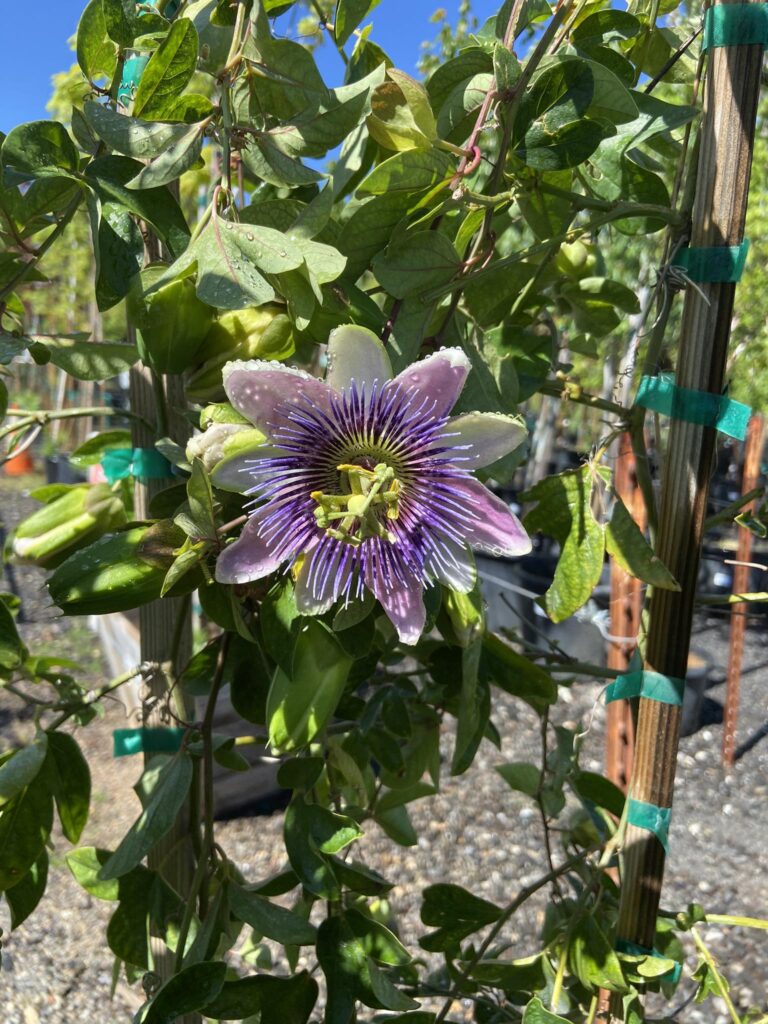
Passionflower produces some of the most extraordinary blooms in the plant world. The intricate, fringed flowers — in purple, lavender, and white — look as though they belong in a tropical rainforest, not a North American backyard. And yet Passiflora incarnata, the native Maypop, is fully cold-hardy to Zone 6 and thrives across much of the South and Mid-Atlantic.
For more temperate and warm-season climates, Passiflora caerulea (Blue Passionflower) is a vigorous grower with equally stunning blooms that can be grown as a perennial in Zones 7–10 and as an annual further north. On a pergola, Passionflower creates a tropical atmosphere that stops visitors in their tracks. It also serves as a host plant for several butterfly species, adding ecological dimension to its visual drama.
- Best USDA Zones: P. incarnata — Zones 6–9; P. caerulea — Zones 7–11
- Sun requirement: Full sun
- Mature coverage: 15–30 feet
- Special feature: Host plant for Gulf Fritillary and Zebra Longwing butterflies
6. Roses — Climbing Varieties (Rosa spp.)
A pergola covered in climbing roses is one of the great classic images of garden design — and with good reason. The right climbing rose provides weeks of spectacular fragrant bloom, attractive disease-resistant foliage, and a structural presence that few other plants can match.
The key word is right. Not all climbing roses are created equal for pergola use. Look for varieties specifically described as “climbers” rather than “ramblers” (ramblers bloom once and can grow to unmanageable sizes) and prioritize disease resistance in your selection. Top pergola-worthy climbing roses include:
- ‘New Dawn’ — pale pink, repeat-blooming, disease-resistant, Zones 5–9
- ‘Don Juan’ — deep red, intensely fragrant, Zones 5–9
- ‘Fourth of July’ — red and white striped, semi-thornless, Zones 5–9
- ‘Iceberg Climbing’ — white, prolific, clean foliage, Zones 5–9
- ‘Blaze Improved’ — bright red, reliable repeat bloomer, Zones 4–9
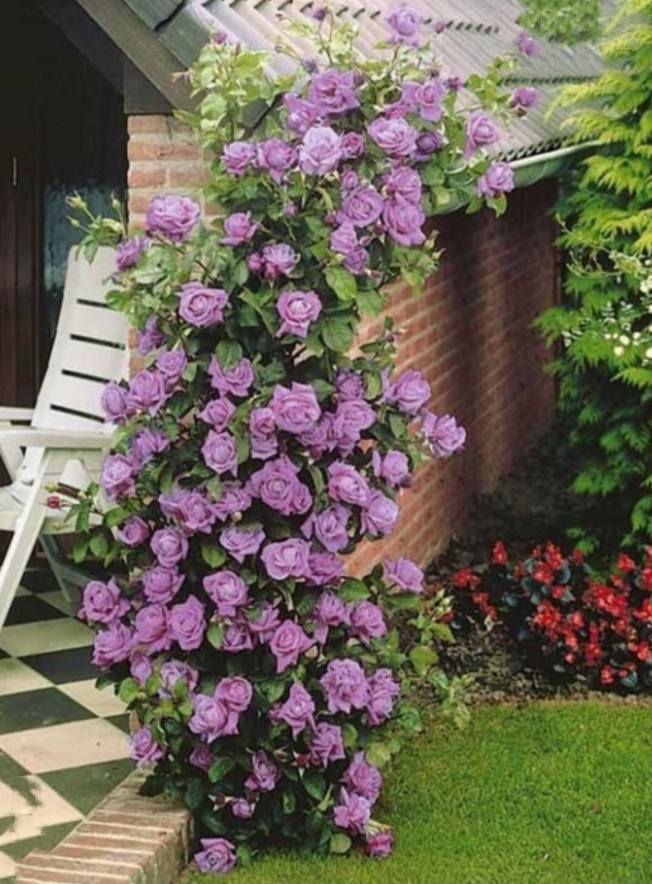
Provide a sturdy support structure and tie canes to beams as they grow — climbing roses do not twine and require manual guidance along pergola beams.
- Best USDA Zones: Varies by variety; most climbing roses perform well in Zones 4–9
- Sun requirement: Minimum 6 hours of direct sun daily
- Mature coverage: 10–20 feet depending on variety
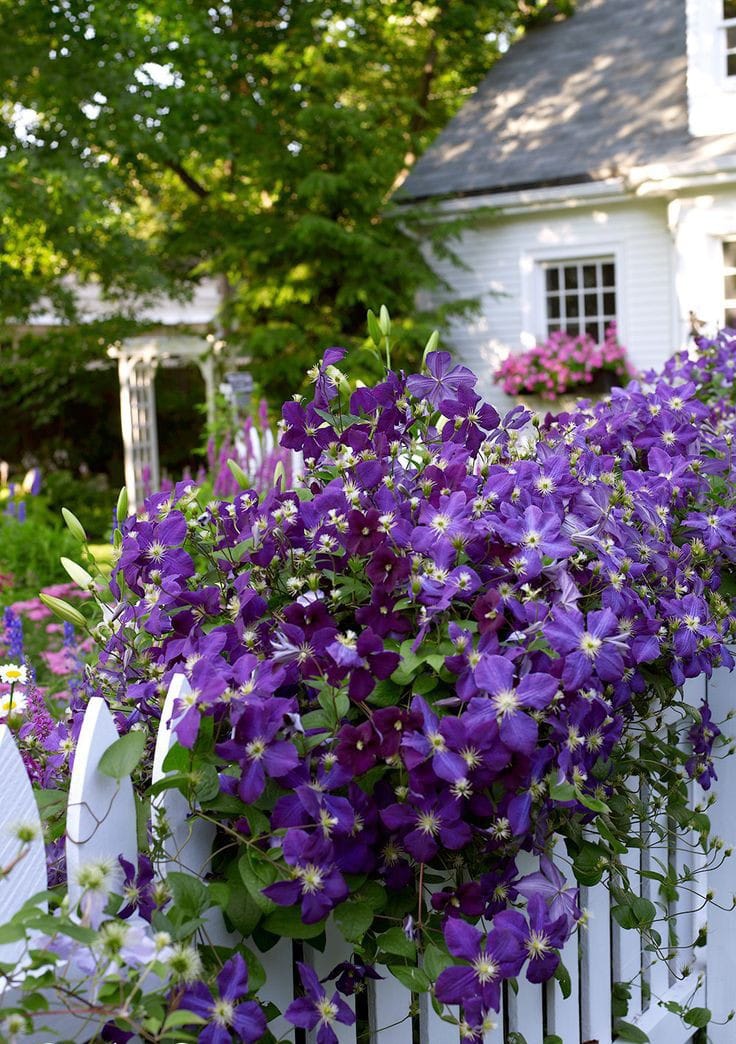
7. Clematis — Large-Flowered Hybrids and Species (Clematis spp.)
Clematis is the most diverse flowering vine genus in cultivation, offering bloom times from early spring through late fall, flower sizes from one inch to eight inches across, and colors spanning white, cream, pink, red, purple, and bicolors.
For pergolas, the most effective approach is often to plant two or three complementary Clematis varieties that bloom in succession, extending the flowering season across multiple months.
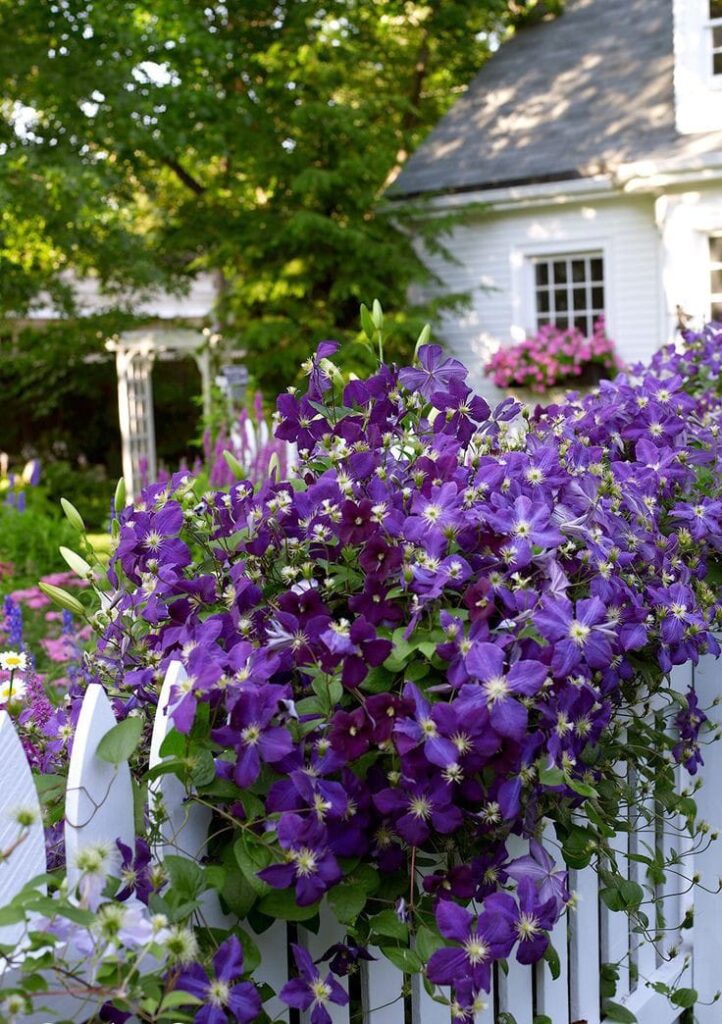
Popular pergola-worthy Clematis varieties include:
- ‘Jackmanii’ — deep purple, midsummer bloomer, Zones 3–9
- ‘Nelly Moser’ — pale pink with deep pink bar, spring bloomer, Zones 4–9
- ‘Henryi’ — large white flowers, repeat blooming, Zones 4–9
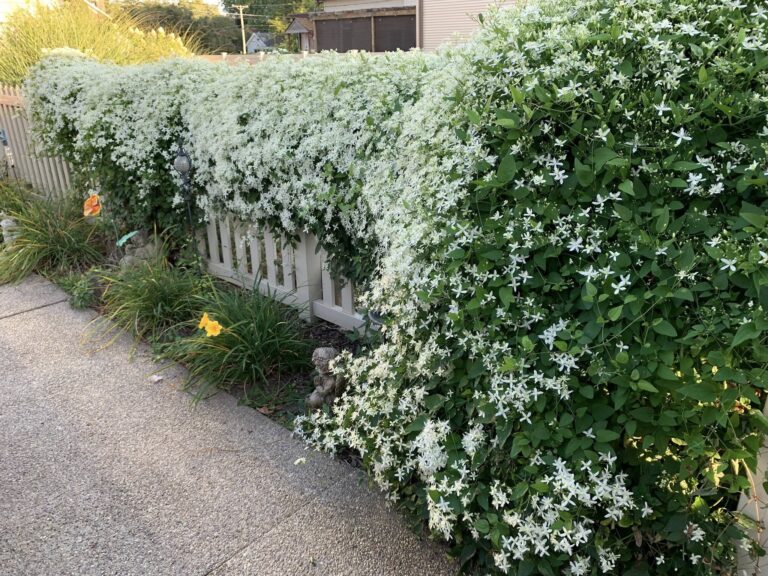
- Sweet Autumn Clematis (C. terniflora) — masses of tiny fragrant white flowers, late summer, Zones 4–9
Understanding pruning groups is essential with Clematis — pruning at the wrong time can eliminate an entire season’s bloom. Most large-flowered hybrids belong to Group 2 or 3; check your specific variety before pruning.
- Best USDA Zones: Most varieties perform well in Zones 3–9
- Sun requirement: Full sun to partial shade (prefers “cool feet, warm head” — roots shaded, top in sun)
- Mature coverage: 8–20 feet depending on species
8. Grape Vines (Vitis vinifera, Vitis labrusca, and Native Species)
A grape vine on a pergola is functional, edible, and genuinely beautiful. Grape vines have been trained over pergolas and arbors since antiquity — there is a reason this combination has persisted for thousands of years across Mediterranean, European, and North American garden traditions.
The large, lobed leaves create excellent shade, the tendrils twine naturally around pergola beams, and the fruit — whether for eating or wine — is a harvest bonus unlike anything another ornamental vine provides.
For ornamental purposes, the ‘Purpurea’ grape (Vitis vinifera ‘Purpurea’) offers stunning burgundy-purple foliage that deepens to rich wine-red in autumn, making it one of the most dramatic foliage vines available for pergola use.
For edible varieties suited to North American climates, look to ‘Concord’ (Zones 4–8) and ‘Muscadine’ types for the South (Zones 7–10).
- Best USDA Zones: Varies — most cultivated grapes perform in Zones 4–9
- Sun requirement: Full sun
- Mature coverage: 15–25 feet
- Special feature: Edible fruit, excellent fall color, deep cultural history in garden design
9. Kiwi Vine — Hardy Varieties (Actinidia kolomikta and Actinidia arguta)
Hardy Kiwi Vines are one of the most underused pergola plants in North American gardens. They are vigorous, bold in leaf texture, and in the case of Actinidia kolomikta, produce leaves splashed in white and pink that create a striking variegated canopy effect. Actinidia arguta (Hardy Kiwi) produces small, smooth-skinned, grape-sized fruits that are edible straight from the vine.
Both species are significantly more cold-hardy than commercial kiwi, with Actinidia kolomikta surviving temperatures well below zero (Zone 3). They twine naturally around pergola beams and grow vigorously once established. For gardeners in the Northern US, upper Midwest, and Canada who want a bold, fruiting pergola vine, Hardy Kiwi is an exceptional and often overlooked choice.
- Best USDA Zones: A. kolomikta — Zones 3–8; A. arguta — Zones 4–8
- Sun requirement: Full sun to partial shade
- Mature coverage: 15–30 feet
- Special feature: Edible fruit on A. arguta; exceptional variegated foliage on A. kolomikta
10. Bougainvillea (Bougainvillea spp.)
In warm-climate gardens, no pergola vine comes close to the sheer color impact of Bougainvillea. What appear to be the flowers are actually papery bracts — modified leaves — in vivid magenta, orange, red, coral, white, and purple.
The true flowers are tiny and white, hidden within those dramatic bracts. In frost-free climates, Bougainvillea can bloom almost year-round, creating a canopy of almost unreal color.
It is the unquestioned queen of pergola vines in USDA Zones 9–11 — Southern California, Arizona, South Florida, Hawaii, and the Gulf Coast. In Zone 8, it can be grown with frost protection. Elsewhere, it performs spectacularly in large containers brought indoors for winter, although container-grown plants rarely achieve the scale needed for full pergola coverage.
- Best USDA Zones: 9–11 outdoors; Zone 8 with protection
- Sun requirement: Full sun (minimum 5–6 hours; more sun = more blooms)
- Mature coverage: 20–30 feet in warm climates
- Special feature: Near year-round bloom in frost-free climates; unmatched color intensity
11. Black-Eyed Susan Vine (Thunbergia alata)
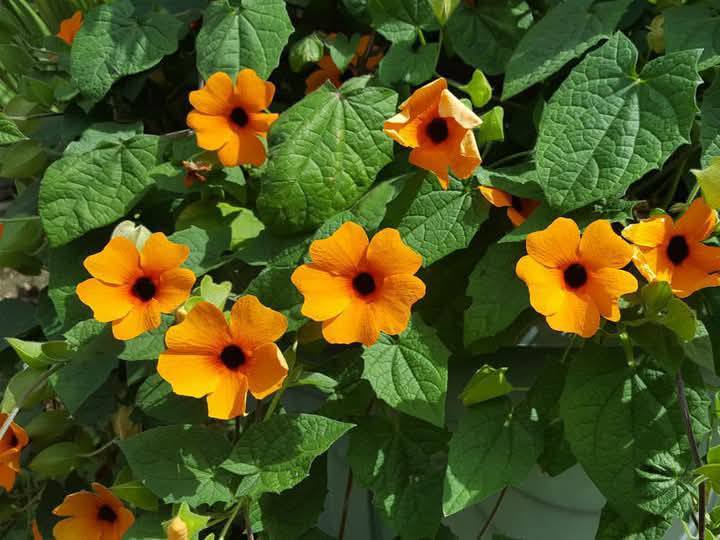
For gardeners who want fast, reliable color on a pergola without committing to a permanent planting, Black-Eyed Susan Vine is an outstanding annual choice. Its cheerful orange, yellow, or white flowers with dark centers bloom prolifically from early summer through frost, and it can cover a modest pergola in a single growing season.
It twines easily around any support and is well-behaved enough not to cause structural concerns. In Zones 10–11, it is perennial; everywhere else, it is a fast and floriferous annual that delivers tremendous visual value for minimal investment. It is also an excellent choice for new pergolas waiting for a permanent vine to become established.
- Best USDA Zones: Annual in most of the US; perennial in Zones 10–11
- Sun requirement: Full sun to partial shade
- Mature coverage: 6–8 feet as an annual; larger as a perennial
- Special feature: Excellent interim vine while permanent plantings establish
12. Hops (Humulus lupulus)
Few plants cover a pergola as dramatically in a single season as Hops. This is a herbaceous perennial vine — it dies back to the ground each winter and re-emerges each spring — that can grow 25–30 feet in a single growing season under ideal conditions. The large, textured, deeply lobed leaves create a lush, tropical-looking canopy in remarkably short order.
The ornamental variety ‘Aureus’ (Golden Hops) produces chartreuse-yellow foliage that brightens shaded areas and provides a striking color contrast against dark wood pergola beams. The cone-like hop flowers are also fragrant and, for the enthusiast, usable in home brewing.
For rapid, dense pergola coverage in a single season, Hops is arguably without equal among hardy perennials.
- Best USDA Zones: 3–8
- Sun requirement: Full sun to partial shade
- Mature coverage: 20–30 feet annually from a perennial root
- Special feature: Extraordinary seasonal growth rate; edible hop cones for brewing
13. Five-Leaf Akebia (Akebia quinata) — With Caution
Five-Leaf Akebia, or Chocolate Vine, offers something genuinely unusual — small, dark purple flowers with a subtle chocolate-vanilla fragrance that is unlike anything else in the garden. The foliage is elegant and fine-textured, and the vine is semi-evergreen in warmer climates, providing year-round interest.
The important caution here is its invasive status. Akebia is classified as invasive in several US states, including Tennessee, Virginia, and North Carolina, where it has naturalized in natural areas. In these states, it should not be planted.
In states where it is not invasive — parts of the Pacific Northwest, the upper Midwest, and New England — it can be a refined and fragrant pergola vine when managed attentively.
- Best USDA Zones: 4–9
- Sun requirement: Full sun to full shade (unusually adaptable)
- Mature coverage: 20–40 feet
- Special feature: Fragrant flowers; exceptionally shade-tolerant among flowering vines
14. Crossvine (Bignonia capreolata)
Crossvine is a native southeastern US climbing vine that produces some of the most vivid early-spring color of any plant in its range. Its clusters of large, tubular flowers in deep orange-red with yellow interiors appear in March and April — a moment of brilliant color before many other garden plants have even leafed out. It adheres to surfaces using adhesive-tipped tendrils and clings to pergola beams naturally and firmly.
It is semi-evergreen across most of its range, turning a handsome bronze-purple in winter before leafing back out in spring. For pergolas in the Southeast, Mid-Atlantic, and lower Midwest, Crossvine offers native beauty, early-season color, and near-zero maintenance once established. It is also significantly more manageable than Trumpet Vine, despite a similarly vigorous growth habit at maturity.
- Best USDA Zones: 5–9
- Sun requirement: Full sun to partial shade
- Mature coverage: 30–50 feet (provide a sturdy structure)
- Special feature: Native vine; early spring bloomer when little else is in flower
15. Star Jasmine (Trachelospermum jasminoides)
If fragrance is your primary goal in a pergola vine, Star Jasmine is the definitive choice. Its small, pinwheel-shaped white flowers produce one of the most intoxicating scents in the plant world — sweet, heady, and unmistakable on a warm spring evening. The dark, glossy foliage is evergreen in mild climates, providing year-round structure and interest.
Star Jasmine is a moderate grower that twines around supports and is far more manageable than many of the vigorous vines on this list. It is the ideal choice for smaller pergolas, courtyard structures, and urban gardens in Zones 8–10 where something refined, fragrant, and evergreen is the goal. In Zone 7, it may die back partially in hard winters but typically re-establishes from the roots.
- Best USDA Zones: 7b–10
- Sun requirement: Full sun to partial shade
- Mature coverage: 10–20 feet
- Special feature: Extraordinary fragrance; evergreen foliage; refined and manageable growth
Tips for Growing Vines on Pergolas
Selecting the right vine is the first step. Giving it the best possible start is the second. Here are the key principles that separate a thriving pergola vine from a struggling one:
Build or verify a strong structure first. Many pergola vines — particularly Wisteria, Trumpet Vine, and Crossvine — develop significant weight at maturity. A pergola intended for heavy vine coverage should be built with larger-dimension lumber or metal and anchored firmly. Retrofitting a structural upgrade after a vine is established is far more difficult than building correctly from the start.
Plant at the base of an upright post, not in the center of the pergola. This gives the vine a clear, direct path upward and reduces competition between stems as the plant matures.
Guide young stems manually. In the first two to three growing seasons, periodically tie new growth to the nearest pergola beam using soft garden twine or plant clips. This directs coverage where you want it and prevents the vine from growing in unwanted directions.
Prune with a plan, not at random. Understand whether your vine blooms on old wood or new wood before you prune — this single piece of knowledge prevents most pruning mistakes. Set a consistent annual pruning schedule and stick to it.
Mulch generously at the base. A two-to-three-inch layer of organic mulch around the root zone conserves moisture, moderates soil temperature, and suppresses weeds — all critical factors in the establishment phase.
Suggested For You:
10 Flowering Vines for Zone 7: Pet Friendly Choices
15 Best Climbing Vines for a Trellis: Turn Your Plain Yard Into a Living Masterpiece
25 Best Rain Garden Plants: Native Perennials, Shrubs, and Grasses
15 Stunning Climbing Vines with Purple Flowers: Purple Power That Will Transform Any Garden
20 Invasive Vines That Can Kill Your Trees (And What to Do About Them)
Final Thoughts
A pergola without a vine is a framework waiting for its purpose. The right climbing vine turns that frame into one of the most rewarding features your garden can have — a living, changing, seasonal presence that provides shade, fragrance, wildlife habitat, and beauty all at once.
The fifteen vines in this guide span a wide range of climates, aesthetics, and care levels. Whether you are drawn to the dramatic fragrance of Wisteria, the tropical fire of Bougainvillea, the edible canopy of a grape vine, or the refined elegance of Star Jasmine, there is a vine here that is right for your pergola, your climate, and your gardening life.
Take your time with this decision. A pergola vine is a long-term commitment — and a deeply rewarding one.
References
- University of Florida IFAS Extension — Flowering Vines for Florida and the Southeast https://edis.ifas.ufl.edu/topic_vines_and_groundcovers
- North Carolina State University Extension — Vine and Climber Plant Profiles https://plants.ces.ncsu.edu/
- Pennsylvania State University Extension — Climbing Vines for the Landscape https://extension.psu.edu/plants-and-the-landscape
- University of California Cooperative Extension — Landscape Plants for Western Gardens https://ucanr.edu/sites/scmg/
- Cornell University — Garden-Based Learning and Landscape Horticulture: Vine Management https://gardening.cornell.edu/

Tim M Dave is a gardening expert with a passion for houseplants, particularly cacti and succulents. With a degree in plant biology from the University of California, Berkeley, he has vast experience in gardening. Over the years, he has cultivated a vast collection of desert plants and learned a great deal about how to grow and care for these unique companions.