Beginner: How to Prune a Fig Tree (Timing, Techniques, and Tools)
Fig trees are among the most rewarding plants a gardener can grow. They are generous with their fruit, forgiving of most soils, and — once established — remarkably tough. But there is one thing that separates a productive fig tree from a scraggly, overgrown one: proper pruning.
I have seen fig trees left unpruned for years. They grow tall and tangled, fruit becomes hard to reach, and yields drop sharply. A well-pruned fig tree, on the other hand, stays manageable, produces abundantly, and can live for decades.
This guide covers everything you need to know — from the biology of the fig to the exact cuts that will keep your tree thriving.
Why Pruning a Fig Tree Matters
Before diving into technique, it is worth understanding why you are making each cut. Pruning is not just about keeping a tree tidy. It serves several important biological purposes.
- Improved fruit production. Fig trees bear fruit on new growth and on short spurs along older wood. When a tree becomes too dense, light cannot penetrate the canopy. Without adequate sunlight reaching interior branches, those branches produce little to no fruit.
- Research from the University of California Cooperative Extension has consistently shown that fruit quality and yield in Ficus carica are directly linked to canopy light exposure.
- Disease prevention. Dense canopies retain moisture and restrict airflow. This creates conditions favourable to fungal infections such as fig rust (Cerotelium fici) and botrytis blight. Opening up the tree through pruning dramatically reduces these risks.
- Size management. An unpruned fig tree can reach 10 metres. Most home gardens and orchards require trees kept between 2 and 4 metres for easy harvesting and management.
- Tree longevity. Regular, careful pruning removes dead, diseased, and crossing branches before they become structural problems. This extends the productive life of the tree considerably.
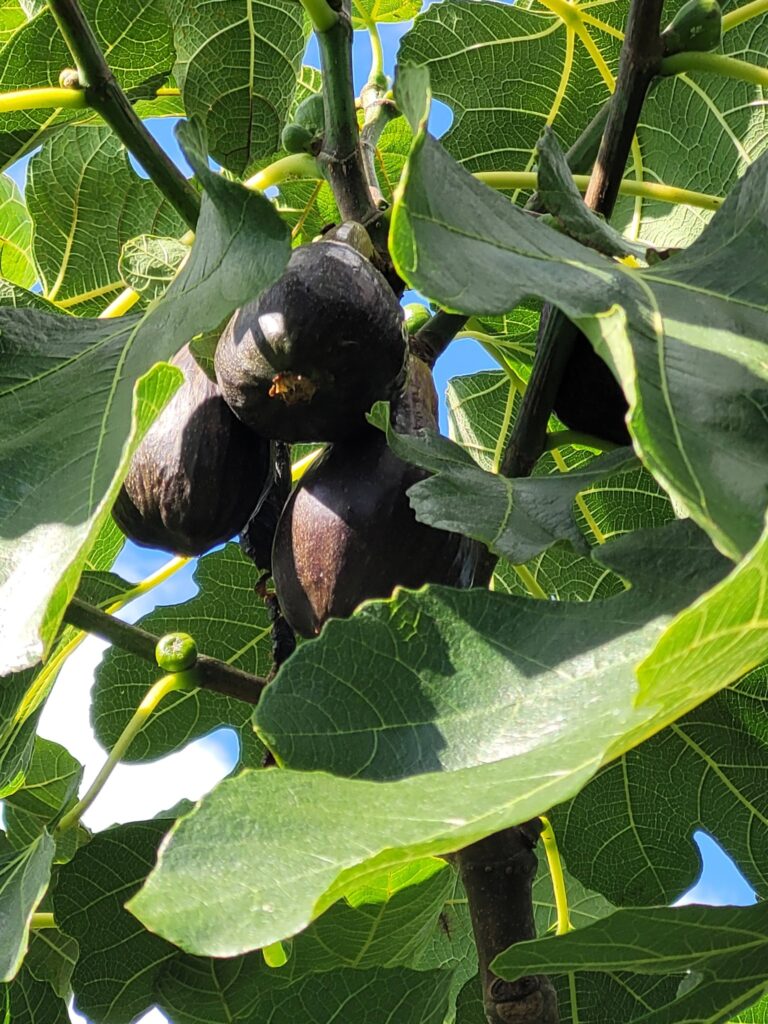
Understanding How Fig Trees Grow and Fruit
To prune well, you need to understand how a fig tree produces fruit. This part surprises many first-time growers.
The common fig (Ficus carica) produces fruit in two cycles:
- The breba crop — This is the early-season crop that develops on wood from the previous year. Breba figs appear in late spring to early summer. Not all fig varieties produce a reliable breba crop.
- The main crop — This develops on the current season’s new growth. It typically ripens in late summer to autumn and is the primary harvest for most cultivars.
This distinction is critical for pruning. If you remove too much of last year’s wood in late winter, you eliminate the potential breba crop. Conversely, if you leave every old branch in place, the tree becomes overcrowded and the main crop suffers.
A balanced approach — removing no more than 20–30% of the canopy in a single season — respects both cropping cycles while still maintaining good structure.
When to Prune a Fig Tree
Timing is arguably the most important factor in successful fig pruning. The ideal window is late winter, just before new growth begins — typically between late January and early March in the Northern Hemisphere, and between July and August in the Southern Hemisphere.
At this stage:
- The tree is dormant, so pruning stress is minimal.
- Cuts heal quickly once spring growth begins.
- The bare branches make it easy to assess the tree’s structure.
- The risk of transmitting disease through open cuts is lower in cold, dry weather.
What to Avoid
Do not prune in autumn or early winter. Cutting stimulates new growth, and any tender shoots that emerge before winter frosts can suffer cold damage.
Avoid heavy summer pruning. Light corrective cuts are acceptable in summer — removing a crossing branch or a water sprout — but major structural work done in full leaf puts unnecessary stress on the tree.
Never prune immediately after a heavy frost. Wait until the coldest weather has passed. Pruning into frost-damaged wood can introduce pathogens and confuse the tree’s response.
Tools You Will Need
Good pruning starts with the right tools. Using dull or dirty equipment can crush tissue rather than cut it cleanly, and can spread disease from one tree to another.
- Bypass pruning shears (secateurs) — For stems up to 1.5 cm in diameter. These make clean, precise cuts. Avoid anvil-type pruners, which tend to crush rather than cut.
- Loppers — For branches between 1.5 cm and 4 cm in diameter. Long-handled loppers give you the leverage needed for thicker wood without straining.
- Pruning saw — For branches over 4 cm. A curved pruning saw is far more effective than a standard handsaw in enclosed canopy spaces.
- Protective gloves — Fig trees exude a white latex sap when cut. This sap can cause skin irritation and is particularly problematic for those with latex allergies. Always wear thick gloves.
- Sterilising solution — A diluted bleach solution (1 part bleach to 9 parts water) or isopropyl alcohol (70%) applied to your tools between cuts prevents the spread of fungal spores and bacterial infections.
Step-by-Step: How to Prune a Fig Tree
Here is the process I follow, broken down into clear, manageable steps.
Step 1: Assess the Tree First
Before making a single cut, stand back and study the tree from multiple angles. Look for:
- Dead or clearly dying branches (these are often dark, shrivelled, or fail to show any bud swelling in late winter)
- Branches that cross or rub against each other
- Suckers growing from the base of the trunk
- Branches that grow straight down or straight into the centre of the canopy
- Branches that are diseased or showing signs of fungal damage
Create a mental map of what you want to remove before you begin. This prevents the common mistake of over-pruning in some areas and under-pruning in others.
Step 2: Remove the “Three Ds” First
The three Ds — dead, damaged, and diseased wood — always come out first, regardless of season. This is non-negotiable from a plant health perspective.
Cut dead wood back to where healthy tissue begins. You will know you are in healthy wood when the inner tissue (the cambium) appears green or white and moist, not brown and dry.
Diseased branches should be cut back to well below the visible infection point — ideally at least 10–15 cm beyond where the damage appears. Sterilise your tools after every cut when removing diseased wood.
Step 3: Remove Suckers and Water Sprouts
Suckers are vigorous shoots growing from the base of the trunk or from the rootstock below the graft union. They drain energy from the main tree and, if left unchecked, can grow into competing trunks. Remove them as close to their point of origin as possible.
Water sprouts are the fast-growing, vertical shoots that often emerge from the interior of the canopy or from pruning wounds. They rarely fruit and tend to create shade and congestion. Cut them cleanly at their base.
Step 4: Thin Out Crossing and Competing Branches
Where two branches cross or grow in the same direction and compete for space, keep the one that is better positioned — generally the one growing outward and upward at a natural angle — and remove the other.
The goal is an open, vase-shaped canopy that allows light to reach every part of the tree. Think of the ideal fig canopy as an open bowl, not a dense dome.
When choosing between competing branches, favour:
- The branch with a wider attachment angle (closer to 45–60 degrees from the trunk)
- The branch facing outward, away from the centre
- The younger, more vigorous branch if both are equally positioned
Step 5: Head Back Long Leaders
“Heading” means cutting a long branch back to a shorter length, which encourages branching and keeps the tree compact. For fig trees, this is particularly important for the main scaffold branches — the primary branches that form the tree’s framework.
In the first few years of a young tree’s life, heading back new leaders by one-third to one-half after each dormant season is standard practice. This builds a strong, low, multi-branched framework.
For established trees, heading is used more selectively — mainly to reduce height, prevent a branch from overextending, or stimulate fruiting spurs on older wood.
When heading a branch, always cut just above an outward-facing bud. This directs the new growth away from the centre of the tree.
Step 6: Make Clean, Correct Cuts
The quality of your cuts matters enormously to the tree’s health. Here are the key principles:
- Cut at a slight angle (approximately 45 degrees) so that water runs off the cut surface rather than pooling on it.
- Cut just above a bud or lateral branch — leave about 5 mm above the bud. Too close damages the bud; too far leaves a dead stub that rots.
- For larger branches, use the three-cut method to avoid tearing the bark:
- Make an undercut about 30 cm from the trunk, cutting upward through one-third of the branch.
- Make the second cut from the top, about 5 cm further out, cutting all the way through.
- Remove the remaining stub by cutting just outside the branch collar (the slightly raised ring of tissue where the branch meets the trunk).
Never cut flush with the trunk. This damages the branch collar, which contains specialised cells that help the tree compartmentalise and seal the wound.
How to Prune Young Fig Trees (Formative Pruning)
The most important pruning of a fig tree’s life happens in its first three to four years. Formative pruning establishes the tree’s permanent framework and determines whether it will be easy to manage for decades to come.
Year 1 (at planting): Cut the young tree back hard — to about 60–90 cm from the ground — to encourage branching low on the trunk. This is counterintuitive but essential.
Year 2: Select three to five well-spaced branches as your main scaffold branches. These should be evenly distributed around the trunk and ideally at 45–60 degree angles. Remove everything else. Head the selected scaffold branches back by one-half.
Year 3: Continue extending the scaffold framework by selecting secondary branches on each main scaffold limb. Head these back as well. The tree should now be forming its characteristic open, vase-shaped structure.
Year 4 and beyond: The framework is largely established. Pruning now shifts to maintenance — removing dead wood, controlling size, and encouraging fruiting.
Pruning Established Fig Trees: Maintenance Pruning
Once a fig tree reaches maturity, the annual pruning task is less intensive but no less important.
A typical maintenance session for an established fig involves:
- Removing all dead and diseased wood
- Cutting out any crossing or rubbing branches
- Removing water sprouts and suckers
- Thinning approximately 15–25% of older fruiting wood to stimulate new growth
- Heading back any branches that have grown beyond the desired canopy boundary
According to the Royal Horticultural Society, an established fig tree generally requires only light to moderate pruning each year to maintain productivity. Heavy renovation pruning — taking the tree back drastically — should only be done if the tree has become seriously overgrown and unproductive.
Renovation Pruning: Rescuing a Neglected Fig Tree
If you have inherited a fig tree that has not been pruned in many years, do not despair. Fig trees are remarkably resilient. Renovation is possible, but it must be done gradually over two to three years, not all at once.
Removing more than 30% of a mature tree’s canopy in a single season causes severe stress, can dramatically reduce fruiting for several seasons, and in some cases can weaken the tree enough to make it susceptible to disease.
Year 1 of renovation: Remove all dead, diseased, and crossing wood. Cut out the worst of the water sprouts. Reduce the height by no more than one-quarter.
Year 2: Continue opening the canopy. Begin cutting back the oldest and most unproductive limbs to younger lateral branches or to strong side shoots.
Year 3: By now the tree should be approaching a manageable structure. Complete any remaining heading cuts and establish the final framework.
Patience here pays off. Within three to four years of careful renovation, a neglected fig can be fully productive again.
Fig Pruning in Containers
Many gardeners grow figs in large containers — particularly in colder climates where the container allows the tree to be moved into a frost-free space over winter. Container-grown figs require the same pruning principles, with a few modifications.
Size control is more critical. Container figs must be kept compact. Annual pruning that reduces the canopy by 20–30% is standard.
Root pruning may also be necessary every three to five years. When repotting, trim the root ball by about one-quarter and repot into fresh compost. This, combined with top pruning, keeps the tree in balance with its container.
Watch for winter dormancy pruning opportunities. When you bring the container tree indoors or into a greenhouse, dormancy may break earlier than for outdoor trees. Be ready to prune as soon as dormancy ends but before new leaves appear.
Common Pruning Mistakes to Avoid
Even experienced gardeners make mistakes with fig trees. Here are the most common ones.
- Pruning at the wrong time. Pruning in autumn exposes the tree to winter damage. Late summer pruning can stimulate growth that does not have time to harden before cold weather arrives.
- Over-pruning in a single season. Removing more than 30% of the canopy in one year stresses the tree significantly and reduces the next season’s crop.
- Leaving stubs. Stubs — short sections of branch left beyond the bud or lateral — die back and create entry points for disease. Always cut to a bud, a lateral branch, or the branch collar.
- Ignoring suckers. Basal suckers left for even one season can grow vigorously. Remove them as soon as they appear.
- Forgetting to sterilise tools. This is particularly important when dealing with any signs of disease. A contaminated pair of secateurs can spread fungal spores throughout an otherwise healthy tree in a single pruning session.
After Pruning: Care and Considerations
Once pruning is complete, there are a few aftercare steps worth taking.
Wound sealants
Opinions are divided in the horticultural world. Many current extension guidance documents, including those from Oregon State University, suggest that healthy trees generally compartmentalise wounds well without sealant, and that some sealants may actually trap moisture and encourage rot.
For clean cuts on vigorous trees, no sealant is typically needed. For larger wounds on older trees, a pruning sealant or wound paint may offer some protection.
Mulching
Apply a fresh layer of organic mulch (wood chips, straw, or compost) around the base of the tree after pruning. Keep it away from direct contact with the trunk. This retains moisture, moderates soil temperature, and encourages the root activity that supports the tree’s response to pruning.
Feeding
A balanced, low-nitrogen fertiliser applied in early spring supports healthy regrowth after pruning. High-nitrogen feeds encourage excessive leafy growth at the expense of fruit.
The University of Florida IFAS Extension recommends a balanced fertiliser (such as 8-8-8 or 10-10-10) applied in early spring for productive figs.
A Note on Fig Tree Varieties and Pruning
Most common fig varieties respond well to the pruning methods described above. However, a few variety-specific notes are worth mentioning.
‘Brown Turkey‘ — One of the most widely grown varieties, particularly in the UK and parts of the USA. It reliably produces both breba and main crops. Prune conservatively in the first few years to protect the breba crop.
‘Black Mission’ — A Californian favourite. It produces heavily on new wood, making it slightly more tolerant of moderate pruning than some breba-dependent varieties.
‘Celeste‘ — A compact variety popular in the southeastern USA. Its naturally tidy growth habit means less pruning is required. Minimal heading; focus on thinning.
‘Kadota‘ — A commercial variety known for large fruit. Responds well to formative pruning and benefits from annual heading to maintain productivity.
Key Statistics on Fig Cultivation
- Global fig production exceeds 1.1 million metric tonnes annually, with Turkey, Morocco, Egypt, and Iran among the top producers (Food and Agriculture Organization of the United Nations, 2022).
- Ficus carica has been cultivated by humans for at least 11,400 years, making it one of the first domesticated plants — predating wheat, barley, and legumes, according to research published in Science (Kislev et al., 2006).
- A mature, well-managed fig tree can yield between 9 and 23 kg of fruit per season, depending on variety, climate, and pruning management (University of Florida IFAS Extension).
- Fig rust (Cerotelium fici), one of the most common fungal diseases, can cause 30–100% defoliation in severe untreated cases, which underscores the importance of canopy management through pruning.
- In the United Kingdom, the RHS reports that fan-trained figs grown against warm walls — a traditional British technique — typically produce up to twice the yield of free-standing trees of the same age, primarily due to improved pruning and light management.
Frequently Asked Questions
Can I prune a fig tree in summer? Light corrective pruning — removing a crossing branch or a water sprout — is acceptable in summer. However, heavy pruning should be reserved for the dormant season.
How much can I cut off at once? No more than 20–30% of the canopy in a single season for established trees. Young trees in formative pruning may be cut more heavily.
Should I use wound paint after cutting? Current evidence suggests it is not necessary for most clean cuts on healthy trees. Large wounds on older trees may benefit from a light application.
Why is my fig tree not fruiting after pruning? The most common causes are over-pruning (removing too much fruiting wood), pruning at the wrong time, or insufficient sunlight. Ensure at least eight hours of direct sun daily and prune no more than one-third of the canopy.
Do I need to prune container fig trees differently? The principles are the same, but size control is more pressing. Annual pruning combined with periodic root pruning keeps container figs productive.
References
- University of California Agriculture and Natural Resources — Fig (Ficus carica) in the Home Garden. University of California Cooperative Extension. Available at: https://ucanr.edu/sites/UrbanAg/files/183635.pdf
- University of Florida IFAS Extension — The Fig (Ficus carica L.) in Florida. Mossler, M.A. and Nesheim, O.N. Available at: https://edis.ifas.ufl.edu/publication/HS43
- Royal Horticultural Society — Figs: Planting and Cultivation. RHS Advisory Services. Available at: https://www.rhs.org.uk/fruit/figs/grow-your-own
- Oregon State University Extension Service — Growing Figs in the Pacific Northwest. Strik, B. Available at: https://catalog.extension.oregonstate.edu/em9156
- Food and Agriculture Organization of the United Nations (FAO) — FAOSTAT Crops and Livestock Products, Figs Production Data. FAO Statistics Division, 2022. Available at: https://www.fao.org/faostat/en/#data/QCL
- Kew Royal Botanic Gardens — Ficus carica (Common Fig): Plant Profile. Kew Science, Plants of the World Online. Available at: https://powo.science.kew.org/taxon/urn:lsid:ipni.org:names:851808-1
- North Carolina State University Extension — Ficus carica: Common Fig. NC State Extension Gardener Plant Toolbox. Available at: https://plants.ces.ncsu.edu/plants/ficus-carica/

Tim M Dave is a gardening expert with a passion for houseplants, particularly cacti and succulents. With a degree in plant biology from the University of California, Berkeley, he has vast experience in gardening. Over the years, he has cultivated a vast collection of desert plants and learned a great deal about how to grow and care for these unique companions.