How to Prune a Peach Tree: Step-by-Step Guide for Bigger, Sweeter Harvests
I still remember the first peach tree I pruned badly. I left it too dense, too tall, and too proud of itself. The fruit that year was small, pale, and mostly out of reach.
That mistake taught me something every grower eventually learns: a peach tree is not pruned to look neat. It is pruned to survive and produce. Get this one job right, and the tree rewards you for years.
This guide walks you through exactly how, when, and why to prune a peach tree.
Why Peach Trees Need Pruning Every Single Year
Unlike apples or pears, peach trees do not fruit on old wood. Peaches form almost entirely on one-year-old shoots, the growth your tree put out last summer. Once a branch fruits, it will not fruit there again.
That single fact changes everything about how you prune. Pruning to renewal points each year, cutting out older growth and most of the previous season’s growth, ensures only a portion of last year’s shoots are needed to make a crop.
Skip pruning for even one season, and you get a tangled, shaded interior where fruiting wood dies out.
Annual pruning is described by Virginia Tech as a critical management practice for producing easily harvested, heavy crops of high-quality peaches, though it is not a substitute for fertilization, irrigation, and pest control.
I think of pruning as a yearly conversation with the tree. You are telling it: grow here, not there. Put your energy into fruit, not shade.
Peach Tree Quick Overview
| Botanical name | Prunus persica |
| Family | Rosaceae |
| Fruiting wood | One-year-old shoots only |
| Ideal shape | Open-center (vase) form |
| Best pruning time | Late winter to early spring, just before bloom |
| Annual wood removal | Roughly 40% of total growth |
| Mature tree height (pruned) | 7–8 feet |
| Bearing age | Typically year 3–4 after planting |
| Sunlight requirement | Full sun, 6+ hours daily |
| Chill hours needed | 200–950 hours, depending on cultivar |
| Average commercial orchard life | 15–20 years |
When to Prune a Peach Tree
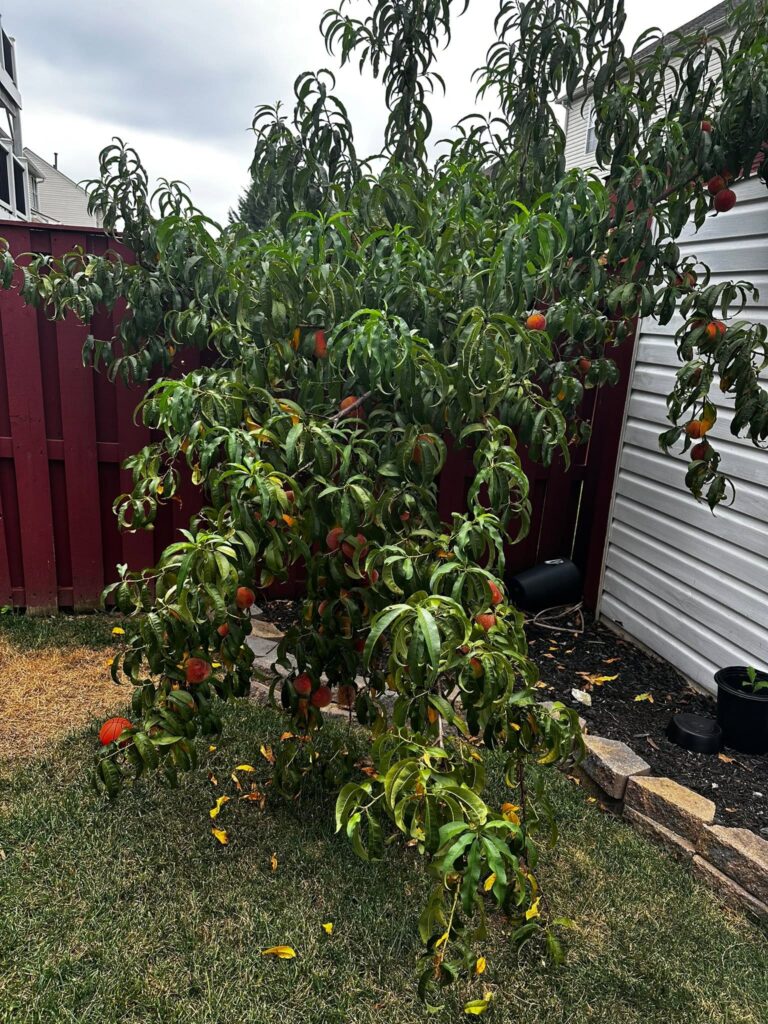
Timing matters more with peaches than with almost any other fruit tree. Prune too early, and you risk cold injury. Prune too late, and you waste the tree’s stored energy.
The general rule: prune in late winter, just before bloom, once the worst frost danger has passed.
Regional timing differs:
- Texas: Pruning should occur at least by February, just prior to bloom in March.
- South Carolina: Prune in mid-February to early March, and do not prune trees from October to January. In the mountains and Piedmont regions, growers should wait until mid-February.
- Cold climates with winter injury risk: Research from West Virginia found something genuinely useful here. Following severe cold snaps, trees with moderate winter injury should be pruned no later than two to three weeks after bloom, using a heavy pruning level, since trees that were “dehorned” (cut back severely) did not recover better than those pruned less severely.
My honest takeaway: if your region sees harsh winters, wait. Pruning opens wounds, and an early cut on a tree that later gets hit by frost is a wound with nowhere good to heal.
ALSO READ: 15 Drought Resistant Fruit Trees: Identification and Growth Details
Understanding Peach Buds Before You Cut
You cannot prune well if you cannot read the buds. Look closely at a one-year-old shoot and you will notice two distinct bud types.
There are two types of buds on a peach tree: vegetative buds, which produce leafy shoots, and floral buds, which produce flowers and eventually fruit.
A healthy, well-positioned shoot usually carries one pointed vegetative bud flanked by two or three rounder floral buds. If a shoot is bare or carries only vegetative buds, it will give you leaves, not peaches. Learning to spot this difference, even just by feel, saves a season of disappointment.
The Three Goals of Pruning a Peach Tree
Every cut you make should serve one of these three purposes. I keep this list in my head every time I pick up the shears.
1. Open the Center for Light and Air
Opening the center of the tree increases air circulation, reduces disease pressure, and allows sunlight into the tree to accelerate fruit color. A shaded peach is a small, pale, disappointing peach.
2. Keep Fruit Within Reach
A second objective of pruning is to lower the fruiting zone to a height that makes hand harvesting from the ground possible. There is no prize for a 20-foot peach tree. There is only a sore neck and rotting fruit you cannot reach.
3. Renew Fruiting Wood
Removing roughly 40 percent of the tree annually stimulates new growth each spring, which becomes next year’s fruiting wood. This number genuinely surprises new growers. It feels aggressive. It is supposed to.
Step-by-Step: How to Prune a Mature Peach Tree
Step 1: Remove the Obvious Problems First
Before shaping anything, clear out:
- Dead, broken, or diseased limbs
- Low-hanging branches that touch or drag near the ground
- Rootstock suckers growing from below the graft line
- Vigorous water sprouts shooting straight up from the trunk
A consistent goal across pruning guidance is removing diseased or dead shoots, rootstock suckers, and water shoots. Get these out of the way first. It is satisfying, and it makes the rest of the job much clearer to see.
Step 2: Open Up the Interior
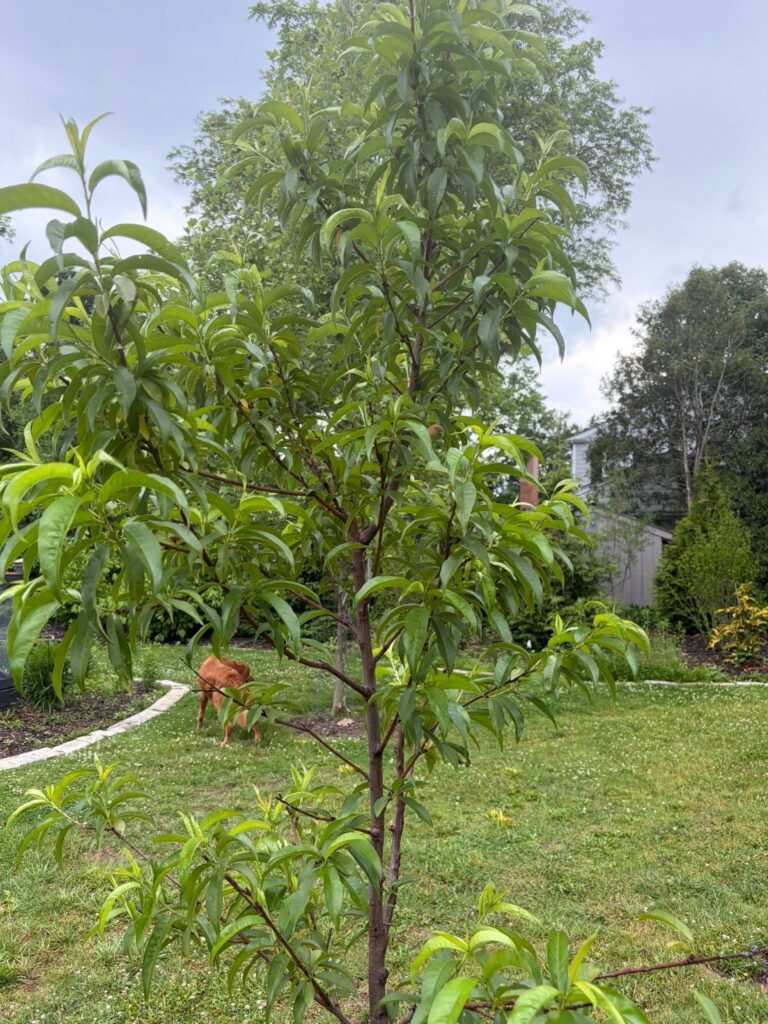
Stand back and look at the tree’s shape. Remove all shoots growing toward the inside of the tree. These crossing, inward branches do nothing but block light from the productive outer canopy.
Step 3: Identify and Keep Quality Fruiting Wood
This is where judgment matters most. The main idea is to remove old, gray-colored, slow-growing shoots, which are non-fruitful, while leaving one-year-old, red bearing shoots roughly 18 to 24 inches long.
Color is your guide here. Reddish, smooth, last-season wood is gold. Gray, woody, multi-year wood is dead weight as far as fruit production goes.
Step 4: Prune to Renewal Points
For an established tree, work scaffold by scaffold. Cut out older growth and most of the previous season’s growth at each renewal point, replacing fruited-out branches with year-old shoots each year. Shorten the long hanging shoots and thin the interior growth, but do not strip it bare.
I find it helpful to walk the tree slowly, scaffold by scaffold, rather than attacking it all at once. Rushed pruning is where good fruiting wood ends up on the ground by accident.
Step 5: Step Back and Reassess
After your first pass, walk around the tree. Look at it from two or three angles. Peach pruning rewards patience more than speed. A few extra minutes of looking often saves an unnecessary cut.
ALSO READ: 25 Types of Peach Trees (Varieties, With Pictures)
Training a Young Peach Tree: The First Few Years
If you are starting with a new sapling, your job is different. You are building the tree’s skeleton, not yet managing crop load.
At planting, nursery trees with trunks less than 3/8 inch in diameter usually have no lateral branches and can be cut back to 18 to 24 inches above ground level, with primary scaffold branches developing six to ten inches below that cut.
During the first growing season, once scaffolds emerge, most of the competing branches should be removed using pruning shears, leaving three to five branches evenly spaced in north, south, east, and west directions.
In the following dormant season, remove vigorous upright shoots developing on the inside of the main scaffolds to establish a true open-center, vase-shaped tree.
Patience matters here. Once the scaffold system is established, prune as little as possible until the tree matures enough to fruit, which usually happens in the third or fourth year. Heavy pruning on a young, non-bearing tree just delays the day you finally get peaches.
Choosing a Training System: Open Center vs. Quad-V
Most home growers should stick with the classic open-center (vase) shape, but it helps to know your options.
Standard-type peach trees, which make up the vast majority of commercial cultivars, are easily trained to an open-center or vase shape with three or four primary scaffold branches, or to a V-shaped form with just two scaffolds.
Training peach trees to a central-leader form is technically possible but not recommended, because it requires considerably more pruning and tends to produce lower yields than open-center trees. Well-pruned standard trees can be maintained at a manageable 7 to 8 feet in height.
There is also a newer commercial approach worth mentioning. The Quad-V system trains peach trees with main scaffolds carrying fruiting wood all along their length, with the rule that columns should never sit directly above each other. This system suits high-density commercial rows more than backyard trees, but it shows how flexible peach training can be.
Thinning the Fruit After Pruning
Pruning alone will not guarantee good fruit size. Once peaches set, follow up with hand-thinning.
Excess fruits must be removed or thinned to prevent limb breakage and ensure good fruit quality, since overloaded branches often produce peaches with poor color and taste. Hand-thin the tree about four weeks after full bloom, spacing the remaining peaches roughly 6 inches apart along the limb.
It feels wasteful the first time you do it. Pulling off perfectly healthy young fruit goes against instinct. But a branch carrying too many peaches simply cannot ripen any of them properly, and the weight risk is real.
ALSO READ: 7 Best Homemade Pesticides for Fruit Trees: Organic Recipes That Actually Work
Common Peach Pruning Mistakes I See Often
- Pruning too lightly. New growers, afraid of harming the tree, often remove far less than the recommended amount. The result is a shaded, overcrowded interior by midsummer.
- Pruning in autumn. Trees should not be pruned from October through January, since fresh cuts in fall leave the tree vulnerable heading into winter.
- Keeping gray wood out of sentimentality. I understand the instinct to keep an old, thick branch because it looks established. But gray, slow-growing wood does not produce fruit. Removing it is not harming the tree; it is redirecting its energy.
- Over-pruning a young, non-bearing tree. Resist the urge to shape aggressively before year three. Let the scaffold system mature first.
Tools You Will Actually Need
- Bypass hand pruners for shoots under half an inch thick
- Loppers for branches up to roughly two inches
- A pruning saw for larger scaffold cuts
- Clean, sharp blades, disinfected between trees to avoid spreading disease
Sharp tools matter more than people expect. A clean cut heals faster than a torn, ragged one, and a torn cut is an open invitation for canker and rot.
A Quick Seasonal Pruning Checklist
- Wait until late winter, just before bloom
- Remove dead, diseased, and low-hanging wood first
- Clear rootstock suckers and water sprouts
- Open the center; remove inward-growing shoots
- Identify red, one-year-old bearing wood and keep it
- Cut back to renewal points on each scaffold
- Aim to remove around 40 percent of total growth
- Step back, reassess, and finish lightly
- Hand-thin fruit four weeks after full bloom
How Pruning Affects Yield and Fruit Quality: The Numbers
I always tell new growers that pruning is not just an aesthetic chore. It has measurable effects on harvest outcomes, and the research backs this up clearly.
Light penetration drives fruit color and sugar development. Peach trees are pruned specifically to manage light and crop load, since standard-type trees can be maintained at a manageable 7 to 8 foot height with consistent annual pruning.
A taller, unpruned tree shades its own lower and interior fruit, and shaded peaches consistently show poorer color and lower sugar content than fruit grown in full sun.
Pruning severity has a documented threshold. In the West Virginia cold-injury study, researchers tested four pruning severities across three different timings on frost-damaged trees.
The heaviest pruning level, applied within two to three weeks after bloom, produced the best recovery, while the most severe “dehorning” cuts showed no extra benefit over moderately heavy pruning.
That is a useful data point: more is not always better once you pass a certain severity, and timing matters as much as how much wood you remove.
Removing roughly 40 percent of annual growth is the benchmark figure cited by Texas A&M AgriLife Extension for stimulating strong new spring growth, which becomes the following year’s fruiting wood.
I have tested lighter pruning loads on my own trees out of caution, and the difference by midsummer is obvious: under-pruned trees produce more fruit, but smaller and less consistently ripened.
Fruit spacing after thinning also has a fixed number behind it. Extension guidance from Clemson University recommends spacing thinned peaches about 6 inches apart along the limb, done roughly four weeks after full bloom. Skip this step, and overloaded branches risk breaking under fruit weight while individual peaches stay undersized.
Bearing age is predictable. Most extension sources agree that a properly trained peach tree begins meaningful fruit production in its third or fourth year, which is also when pruning shifts from structural training to annual maintenance and renewal.
These figures are not arbitrary. They come from decades of orchard trials across different climates, and they hold up whether you are managing two backyard trees or two hundred commercial acres.
ALSO READ: 15 Dwarf Fruit Trees for Garden Beds: A Complete Growing Guide
Frequently Asked Questions
How often should I prune a peach tree? Every single year, without exception. Peaches fruit only on one-year-old wood, so skipping a season means losing that year’s renewal growth and crowding the canopy for the year after.
Can I prune a peach tree in summer? Light summer pruning to remove water sprouts or improve light penetration is sometimes done, but the major structural pruning should happen in late winter, just before bloom. Avoid heavy cuts from October through January.
What happens if I do not prune my peach tree at all? The canopy becomes dense and shaded within two or three seasons. Fruiting wood dies out in the shaded interior, fruit size and color decline, and the tree becomes harder to harvest and more prone to disease due to poor air circulation.
Is it bad to prune too hard? Pruning too aggressively on a young, non-bearing tree delays fruiting. On a mature tree, however, research shows that even quite heavy pruning, up to a point, supports recovery and renewal better than light pruning, particularly after winter injury.
Why are my peaches small even after pruning? This usually points to inadequate fruit thinning rather than a pruning problem. Even a well-pruned tree will produce undersized fruit if too many peaches are left to compete for the same branch’s resources.
Do I need special tools? A sharp pair of bypass hand pruners, loppers for thicker branches, and a pruning saw for major scaffold cuts will cover nearly every situation a home grower faces. Keep blades clean and sharp; ragged cuts heal slowly and invite disease.
Adjusting Your Approach by Climate
Peaches are grown from the Carolinas to the Pacific Northwest, and no single calendar date works everywhere. Chill hours, the cumulative time a tree spends below roughly 45°F during dormancy, determine when a cultivar breaks dormancy and blooms, and that in turn shapes your pruning window.
In warmer southern regions, bloom arrives early, so pruning has to happen correspondingly sooner, often by February. In cooler inland or mountain areas, bloom is delayed, which pushes the safe pruning window later into March.
If you are unsure which category your area falls into, your local extension office is the most reliable place to check, since recommendations are calibrated to regional frost data rather than a generic national average.
I have found that watching the buds themselves is just as useful as watching the calendar. Once you see buds swelling but not yet open, you are usually within the safest pruning window regardless of the exact date on paper.
Final Thoughts
Pruning a peach tree always feels more drastic than it should, right up until midsummer, when you see the result: open branches loaded with full-sized, well-colored fruit instead of a crowded mess of small ones.
I have made the over-cautious mistake. I have also made the over-zealous mistake. The sweet spot, somewhere around removing 40 percent of last year’s growth while protecting the strong, red, one-year-old shoots, is where the tree truly thrives.
If you take one thing from this guide, let it be this: peach trees do not punish confident pruning. They punish neglect. Pick up the shears, look closely at the wood, and trust the process.
References
- Sherif, S. Pruning Peach Trees, Publication 422-020. Virginia Cooperative Extension, Virginia Tech. https://www.pubs.ext.vt.edu/422/422-020/422-020.html
- University of Arkansas System Division of Agriculture. Pruning Fruit Trees, FSA6042. Cooperative Extension Service. https://www.uaex.uada.edu/publications/PDF/FSA-6042.pdf
- Hansen, S. et al. Training and Pruning Peach Trees. Utah State University Extension, DigitalCommons@USU. https://digitalcommons.usu.edu/cgi/viewcontent.cgi?article=2845&context=extension_curall
- Texas A&M AgriLife Extension Service. Pruning Peach Trees. https://agrilifeextension.tamu.edu/wp-content/uploads/2025/05/Pruning-Peach-Trees.pdf
- Sherif, S. Pruning Peach Trees. Virginia Cooperative Extension, School of Plant and Environmental Sciences, Virginia Tech. https://www.pubs.ext.vt.edu/content/dam/pubs_ext_vt_edu/422/422-020/SPES-221.pdf
- Polomski, R. F. & Reighard, G. Pruning Peaches & Nectarines. Home & Garden Information Center, Clemson University Cooperative Extension. https://hgic.clemson.edu/factsheet/pruning-peaches-nectarines/
- Penn State Extension. Peach Tree Pruning – Managing Light and Crop Load. The Pennsylvania State University. https://extension.psu.edu/peach-tree-pruning-managing-light-and-crop-load
- University of Florida IFAS Extension. Training and Pruning Florida Peaches, Nectarines, and Plums, HS1111/HS365. https://ask.ifas.ufl.edu/publication/HS365

Tim M Dave is a gardening expert with a passion for houseplants, particularly cacti and succulents. With a degree in plant biology from the University of California, Berkeley, he has vast experience in gardening. Over the years, he has cultivated a vast collection of desert plants and learned a great deal about how to grow and care for these unique companions.