Dangerous Tree Removal: Risks and Safety Guidelines
Dangerous tree removal is one of the most hazardous tasks in any residential or commercial setting. Done carelessly — or by someone untrained — it can injure bystanders, destroy property, and cost lives.
This guide breaks down everything you need to know, from recognizing a hazardous tree to hiring the right professional and understanding what happens during a high-risk removal.
Why Dangerous Tree Removal Deserves Serious Attention
Let us start with a fact that most homeowners do not know.
According to data reported by the U.S. Bureau of Labor Statistics, tree removal results in approximately 200 fatal injuries every year in the United States, making it one of the leading industries for on-the-job fatalities.
The Occupational Safety and Health Administration (OSHA) has formally designated logging — which includes commercial tree felling — as the most dangerous occupation in the United States, with a fatal injury rate more than 30 times higher than the national average across all industries.
Research published in the Morbidity and Mortality Weekly Report by the CDC examined work-related fatalities associated with tree care operations between 1992 and 2007 and found a persistent, multi-decade pattern of death and severe injury tied directly to tree removal work.
A peer-reviewed study published in PubMed analyzing tree-related fatalities in Connecticut from 2004 to 2019 found that blunt impact — primarily to the head — was the cause of death in the majority of tree-related fatalities, with falling trees and falling limbs responsible for 78% of fatal events among all categories of woodcutters.
Beyond the fatalities, each year tree care injuries account for at least 23,000 chainsaw injuries treated in hospital emergency rooms across the United States, according to the Texas Department of Insurance.
These numbers matter. They explain why this work is never casual.
What Makes a Tree “Dangerous”?
Not every tree that needs to come down is a dangerous removal. But many are, and the difference lies in a combination of factors that only a trained eye can fully assess.
1. Location Near Structures or Power Lines
A tree growing close to a house, a fence, a garage, or overhead utility lines dramatically changes the complexity of removal. There is no room for error when a falling trunk has a target. Even a small miscalculation in the direction of fall — called the “lay” — can send several tons of wood through a roof or into a live electrical line.
OSHA’s tree care hazard guidance specifically identifies overhead power lines as one of the most common causes of electrocution during tree work.
Contact with electrical current carries a fatal-to-non-fatal injury ratio of approximately 1 in 4, far worse than the 1-in-14 average across other tree care hazards.
2. Dead or Dying Trees
Dead trees are unpredictable. The internal wood may have decayed far beyond what is visible from the outside. Branches can snap without warning. The root system may have already failed, meaning the tree could fall at any moment — even on a calm day with no wind.
A dead tree does not wait for the right time to fall. This is why dead-tree removal is classified as emergency work in most arboricultural standards.
3. Storm-Damaged Trees
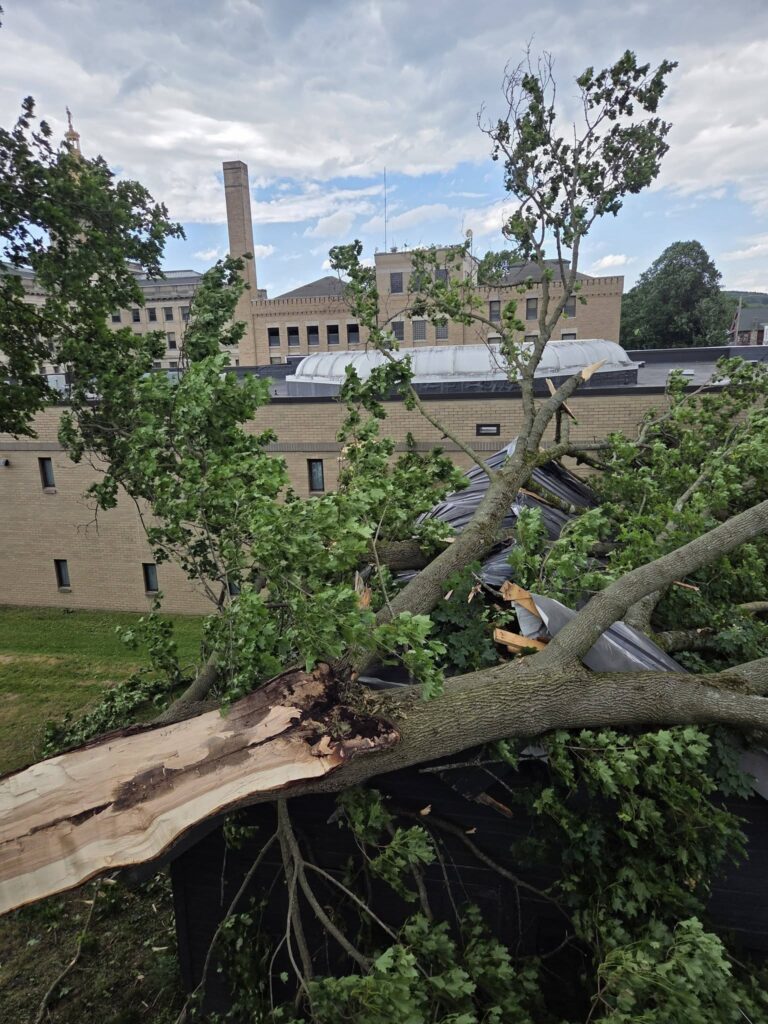
After a severe storm, broken and partially hanging branches — known in the industry as “widow-makers” — become one of the most immediate threats on a property. These limbs are under unpredictable tension. Moving one can cause others to spring loose without warning.
Research from Penn State University studying tree-felling fatalities found that years with abnormally high hurricane and storm damage — such as 2012, 2017, and 2018 — also saw significantly elevated numbers of landscaping fatalities tied to urban tree removal operations.
4. Trees With Structural Defects
Structural defects are not always visible to the untrained eye. A crack running through a central crotch, a co-dominant stem (two equally sized trunks growing from the same point), or a cavity in the lower trunk can all compromise a tree’s integrity completely — while the tree still looks healthy from the outside.
These are the trees that fall on houses on still, sunny afternoons. They carry no obvious warning.
5. Trees on Slopes or Unstable Ground
Soil movement, erosion, and root exposure on sloped terrain all affect how a tree falls and how stable it is during removal. A tree leaning uphill or with exposed roots on one side is already fighting gravity. Removing it safely requires calculating the forces at work in three dimensions.
6. Trees With Root Damage
Construction near trees — digging, paving, grade changes — often severs or compresses roots without anyone realizing it. A tree with compromised roots may look entirely healthy above ground but be dangerously unstable below it.
The Anatomy of a Dangerous Tree Removal: What Professionals Actually Do
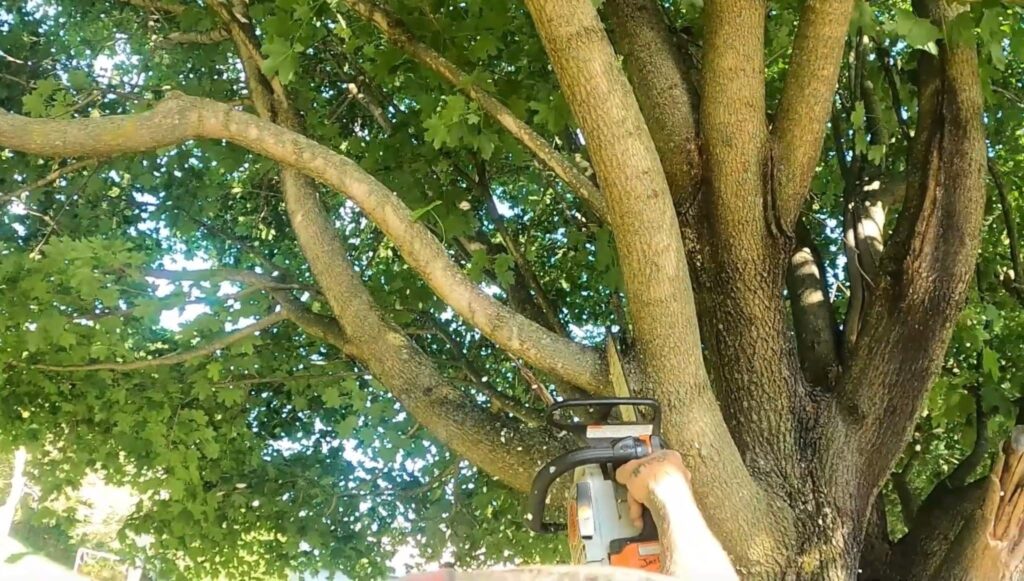
When a certified arborist arrives at a hazardous tree, the process looks nothing like what most people imagine. It is methodical, layered, and built around safety at every step.
Step 1: Site and Risk Assessment
Before touching any equipment, the arborist evaluates the full picture. This includes the lean of the tree, the condition of the wood, proximity to structures and utilities, the state of the root system, the soil condition, and any signs of disease or decay.
ISA-certified arborists trained in Tree Risk Assessment Qualified (TRAQ) methodology follow a structured, three-level assessment process that produces a documented risk rating.
This assessment is not optional. It shapes every decision that follows.
Step 2: Establishing a Drop Zone and Escape Routes
A controlled tree removal always begins with planning for the worst. The crew identifies a safe drop zone — the intended direction of fall — and clears it. They also plan escape routes: specific paths each worker will take the moment the tree begins to move.
Professionals never stand behind a falling tree or within the arc of a potential kickback.
Step 3: Rigging and Sectional Removal
For trees in confined spaces — near houses, over fences, or beneath power lines — complete felling is not possible. Instead, the tree is removed in sections, starting from the top and working downward. This technique is called sectional dismantling or sectional removal.
Ropes, pulleys, and rigging equipment are used to control the descent of each section, lowering cut pieces gently rather than letting them drop. This requires a climber in the canopy, a ground crew managing the rigging lines, and careful coordination. It is a team effort, not a solo task.
Step 4: Stump and Root Management
After the trunk and branches are removed, the stump remains. Depending on the situation, this is ground down with a stump grinder, chemically treated, or left to decay naturally. Root systems near foundations may need additional attention to prevent ongoing soil movement.
ALSO READ: Small Trees With Non-invasive Roots to Plant Near Your Home
The Most Common Dangerous Tree Removal Scenarios
Removal Near Power Lines
This is arguably the highest-risk scenario. Lines may carry tens of thousands of volts. ISA Utility Arborists carry specific credentials for working around high-voltage lines, and this specialization exists because the work requires a distinct skill set.
Do not allow anyone without line-clearance credentials to remove a tree that touches or overhangs a power line. In most jurisdictions, utility companies must be contacted before any work begins.
Emergency Storm Removal
After a major weather event, the pressure to “get it done fast” can override caution. This is when accidents happen. Widow-makers are still in the canopy. The ground is wet and unstable. Workers are fatigued.
Emergency tree removal after storms is responsible for a disproportionate number of tree-related injuries. Research following Hurricane Sandy in New Jersey found emergency department visits for tree-related injuries surged dramatically in the immediate aftermath of the storm.
Large Tree Removal in Confined Spaces
Large trees — those over 60 feet — require additional planning, larger equipment, and more experienced crews. In a confined yard with structures on multiple sides, the margin for error is razor-thin.
Cranes are sometimes brought in to lift cut sections directly, bypassing the need to drop them into the surrounding space at all.
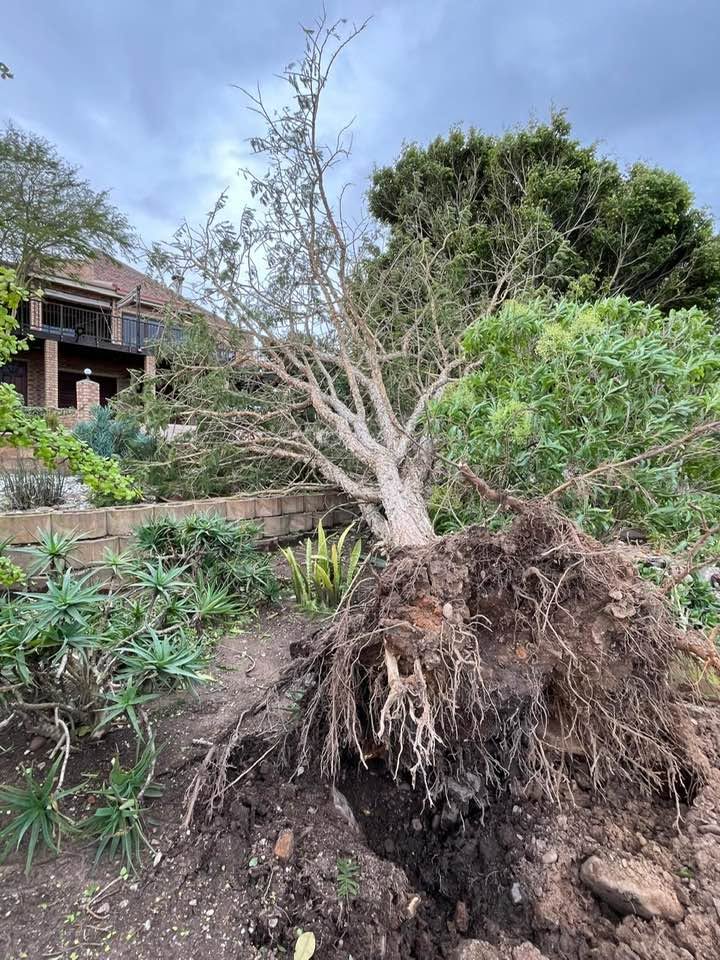
Leaning or Uprooted Trees
A tree that has partially uprooted is under enormous mechanical stress. The roots still in the ground are acting as a fulcrum.
The moment any of those roots are disturbed — even slightly — the tree can pivot and fall in an unexpected direction. This type of removal requires specific rigging techniques and, in many cases, machinery assistance.
DIY Tree Removal: When It Goes Wrong
I have spoken with more than a few homeowners who tried to take down a tree themselves. Most of them did not think it would be a problem — a manageable tree, a rented chainsaw, a YouTube tutorial.
A surprising number of those conversations end with stories of damaged roofs, destroyed fences, and, in too many cases, injuries.
The data supports this pattern. The Connecticut fatality study found that nonprofessional woodcutters who died were significantly more likely to be working alone (67% of cases) compared to professional workers (11%).
Working alone removes every layer of backup — no one to spot a shifting trunk, no one to call for help, no one to manage the ropes.
The most dangerous moment in DIY tree removal is the one you did not plan for. The branch that falls at an unexpected angle. The trunk that kicks back off the stump. The chainsaw bar that pinches and jumps.
This does not mean every homeowner should avoid all tree work entirely. Removing a small, isolated tree — one under 20 feet, with no nearby structures and no power lines — is something a careful, equipped, and experienced person can manage.
But anything beyond that category deserves a professional assessment at minimum.
ALSO READ: 15 Inasive Trees You Should Avoid Planting Near Your Home
Signs a Tree Must Be Removed Immediately
Some situations are urgent. Do not delay if you observe any of the following:
- The tree is leaning noticeably more than before, especially after rain or wind
- Large branches are hanging broken in the canopy (widow-makers)
- Fungal growth — mushrooms, conks, or shelf fungi — at the base of the trunk or on the roots
- Visible cracks or splits in the main trunk or at major branch unions
- Hollow sections visible at the base or upper trunk
- Roots that have lifted the surrounding soil or are exposed and broken
- The tree has died — no foliage in growing season, brittle branches that snap cleanly
- The tree is touching or leaning into a structure, power line, or neighboring property
Any one of these signs warrants a professional inspection. Several together mean the tree should probably come down before the next storm decides for you.
Hiring the Right Professional: What to Look For
This is where many property owners make costly mistakes. Anyone with a truck and a chainsaw can advertise tree removal. That does not make them qualified.
Here is what to verify before hiring anyone for dangerous tree removal:
ISA Certification
The International Society of Arboriculture (ISA) is the global standard-setting body for arboricultural practice. An ISA-Certified Arborist has passed examinations and maintains credentials through ongoing education. For high-risk removals, look specifically for credentials such as:
- ISA Climber Specialist — trained for elevated removals
- ISA Aerial Lift Specialist — certified for crane and lift operations
- ISA Utility Specialist — qualified for work near power lines
- TRAQ Certification — Tree Risk Assessment Qualified
TCIA Accreditation
The Tree Care Industry Association (TCIA) operates a voluntary accreditation program for tree service companies. Accredited companies have demonstrated adherence to professional and safety standards through a third-party review. This is a meaningful signal of a company’s commitment to quality.
Insurance — Non-Negotiable
Ask for proof of both general liability insurance and workers’ compensation coverage. If an uninsured worker is injured on your property, you may bear significant financial and legal responsibility. Do not take anyone’s word on this — ask to see the documentation and verify it.
Written Estimates
Reputable professionals provide written estimates that specify the scope of work, the timeline, and the payment structure. An estimate that is vague or purely verbal is a warning sign.
References and Reviews
Ask for references from similar past projects. A professional company with a track record in dangerous tree removal will have no hesitation providing them.
The Legal Side of Tree Removal
Tree removal is not always at the property owner’s sole discretion. Many municipalities have ordinances protecting certain trees — often called “heritage trees” or “protected trees” — that require permits before removal. Removing a protected tree without the proper permit can result in significant fines.
Some jurisdictions require that any tree work on trees above a certain size be performed by a licensed professional. Before any removal begins, check local regulations. Your arborist should be familiar with local requirements and able to assist with permit applications where needed.
Liability is also worth understanding. If a tree on your property falls and damages a neighbor’s home, your liability often depends on whether you knew — or reasonably should have known — the tree was hazardous. Regular inspections and documented maintenance can matter legally.
Safety Equipment Used in Professional Tree Removal
Professional dangerous tree removal involves specialized equipment that goes well beyond a chainsaw and a hard hat. A full-equipped crew will typically use:
- Climbing harnesses and lanyards rated to specific load limits
- Helmets with face shields to deflect flying debris
- Chainsaw-protective trousers (chaps) designed to clog a chainsaw on contact
- Steel-toed boots with ankle protection
- High-visibility clothing so crew members can track each other
- Rigging ropes, pulleys, and friction devices for controlled lowering
- Aerial lifts or cranes for trees too large or unstable to climb
- Wood chippers for branch disposal on site
- Stump grinders for root zone management
Each piece of equipment serves a specific protective function. The absence of any one item increases risk.
After the Tree Comes Down: What Happens Next
Removal does not end when the last section hits the ground. A professional crew will:
- Chip or haul away all branches and debris
- Cut the trunk into manageable sections for removal or firewood
- Grind the stump to below ground level
- Clear the work area and restore the site as closely as possible to its original state
If the removal was near a structure, a post-removal inspection of the area — looking for any root damage to paving, foundations, or drainage — is also advisable.
How to Maintain Trees to Prevent Emergency Removals
The best dangerous tree removal is the one that never has to happen. Regular maintenance dramatically reduces the likelihood of a tree reaching a state where emergency removal is the only option.
Annual or biennial inspections by a certified arborist allow problems to be caught early — when cabling and bracing might save the tree, or when a targeted crown reduction might reduce wind resistance and extend its life safely.
Dead branches should be removed promptly. Disease and pest infestations caught early are almost always easier and cheaper to treat than trees lost entirely.
A healthy urban tree adds measurable value. Research conducted in Cincinnati neighborhoods demonstrated that tree canopy contributed an average of 10.7% to residential sale prices. Preventive care is not just a safety investment — it is a financial one.
Key Takeaways
- Dangerous tree removal is statistically one of the most hazardous activities around any property. Professional fatality rates are 30 times higher than the national average.
- Dead, diseased, storm-damaged, leaning, or structurally compromised trees require immediate professional assessment.
- DIY removal carries disproportionate risk, especially for anyone working alone or without proper equipment and training.
- Hire ISA-certified arborists with verifiable insurance, written estimates, and relevant credentials for the specific type of removal needed.
- Check local regulations — permits may be required, and legal liability can attach to negligent inaction.
- Preventive maintenance is the most cost-effective approach to tree management and reduces the need for emergency removal.
If a tree on your property is causing concern, the first step is not to pick up a chainsaw. The first step is to call a qualified arborist, have the tree assessed, and make an informed decision based on professional advice.
That decision — and the expertise behind it — is what separates a controlled removal from a catastrophe.
References
- U.S. Centers for Disease Control and Prevention (CDC) / MMWR — Work-Related Fatalities Associated with Tree Care Operations — United States, 1992–2007 https://www.cdc.gov/mmwr/preview/mmwrhtml/mm5815a2.htm
- Occupational Safety and Health Administration (OSHA) — Tree Care Industry: Hazards and Solutions https://www.osha.gov/tree-care/hazards-solutions
- Penn State University — College of Agricultural Sciences — Loggers, landscapers face deadly danger felling trees in forests and urban areas (Research by Judd Michael, Nationwide Insurance Professor of Agricultural Safety and Health) https://www.psu.edu/news/research/story/loggers-landscapers-face-deadly-danger-felling-trees-forests-and-urban-areas
- PubMed / National Library of Medicine — Accidental Deaths Involving Trees: Professional and Nonprofessional Woodcutters and Tree Failures With Autopsy Findings (Connecticut Medical Examiner Study, 2004–2019) https://pubmed.ncbi.nlm.nih.gov/33989206/
- PubMed Central (PMC) / National Institutes of Health — Tree-Related Injuries Associated With Response and Recovery From Hurricane Sandy, New Jersey, 2011–2014 https://pmc.ncbi.nlm.nih.gov/articles/PMC5958394/

Tim M Dave is a gardening expert with a passion for houseplants, particularly cacti and succulents. With a degree in plant biology from the University of California, Berkeley, he has vast experience in gardening. Over the years, he has cultivated a vast collection of desert plants and learned a great deal about how to grow and care for these unique companions.