35 Weeds With White Flowers (Names, With Pictures)
White flowers look innocent in a garden bed. I’ve learned the hard way that some of the prettiest white blooms belong to plants you really don’t want spreading through your lawn, or worse, growing near livestock and children.
This guide covers 35 weeds with white flowers commonly found across North American lawns, gardens, roadsides, and pastures. Some are simply a nuisance. A few are genuinely dangerous.
Let’s work through them one at a time.
Why Identifying White-Flowered Weeds Matters
Not every white flower in your yard is a problem. Some are edible, some are pollinator favorites, and a few are simply misunderstood natives doing exactly what they evolved to do.
But a handful of these plants rank among the most toxic species in North America. Water hemlock, for instance, is described by the USDA as the most violently toxic plant on the continent, capable of causing death within fifteen minutes of ingestion.
Correct identification protects people, pets, and livestock. It also saves you from pulling a beneficial native plant while ignoring the aggressive invader growing right beside it.
With that in mind, here are the 35 weeds worth knowing.
1. White Clover (Trifolium repens)
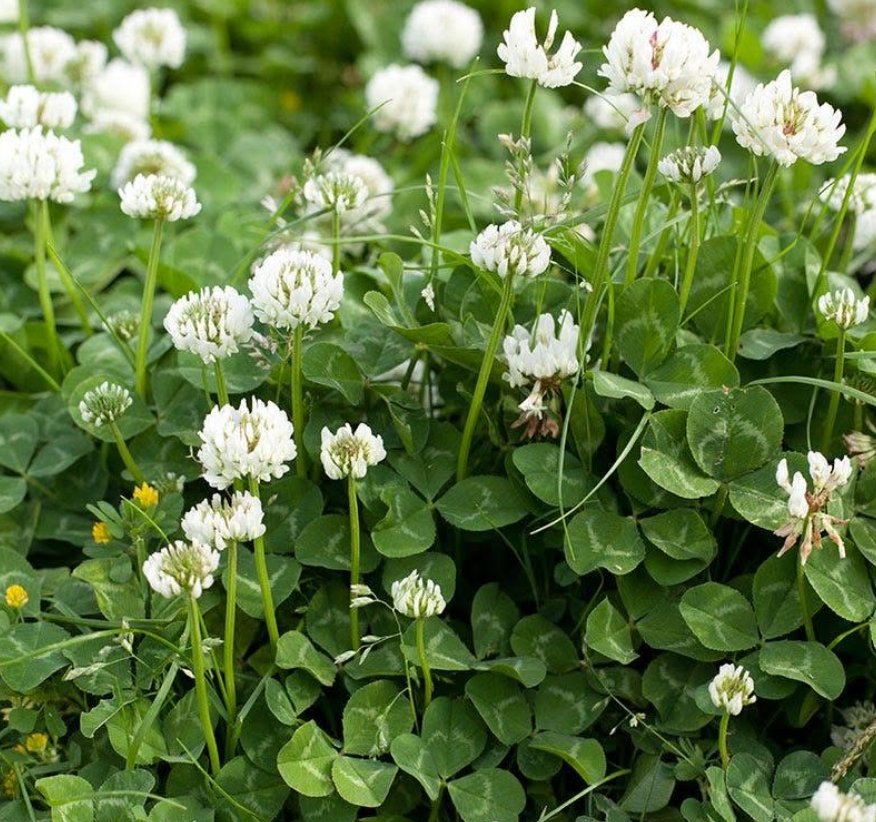
White clover is probably the most recognized lawn weed in North America. Its round, puffy white flower heads sit atop low, creeping stems with the familiar three-part leaves.
It spreads aggressively through stolons, creeping stems that root wherever they touch soil, allowing a single plant to cover a wide patch of lawn within a season. Many older turf seed mixtures actually included it intentionally before its weed status changed.
White clover fixes nitrogen in the soil, which is genuinely beneficial for surrounding grass. Still, most homeowners consider it undesirable in a manicured lawn, partly because its flowers attract bees, increasing the risk of stings for bare feet.
2. Common Chickweed (Stellaria media)
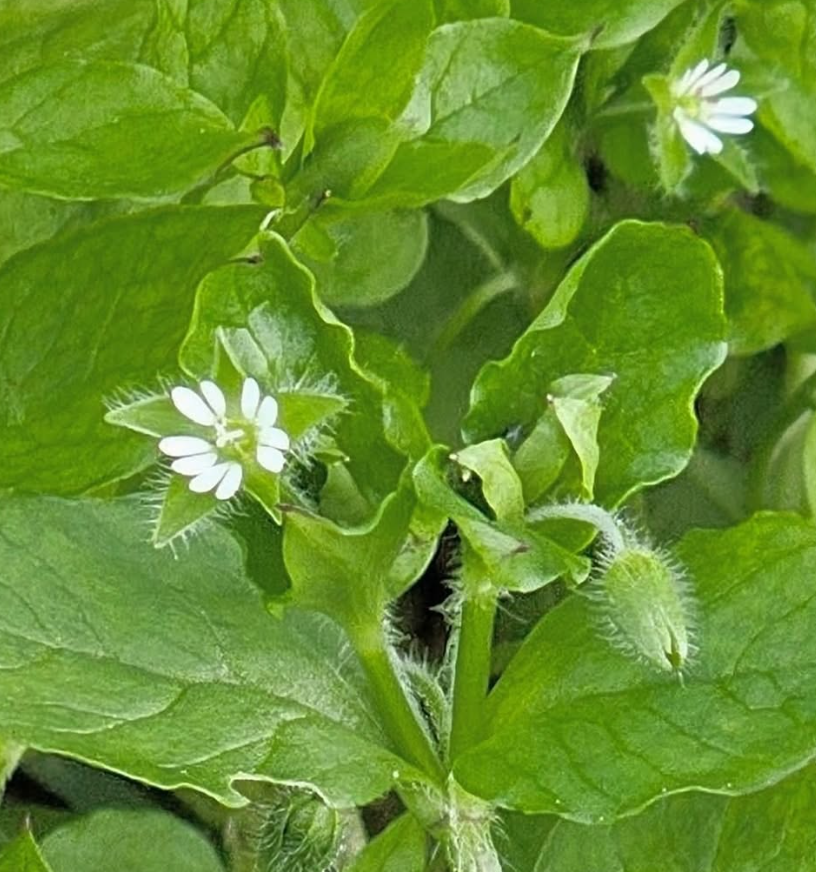
Common chickweed forms low, sprawling mats with small, star-shaped white flowers that look like they have ten petals but actually have just five, each deeply notched down the middle.
It thrives in cool, moist conditions and often appears first thing in spring or during mild autumn weather, when most other weeds are dormant. I’ve noticed it filling bare garden patches almost overnight after a rainy week.
Chickweed is a prolific seed producer, and a single plant can produce thousands of seeds in one growing season. It is edible and has a long history of use in salads, which somewhat softens its reputation as a nuisance.
3. Mouse-Ear Chickweed (Cerastium fontanum)
Mouse-ear chickweed looks similar to common chickweed but has small, fuzzy, hairy leaves that genuinely resemble tiny mouse ears, which is exactly where the name comes from.
Its white flowers measure roughly a quarter-inch across, with five deeply notched petals creating a cupped, almost star-like shape. The plant forms dense mats that spread steadily through thin or weak turf.
Unlike its smoother cousin, mouse-ear chickweed is a perennial, meaning it returns year after year from the same root system rather than relying purely on reseeding. This makes it noticeably harder to eliminate permanently.
4. Queen Anne’s Lace (Wild Carrot)
Queen Anne’s lace produces large, flat-topped clusters of tiny white flowers, technically called umbels, that many people genuinely find ornamental. It’s the wild ancestor of the cultivated carrot, sharing the same species name.
It commonly grows along roadsides, in ditches, and in disturbed soil throughout the growing season. I always look for the single dark purple floret often found at the very center of the flower cluster, a helpful identification trick.
Here’s the caution: Queen Anne’s lace closely resembles poison hemlock and water hemlock, two genuinely dangerous plants. Never harvest wild carrot for food unless you are completely certain of the identification, since misidentifying it can be fatal.
5. Poison Hemlock (Conium maculatum)
Poison hemlock is one of the most important plants on this list to learn, purely for safety reasons. It was originally introduced to North America from Europe as an ornamental and has since spread into nearly every U.S. state.
The plant typically grows six to eight feet tall with smooth, ridged stems marked by distinctive purple spots, a key identifying feature that separates it from similar-looking plants like cow parsnip. Its white flowers form umbrella-shaped clusters.
Every part of poison hemlock is toxic if ingested, including the fern-like leaves that some mistake for wild parsley. The fleshy white taproot even smells faintly like carrots, which has led to tragic poisoning cases over the years.
6. Water Hemlock (Cicuta species)
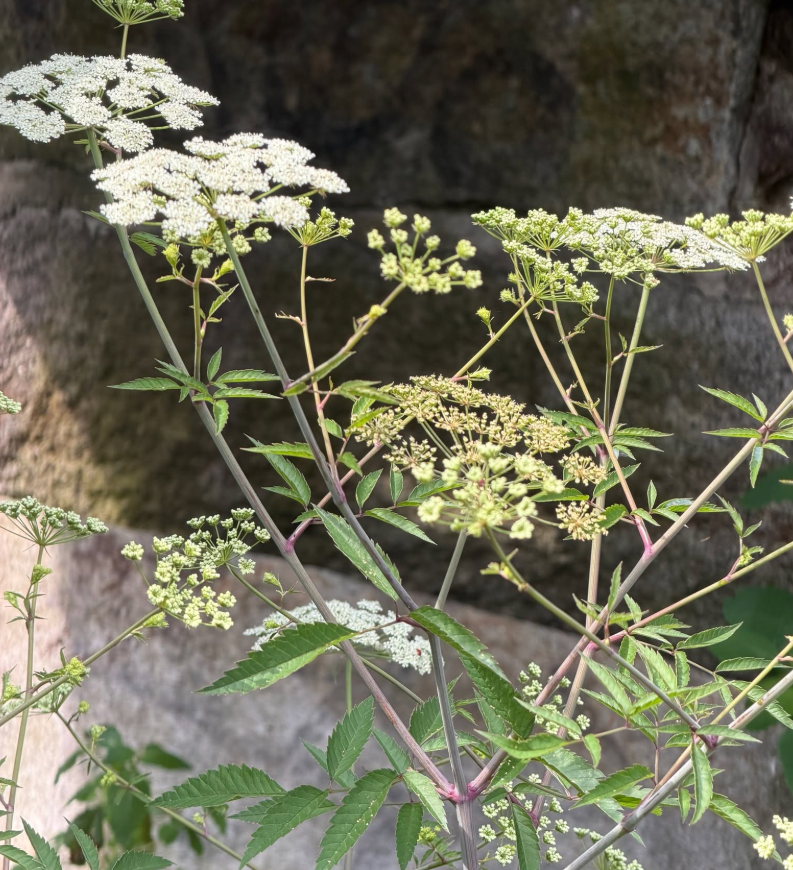
If poison hemlock is dangerous, water hemlock is worse. According to the USDA, it is described as the most violently toxic plant in North America, capable of causing seizures, convulsions, and death within fifteen minutes of ingestion.
It grows in wet, marshy areas, along ditch banks, streams, and irrigation canals, typically reaching three to seven feet tall. Its white flowers form the same umbrella-shaped clusters seen in poison hemlock and Queen Anne’s lace, making careful identification essential.
Washington State University Extension notes that a piece of water hemlock root no larger than a walnut can kill a mature cow. If you find this plant on your property, especially near livestock or grazing land, professional removal is strongly recommended.
7. Field Bindweed (Convolvulus arvensis)
Field bindweed produces funnel-shaped white to pale pink flowers, roughly one inch wide, on twining vines that climb over fences, crops, and other plants. It’s often called perennial morning glory, and the resemblance is obvious.
What makes it genuinely difficult to manage is its root system. University of Nevada Extension reports that field bindweed roots can extend 20 to 30 feet laterally, with vertical roots reaching depths of 20 feet or more in favorable soil.
Even more frustrating, its seeds can remain viable in soil for up to 50 years, according to multiple extension sources. A single plant may produce hundreds of seeds annually, so eradication genuinely requires years of persistent management.
8. Hedge Bindweed (Calystegia sepium)
Hedge bindweed looks similar to field bindweed but produces noticeably larger, trumpet-shaped white flowers, sometimes with faint pink stripes, and generally has larger, more heart-shaped leaves.
It climbs aggressively over shrubs, fences, and garden structures, sometimes smothering desirable plants entirely within a single growing season. I’ve watched it swallow an entire tomato cage in just a few weeks of warm, wet weather.
Unlike field bindweed, hedge bindweed lacks the two small bracts positioned just below the flower, which is the easiest way to tell the two species apart in the field. Both spread through rhizomes and are notoriously difficult to eliminate.
ALSO READ: 25 Types of Lawn Weeds (With Photos, and Expert Control Tips)
9. Shepherd’s Purse (Capsella bursa-pastoris)
Shepherd’s purse gets its name from its distinctive seed pods, shaped like small, flattened purses or hearts, that form after its tiny four-petaled white flowers fade. The flowers themselves are unremarkable, but the seed pods make identification easy.
It’s a winter annual, meaning it germinates in fall, survives winter as a low rosette, then flowers rapidly once spring arrives. This life cycle allows it to complete its reproduction before most gardeners even notice it.
Shepherd’s purse thrives in disturbed soil, garden beds, and cultivated fields worldwide. It’s actually edible and has a long history of culinary and medicinal use in various cultures, though most gardeners simply pull it as a nuisance.
10. Hairy Bittercress (Cardamine hirsuta)
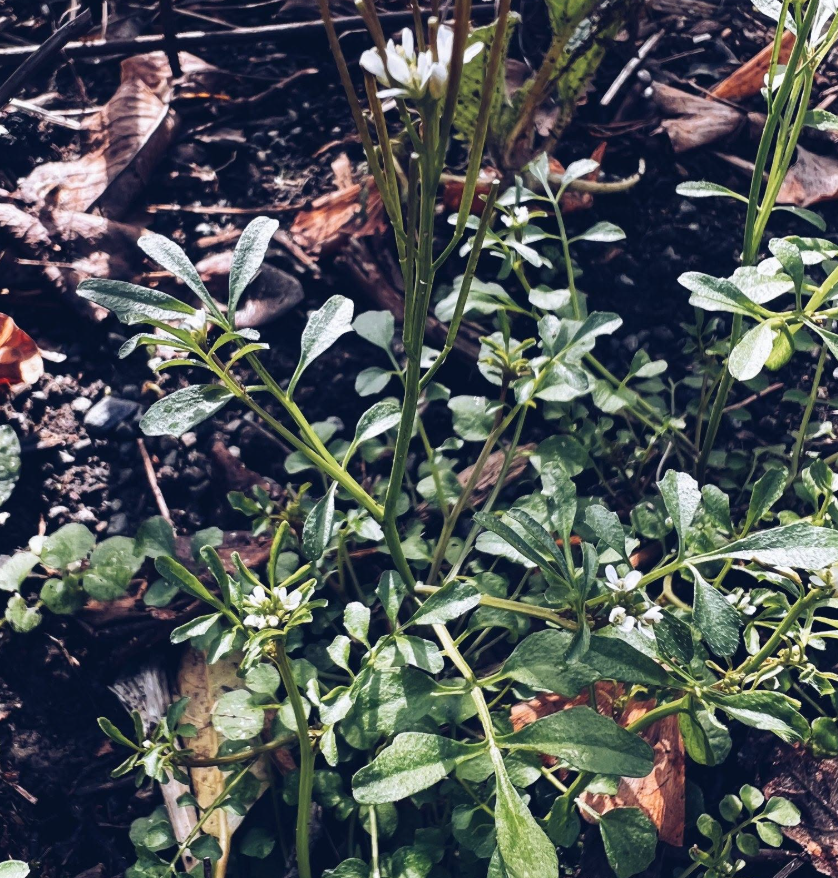
Hairy bittercress is a small winter annual with tiny white flowers arranged in loose clusters atop thin stems, rising above a low rosette of rounded leaves. It rarely grows taller than eight inches.
The real challenge with this weed is its seed dispersal mechanism. Ripe seed pods burst explosively when touched, launching seeds several feet away, which allows it to colonize new ground remarkably quickly through nursery pots, mulch, and garden beds.
It germinates readily in cool, moist conditions, often appearing in late winter or early spring before most other weeds. Regular hand-pulling before flowering is genuinely the most effective control, since removing it after seed pods form only spreads the problem.
11. Oxeye Daisy (Leucanthemum vulgare)
Oxeye daisy produces the classic daisy flower most people picture immediately, white petals surrounding a bright yellow central disk, on stems roughly one to two feet tall. It’s genuinely attractive, which explains why it was originally introduced as an ornamental.
Despite its charm, oxeye daisy is classified as a noxious weed in several U.S. states because of how aggressively it spreads in pastures and rangeland. It reduces forage quality for livestock and can form dense monocultures that crowd out native grasses.
A single plant can produce over 26,000 seeds in its lifetime, and those seeds remain viable in soil for years. It spreads both by seed and through shallow, creeping rhizomes, making mechanical control alone insufficient in most established infestations.
12. Common Yarrow (Achillea millefolium)
Common yarrow produces flat, dense clusters of small white flowers atop feathery, fern-like foliage that releases a distinctive aromatic scent when crushed. It typically grows one to three feet tall.
Native to North America, yarrow has a long history of medicinal use, historically applied to wounds to help stop bleeding, which is where its old nickname “soldier’s woundwort” originates. Many gardeners now grow it intentionally rather than treating it as a weed.
It spreads through rhizomes and self-seeding, tolerating drought, poor soil, and neglect exceptionally well. In lawns, it can form dense patches that outcompete turf grass, which is where its reputation as a weed genuinely comes from.
ALSO READ: 15 Weeds That Look Like Grass: How to Identify and Deal With Each One
13. White Campion (Silene latifolia)
White campion produces delicate, five-petaled white flowers with noticeably notched tips, opening in the evening and releasing a faint fragrance that attracts night-flying moths for pollination.
The plant typically grows one to three feet tall with slightly sticky, hairy stems and leaves. It’s a biennial or short-lived perennial, often found along roadsides, field edges, and disturbed waste areas throughout much of North America.
It readily hybridizes with its close relative, red campion, in areas where both species overlap. This genetic mixing has made pure white campion populations increasingly difficult to identify with certainty in some regions.
14. Bladder Campion (Silene vulgaris)
Bladder campion is easily recognized by its inflated, papery calyx, the balloon-like structure behind each flower, which gives the plant its common name. White petals, deeply cleft into two lobes, emerge from this distinctive pouch.
It’s a perennial that spreads through both seed and creeping rhizomes, often forming loose colonies in meadows, pastures, and along roadsides. The young shoots are actually edible and have been used in Mediterranean cuisine historically.
Bladder campion tolerates poor, dry soil exceptionally well, which allows it to establish in areas where more demanding plants struggle. It rarely becomes a serious agricultural problem but can be persistent in ornamental beds.
15. Canada Horseweed (Marestail)
Canada horseweed, also called marestail, is a tall, upright annual that can reach heights of six feet or more, topped with small clusters of inconspicuous white to greenish flowers along branching stems.
It has become a significant concern in agricultural fields because certain populations have developed resistance to glyphosate, one of the most widely used herbicides in modern farming. This resistance has forced many growers to change their weed management strategies entirely.
A single plant can produce well over 200,000 seeds, which are lightweight and easily carried by wind over considerable distances. Early detection and control before flowering genuinely matters, since mature plants become substantially harder to manage.
16. Daisy Fleabane (Erigeron annuus)
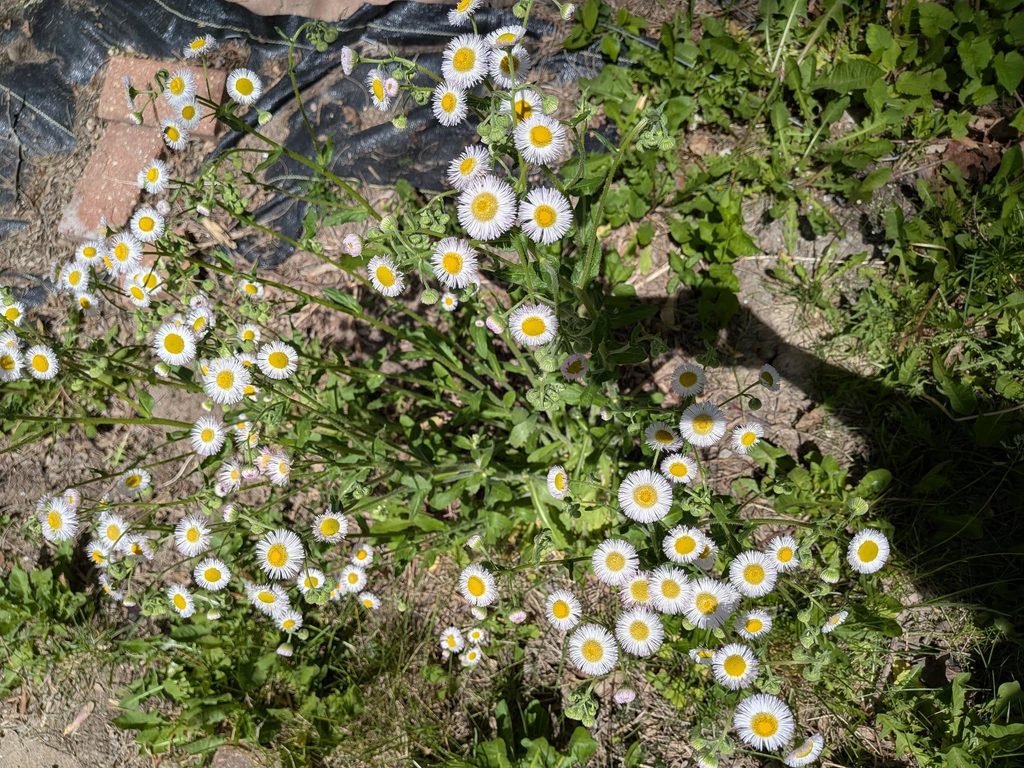
Daisy fleabane produces small, daisy-like flowers with thin, thread-like white petals surrounding a yellow center, blooming in loose clusters atop branching stems that typically reach two to five feet tall.
It’s an annual or biennial native to North America, commonly found in fields, roadsides, and disturbed areas. The name “fleabane” comes from an old belief that dried plants could repel fleas, though modern evidence for this is limited.
Fleabane is genuinely valuable to pollinators, attracting a wide range of bees, moths, and butterflies throughout its bloom period. Many gardeners now tolerate or even encourage it in wildflower borders rather than removing it entirely.
17. Common Boneset (Eupatorium perfoliatum)
Common boneset produces dense, flat-topped clusters of small white flowers in late summer through early fall, rising above distinctive leaves that appear to be pierced directly through by the stem.
It thrives in wet conditions, including soils that remain consistently moist, making it common along stream banks, wet meadows, and low-lying areas. This tolerance for wet ground sets it apart from many other weeds on this list.
The plant earned its name from historical use in treating dengue fever, sometimes called “breakbone fever,” rather than any connection to actual broken bones. It remains a valuable late-season nectar source for pollinators preparing for colder weather.
18. White Snakeroot (Ageratina altissima)
White snakeroot produces clusters of small, fluffy white flowers in late summer and fall, typically growing two to four feet tall in shaded woodland edges, fence rows, and disturbed forest understories.
This plant carries real historical significance and danger. It contains a toxin called tremetol, and in the early 1800s, it caused “milk sickness,” a poisoning that killed thousands of settlers, including Abraham Lincoln’s own mother, after consuming milk from cows that had grazed on it.
Modern dairy practices have largely eliminated this risk, since milk is now pooled from many animals, diluting any contamination. Still, the plant remains toxic to livestock and should be removed from pastures whenever it’s identified.
ALSO READ: 15 Weeds That Look Like Hollyhocks (Spot The Difference)
19. Wild Garlic (Allium vineale)
Wild garlic produces clusters of small white to greenish flowers, often mixed with small bulbils, atop tall, hollow, grass-like stems that release a strong garlic or onion smell when crushed or mowed.
It’s a persistent perennial that spreads through underground bulbs and above-ground bulbils, making it notoriously difficult to eliminate through mowing alone. In fact, mowing can actually spread the bulbils and worsen an infestation.
Wild garlic is a common problem in lawns and pastures, particularly because livestock that graze on it can produce milk with an off-flavor. Its persistent, waxy leaf coating also makes it resistant to many standard herbicide treatments.
20. American Pokeweed (Phytolacca americana)
American pokeweed is a large, robust perennial that can reach heights of four to ten feet in a single growing season, with reddish-purple stems and clusters of small white flowers that later develop into deep purple berries.
Every part of this plant, roots, leaves, stems, and unripe berries, contains toxic compounds that can cause serious illness if ingested. Despite this, young shoots have historically been prepared as “poke sallet” after extensive boiling, though this practice carries genuine risk.
Birds readily eat the ripe berries and spread seeds widely across the landscape, which explains why pokeweed frequently appears unexpectedly along fence lines, garden edges, and disturbed ground near wooded areas.
21. Broadleaf Plantain (Plantago major)
Broadleaf plantain forms a low rosette of wide, oval leaves with prominent parallel veins, from which rise thin, upright spikes covered in tiny, inconspicuous greenish-white flowers.
It’s remarkably tolerant of foot traffic and compacted soil, which explains why it thrives in walkways, driveways, and heavily used lawn areas where grass often struggles to survive. I’ve seen it flourish in gravel paths that seem almost inhospitable to plant life.
Plantain has a long tradition of medicinal use, particularly for soothing insect bites and minor skin irritations when leaves are crushed and applied topically. Many herbalists still value it highly despite its weedy reputation among lawn purists.
22. English Plantain (Narrowleaf Plantain)
English plantain, also called narrowleaf plantain, has long, lance-shaped leaves and produces a distinctive flower spike topped with a dense ring of tiny white stamens encircling a brownish central cone.
Like its broadleaf relative, it tolerates compacted, poor-quality soil exceptionally well, making it a common sight in lawns, pastures, and roadsides across most of North America and Europe.
It spreads primarily by seed, with each plant capable of producing thousands over a single season. Regular mowing can reduce flowering and seed production somewhat, but the low-growing rosette often survives beneath the mower blade entirely.
23. Whitlow-grass (Draba verna)
Whitlow-grass is a tiny winter annual, often among the very first plants to bloom each spring, sometimes pushing up through late frost. Its small white flowers have four deeply notched petals that can appear as eight at first glance.
The entire plant rarely grows more than a few inches tall, with leaves arranged in a flat rosette close to the ground. Rutgers Cooperative Extension notes it is not considered a serious weed in any major cropping situation.
Because of its small size and early bloom time, many gardeners never notice it at all. It completes its entire life cycle quickly, setting seed and dying back well before summer heat arrives.
24. Virginia Pepperweed (Lepidium virginicum)
Virginia pepperweed produces tall, slender spikes covered in tiny white four-petaled flowers, followed by small, flattened, round seed pods that give the plant a distinctive, almost decorative texture later in the season.
It’s native to North America and commonly found in disturbed soil, roadsides, and neglected garden beds. The leaves have a peppery, mustard-like flavor, which has led to occasional culinary use in salads and garnishes.
This weed reproduces prolifically by seed, with a single plant capable of producing thousands of seeds in one growing season. It germinates readily in both fall and spring, giving it two potential windows to establish each year.
ALSO READ: 35 Beautiful Poisonous Flowers (Stunning Yet Deadly Blooms)
25. Wild Radish (Raphanus raphanistrum)
Wild radish produces four-petaled flowers that can appear white, pale yellow, or lavender, often with distinctive purple veining running through each petal, making individual plants surprisingly variable in appearance.
It’s considered a significant agricultural weed in many regions, particularly in cereal grain crops, where it competes aggressively for nutrients, water, and sunlight. Its rapid growth rate allows it to outcompete slower-establishing crop seedlings.
The seed pods are segmented and break apart at maturity, each segment containing one or more seeds that can remain viable in soil for several years. This staggered germination pattern makes complete eradication a genuinely multi-year effort.
26. Garlic Mustard (Alliaria petiolata)
Garlic mustard produces small clusters of white, four-petaled flowers atop upright stems, with heart-shaped, toothed leaves that release a distinct garlic smell when crushed, hence the common name.
This biennial plant is considered one of the most aggressive invasive species in North American forests. It releases chemicals into the soil that suppress the growth of native tree seedlings and fungi, disrupting entire woodland ecosystems over time.
A single plant can produce hundreds of seeds, which remain viable in soil for several years. Many conservation organizations now organize volunteer pulling events specifically targeting garlic mustard before it sets seed each spring.
27. White Sweet Clover (Melilotus albus)
White sweet clover is a tall, branching biennial that can reach six feet or more, covered in long, slender spikes of small white flowers that release a sweet, hay-like fragrance, particularly noticeable when the plant is cut or dried.
It was originally introduced as a forage and cover crop, valued for its nitrogen-fixing ability and drought tolerance. Unfortunately, it has since escaped cultivation and now spreads aggressively along roadsides, prairies, and disturbed grasslands.
The plant contains coumarin, a compound that can convert to a dangerous anticoagulant in improperly cured hay, posing a genuine risk to livestock that consume spoiled feed. This makes proper hay management essential wherever sweet clover grows in pastures.
28. Common Mallow (Cheeseweed)
Common mallow, often nicknamed cheeseweed, produces small, pale pinkish-white flowers with delicate purple veining, blooming from low, sprawling stems with rounded, scalloped leaves.
It gets its nickname from the small, round, segmented seed pods that resemble tiny wheels of cheese. Children in many regions have snacked on these mild, slightly nutty pods for generations, which adds a curious charm to an otherwise unremarkable weed.
Common mallow develops a surprisingly deep taproot for such a low-growing plant, which makes hand-pulling difficult once it’s established. It tolerates poor, compacted soil exceptionally well, often thriving in cracks along sidewalks and driveways.
29. Prostrate Knotweed (Polygonum aviculare)
Prostrate knotweed forms dense, wiry mats that hug the ground closely, producing tiny white to pinkish flowers tucked into the leaf axils along its jointed, wire-like stems.
It’s exceptionally tolerant of compacted soil and heavy foot traffic, which is why it commonly appears in the exact spots where lawns struggle most, along paths, driveway edges, and heavily trafficked play areas.
This weed germinates very early in spring, often before soil has fully warmed, giving it a head start over surrounding grass. Improving soil compaction through aeration is generally more effective long-term than repeated herbicide applications alone.
30. Japanese Knotweed
Japanese knotweed produces large, showy plumes of small creamy-white flowers in late summer, rising from tall, bamboo-like hollow stems that can reach heights of eight to ten feet in a single season.
This plant is considered one of the world’s most invasive species, capable of growing through concrete, asphalt, and building foundations. Its aggressive rhizome system can extend many feet from the visible plant, making complete removal an extraordinarily difficult, often multi-year project.
Several U.S. states and UK regulations now specifically restrict its sale, transport, or disposal because of the ecological and structural damage it causes. If found on a property, professional consultation is genuinely worth the investment before attempting removal yourself.
31. Feverfew (Tanacetum parthenium)
Feverfew produces small, daisy-like flowers with short white petals surrounding a yellow center, blooming abundantly atop aromatic, finely divided foliage that releases a distinct bitter scent when brushed against.
Originally cultivated for its medicinal properties, particularly for migraine relief, feverfew has since naturalized widely and now self-seeds readily in garden beds, waste areas, and along fence lines throughout temperate regions.
It’s generally considered a mild weed rather than a serious threat, and many gardeners actually welcome it for its cheerful appearance and continued medicinal reputation. Its main downside is a tendency to spread more freely than intended once established.
32. English Lawn Daisy (Bellis perennis)
English lawn daisy produces small, classic white flowers with yellow centers on short stems, rarely reaching more than a few inches tall, which allows it to bloom happily even in frequently mowed lawns.
It forms low rosettes that hug the ground closely, making it remarkably resilient against mowing compared to taller weeds that simply get cut back before flowering. This low profile is exactly why it persists in even the most manicured lawns.
Many European gardeners actually tolerate or encourage lawn daisies for their cheerful appearance, while American homeowners more often treat them as an unwanted intrusion. Either way, they’re generally harmless and pose no toxicity concerns.
33. Wild Strawberry (Fragaria virginiana)
Wild strawberry produces small, five-petaled white flowers with bright yellow centers, followed by tiny, sweet red berries that are genuinely edible, though considerably smaller than cultivated garden strawberries.
It spreads through both seed and runners, forming low, spreading mats of three-part leaves that can gradually fill in bare patches of lawn or garden bed. I’ve always found it one of the more pleasant “weeds” to discover unexpectedly.
Native to much of North America, wild strawberry supports local pollinators and provides food for birds and small wildlife. Most gardeners tolerate it far more readily than other spreading weeds, given its edible fruit and attractive appearance.
34. Meadow Death Camas
Meadow death camas produces spikes of small, star-shaped white to cream flowers rising from grass-like leaves, closely resembling wild onion or edible camas in general appearance, which is precisely what makes it dangerous.
Every part of this plant is highly toxic to both humans and livestock, containing alkaloids that can cause severe illness or death if ingested in sufficient quantity. It’s frequently confused with edible camas species, leading to accidental poisonings among foragers.
It typically grows in meadows, open woodlands, and rangeland across western North America. Ranchers in affected regions monitor pastures closely for this plant, since livestock losses from death camas remain a genuine seasonal concern in some areas.
35. Spotted Spurge (Euphorbia maculata)
Spotted spurge forms low, prostrate mats with small oval leaves, each often marked with a distinctive reddish-purple spot, and produces tiny, inconspicuous white to pink flowers tucked along its reddish stems.
It thrives in hot, dry conditions and readily colonizes cracks in pavement, gravel driveways, and thin, stressed turf where competition from grass is minimal. The plant exudes a milky sap when broken, which can mildly irritate skin in sensitive individuals.
Spotted spurge germinates in warm soil and can complete its entire life cycle, from germination to seed production, in just a matter of weeks. This rapid cycle allows multiple generations to emerge within a single growing season if left unmanaged.
Which of These Weeds Are Toxic?
- Extremely dangerous: Water hemlock, poison hemlock, meadow death camas
- Toxic if ingested in quantity: American pokeweed, white snakeroot, white sweet clover (spoiled hay)
- Mild skin irritation possible: Spotted spurge
- Generally safe, some edible: White clover, common chickweed, common mallow, wild strawberry, shepherd’s purse
I’d encourage extra caution with any plant resembling Queen Anne’s lace, since it shares its family and general appearance with two of the deadliest plants on this entire list.
Final Thoughts
Most weeds with white flowers are simply persistent, not dangerous. Clover, chickweed, and daisies are annoying at worst, and honestly, some of them add a quiet, wild charm to an otherwise uniform lawn.
A small number, though, genuinely deserve respect and careful identification, particularly anything resembling wild carrot growing near water, pastures, or areas frequented by children and pets.
When in doubt about a specific plant, your local extension office is genuinely the best resource available. They can often identify a species from a clear photo and advise on safe, effective removal specific to your region.
References
- University of Nevada, Reno Extension – Water Hemlock and Poison Hemlock Identification
- University of Nevada, Reno Extension – Managing Field Bindweed
- Oregon State University Extension Service – Poison Hemlock and Western Waterhemlock: Deadly Plants May Be Growing
- Washington State University Extension – Field Bindweed
- University of Nebraska–Lincoln CropWatch – Nebraska Invasive Weed: Field Bindweed
- Rutgers Cooperative Extension – Weed Identification Gallery
- University of Maryland Extension – Weed Identification Resource Library

Tim M Dave is a gardening expert with a passion for houseplants, particularly cacti and succulents. With a degree in plant biology from the University of California, Berkeley, he has vast experience in gardening. Over the years, he has cultivated a vast collection of desert plants and learned a great deal about how to grow and care for these unique companions.