35 Types of African Violets (Plant Details, With Pictures)
African violets look simple at first glance. A rosette of fuzzy leaves, a cluster of small flowers, done.
Spend a little time inside the hobby, though, and the picture changes fast. Growers currently register thousands of named varieties, built from just a handful of wild ancestors.
I have grown a few of these over the years, and I still find it surprising how differently two plants can look while carrying the same species name in their background.
This guide organizes 35 types of African violets into categories that actually help you shop, grow, and identify plants with confidence: wild species, growth habits, leaf types, flower forms, and color patterns.
Wild Species: Where Every African Violet Began
1. Streptocarpus ionanthus (formerly Saintpaulia ionantha)
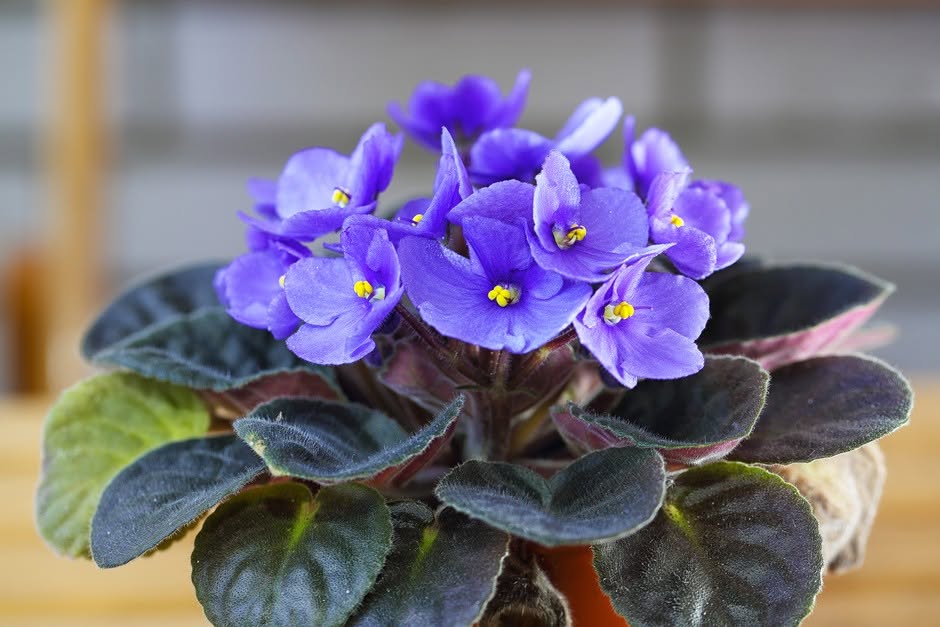
This is the original species, discovered in 1892 by Baron Walter von Saint Paul in the Usambara Mountains of what is now Tanzania.
Nearly every modern hybrid traces its ancestry back to this single wild plant, which explains why “ionantha,” meaning violet-like in Latin, still shows up constantly in catalog names.
In the wild, this species grows in the humid understory of montane forests, tucked into rock crevices where roots stay cool and shaded even as leaves catch filtered light.
The original flowers were a simple violet-blue, five petals arranged around a small yellow center, with rounded, hairy leaves that barely resemble the ruffled, patterned foliage bred decades later.
This is the parent plant behind the light and watering guidance still used today. Because it evolved under a dense canopy, modern hybrids inherit that same preference for bright but indirect light.
ALSO READ: African Violets Cultivation: How to Grow These Beauties in Your Home
2. Streptocarpus confusus (formerly S. confusus)
Alongside S. ionantha, this species forms the genetic backbone behind most commercial African violet cultivars sold today.
Nearly all modern hybrids descend from hybridizing just these two wild species, a fact that still surprises new growers given how varied today’s cultivars look.
S. confusus tends to bloom in pale lavender or light violet tones, and its flowers sit slightly higher above the foliage than the deeper-toned S. ionanthus.
Early hybridizers crossed the two species specifically to combine flower color depth with a fuller, tighter growth habit, a pairing that essentially launched the modern African violet industry.
Its genetic contribution shows up today mainly in flower substance and stem strength, traits that helped later cultivars hold blooms upright instead of drooping.
3. Streptocarpus pusillus (formerly Saintpaulia pusilla)
This is often cited as the rarest African violet species in existence, found only on a few Tanzanian mountains.
It grows on shaded, moss-covered rocks at elevations between roughly 1,300 and 1,500 meters, a genuinely narrow habitat window that makes wild populations vulnerable.
Adolf Engler first described the species back in 1900, and for decades afterward, botanists could only confirm it growing at a single site on two of those mountain ranges.
The plant itself stays remarkably small, with tiny leaves and correspondingly tiny pale flowers, nothing like the showy blooms most people associate with African violets.
Its diminutive size has made it a quiet but valuable genetic resource for breeders chasing ever-smaller micro-miniature cultivars.
4. Streptocarpus shumensis
Native to the Shume-Magamba forest region of Tanzania, this species contributed genetic material valued for its compact growth habit.
Breeders have used it selectively to develop smaller, tidier hybrid forms over the decades.
The Shume-Magamba forest sits at a relatively high elevation, and plants growing there have adapted to cooler nights and consistently high humidity, conditions quite different from a typical living room.
Leaves tend to stay smaller and more tightly packed than those of the more widespread S. ionanthus, giving the whole rosette a neater, denser silhouette.
That naturally tidy growth habit is exactly why hybridizers kept returning to this species when compact plants became fashionable among collectors.
5. Streptocarpus teitensis
This species grows in the Taita Hills of Kenya, outside the core Tanzanian range shared by most other wild African violets.
Its geographic isolation makes it botanically significant, even though it rarely appears in commercial cultivation.
Because the Taita Hills sit apart from the Usambara and Uluguru ranges where most other species cluster, S. teitensis evolved on something of its own botanical island.
Researchers studying the genus rely on species like this one to map how African violets spread and diversified across East Africa over geological time.
You are unlikely to ever find this species for sale, but its existence helps explain why taxonomists keep revising the family tree behind the plants sitting on your windowsill.
6. Streptocarpus grotei
Grotei is a trailing wild species, distinct from the compact rosette habit typical of most other Saintpaulia relatives.
This species sits behind nearly every trailing African violet cultivar available today, making it one of the more commercially influential wild ancestors.
Instead of forming one tight rosette, S. grotei produces multiple crowns along a lengthening stem, each capable of rooting and spreading further if left to trail naturally.
Its leaves also tend to run larger and more elongated than typical rosette-forming species, an adaptation suited to scrambling along shaded forest banks.
Hybridizers noticed this growth pattern early on and used it deliberately to create the cascading, basket-friendly plants trailing enthusiasts collect today.
Growth Habit Types: Sorting by Size
7. Standard African Violet
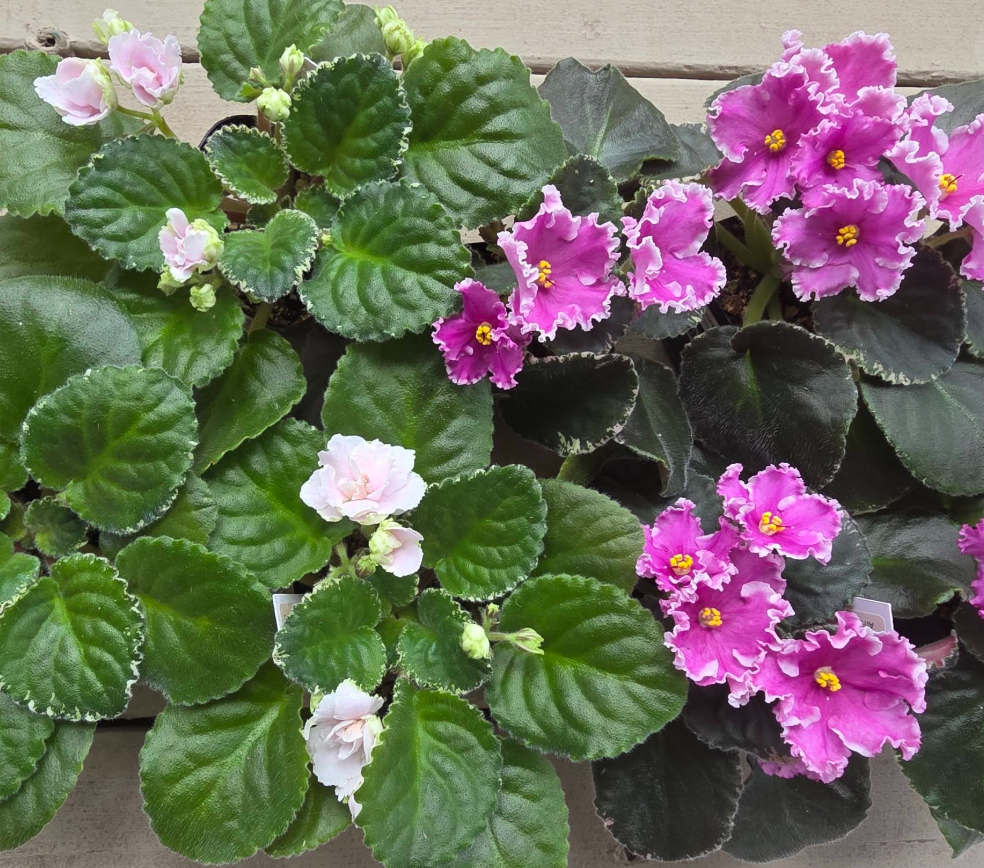
Standard varieties form rosettes measuring 8 to 16 inches wide, according to University of Minnesota Extension plant sizing guidelines.
This is the classic size most people picture, and it remains the most widely available category in garden centers.
A mature standard usually sits comfortably in a 4 to 6 inch pot, with a root system substantial enough to support several flower flushes per year without constant repotting.
Because they have been in cultivation the longest, standards also offer the widest possible selection of leaf types, flower forms, and colors, essentially every category on this list overlaps most heavily here.
For a first-time grower, a standard plant tends to forgive minor watering or lighting mistakes more readily than smaller, more delicate categories.
8. Miniature African Violet
Miniature types stay under roughly 8 inches wide, fitting neatly onto crowded windowsills without overwhelming the space.
Collectors often favor minis because a single shelf can hold far more plants than standard varieties allow.
These plants typically grow well in 2 to 2.5 inch pots, and their smaller root systems mean they dry out faster than standards, so watering schedules usually need closer attention.
Flower size scales down along with the plant, but bloom count per rosette often stays surprisingly high relative to the plant’s overall footprint.
Many miniature lines were developed specifically for indoor light gardens, where consistent artificial lighting supports their tighter, more compact growth habit.
9. Semi-Miniature African Violet
Semi-miniatures sit between miniature and standard sizing, offering a middle ground for growers who want compact plants with slightly larger blooms.
This category has grown in popularity precisely because it balances manageable size with a fuller flower display.
A 3 inch pot usually suits a semi-miniature plant well, striking a practical balance between root space and overall footprint.
Show growers frequently favor this category because it tends to produce a fuller, more symmetrical rosette than true miniatures, without demanding the larger footprint of a standard.
If you are working with limited windowsill space but still want a generous bloom show, semi-miniatures often hit that sweet spot better than any other size class.
10. Micro-Miniature African Violet
Micro-minis push compactness even further, staying extremely small and slow-growing.
These are specialist plants, usually sought out by dedicated collectors rather than casual houseplant buyers.
Mature rosettes often stay under three inches across, small enough that several plants can share a single small tray under one grow light.
Their tiny root systems leave very little margin for error. Overwatering or letting the mix dry out completely can stress the plant far faster than it would a standard-sized violet.
Because of that sensitivity, most growers recommend micro-minis only after you have successfully kept a standard or semi-miniature plant thriving for at least a full growing season.
11. Large African Violet
Large varieties exceed 16 inches in width, according to extension sizing categories, producing a dramatic, full display when mature.
They demand more shelf space and often more light, but reward growers with an impressive floral show.
A mature large violet often needs a pot in the 5 to 6 inch range or bigger, along with a sturdier saucer to keep the top-heavy rosette from tipping once flowers open in full.
Because of their size, these plants also take noticeably longer to reach full maturity from a leaf cutting than miniature or semi-miniature varieties do.
Growers with sunrooms or dedicated plant rooms tend to gravitate toward large varieties, since a mature specimen can genuinely anchor a display the way a smaller plant simply cannot.
12. Trailing African Violet
Trailing types grow multiple crowns along a spreading or cascading stem, rather than forming a single tight rosette.
These varieties descend largely from trailing wild species and suit hanging baskets far better than standard pots.
Unlike a standard violet, a trailing plant keeps producing new crowns as it grows, and each of those crowns can flower independently once it matures.
Left unpruned, stems can extend well beyond a foot in length, cascading attractively over the edge of a hanging basket or elevated shelf.
Periodic pinching back keeps the plant fuller and encourages branching, since an entirely unpruned trailer can start to look sparse and leggy over time.
Leaf Types: The Overlooked Detail
13. Plain Leaf (“Boy” Leaf)
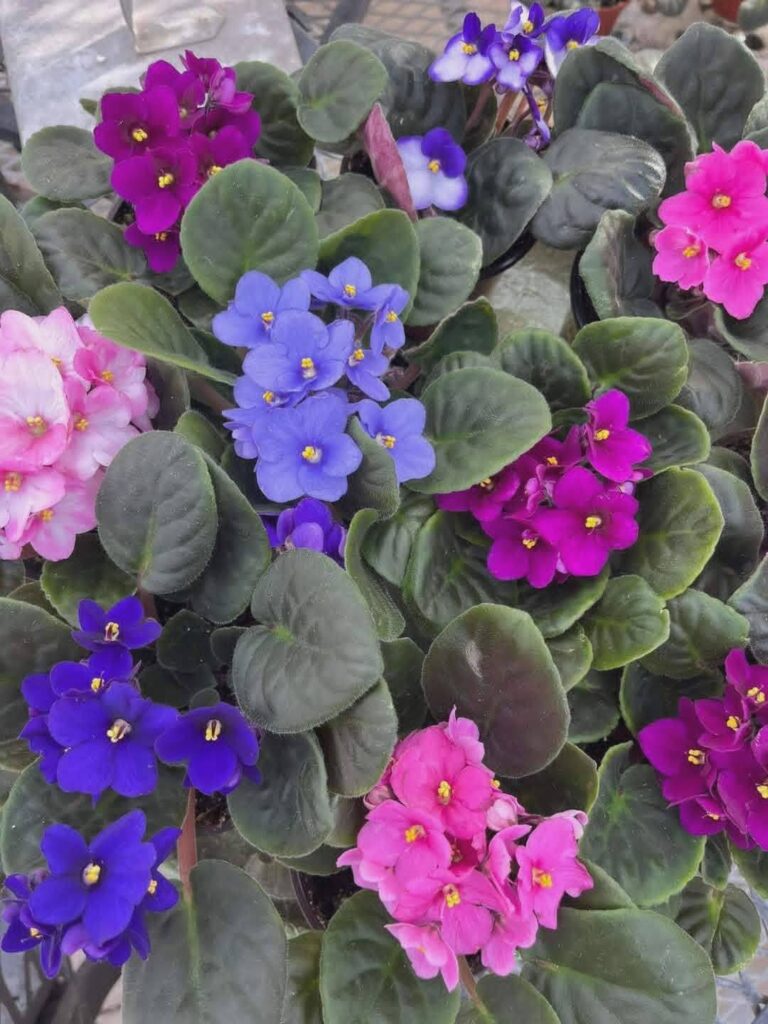
Plain leaves have smooth, unnotched edges and a single solid green color, no variegation involved.
Hobbyists nicknamed this the “boy leaf” decades ago, a term that has stuck within the community despite having nothing to do with actual plant sex.
Genetically, plain leaves are the more stable, predictable trait, which is exactly why so many older and heirloom cultivars still carry this simple foliage type.
Because the leaf lacks any variegation to maintain, plain-leaf plants also tend to propagate more reliably from a single leaf cutting than their patterned counterparts.
For growers who want foliage that stays consistent generation after generation, plain leaf varieties remain the more dependable starting point.
14. Variegated Leaf (“Girl” Leaf)
Variegated leaves show a small notch near the leaf stem, often paired with cream, white, or pink coloring mixed into the green.
This is the counterpart nickname to the plain leaf, and variegation of this type is considered a desirable, collectible trait.
Variegation intensity can shift with light levels and season, so the same plant may show bolder cream patches in bright winter light and appear greener during darker months.
Popular variegated patterns within the hobby include the “Tommie Lou” style, known for its bold, ruffled cream margins, alongside subtler forms that show only faint speckling near the leaf base.
Because variegation depends on maintaining specific cell layers, propagating these leaves sometimes produces plain, non-variegated offspring, which is part of what makes stable variegated lines genuinely prized.
15. Quilted Leaf
Quilted leaves have a raised, puckered surface texture, almost like a padded quilt pattern pressed into the foliage.
This texture appears across many modern hybrids and adds visual interest even when the plant is not in bloom.
The puckering comes from uneven growth rates between the leaf veins and the tissue surrounding them, a trait breeders have selected for purely on visual appeal.
Quilted foliage tends to catch and hold light differently than flat leaves, creating subtle shadows across the rosette that photograph particularly well.
This texture also shows up frequently on show-bench winning plants, since judges often reward foliage with distinct, well-defined character alongside strong flowering.
16. Spooned Leaf
Spooned leaves curve slightly upward at the edges, creating a shallow cupped or spoon-like shape.
Growers often use this trait, along with leaf glossiness, to help identify specific cultivars when tags get lost.
The upward curve happens along the leaf margin, leaving the central portion relatively flat while the edges lift, almost like a shallow bowl turned upside down.
This trait tends to appear more consistently in cooler growing conditions, and some growers notice their spooning becomes less pronounced during hot summer months.
Because the shape is subtle, spooning is easiest to spot by comparing a mature leaf against a younger one still developing near the plant’s center.
17. Ruffled Leaf
Ruffled leaf edges show a wavy, crimped border rather than a smooth outline.
This trait frequently pairs with ruffled flower petals in the same cultivar, giving the whole plant a coordinated frilled appearance.
The wave pattern can range from a barely noticeable crimp to a dramatic, deeply scalloped edge, depending on the specific breeding line involved.
Ruffled-leaf plants often need slightly more careful handling during watering, since the folded leaf edges can trap moisture and encourage spotting if water sits too long.
Despite that extra care, this leaf type remains a hobbyist favorite precisely because it adds texture and movement to an otherwise still, rosette-shaped plant.
18. Glossy Leaf
Glossy-leafed varieties reflect light noticeably more than the typical matte, fuzzy African violet leaf.
This trait tends to appear in specific hybrid lines bred for a more polished, decorative look.
Most African violet foliage carries a fine, velvety layer of hairs, which is what gives standard leaves their soft, matte finish. Glossy varieties simply carry fewer of these hairs.
That reduced hair density can make glossy-leafed plants slightly less prone to water spotting, since droplets slide off more easily instead of sitting trapped against the surface.
Collectors sometimes seek out glossy foliage specifically for display purposes, since the reflective surface tends to show off leaf color and shape with unusual clarity.
19. Pointed or Strap Leaf
Some cultivars produce longer, narrower leaves with a more pointed tip, departing from the classic rounded shape.
This leaf form often accompanies certain trailing and species-influenced hybrids.
Rather than the classic rounded, almost circular outline, strap leaves narrow gradually toward the tip, giving the whole rosette a slightly more open, star-like silhouette.
This trait often signals a closer genetic link back to wild species foliage, since many of the original Streptocarpus ancestors carried longer, less rounded leaf shapes.
Growers sometimes use pointed leaf traits as an identifying clue when trying to trace a modern hybrid’s parentage back toward specific species influence.
Flower Forms: Single, Double, and Beyond
20. Single-Flowered African Violet
Single flowers show one simple layer of five petals, the closest form to the original wild species appearance.
This remains the most common flower type across both older and newer cultivars.
Because there are fewer petal layers to support, single flowers tend to open faster and often produce a higher total bloom count per flush than heavier double forms.
This simplicity also makes single flowers a practical starting point for new growers, since the plant spends less energy building petal density and more on overall vigor.
Many award-winning show plants still carry single flowers, proof that simpler is not automatically less impressive within the hobby.
21. Semi-Double Flowered African Violet
Semi-double blooms carry extra petals beyond the basic five, without forming a fully layered, rounded flower.
Clemson Cooperative Extension notes that double or semi-double rows of petals are available on many newer varieties, reflecting decades of breeding work toward fuller blooms.
Typically, a semi-double bloom carries somewhere around six to ten petals, enough extra fullness to look noticeably richer than a single flower without the dense, packed look of a true double.
This form often strikes the best balance between bloom count and individual flower size, which is part of why so many popular modern cultivars settle here rather than pushing toward full doubles.
Semi-double flowers also tend to hold their shape a bit longer on the plant than fully single blooms, extending that three to six week flowering window mentioned earlier in this guide.
22. Double-Flowered African Violet
Double flowers pack in multiple full layers of petals, creating a dense, rounded bloom that looks almost like a small rose.
These varieties tend to hold their shape and color especially well, which makes them popular for show competitions.
Producing a full double bloom takes considerably more energy from the plant, so double-flowered varieties often bloom in slightly smaller flushes compared to their single or semi-double relatives.
Because the extra petal layers add real weight, double blooms sometimes benefit from slightly stronger stems bred specifically to keep the flowers upright rather than nodding downward.
This is also the form most associated with the classic “African violet as a small rose” comparison, a look many collectors specifically chase when building a display shelf.
23. Star-Shaped Flower
Star-shaped blooms have evenly spaced, pointed petals radiating outward in a distinct star pattern.
This form stands apart clearly from the rounder, softer edges typical of standard single flowers.
The geometric, angular look comes from petals that taper more sharply toward each tip, rather than curving into the soft, rounded outline typical of the species’ original wild form.
This shape reads especially well from a distance, since the sharper points create more visual contrast within a mixed plant display than a softer, rounder bloom would.
Breeders often pair star-shaped petals with bold, saturated colors, since the crisp outline tends to showcase strong pigmentation particularly effectively.
24. Wasp-Type Flower
Wasp-type flowers have narrow, slightly curled petals that create an unusual, almost insect-like silhouette.
This is one of the more distinctive and immediately recognizable flower forms within the hobby.
The name comes from the way the curled, narrowed petals resemble a wasp’s folded wings or narrow body, a resemblance breeders originally treated as a novelty trait.
This form actually traces back to a natural genetic mutation, one that hybridizers deliberately preserved and expanded on once they recognized its unusual visual appeal.
Because the trait is relatively rare, wasp-type cultivars tend to attract dedicated collectors specifically hunting for unconventional flower shapes beyond the typical rounded bloom.
25. Bell-Shaped Flower
Bell-shaped blooms curve inward at the petal tips, forming a cupped, bell-like outline rather than lying flat.
Breeders prize this form for the way it catches light differently than a flat-faced bloom.
Rather than opening flat, each petal curls gently inward, so the flower reads more three-dimensional when viewed from the side than from straight on above the plant.
This cupped structure also tends to protect the flower’s center slightly better from dust and water spotting, a small but genuinely practical side benefit of the shape.
Bell-shaped blooms pair particularly well with deeper, saturated colors, since the curved petal surface creates subtle shading that a flatter flower form simply cannot produce.
26. Fringed or Ruffled Petal Edge
Fringed varieties show a crimped, wavy border along each petal edge, adding texture to the overall flower shape.
This trait often shows up alongside ruffled foliage, giving certain cultivars a fully coordinated frilled look from leaf to flower.
The fringing can vary from a light, barely visible crimp to a heavily ruffled, almost carnation-like edge, depending on the specific cultivar and how mature the bloom is.
Show growers pay close attention to how evenly the fringing distributes around each petal, since uneven ruffling is typically marked down in formal judging standards.
Because this trait adds visual texture without changing the underlying flower structure, it pairs successfully with nearly every other form on this list, from single to fully double blooms.
Color and Pattern Types: Where the Real Variety Shows
27. Blue and Purple African Violet
Blue and violet shades remain the closest link back to the species’ original wild coloring.
Smithsonian Gardens notes that the specific epithet “ionantha” refers directly to this violet flower color, tying the name itself to this shade group.
This color family covers a genuinely wide range, from a pale, almost powdery lavender through medium violet-blue and into deep, near-black purple tones.
Anthocyanin pigments produce this coloring, the same broad pigment family responsible for blue and purple shades across countless other flowering plants.
Because this shade group ties directly back to the species’ natural coloring, it also tends to be the most genetically stable, meaning plants in this range are often easier to propagate true to color from leaf cuttings.
28. Pink African Violet
Pink cultivars range from pale blush to deep rose, and they rank among the most commercially popular color choices after classic purple.
Breeding programs have expanded this shade range considerably over the past several decades.
Pink coloring arose from natural mutations affecting pigment concentration, and early hybridizers who spotted these mutant blooms propagated them carefully to stabilize the trait.
Lighter pink shades tend to show the most noticeable color shift under different light conditions, sometimes appearing almost white under strong artificial lighting and deeper rose-toned in softer natural light.
Because pink pairs so well with both plain and variegated foliage, this color group offers some of the widest cultivar selection outside the original blue-purple family.
29. White African Violet
White varieties offer a clean, neutral option that pairs well in mixed plant displays.
They are also frequently used as a breeding base for developing new bicolor and pastel combinations.
True white blooms lack the anthocyanin pigmentation responsible for every other color group on this list, which is precisely why breeders find them so useful as a genetic starting point.
Crossing a white-flowered plant with a strongly pigmented one often produces offspring showing partial color patterns, a technique that has contributed heavily to today’s bicolor and fantasy varieties.
On their own, white varieties also tend to show off leaf texture and shape more clearly than heavily colored blooms, since there is no strong pigment competing for visual attention.
30. Red and Maroon African Violet
True red remains one of the harder shades to achieve in this genus, so deep maroon and wine-red tones are more common than a pure fire-engine red.
University of Minnesota Extension lists maroon among the recognized standard flower color categories for the species.
The difficulty in reaching true red comes down to pigment chemistry. The anthocyanins available within this species naturally lean toward blue and purple, so red requires stacking multiple genetic factors just to shift the hue that far.
Growers chasing the reddest possible blooms often look for cultivars marketed as “wine,” “burgundy,” or “brick red,” since these tend to be the closest commercially available approximations.
Lighting conditions also affect how red or maroon a bloom appears, with cooler light sometimes pulling the color noticeably toward purple rather than true red.
31. Bicolor African Violet
Bicolor flowers combine two distinct colors on the same bloom, often as a solid petal with a contrasting border.
Clemson Extension specifically describes bicolored flowers with white petals and contrasting purple borders as a well-established, popular pattern.
Beyond the classic white-and-purple combination, bicolor patterns also appear in pink-and-white, blue-and-white, and occasionally red-and-white pairings, depending on the specific breeding line.
This pattern tends to be more genetically stable than fantasy or chimera types, meaning bicolor plants generally propagate true to their pattern from a single healthy leaf cutting.
Because the contrast reads clearly even from a distance, bicolor varieties are a popular choice for growers who want a distinctive look without venturing into rarer, harder-to-source pattern types.
32. Multicolor or “Fantasy” African Violet
Fantasy-patterned blooms display flecks, streaks, or splashes of a second or third color scattered irregularly across the petals.
No two flowers on a fantasy-type plant look perfectly identical, which is exactly why collectors chase these patterns.
Even blooms on the same plant, opening within days of each other, can show noticeably different fleck placement and intensity, adding an element of surprise to every new flush.
Environmental factors like temperature and light can influence how strongly the fantasy pattern expresses itself, so the same cultivar may look bolder in one season and subtler in another.
Because the pattern is genuinely unpredictable, growers often describe fantasy varieties as the most exciting category to watch bloom, since you rarely know exactly what you will get.
33. Chimera African Violet
Chimeras show a distinct, precise pinstripe pattern running from the center of each petal outward to the edge.
This pattern results from a genetic quirk affecting cell layers, and true chimeras can only be propagated through crown division rather than leaf cuttings, since leaf propagation loses the pattern entirely.
The plant’s outer cell layer and inner cell layer carry genetically different instructions for pigment, and the visible pinstripe is essentially where those two layers meet along the petal surface.
Because propagation is so restrictive, genuine chimeras stay relatively rare and often carry a higher price tag than comparable non-chimera cultivars in the same color family.
Collectors sometimes describe hunting for stable, well-defined chimeras as one of the more advanced pursuits within the hobby, precisely because the trait resists easy multiplication.
34. Two-Tone Edge (Geneva-Type) African Violet
Geneva-type blooms show a solid center color with a thin, contrasting band of white or a lighter shade running along the outer petal edge.
This banded edge effect has become one of the most recognizable and consistently popular patterns in the hobby.
The pattern takes its name from the Geneva chapter of an African violet society, where the trait was first stabilized and popularized decades ago among dedicated hybridizers.
Unlike a chimera’s fine pinstripe, the Geneva edge shows as a clean, continuous band, making it noticeably easier to spot even on a plant viewed from several feet away.
This trait also propagates more reliably than chimera patterns, since it does not depend on the same precise cell-layer arrangement, making Geneva-type plants more accessible to everyday collectors.
35. Green-Edged African Violet
A smaller but distinctive group of cultivars shows a subtle green tint along the petal edges, blending floral and foliage tones in one bloom.
This unusual trait tends to appeal most to experienced collectors looking for something beyond standard color categories.
The green tinge typically appears strongest along the outermost edge of each petal, fading back toward the flower’s main color closer to the center.
Because chlorophyll and floral pigments rarely overlap this visibly in most flowering plants, the effect reads as genuinely unusual even to people with no background in African violets specifically.
Growing conditions can influence how pronounced the green edge appears, with cooler temperatures and strong light often intensifying the effect during peak bloom periods.
A Short History Behind the Hobby
The African violet’s story is shorter than most houseplants you will grow, which makes its explosive variety even more striking.
Baron Walter von Saint Paul found the original plant in 1892, roughly an hour from the town of Tanga in what is now Tanzania. He sent seeds back to his father in Germany, who passed them along to a botanist for formal identification.
That botanist, Herman Wendland, recognized the plant as new to science and named the genus after the Saint Paul family, coining “ionantha” from the Latin for violet-like.
Commercial interest followed almost immediately. The plant reached the United States by 1894, just two years after its initial discovery, according to University of Florida IFAS Extension records.
From there, hybridization programs spent the better part of a century exploiting natural mutations, gradually producing the thousands of colors, leaf textures, and flower forms available today.
ALSO READ: 40 Different Types of Violets (Identifying Every Viola Species and Variety)
African Violet Facts Worth Knowing
A few verified numbers help put this plant’s popularity into perspective.
African violets were introduced into the United States in 1894, just two years after their initial discovery in East Africa, according to University of Florida IFAS Extension records.
Standard varieties reach 8 to 16 inches wide, while miniature and semi-miniature types stay under 8 inches, based on University of Minnesota Extension sizing classifications.
Individual flower clusters typically last three to six weeks under good growing conditions, per Clemson Cooperative Extension and South Dakota State University Extension guidance.
For best flowering, African violets generally need 10 to 12 hours of strong indirect light daily, a figure drawn from Smithsonian Gardens plant care guidance that mirrors the dappled forest canopy of their native habitat.
Ideal growing temperatures fall between 65 and 70°F at night, and 80 to 85°F during the day, according to Clemson Extension’s horticultural fact sheet.
How to Use These Categories When Shopping
Growth habit tells you how much space a plant needs. Leaf type and flower form tell you what to expect visually, even before the plant blooms.
Color and pattern categories matter most for collectors chasing something specific, like a true chimera or a Geneva-edged bloom.
If you are simply starting out, a standard or semi-miniature plant with single or semi-double flowers offers the easiest path to consistent, reliable blooming.
More advanced growers often move toward trailing types, fantasy patterns, or chimeras once they have mastered basic watering and light requirements.
Basic Care Tips Across All Types
Regardless of which type you choose, a few care principles apply broadly across the genus.
Bright, indirect light works best. Direct afternoon sun can scorch the fuzzy leaves, while too little light produces thin foliage and weak flowering.
Water from the bottom when possible, and let the soil surface dry slightly between waterings to avoid root rot, one of the most common causes of plant failure according to extension sources.
A well-drained potting mix, often a blend of potting soil, peat, and perlite, supports healthy root growth far better than standard garden soil.
Watch for common pests like mealybugs, aphids, and spider mites, and contact a local extension office if an infestation appears difficult to identify or control.
Fertilize consistently during periods of active growth, using a balanced, water-soluble formula diluted to a mild strength. Regular light feeding encourages the continuous blooming cycle this plant is known for, rather than a single seasonal flush of flowers.
Repotting also matters more than many new growers expect. Nursery-bought plants are frequently potted too deeply for healthy long-term growth, so checking crown depth and repotting when needed helps prevent stem rot down the line.
Frequently Asked Questions
How many types of African violets actually exist? True wild species number around six, but cultivated hybrids and named varieties run into the thousands, with growth habit, leaf type, flower form, and color creating countless combinations.
What is the difference between a standard and miniature African violet? Standard varieties typically measure 8 to 16 inches wide, while miniature types stay under 8 inches, based on extension sizing guidelines.
Why do some African violet leaves have a notch near the stem? That notch typically signals a variegated leaf type, nicknamed the “girl leaf” within the hobby, often paired with cream or pink coloring in the foliage.
Can a chimera African violet be grown from a leaf cutting? No. Chimera patterns exist in specific cell layers, so leaf propagation does not preserve the pinstripe pattern. Crown division is required instead.
Final Thoughts
Thirty-five types may sound like a lot, yet this list barely touches the full range of named cultivars circulating through hobby societies and specialty nurseries today.
What matters most is understanding the underlying categories, size, leaf, flower form, and color, since nearly every new variety you encounter will fit somewhere within this framework.
Once you can read a plant this way, shopping for African violets stops feeling overwhelming and starts feeling like second nature.
References
- University of Arkansas Cooperative Extension Service — Plant of the Week: Saintpaulia ionantha, African Violet. https://www.uaex.uada.edu/yard-garden/resource-library/plant-week/Saintpaulia-ionantha-African-Violet-03-08-2019.aspx
- Clemson Cooperative Extension, Home & Garden Information Center — African Violet Fact Sheet. https://hgic.clemson.edu/factsheet/african-violet/
- University of Minnesota Extension — African Violets. https://extension.umn.edu/houseplants/african-violets
- South Dakota State University Extension — African Violet: Houseplant How-To. https://extension.sdstate.edu/african-violet-houseplant-how
- University of Florida IFAS Extension, EDIS — Cultural Guidelines for Commercial Production of African Violets (Saintpaulia ionantha). https://edis.ifas.ufl.edu/publication/EP360/pdf
- University of Florida IFAS Extension, Pinellas County — Repotting African Violets. https://blogs.ifas.ufl.edu/pinellasco/?p=143
- Smithsonian Gardens — Care of African Violets. https://gardens.si.edu/learn/educational-resources/plant-care-sheets/care-of-african-violets/

Tim M Dave is a gardening expert with a passion for houseplants, particularly cacti and succulents. With a degree in plant biology from the University of California, Berkeley, he has vast experience in gardening. Over the years, he has cultivated a vast collection of desert plants and learned a great deal about how to grow and care for these unique companions.